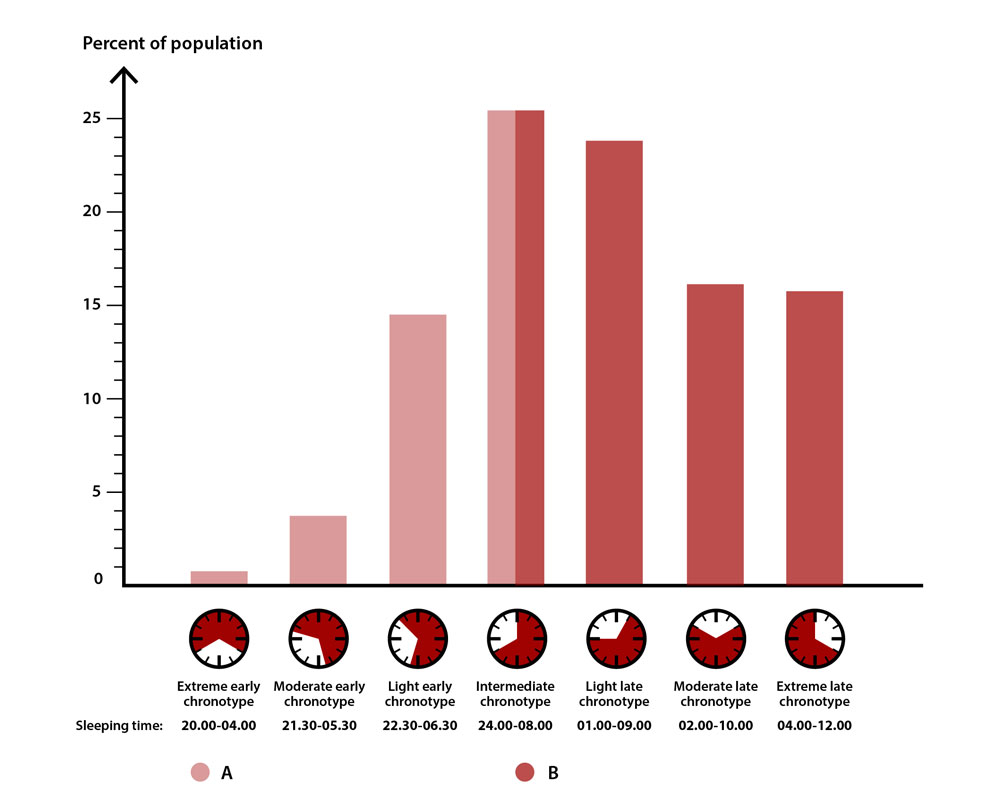
I didn’t even choose to be a late sleeper, that’s how I always was. Yet the worldwide conspiracy to wake up absurdly early for any important matter is really annoying /s. As I’m approaching my 40s and am lucky enough to have a flexible schedule, waking up early is still borderline painful for me, and if I don’t wake up late enough, my day is usually not as productive as I would want it to be, if not outright ruined. Glad to see my impressions of this global early morning stupidity /s being validated somewhat.
And then one faithful morning there was this training session that was just sublime - working out outside, in the heat of the rising sun, very idilic. From that morning onwards, I started waking up 7am by myself, whatever I do, no matter if I stay late or not ... it was very bizarre, I just "flipped" from one day to the next.
I attribute this to the fact that most really fun things in my life happen late - parties, dancing, playing computer games to 3am, bouts of in the zone coding, spending nights with my partner - all happening in the evening, so my body obviously tries to "optimise" its attention to when I crave it most.
When I consistently had a thing that was really engaging for me for a long enough period (and no corresponding "high" in the evening) I switched to an early bird.
Last year I've stopped doing the fun morning stuff and I can sense slowly moving back to late evenings and unpleasant mornings.
Artificial lights, entertainment, modern lifestyle, and socializing all keep us up later than we ever would be in our natural state. How many night owls do you think there would be if we did not work indoors all day, had no light past sundown, no television or sporting events to watch, no bars or parties to attend, and no addictive activities to engage in? When considering this, it is easy to conclude that one is a night owl.
Just as the night owl feels ostracism for being unable to perform at early meetings and suffers throughout their youth, many early birds feel similar ostracism, because they want to sleep when night life is coming alive. I imagine these “coincidences” create vastly different outcomes in life for people based on their biological inclinations. It’s something we should be cognizant of.
I suspect this is at the root of a lot of “night owl” personalities: Night time is equated with freedom, whereas mornings are equated with having to do something they don’t like (work, school).
Finding something semi-enjoyable to do in the morning is key to not hating mornings. If someone’s mornings are just a painful slog to a job you dislike and a detour until you can get to the evening where you can maybe enjoy something, of course they’re going to be a night owl.
I’ve personally found that 4am wake-up is driven by the same goal as 3am bedtimes: hours when everyone else is too asleep to bother you. The big difference is that it’s far easier to stay awake than it is to force yourself out of bed.
But after returning from a trip to a different time zone, I discovered something kinda bizarre. If I wake up around 4:30am, I feel amazing and I’m super productive for the whole day. I have to be in bed by 9pm, but even with slightly less than 8 hours sleep, the effect is transformative.
But my problem ends up being that the world is super hostile to an adult going to bed by 9pm. It’s just really hard to keep on that schedule when you’re interacting with the rest of society. So I end up on my old night owl schedule because it’s the only one that somewhat works for my body and my interactions with other people. I really wish I could stay on the up-at-4:30 schedule, though, because it’s just so energizing.
     but as a night owl till my mid 30s I actually managed to
     flip to an early bird.
If I'm sleeping later, I prefer to work late, at least until 3am. However, my most natural awakening happens by 5am. From there, I can work for 3-4 hours in silence until it begins to warm up outside.
I don't do well with either too little sleep or an irregular sleep schedule, and I don't like sleeping around other people's schedules. Which, with a partner and a very bossy cat, I don't have much hope of overcoming.
That is gradually improving and once my youngest starts school I'm going to try to return to the early bird pattern. We'll see how it goes.
This morning I had to get up at 0615 for the second morning in succession due to a couple of appointments. This is absolutely not normal for me and it's completely painful. Obviously sometimes it has to happen, and that's OK, but it comes at a cost.
People will say, "just go to bed earlier", but actually that doesn't really work because unless I go to bed hours after I've eaten I don't sleep and tend to get heartburn. Case in point, last night: got home at about 1915, ate dinner just after 2000, went to bed at 2200 (because I had to get up early this morning), slept like absolute crap.
Sorry (not sorry), but I can't live like this. I need a good 8 hours a night every night, and that means going to bed at 2300 - 0000 and getting up at 0700 or, ideally, 0800. I work much better that way, and am much happier with it. More than that, I'm not falling asleep by lunchtime.
I consider myself a night owl and if I ever get to bed before midnight I consider this early. I still have to wake up between 0730 and 0800 (because life/obligations) and that is why I am like a zombie half the day.
But no matter how tired I might be through the day, at night something happens and I feel full of energy.
I think it's detrimental to someone's quality of life to be unable to shift their sleping schedule.
The only physiological thing you cannot shift is the sunlight. If I have to wake up early before sunrise and feel like crap, I will take a walk out a couple hours later and the rest of my day will be productive.
I did manage to switch from a night owl to a morning person but what I realized is that sitting on a chair, starring at blue light and the stress to "make things work" are actually toxic and they will mess up my sleep.
FWIW YMMV going low-carb completely cured my heartburns who were particularly annoying when laying down just like you. I had been taking proton pump inhibitors for 10 years before finding that out. And every time I eat carbs, I need to take antacids. It doesn't seem like it's been studied much, but insulin stimulates the proton pump and the stomach produces more acid.
This is the advice you need to avoid. Don't go to bed earlier. Go to bed when you are tired. Then get up at exactly the time you set your alarm for the next morning. Then repeat that over and over, every single day (even weekends). You will adapt and start going to bed earlier so you get the amount of rest you need.
Or you'll make an excuse for why you can't do this and why it certainly won't work for you.
I feel like this is extremely important. I try very hard to eat no late than at least 4 hours before I feel like going to sleep. And get as sober as possible before that too.
On a different startup podcast, there was a guy claiming he went to bed at 7pm and woke up at 3am! He claimed his kids went to bed at 7pm too. I mean sure, maybe between 1 and 3 years of age, but in the long run this is just absurd (or you are not putting in an equal share of parenting, or spending time with your kids or spouse in the evening.)
Perhaps it's not "extra" hours, it's time you can use productively vs time you can't.
Three completely uninterrupted hours in the morning while everyone else is asleep vs three hours in the evening while everyone is is awake?
To actually concentrate on something important, I'd always pick the former.
Our neighbors are the 7pm family. They own their own business and they're out the door at the crack of dawn to tend to things. The kids have always gone to bed at 7pm, except the teenager of course. So such families do exist, but I think it's important that the whole family be on the same schedule, for the reasons you mention.
But generally you're right. I don't get it, what's the fuss about doing things early? Artificial light has existed for a long time now, why not get up a little later, relax, eat, chat a bit, and then go do whatever it is?
So if people are living their lives roughly aligned to the sun, then they'll naturally wake and sleep later.
It would be interesting to contrast that with Athens which is more aligned to the correct timezone for their longitude.
I feel like it has to do a lot with the most recent industrial revolution and how factories had to operate, and the school systems built around that. Most of places and industries, it hasn’t gone anywhere.
And I guess it won’t until we solve the problem of massive energy generation for pennies, orders of magnitude more than we have now, and bump up production output everywhere across the board, with AI or else.
Because a brisk early morning when the sun rises is sublime. In that regard, I totally support people who need to sleep in -- because the only thing better than a brisk early morning sunrise is a quiet one. No rushing about, just relax and enjoy how peaceful it is before the day ramps up. It's energizing.
I'm a night owl from southern California, and when I lived in England for a bit I was surprised to find how depressing it was to enter the world at noonish, only for the sun to set after a few hours, and then having to resign myself to the indoors shortly after that. It was just a dreary way to live. (Yes, I realize England isn't even that cold.)
I like the nights, but I also love having the option to be out and about in the warm evenings. When those mild evenings are taken away, there's more motivation for people to callus themselves to the early morning alarm clocks.
In the long run though, the >adversity< experience that is the human condition trains us to be hard. I'm not talking about body wise, but in fortitude. We weren't meant to be given everything on a silver platter, yet here we are in modern society.
You don't have to go all "liver king" on this one, but recognizing that a healthy dose of day-walker ain't so bad. I returned to the day-walker realm about 3 months ago and have since dropped 20 of the 30, drink about 1x a month (best I can tell that trend will continue) and I actually give a sh*t.
I don't want to say this is wrong, but its a cautionary tale about taking the uphill battles as a challenge to sharpen you for the time you really meet adversity.
Oh, no that's not what you do when you get up early!
You do the fun stuff first, have a break to go to the shop when there is near-no traffic, and start working at the end of your day. Then finish the work and just drop on bed and sleep.
The problem with getting up early is no partying of any sort really, or any evening activities.
Like a lot of people I hated high school but I attribute 75% of that or more to the fact that it started at 6:45 and that I spent most of my days catatonic.
I'll echo the early morning exercise suggestion as an additional data point.
I was worse than you...for over ten years. I used to work nights. I'd go into work at 4 PM and get back home anywhere between 2 AM and 4 AM (my theoretical midnight out-time never happened). As a result, waking up between noon at 2 PM was pretty normal. Again, this was the case for over ten years.
I was eventually faced with having to flip my life to a normal schedule. That took a few years. What made a huge difference was exercise. This is when I got into strength training. I'd get out of the house at 5:30 AM to go to the gym. By the time I went to the office I was definitely fully awake and functional. It didn't take more than a couple of months for this schedule to become my new normal and for it to feel easy. A year later, waking up at 5:30 AM happened normally and without having to use multiple alarms. These day I wake up at 6 AM even if I go to sleep at 1 AM.
If you are interested in making a change, you might want to consider early morning exercise.
I just don’t like going to bed.
If University started at 11 I would still be tired though. I would just go to bed later.
We cannot fill the employment roles for professors, support staff, and every other type of worker even with this rigid 8AM system. In my head that new world would include layers and layers of renduncancies which would be a system we could not feed with our current worker population.
And realistically, it isn't like they are proposing offering more evening classes. Most proposals for later start times are advocating starting 1-2 hours later, not "lets all work second shift".
[1] https://www.appliedchronobiology.com/wp-content/uploads/2022...
My “conspiracy” remark was with /s which meant sarcasm. It’s just that it can very practically suck to be an outlier from the blessed “norm” of having your sleep schedule more or less synced with day-night cycle.
Not sure how to address the night-owl phenomenon, but there seem to be people who have successfully converted from being a night-owl to an early riser. The only thing I have seen to help is sticking to a strict schedule.
Doesn't need the "/s"
At some point I hope to see Delayed Sleep Phase Disorder treated like a proper medical disability and for discrimination cases to be won by people with it.
That should cause corporate legal departments to shift schedules to being later.
All worked out in the end though =)
From an evolutionary perspective I guess you can try to argue that in the past there was some benefit to some people being on a shifted schedule so they can stay awake to keep watch at night, but I feel like overwhelmingly throughout human history people mostly just naturally woke up when the sun rose and anyone that stayed at camp sleeping in, not helping with duties, was very looked down upon by the rest of the group.
I strongly agree that it feels like this whole thing came from ancient times and the need to sync to day-night cycle because of how things were.
In the same time I feel like the “morning conspiracy” is being sort of inertially reinforced in modern times for no measurable metric gain of anything.
See, I don’t wanna rise and shine and shit, because it’s not only the early bird that gets the worm really; I want to wake up after enough of sleep at the time when I feel optimally the best possible for a day, and that’s about it.
Question is whether I can afford it.
Covid mess showed that many of us actually can work remotely, and if anything else, it also showed that many of us can wake up when they feel optimally good without hindering the business we’re contributing to.
I didn’t quite expect my comment to be a top comment here though, but reading from people who have simialr experiences makes me feel a bit less conspiratorial. Or more! :)
The most natural thing to do for a human is to sleep when it's dark and get up when it's light.
The second best thing given that nobody does the above anymore is to sleep late and get up late.
But make no mistake it is more "healthy" and "natural" to have classes early in the morning.
Most of the time it’s steady 3am-11am for the last couple of years, and it’s perfect for me based on how I feel. 5am-12pm works well enough too if needed.
Usually I can’t sleep earlier than 12am, but even if I do, if I wake up 10am or earlier, it doesn’t feel good. In that case, if I’ve slept less than four uninterrupted sleep cycles, I’m most likely a wreck.
Also, showing up on time is a sign of determination, but making someone get up at 7AM because you do is a sign of narcissism.
I've always considered myself to be a night owl. I struggle to go to bed on time. Yet on some of my lengthy remote travels I learned it's all bullshit.
There, the sun sets at 6PM. There's little artificial light, and nothing much to do, so some 2 hours after dinner people tend to go to bed. So for weeks I went to bed around 9pm and wake up super fresh at 5-6am like some crazy morning person.
Just like that. Zero issues. So no, I'm not a night owl, it's distractions that make me not want to go to bed, it's not that I can't.
I had a before school class in high school and 8-9am classes in college. It was never an issue for me. Anecdotally the people who had trouble at these times and even later where the ones who stayed up late playing videogame and drinking (caffinated soda or alcohol), partying, or working as a bartender (sounds like the study controlled for this last one with shift work exculsionl).
I got hired by a big tech company right out of high school. Skipped college. I’ve done well for myself career wise, but I certainly regret not having the “college experience”.
You seem to be quite harshly judging those who used college as a place to have fun, as well as building life skills.
We usually stay up talking at least until 11PM and wake up roughly ~7:30AM
What's different about camping is usually the quality of sleep. If you're a nightowl and you get 8.5 hours of really good sleep, you won't be feeling like crap waking up at 7-8 AM.
But with a flexible schedule now I’ve moved it later. except the dog keeps me in check ..
Most early birds I know are ready to _pass out cold_ at 10PM, naturally.
Otoh, I successfully followed an 11p-6a sleep schedule for months, but I'd never noticed any negative differences in my general day to day energy/etc levels compared to when I would go to bed late. (Maybe better mood bc being up before most ppl is a great feeling?) But really, the biggest difficulty I had with this regimen was to just go to bed on time, and I think this is more to do with habits rather than genetics. But only partly.
https://en.wikipedia.org/wiki/Delayed_sleep_phase_disorder
https://en.wikipedia.org/wiki/Non-24-hour_sleep%E2%80%93wake...
The latter in particular can look and feel very much "night owl" when forced in a regular 24-hour schedule on a mostly permanent basis.
I found that the later I sleep, the more sleep I need. I attribute that to environmental noise, like my neighbours waking up at 5:50 and walking with little to no regards for everyone below them.
However, when I sleep at 23, I am usually up by 4:30, and I am functioning great. When I sleep at 00, I am usually up by 6:30, at 01, it goes to 8:00, and so on.
So I decided that I will not use electronic devices after 21:00.
Depends on the country, but it could be that this is intentional - having those lectures at 08:00 raises the difficulty bar, helping to fail more students, which is exactly what the class is for in the first place.
In my university time, the math class that most people fail would also have lectures at 08:00[0]. It was also widely known that the class is just about getting us up to speed with calculus, as it is to filter out a good chunk of the year. My understanding, shared by fellow students and even faculty members, is that universities in Poland (and I suppose most of EU) tend to admit ~1.5-2x the number of students they can handle, and use first two semesters to filter out tat ~0.5-1x excess. In STEM courses, those intro math classes were understood to be those filtering classes.
--
[0] - What's worse, on the first lecture, the professor wisely noticed that some of us will be hitting rush-hour traffic trying to get to the lecture on time, and suggested that... we should all start 15 minutes earlier, so we can avoid the traffic by waking up and traveling 15 minutes earlier... I think I attended one or two more lectures of that professor, at which I fell asleep few minutes in, and eventually decided it's just pointless waste of life.
I, on the other hand, went to a local branch of a state college. So many classes were only available in one time slot, which meant that I had both classes that started at 8am and classes that started at 6pm.
Attendance wasn't always optional.
...so I tried again next quarter. This time, it was Quantum Mechanics A--I had previously tried skipping into C--so the professor probably just thought I couldn't handle the material without the stuff that came in A/B, and realized I was in "the wrong one". Well, it happened again.
I tried a third time. This time, showing up to B, the professor must have figured out what was happening and I kind of remember her laughing at me a bit. When it happened a third time I gave up, stopped ever trying to do early classes, and, 20+ years later, give students the advice you were given ;P.
Social time is another aspect, although linked more closely with clock time. After moving countries I found it very strange to see popular TV shows advertised with with a start time of half-past midnight. "Who would be up to watch it?" I thought. Of course, it turns out, there are plenty of people up watching TV at that time in this culture.
An 8am class would be showing up at 6-7 to find parking and get to the classroom. Disgusting, I never took courses that required regular attendance there for that reason.
There's so many compounding variables that emerge from Universities total neglect of prioritizing learning. I don't think its as simple as early=bad.
http://blog.poormansmath.net/the-time-it-takes-to-change-the...
Pretty interesting, and it seems to comport with my feelings when traveling to different places.
My wife used to tell me that kids should be asleep by 2100 because some study showed it is better for them. But what does 2100 mean? It is totally arbitrary. I could accept a study that would reference sunrise/sunset but a specific time?
I would always ask her "is this winter or summer time?" just to show how this does not really make sense. Other times I would say "what if we lived right at the point where a timezone changes?". A few meters difference means 1 hour difference. Which 2100 is the correct one? Or what if 2 people live in the same timezone at the opposite ends of it?
I believe most of these studies are performed in the USA. I have never lived there (I am in Greece, have also lived in Germany) but the feeling I have from some movies and shows is that there are places in USA where the sun comes up at 0500, maybe earlier (and accordingly also sets early). I do not think that the sun ever rises that early here (I actually just looked, throughout the year the earliest is ~0600 summer time). It is only natural to also have different habits on when to wake up/go to bed. And also 2100 (or whatever other time) to mean something else entirely.
a quick search did not verify thisIf the rest of your schedule keeps the same numeric time, then this does make sense. If your schedule allows for 9 hours of sleep before waking up for school, then you're still getting 9 hours. If you changed the numeric value, then it would either 8 or 10 hours since the school start time retains its numeric value.
"I believe most of these studies are performed in the USA."
The study being discussed is from Singapore.
This. I made an app to help: https://sunclock.net
I live in a smallish country (Czechia) and I sometimes commute between Prague and Ostrava. The sunset difference is already some 15 minutes, quite visible.
The actual sunrise/sunset difference between, say, Paris and Kraków is even more pronounced. Not to mention Madrid; Spain using the Central European timezone is a weird leftover from Franco/Nazi times that no one bothered to correct.
8 am feels very early in Granada and fairly late in Kraków.
- let's say it takes 30min from your home to the university
- let's say it takes you 15min to get ready (including shower)
- let's say it takes you 30min to have breakfast (10min preparation + 20min eating)
That means you need to leave home at least at 6:45. To sleep at least 8.5h, you'll need to go to bed at at least 10:15pm. I don't know you, but when I was younger, at 10:15pm I was feeling full of energy and couldnt go to sleep just like that.
Good luck find a university student with that type of sleep hygiene. I was the most sleep vigilante of my group and almost never slept more than 8 hours. 7 was my minimum, anything less led to migraines.
If your circadian rhythm is set to sleep at 2am, an 8am class is going to be hell no matter what you do.
You have a fair amount of flexibility as a student. I had a roommate who napped from 4-4:30 every day.
Even the early birds I knew didn't quite like the morning classes, because they then had to rush towards lecture halls first thing in the morning, rather than strolling leisurely to the library, eating breakfast, or jogging and taking a shower, which I suspect is what many early birds most enjoy about being an early bird.
The problem is that there are seminars and stuff that occur at at like 7 or 8 pm, so university life almost necessarily extends late (after lecture, dinner, assignments, projects) in the evening at least on some days. This is further exacerbated by the fact that given how many group assignments there are, individual student rarely have total control over their own schedule. Even if you carefully choose your classes, avoid all late-night sessions, don't party, plan your life, it's still incredibly hard to sleep before 11pm consistently.
As an early bird, spot on. I don't like being late or being rushed. I also like surfing with the sun coming up or working out first thing in the morning.
...that said, they have the other extreme of classes ending at 10PM...
I’m an extreme case of loving the mornings, but still.
Also, as you said, I hate early morning classes. I like feeling productive in the morning, and sitting in an 8:30 lecture is the bane of my existence.
I didn't really have that problem. I had one semester that was really had where I would stay up late to do solo projects and coursework. The rest of time it was easy to go to sleep before 11pm. I think the only times that I didn't would have been due to partying, but usually not on a school night.
Too right. I, and a number of classmates, got screwed one year by our college when enrollment was a good deal lower than forecast. I had wisely enrolled in a 9AM math class but there was a whole spread of classes by one professor that were under-enrolled so they combined them all into one class.
At 7AM.
It was supreme bullshit.
Of course you could argue about the anciliary benefits of teaching people to wake up early, and how that prepares them for society. But if all you care about are measures like academic performance and sleep duration (which in turn is linked to health), removing 8am classes provides better results.
I didn’t see that data in the study.
It's a lifestyle choice - if you go to sleep at 11pm of course 8am classess will make you detest them will have no concentration. Especially true if you use your phone up until you fall asleep. I was a student until recently and can say most of the burden is unfortunately on us. From my experience students lock themself in their room listen to music/play games/scroll social media until midnight. Instead of building a community where hanging out/studying with other students until lets say 8pm and then going to sleep would be the best for most students. When hanging out in groups you are filling our your need for socializing and more likely to regulate each other. When everyone is siloed in their own room you are more likely to see extreme disregulation like going to sleep at 1/2am on most days.
Not everyone is a morning person I will concede that much. But being a morning person, there is NOTHING that makes a day more cursed for me than waking up at 9AM when the sun is already up and most people are out and about.
In my opinion, what students (and all of us) need is universal digital hygene. A set of guidelines where we would finally be able to follow if we ever fall into disregulation. Not advocating for China style timeout lockdowns of your netflix/games, just a general set of guidelines so that if you stay up until 23pm /1am - it's your responsibility. Just like it's your responsibility to not regulate every other aspect of your life. You should be encouraged to be an adult.
I have ADHD, which I didn't know when I was a teenager in the era before the phones you're blaming for poor sleep hygiene. I have struggled for essentially my entire life with sleep routine. I can't for the life of me get to bed at the same time every day; after three decades of trying I just don't think it is something I am readily capable of doing. It works for a few days and then gets later and later and eventually it's so late that I'm ruined by 8pm and I reset for another cycle.
This is, as it turns out, not uncommon among folks with ADHD and similar conditions -- and those conditions are more likely than you would obviously believe them to be.
So, while it absolutely is my responsibility to regulate my life, I feel you can probably keep your sanctimonious encouragement to adulthood!
More to the point: Honestly my 8ams in 1991 had these exact problems! Parking, partying, sleeping in class, the whole schlemozzle. We did not have phones but we did have TVs - there are millions of people who for a lack of something better to do have entire Seinfeld/Simpsons episodes locked in their heads.
But considering the amount of students whose primary social activity is "I go back to my dorm room and play CoD with my high school friends" you have a point.
But I'd suggest that the activity indicates a mental wellness issue for first gen student. Loneliness, insecurity - it impacts their digital hygiene and can't be addressed by "be more adult." That said, I see thriving club and extracurricular activity here, too ("when hanging out in groups") and I think it's healthy but largely unregulated in that all kinds of unhealthy interpersonal interactions emerge there. Or is binge drinking no longer an issue?
And yr professors...well. These adults are doomscrolling and gaming and going to shows and being parents and all that stuff on top of the assignments and prep that they have, too. So I don't think this is all reducible to media use. I remember just having to stare blankly the five minutes before classes began, where students now just look at their phones, so it's not like students staring at phones is something GenXers wouldn't have done. I like to get there and just maintain uninterrupted eye contact with them until they are suitably freaked out. It's a pedagogy
“But just schedule evenings” maybe you object. Ok, so what about the other daytime obligations that teachers may have? Daycare, office hours of collaborators, etc.
The 8-5 schedule is an emergent property of society, not a ruthless schedule imposed by the elusive morning person cabal.
So long as you are awake enough to be safe and aim at the target, you can shoot a gun. Realistically, guns are designed to be used even if you aren't at your sharpest, and there is only so much you'll learn during a session. You are also active, while doing a leisurely activity (assuming here that even if it was an accredited class, it was optional).
This isn't quite like taking a biology class where you are supposed to be sharp enough to learn - or prove you grasp complex subjects. It takes more mental effort. On top of this, classroom conditions are different. Stuck in a chair, in a room often too cold/too warm, listening to someone go on about the history of trees and how they developed into the modern tree. Thrilling.
There’s also evolutionary bias for why natural selection would have favoured staggered sleep schedules - in a group setting this would have allowed different people to stay alert at different times during the night and thereby increasing the chances of survival of the entire group.
Irrespective of all of this - it fucking doesn’t matter. If some people say they struggle to get up early and are sincere about it, it makes sense to provide very basic accommodations. For example, what’s the harm in having meetings only after 9pm? Also don’t schedule meetings after 3pm so those who are the morning types can wind down and get home? We make all sorts of reasonable accommodations for food preferences, religious beliefs, …etc. If some people are more productive during certain hours, it fucking makes good business sense to let them work during their best hours - within reasonable limits.
I can only recommend people to read Why We Sleep by Matthew Walker for the health and economic damage we do this society in the name of perfect adherence.
(I have an ADHD diagnosis but looking at the effects of poor sleep sometimes I wonder if I really have ADHD or if it’s just the poor sleep that’s been fucking with me all my life)
Prior discussion: https://news.ycombinator.com/item?id=21546850
Sadly, a lot of the reason for this scheduling is because no one wants sports practice to start at 4pm and we all know how that's always prioritized in our society.
The funny thing is, the reason why the university held early classes was "low capacity of amenities". E.g. not enough classrooms. Very understandable in early post-Communist Czechia where there was "low capacity" of everything.
But if American universities with their high tuition suffer from the same problem ... uh, is it caused by parasitic growth of bureaucracy that sucks all the money out of the actual educational part of the system? E.g. your tuition feeds thirty vice-probosts for Absolutely Necessary Stuff, but not enough teaching staff to have classes at a more reasonable hour?
BTW I am very sure that the vice-probosts for Yet Another Absolutely Essential Bullshit don't start their workday at dawn.
There is a third option - go to bed earlier. Farmers have been doing it for millenia. Which raises an interesting question - are early classes at agricultural schools well-attended and do those students experience these same problems?
They seem to completely ignore evening activities except to remove study participants who are involved with shift work. I wonder what they would have found if they included those students. Perhaps the people best suited for early classes are also best suited for shift work. It would have been interesting to see.
Another example:
https://www.nature.com/articles/d41586-020-00375-z
It may sound silly, but isn't it time night owls advocated for themselves?
Night owl advocacy?! You lot won't shut up about it!
Personally, I don't care as long as a workday has some overlap. But I've watched these same "advocates" been granted the right to timeshift, then watched the same try to schedule 7pm meetings!
You're welcome?!?
I did chose sometimes early morning, sometimes late depending on my job or my preferences.
It made no difference at all. Just a different schedule. If you have early classes you need to sleep early.
I believe most people that never experience late classes are just idolizing, because what I see is most people get to bed late and that is the main problem that they have.
There is a tendency on humans beings of going to bed later, because everyday we can delay two hours going to bed but we can only change one hour ahead, so most people delay going to bed following friends on facebook or doing whatever they like. Just change your habits.
But for the early and mid-morning classes, my brain was sharp. I could listen and watch the professor then copy only the key points and equations. My retention and understanding of the material became SOOO much better. And, as a bonus, the morning classes were poorly attended, meaning additional face time with the professor.
We were able to arrange our own working patterns and were responsible enough to do it.
In my experience in the US, "class" is used interchangeably with lecture. Although some subjects will also have labs, small group discussion, or recitation.
I'm not sure what distinction you have in the UK.
It worked for me but I think I would have performed better with later classes. 10AM classes are probably the best. Not too close to lunch, not too early.
For example, stop eating at 4pm, and you'll more easily wake up at 6am the next day. Do this for a couple days and you'll find yourself on the flipped the scheduled.
I was an extreme night owl down to my late 20's. Having kids forced me to change. It took 7 years. Since my 40's, have me teach an 8am class and it will be 3x as goed as a 2pm.
I think it's just stress about being late for things that my mom instilled into me. I've had frequent nightmares about being late for things for basically as long as I've been independent with being places. If something is happening later in the day, I can't do anything that might distract me from missing the appointment. It usually ends up with me mindlessly watching YouTube videos and glancing at the clock until it's time to go do the thing.
So yeah, I took early morning classes in university whenever I could. And I pretty much always attended them!
"Early morning university classes linked to poor sleep and academic performance, blurry eyed researcher says"
What were the motives for this research, I wonder? And who clung on?
Let me guess... those who can't get up at 5am.
Because waking up at 5am is HARD, and thus honourable.
The study literally says "on average the highly trained students of this important university perform badly if they're asked to wake up too early".
This might suggest that not-having-classes-at-8 might improve their performance, given that for some reason, on average, they can't get up at 5am.
We could investigate their lifestyle, it is because of their excessive screentime? Is it because of video-games?
Or, maybe, we could just not-have-classes-at-8, and we could just stop pretending that waking up early is good and everyone should absolutely do it, in spite of how hard it is.
Class attendance was nonexistent after the first two weeks. Grades were abysmal.
But to be fair, it was a horribly boring class as it was thought. Just hours of going through various communication protocols, that early in the morning?
Students taking the same course appear to perform significantly better when they take that course <= 9:00am. This trend is stronger the more students take the course. The difference tends to be on the order of the difference between, say, a B and a B-. (and I also chose specific courses where students are likely to have a variety of choices). I found that it tended to be the better students who self-selected into taking earlier courses, IIRC.
The authors add confounding factors when they structure the question as "# of early courses taken" and compare it to overall GPA. For example students who are able to take later classes tend to be Juniors & Seniors, and they may have different GPA's for other reasons-- program retention requirements for example often have higher requirements than for freshmen/sophomores. Students also have different constraints if the have a job, or commute and live further away.
Again, I'm only commenting on the academic performance side of the conclusions, not attendance or the other (interesting!) areas the study covered. My guess is that if the study's authors controlled for variables like student class standing, employment, age, and other factors their results might be weakened a bit. Or it could be that their results don't apply uniformly outside their own school (Though mine came from a school that was substantially similar in terms of market niche)
The reason is that registration at universities has become akin to airline boarding, comprising a complex schedule of priorities allowing certain privileged groups to register first—students in various honors programs, students enrolled in the same major as the course, athletes, and so on. As a result, more desirable class times (or instructors) will frequently be populated with more successful or well-prepared students compared with unfavorable times. (And 8AM is about as unfavorable as it gets.)
Whether or not registration prioritization makes any logical sense or serves any objectives other than making some students feel special is another question. (It's certainly not optimized around minimizing time to degree. Because why would we care about that? /s) And clearly it can have the effect of putting students who are already at risk into schedules that place them more at risk. But the effects of non-random assignment can also pollute studies like this.
Why we're holding classes at 8AM at all is another great question. You'd be tempted to answer "because space", but you might be surprised to find that many large classrooms are idled as early as mid-afternoon. Students seem to also dislike afternoon courses, but I suspect that faculty preferences are more the reason that those time slots don't get used.
I recently travelled while working; through the Eastern and Atlantic timezones. It was hilarious how much more effective I felt. I was fully awake for morning meetings and had several hours for focused work each day where no one could bother me. People who work in the "ahead" timezones truly have a slight advantage in the corporate world, IMO. Makes me wish I worked for a company on Hawaii time TBH.
But damn do those days feel great.
I don't really notice til 3-4pm, then my brain basically shuts off.
Otherwise, I am trying to find the 'productivity sweet spot' for me these days. I have found, for me, it ramps throughout the day until I hit the zone, around 3-4pm. I can stay here until 9-10pm easily, if I can avoid the outside distractions of life.
The rest of the day I can learn pretty well. I spend most of my waking time reading and absorbing information. I don't feel inhibited from doing so really any time.
Later he became undergrad chair. I needed to retrieve my class rank for grad school applications, and the request went to him. He rummaged through the files in my presence. When he found mine, he said “it’s impossible”. I was 4th in class in a cohort of about 50.
I was a decent student but I always underperformed at 8am.
(I’m much older now and I’ve been keeping normal hours for decades since. I’m ok at 8am now. I still hate early morning 7am meetings with Asia however — I’m in pacific time.)
When was the last time any of us did anything that REALLY needed sunlight?
Except farmers and maybe construction workers. This makes even less sense in hot climates, where they spend an asston of energy to cool themselves while insisting on working over the afternoon.
Honestly, why can't we nudge the working hours up a bit in the day so that everyone starts their job after noon, and comes home at night, with a few hours of free time before and after sleep.
Elect me and I will abolish getting up in the morning.
If i know i have time to buffer against interruptions, I sleep better. If i know my window of error is tiny, Im doomed to poor sleep regardless.
I can totally see this being a problem and it happens more often with 200+ people seminars for freshmen. Best advice I can give you and didn’t realize until I was about to graduate is that you can retake a class and replace the grade.
But I'm going to try not to start before 10 AM from now on, though I'm a 6-6:30 AM riser. The 10 AM to 2 PM timeslot seems to cover the most people.
I don't like my job -> don't want to go to bed yet (need to do sth I enjoy and also b/c I want to artificially stretch time until having to work again) -> I don't want to get out of bed (because I don't like my job and I also happen to sabotage my sleep by avoiding it at night and hence I didn't sleep enough) -> apparently I'm an owl ...
one question would be ... are there owls who enjoy whatever forces them to get out of bed early?
Had an 8AM class freshman year. Guy in front of me would always fall asleep during class, so I'd kick his chair to wake him up.
Honestly I mostly did it because I felt bad for the prof. There were only 15-20 of us in the class and it was quite obvious when one person dozed off.
Notoriously known for difficult assignments and exams, he would allow extra time for tests, if we showed up an extra half hour early. Who wants to take an exam at 7am?! There was a massive curve to everyone’s grades.
He also mentioned that living away from the timezone you were born in can also cause sleep issues, based on his experiences with clients he has coached.
Anyone who is interested in this more should check out Why We Sleep by Matthew Walker. The book isn’t perfect, but it does discuss how we systematically harm our children by the timing of our school days. For example, teenagers need more sleep than younger children, but we have the teenagers up the earliest for school because they ought to be “responsible”. This reflects in their lack of classroom engagement and progress and test scores. IMO, if we want to consider our public education system an actual service to our youth, we should be doing what we can to meet their needs, rather than imposing our virtues and opinions on them.
Thus, I do my reflections at 5-8 am with my planning at end of day. My own nootropics mix seems to work better with a micro-dose of L-DOPA as I double up on MAO-B inhibitors.
Plan and prioritize.
If it’s too much, you are either over loaded or out having fun at night. Either way, decrease the work load.
Theories like this one from Nature does more harm than good, by placing blame on the school or hours rather than the students lifestyle or choices.
Snowflakes creating more snowflakes.