To give a sense of the scale of this claim: If correct, Zhang's work is the most significant progress towards the Generalized Riemann Hypothesis in a century. Moreover, I think this result would not only be a more significant advance than Zhang's previous breakthrough, but also constitute a larger leap for number theory than Wiles' 1994 proof of Fermat's Last Theorem (which was, in my opinion, the greatest single achievement by an individual mathematician in the 20th century).
Some discussion / explanation of Siegel zeros and Zhang's claim can be found here:
https://old.reddit.com/r/math/comments/y93a86/eliundergradua...
https://mathoverflow.net/questions/433949/consequences-resul...
An account of Zhang's remarkable story (and his previous breakthrough) can be found here. Famously, prior to his breakthrough, he worked at Subway and lived in his car:
https://www.newyorker.com/magazine/2015/02/02/pursuit-beauty
The sad part is that as the trend continues we may reach a point where a mathematician's intellectually productive life is not sufficient to contribute anything novel, statistically speaking. And as population seems to be close to peaking, we will also have less chances of exploring the extremes of mathematical dexterity.
Perhaps we could then rely on computer assisted theorem provers. Or life extension, as long as intellectually productive years are also increased. Or we will need to focus and specialize kids earlier on.
That's not really the case here. Zhang spent 10 years out of school working in fields in the cultural revolution, and didn't start college until he was 23. After his PhD, he couldn't get an academic job for 8 years and ended up delivering food and working as an accountant. He only got a part time lectureship after that. He wasn't made a professor until his big proof at the age of 58.
It seems incredibly likely he'd have been able to proove his big proofs faster had his life gone otherwise.
Why do you think that? It takes sometimes years (!) until you get used tona certain mathematical theory. And how long it takes isa very personal thing.
Remember von Neumann, who that that we don't learn nu mathematics, but only get used to it.
I think the only thing one can say was incredibly likeli is that Zhang, while not formally employed as a mathematician, kept thinking about mathematics (a rather common for people with mathematical training, though many just stick to do occasional problem solving).
IMO, an under appreciated dynamic across the board of human endeavours.
With increasing complexity comes the need for more time to understand and master anything.
A second example is that of recent advances in virtualization, where the last decade of advances in things like cgroups, namespaces and containers were all done by people who I assert had no training in IBM MVS/zOS and therefore weren't building on what went before (imho, to their detriment).
People talk about this a lot. While I think it could happen for certain subdisciplines (it already takes essentially an entirely PhD's worth of time to learn all the necessary background to be an algebraic geometer, so most algebraic geometry PhD students publish nothing besides their thesis during their PhD studies), it can never happen to mathematics as a whole. If one part of math gets too deep, you can always go somewhere else, where the water is still "shallow."
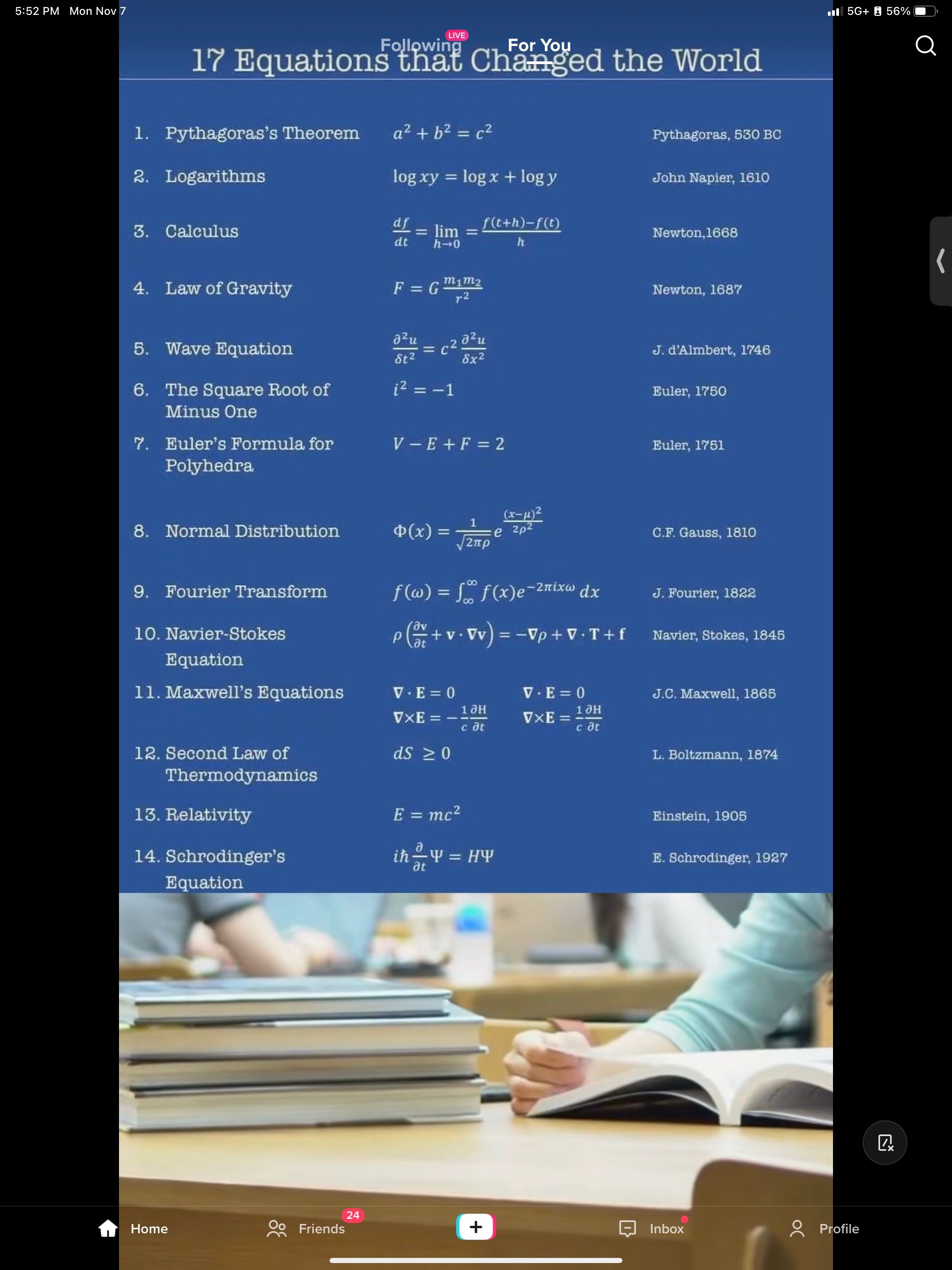
Math as a whole may last longer, but this list reminds us how far we’ve come in a mere few millennia: https://usercontent.irccloud-cdn.com/file/SaI50Q1d/166786520...
On the timescale of civilization, it seems less and less likely that lone mathematicians can revolutionize the field.
We’re fortunate to have been born so early, relatively speaking.
Maybe some CAS-assisted work gets us into feedback loops allowing us to go indefinitely, as in a technological singularity.
But the "shallow" part is also quite wide.
You can teach people what you've learned forever, for instance.
Yes, but the shallow areas aren't very interesting, which is why people work in the deep areas.
The simplest example that comes to mind is that you can learn group theory without really needing to know anything about Galois theory. I also imagine there's a lot of good math that has shed vestigial physics...
Maybe we will keep forever discovering new shallow areas but I suspect this is not the case. In any case this is a phenomenon that I think will play out in the next few hundred years, not sufficiently impactful in the next few decades but more and more noticeable.
>The sad part is that as the trend continues we may reach a point where a mathematician's intellectually productive life is not sufficient
Hmm. I had never thought of it like this. Is it possible for human knowledge to become so advanced in a single subject that it takes a persons entire life to learn just one subject? That's already true of something like the human body, which is why doctors specialize in organs or regions of the body. The more human knowledge expands, the more individuals specialize into increasingly smaller niches.
The cognitive burden reduces via the new foundations not requiring deep understanding of the old ones to be able to make new steps forward.
There's limit to human knowledge, but we are getting more and more efficient at communication, both with other humans and with machines.
Even without something like Neuralink we are creating abstractions and interfaces allowing us to quickly connect our work with others. E.g. especially with ML you can lazy load all necessary context.
Another angle here, I remember seeing a study where some children were just... taught algebra. Like given high school algebra classes in 3rd grade, and kids were able to absorb all that abstract reasoning "just fine" (according to the study).
Of course there's only so much abstraction that can be done, but I think we shouldn't assume we are at the end of history on much of anything (except for parsing algorithms)
There was a cottage industry of exotic hypercomplex numbers that disappeared when linear algebra matured to eclipse them.
In fact, Maxwell's Equations were originally derived with quaternions.
Nonsense.
First, the frontier of mathematics is far closer than you think. Number theory is one of the oldest branches of mathematics, going back thousands of years. There are many more branches that have originated in the latter half of the 20th century. And new ones are coming into existence all the time.
Second, we don't need to focus and specialize — we need to do the opposite. Mathematics is about seeing connections and patterns. We need to teach philosophy and critical thinking, and we need to give people exposure to the vast universe of unexplored — and fun — world of mathematics so that they can go towards the frontiers and push them, rather than spend half a lifetime going in the well-trodden direction.
Finally, undergraduates are still producing new results, every year, in numerous REU programs around the US alone. What gives?
The problem isn't that math is so well-studied that you need so much education to do it. The problem is that we aren't teaching people to do math, we teach them about math that they may or may not use elsewhere.
We don't encourage (or give space) for them to play, experiment, explore, wonder, ask questions, venture into the unknown, and be surprised by what they see (outside the aforementioned REUs).
So many people simply don't get to even start doing mathematics until their third year of graduate school, simply because that's when the structure of our education allows them to.
None of that is necessary. We do it that way because professors are underfunded and mentorship is not rewarded (publish or perish), among other things.
The situation is due to structural problems in academia, not mathematics, humanity, or the advances we made.
Signed, —your neighborhood mathematics PhD
Speaking as a former undergraduate math student producing “new” results in REU programs, all but a few of these results are completely negligible. There’s still a genius here and there though.
I.e. Today's world wouldn't support an individual who could have such an impact on most math/scientific disciplines?
General relativity was much more difficult. It took Einstein about a decade to develop it and he had to learn differential geometry in order to do so. This work was undoubtedly more profound and required much more advanced mathematics merged with deep insights such as the equivalence principle [0]. This was what made Einstein so successful: the combination of mathematics with physical insights that no one else had put together at the time.
Newton's Gravity was known to be incomplete for many years, just by looking at Mercury. It took several carefully derived experiments studying light for 100s of years that led us to Maxwell's equations in the 1860s that became the basis for Einstein's special relativity in the 1910s. You don't need a billion dollar particle accelerator to come up Maxwell's Equations (2 of them were done by Guass in the 1700s!). 20 or 30 years (and talent!) studying calculus or physics could get you something.
Today we know Einstien's theory of gravity is incomplete but the only places it is incomplete is inside of a black hole (good luck running a test in a blackhole) or at very tiny scales where gravity's affect is minimal. Today, I don't know how you would even come up with a competing theory without having millions to spend on a particle accelerator. While einstein famously just did a thought experiment on what should happen if the speed of light is constant for all observers, most "discoveries" are done now by smashing particles in billion dollar tubes.
Age is (almost) not a limitation with the right tools, less in the near future.
So we could solve this a few ways:
- Continue to extend the length of human life. Living to 150 will be the norm in a few generations.
- Create AGI that are smarter than us and make the advances for us
- Genetically engineer humans to be twice as smart, and learn as much as an average 30-year-old in 15 years
So even if world population declines for a while, I suspect it'd be possible to enjoy more mathematical talent in the coming decades / centuries.
Over time I think we need to either create a GAI or enhance ourselves(via genetic engineering, brain-computer-interface, eternal youth or other ways) to overcome this fundamental human limitations.
The abstractions need to be understood, but potentially only to a level of n-1. Isn't this one of the core principles of proofs?
On the other hand, it's extremely plausible that math as an abstract idea could build arbitrarily complex structures that would be of interest if we were able to learn to model them - so, almost necessarily, within the limitations of current human cognition and/or lifespan, there will be some structures that it is impossible for a human to learn.
Of course, in some arbitrary future we may find that those limitation of human cognitition/life-span can themselves be overcome - if that's the case, then the argument changes significantly.
Question is, are we dedicating enough effort to this endeavors? Is rewriting known math under a different guise sufficient to survive the publish or perish attrition? And will these efforts keep returning results?
I suspect the answer is no to the first two questions, and I don't know the answer to the third.
I would say that it supports the idea that only young people are able to change the fundations of maths, while older people can still use the existing techniques to push the bord, specially on those super technical fields where experience and knowledge are an advantage.
Only in very few exceptional times in history it was been used for something else, being the largest exceptions the industrial and scientific revolution, and these usually did not require breakthroughs: just apply existing knowledge.
It’s never been a young person game.
I don’t foresee AI overtaking human cognition for at least a decade or two.
(genuine question, as I don't know anything about it)
Or AI, particularly if we figure out AGI.
Analogously, I've heard transhumanists make the argument that as fluid intelligence declines as crystallized intelligence grows, we have yet to see a human mind in its full power.
1. Zhang posted an attempt at solving this problem in 2007 that he later more or less admitted was flawed: https://mathoverflow.net/questions/131221/yitang-zhangs-2007.... But speaking with mathematicians who are intimately familiar with Zhang's previous work, there seems to be good reason to be optimistic nevertheless. First, the idea behind Zhang's proof is similar to the zero-repulsion ideas appearing in known results about Siegel zeros, and is thus reasonable. Second, Zhang seems to have matured late, and unlike the flawed 2007 paper, his 2013 paper on bounded gaps in primes is meticulously written. He came a long way between those two papers, and he may have come even further since then.
2. Zhang is 67 years old. If the paper is correct, then Zhang constitutes a strong counterexample to G.H. Hardy's famous claims that "mathematics is a young man's game" and nobody alive today could say, as Hardy did, that "I do not know an instance of a major mathematical advance initiated by a man past fifty."
Note that, universities could accept people who did not attend school if they passed their university entry exams because so many people were unable to attend schools because they were all closed and teachers purged during the Cultural Revolution.
I would say he "matured" later mainly because he did not have the right opportunities because he could not go to high school and after his university graduation, had no good opportunities because many good professors were purged during the Cultural Revolution so he fled to the US for a better life.
Source: https://www.newyorker.com/magazine/2015/02/02/pursuit-beauty
And I quote from the above source which is from a 2015 New Yorker interview with Zhang:
'I asked Zhang, “Are you very smart?” and he said, “Maybe, a little.” He was born in Shanghai in 1955. His mother was a secretary in a government office, and his father was a college professor...As a small boy, he began “trying to know everything in mathematics,” he said. “I became very thirsty for math.”...The [Cultural] revolution had closed the schools. He spent most of his time reading math books that he ordered from a bookstore for less than a dollar.'
As well:
'...when he was fifteen he was sent with his mother to the countryside...where they grew vegetables. His father was sent to a farm in another part of the country. If Zhang was seen reading books on the farm, he was told to stop...After a few years, he returned to Beijing, where he got a job in a factory making locks. He began studying to take the entrance exam for Peking University, China’s most respected school: “I spent several months to learn all the high-school physics and chemistry, and several to learn history. It was a little hurried.” He was admitted when he was twenty-three.'
Said another way - I've known quite a few people like him to a point - with the difference that none of the others ever produced good mathematics, much less solved a major problem.
Actually I think Math is more or less a young people's game is because whence someone be super successful and famous it's kinda difficult psychological to retain the previous mental state and push out similar results.
https://mathoverflow.net/questions/25630/major-mathematical-...
I agree.
That house price appreciation must just be that good.
(Also, it was reported he "worked at a Subway" but IIRC he was actually the accountant for a friend's Subway franchise.)
Intelligent people will end up learning something profound when they are young.If they find something else interesting enough at a later stage in their life, they apply some transformation learning.
Leibniz did not start his training in Math until he was ~30
> Thus Leibniz went to Paris in 1672. Soon after arriving, he met Dutch physicist and mathematician Christiaan Huygens and realised that his own knowledge of mathematics and physics was patchy. With Huygens as his mentor, he began a program of self-study that soon pushed him to making major contributions to both subjects, including discovering his version of the differential and integral calculus.
I think the actual truth is more like, "big breakthroughs mainly happen early in one's career". Most mathematicians start their careers young, therefore they publish breakthroughs while young. Zhang started quite late so his innovations are later in his life, but still early in his career.
And it makes sense, everyone has a slightly unique way of thinking, and long-standing problems will only yield to unique thinking. Eventually someone will come along that has just that right type of unique thought process that will find a hole to solve such a problem.
So I expect them to stick to their rule.
Not to mention that up until 1910s, life expectancy was under 50.
Being able to work in academia as a tenured professor/researcher probably resulted in drastically different life expectancy, compared to being forced to do something else. I think it's safe to say that Zhang would been forced to live as a peasant, had he been born 120 years ago.
> Prior to getting back to academia, he worked for several years as an accountant and a delivery worker for a New York City restaurant. He also worked in a motel in Kentucky and in a Subway sandwich shop. A profile published in the Quanta Magazine reports that Zhang used to live in his car during the initial job-hunting days.
Many graduates from post Cultural Revolution China left the country in 90's and found the language barrier (and accompanying discrimination) too high to overcome. The man delivering your fried rice might have a PhD.
FTA:
In Kentucky, he became involved with a group interested in Chinese democracy. Its slogan was “Freedom, Democracy, Rule of Law, and Pluralism.” A member of the group, a chemist in a lab, opened a Subway franchise as a means of raising money. “Since Tom was a genius at numbers,” another member of the group told me, “he was invited to help him.” Zhang kept the books.
Quite a different feel to that characterization.
I sometimes rewrite them using A, B, C then try to understand them. This procedure should be automatic but unfortunately TeX is ancient.
Can't be harder than learning the meaning behind these characters: https://www.pandatree.com/book/DiaryofWorm.jpg
It's like watching a Marvel movie and not only knowing the plot of the current movie but also the deep history of each character and their relationships with other characters.
I assume the paper didn't come out of nowhere and it's based on "the shoulders of giants".
https://www.goodreads.com/quotes/99345-i-am-somehow-less-int...
In a field where finding every genius really matters because of the difficulty of expanding the frontiers it's heartbreaking to realise most just never get the opportunity of good mathematical education in the first place.
However, isn't it possible that giving great teaching resources to people who aren't already at the top level in terms of raw talent, allows them to succeed at a very high level? If so, it's not a zero sum game - the 'averagely clever people who have received great tuition' and who go on to succeed might be a sign of the education system working, not its failure. We might focus more on making sure a wider group of 'averagely clever people' get such good tuition, rather than on the finding and promotion of undiscovered geniuses.
Two examples that I often think about in this context: firstly the Budapest school of mathematics in the early 20th century. A hugely disproportionate number of the world-class mathematicians from that era were directly taught by Fejer and/or part of his seminar and mentee group. (He stands out as a supervisor to a far greater extent than any mathematician stands out from the pack for his own achievements.) Is it possible that while one or two of this group might have been 'born geniuses', it also includes several who might otherwise have been second-rate, but who became world-class because of the influence both of Fejer and of their high-performing colleagues?
Secondly, George Harrison of the Beatles. In the second half of the Beatles' recording career, he wrote some of their best-loved songs, several of which are regarded as absolute classics. Did the Beatles happen to contain three inherently gifted songwriters, by sheer coincidence? Or is it more likely that working for a decade alongside two extremely talented and successful songwriters nurtured and elevated Harrison far beyond what might otherwise have been expected?
The data could be analysed further to see if there were certain mathematical learning styles (I suspect there are). One cohort of students might be better off on the visual/geometry heavy track, one might be better on the abstract track etc.
It should be initiated at the national government level and mandated to use in schools but the actual building of the application should be contracted out to a company from Silicon Valley/Roundabout/$COUNTRY_TECH_HUB.
Until this happens or something similar we’re just going to continue having this grossly unequal and unfair state of affairs where access to good mathematics education is complete geographical potluck for anyone whose parents can’t afford tuition. The amount of wasted potential is staggering.
Most students with creative insights that could help advance the field tend to wind up one of two ways: (We need to create a viable, replicable third way - today it seems to require exceptional personalities for both student and teacher...) 1) They slog through the existing math education system, but it crushes their creativity and insight, leaving them mostly useless husks (this pit catches most mathemeticians, IMO), or, 2) They become disgusted by the incomprehensibility of higher mathematics and abandon the field entirely (this is a huge chasm of a pit, that prevents most all engineers and scientists from ever becoming more than moderately competent in mathematics and methods.)
I also like to think that intelligence is everywhere, but the persistent pursuit of truth is difficult. Zhang embodies a man determined to work on his particular pursuit.
I hope I can be as persistent over time.
On the other hand, I doubt this proof will help you to build a faster gizmo or something in the real world.. especially since it's proving something we really think is true (a consequence of the Generalized Riemann Hypothesis), and for real-world applications you can just assume the thing that we think is true is actually true (even if we haven't been able to prove it for a century). (E.g., you don't need to prove that factoring is hard to use cryptography for practical purposes..)
Like, try
openssl prime -generate -bits 2048
Some number theory research may impact the security of cryptosystems, but not all results do.
Some crypto (namely, RSA) depends on on composite numbers being hard to factor, which is a different problem.
That depend on large semiprimes being hard to factor.
I never expected to see his name in a context like this again. I'm glad he's still being himself and working hard on what he loves.
Clearly a flawed person. Not sure why he blew off his family so hardcore for so many years. Too bad to hear he was arrogant as a kid too, although a lot of smart kids are. Some of them turn out to be Peter Thiel, luckily this guy just wanted to work on math.
Anyway, I wish he had been better to his parents. On the other hand, he needed that big breakthrough to save his life as a mathematician: until that point, he was just an adjunct lecturer with no stability at all. Life is weird and complicated and we don't have full control of the choices we make, some choices can seem really hard to some people. I'm not excusing his behavior toward his family but I would be interested to know why he made that choice.
[A journal reviewer of his famous paper says]: "you should be careful. This guy posted a paper once, and it was wrong. He never published it, but he didn’t take it down, either.’ ” The reader meant a paper that Zhang posted on the Web site arxiv.org, where mathematicians often post results before submitting them to a journal, in order to have them seen quickly. Zhang posted a paper in 2007 that fell short of a proof. It concerned another famous problem, the Landau-Siegel zeros conjecture, and he left it up because he hopes to correct it.
Looks like he might have lived up to that!
  After graduation, Zhang had trouble finding an academic position. In a 2013 interview with Nautilus magazine, Zhang said he did not get a job after graduation. "During that period it was difficult to find a job in academics. That was a job market problem. Also, my advisor [Tzuong-Tsieng Moh] did not write me letters of recommendation." ... Moh claimed that Zhang never came back to him requesting recommendation letters. In a detailed profile published in The New Yorker magazine in February 2015, Alec Wilkinson wrote Zhang "parted unhappily" with Moh, and that Zhang "left Purdue without Moh's support, and, having published no papers, was unable to find an academic job".

  In 2018, responding to reports of his treatment of Zhang, Moh posted an update on his website. Moh wrote that Zhang "failed miserably" in proving Jacobian conjecture, "never published any paper on algebraic geometry" after leaving Purdue, and "wasted 7 years of his [Zhang's] own life and my [Moh's] time".
This sounds like a hard task as I couldn’t find anything online that does it :(
https://old.reddit.com/r/math/comments/y93a86/eliundergradua...
For certain complex number inputs s, this function ZETA(s) returns zero. Riemann's hypothesis states it returns zero when the real part of the input Re(s) = 1/2, and the imaginary part Im(s) some non-zero value (the first zero occurs at Im(s) = +/- 14.135.) As far as we've checked with computers, all zeroes have Re(s) = 1/2. We are interested in these "zeros" because we can use them to construct a harmonic function (think overlapping waves) which tells us how the prime numbers are distributed.
A Siegel zero is a potential counterexample where a zero could theoretically occur for complex number with Re(s) close to 1 (i.e. not 1/2.) This is based on the study of Dirichlet-L functions which are a generalized version (i.e. superset) of the Riemann Zeta function.
If Zhang's result is correct, it simplifies the problem space for finding Riemann zeros, and thus for understanding the distribution of primes.
This is part of a general trend. As the world population ages, the number of people being able to achieve world-class performance later in life increases. One can see this spectacularly in sports, where older and older people win medals (for example: https://www.npr.org/2022/02/12/1080338798/older-athletes-bre... )
The Fields committee would probably do good updating their statutes, in order to not be so out of step with the times...
Maybe we just need a new Nobel in math.
They are usually spotted at a much younger age, and they get the medal when they are almost 40 because after that it will be too late. I.e. if there are several deserving mathematicians you give the medal to the one where the clock is about to run out, since the others will have more shots at it.
A real-life Good Will Hunting, his backstory is incredible.
source: UK is my alma mater.
* (Nearly) everybody on our planet lives under a government whose fundamental structure and right to power comes from modern (meaning 17th century) political philosophy.
* Everybody posting on this board is using a machine that only existed in the mind games (and works) of math philosophers just over a century ago.
* The philosophical foundations for contemporary science are very young, practically within living memory. Popper died less than 30 years ago!
Thanks, that totally failed to give any sense of scale.
Was the rest of the context not more enlightening?
E.g. Would constitute a larger leap than proving Fermat's Last theorem which was "the greatest single achievement by an individual mathematician in the 20th century"
But here is the worst (or "most mysterious," depending on your mood..) thing about Siegel zeros. Our best result about Siegel zeros (excluding for present discussion Zhang's work), namely Siegel's theorem, is ineffective. That is, it says "there exists some constant C > 0 such that..." but it can tell you nothing about that constant beyond that it is positive and finite (we say that the constant is "not effectively computable from the proof").*
So then, if you try to use Siegel's theorem to prove things about primes, this ineffectivity trickles down (think "fruit of the poisoned tree"). For example, standard texts on analytic number theory include a proof of the following theorem: any sufficiently large odd integer is the sum of three primes. However, the proof in most standard texts fundamentally cannot tell you what the threshold for "sufficiently large" is, because the proof uses Siegel's theorem! In this particular case, it turns out that one can avoid Siegel's theorem, and in fact the statement "Any odd integer larger than five is the sum of three primes" is now known https://en.wikipedia.org/wiki/Goldbach%27s_weak_conjecture. But it is certainly not always possible to avoid Siegel's theorem, and Zhang's result would make so many theorems which right now involve ineffectively computable constants effective.
*Why is the constant not effectively computable? Because the proof proceeds basically like this. First: assume the Generalized Riemann Hypothesis. Then the result is trivial, Siegel zeros are exceptions to GRH and don't occur if GRH is true. Next, assume GRH is false. Take a "minimal" counterexample to GRH, and use it to "repel" or "exclude" other possible counterexamples.
Please, keep going. This is good reading.
https://old.reddit.com/r/math/comments/y93a86/eliundergradua...
https://old.reddit.com/r/math/comments/ymlacu/professor_yita...
The class number formula, mentioned in the second comment, is one of the craziest "bridge results" in all of math (meaning a result that connects two seemingly disparate areas). The class number formula connects the values of Dirichlet L-functions at s = 1 (Dirichlet L-functions are complex functions related to the distribution of primes in arithmetic progressions), to class numbers of number fields. (Remember that the value of Dirichlet L-functions at 1 is exactly what the question of Siegel zeros concerns.)
To give a crash course on what some of those words mean:
1. A number field is what you get when you take the rational numbers, and you throw in the roots of some polynomials to get a bigger object where you can still do all of the usual arithmetic operations, in the same way that we throw in the roots of x^2 + 1 (namely, i, -i) into the real numbers to get the complex numbers.
2. The ring of integers is the right notion of the "integers" in that number field. (That is, rational numbers : integers = number field : ring of integers in that number field.)
3. The class number of a number field tells you how close you are to having unique factorization into primes holding in the ring of integers of that number field*. If the class number is 1, then you have unique factorization; if the class number is 1000, then you are very far from it.
What this connections means is that you can prove things about regular old primes in arithmetic progressions (in the integers) by proving things about these exotic / abstract primes (in rings of integers of number fields), and vice-versa.
Anyway, as a result of the class number formula, there are a lot of results about class numbers that are ineffective because of Siegel's theorem too, e.g., https://en.wikipedia.org/wiki/Brauer%E2%80%93Siegel_theorem. Zhang's result (if correct) would make all of those effective, too.
*While in the integers, it is true that every number factors uniquely into a product of primes, this is unfortunately not true in more general contexts. In fact, algebraic number theory basically began with a mistaken proof of Fermat's Last Theorem, which was mistaken precisely because it assumed that unique factorization always holds in this more general context, which is not true. (If unique factorization did always hold, then that proof of FLT would have been correct.)
Part of the translation is not so perfect and you have to use your best guess sometimes. The Chinese version is a masterpiece.
In addition, here is an article from Yitang Zhang's PhD advisor. Not so nice: https://www.math.purdue.edu/~ttm/ZhangYt.pdf
I just wish he continue to enjoy mathematics, no matter if this paper is flawed or not.
I still need to read the article. The letter from Moh was interesting.
[1]: https://leanprover-community.github.io/blog/posts/lte-final/
–Karen K. Uhlenbeck
After spending way to much into this, is it basically that you theoretically in specific cases might get a rouge result? But when working with numeric methods or statistics you already sort this out on a set level. No?
> It is possible to replace the exponent −2022 in Theorem 1 by a larger (negative) value if the current arguments are modified, but we will not discuss it in this paper.