So it seems China isn't so much ending its one-child policy, as augmenting it by one to a two-child policy. This means the brutal and cruel enforcement will continue, only it will kick in at the third child instead of at the second.
Some tried giving Arab countries democracy and it turned out they never really wanted it and most of the dictators were much better alternative (still bad, just better - to clarify).
Same with China - imagine them exploding with an extra 1 Billion people over next 20 years. Who will feed them? What would be social implications of such a move?
Our freedoms are not always applicable in other parts of the world.
As I wrote elsewhere, it's hard enough in a vacuum to overthrow a dictatorship and start a free and functional democracy. It's even harder when there are a multitude of foreign powers interfering in your country preventing this from happening. Democracy is failing in the middle east because there are a lot of powerful people and nations who don't want it to succeed, want the region to remain unstable, and want the region to remain within their respective spheres of influence.
And finally, how does anybody know "what they really want" unless you ask the entire country in a free and fair manner? This is the big fallacy behind "the people prefer the lesser evil of dictatorship." You can't say that. You don't have a clue what the people prefer. This is the whole point: if the people want a dictatorship, give them a free, fair, democratic vote and let them choose dictatorship.
To be clear, do you think that killing children or forced abortions were major contributors to that? Or does it just so happen that the two happened at the same time?
It seems like a bit of a logical stretch to me to say, "America installing democracy didn't work in Iraq, so we shouldn't be worried if China kills or forcefully aborts children."
Well for one thing, you'd have a billion more potential farmers...
Population growth is a pretty old problem, and if recent developed nations' demographic reports show, it solves itself once you reach a certain level of development.
China's success is not necessarily because of the policies in place by the government. It could very well be in spite of them.
That is highly contentious statement.
A mistake was made. It was not understood that people in war-torn countries want peace and stability above all else, and are willing to hand in their liberties for it. It was also not understood that among people who don't trust news or words of any kind (justified in this case) it is rational to support the candidate that's closest to yourself genetically.
The link between democracy and wealth, stability and trust flow both ways, and it's easier to start with wealth, stability and trust than with democracy.
You have a lot of exciting history reading ahead of you if you have the will to learn.
Is that what they teach in American schools? Let's see how you cope with this:
Does the presence of terrorists in developed countries prove "we" don't want democracy either?
Because I didn't see the people (of the middle east) choosing, I saw the same thugs and warlords of the past continuing to make the decision for them.
Also, I think it could benefit the earth if more countries would limit children.
Brutal and cruel acts include:
* Killing of child immediately after birth
* Killing of child whilst being born, e.g. in birth canal during birth
* Termination of pregnancy as late as 8.5 months
* Forced abortions (incorporating kidnapping and assault)
All of these things have happened routinely as part of enforcement of the "one child" policy in China and have been widely reported on by human rights organisations. See for example: https://en.wikipedia.org/wiki/One-child_policy#Human_rights_...
The policy has also encouraged infanticide/gendercide, corruption, child abandonment, neglect, and abuse.
I am also pro child limit laws. I would suggest nothing too strict, just impose a tax on the third child and up. We know from psychology that little restrictions and the mere fact of a 'cost' would reduce the intrinsic desire of people to even take an action, in this case child bearing. Furthermore, I think a tax is a not an extreme measure, considering the fact that you would still be allowed to have children if you want. But do keep in mind that the poorest, less educated are often the ones to have plenty of children, which ends up harming the family, this might be good for them.
It's a terrible thing to let economic concerns so dominant the public arena and politics that people let the gov't decide how many kids they have.
The problem of illegal and brutal "enforcement" only exists in some rural areas and nowadays with the popularity of Internet, it a lot more rare than before.
And thus it's not part of the incentive to end the one-child policy.
People talk about the dangers of overpopulation as if they're theoretical. They're not, numbers don't lie. At some point people have to stop having babies, whether humanely by a government mandate, or by the inhumanity of war and poverty.
If you want more, then there's only one solution - push harder for science and technology, so that we may use our resources in a more efficient way (Earth has a lot of carrying capacity on the surface, and we haven't even begin to colonize oceans). And then we may move to other planets.
But people need to grow up and realize they're not free to do anything they like, not yet. Freedom to breed is just another one we need to collectively decide to restrict for now. And then, like with every other coordination problem, you have to punish the defectors, because coordination is not a statically stable state.
A nice talk from Hans Rosling on this: https://www.youtube.com/watch?v=eA5BM7CE5-8
We are already at more than twice a sustainable population level. Even the most generous estimates I've seen place the Earth's carrying capacity at 7.7 billion people. But most estimates say that the Earth can support 2-3 billion people at modest levels of first-world consumption. The more our planet will be stripped of its resources now (whether through overfishing, destruction of forests, or climate change), the lower the sustainable planet population will become.
Put differently, we need to lose at least 5 billion people in the next decades without replacing them with a younger generation to be able to sustain the emancipation of emerging countries. It's not about population growth stabilizing, we need both massive negative population growth and halving of current energy use in developed countries. The only "natural" means through which I can see that happening is massive food shortages or horrific wars, and I think it's a pretty safe bet that the former will trigger the latter. It's also a pretty safe bet that our global society will disappear in that scenario, so I'd rather we have better solutions before that happens.
What do you expect is causing this? Isn't a large part of the reason for this due to changes in society rather than a synchronised biological trend? For example, couples choosing to have children later, if at all.
If the reasons are social rather than biological, then there's no reason why birth rates (I'm using the term birth rates as it's a more general term for what we're considering) can't increase in the future. The view that overpopulation is a non-problem seems to be based on wishful thinking and/or short-sighted analysis.
> "increase to 11.2 billion in the year 2100"
> "may rise to 16 billion by 2100"
> "forecasts between 9.3 and 12.6 billion in 2100, and continued growth thereafter"
> "World population to hit 11bn in 2100 – with 70% chance of continuous rise"
Exit programs for the kids of the local religious nuts starting from pre-school?
world won't be able to feed infinite humans so a restriction policy will eventually be needed (or systematic culling, depending on whichever comes first between enlightenment and desperation)
an interesting resulting problem of which is that population will keep aging. solutions will need to take into account non productive member in their older age, either balancing with equal amount of younger or culling from the top instead of the bottom of the age bracket
we won't likely see that in our lifespan, with some luck.
Most western countries populations grow only because of immigration - fertility is below the replacement rate.
Overpopulation is the "problem" people trot out so they don't have to talk about things they might actually have to do something about, like switching to renewable energy sources, or improving women's education in developing countries.
Overpopulation causes many problems, being able to feed them is not one of them.
If so, I totally support the idea of licensing human breeding.
Up until the 1990s in Spain, many thousands of children were systematically stolen from political activists and others with the wrong politics or wrong lifestyle. Parents were told that their newborn had died. http://www.bbc.co.uk/news/magazine-15335899
That sort of licensing is ripe for abuse. What would happen if someone in power took that license away from you just because they didn't agree with your political views?
In the context of America this was already tried
https://en.wikipedia.org/wiki/Eugenics_in_the_United_States#...
Sterilization and licensing are the exactly same mechanism - the state holds veto right over who gets to procreate.
I do understand the one-child policy because there are too many people in China, especially in cities. The population should be under control. (However, as far as I know, one-child policy never really works in the very poor area. It's common to have 3+ children there.)
In recent decades, China becomes much richer and people have better education. Many families (in cities) get used to having only one child and don't want to have the second child because the cost of raising a child becomes very high. Two-child policy should come earlier.
The scary part was learning later on that the policy pushed many Chinese families to discard their female offspring since boys could earn better.
Technology (like GMOs) can help you make incrementally more efficient use of those resources, but not as fast as unbounded exponential population growth.
At some point, the average standard of living has to come crashing down. The biologically necessary quantity of food and water is not available for everyone. Even with unlimited labor to supply factories, there are no more raw materials to make gadgets and medicine out of.
A country in that situation has basically one reasonable course of action: kill the neighbors and take their resources.
China is arguably being a good world citizen by trying not to put itself in that position.
You may find this statist interference with a natural process distasteful, but consider the alternative: only the fittest get to survive.
[1] http://www.travelchinaguide.com/essential/country.htm
[2] http://worldpopulationreview.com/world-cities/shanghai-popul...
We could have 10 billion people on this planet and we'd be fine, so long as we were resource-efficient.
only someone who's never been to china would ask about the 'standard' for determining overpopulation. it's abundantly clear as soon as you step off the airplane and take a look around. it's just too damn crowded.
what is the standard for determining that water is wet?
Its not current population so much as the growth rate. China is 2/11 of the World. That's between 1/5 and 1/6, so small changes they make have dramatic effects decades down the road. Our current population is almost certainly not sustainable doing things the way we are now, but we are changing that. Population growth is only sustainable with dramatic changes in the way we live, yet we are adding people by the billion.
The thing is that in developed countries this kind of laws are not necessary because people just don't have children because they are too expensive.
"China - total fertility rate (graph)"[1]
"List of famines in China."[2]
"China - Population 1950 - 2015" [3]
In 1970, the fertility rate (babies born per woman) was 6. That's huge but not untypical for an undeveloped country, where a lot of people die young. Once some basic modern medicine was deployed, the number of people surviving went way up, and the population doubled in 50 years, even with the one-child policy. It would have been much, much worse without it. Something had to be done. China has a history of famines, and the last big one was in 1962, and 20 million to 40 million people starved to death. Keeping that from happening again is a major goal of policy in China.
The one-child policy worked. The population is leveling off. The fertility rate is now around 1.55, which is about typical for a developed country. Once a country develops, the fertility rate drops off without coercion. China has reached that point, and no longer needs a mandatory one-child policy.
India's population grew by a factor of 3.4 during that period, but India has more arable land. China is a big country, but most of it is desert, tundra, or mountains. The US has six times the arable land per capita as China. China has nothing like the Midwestern US.
Actually, the one-child policy was relaxed years ago. Only some provinces require it.
[1] http://www.china-profile.com/data/fig_WPP2010_TFR_1.htm [2] https://en.wikipedia.org/wiki/List_of_famines_in_China [3] http://www.china-profile.com/data/fig_Pop_WPP2006.htm
Compare the mainland's One-Child Policy with the similar "Two is Enough" and "Stop at Two" campaigns in Hong Kong and Singapore, respectively. Those campaigns were successful in reducing the birth rate (too successful, in Singapore's case) without the abuses and demographic issues that plagued China's implementation of the one-child policy.
Fortunately, future decisionmakers now have competing examples of China, Hong Kong and Singapore to learn from.
and
> It would have been much, much worse without it.
I have my own graph that questions these two (widely made) assertions. It shows the decline in total fertility rates for two countries over the last 50 years. Those countries are China and Thailand [1]. You can see that both countries had almost exactly the same TFR in 1965 (just over 6.0) when both countries were still mainly agrarian societies. Since 1965 both countries' fertility rates have declined remarkably but Thailand did it without the authoritarian policy that caused such a lot of suffering in China. You can also see from the graph that the introduction of the One Child Policy in China in 1980 caused an interruption in the decline, while Thailand's rate continued to decline smoothly. And Thailand's TFR is now slightly lower than China's.
So why was it necessary to introduce the One Child Policy in China when the fertility rate had already been rapidly declining over the previous 15 years and when a country that was in exactly the same position as China in 1965, and whose fertility rate decline between 1965 and 1980 was less steep than China's, then brought their TFR down to below China's in 1985 and in 1990 brought it down below replacement level and now has a TFR slightly below China's, all without implementing such a drastic policy?
[1] https://www.google.com.au/publicdata/explore?ds=d5bncppjof8f...
[1] https://en.wikipedia.org/wiki/List_of_dams_and_reservoirs_in...
If you ignore the invasive health monitoring, gender selective abortions, forced abortions, and other human rights violations, sure.
But I'm not sure this cure wasn't worse than the disease. Especially, as you point out, since fertility rates seem to regulate themselves in developed countries.
I guess if you're a pure utilitarian, you could try to make the case that it all was a net benefit, but I don't see many utilitarians around these days.
Our creator inspires freedom and love. When we follow him we seek to spread freedom to not only ourselves but to others as well. A population willingly adopting the new testament Biblical principles will spread freedom willingly.
The humanist world view on the other hand has no moral absolutes and must enforce the popular or elected rules onto the majority by force.
America has been slowly transitioning from a Bible believing nation to a humanist world view. The result is predictable, the loss of individual freedom and the increase in the use of force to preserve the lack of these freedoms.
I think you need to specify which principles exactly one wants to adopt in a society. All the european states were devoutly christian for 2000 years and I would not call e.g. 15th century Spain the epitome of human rights and freedom.
"America has been slowly transitioning from a Bible believing nation to a humanist world view. The result is predictable, the loss of individual freedom and the increase in the use of force to preserve the lack of these freedoms."
At what point in time would you say america was more respectful of individual rights? It's not long ago it practiced genocidal policies towards the indigenous people of the continent - nor is it that long while ago it abolished slavery. If you go much back the colonies will not have been even established.
These concepts were flipped upside down, and if you study why, you'll see the reason is Biblical principles. All you have to do is read many founding documents to see this.
John Adams wrote "Our Constitution was made only for a moral and religious people. It is wholly inadequate to the government of any other." Why would he say this? Think about it.
I'm not experienced enough to describe or explain why America has done bad things throughout history. We all make mistakes, and we are all unique. I'm sure corruption existed throughout our history. My personal feeling is that between 1900 and say now, Americans are more willing to reject the reasoning that gave it freedom to accept the reasoning that will take it away.
This rejection starts not only at the bottom but at the top. Many Ivy League colleges were founded to educate and raise missionaries. Why? Perhaps to spread the message of freedom and liberty. What are they doing now? The exact opposite. Think about that.
Many here will argue it's a good thing. So be it, but it doesn't make it anymore true than the message I'm sharing.
America has been slowly transitioning from a superstitious nation to a more rational one.
Fixed that for you.
> The humanist world view on the other hand has no moral absolutes and must enforce the popular or elected rules onto the majority by force.
No one has moral absolutes, they do not exist except in the minds of those who want to force their morality onto others who don't agree with them. Laws aren't about morals, they're about reason.
Most contentious issues--marriage laws, universal healthcare, minimum wage, etc--are explicitly framed and argued (by both sides) with the language of justice. Moral preferences guide law; reason is just post-hoc rationalization.
You might object that "law" is not the same as "contentious issues," but that changes nothing. The emotionally charged political process that drives these debates is the same one that produces legislation. It is almost structurally incapable of producing rational outcomes.
lulz
Rationality requires laws of logic--which do not exist in a humanistic, materialistic world.
Tell me, can you stub your toe on the law of non-contradiction? No? How does it exist then?
We would also expect to see correlations between freedom and Christian belief and affiliation within nations on longer timescales. For instance, in Europe the Middle Ages are generally thought of as particularly religious; was that a specially free period of history? It doesn't seem so.
Your example of the Middle Ages is a case in point: During this time, scripture was taken away from the people and mainly transmitted between clergy in a dead language (Latin). How could society develop an attitude towards freedom in such a climate of religious oppression?
Their main finding: "[We find that the one-child policy] has produced significantly less trusting, less trustworthy, more risk-averse, less competitive, more pessimistic, and less conscientious individuals."
> less trusting, less trustworthy (...) less competitive
I wonder how it goes together. "Less trusting" and "less trustworthy" should mean "less cooperating" and thus more competitive. Adding "more risk-averse", does this mean they just sit around doing nothing? I'd be interesting to read an additional analysis, as I notice I'm confused by those findings. But:
> less competitive
That's actually a good thing, isn't it?
edit: This seems to be the paper that's not behind a paywall http://www.researchgate.net/publication/234104566_Little_Emp...
I have a number of friends who are teachers, all of whom say that you can spot a single child within about 5 minutes of observing them. They just act differently.
Watching the difference in my oldest child when the second came along and was old enough for them to play together - it was astounding.
There must be some optimal number of siblings for mental health. More than 1 less than 4 ?
Differently how?
Whenever a student comes late to class, I've always imagined that those students who look up from their work are more likely to come from rural areas in Norway, and that those who don't look up to see who is coming are more likely to come from the city.
But I don't really know what the difference in behavior would be for a sibling vs only child.
China vs. India: GDP per capita versus fertility rate
http://www.google.se/publicdata/explore?ds=d5bncppjof8f9_&ct...
Citation needed; correlation does not equal causation. Other East Asian countries showed similar reductions in fertility in spite of no similar policies, and much greater reductions in poverty.
China vs. India vs. Asian Tigers (Hong Kong, Singapore, Korea): GDP per capita versus fertility rate
http://www.google.se/publicdata/explore?ds=d5bncppjof8f9_&ct...
Taiwan excluded because it seems to be missing from that dataset.
Hopefully it can help address the increasing gender imbalance. It has reached 6:5 male to female births, resulting in huge numbers of Chinese men who cannot find marriage partners.
[0] http://sinosphere.blogs.nytimes.com/2015/10/26/china-polyand...
The 2011 projection says 19 million more boys than girls (Age 0-14).
And 34 million more males than females if you look at the whole population.
(Yes, it's from a couple of years ago, but it describes China's thinking).
> To ensure coordinated economic and social development, the population size for China should be kept at about 1.5 billion, said Guo, citing the results of a study sponsored by the State Council, China's cabinet.
> China should keep its total fertility rate at around 1.8, and the current rate is between 1.5 to 1.6, allowing the country to maneuver its population policy, according to Guo.
It seems like the aim is for a long-term stable demography. Ensuring the working population doesn't fall too much, for example.
> there will be 30 million more men than women in 2020
https://en.wikipedia.org/wiki/One-child_policy#Sex-based_bir...
It was against the law to find the gender of your child in China because if given the option many people wanted boys and would abort.
Look at the timestamp. The article you linked was from two years ago.
The "parents can have two kids if at least one parent is an only child" policy described in that article was overturned today. Now everyone can have two kids.
So there are still rules, just not as stringent.
It's not so much that overpopulation isn't an issue, of course it is (that's why it's called 'over' population), but rather that the trend line is that population growth is very rapidly slowing, that people tend to overestimate population growth, are unaware of big population centres that are shrinking, that the average worldwide children per woman rate is < 2.5 (used to be > 5 just 50 years ago) and that population will likely decline after we add a few billion more.
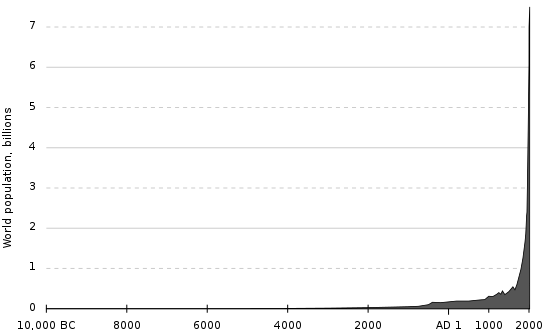
That's not to say that it isn't an issue, but traditionally we held some really weird views about overpopulation. Basically we looked at this graph: https://upload.wikimedia.org/wikipedia/commons/thumb/b/b7/Po...
and extrapolated the exponential growth, and ended up with scenarios of doom, war etc. Food shortages for example are consistently predicted, but food production growth has outstripped population growth substantially and food security is better than any time in the past (yet far from perfect).
Obviously there are huge sustainability concerns, but the biggest source is our level of consumption levels and patterns, not our population numbers, which comes in second.
Of course this illustration is a simplification but it brings the world population back to perspective.
Other than water, I think the only real problem with the current and projected populations is energy. It's not cheap to get oil. And we use it in everything. So, it's really a matter of time before the question of energy makes the rest of the abundance we have useless. No cheap oil means no cheap way to ship food to markets.
So, I'm split on how to see the problem as it is. I think Malthus is going to get the last laugh on all of us.
That's not the way you control birth rates.
You control birth rates by controlling FEMALE fertility... not male fertility.
There are mathematical reasons behind this, but for the purposes of simplicity I'll give the lay explanation. ie - A female can only have one (or so) child every 9 months. A single human male can produce one every day. So having a population with only one male, but 100 females, allows for a FAR higher reproduction rate than a population with 100 males, but only one female.
But it's a well documented effect. Seems to me the easiest way to cut reproduction is to simply develop countries.
Talk about good things about China -> Get downvotes and people rebutting you with clearly one-sided sources.
Am I surprised? No.
Am I pissed? No.
I believe time will tell.
On one hand, "population crisis" is something a lot of people are concerned about^ and the policy was a direct and practical way of tackling it. On the other, it is unmistakably totalitarian.
Going to 2 is a strange choice. It's just as totalitarian, but probably has a fairly negligible effect on average fertility rate. I guess they don't see
^On a tangent, I don't totally buy population crisis and judging from how rarely I hear it mentioned these days I think I'm not alone. There is obviously some natural limit on human population, but I don't think we're near it.
The fact that we hear less concern about it is says something interesting about the zeitgeist. I think people believe in technological progress more in 2015 than they have since the space age and nuclear age of 50 years ago, maybe more than ever. At our current rate (ignoring the projected gradual reduction) we'll double every 65 years. I can certainly see us absorbing doubling population density in that time considering all the empty oceans, deserts, the potential for landless food productions, megacities and all that jazz. I mean, If the US & Australia went to the population densities of Germany and France (moderately dense with quite a lot of open spaces), we would be good for another 100 years.
Basically, I think we have the space.
https://en.wikipedia.org/wiki/Demographic-economic_paradox
>There exists a realizable, evolutionary alternative to our being either atom-bombed into extinction or crowding ourselves off the planet. The alternative is the computer-persuadable veering of big business from its weaponry fixation to accommodation of all humanity at an aerospace level of technology, with the vastly larger, far more enduringly profitable for all, entirely new World Livingry Service Industry. It is statistically evident that the more advanced the living standard, the lower the birth rate.
-Buckminster Fuller, Foreword to Grunch of Giants
Its not really a strange choice, its been "1 with lots of exceptions that mostly make it 2" for some time (there were exceptions with a limit of 2 instead of 1 for many rural areas, for families where at least one parent was an only child, etc.) Going to 2 is a pretty obvious simplification that doesn't really change much except the degree of administrative overhead, plus the policy has hurt perception of China in the developed world, and changing it to two from one along with well-managed press relations get you lots of "China to end one-child policy" headlines around the world, and with most people not reading below the headline, that's a huge propaganda win for doing essentially nothing but making a totalitarian policy administratively simpler.
And, really, it was always the plan: the OCP was originally conceived of as a single generation policy to bring the population down, which would be replaced with a stable population policy; it didn't exactly work out that way in a crisp sense, but a going from a one-child policy with very limited exceptions, to a growing set of exceptions, to finally a two-child policy is, in outline, generally consistent with the original blueprint.
> There is obviously some natural limit on human population, but I don't think we're near it.
The practical limit is going to be dependent on pre-existing environmental conditions, technology and distribution of lifestyles and other factors; its a moving target. (And not necessarily moving consistently in one direction.)
> The fact that we hear less concern about it is says something interesting about the zeitgeist. think people believe in technological progress more in 2015 than they have since the space age and nuclear age of 50 years ago, maybe more than ever.
I don't think that's the issue. I think that the fact that Gen X and the Millenials have been less economically secure than preceding generations (reversing the trend toward greater security) means that increasingly, people are focused on more immediate, personal concerns. Plus, to the extent that there is a concern for broader, global environmental issues, the focus has been climate change rather than overpopulation (the two concerns overlap considerably, but climate change is more specific and concrete than generalized carrying capacity concerns.)
> At our current rate (ignoring the projected gradual reduction) we'll double every 65 years.
And, IIRC, in the mid-1960s, that was about 32 years. Which difference also contributes to the reduction in concern for overpopulation since then: we may be closer to whatever limit exists, but we're approaching it much more slowly now and that rate is still dropping.
1. Multiple children has previously been reserved to those with political connections or money. Now that everyone can have two they will jump at the opportunity.
or
2. Almost every young person in China has grown up in a single child family and sees it as the normal family. Social norms are also based around parents dedicating a lot of resources to one child. So they continue to have only one child. In about a decade China may have to start encouraging people to have more children, like Japan.
Most I've met who already have a child and could feasibly have a second, don't plan to. I suspect they've already gone through the decision to only have one and don't want to revisit it.
However, I don't know what the rural attitudes are, since I haven't talked with people in the countryside.
I think China's demographic future looks a lot like South Korea's or Japan's, with a shortage of young people:
Rural families have largely been exempted from the one-child policy for a while now. This new development won't change anything for people living in the countryside.
> I think China's demographic future looks a lot like South Korea's or Japan's
Yeah, China already has an issue with a rapidly aging population. It's called the 4-2-1 problem (4 grandparents, 2 parents, 1 child). But this happens in most developed countries. For instance, the average age in the US would be much higher if it weren't for immigration. The native birth rate isn't very high.
Next it will move to Vietnam
(four times the entire population of the USA for perspective)
I guess the logic is it will help their economy?
It's often too expensive to have multiple children in a large city, and when infant and child mortality is reduced there's less incentive to have lots of kids (so people use birth control).
With growth and technology, fertility rates goes down and emerging markets,specially BRIC nations, will be severely affected by this.
bye bye green Earth, hello surpopulation and pollution...