My question is, what then will happen when Bitcoin stabilizes, that is, when the time to new coin mined approaches practically infinity? Let's assume the global economy grows at 4% per year. Do Bitcoin's proponents believe a constant 4% deflation rate will be somehow compatible with capitalism? Why lend, why build new companies, when simply storing it is more than enough? Take shocks such as bubbles and demand-side crises. Could a economy based on Bitcoin survive them, and not crash inevitably into a deflationary spiral? I claim it won't.
The party line usually argues for the evils of inflation. What they don't understand, I think, is that capitalism, in its revolutionary (in the sense of production) facet, needs inflation, feeds from it. Inflation might screw lenders, and favor debtors, sure. But deflation is just the inverse: a gift for the leecherous rentier class, and a massive "fuck you" to entrepreneurs.
If that doesn't make sense, think of it like this. Inflation is similar to nuclear fusion and deflation is like nuclear fission. When the former goes critical, you can just shut off the spigots and things more or less fix themselves(albeit with some collateral damage) without the whole system crashing. However, with the latter, there may be no fixing without dismantling everything and starting over.
I think this argument can be discounted simply by looking at the current state of things--people are still spending bitcoins even though the recent appreciation dwarfs any built-in deflation. Sellers may need to discount their price to get people to pay in bitcoins, but even that doesn't seem to be happening yet.
Let's look at a single-currency country first. Prices fall. Including wages. Credit is tight - money appreciates without being invested and borrowers have to repay debts in more expensive currency tomorrow, making them more likely to default [Fisher]. People with money benefit - the rich get richer and the banks hoard capital, refusing to make loans. Inflation fuels asset bubbles as the economy over-invests; deflation fuels the opposite as the economy starves itself.
Yes, we have seen deflation. The U.S. and U.K. both experienced crippling deflation in the 1930s [1]. Before that, remember the American populist movement's "Cross of Gold" speech [2]? That wasn't a reaction to an inflationary gold standard. The euro zone offers a more contemporary view of the effects of deflation, as does my Switzerland [3].
Uncertainty in the future path of deflation that is more toxic than deflation per se. The U.S. grew through the Great Deflation in the 1870s and Japan has had mixed real effects from its almost two decade deflation [Morana]. Theoretically, if deflation proceeded at a steady clip, markets could accommodate (Milton Friedman advocated for an economy deflating at the real interest rate [Friedman]).
But what if we have two currencies, e.g. U.S. dollars and Bitcoin? Argentinians have a choice between black market (or "blue") dollars and an available but inflating peso. Tellingly, Argentinians buy dollars primarily for overseas vacations [4]. This is an example of a bad currency (the peso) and a good (the greenback). The Argentinians still execute the bulk of their transactions in pesos, not dollars.
Deflation is not likely to be Bitcoin's death knell, but rather a ceiling on its usage. A deflating Bitcoin will crimp transaction demand for the currency as spenders shift preference to more easily borrowed and spent dollars. Sellers would respond in kind (or, alternatively, sellers who respond in kind would gain market share).
Caveat: if Bitcoins are treated as a financial asset, for speculating versus spending. If so, deflation would proceed un-checked, with speculators driving out the transaction value of the currency. That said, gold has survived both deflation and speculation, so this isn't a fatal blow either.
[Fisher] http://www.jstor.org/stable/10.2307/i332559 The Debt Deflation Theory of Great Depressions (1933)
[1] http://www.amazon.com/gp/aw/d/0143116800/ref=redir_mdp_mobil... See Norman Montagu; British depression
[2] http://en.m.wikipedia.org/wiki/Cross_of_Gold_speech
[3] http://www.ft.com/intl/cms/s/0/1c23c088-60c3-11de-aa12-00144... Swiss central bank moves to weaken franc (June 2009)
[Morana] http://www.icer.it/docs/wp2004/Morana29-04.pdf (2004)
[Friedman] http://www.amazon.com/gp/aw/d/1412804779/ref=redir_mdp_mobil... The Optimum Quantity of Money (1969)
[4] http://blogs.ft.com/beyond-brics/2013/01/17/argentinas-blue-... Argentina’s “blue” dollar blues (January 2013)
Regardless, it is certainly a consumer's right to store their assets in something that is not inflationary, as most do. Is the population holding empty real estate or gold instead of currency really that much better for the economy? No.
Smart money will simply shift out of cash in an inflationary environment, and the value will not necessarily be productively invested.
An opposing viewpoint more thoroughly articulated:
I hear this argument a lot, but no nation that we know of has ever collapsed because of deflation, right? We've never (recently) been in a period of significant deflation, so how can we be so certain of its effects?
> deflation makes it more profitable to do nothing than to invest.
Investment won't ever stop, it just behaves more like a there is a minimum interest rate. No matter what the deflation is, I can still loan out $100 and expect $110 back within a year and make a bigger profit than holding on to it.
People will still work, and spend what they need to. And there's a limit to how much a currency can deflate before it cycles back. And hell, how do we even know that inflationary/deflationary cycles are unhealthy? Even if it causes some businesses to die, maybe this improves an economy in the long term by churning things up a bit.
This makes no sense to me. If keeping 100 units makes one richer because they are worth more in a year, then any investment which has a positive return (that is, you end up with more than 100 units in a year) must be that much better... What am I missing?
If this is holds true, why do people buy from markets where prices regularly decrease? Wouldn't it follow that they will wait in perpetuity and never buy that new phone/laptop/etc?
Saving is investing. You're investing in your ability to manage your risk at a future date. If you have no savings, then you are at risk of any minor problem (e.g. an injury, decreased revenue, or a natural disaster) causing you a major setback.
The "common wisdom" you've heard about inflation being necessary for an economy is a lie. It's a lie that justifies the wealthiest class of individuals in this society to be "bailed out" again and again.
Of course, inflation can be very bad, too.
If the market reduces because of a lack of investment, wouldn't the currency reduce because you hold the same proportion of a smaller thing, creating an incentive to stop negative growth.
There is also the factor of the OP's so-called CryptoBarons. Money is just an idea until you actually spend it. If there are a number of people living it up because they got a bunch of bitcoin really early the result would be essentially another form of bitcoin creation. Those CryptoBarons would be adding currency into circulation as they spend, currency that was effectively frozen before that point.
I'm not sure what will happen in the end, but it will certainly be an interesting ride.
Isn't deflation for the buyer seen as inflation for the seller and vice versa?
Why would you then not (applying your deflationary spiral model) expect a "market death" from sellers not selling under currency inflation?
Ohhh, now I get it.
Hoarding is a derogatory term, intended to evoke an emotional response from the reader. I prefer the term "saving".
> Why lend, why build new companies, when simply storing it is more than enough? Take shocks such as bubbles and demand-side crises.
Most bitcoin proponents to indeed reject Keyensian, demand-side economics.
I, for one, think entrepreneurs would typically benefit from not relying on debt.
>capitalism[...] needs inflation, feeds from it
Increasing the money supply helps one class of people: the bankers. It doesn't help the middle class, it doesn't help entrepreneurs, and it definitely doesn't help the common person. It's an insidious hidden tax.
All this talk about inflation reminded me of a funny (in a dark way) propaganda video made in 1933 regarding inflation: https://www.youtube.com/watch?v=JUvm9UgJBtg.
I don't understand how something completely unsupported by the data is repeated as truth.
Historically, deflation is disastrous for everyone, and high inflation also disastrous for everyone. Moderate inflation has the effect of redistributing wealth from capital to work, and tight money the effect of redistributing wealth from work to capital. Compare Australia (loose money) to the Eurozone or America or Japan (tight money) for example.
"Investing" one's resources means putting them to work to create value. "Hoarding" them means the assets are as good as if they were buried in the ground. Investing is riskier and takes more work and more smarts, but any idiot can hoard.
What creates (or is more likely to create) more value? 1 million dollars distributed among promising startups, or 1 million dollars spent on mining gold? 1 billion dollars spent creating an airline, or 1 billion dollars spent on vast swaths of real estate?
That's why we're laughing at you.
tl;dr; money is useless if no one spends it, that's the whole point.
another way to think about it is a stock. if a stock is priced, and no one is buying or selling at that price, is that price really valid? whats to keep another actor in the economy from pricing a stock totally different if there is a 'dumb' actor wiling to buy at that price.
This isn't 1941 England and bitcoins aren't sugar. Early adopters in the right thing often make money. Usually on HN they are called investors and congratulated. Sour grapes on missing out? (I did too)
If you don't want to miss out again, buy Litecoins and Namecoins. Litecoin will never be worth as much as BTC (because there will be 80million of them as opposed to 20something million BTC) but it will slowly gain in value as it has some impressive features especially suited for online gaming payments with fast confirmation, secure online voting apps, or of course online gambling.
Litecoin is presently $1.30/each I see that going up to $4 at least by end of year now that more people are using it.
2. Why take credit for business if you can save your own earned money which appreciates over time and have 100% stake at your own project?
3. How deflationary spiral is supposed to happen? Will people be paralyzed and dead of hunger and thirst holding their precious coins? Or they will trade with each other to get stuff done?
Some of the ways people handle their property is detrimental to society. If enough people do it, hoarding capital is one of them.
Regardless, many assets are deflationary. Rich people buy real estate and commodities because they are deflationary, or at least not inflationary. There is nothing wrong with assets that grow or maintain value.
Bitcoin is a liquid and easily transferrable deflationary value store, just like gold. Telling people they should submit to inflation for the greater good is ridiculous. Inflation works because it keeps those too poor to have real assets on the gerbil wheel. The wealthy (or smart) just store their money in non-inflationary assets and sit pretty.
Besides, if you can't get better than a 4% return, you probably shouldn't be investing in whatever it is you're considering anyhow.
Edit: I don't think space colonization matters here. Sure, it may be possible. But Mars is sufficiently far from Earth and the energy cost of transport sufficiently high that a populated Mars would effectively be an entirely separate economy for everything but intangibles. I don't think a Mars colony would permit Earthly exponential growth to continue, even though Martian exponential growth could occur for quite some time. (Until Mars' own unique limits were reached.)
Quite to the contrary, it gets the proletarians out of debt!
Price inflation only hurts wage earners when it is coupled with flat nominal wages-- but that is merely a (too powerful) psychological trick that people don't notice.
I think you are wrong. Imagine living in such an economy and facing the choice between hoarding (4% deflationary gain) and a good investment (10% gain). What would you do? All I see happening is that less money is being spent on bad investments due to artificially low interest rates as it happens to today.
When there are no liabilities for holding an asset, there's not a big incentive to sell it.
Jokes aside, any sort of investing in illiquid assets is fraught with risks. We are talking about a currency here which by definition requires liquidity to be useful, these are two very different things.
Yes, I'm arrogant and I'll deal with an idealized model where the same set of resources is transformed into final goods, but bear with me.
In order to get a real growth of 4% be it per year or per century in such a scenario, you need to find a better use of resources so that with the same resources you may produce an output which is 4% greater than before.
Which is the same as saying the the only way to grow is to find ways to produce final goods cheaper.
And because production is cheaper, more goods could be sold but.. entrepreneurs will still make a profit. Pretty much the same.
And the fact that final goods get cheaper means just that.. That goods get cheaper.
And you will not get rich by just holding bitcoins, or any other fixed supply money. Yes, you will be able to get more stuff for but only because the stuff get cheaper..
You'll still hold the same fraction of total purchasing power that as the day you decided to "hoard" your money for a while.
That's not what I call getting rich, and that's why loans and interest make sense and are safe with bitcoin.
P.S. Take you time. It's late in my TZ.
Let's work through an example. I buy 100 seeds for $1 each. I plant them, let them grow, and harvest the result. I now have 104 seeds. My real growth is 4%!
Now I want to sell the seeds back to recoup my investment. But I discover that prices have dropped by 4%: seeds now go for 96 cents apiece. My 104 seeds now are worth $99.84! I would have been better off not buying seeds at all, and instead just holding on to my money. Real output is reduced.
This illustrates how deflation inhibits growth.
In a case where monetary supply is fixed (ie gold), if you hold on to it for a period of time, you will get more goods for it than now. That 'more' will correspond to economic growth over the period. You will have the same fraction of the purchasing power pie as before, but now the pie is larger. Does not look like a win to me, but this is the judgement call for the reader.
PS. Yes, I am simplifying and ignoring some thing like velocity of money and fluctuations in economic output, and growth of capital, human resources, and technology.
It's not like ~2035 (or whatever) rolls around and everyone's like "Holy crap! There aren't going to be any more of these! Better quadruple my bids!" No -- there's no profit to be made simply from the fact of supply increase stopping at some point, not when the entire market knows it as well.
So you can't really compare it to a situation in which a government (or affiliated central agency) controls the money supply, changing its mind at future dates, to arbitrarily hold the supply steady when it had been growing before -- which is what is required to get the results you've described.
Looking at PCs, DVD players, etc. it seems price deflation has been great for the consumer and overall "market". Perhaps it has been bad for the manufacturers, but the overall society has benefited from the deflation of those goods.
Electronics might also became cheaper due to, say, someone setting money on fire, so there's less to go around. Clearly in this case our real wealth would not be increasing, so it's not good. But it's not obvious why it should be bad, either.
The reason it's bad is due to our psychology. If the money supply shrinks (and nothing else changes), prices and wages must both go down. But people hate the idea of negotiating a lower wage, so instead wage drops are accomplished through layoffs and unemployment. That's bad because it means that people aren't working: the economy's real output is reduced.
So inflation provides a buffer that allows the economy to adjust wages downwards in a way that we find more palatable than negotiated nominal wage decreases.
A mistake 'economists' make with bitcoin is to draw macroecomic conclusions based on theories suited to single currency economies. Actually we need theories that allow for multiple currencies circulating that have different strengths to understand the effects.
Tl;dr Bitcoin won't change the way we price things, it just provides another option to transfer wealth.
Basically Bitcoin hoarders are not going to sit on their fortunes and passively watch Bitcoin dies.
This makes the assumption that people won't make their own forks of bitcoin. If there's a shortage of bitcoins, and not enough is being mined to meet demand, I think that will give more incentive to people to make their own forks of the currency. Maybe will see various communities forming their own currencies for their own trading purposes.
To me bitcoin is excellent for e-commerce because of it's secure signatures you can use for escrow, proof of payment, decentralization so nobody can interfere with your commerce and safety for me as a merchant to prevent fraud.
Deflation is not obviously bad. We had deflation during the whole industrial revolution and things were running smooth. If people hold on to savings rather than invest suppliers will quote higher prices in order to put the money back into system or hoard the money for themselves.
One thing for sure. You wont be robbed out of thin air and that whats inflation is for. Central bank has no money for retirment... fiiiine, let print more -> market will stabilize itself.
Plus if the value of bitcoin goes sky high. It will be lucrative to mine again. It has the mechanisms of selfhealing.
For example, if the economy will be in such a terrible state thanks to the deflation, somebody can do a fork of bitcoin that will not have halved mining reward (and thus not having finite number of bitcoins in existence), and if the miners will jump to this new version (and probably clients, too, not sure about that), this new currency will be used as easily as the old bitcoin.
If I am wrong technically, please correct me.
The nice thing about bitcoin is - nobody enforces anything.
Capitalism doesn't need inflation. Capitalism works best with a hard currency. Money gaining 4% per year in purchasing power isn't "deflation". The notion of "4% growth" is ill-posed.
I could back these statements up with logic and evidence, but experience shows that virtually no amount of rational argument ever convinces anyone of these points. Luckily, rather than arguing till we are hoarse, those of us who have swallowed the hard-money red pill can now put our money where our mouth is and buy some bitcoins.
Bitcoin's value is not held by how hard it is to mine them. It's held by how bad people want to use crypto-currency for trading behaviours.
When bitcoin's value become too high to be used for normal trading, it's value will decrease, simply because people will invent new types of crypto-currency(i.e litecoin, namecoin) to replace its function. When less people using bitcoins, no matter how 'hard' its mining algorithm gets, its price will drop.
Therefore crypto-currency is inflationary, and that's why Bitcoin will become inflationary eventually.
Currently bitcoin is not a currency but a very speculative investment.
Imagine a world where that wasn't true. Imagine you had to spend more and more every year just to get the same quality of phone or computer or TV. Now ideally, and depending on what's causing the inflation, your income would increase at exactly the same amount and so it wouldn't make a difference. The same quality TV would cost the same percent of your wage in 1960 as it would in 2013.
But with deflation it's the opposite. Your income will (on average) remain the same, since the amount of money in the economy hasn't changed and it's being divided over the same number of people. But prices will go down due to the economy growing, increasing efficiency, technological improvements, and all that good stuff.
You may see a slight flaw in my argument. Presumably the same amount of stuff is being produced in both economies, regardless how the currency is changing in value over time, and presumably there are the same amount of people to receive all the stuff being produced. So how can people in the deflationary economy be richer, on average, than people in the inflationary one?
Well on average, they aren't. Inflation as you are talking about it is caused by the money supply increasing. Usually due to the government printing more. Whoever gets the money first is suddenly richer, because prices haven't increased in response to inflation yet. The amount of money they have relative to everyone else has increased. Therefore everyone else has become poorer relative to them.
Only on average does everything stay the same, but it's a zero sum game where for one person to benefit, someone else has to lose. The amount of goods in the economy hasn't changed. But the person with more money (obtained through printing money) gets a bigger piece of the pie and therefore everyone else gets less.
Inflation is just a really confusing, inefficient, and indirect form of wealth redistribution. Whoever gets the printed money obviously gets to benefit from it, and everyone else is therefore poorer, including your entrepreneurs and investors and consumers and everyone else.
The only way this isn't true is if the money is distributed perfectly equally so the percentage everyone has is exactly the same as before. However this is not the case in the real world at all.
This can't be universally true. If food gets continually cheaper, unless the cost of owning land and farming it goes down by the same amount, farmers must eventually make less money than before (or be driven out of business entirely).
And I don't quite buy the comparison between technological progress (where things get cheaper due to massive amounts of competition and research) and switching to a fiat currency which is arbitrarily limited (bitcoin). Using bitcoin doesn't guarantee technological progress.
> Inflation as you are talking about it is caused by the money supply increasing. Usually due to the government printing more. Whoever gets the money first is suddenly richer, because prices haven't increased in response to inflation yet. The amount of money they have relative to everyone else has increased. Therefore everyone else has become poorer relative to them.
Yes, printing money is in effect a government tax for usage of that currency.
1) High tech sector has been experiencing massive deflation for decades and is thriving. Why? Is deflation really that bad when it comes from productivity? We know deflation due to massive decrease in money supply or velocity is bad, but what is wrong with slow, steady deflation from productivity?
2) With 2-3% steady deflation, won't interest rates adjust? People will lend their money out to earn a better risk adjusted rate than deflation. There isn't some magical number or percentage where people will start or stop lending. It's more like behavioral economics where people have several choices at different risk profiles.
3) The biggest proponent for an inflationary system is the banking system and economists who are funded/trained/selected by the banking system. This casts a lot of doubt on 'inflation is bad for lenders' statement. In a deflationary system, productivity gains go to the consumers (via lower prices). In an inflationary system, productivity gains go to capital owners (via debt and higher prices).
The US experienced very strong but volatile economic growth under a capitalistic fixed currency system (gold standard) that had periods of deflation and inflation in the 19th century. There is no historical basis that shows that capitalism needs inflation.
It'd also be interesting to look at the effects of deflation in the fledgling bitcoin economy, although the actual exchange of currency for goods and services is a bit small to judge this effectively.
When was the last time someone acquired a good or service with an ounce of gold? Perhaps we shouldn't consider gold a currency? Well I'm fine with that. Bitcoin probably isn't a proper currency yet either (in the sense that people aren't exchanging much with it yet). But not being directly relatable to utility in exchange certainly hasn't hurt gold in recent history. So I don't see why necessarily it will be a problem for bitcoins.
1) Store of value. Much easier to store gold/USD/Bitcoins than the food you will need in the future.
2) Medium of Exchange. Can be used to exchange for real goods, thus avoiding the headache of barter.
3) Unit of Account. e.g. is easily divisible.
Bitcoins aren't great at #2, but gold is terrible at #3. If bitcoins prove to be a lasting store of value, then it will almost certainly be more "money" like than gold.
Fact is, if I had "invested" in 100 BTC only 5 months ago when it was hovering around USD$10, that would have cost me about $1000. And now it would be worth $10000. There are not that many investments that have that kind of return in such a short time. You'd have to be dumb to believe that people aren't doing exactly this. You don't see 1000% returns and just ignore it and wonder about its utility. Right now, it's a volatile and risky currency exchange being intentionally used to ride the rising popularity into a cash la-la land.
At some point people are going to convert this toy back to a real-world currency and take their winnings home with them. I don't know what's going to happen then, but I don't believe it will be good. Perhaps 'stabilizing' would be a good optimistic name for it.
I'd say it has been that way for a long time. When I dabbled in the community 2 years ago it was already brimming with speculators. Early adopting evangelists looking to legitimize their hoards and speculators who'd have been gambling on leveraged ETFs or FX if not BTC.
There's a fork of Bitcoin which actually has this built in.
I imagine we could see an interesting future with cryptocurrencies, where people are essentially betting/investing on the stability of the framework/algorithm and demand on it. Multiple ones could exist, and you're hoping for the best return, or greatest stability.
What would be REALLY interesting is if essentially one of these ends up seeming a better 'idea' than US currency (the de-facto currency now)
I do believe that will happen eventually, but it's too early right now. Bitcoin works by the law of numbers - after all it's all numbers and math. When its tiny in value, its growth can be very high. When it's already huge, the growth will slow down a lot.
http://en.wikipedia.org/wiki/Logistic_function
Of course growth will probably come in fits and starts, not so smoothly.
Well, it is. As more people hold some BTC "for the future", they are more than willing to accept them as payment for their services. Imagine you are surrounded by people who have "hoarded" some BTC. Suddenly they can just trade in BTC without going to a bank (unless they have some spare cash which they haven't allocated to other purchases yet).
IE: Deflationary Spiral. It becomes hard to be a merchant who accepts bitcoins, because everyone expects BTC to keep rising in prices.
People who bought a domain name for 1 BTC a few weeks ago from Namecheap lost a lot of money. They should have instead "saved" that BTC. Therefore, people are discouraged from using BTC as a transaction vehicle.
Currently, hoarders are the ones benefiting from BTC, but no one else is. No merchant knows how to value their services in BTC, not when there is this much volatility around.
"I can BUY things with these? Wait... I can sell things? I just need to paste a hash?!"
So the real question you should be asking is, "Who would benefit from a Bitcoin failure, and could they amass that much computing power?"
The GDP stats for bitcoin is not systematically collected. The blockchain data only gives us a approximate picture.
So most people just rely on their guts and vague feeling about the size of the bitcoin economy. Bitcoin detractors tend to underestimate the size of bitcoin economy because they can't recall selling or buying goods or services. Bitcoin users tend to be more optimistic because they keep up with news of merchants opening up.
I think it would be very useful if somebody built a stats site dedicated to systematically report on economic activities occuring in bitcoinland.
Gold and silver stand in opposition to this statement.
You can't buy groceries with gold or silver coins, but they're a fantastic store of value and time-tested investment.
Furthermore, according to Gresham's Law, people keep "good money" (i.e. money that holds its value) out of the marketplace and spend their "bad money" (i.e. fiat) acquiring goods and services.
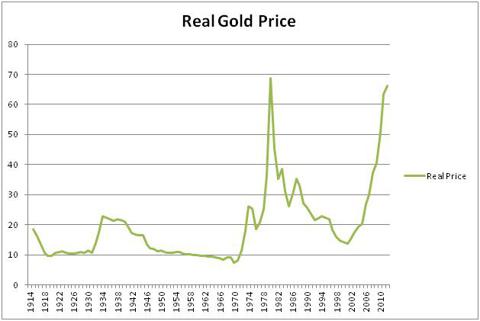
Real value of gold:
http://static.cdn-seekingalpha.com/uploads/2013/2/18/1019887...
That is very much not my idea of a "fantastic store of value." Not unlike bitcoin, its value appears to vacillate wildly. The S&P 500 looks tame by comparison, and also has the added benefit of a much higher long-run rate of return.
LOL.
In the two years I've been watching it I've seen no evidence that it's anything but an investment (and speculation) vehicle.
And there are a lot more not on this list. Bitpay alone (a Bitcoin payment processor) claims to have multiple thousands of merchants.
I invested in a payment system of the future.
If it ends up being used, I'll have (however many I invested in) BTC to spend, which could be worth significantly more or less than I paid for them.
If it ends up being useless, I'll lose my principal.
Unfortunately it seems like that's just not going to work at this point. I set the price at 2 BTC when the exchange rate was $35--like two weeks ago or so. That meant the BTC membership price was about in line with the USD price. But in a few weeks, the value of a Bitcoin has tripled. Since most people using BTC ultimately want to convert it to dollars, this insane instability makes BTC impossible to use for anyone interested in a pure BTC economy. Too bad.
This bounds their volatility in a way that bitcoin can't, and makes me wonder if the lack of a similar stabilizing mechanism isn't a long-term flaw in bitcoin's design.
The only way I can see bitcoin ever reaching a similar level of stability is for its market cap to reach a level such that it stabilizes under sheer weight and momentum rather than any built-in mechanic, which could require exceeding that of all other currencies combined (making speculation and market manipulation difficult or impossible), no small feat.
Flipping around the question, how could a risk-free rate of return exist in Bitcoin at all? Nobody has the power to create more currency or forcibly acquire some in order to satisfy a promised payout.
Even if there is no value in BTC as a medium of account, the quantity of economic transfer it could plausibly come to represent alone has a certain value.
BTC as a proxy for USD is still useful IMO, it gives us a way to avoid Paypal and other online processors. But for it to be a USD replacement, it needs to first settle down and stabilize.
Considering that this is the largest spike in the history of Bitcoin, I would like to know what makes you think that.
"I think it will eventually stabilize."
So do I, but that is because I think it will eventually fail (and stabilize at $0/BTC).
http://www.reddit.com/r/Bitcoin/comments/19t3uq/hey_rbitcoin... is the best that I could find (admin from Reddit talking about Reddit Gold revenue).
It's interesting that the accounting costs more than they bring in (though this is something that could obviously change with increased stability in the BTC/USD rate / increased volume / better processes). Somewhat concerning, considering that they host what seems to be one of the most active/vocal bitcoin communities out there.
Also, http://www.reddit.com/r/Bitcoin/comments/1auzjg/factorio_dev..., though this one may just be a case of not properly targeting for users.
1. The site audience tends to be a little older and not very tech-savvy, so Bitcoin isn't something that many are interested in comprehending.
2. Since the price was fixed at 2BTC a few weeks ago when 1BTC~=35USD, and now 1BTC~=100USD, people will see this is a raw deal. (The USD price for a membership is $65.)
It's #2 that's the hard part. I'm not interested in accepting BTC just so I can convert it to USD, but since everyone's so focused on the BTC->USD exchange rate as the measure of value for BTC, and since the rate is so insanely volatile, it's impossible for a merchant to fix a "fair" price without auto-adjusting the BTC price to the USD exchange rate.
Using BTC as a "proxy" currency isn't unhealthy per se -- it's merely a transitionary step until people have adopted BTC more widely.
I'm going to go with something closer to $300 to $150 at least. If there's a pop coming, it is a long ways off.
I don't think "core bitcoin" users are scamming anyone. But at this point, the speed at which BTC has grown has triggered my "manipulation trigger". A decentralized currency is prone to manipulation... its not like there is an FCC out there to stop people from manipulating BTC.
Bitcoin is not a promise of future delivery. Like William Gibson said, "The future is already here — it's just not very evenly distributed."
Bitcoin grows like crazy thanks to various entities of increasing credibility building an ecosystem around BTC. Like Coinbase, which I'm sure is why a lot of people here got into bitcoin.
Listen for about 30 seconds of https://www.youtube.com/watch?v=0UKC7iaBKvs#t=830s
No, a transaction can take from 10 minutes to an hour to complete. You may have to pay a percentage to do that aswell.
E.g. I myself and many of people I know are not going to sell a single Bitcoin unless any sort of personal or global disaster. And many of them are going to spend their BTC over time to avoid interaction with banking system as much as possible.
> I myself and many of people I know are not going to sell a single Bitcoin unless any sort of personal or global disaster.
In the case of global disaster, who's going to be buying a fringe currency?
What is the purpose of avoiding the banking system?
Those PSPs compete and one dimension they compete on is breadth of payment methods. Who wants to be the only one who doesn't offer BTC?
Once PSPs have integrated bitcoins, many merchants will accept them.
Rapid price increase doesn't always mean "bubble". Sometimes innovative things are created.
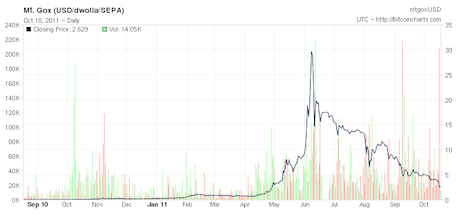
http://static.guim.co.uk/sys-images/Technology/Pix/pictures/...
90% of the value were lost in a few months. The market seem even frothier this time so I'd expect the eventual pop the be harsher as well.
http://bitcoincharts.com/charts/mtgoxUSD#tgSzm1g10zm2g25zv
This is the value over a larger time. Sustainable?
Gold is a tangible substance. BTCs are just data and we all know how volatile that can be.
For a small-scale, but very instructive example that shows there are cases where simply increasing the money supply can sometimes create more value in the economy (or how deflation can destroy value), see the story of the Capitol Hill Babysitter Co-Op [0].
At a more serious scale, many prominent economists believe that an artificial restriction of the monetary supply led to, or exacerbated the Great Depression [1].
So, like Krugman [2], I think that BTC proponents really have to explain how the artificial restriction of the size of the BTC money supply is not a serious design flaw in the currency. Are BTC just crypotographic gold? If so, then is a successful BTC economy just a different gold standard (and all its associated problems)?
[0] http://en.wikipedia.org/wiki/Capitol_Hill_Babysitting_Co-op
[1] http://en.wikipedia.org/wiki/Gold_standard#Prolongation_of_t...
[2] http://krugman.blogs.nytimes.com/2011/09/07/golden-cyberfett...
This was compounded by a case of retardism on the part of its managers, who refused to accept that different nights have different value, and that prices have to change to achieve equilibrium. So the supposed solution of inflation was actually replacing one artificial problem (a price floor) with another (temporary misvaluation of the new currency due to "money illusion").
Go find out how Krugman answers the question of "Why didn't they just let the exchange rate of scrip per hour float freely in response to differential weeknight demand and risk aversion?" (Hint: he doesn't, anywhere.)
The main problem with gold standards, is that governments don't like them, because it makes it really hard to fund wars and other expenditures. Eventually, this leads to gold confiscations [1], and the effective end of a gold standard. Bitcoin solves this by being resilient to confiscation, and also by having a value transfer mechanism built-in, so that you don't need to replace gold with paper receipts for the sake of convenience.
In essence, bitcoin has all the upsides of a gold standard, with none of the downsides.
The one problem associated with gold that it does solve is being as good a medium of exchange as visa/paypal (or better).
Anyone in the world would immediately accept gold standard, but this BTC, despite being a digital gold, will be difficult to overcome the initial fear/mist-trust. It doesn't matter what mathematical proof you provide - the laymen doesn't really understand it. May be one day, it becomes accepted, and BTC will then really be a new gold standard. But i don't see that day coming, because there are people who don't like the gold standard (as it prevents them from leeching money from society - i.e., various parties/entities who hold controlling interests in major central banks etc).
The annualised velocity of the M2 Money Stock for Q4 2012 2 was 6.152 [2]. That is, the average dollar in the form of notes and coins in circulation (M0), traveller's cheques, checking account/demand deposits, savings deposits, time deposits/CDs under $100 000, and individuals' money market deposits was spent 1.538 times on economically useful activities in the fourth quarter of last year.
The annualised velocity of the Bitcoin Money Stock for Q4 2012 was 1.27. That is, the average Bitcoin in existence was transacted 0.32 times in the last 90 days of 2012. This includes economically useless transfer payments, i.e. transactions not involving the exchange of real goods or services, as well as economically useless hoarded or lost coins, i.e. Bitcoins not in circulation and so less a unit of "money" than a speculative asset (in the case of hoarding). Since this is a ratio, the two balance out, though it is still biased to the downside. For the 30 days ending on 29 March 2013, it was 1.86. Here is what it has been doing since February 2009 [3].
More encouragingly, Bitcoin Velocity has quadrupled YoY. M2 Velocity declined 4% over the same time. I would thus offer, very tentatively, that there is a substantial portion of the Bitcoin economy involved in real transactions (versus financial ones, e.g. trading on an exchange).
Curiously, yet to emerge (to my knowledge [EDIT: which was wrong]) is a majour vendor of Bitcoin mining equipment that accepts Bitcoin as a mode of payment. If that were to happen, the Bitcoin economy would have an endogenous "risk-free rate" in the form of mining yields, with power companies serving as the most salient factor. If it were not for the ceiling on the number of Bitcoins which can come into existence, it could very well have been the first currency pseudo-denominated in energy.
[1] https://en.wikipedia.org/wiki/Velocity_of_money
[2] http://research.stlouisfed.org/fred2/series/M2V?cid=32242
[3] http://imgur.com/f7oFZKb Annualised Bitcoin Velocity, Feb 2009 - March 2013
But interesting analysis. What do you think about the Bitcoin Days Destroyed metric [0] as a way to measure the health of the Bitcoin economy?
I've been looking at it lately though and thinking that it surely must drop back soon. I'm thinking a drop back down to 15 us is reasonable.
Right now its proponents are valuing it like a tech startup stock- what's its potential future value?
Its opponents have already decided it will fail.
Either side may be right at this point, though bitcoin has more going for it than it did six months ago.
To me, the trend is currently towards "it's going to work", so I think it's worth a gamble. But it's definitely a gamble.
I think cryptocurrency is without question a force for the future. It makes exchanging money too easy and too fast for it not to eventually dominate economic systems. Economies/companies that don't use it will be at a disadvantage.
What's in doubt for me is whether bitcoin will be the winner of the cryptocurrency market.
It's the hope of some in the bitcoin community/industry that bitcoin becomes one of the top 3 currencies in the world.
Given that there is a hard limit of ~ 21 million bitcoins (half of which have already been given out), the only way to get in the top 3, is for each bitcoin to be massively valued.
Or is it a single unit or nothing?
BTC can be sent in any amount, all the way down to Satoshis at 0.00000001 BTC.
Also there is talk of making the default traded unit a mBTC, (I think) Its a unit that represents a thousandth of a unit. once this becomes the standard unit the psychology is there to allow BTC to rise even further.
add: in fact the ideology of bitcoin is steeped in disempowering central banks. So you are buying into an ideology, and so long as the tech can keep up with the ideology, and there's nothing with better tech, and central banks keep ripping people off, then bitcoin will rise. It's far from perfect, but I think the web itself was about unlocking information to empower people (as created by hippies), something like the advent of literacy to empower people to read the bible when it was limited to priestly classes. Bitcoin is like grade 1 spelling and grammar, or the first web browsers: sure is better than not having either.
I set up camp over the Golden Gate Bridge. I ask people if they'd be willing to throw their lunch into the water (use their computer's time/energy/money to mine Bitcoin), with no possibility of retrieving it, and in return I offer to give them a certificate stating that they've thrown their lunch away (a Bitcoin).
Now, I see no reason why anyone would expect why these certificates would have any value. But let's suppose they do have value, and people can trade their certificates, say, for a lunch (or perhaps half a lunch). NOW, suppose I have been secretly stashing away those lunches (really it doesn't need to be in secret - you don't care what happens to your lunch after you throw it away). Then there is now objectively more value in the world than there was before I set up shop - there are the same amount of lunches in the world, but there are also now certificates that have some positive value. We've made a free lunch!
This is a contradiction. If we could create value by this silly game, we could easily make as much value as we want, and we would have solved all the world's problem.
But this should be obvious in the first place! Why on earth would you expect to be rewarded with something of value (a Bitcoin) for doing something fundamentally useless to society (mining Bitcoin). Even though mining Bitcoin comes at a cost to you, this doesn't matter - it just means you're throwing your lunch away.
Now why does the US Dollar have value? Instead of throwing away our lunches for a certificate, we basically asked the government to store our lunches in Fort Knox. Today, lots of gold and other items of value are held there. Why are they held there? There is an implicit assumption that these items of value support the US Dollar. The government knows it could not start "eating those lunches" that it's got in its reserve! It would not yield society a free lunch - it would crash the US Dollar.
Does Visa provide value to society? "mining bitcoin" translates to "certifying the current outstanding global transaction registry". FYI.
I don't think the BTC will ever be a 'currency' as the USD or the GBP. It is also not necessary for the BTC to be at a 'fixed value' at any time. As a virtual currency it's ok for the BTC to fluctuate heavily as the only thing needed for it to still succeed is that payment systems are 'always on' and can determine a spot price for goods and services.
I would rather see the BTC tied to 'Pizza index' than USD. This would make it easy for people to use an in-app value determinator when making purchases.
Say you just tap your phone with a BTC wallet against a cash register. The register answers, well your burger will be 0.00065 BTC at spot price as of 12.24.44.32 PM. Accept/decline.
That's it. I see the BTC/LTC (Litecoin) as alternative currencies but still worthy of a HUGE market share for micro/everyday transactions.
Bitcoin will never reach that level of ease of use. But when it has something like a 5 step LiveCD[1] it might start to get wider use.
[1] Something like insert CD, prepare anonymising stuff; load encrypted file from USB stick; load key from hardware token and enter short password; and have the distro wallpaper give idiot proof flowchart diagram instructions.
You install the bitcoin wallet.
You sell something for bitcoins, and you give them your private key address in your wallet.
You receive bitcoins.
You buy something with bitcoins else where, and you just hit send and specify an address.
Simple as an account # + routing number.
Now funding your wallet with fiat currency is a little harder, but Coinbase has mostly taken care of that. It's as hard as paying a credit card off - link your current bank account, press buy or sell.
Buying bitcoin is essentially a bet on the probability it will be monetized. This probability will wax and wane in the minds of the population participating in the bitcoin market, who in turn will be influenced by media perceptions, the actions of the state etc. So the price will no doubt be quite volatile. But the increase in price, based on an increase in reservation demand, is self-reinforcing. It increases the desire of merchants to accept bitcoin in payment (since there are now a greater pool of holders who have greater savings looking for an outlet to spend those savings). And as new merchants begin accepting bitcoin in payment, the reservation demand increases. These two causalities are linked together and reinforce each other. At some point they become entrenched enough that the whole thing "lifts off", so to speak, and the commodity becomes money. Interestingly, the same thing happens with gold, except that one of the two causalities is short-circuited by the state: the reservation demand for gold does not spur merchants to accept gold in payment, because that is made illegal by the state. Thankfully bitcoin is so well engineered that the problem of the state banning use in transactions is essentially moot (no offense "Chuck" Schumer).
Its hard to compare against dollar. As bitcoin is newborn with freedom written all over it. If it gets adapted more chances are its gonna be rising in value and will become first a currency for savings later on a day to day activity currency.
This is one of the scenarios I think that would incorporate bitoin into the current financial system.
Bitcoin for larger sums, international or less timely.