The kicker: I'm not even in a suburb, I live in SF!
All we do in SF is make car driving worse, we almost never make public transit better. At least NYC has a plenty good enough train system.
I end up WFH anyway, largely because it's annoying to get to an office downtown every day.
In the last half decade we've seen the opening of the Salesforce transit center, the Chinatown subway station, the Van Ness BRT, the Caltrain Electrification Project, BART expansion to Berryessa, 800 new BART cars, and hundreds of smaller projects.
You can see a full list of SFMTA projects at https://www.sfmta.com/sfmta-projects
The better question is, have you ever seen a kid crying in the back of a bike?
They do that really well here in Barcelona. 21€ a month and you can use all the transport you want in the city, all modes. Why would i want a car what's expensive to own, park and maintain and I can only just it when I've not been drinking?
Problem is, making transport good costs money and a lot of effort. Taxing cars is easy and brings money in.
Well, congestion pricing would make driving better. (And perhaps make busses better, too, since they use the same roads.)
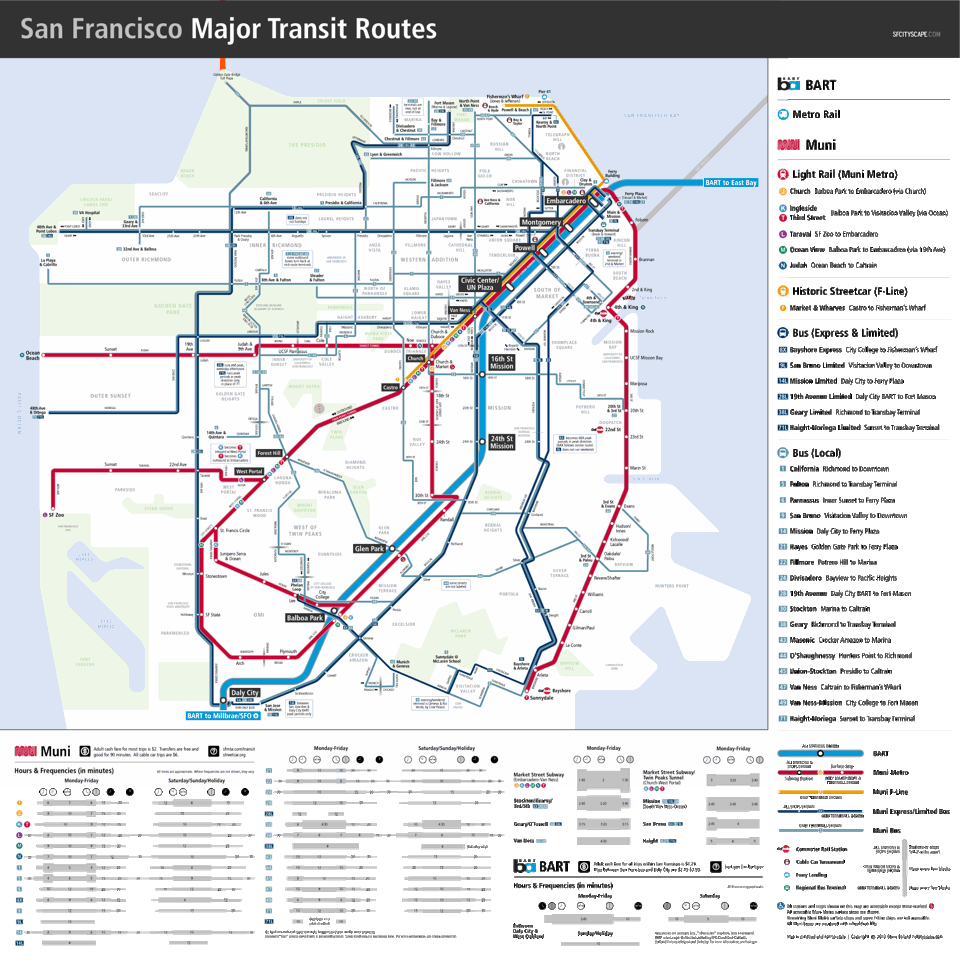
Except that SF public transit is actually pretty good. East-West transit works extremely well via buses and MUNI depending on whether you live in the northern or southern part of the city. Bay Wheels is extremely affordable and makes a lot of sense for short trips in a city of SF’s size. BART has its limitations but it also generally pretty good. Sure, SF public transit could be better, but I’d actually argue the problem is that driving in SF isn’t hard enough - many people have great public transit options but refuse to use them because we haven’t forced them to reprogram their car-brains.
Same happening here in my smallish (~300k peeople) capital of a small eu country...
Too many cars? More expensive parking! Less parking! More expensive parking! Less parking! More pedestrian-only streets, and even more cars around that...
And the buses? They suck. The city is roughly star-shaped.. want to go from one leg to another? Well, you have to cross the city center. Sunday? Half of the buses don't drive then. Something happening in the city center? Good luck with getting on the last bus after the event is over, and no extra buses added. Dog? Not during "rush hours" (6.30-9:30 and 13-17h). AC? Barely any. Two buses needed? No time sinchronization at all. Train-bus time sychronization? haha good luck. Need to go just a stop or two? It's expensive. Need to go across the whole town? It's slow, even with empty streets.
But hey, parking will be made even more expensive!
edit: also, a student? You get cheaper transport! Here's a line for you to wait to get the transport card: https://www.zurnal24.si/slovenija/pred-okenci-prevoznikov-pr...
https://www.sfmta.com/reports/average-daily-muni-boardings-r...
Then use tolls to improve and expand the mass transit services instead of only ever catering to the single-person-car-commuters.
(ofc it takes more than ontime performance to sell people on mass transit, needs to be a safe environment at all hours of the day -- even if I can take BART into the city in the afternoon, if I don't feel safe taking it back at 10PM then I'm just going to drive both ways, to say nothing of the choice to stop running trains at midnight)
https://en.m.wikipedia.org/wiki/List_of_United_States_rapid_...
I live in Boston and I could see it working here, now that the T is on a path to reliability.
While it would be great if money wasn’t a concern, you don’t need to plaster the city in a grid of metro lines. Careful usage of bus only lanes has really made a difference in some areas of Boston that I frequent.
Edit: The link above is only for heavy rail - Boston’s numbers are better if you also include light rail, which is a significant part of the system:
https://en.m.wikipedia.org/wiki/List_of_United_States_light_...
"The issue arises from a 1977 agreement between then-U.S. Secretary of Transportation William T. Coleman Jr. and the state of Virginia. In the so-called Coleman Decision, Arlington agreed to drop its opposition to the construction of I-66 in exchange for certain promises, including a four-lane limit, sound barriers, and truck and car-pool restrictions."
https://www.arlingtontransportationpartners.com/services/i-6...
https://www.arlingtonmagazine.com/i-66-construction-protests...
A Long Road Bitter Fight Against I-66 Now History https://archive.is/oo06a
Arlington Board United In Opposing Wider I-66 https://archive.is/NMhbH
Got to make sure the multibillion dollar oil companies, executives, and shareholders get their fucking nut.
There's an easy solution to this: have ticket writers waiting at intersections to paper all the cars who do it. It's not like they can drive away. NYC used to be really good about enforcement, and it worked extremely well.
It doesn't solve traffic, but it does help stave off gridlock and keep intersections free for bus lanes to operate normally.
Meanwhile everyone blocks the box and there are cars without even plates on them.
As someone who doesn't live in Manhattan I wish there was a better way to go basically anywhere in New York without entering Manhattan. Every single road, bus, and subway goes through this super dense area.
Like why do I need to go through Manhattan to get from Newark Airport to Flatbush? (Unless I have a car, then I can go over the Verazzano, but in a bus/subway/train? It's all via Manhattan.
when the vast majority of daily trips are into and out of that dense core, that defines the most economic routes for building transit. beltways/bypasses exist to relieve the already saturated surface roads of the core. you don't see the same thing with trains because it's not necessary. it sucks for the passenger to transfer between three or four different trains to get from EWR to flatbush, but the rail infrastructure has plenty of capacity to accommodate a few extra pax on that route.
I think it would be a lot nicer to have urban life/transit built around many smaller cores with everyone living much closer to work. but in aggregate, businesses want the largest hiring base, and people want the best jobs they can get in the area.
IMHO, they would need to push higher than $50 to get drivers to blink.
So you need pricing which will make a few people reconsider driving, who were on the edge of using public transit anyway.
Personally I find it weird that SF’s public transit is so under water it needs bail outs from car drivers. Yet it also doesn’t serve the car drivers with any compelling equivalent.
i got a fine in London for doing this by mistake. i didn’t even block traffic, i just went into the intersection without the cars in front moving. bam, fine. lesson learned.
It's better this way that the law penalizes what you can control (your own vehicle movement) as opposed to what you can't (the cars in front of you)
Maybe it will work in NYC, but in the Bay Area I can’t help but feel like it’s a regressive tax because people who already have the money will continue their ways and pay but people who are on a budget now have to wait longer to get anywhere in the peninsula.
SF has a ton of folk coming from quite a ways away and it can easily take 2x the time if using public transit. Outside of rush hour Caltrain can take 1.5-2h, and Bart from Berryessa isn’t quick (plus contending with BART delays).
Sure, we could means test every toll and fee, but there's a different solution for that already - taxation.
There's a secret third option to congestion, which is you disallow some number of people at a time from using the facility, and people really don't like that one.
Dig deeper and you find it's a housing problem anyway. People can't afford to house themselves/their families in the cities they toil in. Build housing near jobs and there's less need to commute in from Tracy.
That’s exactly what it is. The richer you are, the better it is. Now people on a budget will pay taxes to subsidize infrastructure that’s only accessible to the wealthy. It’s a massive scam perpetrated by the rich for the rich.
Why stop with roads? Why not have congestion pricing for schools or hospitals or access to water? That way we only have to build enough infrastructure to serve the wealthiest half of society.
Define "pays off". Who benefits, who suffers?
- watching people have to squeeze between stopped (mostly single-occupant) cars blocking sidewalks on Broome or Canal on their own pedestrian light at rush hour, and realizing that it would be impossible for someone with a stroller or mobility aid.
- seeing packed busses miss light cycles because the intersection is blocked
- seeing ambulances or fire trucks with sirens blaring stuck in gridlock
“Pays off” to me means that transit users and pedestrians are no longer regularly inconvenienced by the fact that more people choose to drive than there is frankly room for.
But somewhere like Atlanta, Dallas, etc.? Absolutely not. It's just a vice tax levied on poor people who are already not happy about having to commute long drives into the city center to find work. They have no alternative. They can't spend 3 hours each way on buses. They can't afford to live in the the handful of walkable blocks in the city with $3k+ rent that effectively serve as a little Disneyland for affluent residents who want to larp like they live in Brooklyn.
Build the public transit BEFORE you hit the poors with a giant stick. Because I guarantee you that hitting them with that stick is not going to effect change in any way, as these people have next to no influence on policymakers already.
Then stop digging deeper and improve the car infrastructure instead of sabotaging it.
But SF doesn't have public transport. This just makes driving expensive, without any real benefit. We already do this on 101.
https://www.iliveinthebayarea.com/wp-content/uploads/2012/12...
At minimum, all MTA executives should be payed off before any such measures can be considered.
That may be because NY/NJ have bridge tolls into the city that are often much higher than those in SF.
This falls solidly in the "it sounds good but causes significant negative unintended consequences" bucket of regulation, like the rest of NYC's many regulations that led up to this point.
Congestion pricing is a way to price an externality, which is usually a good thing compared to externalities being free.
2. So the success of this policy really depends on how much additional revenue it's bringing in for the city and the MTA. The $9 increase needs to significantly offset the loss in toll revenue from the decrease in drivers.
3. There are so many other simple policies that would benefit quality of life in NYC:
- Daylighting — Don't allow cars and trucks to park at the corners of intersections. Huge safety benefits.
- Metered parking everywhere. Why is NYC giving away the most valuable real estate in the world for free? Would be a huge revenue stream while discouraging car ownership in Manhattan.
- Close more streets to car traffic. This is already true on 14th street and it's fantastic. Close Houston, 34th, 42nd, 59th, 125th. This would make buses much more efficient and further discourage passenger car usage
I thought the point of the policy is to get people to use the train instead of cars, freeing up the roads for people that actually need it?
> 1. The data is obviously flawed, but if there's anything to speculate from it, it's that the actual congestion in lower Manhattan isn't affected that much.
I'm not saying that's correct or incorrect, but the person you replied to already considered what you brought up and responded to it. The primary "point" seems not to have worked, so the in-practice reason to keep the policy becomes other benefits, which for the city would include revenue being raised. (I guess you can argue it's not a "success" if the main point wasn't achieved, but good luck convincing the city to give up the additional revenue.)
Many of the entries in question are not tolled: the Brooklyn/Manhattan/Williamsburg/QBB are all toll-free, but are included in congestion pricing. Similarly, the street-level entries to the congestion zone were never tolled. I think the state's calculations probably conclude that these more than offset the drop in toll revenue.
(Or, more nuanced: much of the previous toll revenue went to PANYNJ, whereas congestion pricing funds go directly to the MTA/NYCT.)
If you want congestion to go down, keep raising the price. It will eventually go down and revenue could go up a lot.
There isn't all that much free parking left in Manhattan south of 60th street.
Not saying it doesn't exist, there still are alternate side streets for sure, but it's a rapidly dwindling thing.
Agree that it should be almost nonexistent though for the most part.
Also the cost of metered parking in most of the city these days is similar to garage parking pricing.
Here in Singapore, the congestion charging pioneer, we adjust the fee dynamically to keep traffic flowing.
Yeah, I'm not sure what to make of that either but it'll be interesting to see when more/better data comes available. Maybe car traffic getting to Manhattan is reduced but those people are using more taxis and Ubers to get around once they're in
Please no. Just tax me at the end of the year if you really need more money. Stop paywalling everything.
But even as a driver I prefer when cities place an efficient price on parking. Otherwise, if parking is too cheap compared to demand it costs time and stress circling the block to find a place to park. Market pricing, where the city sets whatever prices are necessary to maintain an empty spot or two on each block, seems more fair, efficient, and pleasant.
The social media response has been particularly interesting. Predictably, there are a lot of non-NYCers who simply object to the slightest inconvenience to driving in any form. These can be ignored.
What's more interesting are how many native (or at least resident) New Yorkers who are against this. They tend to dress up the reasons for this (as people do) because it basically comes down to "I like to drive from Queens/Brooklyn into Manhattan". There's almost no reason for anyone to have to drive into Manhattan. It's almost all pure convenience.
The funniest argument against this is "safety", the idea that the Subway is particularly unsafe. You know what's unsafe? Driving.
Another complaint: drivers are paying for the roads. This is untrue anywhere in the US. Drivers only partially subsidize roads everywhere.
And if we're going to talk about subsidies, how about free street parking... in Manhattan. Each parking space is like $500k-$1M on real estate. In a just world, a street parking pass would cost $500/month.
The second interesting aspect is how long it takes to bring in something like this. In the modern form, it's been on the cards for what? A decade? Longer? Court challenges? A complicit governor blocking implementation? That resistance only ever goes in one direction.
My only complaint is that the MTA should be free. Replace the $20 billion (or whatever it is) in fares with $20 billion in taxes on those earning $100k+ and on airport taxes. Save the cost of ticketing and enforcement. Stop spending $100M on deploying the National Guard (to recover $100k in fares).
Public transit fares (that are going up to $3 this year) are a regressive tax on the people that the city cannot run without.
An MTA monthly pass is 130$. That's the price of a single uber round-trip to JFK. NYC also allows employers to provide commuter benefits tax-free.
It's cheap enough.
While small, Luxembourg is still considered a country. And their public transit is both free, and fantastic
Also, as you so eloquently put it, it isn't clear that the cost for issuing and checking tickets is covered by the income from the tickets, and there are reasons why MTA tickets cannot be priced at the actual cost to cover the ticket compliance infrastructure -- with a nice analogy to the cost of parking vs value of parking real estate. What justifies the subsidy for on-street parking?
This is one of the main criticisms of free fares: in reality the revenue stream from fares is never actually fully replaced, so it just results in the transit agency becoming underfunded. This makes transit worse for existing users who are already paying. The new users you get because of free fares are mostly casual users like tourists who have alternate options, so serving them isn’t that useful and not worth the negative impact on existing users.
I agree with pretty much everything else you wrote, but this it needs to be noted that most road damage is done by weather and heavyweight vehicles like semis/trash/buses/delivery vehicles etc., not regular passenger vehicles.
Semis et al. definitely do not pay taxes proportionate with the damage they cause to the roads, but then again we all need them even if we don't drive.
This is still a small portion of overall road damage, but it matters in places like NYC. In particular it matters on our bridges and cantilevered highways, where passenger traffic can't be easily filtered away from weight-sensitive areas like commercial traffic can.
I don't think there would be much point. At the end of the day we'd all pay it because we all consume the goods they deliver or transport during intermediary steps in the supply chain.
I guess you could argue that the status quo is somewhat of a tax incentive that favors local manufacturing (i.e they use the roads for every step of the chain vs imported goods which only use it for delivery). I don't take much issue with that.
Then the space taken up by unnecessarily big roads and parking lots further stretches distances between destinations out, leading to... more roads required.
Should the rate be higher? Perhaps. But it's already a bit slanted towards vehicle weight based on fuel type and consumption.
Electric vehicles, and especially electric shipping trucks, are going to require finding new taxation sources.
There has to be another, more sustainable way for a rich city like NYC to make a service truly accessible and free without another tax. It’s like how the Bay Area bridge tolls have increased by $1 this year to fund the BART system => we still don’t know what was done with the last increase in tolls, yet we have to pony up the extra cash this year.
Smarter folks than me on HN might have an idea other than, “let’s tax folks who make more than an arbitrary dollar amount annually” that has worked in other large metropolitan areas.
The biggest policy failure of CP though to me is that they left taxi/uber relatively unscathed. Often the majority of traffic is taxi/uber, so make the surcharge on them a fraction of what individual drivers pay is kind of nonsensical.
Are we trying to minimize traffic (so tax call cars) or parking (so tax taxi/uber less since they don't have to park in Manhattan?). It smells of lobbying mostly.
Why should it be cheaper to be chauffeured?
Also your average Taxi may not even cross into the CPZ 12x per day, so unclear we are making it up on volume either.
The fee for cabs was actually set by dividing the regular fee for private cars by the average number of trips cabs make into the Congestion Relief Zone per day (because the fee is only paid once per day for private cars, but per trip for cabs)
Or toll beating. An old trick is taking a tractor trailer (or any big truck with more than a few axles) from LI to mainland without paying tolls: take the 59th st bridge, left onto 2nd, left onto 59th, left onto 1st and strait up to Willis bridge which leads strait into the Deegan.
This ends up being a little awkward since Uber charges market prices, so what happens when the number of Uber drivers is capped is _Uber_ pockets the congestion fee instead of the city. But the taxi lobby is strong and we can't fix everything at once
In the case of a regular driver you you have someone paying $9 to bring a car into the congested area, probably serving one trip by one person.
In the case of a TLC driver you'll have them paying probably well over $100 a day (assuming the $2.75 charge x 4-5 trips an hour give or take) and aiding in the transport of probably dozens of people to their destination.
It seems completely obvious why this is a better approach to relieving congestion while still preserving the ability of people to get around.
This is completely wrong.
First, the fee for cabs is different from the fee for private cars, and in fact, it was set at the value which is the private car fee divided by the average number of trips into the Congestion Relief Zone that cabs make each day.
Second, passengers are the ones paying the fee, not cab drivers. It's one of the fees tacked on to your receipt.
Third, this fee has already been charged on cab fares since 2019. The only difference is it's now being applied to all vehicles except taxis/FHVs. For cab drivers, there's no difference - it was the one part of the program that has already been in effect for years!
So I was previously comparing: $0 car toll + $20-50 parking vs $0 car toll + $50 Taxi/Uber fare
Now I am comparing: $9 car toll + $20-50 parking vs $1.50 Uber toll + $50 Uber fare
That is - the fee is being passed onto riders anyway, so why should I pay a lower toll sitting in the back of an Uber than when driving myself across the bridge?
This is where some of the concerns about classism come into play. I'm already paying more to be driven around in an Uber vs drive myself. Why should I be given a toll discount?
The dashboard is based off of Google Maps travel time data which I'm unsure of the exact accuracy. I imagine the city might also have other more direct metrics that can be used, such as the count of vehicles passing through the tunnels into the congestion zone.
Also, while simple metrics are cool, what commuters really care is how long it took to get from point A to point B, which is what this shows...
I love congestion pricing, I will gladly pay $9 if it lowers traffic during peak hours. I also try to plan trips in the offpeak hours anyway. If you leave at 11pm you can get from shea stadium to Philly in an hour forty-five.
With crazies it's not that bad. I remember the bus getting pulled over once by a car with people with pipes/bats who beat a grandpa for getting in an argument with one of the guys prior. That was the only actually violent occurance over thousands of rides, however I still have yet to feel as threatened with a personal vehicle. With a car I could have rammed the fuck out of them or ran them over, with a bike I could have been gone in a second, when the bus driver stops and opens the front door you're just stuck. Again, realistically it's mostly crazy homeless people who pose no threat but I prefer to have some control at least.
My issue with electric bicycles is:
If limited they don't fit with pedestrians or cars so you need to complicate infrastructure. Good for going to the post office but not as a daily since they're just not fast enough. Lovely for old people and to an extent kids.
If not limited they are less tested motorcycles with usually shitty tires and brakes, no ABS, TC, etc with pedals to fulful some potentially existing legal loophole since there's no way you're doing anything close to the motor output manually yet since you feel inclined to pedal gear becomes problematic.
I still have yet to try an electric motorcycle but I'd guess the little electric scooters would be great for commuting. I'm guessing an electric scooter that can do 100-140kmh would be the utility sweet spot. You'd be able to go everywhere and charge for pennies with minimal maintenance. You'd also get the scooter benefits of improved road muck/weather protection and actual underseat storage.
The amount of crazy people on there is a lot too. Every friend has some story of some person assaulting or nearly assaulting them on the subway. No one truly feels safe on it.
Motorcycles are definitely not the solution. Motorcycle usage in NYC has skyrocketed since 2020 and as a result the streets are far noisier, more chaotic, and more dangerous, especially for pedestrians and cyclists.
And there are scooters and commuter bikes which are tamer, even electric ones. I'm not saying everyone should get sports bikes with 16 Rs in the name and a straight pipe or a Harley Tractor.
Out of curiosity, are motorcycles actually more dangerous for pedestrians and cyclists than cars? Couldn't find anything quick enough.
I'm not sure how well 1 and 2 could generalize from Germany to America. You'd need Harberger Taxes or liberal use of Eminent Domain to put rail networks into a city. You'd need competent and well-funded law enforcement to curtail the crazies.
#3 we could fix in either area with UVC and filtered air circulation; or I could just get comfortable with being the weirdo wearing an N95 mask every day
I have also commuted by motorcycle for around 30k miles. It does save a lot of money, but it's not much faster than cars if you're strictly following the law in the 49 states where lane splitting isn't fully legal. You also have 90 times the risk of death per mile travelled, compared to a car, which balances the increased disease risk on a train.
Will never happen. Too 3rd worldy for many of the demographics that tend to drive policy on transit matters.
We need a small business revolution in this country.
Side note: An economy made up of small businesses was Adam Smith's original vision (the godfather of capitalism). He also hated the idea of a corporation. What we have today really is very far from Adam Smith capitalism.
New York City is filled with small businesses. When walking distance puts you in range of entire towns’ populations, that becomes much easier. Emphasis, there, on both the distance and walking. Someone who drives into New York to go to a destination doesn’t pass as many small businesses as someone who takes transit.
I am going to assume that the most people who live in NYC are there exactly because they want big city (with correspondingly big government).
People could try actually reading what he wrote for once.
Do that and NYC will be a much, much nicer city to live in.
You need ~35% just to keep the system running functioning (which does not include operations - like the actual drivers).
That's only going to leave you ~25% leftover for everything else - and a non-trivial percentage of that comes from the Federal Government - which may not be there in the future (when all of their money is going to pensions and healthcare).
Until they can start using their enormous existing budget wisely I don't see any reason they should be given more money.
Isn't this a step backwards for social justice?
It's not "having a lot of money". It's actually "having a lot of options".
By definition, rich people will have more ways to get around than poor people. The rich can hire a limo, hop in a helicopter, and even take a trip to space.
Is it a social injustice that not everyone can afford a limo, helicopter, or spaceship?
I do not think it's bad to take steps to make driving an activity for richer people, to make it a luxury that it initially was when cars were invented.
On the flip side of things, look at what the dream of mass-market affordable cars, free highways, and free parking have done to society: Swathes of land wasted for parking, low density cities that kill walking/cycling/transit, millions of people dying in car crashes, endless congestion and lane-widening.
(This assumes that the mass transit options are invested in, rather than overrun by people switching.)
I personally took a cab from Newark to Laguardia at MIDNIGHT and it took 40 min to cross into Manhattan to get to the Queens-Midtown tunnel. Just a new level of traffic. Was fun going in the MIB tunnel.
An important piece of context is that NYC has some of the US's best suburban transit, including three different suburban rail systems (NJT, MNRR, LIRR) and one non-subway interurban rapid transit system (PATH).
I don't understand why anyone would ever attempt to do this. Was it truly the only option?
Are there are cameras inside the zone tracking cars to bill them if you are already in the zone, or if cameras only track entry to the zone? (i.e. cameras only on the border). If someone happens to evade the cameras, do they catch them eventually just by traveling within the zone? I believe London for example has internal zone cameras.
The purpose being, first of all, to ensure that people do not somehow evade paying just by operating solely within the zone, defeating the purpose of reducing traffic. And secondly, to stop people from engaging in loophole seeking behavior.
I hope that loopholes and people defrauding the system (license plate obscuration, etc) are quickly caught and penalized. You would hope that if a car enters or is detected with invalid plates, it triggers an automatic report to police nearby to follow up. Otherwise, like so many things (it seems now) we just throw our hands up at people who evade the rules and charge those who follow them. (my comment spurred by an NYT article about how people might scam the system)
Maybe it's the cost of the cameras to be installed.
What would worry me is if it leads to more license plate theft. Criminals get to ride for free, while legally registered owners have to fight the fines and clear their name in NYCs byzantine government.
I will say, being in Manhattan, their seems to be less traffic on the road. I wonder if Google Maps traffic data is using a rolling average of ~7 days or something
https://www.strongtowns.org/journal/2021/3/3/the-fundamental...
HN's takes on cars are shockingly bad. For a community as thoughtful as HN, their responses are (to use an insult provocatively) car brained.
It's as if cities don't exist outside the US. The US is decades behind on urban infrastructure and governance. This means their policy debates in 2025 have been globally settled issues for decades with outcomes to back it up. Conjecture can't be an effective rebuttal to evidence.
Hm, as a big public-transit advocate coming here 5 hours after your comment, I actually thought the discussion is in pretty good shape. There's a handful of "cars only!" nuts, but they're a small minority. It seems the vibes around this topic are fairly positive, with lots of support for funding better public transit.
It is also important to note that induced demand is not infinite. There is a point when there aren’t more drivers to actually get on the roads. We see this in some midwestern cities that had their full freeway plans built and didn’t experience significant growth after those plans were made. Those are “20 miles in 20 minutes” places any time of day for the most part.
Originally it was meant to be $15, but was ultimately lowered to $9.
That doesn't make sense, because $15 was already the lower price that she fought for.
It was originally supposed to be $27. $15 was the lower price that Hochul fought for and issued a press release boasting that it was the correct price.
Then she just unilaterally decided to cancel the entire program before bringing it back at $9.
It was not. Public transit pricing is completely independent and did not change with the implementation of congestion pricing.
> I don't think transit officials are acting in good faith when it comes to their moral arguments and just want to justify raising taxes for the poor.
The only person who has acted in bad faith is Kathy Hochul, who bent over backwards to water down the policy by having poorer people subsidize wealthy car commuters.
FIFY. It's all the rage, you know ...
Tbh, most so-called "rational thinkers" are as emotional as "mouth breathers" if prodded sufficiently.
All the "the subways are too crime ridden to use" shouts are pure propaganda. If millions of New Yorkers can survive, so can you.
-- making the cost of employing a good staffing level of police more affordable (so that we can have more, everyday police doing a job as a neighborhood force and seen as a reliable presence against crime)
-- more certain prosecution and penalties for quality of life crimes that we all pay for in seeing petty but significantly confidence-decreasing incidents that reduce our willingness to take public transport
-- reducing the cost / increasing the frequency and usefulness of public transport services where you regard it equally as convenient as private vehicles
You go to some other countries (less rich ones particularly) and buses have 2 crew, trains have multiple staff, taking fares, making sure rules are obeyed. Giving people confidence that this is something they want to ride on. Not a system where it looks like the station is half abandoned, was last cleaned about 2 years ago, and if you were mugged or even just reported a crazy ranting homeless person, they would shrug and tell you to phone it in.
I am also wondering if other Cities will adopt this. Eventually I can see this or something like it be rolled out nationwide as EVs become more popular.
It could have been separated into two very normal things: tolls and parking fees. Every city has those. NYC could have played with those knobs until they got mostly the same effect but there would have never been any nonsense about it being illegal or unconstitutional or whatever car advocates are saying.
Even if this works, it will always be hated and fought by a large minority.
Just rip the bandage off already.
2. Congestion pricing, more generally, is ivory tower social engineering (economic discrimination like toll lanes) and a disproportionate tax on the working poor. It would be fairer if it were progressively taxed based on income.
/sarcasm
Poor people aren’t commuting into lower Manhattan by car.
Congestion pricing is a luxury tax. The only downside is tradies who need to move their heavy equipment around the city, except this might be a net-benefit for them because getting stuck in traffic costs them more money in the form of longer turnaround times.
If the guy got shot visiting relatives in Park City, would you suggest that any contemporary public policy in Utah was bad?
Where is the congestion pricing tracker that measures the higher cost of groceries to working-class lower Manhattan residents?
Mind elaborating on how this is a "moral issue"? Public transit is funded by "everyone's taxes" as well, but you still have to pay a fare to use it. Do you get similarly aggrieved?
>Around the time the charge was starting it was easy to find supporters for it on tv chat shows but I never met one in real life.
It's trivial to find polls that show a non-negligible level of support for the charge. eg. https://www.theguardian.com/politics/gla/page/0,9067,897312,... or https://www.vitalcitynyc.org/articles/how-london-and-stockho.... Just because your small circle of friends don't support it, doesn't mean they don't exist.
@gotmedium, would you consider integrating:
1. MTA's Bus Time feed: https://bustime.mta.info/wiki/Developers/Index and 2. MTA bus/MNRR/LIRR/Access-A-Ride ridership feed: https://data.ny.gov/Transportation/MTA-Daily-Ridership-Data-... 3. Equivalent feeds for city-connected NJ transit services.
Something like "Congestion Pricing Impact Tracker" would be clearer.
NYC Congestion Pricing Set to Take Effect After Years of Delays
I think its attributed to the fact that it was a weekday and the weather was worse, however I would like to think the pricing had some effect.
Time will tell!
Expresslanes made commute times worse . Little of the revenue went to the roads . Few of the roads were fixed .