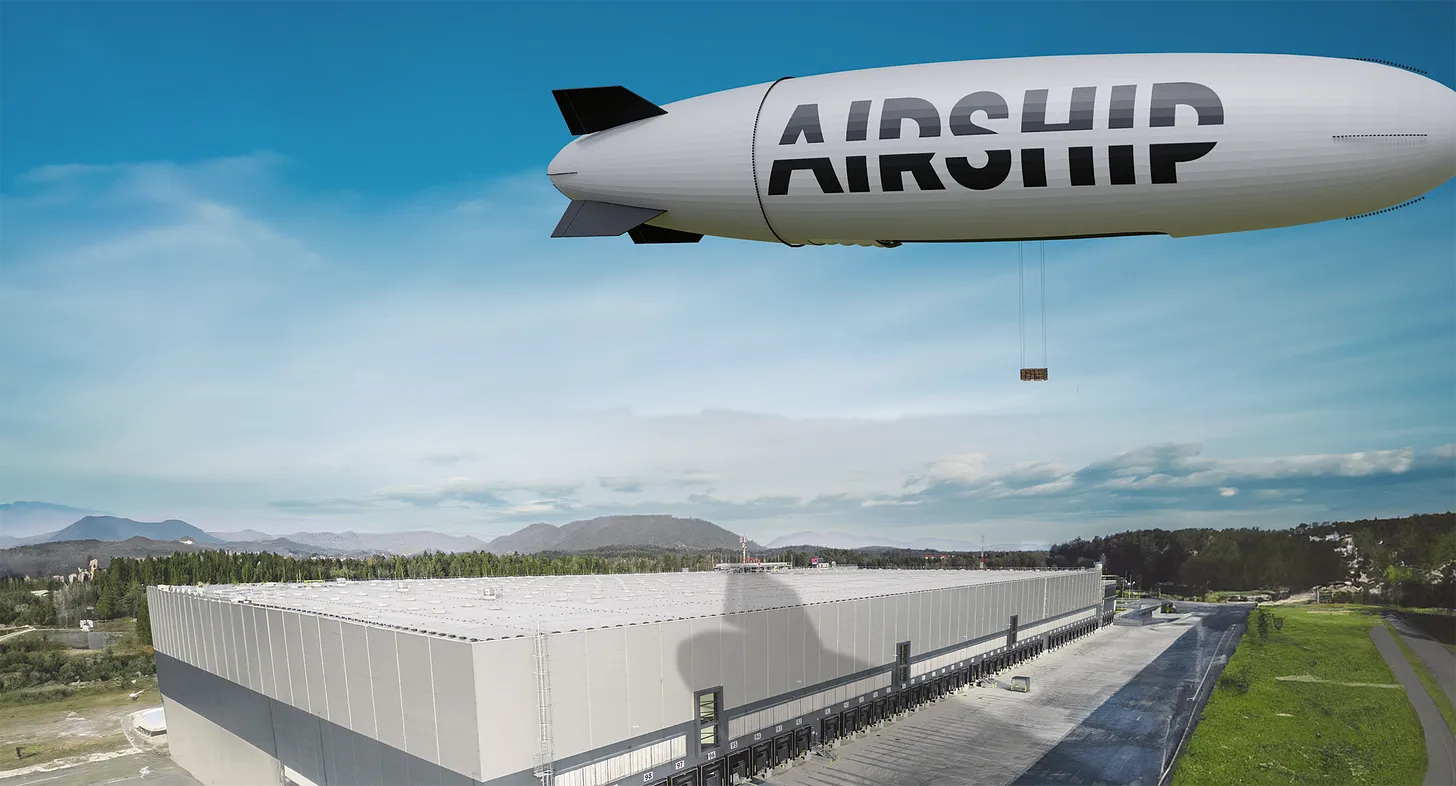
How does an airship solve any of those problems? Its still got to go through customs and such, and still go through local truck delivery
Nor is it clear how they are refuelled, or how they are immune from the same fluctuations in fuel cost as conventional cargo aircraft.
But what is clear is that you should “possibly invest” in his syndicate which is funding all this…
The need for specific geological features dramatically limits the amount of ports we can have, which seriously affects costs. If you could build a single, tiny airship point in every major city, you could save a bundle, and likely be close enough to the destination to unload directly to the customer at the port.
Yeah, and that shit isn't going to happen either for a bazillion $very_good_reasons.
Not least safety.
I mean, yeah, let's just turn up at a densely populated environment and use a winch to long-line drop a few tons of cargo.
Whilst the general public and employees are walking around the place ?
When there's overhead cabling around ?
Even in perfect weather, with no wind, no rain, its still a dumb-as-shit idea.
> For air freight service, end-to-end delivery takes a week or more, involving multiple parties: in addition to the air carrier and freight forwarder, at both the origin and destination, there is a trucking company, a warehouse, a customs broker, and an airport. Each touchpoint adds cost, delay, and the risk of theft or breakage.
> Once you account for all these delays and costs, the 4 to 5 days it takes to cross the Pacific on an airship starts to look pretty good. If you can pick up goods directly from a customer on one side and deliver them directly to a customer on the other, you can actually beat today’s air freight service on delivery time.
If an airplane takes 12 hours to cross the ocean, and it takes 2 days on both sides with customs, warehouses, trucking and the last mile delivery, then it's a total of 4.5 days. If the airship takes 5 days to take the ocean, and the same 2 days on both sides, the total is 9 days. Despite being 10 times as slow in flight, the end-to-end delivery time is only two times slower than the one for the airplane.
Whether there is any market for an "in between" mode is an open question, and it's the business case of these airships for better or worse.
To safely operate a suitably efficient (large) airship, we'd need both huge specialized docks with extremely strong mooring structures to keep wind from smashing the airship into whatever is near it, and a system (such as a 3-axis propulsion system on the airship) that is capable of counteracting wind force acting on the airship when it's near the ground or other solid objects and not docked.
Despite the many attractive advantages of airships, there's yet been anything like a good solution to this problem. There are other challenges too (what do you do when you drop off your cargo and the airship wants to shoot up into the air? Vent gas? Rapidly compress your gas?), this is just the biggest.
Not to detract from your overall point, but you do the same thing you do when burning fuel while cruising: Add ballast.
Yes, but how do you add ballast to an airship while it is underway? Simple: condense water out of the exhaust like the zeppelins did.
Citation? Would not the condenser need to burn fuel, thus lightening the ship?
Obviously that was simply a post thinking through everything hypothetically and I didn't read anything that seemed like they actually had the best solution, but at least they seem to be aware of the challenges to landing and off-loading cargo efficiently.
A cargo airship would lowering cargo would essentially be an incredibly dangerous crane. The sail area of the airship makes it far more dangerous than lowering external cargo with a helicopter.
As long as it's just one small bubble with hydrogen, you can flare it off or combine with oxygen from the air outside to reduce lift.
"If you can pick up goods directly from a customer on one side and deliver them directly to a customer on the other..."
How do you handle customs inspections and duties on imports? As TFA states, in current air freight, "there is a trucking company, a warehouse, a customs broker..." Freight has to go through the warehouse on arrival in-country so the customs inspectors can look at it and assess duties. The article seems to envision the airship dropping down directly at the destination address, which would be that nation's customs agency's worst nightmare.
Probably no different from private airfields, you have to file customs paperwork before arriving, and they can send inspectors out.
Firstly, not just any FBO is a point of entry.
Which brings us to the second point, the entire reason for designated points of entry is so that the customs officials can be on site already. As in, assigned to that FBO. Now at times specialists have to be sent out. (Think exotic or rare animals or biological/agricultural products.) But if that happens, your freight, and maybe even you, are quarantined and your freight isn't going anywhere any time soon. Believe me.
Most important, and relevant in this context is the third issue. Which is the fact that arrivals are met by customs officials and passengers and cargo are always subject to the same inspections/regulations as they are at any commercial airport.
So the original question is valid, how are they handling customs at the scale they're hoping to achieve in a fashion any faster than anyone else?
But for regular freight I doubt it. I use to fly from England to France in a single engine plane, pre Brexit, and you might think just stick stuff in the plane in an airfield in the UK, fly to a field in France drop it off, vive the single market and that. But no you have to fly to a customs airport in the UK, queue up with your passport as usual, do the same in France then fly on to your field. Probably France to Germany say would be ok. It all depends on the local laws.
I ran a tugboat business and we had all of the required paperwork to file directly with U.S. Customs.
In many cases, we moved cargo too big to be transferred at a port or terminal.
Seriously, if a Toyota supplier in Japan delivers parts daily to a factory in Ohio, do they go through regular customs or is there some other arrangement? Can they fly directly to an airfield near the factory?
What IS spent on new ships globally, and what direction does it point in?
• Approximately 900 container ships are currently being built or on order worldwide
• These have a combined capacity of 6.8 million TEU (Twenty-foot Equivalent Units)
Major shipping lines:
• Evergreen: 20 ships of 15,000 TEU capacity (delivery 2024-2025)
• OOCL: 10 vessels of 16,000 TEU capacity
• MSC: Multiple orders including 24,100 TEU ultra-large ships and smaller vessels
• CMA-CGM: 6 vessels of 15,000 TEU capacity (delivery 2025)
It points to that the business is not only doing good but that investments is being made, heavily.
On a broader scale I also wonder if we're near the top of a technological S-curve. It's worth remembering that until the industrial revolution the average pace of technological advance was extremely slow. The Mongols conquered Asia with weaponry that would have been instantly familiar to people living 2000 years earlier. Perhaps our descendants 1000 years from now will still be using refrigerators virtually identical to our own.
The other problem is the drones. For this to work you’d be shipping either regular TEU containers or the air freight equivalent (not sure what they’re called but there’s a standard shape I believe), however no drone available today can move either of those. That means new drones, new shipping form factors, or both, and those are both hard problems that you probably don’t want to face when already trying to launch a new freight modality.
One thing worth considering is going back to hydrogen as a lifting gas. Not only is it a better lifting gas than helium and much cheaper, it could be used as fuel.
An airship that burned its own lifting gas would have the curious property of getting heavier the further it traveled. This could be countered by dual-fueling it and also have engines that burned heavier-than-air fuel like kerosene or propane. The hydrogen engines could burn the lifting gas at the same rate as the kerosene engines burn the ballast-fuel.
That article mentions that the Zeppelins experimented with burning Hydrogen lift gas as fuel "without much success" but doesn't add detail.
[1] https://en.wikipedia.org/wiki/Blau_gas
[2] https://en.wikipedia.org/wiki/Buoyancy_compensator_(aviation...
Sounds perfect for a cargo situation. Add new cargo as old cargo is removed.
Would this issue even be a problem for fixed routes? If you're always taking full containers between two points, that is.
The cargo capacity of the airship shown appears to be four 20-foot containers, or 4 TEU. This is comparable to a B-747 freighter. Current new price of a B-747 freighter is about US$400 million. Trips per unit time would be less but fuel cost would be lower.
Large container ships are now in the 20,000 TEU range.
It's not clear there's much demand for faster container shipping. Container ships tend to run slower than they can, to save fuel. Maersk has some 4,000 TEU high speed container ships capable of 29 knots, but due to lack of a market and huge fuel costs, they're mothballed in a loch in Scotland.
[1] https://images.squarespace-cdn.com/content/v1/66b24fc3f58cf0...
Either that's a smaller airship than his articles describe, or it's just artist's discretion. They always talk about 500 ton cargo ships - as in "delivering 500 tons of cargo", not "500 ton total mass". And 500 tons of cargo are at minimum 25 TEU.
If they are competing with 747 freighters, those containers will almost always be "cubed out" (the container volume is full long before reaching its maximum legal weight), meaning the airship would load several times as many containers.
This is another advantage they have against air freight. Those 747s are frequently cubed out themselves, flying lighter than they would like. And you can't easily build much more volume into jet aircraft (well, you can, that's what the Airbus Beluga XL is, and apparently several air freight companies are pestering Airbus to re-open a production line for those). Airships, on the other hand, will be practicably impossible to cube out.
From their images, the airship is about 30 containers long. That's only 600 feet, shorter than the Macon or the Hindenburg. Useful lift of the Hindenburg was 232,000 kg.
Or maybe they are back? There aren't a lot of sources I could find.
This typo is perfect.
It’s not just an easy target to hit, it’s a symbolic target.
Airships were abandoned because very large objects falling out of the sky did not appeal to the public… and too many of them fell.
Extremely severe weather brings down relatively tough aircraft, but once on the ground or in hangars they are relatively safe. Airships are flying cheesepuffs.
Also the airship is simply too slow to dodge any sudden severe weather, even if they saw it coming hours before.
How many of them fell? Tried searching this up and barely any fell. Very few deaths too.
The list of Zepplins is also enlightening: https://en.wikipedia.org/wiki/List_of_Zeppelins
This list is quite comprehensive I think
The challenge is fitting the engineering required into the revenue that could be expected from those tiny markets It's tempting to characteristize turbine blade delivery as bigger than tiny, but compared to commodity transport like shuttling containers between China and the rest of the world that's still tiny.
Many countries export and import fruits from neighboring countries, because goods like fruits need a riping process and time, and storage space locally is more expensive than transporting them via container ship.
For example, almost the same fruits that are exported from Hawaii are simultaneously imported from Chile, and vice versa. Both nations grow those natively, but storage space on the ground is more expensive than shipment.
If this was part or focus of the airship freighting company, I'd see great potential there. Not even that, they wouldn't even need to transport anything, if they could invent a storage space in the air that's tax free, or maybe even offshore above the water.
Fruits picked ripe from the tree are significantly tastier and probably healthier.
like, a boat?
Above water: maybe rope-anchored airships.
What I wanted to point out is that taxes are ground based, meaning the volume that's available above the ground usually is not used because of physical limitations of buildings and construction.
You could increase that efficiency of recurring costs for land vs storage space with airships.
I remember when i had a students job, some older colleague told me he sunk a nice sum into this. Foolishly, maybe!
Reminds me of CargoLifter:
https://en.wikipedia.org/wiki/CargoLifter
The german article states that the price the Zeppelin GmbH (yes those guys) calculated, that the costs of transportation via airship, would be about 10 times as high as conventional methods.
CargoLifter used helium which is stupidly expensive, this is supposed to use hydrogen and more modern materials but i think that does not make a factor of 10.
Also "current FAA guidance disallows the use of hydrogen as a lifting gas". So good luck with that.
As you burn fuel you must either gain weight or vent gas.
Old Airships had either rain collectors (yep really) or piston engines which burned gas with a similar density to air (which digs a lot into your carrying capacity and volume).
Venting helium is way to expensive and one of the reasons CargoLifter failed, was that they never managed to get water collection running.
This article and the linked website have no idea how to solve the propulsion problem. There is some stuff about turbines going with the the old Zeppelin approach, of burning gas. Or something about solar cells, which obviously would not work because solar cells are rigid and heavy but this is supposed to be semi rigid. And you would need heavy batteries too.
Also airships sink when they get wet. And it gets warm the gas expands and it rises. You need ballast to account for that; this is large so it will do that a lot.
Don't forget how stupidly large these things are and thus how much wind is a problem. The linked website claims a predicted length of 388 and width of 78 Meters minimum!
So maneuverability is going to be a large problem, you can overcome this by adding lots of propellers everywhere but that add weight and uses fuel.
Now imagine a 388x78 m giant filled with hydrogen, with hordes of engines everywhere, dropping of a bunch of containers at some delivery center...
Since wind might be coming from every direction you need a landing circle (!) of roughly a km in diameter. This is why old Zeppelins landed at large (!) airstrips or sometimes on masts attached to skyscrapers.
Then cargo gets loaded off and ballast of the same weight must be moved onto the ship.
That ballast has to go somewhere, so the ship either needs water tanks (again loss of carrying capacity). Or the landing strip has some attachable ballast (how do you transport that back and forth?).
If you have the infrastructure to accommodate this thing you can be reached by truck or rail, which is cheaper, not depended on weather and so on... And weirdly enough you can be reached by cargo aircraft which is a solved problem!
Door to door delivery was exactly what CargoLifter was supposed to do. But it was basically a more expensive and clunky helicopter. Thus it failed.
Can't you just compress lifting gas to reduce it's volume?
I looked up some compressor manufacturers. And got roughly the following:
Large helium compressors, which compress like 2000 liters of helium per minute to 200bar, weight around 2 tons and consume power in the order of 60kw.
Not sure if 2000 liters per minute is the right amount but you get the idea.
So even if you can fit that thing on your airship, the 60kw power plant and all its accompanying fuel does not fit.
And remember you are doing this because of fuel usage the first place! So you would be using fuel to compress gas which you have to compress because you are using fuel...
Usually gasses like this are compressed (and liquified) via something like the Linde process:
https://en.wikipedia.org/wiki/Hampson%E2%80%93Linde_cycle
That is industrial scale and does not go onto anything that moves...
And you would need to store your compressed gasses somewhere too.
All of this is super complex, heavy, requires stupid amounts of energy and thus is way to costly to do on something that flies.
But compressing the gas takes time. If you intend to leave the ship parked there until you finish this, you will need a lot more of space.
1) The economic model is unproven so even initial costs will be far too high to pay of debt incurred to manufacture, market, and maintain and they're not competitive with extant mass-market alternatives on cost & time out-of-the-gate with no clear pathway to even being niche competitive, let alone having mass-market adoption. And no, the Airship cruise industry is never going to take-off (heh) because there wouldn't be any extant "ports of call" (unlike with sea-going cruise ships) and no way to economically stimulate their construction.
2) Inclement weather mitigations (aside from docking, re-routing (delaying), or rescheduling (also delaying)) are virtually non-existent so there's a much higher trip variance which eats into fuel, time, labor, and ultimately a far higher cost variance which (as a 2nd order effect) leads to an overall MUCH higher cost to operate ANY route compared to conventional cargo or mixed-mode transportation. As a historic model, look at the air cargo transport costs in the transition from mandated multi-stop piston engine refueling and in-weather flying in the late 1930s to single-hop above-the-weather flying in the gas turbine "jet age" of the late 1940s. It's not JUST that jets were much faster, they were also far more predictable to service routes AND had far lower maintenance costs. A lower, slower, and less predictable airship with higher maintenance costs and, at best, a handful of percentage points off of the dollars/mile/ton figure with a higher initial cost outlay doesn't merit investment.
3) Safety is still a huge issue for any airship attempting station-keeping or full-authority-navigation close to any ground-effect altitude which is, unfortunately, also the airspace where any accident is likely to cause the most collateral damage. No other form of transport has this problem and, with current tech, would seem insolvable without turning the airship into a poorly performing version of a plane or rotor-craft.
>The AD500 was "a new-generation airship making use of advanced materials and technology." It was 164 feet (50 m) long and contained 181,200 cubic feet (5,130 m3) of helium.
>Unfortunately, on 8 March 1979, the month-old AD500 was seriously damaged when the nosecone failed while the ship was moored in high winds.
And various other things not really working till they went bust in 1990. https://en.wikipedia.org/wiki/Airship_Industries
I wonder if Airship Industries (2024) will do any better?
Their ships don't looks very different - old co https://www.airliners.net/photo/Airship-Industries/Airship-I...
New co https://substackcdn.com/image/fetch/w_1456,c_limit,f_webp,q_...
"Well the front's not supposed to fall off, for a start."
I didn't understand this part, specifically how you could beat today's air freight. Why wouldn't airships be subject to the same (ahem) overhead at either end?
Competitive enough on speed while being less expensive makes sense, though.
If (big regulatory issues here) you can deliver directly from one site to another, you eliminate trucking goods to the source airport & from the destination airport. A 3 hour dirigible flight is slower than a 45 minute cargo plane flight, but buffering at a warehouse to loading / unload a truck (twice) could easily add 2-3 days latency.
You're right that there are big regulatory issues still.
They currently are showing the world what cargo airships can do (ie nothing). The world just perpetually doesn't want to listen.
>Lighter Than Air, a company owned by Google's co-founder, begins testing Pathfinder 1, a next-generation airship that could revolutionize air travel, cargo transport, and the movement of humanitarian aid.
are doing with their ship? I think it's built and sitting around. (https://www.domusweb.it/en/sustainable-cities/gallery/2023/1...)
What is the target operating speed considering cargo weight?
How much cargo can such an airship carry at its target operating speed such that this is more efficient than air-freight and land-freight?
Airship Industries is designing its vehicle to dominate transoceanic air freight. It checks all the right boxes. It shortens end-to-end freight delivery time. It lowers freight handling costs, delays, and breakage. It’s highly profitable on a unit basis. It lowers fuel burn and carbon emissions by 75 percent without any sustainable fuel breakthroughs.
How many shipping container can a single airship carry?
If you're want to use your cargo airship for point to point transport, you'll need ballast at the target point so that the buoyancy of the airship doesn’t change too much. CargoLifter back then used water. Their prototype could lift an armoured vehicle and lower it – while maintaining buoyancy through pumping water with an high speed pump. They planned cargo services for very remote points.
But if you’ll can transport water and a high speed pump and a mobile mooring tower to the very remote target, chances are, you’ll already can transport the cargo itself to that target.
Today the CargoLifter hangar is the biggest indoor water park.
According to AI, there have been 5 historical attempts to make airships work before the modern resurgence:
The early experimental phase (1780s–1850s), The pioneering era (1850s–1900s), The golden age (1900s–1930s), A post-Hindenburg decline (1930s), Cold War military uses (1940s–1970s), and A modern resurgence (1990s–present).
"When Zeppelins Ruled The Earth" (6m47s)
https://www.youtube.com/watch?v=omobajJmyIU&ab_channel=Simon...
Someone long ago did a napkin calculation for me showing a hard vacuum airship made of reinforced concrete can work if you make it big enough. What are a few miles on the cosmic scale?
What has changed?
Honestly, it sounds like a cool thing to work on, but this article is not convincing about the potential market. I can easily imagine former SpaceX and Hyperloop engineers thinking a cool technology will simply find a market, but that's not really what Elon Musk did with SpaceX.
A team of what??