In just the two years since then, prices on batteries and panels have dropped 25% or more, and solar power per square foot at a good price point has gone up significantly (400W monocrystalline panels can be gotten for $200, in the same form factor as the 200W panels I had been budgeting for). I've now lowered my budget to $4000 for the same setup I was planning to spend $6000 on two years ago, and with 400W panels, I no longer need to upgrade to a larger RV to begin the project.
This summer is almost over, so I'm going to wait until spring to start assembling my system in earnest. Anecdotally, this is a game-changer for me. I'm looking toward year-round full-timing starting next summer, because I can now afford the power I need and don't need a larger RV as soon as I thought I would.
I intend to buy undeveloped land far from civilization in the next few years, and I'm now confident that I can DIY a whole-house solar and battery setup so cheaply that access to mains power won't be a factor in deciding where I settle. Even with seasonal variation in power production, I'll manage just fine, and the system will pay for itself in well under five years. In fact it'll pay for itself instantly if you discount the five-figure cost I would otherwise have had to pay for running a new mains power line far into the woods. And by the time I pick some land to settle on, I'll already have enough solar on my RV that I won't even need to augment the system initially; I'll be able to power a small house in a temperate climate directly off the RV itself, while I build a larger solar array (likely ground-mounted to avoid regulations and insurance complications related to roof-mounted setups).
I know my situation is unusual, but the fact that any of this is possible for well under $10k is a huge change from even a decade ago.
I did the full time RV bit in a class A. Hated it. Too small to live in, too big to travel in. Hate that black tank. Had to leave great camping spots once a week to dump and get more water, or hook up to some sort of developed campgrounds. Sucked. Regret not going for a small schoolie to travel in, large house on 5 acres to live in. That's the new plan, anyway. Best of luck.
It's pretty hard to do worse than "the very small amount of water is being sucked dry because there are no regulations around water use." Once the water table compacts, it never comes back...
> Rooftop water collection for water.
It's one of the dries parts of the country. Good fucking luck.
A growing number of people in AZ and NV have to have water trucked in, and that is insanely expensive.
The worst part about any long-term RV situation is the tanks. Full hookup is great, but generally only existed at the kind of campgrounds I try to avoid, where everyone is crammed together. I spent most of my time at state park campgrounds, which usually have decently-large sites, but rarely have sewer hookups (even when they do have water and electric). I got a Rhino tote to empty my tanks without moving the trailer. That helped a lot. It's still both tedious and gross, but it's a lot less time and hassle than moving the trailer. That's only really viable if there's a dump station in the campground, though. I've used it while boondocking, putting the tank in the bed of my pickup, but that sucks a million ways.
I'll probably get sick of full-timing pretty quickly. I'm already sick of it this summer. The past two summers, I wasn't working, and it was a lot less stressful.
A quick google image search shows a very hot Arizona.
As someone who enjoys following a lot of youtube self-builders around the world I get the impression that most channels I follow have to thread their way through some pretty convoluted and not-self-build nor budget-friendly rules :(
Do you know of any other places in the US that have similar easy-to-self-build but are more wooded and temperate?
What were you a fan of instead?
I do know that there are water condensation machines that could be fed with solar power, but at that point will likely be too expensive for a single family.
I'm always intrigued by this notion, I know plenty of Americans have this kind of plan, but it's never quite as remote as they think, because, y'know you're still in America somewhere.
Unless you're thinking of somewhere in northern Canada.
I'd love to know where is considered 'far from civilization' on the continental US.
Not to mention Slab City: https://en.wikipedia.org/wiki/Slab_City,_California
Infrastructure-wise, roads come before water or electricity, and so plenty of the United States has a road but no power or water. This can even be standard for those who are near civilization.
And like I say, if you want peace and quiet you don't have to put your life at risk by going out of range of water, power, roads, phone coverage etc.
Ignore me, I'm sure I just don't get it.
There are many interpretations and levels of remoteness.
In my case, I want to be away from the sights and sounds and crowds of anything that would be considered urban or suburban. My prime criteria is that I don't want to see another person unless I choose to. I don't want to see a road with cars on it, I don't want to see another house or any other man-made structure that isn't mine. Ideally I don't want to hear anyone else either, but I accept that I may hear things in the distance.
I don't want to be a complete hermit, and I'm not a survivalist looking to be 100% self-sufficient. I want a small-to-midsized town about 30-60 minutes away. Something with a grocery store, gas station, and a post office or other place to receive deliveries. I don't want to be more than an hour away from doctors' offices or a hospital or urgent care. I don't want to be trapped by snow for weeks at a time.
Saying "far from civilization" was a stretch. What I really mean is I don't want to have people all around me. And I don't want to be anywhere near cities and suburban sprawl. I don't want neighbors in any meaningful sense.
Places I'm considering are Maine, Montana, northern Wisconsin, Upper Peninsula Michigan. I would absolutely consider parts of Canada, particularly northern BC. I don't have an easy path to Canadian citizenship, though. Before my Canadian girlfriend passed away last year, we had been planning to look for a secluded lakeside cabin or undeveloped land in BC.
My requirements are dense forest (desert/plains states are right out) and water (lake or canoeable river) on the property itself. I can live with other people using the water, so long as it's not motorboats and a party scene.
Canada is vast and in some places very rugged. "Remote" and "northern" are not related terms. Just look at BC on google maps. Look at the bit of vancouver island that is south of the US border. That is some very remote terrain, but is no way northern. Then scan up into the BC coast. Just a few hundred miles from downtown Vancouver and not a single road to be found. Or start at Whistler and pan west. Hundred of miles of mountains with nothing more than the occasional logging road.
Anywhere not colored
For someone it could be defined as minimal human interaction, for others it could be a function of distance from the nearest urban/ suburban center. For most, it would be some combination of these two.
I've backpacked to some very remote places around the world, but it's hard to beat the USA (western half), Canada, Russia (east of Moscow) and Australia (anywhere not on the coast).
I’d like more land still - I grew up on 60 acres - but I still basically have complete privacy.
Go to Wyoming or Montana. You get a 2 or 3 hr drive outside major cities and you might be the only person around for 10+ miles.
https://www.bbc.com/news/world-us-canada-42104894
With more than 14,000 of them, it's not possible to be more than 115 or so miles from one:
(I'm speaking about large class A RVs like an apartment with washer/dryer etc...)
But as solar becomes more prevalent, I don't see why they don't design RVs more around solar.
It has only been recently that I've seen "all electric" type RVs. Before that, most RVs were hybrid propane/electric or diesel/electric, for example gas stoves, dual propane/electric refrigerators, dual propane/diesel + electric heating and propane or diesel generators.
A future RV could have huge batteries for driving, and then use those batteries for appliances, air conditioning/heat pump and other on-board power. Then add increased solar by not only rooftop solar, but maybe fold-out solar awnings. (it could also charge via EV chargers, or 220 at a campsite)
An RV like this would be modern, comfortable and let you go anywhere.
Part of the reason solar is still a fringe thing for RVs is due to the costs up till now. Another big reason has been solar panel energy density; there simply wasn't enough room on the roof for the thousands of watts you need to generate for true full-time off-grid living with all the creature comforts (most notably air conditioning). Affordable, compact DC-powered refrigerators are still new (but are becoming standard items). Battery cost used to be prohibitive, and battery weight is still a problem. The 1200Ah I'm targeting (at minimum) is going to weigh a few hundred pounds.
If you want a residential-sized fridge, washer/dryer, and air conditioning that you can use 24/7, you need more like 3200W of solar and 2400Ah of battery. The larger the RV, the more expensive it is to cool. RVs have crap insulation, and most RVs are used in hotter southern areas. True self-sufficient electric and solar with no behavioral/comfort sacrifice still requires a lot of space and costs a lot.
The market is headed toward more solar, but the kind of setup you're talking about (and that I'm building for myself) is still quite expensive. And it's a huge cost for people that don't typically need it; the vast majority of people full-timing in RVs are content to do so at a sardine-packed RV park with full hookups. The market isn't going to bear the cost of massive solar installations as standard equipment.
Keep in mind - the dollar is down ~10-15% in that time frame, so in real terms, the previous cost might have been >$6600 in today's dollars vs ~$4000 or a >40% reduction.
The cost of electricity is up ~5.5% compared to last year: https://www.bls.gov/regions/midwest/data/averageenergyprices...
I wanted 2.5 days of power, not including AC, as I'd run the Jenny when needing AC
Solar is (was) coming at a future date with something in the 1200 watt range.
What I found was that we were boondocking roughly 8 nights a year, needing about 2 hours of generator each day to top off the batteries. (FWIW, there's a LOT of power to a gallon of gas) I can charge at home before we leave, exercising the generator is good, because I can rely on it when I need it (where if we right or over-size the solar, you might go a very long time before really needing the generator.
So, I'd like solar (it's quiet), but the $2500 or so to install it probably doesn't have a reasonable ROI. And I really like having AC the few days it's needed away from shorepower.
It's wild, I was able to power an AC brushless motor as well as a corded (technically?) drill. I could have run the drill for an hour at full power.
All around it just improves so fast I'm starting to feel like I do about computers -- the longer I continue to be satisfied with my current setup, the better the next one will be!
i do have one quibble, though, and it's a big one. in the last two years, prices on mainstream solar panels (monocrystalline with warranty) have fallen from €0.25 per peak watt to €0.12 per peak watt; low-cost panels have fallen from €0.17 per peak watt to €0.07 per peak watt.† technically that is 'fallen by 25% or more' because it's fallen by almost 60%. 2400 watts of solar should cost you 290 us dollars plus retail markup, not 1200 dollars. if you're paying 1200 dollars, you're being swindled! https://news.ycombinator.com/item?id=41394506 goes into details on how the swindle works
______
† https://www.solarserver.de/photovoltaik-preis-pv-modul-preis...
Like all things, the raw material cost is trivial. There are the tariffs you mention (I just skimmed your link, and don't speak German), but there's also economy of scale, packaging, logistics, etc. I'm sure I could get 400W panels for as little as $100/ea if I went to the factory myself and bought hundreds of them. Maybe even cheaper. It's not really fair to compare consumer one-off costs to industrial/commercial-scale installation costs.
I had planned to start by putting 4x200W panels on the roof, until I get a large 5th wheel. Now I'm going to put 4-6x 400W on the current trailer for next summer. The price and size of 400W panels dropped enough to make that viable.
I'm generally too lazy to do a writeup/photos of my projects, but I might when I get it installed. There are a lot of writeups out there already though. People are squeezing lots of solar onto vams and small RVs these days.
A lot of people like Will Prowse on YouTube[1]. I've watched a few of his battery test videos and it's influenced what I'll end up buying. I haven't watched any of his solar videos.
I've been lurking in r/SolarDIY[2] as well.
I'm buying a bunch of Victron[3] gear. They have forums, HOWTOs, some videos, plus the various product sheets. They have some circuit diagrams too.
The rest is Google and reading blog posts, DIY articles, price comparisons, etc. There are books, but I haven't read any.
I've got basic electronics chops and tinker with things a bit. I'm by no means an expert.
[1]: https://www.youtube.com/@WillProwse [2]: https://www.reddit.com/r/SolarDIY/ [3]: https://www.victronenergy.com/
I don't mean to straw-man your argument, I was merely thinking that the 'actual' drop must be bigger, considering the inflation in most countries (in some EU countries it approached or hit 10%), so under normal circumstances and/or in the future the drop would/will be at 30%-35% if the same rate continues (prices getting lower - inflation getting lower)
If energy was 10 times cheaper than currently and still available (no shortage) then we would automate more tasks and increase the global productivity. We could mine more, build more, to train/run more LLMs.
GDP is tied to energy price and availability. It is likely the main reason why US enjoyed a growing economy thanks to its free oil reserves (and the reason why Texas alone is the 8th economy in the world). Now one could argue that after pumping oil for a century now, it might not be as cheap or plentiful to extract in the future, and we better be prepared for it.
It is all about energy. No energy, and we will reduce to human/manual or animal (bring back the horses!) labor. Productivity will decrease significantly.
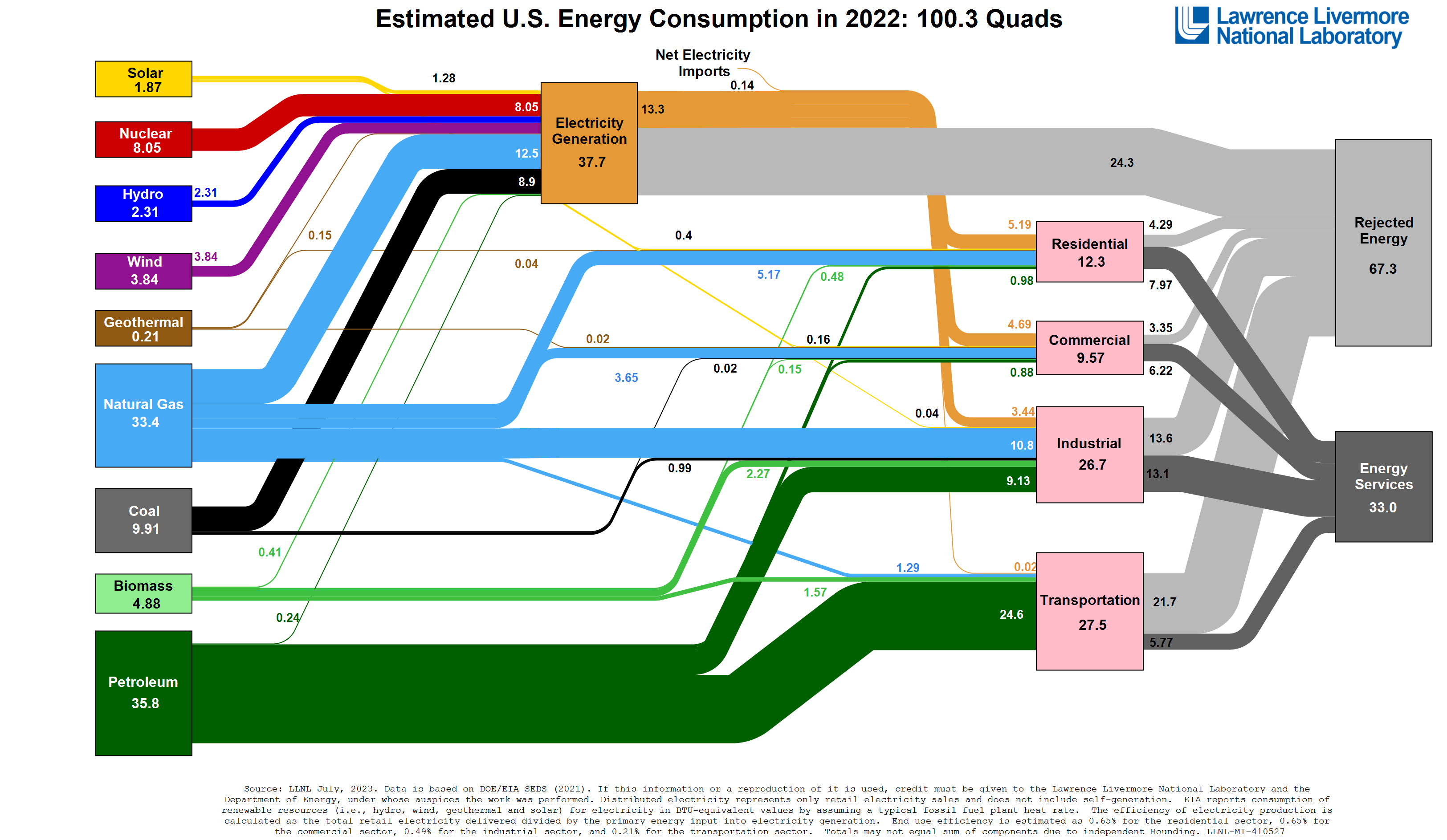
One issue I have with the paper, is that it equates energy and electricity. My favorite chart about US energy: https://flowcharts.llnl.gov/sites/flowcharts/files/2023-10/U...
shows that in 2022, electricity was just 13.3 Quads of the 76.07 Quads of the energy consumed in US by residential, commercial, industrial and transportation. So unless US "electrify" the whole economy having more electricity would only help a small part of the economy.
Sure.
> To increase productivity, we need more machines,
That is just one way to increase productivity. You can also make more efficient machines, come up with more efficient production processes, find alternatives to existing products that are more useful for a given task per quantity, and similar kinds of concepts. This is the point GP was making (there are more ways production changes than increasing energy used), not that energy is completely unrelated to production as a whole.
A graph of major economies percentage of electricity in final energy:
https://preview.redd.it/china-is-electrifying-far-faster-tha...
Many physical things take pretty fixed amounts of energy. Eg heating a liter of water.
for other economic activities, such as solar panel production, aluminum production, and neural network training, energy is a limiting input. reducing the cost of energy will result in more gdp in those sectors
Why? They are correlated and so are reasonable metric to gauge progress when starting from a subsistence economy (as all economies in the world began). At some point, this may be less true when you hit a energy generation ceiling and you start 'optimizing' and trying to do more with the same amount .. but again, we're not there yet so it's a good metric today, and especially for developing economies.
Put another way, you show me GDP per capita or per capita Energy use and I can get a reasonable ballpark for the other as well as a measure for the wealth of that nation.
The author asserts that we should see 5x GDP/c if we had 5x power usage per person and their own graph shows that that's not the case because it's a flawed assumption that ignores increases in efficiency and transitions away from energy intensive manufacturing to service based.
The best evidence for that is that the GDP/c didn't fall off when we fell off the HA curve. In fact I took the GDP per capita and Energy consumption per capita data from world data bank and the ratio between the per capita GDP vs the per capita energy consumption has been going up steadily since we stopped following the HA curve.
Between 1960 and 1970 the ratio between GDP and Energy Consumption per capita was essentially static at .74 then after 1970 the ratio begins to increase showing we're producing more per unit of consumed energy at a nearly linear rate. By 2014 which is the last year they had the Electric power per capita data the ratio was all the way up to 4.2. Eyeballing it the relationship is almost perfectly linear each year we get a little better at producing GDP for each kWh we consume.
I even redid the calculation based on raw energy use in kg oil equivalents and it gets even more drastic. 1960 to 1970 it goes from .53 to .69 GDP/kg oil equivalent [0]. Then after 1970 the rate increases quite distinctly going from .69 to 1.58 in 1980, 3.11 in 1990, 4.5 in 2000, and 6.79 in 2010.
It's pretty clear from the data that we're getting better at producing things with the same amount of energy. It's an assumption that simply making more power would increase the amount of things made.
Electricity use per capita: https://data.worldbank.org/indicator/EG.USE.ELEC.KH.PC?locat...
Energy use per capita in Kg oil equivalents: https://data.worldbank.org/indicator/EG.USE.PCAP.KG.OE?locat...
GDP per capita in current USD: https://data.worldbank.org/indicator/NY.GDP.PCAP.CD?location...
[0] nice.
YUP. Of course there is a strong correlation between energy use and GDP growth; it takes more energy to produce more stuff.
But ultimately, what produces more stuff is harder to measure. To light the factories, more energy used to correlate with more light, until we swap out the incandescent/halogen lighting sources for LEDs. Then, we get more light for something like 16% of the energy usage. Or, getting to the stage of "lights-out" automation, and the same production for zero lighting energy. Same for more efficient motors, swapping ovens for inductive heating, more efficient processes, etc.
Seems that measuring GPD growth by energy consumption is like Bill Gates' famous example of saying that "measuring software progress by lines of code is like measuring progress in aircraft by the weight of the planes". Obviously, in specific cases, all things being equal, more is more, but in reality, fewer LOC and lighter airplanes generally produce more results.
Energy consumption is also about using that stuff. And in rich countries like the USA, a lot of energy goes to using things or just moving people. So it's possible to build more and use less energy, even if you don't reduce the energy cost of building things. They can simply become more efficient to use and move.
In USA, 30% is just homes and commercial sector. 40% is transportation. 30% is "industry". By a sort-of inverse-amdahl's law, it's possible to get lower energy use with more throughput even if we don't make "industry" more efficient.
> Yet the amount of electricity we consume for light globally is roughly the same today as it was in 2010. That’s partly because of population and economic growth in the developing world. But another big reason is there on the Las Vegas Strip: Instead of merely replacing our existing bulbs with LED alternatives, we have come up with ever more extravagant uses for these ever-cheaper lights
NYT: The Paradox Holding Back the Clean Energy Revolution
this is nonsense. lighting hasn't been a significant fraction of the energy usage of factories since they switched from being lighted by fireplaces to gaslighting. not in 02024, not in 01974, not in 01924, not in 01874
> Seems that measuring [gdp] growth by energy consumption is like Bill Gates' famous example
it's true that higher efficiency is better, of course, but your comment embeds the false assumption that higher energy efficiency reduces energy use. in fact, higher energy efficiency usually increases energy use, because it increases the scope of things to which marketed energy can be economically applied more than it reduces the use of marketed energy for things it was already being used for. (this is the well-known jevons paradox mentioned in https://news.ycombinator.com/item?id=41392248). so, even today, it turns out that the countries with the lowest gdp and lowest energy use also have the lowest energy efficiency
similarly, using high-level languages reduces the number of lines of code to implement some given functionality; but you would be completely mistaken if you used that fact to predict that the vast majority of programmers spend their time writing assembly language instead of python because python requires one twentieth of the code to do whatever. many things are done with python not just because companies writing python outcompete companies writing assembly, but also because programs that would be unprofitable to write in assembly language become profitable to write when you can write them in high-level languages!
Oh the irony.
https://wimflyc.blogspot.com/2021/01/the-henry-adams-curve-c...
Henry Adams points out that over 60 years you got 3-4x more power from a ton of coal. That combined with the extra coal dug up, he claims, doubled usable energy every ten years.
But then the modern graph simply shows the coal energy, with (as far as I can tell) no attempt to account for the extra efficiency, even though the modern author of the graph makes explicit reference to the increasing efficiency of steam engines.
This is possibly why energy use has flattened while GDP clips along at its normal exponential curve - we're also more efficient.
I found the following comment about Smil:
"There is a way how to evaluate the quality of prophets, seers and visionaries. Find their 5,10,15 years old predictions. I own the Smil’s book: Energy Myths and Realities: Bringing Science to the Energy Policy Debate (2010). So have a look how good prophet he was 10 years in advance and focus on photovoltaics (I own Czech translation of the book, so I need to re-translate his text back to English, I hope I will not skew his ideas too much):
* To get 1 PWh/year of electricity you need to install about 450 GW worth of solar panels. You need dozens of years to acomplish such task. Reality check: 3 years in current speed, in the future probably faster.
* The cost of PV panels fell from 5 USD/W in 2000 to 4.5 USD/W in 2009. He don’t see much perspective of price plummeting as predicted f.e. by Al Gore (who cited the learning curve, Smil counted with 0.05 USD/W in 2020) or by PV industry (1.5 USD/W in 2020). Smil predicted that PV panels would be 25% cheaper in 2020 and 50% in 2030. Reality check: Current price of PV panels is ~0.2 W/USD. While Smil wrote the book manufacturers finally scaled their production of polysilicone and PV cells to cover the demand. Competition among them set the cost of PV panel on the freefall trajectory. PV panels cost less than he predicted for 2030 in 2011.
How credible are such visionaries?"
I will add that in 2023, 447 GW of PV was installed globally. So, we're at the point where Smil's "dozens of years" is being done each and every year.
We want things that are the same but less intense, or that are much better at a fractional increase in input.
And we really need it if we want a planet worth living on fifty years from now. So to ignore this desire is dangerous.
I did the rough math [0] and we get 10x as much GDP out of each kg oil equivalent used as we did in the 1970s when the article bemoans us falling off the HA curve. That was one of my core problems with their point, the amount of energy used is not directly tied to the economic value of the output.
Perhaps this comes down to a quality of life vs GDP per capita not being identical. While I could use more energy to consume more, I don't have a very strong desire to go much above my current level of consumption.
But outside of the wealthy there is still huge latent demand for energy and what comes with it.
I was wondering if there was any way to bring 10.000 Einsteins online. Einsteins who know all about physics, programming, math and so on, cranking up ideas days and night. If the Einsteins never sleep, that would be ideal.
Yes, this was a central simplifying fallacy in the article for me too.
Plenty of phenomena follow a logistic curve [1] — which starts out exponential but then flattens out when it reaches constraints or fills a niche or fully satisfies a need or something.
The initial exponential growth may have been a period where economic productivity was constrained in a major by energy availability. We still have some energy constraints, but they seem to be secondary — and in many areas energy requirements have fallen, as others have pointed out in this discussion. It's too complicated to simply flatten, but modern energy use does seem to broadly resemble a logistic curve.
---
so, with the advent of innovations that dramatically drop the cost of energy, we should expect to see energy use grow faster than gdp. that's decoupling but in the opposite direction from the decoupling you're talking about, which has been driven by the 01973–02023 energy crisis
Put another way, instead of producing the products we consume, we offshore production (and the associated energy consumption)
It's always a little hard to read logarithmic values other than those explicitly labelled but it looks like up to a 5-7x difference in energy consumption can have basically no effect on the GDP per capita!
If we would have more energy we would get much richer and not more poor like right now.
German electricity is expensive because gas is expensive in Germany. Electricity will be expensive in Germany until Germany completely stops using gas shipped in via container ship.
Perhaps author is nodding towards replacing fossil fuels with electricity.
Decarbonizing steel uses a lot more energy. Ditto cement, plastics, fertilizers, HVAC, etc.
Anyone care to guess how much more energy our glorious renewable energy future perfect economy will require? 4x? 6x?
Fossil fuels waste most of their energy as heat. Gasoline cars are ~30% efficient, EV's are ~90%.
And heat pumps are often 200-500% efficient, unlike fossil fuel furnaces which cap out around 95%.
Transportation and heating use far more fuel than industrial uses.
unless the humans die out as yet another sad single-planet species
A classic example here is cars. A typical Tesla would have about 65kwh of usable battery. A gallon of fuel represents about 31 kwh. So, a 1 to 1 replacement would mean that Tesla would have about 8x less range than it actually has compared to a car with e.g. a 15 gallon tank and. pretty decent mileage of 16 miles to the gallon. Reason: a Tesla manages about 4-5 miles per kwh which amounts to about 250-300 miles range. Let's low ball that to 250. Meaning, you can drive about 8 cars more per kwh of electricity than per kwh of ICE car. Switching all road traffic to electric would mean we actually save a lot of energy. Maybe not 8x but it's going to be substantially less than what we currently consume in fuel for road traffic.
People underestimate how quickly this is going. Most commercial fleets are switching sooner rather than later. They have to, the cost savings are to large to ignore. That's most of the traffic on roads and it's not going to take decades.
Heating and cooling with heat pumps is the similar. A good heat pump that is installed properly should deliver a COP of about 4. Meaning you get 4 units of heat (or cooling) for every kwh you put in. A gas heater has a COP of slightly below 1. 1 is it's theoretical maximum. So switching industrial and domestic heating/cooling over to heat pumps is going to deliver some pretty significant savings as well. Mostly industries have barely scratched the surface on this topic. Industrial heating is mostly still based on burning gas or other fossil fuels. That's because gas used to be cheap and electricity used to be expensive.
Now that that cost has flipped around, companies are slow to adapt. But eventually some companies will start figuring this out and once they do it might save them a lot of money and make them a lot more competitive. And all that is before you consider using cheap off peak electricity when wholesale energy prices occasionally go negative!
4x-5x overall more electricity usage sounds about right. I expect it to be more because as energy keeps on getting cheaper we'll keep on finding new uses for it as energy prices keep on dropping. Assuming everything stays the same is not a great way to make predictions about the future. Things rarely do. But it's not that unreasonable to assume a 5x increase to happen over the next few decades. But it will cost us a lot less than our current energy spending. If we keep on going at the pace we are currently going we'll get there easily. And there are good reasons to expect things to speed up actually.
Solar cost will keep on shrinking. Especially in the US there is a lot of potential for improvements. That's because cost is currently inflated due to a combination of import tariffs and asinine regulations that mean installation cost is insanely high compared to other countries. Some of that regulation is courtesy of fossil fuel companies lobbying for this. But both are fixable problems. And more importantly, both are non technical problems. Meaning that international competition between countries (and domestically between states) will force the issue ultimately.
There are unfortunate side effects to this, even besides the attacks on net metering that have cut financial returns for existing solar customers. Distributed generation is more resilient. With a battery, you can keep your electricity during a power outage. Outages themselves are more isolated - with a VPP individual neighborhoods could keep power, while if a transmission line to a major solar farm goes down, a whole city could lose power. Large solar farms would be huge targets for warfare or sabotage, and wouldn't last very long at all. Transmission lines to them are vulnerable to natural disasters. Economically, large utilities have more market power and can capture their regulators, leading to higher prices and poor service for consumers.
But the economic benefits of scale make it harder to justify putting panels on each individual home, when the same generation capacity can be built much cheaper at a solar farm.
The "attacks on net metering" are merely acknowledging that the proportion of renewables on the grid is high enough that balancing grid supply and demand is becoming an issue. I'm a big proponent of rooftop solar, but the reality is that 1:1 net metering just doesn't make sense once there's a critical mass of solar installed (the duck curve problem). This is not a problem unique to California or the US. If you look at other places with high solar adoption (Australia, EU), you'll find even stricter policies like negative feed-in tariffs: the utility will charge you for exporting solar to the grid.
Battery storage is a solution to that problem, but that's where prices are still too high. I'm actually surprised that battery storage is not mentioned in the article, because that's a critical component of allowing solar/wind to grow further.
The other major problem is the grid is not setup at all for consumers to also be generators. At least in the UK it is rare/not possible for the DNO to send power back from a neighbourhood to the grid (at least not without a total remodel of the local grid infrastructure).
So we are now hitting problems where solar is not allowed to be connected to the DNO if you have streets with a lot of solar on, because at some point the generation from the houses on the areas local transmission outstrips the demand in summer, and in that case you have too much power and nowhere for it to go (the excess cannot be sent back to the high voltage grid). The DNO cannot turn off individual solar generators easily (and even if they could, do they trust a load of chinese inverters to work reliably remotely?)
I think the key problem with solar/renewables is not undersupply in winter in northern climates (though that is a big one for true net zero) it is oversupply in the summer. It's already causing massive issues in Europe with long spells of negative pricing. Interconnectors don't really help with this because when it is sunny (and potentially windy) in one place in Europe it tends to be similar elsewhere, so everyone has too much power.
This is before the UK adds another huge amount of solar and wind in pipeline by 2030.
Note this comment only applies to northern climates. It's far less of an issue further south because AC load tends to follow solar production much more, but that is far less common in the UK.
Also, here the northern latitude helps, in Germany people start putting solar panels on walls and fences. There is plenty of cheap space and the efficiency isn't too bad considering the cheap panel costs.
Doesn't matter if it doesn't bring down the cost of electricity. For example in california PG&E will still charge a substantial "delivery fee".
Thankfully, the impetus for residential roof solar was always more ideological than practical. There's plenty, PLENTY, of empty unused land within a 95% transmission efficiency (hundreds or even thousands of kilometers depending on tech) of the end user, for all non-island cases.
Utility-scale solar installations also make a lot of sense, but around here transmission capacity for that is still a massive issue. You can install more transmission capacity, but it's not cheap.
As soon as we had it, and I looked at the tiering, time-of-use, etc, and I realized it's all an arbitrage game. I'm selling my roof space and fixed asset back to the power company, and buying power from them.
https://www.youtube.com/watch?v=5AVO1IyfA9M
edit: I see others have linked similar videos, all good sources on this topic.
But they already exist and are pretty popular in Germany to put on your balcony.
But if you put the panels basically anywhere else it becomes a lot more viable. Some houses come with a plug to connect your generator, you can do something similar to plug in your inverter. Then you can later decide to put up a solar fence or put solar panels on the balcony or whatever strikes your fancy
https://electrek.co/2022/12/12/texas-solar-farm-flat-on-the-...
I think the efficiency figures are exaggerated, but the fact remains that such an installation requires less labour.
The aluminium frame was 25%, labor 30% and putting up the scaffold 20%.
I hope thin film solar panels integrated in the actual roof material will become more common going forward as it removes the need for an aluminium frame, you get a new fresh roof, it's lighter, no holes are drilled in the roof etc.
But everything else around solar such as inverters, cables, framing, labor, battery storage is where a large part of the cost now. Innovations in those areas will probably yield better cost reductions than the panels will nowadays. That is just wild to see!
It seems australia removed a lot of roadblocks and solar is very popular.
At this point solar+batteries is a cheaper option in almost all locations except perhaps places with low levels of sunlight combined with high demand, like maybe very high Northern latitudes.
I hope that can be worked out, as I think we'd be well-served by having as many eggs in our energy basket as possible.
Ultimately these regulations are driven by the large fraction of the public that is terrified of nuclear disaster. Unless that changes, costs may not go down significantly.
The problem is, once Chernobyl happened (which might have bankrupted a struggling USSR), every country became wary of nuclear as some hidden costs are now more apparent. The Fukushima disaster didn't help either: Even if you run your plant just fine, a strong earthquake can turn it into a nuclear bomb.
So we are back to basics, collecting photons from far away. Using quantity instead of sci-fi stuff. It's quite safe too, at least the panels themselves.
Please elaborate how? In my understanding electricity access is a problem in many poor countries but what makes the people poor is the lack of any ressources (food, tool, book, pills, land, shelter, money for proxy those…). Electricity may be on the list but it’s far from the first.
Works great for California, not so much for the Northern long dark cold winters.
The pallet price of solar panels in the US is below 30 cents a watt.
https://a1solarstore.com/wholesale-solar-panels.html
And from alibaba, it is below 15 cents a watt.
https://www.alibaba.com/product-detail/Longi-solar-Hi-MO-X6-...
With full systems below $1/watt. https://www.alibaba.com/product-detail/Moregosolar-hybrid-so...
They got the "fuck off" price because there's far more demand that supply at the moment. When businesses have more work than they can handle, they'll give customers quotes with absurd markups like that. It's enough money that it's worth the disruption if the customer actually wants it that bad, but they also don't really want the customer.
I don't think I really believe your quote of 40k. Does that even break even on energy bill savings?
Or if you're at all handy and willing to educate yourself, you can DIY it for a fraction of the cost. That's obviously not for everyone, but you don't need any professional skills. You could hire an electrician if you want to be grid-tied.
I should be able to supply a data point of the cost of panels today without getting admonished as being off-topic, rtfm.
So I am a bit skeptical. I also remember around 1975 getting all excited about solar and getting told that costs were dropping so fast that in five years solar would be cheaper than power produced from coal or natural gas. Close to fifty years later I am still waiting.
I bet if you're in San Diego, Dallas or Tampa its already there. We have tons of solar getting built in the state of Michigan area but if you inquire its all either government subsidized or wealthy folks who can afford to not care about the economics.
I am not against solar in the least. But it needs to be pointed out that those of us in the Northern climates need a Plan B whether it be nuclear, geo-thermal or something else.
Simply consider the case of China. They install and export more solar PV than anyone else in the world, and they are aggressively building out wind as well. It is literally impossible to get a better price than China when it comes to renewable energy, yet for some reason the Chinese have decided to dump tens of billions of dollars into nuclear energy.
My understanding is commercial solar (as opposed to household solar) is cheaper than natural gas so that prediction is at least partly true
the numbers you saw for solar in 01975 were wrong, based on at most five years of commercial solar panel production. now we have 50 years of commercial solar panel production to estimate the learning rate from, and consequently for the last five years or so solar is cheaper than power produced from coal or natural gas in most of the world. you should have stopped waiting five years ago
in northern climates your plan b is probably a combination of wind, batteries, thermal energy storage, and emergency generators burning emergency-priced liquid fuels — initially fossil fuels, later electrolysis-sourced
I'm curious about the land use analysis and the embodied energy. Given the capacity factor inherent in my climate, will solar panels ever pay off the energy used to make, ship, and install them? Similar question for batteries. And how much land do we need to cover to handle the P95 dark/calm weeks?
Anyway, interesting stuff. Solar continues to eat the world, slowly but surely. :)
There was a brief period in the US from the late 1960s through the early 1970s where it looked like new nuclear power plants were going to supply electricity cheaper than coal. A few commercial reactors had just been finished on a reasonable schedule and budget. Government cost projections showed that just-completed reactors were competitive with coal and that by the mid 1980s, with rising coal production costs, nuclear would have a clear edge.
Most people who care about the history of nuclear power know about the ballooning costs and schedule overruns for nuclear reactors after Three Mile Island, so that explains part of why this projection didn't pan out.
The other part is that real coal prices fell in the 1980s instead of rising. Increased surface mining of coal reversed the upward price trend for coal as a fuel. At the same time, the thermal efficiency of coal fired power plants kept improving beyond what was considered practical circa 1968. So new coal fired power plants were spending less per gigajoule of fuel and turning more of the fuel into electricity. New coal plants in America became so cost-effective in the 1980s that nuclear would have been hard pressed to compete even without the actual delays and cost overruns that nuclear foundered on. France dodged this environmentally dreadful rise of coal because they didn't have abundant domestic coal like the US, so they were committed to developing non-fossil electricity regardless of improvements in coal technology.
I wonder if those over-optimistic solar cost predictions you saw in 1975 also assumed ever-rising fuel costs. If solar companies expected coal power to keep getting more expensive, that would indirectly accelerate the adoption of solar power (lowering its costs) as well as directly easing the cost benchmark that solar power needed to meet.
Or maybe, like in many other cases, the people working on solar back then were just over-optimistic about improvements and had blind spots about the obstacles ahead.
Costs were ballooning even before TMI.
> The other part is that real coal prices fell in the 1980s instead of rising.
More importantly, 1979 saw the passage of PURPA, which began to open the power market to non-utility providers. There was enormous untapped potential for cogeneration (and, as it turned out, cogeneration-in-name-only) that produced a slug of new output, mostly gas fired, into the grids just after what had been inexorable 7%/year increase in electricity demand in the US suddenly moderated.
In this environment, it was very difficult to make the case for new nuclear power plants.
> I wonder if those over-optimistic solar cost predictions you saw in 1975
In what sense were they over-optimistic? PV has experienced a remarkably relentless cost decline along an experience curve of about 20% decline in cost with each doubling of cumulative production.
Nuclear has received significantly more subsidies than solar or wind (in both the US and EU) and is still not viable (mind you fossils have received by far the most subsidies) .
Yes, somebody years ago published a study that said, Uneconomical! because lift costs, panel cost, transmission inefficiencies.
All of those are now drastically changed, by orders of magnitude. It is not a matter of IF orbital solar is economical, but WHEN.
400W solar panel costs $200 and weighs 40 lbs. If Starship gets down to $100/lb, that is $4000 to put a panel in space. There are thin film panel that weight way less but cost more that would improve the launch cost but still be expensive. That means that will be cheaperp to have many panels on Earth and have enough left for storage.
Solar input in orbit is higher than what is received at ground, but similar order of magnitude. I am not sure there are real world designs for beaming power 100km from space, but you are going to take some amount of loss in transforming the power to a transmissible form, beaming it through the atmosphere, and reassembling it on the ground. Unless you have a pin point death beam, the power is going to be transmitted to a relatively large area, requiring a large amount of land to receive it. Why not just build solar panels there?
Seems far easier to overbuild panels on the ground + batteries.
A base assumption is often that orbital solar requires a panel in space, but even that might not be the case.
A few years ago I looked at putting solar panels on my roof.
Both the company who roofed my house, and my insurance company - said it voided any warranty / claims against future roof damage if a solar panel was installed
I bought a pallet just after the tariffs were announced and the price today is cheaper.
One of the problems for residential roof-mounted systems is the wind load that large flat panels introduce. This load needs to be offset with very strong roof penetrations. You need to drive large bolts directly into the trusses of the roof which requires a bit of expertise, and has risks if you knick the edge of a piece of structural timber.
Contrast this with the round tubes used by solar thermal that don't introduce large wind loads, and nearly any DIYer can drill holes in their roof to support them.
But that generated electricity is likely to be a region very far from your (or someone else's) consumption - needing a lot of money to lay transmission and distribution lines to the end consumer.
Co-locating with consumption makes the difference in total costs far closer.
Very location dependent, but please don't dismiss offhand without considering the very real transmission costs.
So at least here in California, inflation and rising labor costs have eaten up all of those savings.
The more interesting thing would be the light reflected by the panels (albedo factor). This could be lower or higher than the surface these panels are placed on.
And roof systems. Cheaper ways to get solar panels on roofs. That's mostly installation cost. Does Tesla's solar roof [1] actually work? Anyone have one?
[1] https://www.fastcompany.com/40422084/inside-steel-pulse-the-...
[2] https://mansionengineer.com/2018/08/10/elon-musk-tesla-and-t...
I'm hoping to see more decentralized/hyper-local power generation and storage.
I want labor to be paid, and I also want cheap clean energy. Help me square the circle.
This National Renewable Energy Laboratory page has a cost comparison of utility scale solar farms with rooftop systems:
https://www.nrel.gov/solar/market-research-analysis/solar-in...
If you look at the orange portion of the bar for each year (installation labor), you'll see that labor gets paid about 50% more for utility scale farms than for rooftop systems. As of 2023 it's about $0.24 per watt on utility scale systems, $0.18 per watt on rooftops. But the complete rooftop system is much more expensive ($2.70 per watt vs. $1.20 for a large solar farm). The solar farm with one axis tracking will also produce more energy per installed watt over the course of a year. As a result, the cost per kilowatt hour generated from a rooftop solar array is multiples higher than from a utility scale solar farm in the same climate.
The big idea most people fail to grok is that we don't need energy at all, we need certain things energy provides us (light, heating, cooking, entertainment etc). But if I could super insulate my house and use 0 energy to keep it warm, this would not make me poorer. On the contrary.
Amory Lovins came up with the idea of "negawatts" a long time ago.
While there are good (as well as bad) reasons for this, the upshot is that the RoI for residential installations changed abruptly and became significantly worse - more or less overnight.
Due to that, and the low cost of the panels themselves, whether they become cheaper isn't very relevant for the market here (since other costs dominate).
Where?
Solar is much cheaper to produce, but there are many challenges to get a reliable grid. Big centralized power plant that have huge turbines with kinetic energy are much easier and cheaper to handle on the grid than a distributed intermittent production where you somehow need to convert to 60Hz and add storage that has quite some loss.
[1] https://www.euractiv.com/section/energy/interview/german-ele...
"Good morning, I would like a 400W solar panel"
"Sir, that will be $4"
Furthermore, for every 1 pound of polysilicon produced...you get 4 pounds of silicon tetrachloride output.
I gambled on $UAN and $AMR guesstimating that the spread of renewables would lead to more nat gas and coal/steel consumption per a kilowatt hour produced globally. I got lucky and it worked out. I'm not bullish on solar costs going below the embodied energy cost of desal per 1000 gallons. (10-14kwh/1000 gallons)
SiCl4 can (and should) be completely recycled in the process that makes silicon, to make more SiHCl3. There is no reason to treat it as waste in a cost optimized system.
Also, while the costs of the solar modules may fall further, the costs for the whole setup does not. A solar power plant requires a lot of mechanical and electrical parts to get the solar modules installed and connected to the electricity grid plus labor costs.
I suspect if these figures were revised for inflation, the same trends we've seen over the past ten years would persist.
In 2020, the Trump administration pressured OPEC to cut production by about 9.7 million barrels a day [1], roughly 10% of the world's production. This was a 2 year deal. Look at the 5 year chart [2] and you can see exactly where this deal starts and ends. This is further confirmed by looking at OPEC oil production [3].
[1]: https://www.reuters.com/article/economy/special-report-trump...
[2]: https://tradingeconomics.com/commodity/crude-oil
[3]: https://ycharts.com/indicators/opec_crude_oil_production
- one is speculation, because yes panels get cheaper, so inverters and batteries, but prices to the customers AUGMENT more and more, and current prices for private, domestic p.v., at least in the EU, it's so high that's a nonsense installing them. Personally, since in my country it legal, a thing NOT so common, I've build a small domestic system for 11.500€ while the cheapest offer was a bit more than 30.000€ for essentially the same setup, worst than mine;
- the other is again speculation on many sides, one of the most prominent the push toward utility-run p.v. witch is UNSUSTAINABLE, because it makes the load to large classic power plant vary way too quickly and too much to keep the frequency stable because we can't make enough grid storage and for such usage batteries life span it's way too low, p.v. works very well for self-consumption, with domestic storage as a grid backup, but not more.
If we do not state clearly: the service model where very few own nearly all it's incompatible with the Green New Deal, we have two options: killing large finance capitalism model or falling to implement the New Deal plunging from the first to the third world countries. I'm damn serious.
A battery storage facility that has lost 30% of its capacity after 10 years of operation is still functional with that lower capacity. Compare this to something like a car that has much more limited function with a lowered capacity.
Batteries continue to get cheaper (also covered). This matters too because storing energy solves the base load "problem". Batteries aren't the only way to store energy either. There continue to be advances in the so-called "power-to-gas" technology, where you essentially use excess power to make fuel, usually from CO2 in the air. This isn't currently economic but it continues to get cheaper. It also provides an upper ceiling on how expensive gas can get.
The LCOE of nuclear in particular is damning [1]. Every single commercial nuclear power reactor has been built with government subsidies too so it doesn't seem like government support is the issue. There are still too many unsolved problems.
Solar is the only method of direct power generation. I think every other method inovles turning a steam turbine. There are no moving parts. They can be installed on everything from wristwatches to power stations to satellites.
[1]: https://www.eia.gov/outlooks/aeo/pdf/electricity_generation....
89x44" for $221.40: https://www.portable-sun.com/products/canadian-solar-540w-bi...
96x48" for $544.00: https://1stwindows.com/retro/milgard2/trinsic/picture-window...
Those were the first that came up in search. I'm seeing other 500 W panels for $100-150 and windows for $1000-2000. But we can safely say that panels are less than half the cost of windows.
The increase in solar panel cost was from Trump's 30% solar tariff in 2018:
https://www.seia.org/research-resources/section-201-solar-ta...
The saddest thing about all of this for me is that we had the tech to manufacture inexpensive solar panels at scale in the 1980s. Just like any of us could design better computer vision sorters for recycling. We're stopped for protectionist geopolitical reasons so that people in entrenched industries don't lose their jobs.
I wish we could be honest about this, because it's what the next US presidential election is about. We can pretend that we live in a free market economy of winners and losers, or we can work together at a meta level above the zero-sum game Nash equilibrium that's leading us inexorably towards species extinction and global climate change:
https://medium.com/nori-carbon-removal/how-to-break-the-clim...
No need to look for doom scenarios here. Interest rates fluctuate. They will be back to some lower point than today but certainly higher than in 2020. LCOE will drop off.
There's no need for solar costs to go down at all anymore. Transition will happen even if they get stuck forever, solar is cheap enough, now it's just about speed at which factories can be deployed, installers trained, etc.
And I don’t mean lithium batteries. More things like molten salt and sand batteries - things that require a bit of planning and infra that is reliant on rare metals etc
the latest ridiculous news item in this pathetic story of regulatory capture is a petition from the american alliance for solar manufacturing trade committee to impose retroactive import tariffs on solar panel imports from vietnam and thailand https://www.pv-tech.org/us-manufacturers-seek-retroactive-ta...
the supposed justification for thus kneecapping us heavy industry by cutting it off from the cheapest energy in history? 'dumping': supposedly chinese solar panels (the majority of the panels sold in the world, but under 0.1% of the us market https://www.seia.org/research-resources/solar-market-insight... More) are being sold 'under cost'. but when you dig into the justifications for the supposed 'dumping', it turns out that they amount to things like 'provision of solar-grade polysilicon for ltar (less than adequate remuneration)' and 'funding on infrastructure'. i.e., the us department of commerce is trying to charge chinese solar module manufacturers for the government building power plants and cutting good deals on raw materials with other chinese companies. see barcode:4426784-02 c-570-011 for example (there's apparently no url i can use to link these documents directly). useful starting points may include https://www.federalregister.gov/documents/2023/07/11/2023-14... https://www.govinfo.gov/content/pkg/FR-2014-12-23/pdf/2014-3...
to give you an idea of how ridiculous these justifications are, one of the other documents i got was arguing about whether the fair market price for chinese solar-panel-assembling labor should be determined by comparing it to malaysian electronics-assembly labor or romanian electronics-assembly labor. they ended up settling on turkish labor, so to the extent that wages in the area of china where trina solar assembles their panels are lower than wages in turkey, the us department of commerce is imposing the difference as countervailing tariffs for 'dumping'. the evidentiary standard in these proceedings is 'guilty until proven innocent' ('adverse inference in selecting from the facts otherwise available')
the us keeps imposing new import tariffs against renewable energy; https://finance.yahoo.com/news/analysis-bidens-china-tariff-... documents how they're trying to keep out not just solar panels but also electric cars, but failing, because chinese investment is creating new productive capacity for the relevant goods throughout the world — the opposite of what would happen if dumping was actually happening, since the objective of dumping is to drive competition out of business
the result is that solar energy in the usa is several times more expensive than in the rest of the world, so it's getting installed only very slowly. the contrast between the rather pathetic https://www.seia.org/news/solar-installations-skyrocket-2023... (32.4 gigawatts installed in the usa in 02023, only 8% of the worldwide 430 new gigawatts installed worldwide) and the 216 gigawatts added at the same time in the prc (https://www.spglobal.com/commodityinsights/en/market-insight...) and the astounding 660 gigawatts expected in the prc this year: https://www.pv-tech.org/bnef-global-solar-additions-655gwdc-...
this by itself should make it clear how ridiculous the 'dumping' accusations are. if you're dumping a product, selling it below its production cost in order to eliminate overseas competition, you don't sell it to yourself. that's losing money on every sale and trying to make it up on volume!
so what's happening is that the world is going through the renewable energy transition, solving the problem of global warming, despite the usa fighting tooth and nail to prevent it with its foreign and trade policy. the prc is leading, developing new manufacturing techniques that lower the prices of energy so low that us companies insist they're dumping their solar panels below cost, but mostly investing in securing access for their own domestic industry
the last time a major new source of energy became available was the steam engine, which is still what powers most of the world's electric grid, in the form of steam turbines in nuclear and coal power plants. that enabled new forms of industry and new economic structures. for the last 50 years we've been stuck in an energy crisis as we've run into fossil-fuel resource constraints and dropping eroei. that crisis has finally ended; the future is already here, but it's not widely distributed. usa policy seems focused on ensuring that the future arrives domestically as slowly as possible, enabling china to obtain as large a lead as possible in the new energy-intensive industries enabled by unbelievably cheap solar energy
if you want the us to be the place where builders go to build things, you need to fix this
I'm sorry, what??? Correlation != causation. We have become more energy efficient, and it does not follow at all that cheaper energy will increase our GDP by 2-3x.