Such "political" discussions and the impact technology has on them are an important part of the discourse here. I'm sad she is gone but I'm glad to see that this post is high up the front page. If you're inclined to denigrate transgender people, I encourage you to consider that they are trying to lead an honest life. I encourage you to consider what you're taking away from them and from the world by dehumanizing them. No matter why they are who they are.
Everything isn't politics and its ok to have a space where arguments about identity and politics aren't constantly surfaced.
That simply is not true. Apolitical topics do exist, and it is incredibly annoying when people try to force politics into an apolitical topic (looking at you, Rust community).
Let's say Lynn were a rust developer and felt as though the the tone of the community and the discussion of her work made her feel unwelcome. Let's say Lynn spoke out against that. Would you entertain that conversation? I imagine that is not too far from what happened at IBM when Lynn was fired. When is it "allowed" to be political in your mind?
Intentionally addressing the ability of marginalized people to be a part of a community, in my mind, is precisely apolitical. If it's clear that anyone is welcome then you don't really need to talk about politics, do you.
Even saying "no politics!" will be seen by some people a political stance — as an approval of the status quo (which may be unfavorable to some groups of people), or even as a denial that certain social problems exist, and a red flag that you won't help them if someone discriminates against them.
Even in a "no politics" environment the you will end up having to decide what is "political" and what isn't, and that is a political stance! Someone will have a Bible quote in their email signature — is that neutral or political? Then is Quran okay too, or rainbow emoji? And when you tell people to stop this circus, the "no politics" policy itself will be questioned as a political stance against free speech, freedom of religion, freedom of expression, freedom of association, etc.
EDIT: unfortunately I can’t reply to the comments as I have been banned
EDIT 2: I have been banned to reply to the commenter, dang told me
EDIT 3: dang has now wiped all the upvotes on this message and given me 2 extra downvotes and suddenly another comment I made mentioning him in a totally different thread has been mass downvoted
To ignore where such contributions to humanity come from, is to ignore a person's existence, their struggles and what makes them, well, them.
I recently stumbled on [1],
> I’m on the board overseeing Linux graphics. Half of us are trans.
which is a reminder that so many years later, the same issues, vitriol and discrimination that Lynn dealt with still plague us. What are we, if we can not show empathy to people who struggle with something as fundamental as their gender identity? Who are we to deny them the life they want to lead every day? Who are we to dehumanize others?
This thought-terminating cliché is bafflingly popular on HN. It's a classic example of the motte-and-bailey fallacy, where the strong claim (the motte) is "everything is political," and the strong claim is "therefore, it's okay to bring politics into everything." (the bailey).
Sure, you can MAKE anything appear political, but not everything is intertwined with politics. Many activities are driven purely by personal interest, scientific curiosity, or artistic expression, without any direct political implications.
A persons right to exist is not political
(This isn't a dig at OP but it's worth restating)
It is, both in the literal sense of political as “relating to government or public affairs”, and also quite often in the frequently used sense of “controversial between political parties or factions”.
The fact that your political view is that it should not be political (in presumably the latter sense) does not change the fact that it often factually is.
I don't think anyone disagrees with that, I think the disagreement comes from the way that activists insist that the best solution for treating [gender dysphoria, etc] is to "socially and heavy handedly force everyone to complete the illusion by treating transgender individuals as indistinguishable from their biological counterparts in every way". That's not the only solution for treating [gender dysphoria, etc], just the current (and perhaps uniquely) American one, and it comes with a variety of problems the obvious of which stem from significant biological factors that make the illusion impossible to complete (sports, etc).
I’m afraid it’s almost impossible to divorce politics and human rights.
I don't think anyone is saying anyone else should not exist.
This means that which ethical framework we as a society use to decide what counts as a human right is an inherently political question: it's a decision that we try to make as a society in as nonviolent a manner as possible.
And before we get too far off the deep end, I want to note that both sides of the aisle firmly believe that the other side ignores fundamental human rights that their side respects. This is what happens when good people operate with completely opposite ethical frameworks, and we won't get anywhere by just shouting that our framework is the only valid one.
It's not the mere existence of a person that's an issue, but rather the coercive, punishing activism that takes place around a false idea that human rights are at risk, while these personal choices are simultaneously being celebrated by nearly every government institution and major corporation in existence.
The same activism requires full acceptance by parents, families, and children who do not want these choices influencing their personal lives.
To say these rights are at risk is an outright lie.
It's one thing to have a significant voter base opposed to those choices and still be fully able to live and express those choices freely and publicly — while it's a whole different issue to have governments actively enforcing a different private life against their will (specifically LGBTQ folks).
(Edits: re-word for clarification)
There are however a bunch of things which is political like: Laws governing universal health care, laws governing minors rights to make decisions as minors, laws that makes distinctions between genders, cultural norms around bathrooms (which is mostly a stupid cost-cutting measure), and norms around cultural sports (which are fairly arbitrary).
Out of those, the first two should likely remain being political, while the two last ones should be resolved, and the middle one should just not exist.
https://ai.eecs.umich.edu/people/conway/RetrospectiveT.html
It is amazing, tragic, and triumphant in so many ways.
"The fact that I started a new career all over again, at the bottom of the ladder, after being fired by IBM and rejected by family and friends . . . may also give hope to others trapped in similar situations."
What also struck me about that snippet of the story, is that the context for what a career meant might have been a bit different than now. A career at one single company seems like quite a rarity these days, and we wouldn't necessarily consider it to be a career restart if you're just going to another company, unless you're perhaps of a certain generation.
It's always hard to truly understand how another person views the world, but I've heard that approach work for others in the past.
In case anyone knows, what's the best way to get this to be readable on an e-reader? Haven't found a PDF yet, probably exporting into a PDF is the easiest since it's only a couple dozen pages maybe?!
$ ebook-convert index.html book.epub
EDIT: Nevermind, Pocket only captures the preface (first four minutes, basically).
(FYI: Readers should note that content warnings for self-harm apply in Part II.)
Given that in 2012 there was an entire IEEE magazine issue dedicated to her career and contributions to the field which really brought awareness of all her contributions...it's disappointing it took IBM so long to apologize, especially given they outed her circa ~2000.
That's a really nice thought. Having lived as a trans woman in the 90s, it does not match reality though.
Management is, always, a mixed bag. More and more managers indeed do not tolerate discrimination, but even in the face of policies, it exists. It certainly existed in the 90s, in very large patches.
As for corporate policies, IBM added theirs (gender identity specifically) in 2002. HP had GLEN in 1995 - "Gay, Lesbian, and Bisexual employee network". You'll note gender identity isn't part of that, though. (And bisexual is a silent B, I guess ;) If anybody knows when they included gender identity, I'd love to hear about it!
Before that, it was patchwork-y, and your best bet was finding a corner of the corporation that was supportive. And never raising your head to far, just in case. (Many of us did anyways, but more often than not, that had indeed the expected outcome)
Don't get me wrong, I'm happy and grateful HP & IBM were at the forefront of these policies. But it wasn't quite as easy a transition.
Talk is cheap.
We are truly an idiotic species sometimes.
She invented superscalar architecture at IBM, just to be fired in 1968 after she revealed her intention to transition, then 52 years later IBM formally apologized to her in 2020. She successfully rebooted her life, invented and taught VLSI design to industry pioneers who founded many successful companies based on the design methodology she invented, wrote the book on, and personally taught to them, and then she became a trans activist who helped many people transition, find each other, and avoid suicide, fight abuse and bigotry, and find acceptance, by telling her story and building an online community.
Lynn Conway receives 2009 IEEE Computer Society Computer Pioneer Award:
It just seems so obvious today that you can create gates, you can create macros, you can create complex designs, and you can define the interface at every level so you can hook them up and they just work. That idea came out of Conway and the early pioneers of VLSI.
The same ideas are the core of how we work with libraries when doing software engineering, too.
And you can see the opposite of this in many early microprocessor designs, like the (original, NMOS) 6502 and Z80. There's a lot of highly idiosyncratic designs for gates, heavily customized for the physical and electrical context that they're used in - and I won't deny that they're often very clever and space-efficient, but they were also extraordinarily time-intensive to design, and weren't reusable. It made some complex designs possible within the limitations of the time's fabrication technology, but it wasn't an approach which would have ever scaled to larger designs.
One great example of this is this bit of 6502 overflow logic:
http://www.righto.com/2013/01/a-small-part-of-6502-chip-expl...
It's really amazing to me how versatile these early hackers were.
Excerpts - text in double parentheses provided for context:
"Lynn Conway and I," Fairbairn remembered, "were the ones who said, 'This VLSI is hot shit.'"
For the next year, Caltech and PARC educated each other. Mead transferred his theories about microelectronics and computer science, and Conway and Fairbairn paid him back by developing design methods and tools giving engineers the ability to create integrated circuits of unprecedented complexity on Alto-sized workstations.
...If the computer lab -- particularly ((Butler)) Lampson, who commanded management's respect -- continued to carp at the money being spent on the hazy potential of VLSI, who knew how long she could survive at PARC?...
While discussing this one day with Mead and Fairbairn she realized the problem was not just scientific, but cultural. VLSI had not been around long enough even to generate textbooks and college courses -- the paraphernalia of sound science that, she was convinced, would force everyone else to take it seriously.
"We should write the book," she told Mead. "A book that communicates the simplest, most elegant rules and methods for VLSI design would make it look like a mature, proven science, like anything does if it's been around for the ten or fifteen years you normally have behind a textbook."
Mead was skeptical...
That's where you're wrong, she replied. What was the aim of all the technology that surrounded them at PARC, if not to facilitate just the project she was proposing? They had Altos ((computer workstations)) running Bravo ((word processor)), a network to link long-distance collaborators, and high-speed laser-driven Dover printers to produce professional-looking manuscripts.
Their collaboration that summer on what became the seminal text of the new technology was only one of Conway's efforts to distill and spread the VLSI gospel. The same year she agreed to teach a guest course at MIT (using the first few chapters of the still-maturing textbook), then printed up her lecture notes for instructors at an ever-enlarging circle of interested universities. By mid-1979 she was able to offer an additional incentive to a dozen schools: If they would transmit student designs to PARC over the ARPANET, PARC would arrange to have the chips built, packaged, and returned to the students for testing.
((Jim)) Clark understood at once that the computing efficiency VLSI offered was the key to expanding the potential of computer graphics. That summer he essentially relocated to PARC, taking over a vacant office next door to Conway's and steeping himself in VLSI lore. Within four months he had finished the Geometry Engine chip, the product of that summer's total immersion.
Literally, I took a Thursday and Friday off (Thursday being the day my name change was granted) and came back as Amy on Monday. My cubicle nameplate had already been replaced, and someone had taped a "WELCOME AMY!" sign over one of my monitors. There were some bobbles with getting all my accounts changed, but those were quickly resolved. (I left that company two years later, and now work somewhere where I've never been anyone but Amy.)
EDIT: GG, the black band appeared as I sent this
She had another extremely important contribution much earlier, when working at IBM, at the Advanced Computer System project.
She invented the first methods that could be used for designing a CPU that can initiate multiple instructions in the same clock cycle and also out of order in comparison with the program. Such a CPU will be named only 2 decades later as a superscalar CPU (also inside IBM and by people familiar with the old ACS project). (The earlier CDC 6600 could initiate only 1 instruction per clock cycle, in program order, even if after initiation it could execute the instructions concurrently and complete them out-of-order, depending on the availability of execution units.)
Her work on superscalar CPUs did not become known until much later, because it was written in confidential internal reports about the ACS project, which was canceled, unlike the later and much less comprehensive work of Tomasulo, which was published in a journal and which was used in a commercial product, so it became the reference on out-of-order execution in the open literature, for several decades.
At the time when she worked at IBM, her legal gender was still male, and when she announced her intention of gender change, she was fired by IBM, which is likely to have contributed to the obscurity that covered her ACS work at IBM.
Her "Dynamic Instruction Scheduling" report from 1966 is mandatory reading for anyone who is interested about the evolution of the superscalar and out-of-order CPUs.
https://ai.eecs.umich.edu/people/conway/ACS/Archive/ACSarchi...
all this time I thought the CSS was screwed up on my browser. I had assumed it all my anti-ad/privacy plugins.
What a truly impressive list of achievements, and achieving such great things before, during and after transition gender in the 60s of all things.
I can't imagine what they would have done without being hampered by the social stigma and discrimination they must have faced.
It saddens me that I have only learned of her existence now, at her passing. RIP.
>"Importantly, these weren’t just any designs, for many pushed the envelope of system architecture. Jim Clark, for instance, prototyped the Geometry Engine and went on to launch Silicon Graphics Incorporated based on that work (see Fig. 16). Guy Steele, Gerry Sussman, Jack Holloway and Alan Bell created the follow-on ‘Scheme’ (a dialect of LISP) microprocessor, another stunning design."
Many more links and beautiful illustrations of her student's VLSI designs:
https://news.ycombinator.com/item?id=31758139
Also, Jim Clark (SGI, Netscape) was one of Lynn Conway's students, and she taught him how to make his first prototype "Geometry Engine"!
http://ai.eecs.umich.edu/people/conway/VLSI/MPCAdv/MPCAdv.ht...
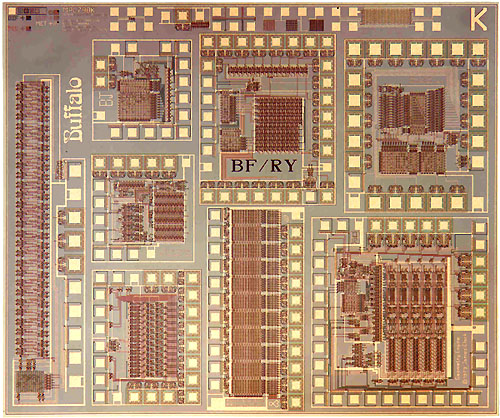
Just 29 days after the design deadline time at the end of the courses, packaged custom wire-bonded chips were shipped back to all the MPC79 designers. Many of these worked as planned, and the overall activity was a great success. I'll now project photos of several interesting MPC79 projects. First is one of the multiproject chips produced by students and faculty researchers at Stanford University (Fig. 5). Among these is the first prototype of the "Geometry Engine", a high performance computer graphics image-generation system, designed by Jim Clark. That project has since evolved into a very interesting architectural exploration and development project.[9]
Figure 5. Photo of MPC79 Die-Type BK (containing projects from Stanford University):
http://ai.eecs.umich.edu/people/conway/VLSI/MPCAdv/SU-BK1.jp...
[...]
The text itself passed through drafts, became a manuscript, went on to become a published text. Design environments evolved from primitive CIF editors and CIF plotting software on to include all sorts of advanced symbolic layout generators and analysis aids. Some new architectural paradigms have begun to similarly evolve. An example is the series of designs produced by the OM project here at Caltech. At MIT there has been the work on evolving the LISP microprocessors [3,10]. At Stanford, Jim Clark's prototype geometry engine, done as a project for MPC79, has gone on to become the basis of a very powerful graphics processing system architecture [9], involving a later iteration of his prototype plus new work by Marc Hannah on an image memory processor [20].
[...]
For example, the early circuit extractor work done by Clark Baker [16] at MIT became very widely known because Clark made access to the program available to a number of people in the network community. From Clark's viewpoint, this further tested the program and validated the concepts involved. But Clark's use of the network made many, many people aware of what the concept was about. The extractor proved so useful that knowledge about it propagated very rapidly through the community. (Another factor may have been the clever and often bizarre error-messages that Clark's program generated when it found an error in a user's design!)
9. J. Clark, "A VLSI Geometry Processor for Graphics", Computer, Vol. 13, No. 7, July, 1980.
Here's another one. It's Carver Mead, Lynn Conway's co-author, talking about the genesis of their legendary book, and process.
I was a university student at the time, and this was the way you could get your little custom processor into a fab and get hardware back. It was kind of amazing to go from a digital file through a compiler and verification, and then to hardware.
Carver's description with some backstory (probably helpful):
https://www.youtube.com/watch?v=eAZWXX5930M&t=1984s
And skipped ahead to just the book part:
EDIT: ah, found it: http://www.myhusbandbetty.com/wordPressNEW/2024/06/11/lynn-c...
RIP.
The example I think of is the person who built one of the first superoptimizers.
Maybe working with computers provides a better environment for people with social-related issues ?
I think a mixture of being (1) a small minority (~1%), (2) which is ostracized, and (3) exists roughly homogenously in the population meant the internet provided an opportunity for community that didn't exist before.
The big thing is the super low-risk and anonymous environment. If you're gay but feel shame about it, or that you might suffer violence for coming out, then your computer might be the first place you don't feel alone.
For ~1980 through ~2010, community meant having a sysadmin to host a bbs / usenet / email list / irc / phpbb, and community meant having the technical knowledge required to join one of those. So, lgbt people and trans people especially have a good reason to become computer people.
I think this pattern applies to other groups which meet the same criteria. E.g. people at far ends of the political spectrum, the extremes you might have found under alt.sex, fans of specific media like TV shows, or people talking about weird alternative operating systems.
To summarize: It's a combination of the culture and the way that various overlapping subcultures are viewed by society.
https://i.imgur.com/w1mNGHZ.png
I'm not trans, but I have to imagine that sort of acceptance is the goal. I wonder the degree to which our media portrayal of hacker subculture has influenced the desire among certain demographics / subcultures to gravitate towards those jobs.
https://web.archive.org/web/20150814232249/https://ai.eecs.u...
This report was issued February 23, 1966 which was close to a year before Tomasulo's An Efficient Algorithm for Exploiting Multiple Arithmetic Units.
I'd never heard of this report before today. It isn't taught in Berkeley's CS152/252. It's not mentioned in Hennessy and Patterson's books.
Something doesn't quite compute here though - according to Wikipedia after she announced her intent to transition Lynn was fired in 1968, but this paper was from 1966 - https://news.ycombinator.com/item?id=40650635 also does not have any information. Maybe at least someone shielded her for some time?
Also Francis Allen seems to have worked on the same project at IBM - she mentioned there were works by other women that other people (Turning award winners IIRC) took credit of - could Lynn's work be one of those? Really hope Fran and Lynn would at least knew each other.
https://www.latimes.com/archives/la-xpm-2000-nov-19-tm-54188...
That kind of makes it sound like Smotherman was poking around trying to find Conway's secrets. What was actually happening is that he was trying to research an early IBM supercomputer project, but was not having much luck. There was very little published information, and IBM had apparently lost its records. Smotherman asked on the net for help and Conway responded and gave him a massive amount of information.
Here's an article that provides more information [1]. Here's the first few paragraphs:
> Late in 1998, a young researcher delving into the secret history of a 30-year-old supercomputer project at IBM published an appeal for help. As Mark Smotherman explained in an Internet posting, he knew that the project had pioneered several supercomputing technologies. But beyond that, the trail was cold. IBM itself appeared to have lost all record of the work, as if having experienced a corporate lobotomy. Published details were sketchy and its chronology full of holes. He had been unable to find anyone with full knowledge of what had once been called “Project Y.”
> Within a few days, a cryptic e-mail arrived at Smotherman’s Clemson University office in South Carolina. The sender was Lynn Conway, one of the most distinguished American women in computer science. She seemed not only to know the entire history of Project Y, but to possess reams of material about it.
> Over the next few weeks, Conway helped Smotherman fill in many of the gaps, but her knowledge presented him with another mystery: How did she know? There was no mention of her name in any of the team rosters. Nor was any association with IBM mentioned in her published resume or in the numerous articles about her in technical journals. When he probed, she would reply only that she had worked at the company under a different name--and her tone made it clear there was no point in asking further.
> What Smotherman could not know was that his appeal for strictly technical information had presented Lynn Conway with a deeply personal dilemma. She was eager for the story of IBM’s project to emerge and for her own role in the work to be celebrated, not suppressed. But she knew that could not happen without opening a door on her past she had kept locked for more than 30 years.
> Only after agonizing for weeks did Conway telephone Smotherman and unburden herself of an extraordinary story.
> “You see,” she began, “when I was at IBM, I was a boy.”
[1] https://www.latimes.com/archives/la-xpm-2000-nov-19-tm-54188...
I was researching some of the names that Alan Kay mentioned in his classic paper about the history of Smalltalk and his 1993 interview with Yoot Saito, and discovered another amazingly accomplished trans woman at Xerox PARC, Diana Merry-Shapiro, who co-invented BitBlt, and wrote one of the first systems for overlapping windows for Smalltalk, and the Smalltalk code editor.
https://github.com/YootTowerManagement/YootTower/blob/main/Y...
Diana Merry-Shapiro (Xerox PARC):
A member of the Learning Research Group, she significantly contributed to the development, testing, and application of the Smalltalk system, focusing on educational technology and learning methodologies. Her involvement was pivotal in integrating and refining the BitBLT graphics operation, enhancing the system's capabilities in graphical manipulation and display.
Diana Merry
https://en.wikipedia.org/wiki/Diana_Merry
SMALLTALK AT 50
https://computerhistory.org/blog/smalltalk-at-50/
>The second half of the reunion event reunited members of Alan Kay’s Learning Research Group. After a brief introductory video featuring Diana Merry-Shapiro and her memories of what she worked on at PARC, Dave Robson hosted a discussion with Dan Ingalls, Ted Kaehler, and Glenn Krasner.
Oral History of Diana Merry Shapiro
https://www.youtube.com/watch?v=5sTUaO3PNkQ
Casa Susanna:
https://www.hammertonail.com/reviews/casa-susanna/
Review: ‘Casa Susanna,’ starring Katherine Cummings, Diana Merry-Shapiro, Betsy Wollheim and Gregory Bagarozy:
https://culturemixonline.com/review-casa-susanna-starring-ka...
Dr. Vanessa Freudenberg is another amazing successful trans woman programmer in the Smalltalk world who's done all kinds of groundbreaking work with Alan Kay, Smalltalk, Squeak, SqueakJS, Viewpoints Research, Croquet, Harc, OLPC, and is quite open and extremely happy about her transition in 2020.
https://www.freudenbergs.de/bert/
Here’s Yoot Saito’s 1993 interview with Alan Kay, when he was visiting Japan with Douglass Engelbart, and Yoot was working for MacWorld Japan. He also has interviews with Douglass Engelbart, Joanna Hoffman, Steve Wozniak, and Bill Atkinson that I hope to dig up and publish, since they were only published decades ago in Japan.
https://github.com/YootTowerManagement/YootTower/blob/main/Y...
Here's Alan Kay's history of Smalltalk paper that Brett Victor put online in html, and I'm working on transcribing and formatting the appendices that are missing from that.
I was told earlier today that my best friend in this world has died. We haven't talked for the past 4-5 days (we usually catch up on the weekends - but this past weekend he had a packed concert-going-schedule - we live in different countries so I couldn't join).
What sucks the most is that we use(d) Signal, and we have autodestruct every 2 days so apart from some really old emails, I got nothing left from him, and our frequent "correspondence".
I am using the "Henry Bemis" moniker because he was making fun of me and my reading and I was making fun of him and his frequent cinema-going (and we both loved THAT episode of the Twilight Zone - Time enough at last)(great episode btw!!)
And now I got into HN and I saw the black banner on top and I thought "WTF is going on today with the deaths!" and my stomach got a bit tighter.
It sucks when people we love die. It's what Keanu said to Colbert "those who love us will miss us".
My friend also "..would like to live five lives in the course of one life", but alas, he managed to live half of it.
Farewell to those who fade/reincarnate/cross the river Styx/go to hell/go to paradise.. we will miss them.
I don't maintain a blog, so I'll be keeping this bookmarked. Apologies for the 'spam', I wanted to get this out of my system.
Anyway, sorry to hear Lynn Conway has died, looked technology just lost a great contributor.
correction: achieved great things TWICE.
We should all be thankful for her contributions and for those who preceded her who were similarly "abnormal" by the standards of their time.
- California continues to be a necessary place for America and the world. By this I mean not just the geography, but a place that welcomes people from all walks of life seeking new beginnings.
- Never give up. Seriously. She was in her late 30s, early 40s -an age many would have considered "old" in the 1970s- when she made the breakthrough that made her famous.
When “others” (such as women and people of color) make innovative contributions in scientific and technical fields, they often “disappear” from later history and their contributions are ascribed elsewhere. This is seldom deliberate—rather, it’s a result of the accumulation of advantage by those who are expected to innovate. This article chronicles an example of such a disappearance and introduces the Conway Effect to elucidate the disappearance process.
https://www.computer.org/csdl/magazine/co/2018/10/mco2018100...
https://en.wikipedia.org/wiki/Hedy_Lamarr#Inventing_career
https://www.inventionandtech.com/content/hedy-lamarr-radio-c...
;)
Mead and Conway's textbook unlocked VLSI design for generations of students. Now you can find videos on youtube, and you can even join tiny tapeout to get your chip design fabricated. And for processor design, you can design something in Verilog or VHDL and run it on an FPGA board.
I also recently discovered Digital, a gate/component-level design tool and simulator for digital circuits (which can also export to Verilog for synthesis), that is similar to the older Logisim.
A true giant both for industry and people.
Shame on all of "us" for missing the date.
She wrote about it 2018.
"When “others” (such as women and people of color) make innovative contributions in scientific and technical fields, they often “disappear” from later history and their contributions are ascribed elsewhere. This is seldom deliberate—rather, it’s a result of the accumulation of advantage by those who are expected to innovate. This article chronicles an example of such a disappearance and introduces the Conway Effect to elucidate the disappearance process."
https://www.computer.org/csdl/magazine/co/2018/10/mco2018100...
see https://www.latimes.com/business/story/2024-06-11/lynn-conwa...
Good grief. Took them long enough.
RIP
[ref] https://youtu.be/W_cB8VYunY8?si=9M9QVmBipbKUXxMR&t=1414
RIP.
I only found out about her a few weeks ago, when I was trying to understand that recent GhostRace exploit. It uses out-of-order execution, which led me to her. There's a fun little cartoon about her somewhere on YouTube, but I can't find it.
Sad that she's now gone!
Comp. Sci was mostly software, but we also did some 7400 series TTL bread boarding in the lab - building things like traffic-light LED sequencers based on DIY flip flops made out of NAND gates.
VLSI design was a revelation - that there was a different way to designing things than out of TTL "lego bricks", and that you could go full custom instead !
I was never aware of Lynn Conway's personal transgender challenges - more power to her for having had such an amazing career and impact while dealing with this.
https://slatestarcodex.com/2014/11/21/the-categories-were-ma...
86 years old! She had a great life.
After the way they treated her, I wouldn't accept it.
I had no idea she was trans. When I figured this out, it became part of my spiel to students: If being different doesn't destroy you, it'll make you stronger. It's not simply that one can be just as good a scientist while being gay, for example. No, we live in a country so stupid it may reelect Trump, and there are still issues with being different. If the experience can teach you that many people are crippled by convention and full of shit, that revelation can liberate you to do more original work.
For those had a doubt like me, it is different Conway than another computer scientist,John Horton Conway (26 December 1937 – 11 April 2020) famous for "Conway's Game of Life".