From Chinese Anti-Secession Law:
Article 8: In the event that the "Taiwan independence" secessionist forces should act under any name or by any means to cause the fact of Taiwan's secession from China, or that major incidents entailing Taiwan's secession from China should occur, or that possibilities for a peaceful reunification should be completely exhausted, the state shall employ non-peaceful means and other necessary measures to protect China's sovereignty and territorial integrity.
https://www.europarl.europa.eu/meetdocs/2004_2009/documents/...
It is USA/EU strategic interest to avoid too deep dependency on Taiwan. We should support the status quo there as people of Taiwan are prosperous and peaceful nation. But we can't be caught off guard by China as EU was caught off guard by Russia.
With that being said, it's not that simple. Bluster isn't just a political tactic -- it also enables the military to slowly chip away at norms and edge closer towards a strategic advantage (e.g.: progressively violating more and more of Taiwan's sovereign airspace). If the party could have things their way, the military would merely continue pushing the envelope until one day a D-Day assault force seemingly randomly washes up on Taiwan's doorstep.
Just in terms of international law, the Chinese flights near Taiwan are provocative but don’t violate any laws. The U.S. and Russia still do this sort of thing all the time. An ADIZ is not sovereign airspace.
That strategy manifests in that slow chipping away: they don’t need to do things all at once.
Taiwan has an Air Defense Identification Zone where they track aircraft and aircraft entering it are supposed to identify themselves. This extends over the Chinese mainland and it's this zone that everyone talks about China "violating". But it's Chinese airspace and ultimately they have the right to fly there without notifying Taiwan.
Well, only 13 countries recognize Taiwan as a sovereign country - such as the 10,000 people of the 21 square kilometer island Naura.
Also, Taiwan occupies Kinmen Island in the bay of Xiamen's harbor on the PRC mainland. The island is in the Xiamen harbor and is 10 km from the city of Xiamen. So any PRC planes flying around Xiamen are "violating Taiwan's sovereign airspace" (which almost no one recognizes as "sovereign" - one of the main parties on Taiwan acknowledges Taiwan and the mainland are all one country).
However, I am not arguing that China is not serious about retaking Taiwan. They are deathly serious.
https://en.wikipedia.org/wiki/Chiang_Kai-shek#Mass_deaths_un...
https://en.wikipedia.org/wiki/Constitution_of_the_Republic_o...:
Following the ROC government's retreat to Taiwan on 7 December 1949, the Temporary Provisions together with martial law made the country an authoritarian one-party state despite the constitution. Democratization began in the 1980s. Martial law was lifted in 1987, and in 1991 the Temporary Provisions were repealed.
ROC has been democratic since the 01990s, but it was an authoritarian dictatorship that killed millions of its own people at the time the Communists drove it out of the mainland (only to exceed its atrocities with their own) and for decades afterwards.
They said they will retake Taiwan and they can and few will really care. So of course they will.
I would go as far as to say that US Army + Marines + Navy could not land on Taiwan without suffering multiple brigades of attrition AFTER at least a year long blockade and air campaign. It is that hard.
PRC has to surpass US in GDP, then spend 10-20 years of US level military spending, then maybe.
wriggling around the law needs only an emergency.
https://en.wikipedia.org/wiki/List_of_US_arms_sales_to_Taiwa...
The latest sale involves adding 60 Harpoon anti-ship missiles to the pile of hundreds they already have.
China will not have an easy time of invading such a well-armed country, and they also have to weigh the non-zero possibility of foreign intervention. It will be a costly endeavor by any measure.
China's best bet is a cultural/political/economic takeover, which will give other countries time to diversify chip manufacturing, as we are currently doing.
China doesn't need to storm the beaches, they can passively blockade Taiwan until they give in.
China doesn’t have to storm beaches to be within shooting range.
If Taiwan were an easy conquest it would have been conquered. It’s not impossible that China would attempt some sort of belligerence, but Taiwan is capable responding to any threat with enough firepower to deter such actions.
China moves at a different pace than the West.
They might retake Taiwan in 2100, after a couple generations maybe care more about shared culture and language than democracy.
On the other side, the US obviously wants to see a war between the two side of the strait. And the US is actually prepareing for it.
The irony here is that it is in fact China that seceded from Taiwan.
Russia is a declining state relative to Ukraine & Europe, so Putin's odds of success in 2022 were considerably higher than they would be 10 years later. So if invading Ukraine was necessary at some point, 2022 was the best time to do it.
China's regime believes that invading Taiwan is necessary, but OTOH the Chinese military is getting stronger very quickly and they believe they'll be in a much better position to invade in a decade then they are now. So there is no way they're going to invade any time soon.
Avoiding a war completely is highly unlikely given Xi & China's policies. But delaying a war is highly likely. And a war indefinitely delayed is a war avoided.
You spend the rest of the comment before this talking about how war will happen when they are stronger and probably can't be avoided, so I don't know how this last sentence follows.
If you know for sure that someone will wage war on you in future, and that they will get stronger faster than you will, then it could be in your interest to go to war against them sooner rather than later.
There's always a bigger fish.
The last time nations were obsessed with autarky, we got WW1, and soon after, WW2.
Most countries (i.e. every country not suffering from a drastic case of the resource curse) have the nature that if they trade a lot with another country, either country would lose economic value if they invade the other, _even if_ that invasion goes off stellarly well with almost no losses: The populace doesn't like being subjugated and produces significantly less.
In an inbalanced trade/dependency relationship, such as Saudi Arabia's oil vs. the rest of the world, or Russia's gas vs. europe, it's actually _both_ sides that are dependent on the other. It's the dutch curse all over again.
Go back in time:
* Europe wants more gas to grow its economy, and doesn't have enough on its own soil. * Russia has more than plenty and is willing to sell it. * We enter a period of years where europe companies and countries more and more build industry that isn't going to work out without the relatively cheap russian gas. As these industries continue to succeed and russia continues to be a reliable supplier, ever more industry takes the leap and becomes dependent on it. * This sounds like handing off quite the 'weapon' to your supplier, but, the problem is, that supplier is now just as dependent on this relationship as the consumer is: Russian economy falls apart without the trade of europe-produced goods (a lot of it by industries that run on russian gas), just as fast as europe falls apart without russian gas.
Thus, if russia were to invade europe, russia's economic value falls off a cliff, and the same applies to a lesser extent to europe. The only reason europe could in theory invade russia (assumes a perfect invasion, no nukes, no significant resistance at all, just a dejected populace), is because russia's primary value is not particularly dependent on human capital.
My theory about why this theory didn't work out and russia invades ukraine is a mix of:
* Misunderstanding by Russia of world/Europe response to this invasion. * Too much power in one person, who, like most people surrounded by yay-sayers for 20 years, has lost grip on reality. * Most of all, a ticking clock: Europe has stated they want to wean themselves off of fossil fuel within a decade or so. And so they should, but it's a torpedo to the trade dependency relationship between europe and russia.
That last one is the economic argument: Russia had to do something or their economy would fall apart if europe delivers on their plans to rapidly reduce their dependence on (russian-supplied) gas.
Thus, autarky -> war. Because if you're doing economically better than your neighbouring country, you produce more weapons and more people, and just invade em, why not.
We can trade the risk of what happened to europe, or what is likely to happen if china and the west become autarkic relative to each other (namely, that china invades taiwan) - with nukes and MAD. But that's got its own problems.
Were they? I thought WWI happened in the midst of first huge wave of globalization - to the point that no one thought war was possible, as it would mean collapse of international trade, and huge losses that come with it.
"One day the great European War will come out of some damned foolish thing in the Balkans."
And to think that in the 80s Regan tried (but opposed by business) to impose sanctions on europe because of the USSR gas pipelines. What a circus. Europe got hooked on USSR gas in less than 20 years, and has been planning to wean off for 10.
Europe after WW2 relied on the US to defend against Russian aggression, and not even 30 years later, in a master class of cleverness played both sides by buying, and then becoming dependent, on Russian gas, only for the Russians to become aggressive again.
Where the cleverness falls apart is that cheap Russian gas was on bought time, and now all the europeans have to show for it is massive debt, expensive social programs, a lack-luster military and closed nuclear plants. Good job...
Ukraine was invaded because they have a great deal of oil and natural gas and could therefore significantly impact the Russian economy especially if the world starts to reduce Fossil fuel use.
Ukraine would solve nothing in the Russian economy.
Ukraine would simply secure two things: Crimea (which is essential to Russia and was strategically exposed), and complete control on all main gas infrastructure towards Europe. It's not a coincidence that the invasion was launched when it became clear that the new gasduct to the North was dead in the water (because of American opposition to it): Putin wanted to make gas furniture to Europe strategically independent from other countries (i.e. completely dependent on Russia), one way or the other. The original calculation was probably "You don't give me Nordstream, so I'll take everything else". Obviously it didn't go as planned.
Putin didn't have to invade! If he was truly worried about Russia's economy he could have (and should have) gone about instituting reforms/policies to encourage economic diversification and growth. I fail to see how even a successful invasion of Ukraine results in economic upside for Russia. They were doomed to fight an insurgency for years which costs money, or they're going to spend resources rebuilding a country they just fought a war in.
Yes, absolutely. Russia, 60m people (or how much is it? More even) notwithstanding, is essentially a petrostate. It was too hard to try to get the population-driven productive elements to compete against the easy resource money.
I mean, Norway is right fucking there. This war is on them, entirely, for failing to prepare for the inevitable day when the natural resources are no longer enough to bankroll the entire state.
But, doing it _now_ is not possible without major political upset, so the major political players, not wanting to be 'upset' out of a window (hey, you live by the sword, you die by the sword, I'm sure the political elite is aware of the usual way to deal with higher ups that need to be lesser higher up: By taking that literally) - start a war.
I guess only if PRC is embargoed (US Sanctions TMSC). Maybe next year.
https://www.reuters.com/technology/us-gives-reprieve-least-t...
that would be equivalent to shooting themselves in the ocean.
for now, they are still under the thumb of the american navy. how else would they ship out all the consumer goods? and to whom? USA is their biggest buyer.
Nobody wants that.
You've got to be kidding me. Putin had been warning West since the Munich speech in 2007. [0]
[0] https://en.m.wikipedia.org/wiki/2007_Munich_speech_of_Vladim...
So I think it's fair to say that the EU was caught off guard by Russia, even if because of the EU's willful ignorance of affairs rather than Russian duplicity.
His people like him. Who are we to decide whether he is “tyrannical” or “insane”?
The west has this constant undercurrent of “we know what’s best for you” when talking about other countries and their leaders.
Its neither warranted nor welcome by the locals.
The other day we were discussing Pablo Azar, "Computer Saturation and the Productivity Slowdown" (Federal Reserve Bank of New York Liberty Street Economics, October 6, 2022) [1]
Simply reinventing systems and deliberately obsoleting stuff to create fake demand is over. The metaverse isn't hoing to happen. People are fatigued with tech.
We're entering a different era in which we need to make better, more humane and effective technology, not just more and more and more of it.
[1] https://libertystreeteconomics.newyorkfed.org/2022/10/comput...
EDIT: less trashy link
Businesses in general started to see the appeal around the time that the Google Assistant, Cortana, Alexa and Siri started to become actually useful and desired by the general public. Because of that, there will continue to be a push to extend and enhance those capabilities.
The current systems can turn a normally worded question into a web search, and present the results in a pleasing manner. The next step is to extend the ability of the systems to actually understand wider and wider ranges of questions. We are still a ways away from having free-flowing conversations with our computers, but there are many steps along the way that are useful of themselves. Advancing this technology is a competitive advantage, and becomes key to drawing in and keeping people in one of the various tech ecosystems (Google, Microsoft, Amazon, Apple).
In the wider business world, people are finding new and better ways to apply this technology.
I think technology has shifted from giving me what I want to telling me what I want. I really dislike it.
Pleasing but not useful. I really miss Google search from 10 years ago. I think things started going downhill when they introduced the instant search feature. Nowadays it's difficult to find anything. The results are mostly irrelevant and littered with spam and AI written nonsense. I remember I could go through hundreds of result pages and find useful things on the tail end, now quite often I get one page only and nothing is relevant to my search term. I have to often use quotation marks etc, but even that stops being helpful - basically more often than not I get no results at all.
I work for a fairly large, fairly successful company and I'm having to explain to my team how to quantify the business value of a product, like showing that the value provided to customer in terms of dollars is greater than the cost of the service we provide. It's an uphill battle, because we've lived in a bubble so long people don't even remember this basic fundamental of business.
The tech industry exploded because of cheap money, but by and large has completely failed to extract actual value from the technology.
Even when I list out the "tech" products I do use frequently (Uber, Door Dash and the like) I realize that the products they offer are basically investor charity since they cannot be sustained indefinitely at the price point they're offered (and they don't make sense if they charge more).
Of the actual technology I use, the vast majority has barely changed in a decade. The most impressive thing I've purchased in years is finally getting an RTX 3070 and that is just "neat!". Anyone who remembers the release of the original iPhone will instantly recognize that despite the trillions spend in the tech industry, nothing quite as game changing as that has come out since. Google search was also better back then.
ps: to add a bit more, from the few chats I have, people are either saying "well I need that to check my bank account or pay taxes" or "well I need that so I can binge on netflix"
People have been saying this about technology for as long as technology has existed.
Better tech is how humans (all of them - rather than the few) get more space to reflect and live outside.
Or I guess we can just be pendantic. There are no such thing as alternating periods, all periods of time are exactly the same!
For example cell phones still sound worse than land lines did in the 90s. We just don't care, and don't have a choice anyway (even most landlines are ultimately going to interface with a digital connection).
Refrigerators have more gizmos than before, but one of the key features, reliability, is in decline.
Personal computers are increasing moving back to a client server model which is absolutely a step back from where we were a decade or more ago. When the services behind all the billion SaaS apps we consume disappear so will the tools themselves.
Market conditions have virtually eliminated software you own.
I suspect this trend will increase dramatically over the next decade where most of the devices and tools we use are objectively worse than what we're using today.
But to argue that technology as a whole has stopped is... well, not irrefutable, but almost certainly wrong. And if it's right, wow, is that bleak.
Constructed more naturally, your statement here:
> we need to make better, more humane and effective technology, not just more and more and more of it.
Is certainly true, but frankly is just a tautology. "Technology" as commonly understood means new stuff that makes people's lives better.
Like 'taking better pictures when you a person of non white color's but that's the wrong attitude. They solve great issues like this and I'm probably more underwhelmed that we even had to fix something like this because it wasn't really solved before.
Let's see if/when we get a more stable timeframe back. With COVID and the Russians it's shitty and climate change might already be a regular constant.
If you wouldn't mind reviewing https://news.ycombinator.com/newsguidelines.html and taking the intended spirit of the site more to heart, we'd be grateful.
If you don't believe in human made climate change pls say so directly so I can ignore you
It's how we end up with shit like grocery self-checkout machines and robots answering customer support calls. Nobody likes being yelled at by a robot who doesn't understand the situation, except the decision-makers buying the machines.
This isn't peak tech, not by a longshot. This is just Intel's competitors eating it's lunch.
Robots answering support calls are annoying, but self-service websites are pretty good for 99% of things.
some wholesale clubs apparently counter this by randomly auditing every cart as you leave, but that seems to leave the whole thing only marginally more efficient than traditional checkout
It has never been easier to build a business(software). Labor is abundant, and the tech boom has created a million Medicis willing to throw money at wild things. Look at FTX fund for example.
I have experienced a handful of magic products, Apple products which are the best example, that are built from incredibly capable software that takes cheap hardware components and makes them sing. All objects could be like this, deep software capabilities running on a few dollars of hardware. I have the idea that the demand for people that can create software is bottomless, that there will always be more thing to turn into perfect iThings.
I think there is plenty of industry tech left to be developer
The US government, US, we, gave Intel and some other companies a huge sum of money to stay awesome.
Then they announce huge layoffs to get rid of a lot of thr talent, people, heart of their business.
So, wouldn't we have been better off as a society of we had just offered thT CHIPs money as a startup find and asked a bunch or people from Intel to leave and build new semi companies using this fund?
In the end the meteic for success of the CHIPs program in the short term should be number of people working in semi in the US. How did we dedicate money and resources to this thing of national importance and end up with fewer experts working on it?
Money is the root of all evil, power corrupts us all.
From my limited perspective of having recently worked at Intel, they had a lot of dead weight. There was a lot of talent, but it was also diluted by a lot of management and bureaucracy.
I honestly don't know if layoffs are an effective solution to this, but IMHO they could definitely benefit from lower headcount and greater urgency.
I'm still trying to reconcile it with the CHIPs thing. Intel on one hand is admittedly bloated and inefficient, and so is choosing to reduce its headcount and therefore bandwidth to do work.
So what is the CHIPs money going to. Typically when you invest in something like this you are buying people's time to do the work and also materials and supplies to build the stuff like factories, etc. So if we are lowering headcount it's not going to labor.
I suspect as you say it's more about changing worker types, like getting rid of skillsets they don't need so they can hire those they do like people to build semi plants here.
So, in my mind, the only way it adds up is if Intel goes on a big hiring spree soon. Otherwise, where did the money go? We can buy equipment to build plants but who builds them?
You can easily guess what the purpose of the program is.
The CHIPs bill was pretty broad. It might make sense to subsidize a pure-foundry company as an ongoing issue (in particular, isolate these big investments from the boom-bust semiconductor trends). Or somehow try to come up with subsidies that go to Intel to the extent to which they act as a pure foundry, but that will be pretty tricky to work out I guess.
An ecosystem of open fabs seems to be a prerequisite of those small plucky startup chip design teams. Of course they can order from TSMC but then they have to wait however many weeks to test out each prototype...
Intel has not announced layoffs. There is a rumor layoffs will be announced at the next quarterly earnings release.
it's not a jobs program and majority of the layoffs are targeting non-technical areas. Raw number of engineers isn't a great metric for government programs either, could be easily gamed. Focus should be on building up the ground level infrastructure needed so actual innovation can happen, not just giving money to Intel and other established players to further strengthen their monopoly
How do you even know whos going to be fired?
Xi became a Leninist and is trying to be the next Mao. He is a true believer that his glory and the glory of China can only happen by taking back Taiwan.
TSMC is a huge reason for this conflict. The current US policy is trying to slow China’s technological might for that next war.
For the last 300? 400? years the dominant global superpower has been a naval power. You don't need to be a Leninist or a "true believer" to see China's future glory being helped by controlling Taiwan.
No, it would still be true. Just beyond Taiwan on the north side are the furthest islands in the Japanese island chain, and if you instead head south, you see Philippine islands instead. Head through the South China Sea and you end up either having to run past Singapore through the Straits of Malacca (already a critical, congested chokepoint), or travel through the internal waters of Indonesia or the Philippines (admittedly, I'm not sure you could call Singapore, Malaysia, or Indonesia US allies, given the general ASEAN propensity for neutrality).
I worked for a defense contractor back in the early 2000s when the USG was selling a lot of arms and systems to Taiwan. I got to see the bullying in person via the ASOC (part of the C4ISR platform) system we were installing. China would routinely fly fighters over the straight to the boundary and fly the line and return to the mainland. I didn't understand the rationale at the time but the US was enabling Taiwan for their own interests in chips. China doesn't matter as much but Taiwan does. The US always had a large naval presence in Taiwan that I saw. China has a relatively weak naval force in comparison - but obviously enough forces to easily take over Taiwan if and when they really feel the need to. I think these programs just bought the US more time.
Ultimately though, China needs Taiwan for those chips. The problem being that if the major producers leave Taiwan then China is hopeless as they don't possess the capabilities or people to retool. They need the likes of Germany and others to even think about the ability to produce competitive processors to AMD / Intel. China can't build its own fab for these types of procs.
Finally, I didn't realize until more recently that China was, and still is, relatively incapable on their own. Some recent books put it into perspective for me on a global scale. But the fact that China just recently figured out how to manufacture a high precision pen is an interesting reference [0].
[0] https://www.washingtonpost.com/news/worldviews/wp/2017/01/18...
"US Could Lose 1000 Fighter Jets, Its Entire Global Fleet If It Goes To War Against China Over Taiwan"[1]
1. https://eurasiantimes.com/us-could-lose-over-900-fighter-jet...
China can't build fabs for very small lithography processes yet. But 40 years ago they couldn't build almost anything. That changed. The fab situation will change, too.
[0]https://www.csis.org/analysis/chinas-slow-motion-financial-c... [1] https://news.usni.org/2021/01/22/chinese-navy-faces-overseas... [2] https://www.scmp.com/economy/china-economy/article/3157385/c... [3] https://www.world-energy.org/article/20509.html
The one thing that matters in the long run is money and even though the US is fighting tooth and nail to halt China it isn't very likely to happen - who knows, we'll see. Whenever this discussion pops up it reeks of racism. People from China aren't less intelligent than people in Germany or in the US so with time and more money they will with 100% certainty overcome any technological gap. Sure they are behind in some areas but pretending they can't make a pen is disingenuous. They have had the capability to launch satellites since the 1970's and are now building a space-station. It is no different than saying the US can't make rockets because they had a lot of outside (Nazi) help after WW2. China has in a very short time-span gone from mostly agriculture to being in the top three in many (most?) high tech areas.
But in short can you explain why the US is using insane amounts of energy to slow down China if they are so totally incapable? Why do we need a completely new doctrine and pivot of the navy to be sailing around an utterly incapable and un-concerning China?
It's not disingenous and it's not racist as I've laid it out. Facts are facts. I've never discounted the fact that China can't make electronics or that it can't, as a nation state, build satellites. What it's manufacturing sector, the bulk of China's financial success couldn't do was make a ball point pen as it requires precision manufacturing. That was not in China's wheelhouse until 2017. There are countries that excel in precision manufacturing at scale. You're conflating some very macro things.
> China has in a very short time-span gone from mostly agriculture to being in the top three in many (most?) high tech areas.
Define "high tech". The top 5 chip manufacturers in the world are: AMD (US), Intel (US), Broadcom (US), TSMC (CN --> Taiwan), NVidia (US). I'm curious if that helps you understand, better, what I'm talking about. I'm not talking about run of the mill electronics manufacturers. If you round out the top 12 - China isn't there: STM, NXP, Micron, LRC, Applied Materials, Texas Instruments, and Qualcomm - none of which are Chinese corporations. These are the companies that know how to build chips. Where is China in this mix? Because these are the companies you need to build high-tech things. Putting an iPhone together is not the same thing as building the chips in them.
> But in short can you explain why the US is using insane amounts of energy to slow down China if they are so totally incapable? Why do we need a completely new doctrine and pivot of the navy to be sailing around an utterly incapable and un-concerning China?
Yes. TSMC. They are the dominant, mass volume, manufacturer of these chips today. The US supply chain relies on this right now. Chip building isn't like retail where you can throw up a store in a few weeks and are off to the races. Building what TSMC has takes time. The US is buying time. That's why you slow China down and keep the issue of Taiwan at bay.
But I don't buy this argument. TSMC is a factor, sure. In that it likely increases the cost of war. The PRC shouldn't expect that by invading, they'll win TSMC (the company, the tech, the talent, the market share).
They know how to fab chips, they don't have the tech.
It would be far more useful to kidnap Dutch technicians and scientists from ASML. But that wouldn't be enough as ASML is also dependent on some key chemicals and tools manufactured in other countries.
This posture change will keep pace broadly with the American domestic chip fab industry.
It's great to legally diversify these fabs, but it does very little to mitigate geopolitical issues that are brewing in and around the east china sea.
It's not so much that cruise missiles used on civilian targets in South Korea or Japan would not be a reason to start WW3, more that it would be less tempting.
The primary reason that we're concerned about semiconductor fab concentration in Taiwan is that China has consistently stated that it is going to invade Taiwan at some point (and that could be 2049 or in a few years for all we know). This is completely outside of any hypothetical scenarios of who lobs cruise missiles at who during WW3.
You can make the point that relying on semiconductor manufacturing outside of your country/coalition is a bad idea for military self-sufficiency, and I would agree, but that's a much more diffuse risk than the very specific scenario that is driving the CHIPS act and concern about fab concentration in Taiwan.
It would take a matter of days until they had massive internal protests. Hungry people topple governments in hours.
I think I also read that the entire foundry would be rigged to blow in the case of invasion. Between controlled demolitions such as these by Taiwan and whatever China has to fire at them to successfully win, there would be very little of value left standing on the island by the end of it. It would take them decades to redevelop it. Very hollow victory for China.
I honestly think there is 100% chance that if China invaded Taiwan today, the US would declare war and send troops to defend Taiwan. In contrast, I think there is >0% chance that the US would not declare war on Russia if they did a (tactical) nuclear attack in Ukraine.
Don't semiconductors represent a significant military advantage? Would we really want China to control the worlds semiconductor supply?
Our dedication to protect our ally Taiwan has nothing to do with Silicone and neither does China's nationalist obsession over it. If it comes to war, chips will play no role
They might rattle their sabers but these fabs will be safe.
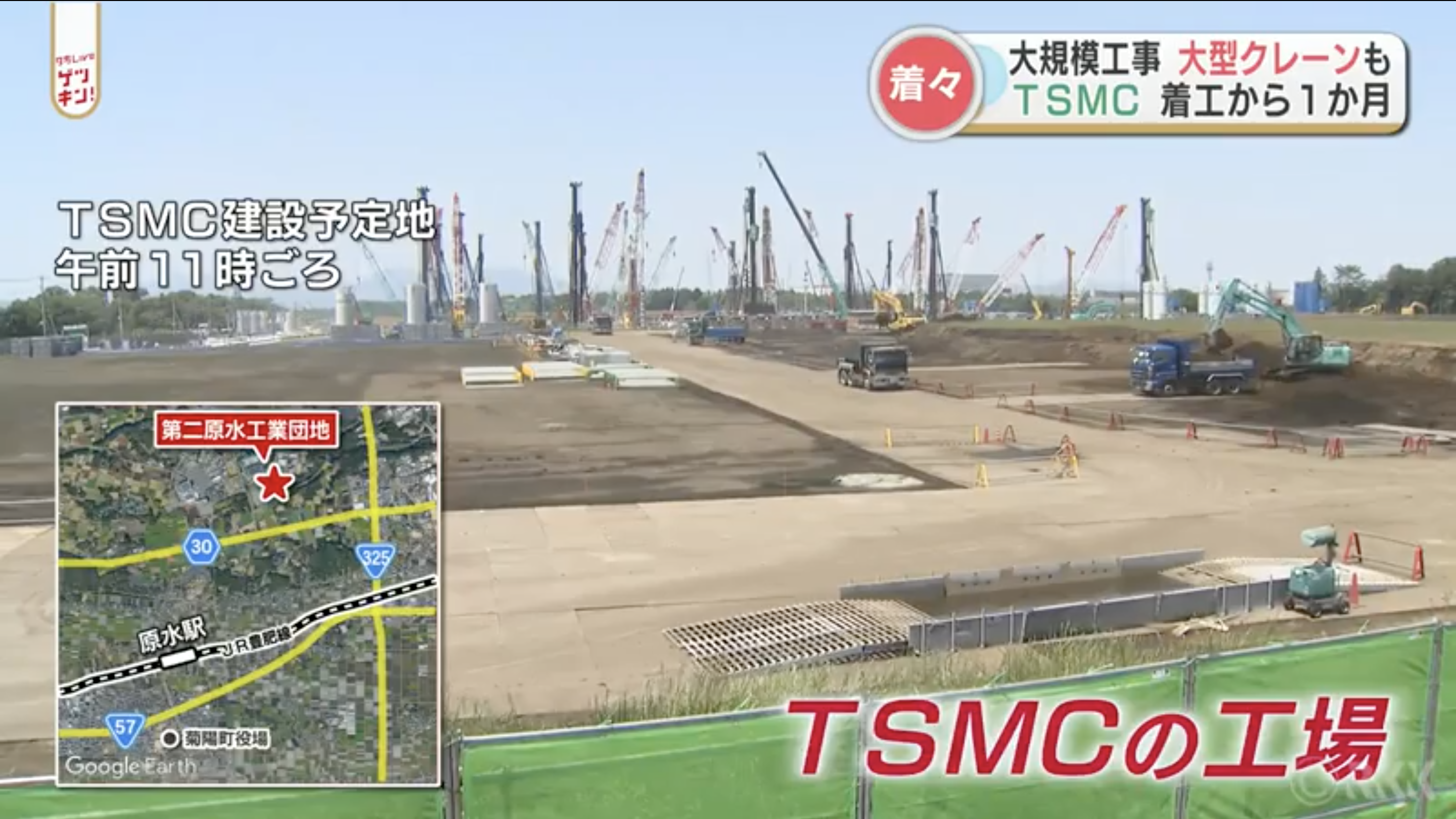
https://www.nhk.jp/static/assets/images/newblogposting/ts/7P...
https://cdn-cw-english.cwg.tw/ckeditor/202205/ckeditor-628ae...
It looks like a forest of cranes...
Similar factories are being built in Germany by Infineon: https://www.infineon.com/cms/en/about-infineon/press/press-r...
Samsung in Texas: https://www.datacenterdynamics.com/en/news/samsung-plans-17-...
Intel in Arizona: https://www.cnbc.com/2021/03/23/intel-is-spending-20-billion...
Samsung/SK in Korea: https://fortune.com/2021/05/13/south-korea-chip-semiconducto...
India is doing something with Risc-V: https://pib.gov.in/PressReleaseIframePage.aspx?PRID=1820621
Overall, divestment from china seems to be the goal. But this many new factories being produced is going to overproduce chips and eliminate any profitability; but inexpensive chips like this will most likely create a boon to the economies.
It's been done many times before (weapons, food, etc.) and always leads to the exact same result: garbage heaps and no available resources when they're actually needed.
Offering companies grants and favors to encourage building real, sustainable, on-shore businesses has a much higher likelihood of success.
I'm curious why not the latest - 3nm, 5nm
TSMC is one of the key players in the 21st century. As we've seen with the supply chain issues from covid and the Ukrainian conflict, high quality semiconductors are a vital resource for modern nations' security and economies.
TSMC is the only entity that can make the highest quality chips (3nm being not actually 3nm, but just called that way for marketing purposes). If Taiwan looses that unique ability, they then loose much of the backing of NATO-aligned nations.
Taiwan bet the whole nation on TSMC, and it's paid off thus far. They're not likely to let go the trump cards they hold.
More on the issues with Taiwan and China here: https://www.youtube.com/watch?v=p6sCsOdqXQw
On the other hand, 22nm and 28nm are almost 10 year old technologies and they are still used in cars, so much so that the industry is begging car manufacturers to get to newer nodes [1].
[1] https://www.theregister.com/2021/10/19/chip_manufacturer_chi...
The chip industry is now swinging the other way.
So the goal is political. The economy can take a hit to achieve it.
Samsung was making Apple's A's in Austin, Texas some time ago, but Apple ditched Samsung's US manufacturing in favor of their China/Taiwan-first offshore outsourcing strategy.
With China having “seized” Hong Kong, and Russia invading Ukraine, flags went up signaling that the next major move in the future could be China invading Taiwan. And Taiwan is where the most advanced chips are made.
In parallel news, playing with the open source AI models, it’s clear that GPUs are NEEDED in order to run these AI models. Ex: an Nvidia RTX3090 (low end of A100) can run Stable Diffusion in a couple minutes, while my 2013 MacBook Pro, cpu driven, takes ~4hrs to perform the same task.
AI models applied to military uses is a game changer, as demonstrated by Ukraine equipped with US tech.
Mitigating the risk of losing Taiwan, enabling production on US shore, and banning sales to China [1] would keep the economic and military advantage on the US side a bit longer than if things kept going the way they were.
Chips might slump now, but GPUs are gonna be in hot demand, even w/o the blockchain use cases. As demonstrated by the open source AI models, we’re about to replace a lot of stock photos, news illustrations, logo services… and that’s just the beginning.
[1] https://www.bis.doc.gov/index.php/documents/about-bis/newsro...
It's mostly cold war era equipment, designed around the '90s or earlier. Modern AI also seems very failure-prone for military applications around populated areas.
Many chips are not fungible, at least not for large-volume orders that incorporate stuff like customer specific mask ROMs or optimizations, and certainly for built-to-order stuff like Apple's SoCs. That means that let's say Apple can't just go and take a bunch of NVIDIA's chips and slap them into their products, and I'd even take a bet and say that manufacturers of NVIDIA cards can't easily take up cancelled order capacity for the same NVIDIA chip from other manufacturers.
The rise of TSMC has somewhat increased the national security risk as the market share has shifted away from Intel. We are seeing with the Ukraine War, a reliable domestic supply of semiconductors is now critical to national security.
I expect Intel will continue to be helped along by the US government for some time.
You are right that those semi companies do not need the government investments to build fabs. However, those fabs materialize overseas, depending on overseas supply chains. The EU and US regions want to build out more of the supply chain domestically, for strategic reasons. Those governments could simply legislate to impose heavy restrictions, but that hurts the competitiveness of the companies involved. And so, they combine that stick with a carrot, which is the government investments. You can already see increased restrictions on the semi supply chain in China, timed right after the CHIPS act passed.
Still no sign of stability in supply.
That's from April, but in short there's a huge order backlog that they're still working through apparently, despite producing half a million units per month. With the lockdown gap in production and the Pi 4s getting increasingly integrated into various 3rd party products I suppose that's no surprise.
It's quite apparent that there's little demand for the Pico, since it's always in stock.
Without additional context (which perhaps you have and used subconsciously) that's not evidence that there's less demand - just evidence that the ratio of demand to stock is lowest. It could be that it has 2x the demand but they prioritised it and produced 3x as much stock, or it could be that a specific component makes one product easier/less delayed than the other to make (in which case equal demand could still lead to only one being regularly in stock).
If for example 100 people a year want to buy a product $A, and 10 a year want to buy product $B, and the company manufactures 200 $A's a year but only 5 $B's, then $B will be out of stock more despite being far less popular.
Or course this partly relates to how well a company predicts future demand when deciding how much of each product to create. But in many cases (though I would guess not when it comes to The Raspberry Pi Foundation) marketing therefore also becomes a factor - in that companies may see value in either creating slightly less than they expect there to be demand for, or artificially limiting / lying about stock levels, in order to get people thinking "wow it's out of stock so it must be popular!"
I bought a few of them a while back and have only recently managed to integrate one of them into a really basic project. They tried to make some kind of middle ground between an ESP and an Arduino, while providing an incredibly buggy MicroPython build and no Arudino IDE integration. Some of that's been corrected, but it still remains this all rounder thing that's never the best choice for the application.
No wonder there's no supply.
As far as Intel goes, they've been on oxygen for decades with the technological advancements they appropriated from DEC, while at the same time selling off the DEC-designed StrongARM technology and exploring new ways to generate heat and waste power. At this point, they have a formal relationship with TSMC and a government mandate to turn the Rust Belt into the Silicon Belt, so don't count them out (unless you are 75 or something, because it will be 10-15 years for all of that to happen), but to guys like me (and I would imagine most people on a site like this), they're about as relevant now as IBM (/s) In the meantime, we need to convince Apple to sell its consumer chipsets, maybe with an incentive from USA (either money or an agreement not to prosecute them for investing so much training and capital in China that they feel comfortable announcing their plan on TV yesterday to murder as many people as necessary to return Taiwan to 1895 legal structure).
Companies can't survive in a peak world without manufacturing crap. Sell more because your tools break.
So now they are looking at how to do that under the premise of eternal growth:
They will try to lock us down in the hardware = deprecate older hardware and force you to move to never software with TLS 1.3.
That has never succeded because you can always hack everything = They will try to rent out the accounts.
They allready started that process, but I'm not buying it. I have all the software I need under permanent license.
Since processors now have peaked, everyone is buying all the computers they can, the really smart ones are buying low energy devices like Raspberry but 1151 Xeon is also sold out.
Anything manufactured today will probably have hardware kill-switches or programmed obsolescence. For companies: "To not lock your customer down for eternity is suicide"...
Edit: Loving the downvotes without comment...
Raspberry Pis are out of stock because 1) companies that used them in production and got those production builds certified in some way get preference and 2) scalpers are taking the rest of the stock and doubling their money with it as it drops.
Older Xeons (and similar hardware) aren't worth running unless you have access to really cheap electricity; upgrading your system is cheaper than paying for the electricity you'd be wasting otherwise, even if you're staying a gen or two behind by buying datacenter surplus from eBay et al.
I understand your consternation, as some devices (e.g. cell phones) and some applications (e.g. SaaS apps) definitely appear to exhibit rent-seeking behavior. But that's no reason to declare literally everything a conspiracy, which just makes you appear to have some wires crossed.
Now Mojang and Rockstar (on azure) have disabled TLS 1.2 on their servers on purpose to lockout Windows 7.
Windows 10 offers NOTHING of value compared to Windows 7.
Furthermore, the makers of Minecraft and Grand Theft Auto don't owe you the ability to use outdated OSes if you're using a service they maintain. They probably didn't intend to break your workflow, and instead wanted to make their own stuff more secure.
If you're not a W10 fan, you could always run Minecraft on Linux. I think GTA V works on there as well. Either way, there's an out.
They also offer excellent support. Their hardware gets like 10 years of OS updates. An M2 Mac today will last well past the next two US presidential cycles.
M1-2 are brittle and controlled, the opposite of open/repairable etc.
ARM, Atom, Xeon from this period can last 100 years.
If you don't have this hardware, you'll get something that will last max 10 years.
USA has banned China from manufacturing without having a replacement.
>M1-2 are brittle and controlled, the opposite of open/repairable etc.
We have reached the point where we cannot have removable ram for technical reasons. M chips get a a lot of their performance from excellent memory bandwidth. Move on from this thought process. The software is still gives you more control compared to Windows and thats what really matters, not the arch that it is running.
>If you don't have this hardware, you'll get something that will last max 10 years.
10 years is enough time for the next computing paradigm shift. It is great that MacOS lets us hold onto the old world for 10 more years(hopefully).
>USA has banned China from manufacturing without having a replacement.
Thats a temporary issue. They mostly made low end junk silicon anyway.
Many traditional hardware companies are transitioning/have transitioned to some form of hybrid model or subscription service explicitly.
We are actually looking at degrowth, not eternal growth.
Processors may be near peaking but the Raspberry Pi is not a competitor with those processors.
The reason stock is down is because of supply chain issues still overhanging from the pandemic.
Raspberry 4 has 2Gflops/W where M1 has 2.5!!!
Pandemic is not the problem. Energy and money is the problem.
Edit: Premise = Promise yes.
Energy, while vital, is not the only component in any part of an economy.
> Companies can't survive in a peak world without manufacturing crap. Sell more because your tools break.
This cuts both ways. If tools break too often or too easily, someone else will manufacture a tool that lasts. That tool will then sell millions or even billions of units. This can sustain a company for quite a long time.
> So now they are looking at how to do that under the premise of eternal growth
No one believes in or expects "eternal" growth. It is well known that any bubble fueled by cheap money, government bailouts, corporate welfare, or any other intervention will eventually burst. This is planned for by the very largest companies. Companies without the resources to plan for these market crashes simply do the best that they can.
> They will try to lock us down in the hardware = deprecate older hardware and force you to move to never software with TLS 1.3
I feel your pain here as an enthusiast for older hardware, but this is simply untrue. No one ever forced me to give up my ZX81, my XT, or my PPC lampshade iMac. I have them, I've kept them running, and they're fine. The XT and PPC can get online just fine either with a TLS bridge or with sites like 68k.news and frogfind.com. The constant upgrade cycle is optional. People are keep phones longer than ever. The cool-down in the PC market indicates that those enthusiasts who wanted to upgrade have done so. The heat up now is likely to be datacenters where the next wave of AMD Epyc offers a very massive energy to performance trade-off against Skylake SP. All of that said, eWaste is an issue and companies who make hardware that cannot be serviced and/or upgraded easily should probably pay a tax on it.
> Since processors now have peaked
There's plenty of room at the bottom. Seriously. I do not normally make appeals to authority because doing so is stupid, but we are talking about the most complicated machines humans have ever created. In this case, I would urge you to listen to the guy who has made these machines with extreme success: Jim Keller. He thinks we still have a long roadway of improvements before we are forced to change the industry in major ways (Gallium Arsenide or quantum or something).
> Anything manufactured today will probably have hardware kill-switches or programmed obsolescence
Already kind of illegal in some jurisdictions, and already a thing in others. Mixed bag there. However, also completely untrue as you used "anything". For example, in the automobile space you can sill get a Jeep with solid axels, a simple naturally aspirated V6, body on frame, and able to be serviced in pretty much any garage anywhere. The will to deal with tradeoffs of such a vehicle is the largest obstacle. Likewise, with computing, the willingness to deal with the tradeoffs is the problem. Do you want the best performance with most convenience? Then you likely want an M1/M2 MBP, and there you are not very serviceable. You could always get a Framework or build yourself a desktop. You can even run Linux, BSD, or Haiku if you want to make sure that your software will be serviceable by you.
In any case, the limit is on you. You can choose the locked-down products, or you can choose open platforms. Most people choose a mixture based upon their needs and preferences. The preponderance of that selfsame majority then determines the overall direction of global markets. This isn't some shadowy cabal purposefully making a system that is unsustainable, this is the consequence of an aggregate of choices that put momentum behind certain things.
How can two people missunderstand eternal growth... I said premise... that is what they promise... obviously it dosen't exist!!! Do I need to add /s or something?!
Jim Keller has been wrong so far... he can't solve the memory bottleneck.
You can choose a non-locked down product now maybe, in 12 months not a chance in hell!
It may be "swinging the other way" but we're at the very depth of the curve right now, and lead times are frequently 12-18 months. I can't see any evidence that it's swinging back, personally, maybe someone else does (like the writer of this article).
For some of the designs that I'm building for clubs and amateur rocket clubs, my chip prices have gone from $3 to $60/chip. I've been able to get by with the stock of chips that I keep for repairs, but, to find chips in the price points that I generally work with (and by price point, I mean, I donate these to clubs/college rocket clubs at no cost, so, I try to keep my costs as low as my sanity/bom/weight permits), I've been finding chips that have 1/4 of the ram or 1/4 the functionality that I need, and reworking my code around the new limitations of what I can build with.
Thank the EE gods that I can get boards from China in about 3-5 days at a relatively sane price point: add in an open source pick and place system (OpenPnP) and a easy-bake reflow oven (hacked together from a freebie on craigslist) and it allows me to iterate over designs about once every two weeks or so, as long as I've got everything in stock. I've had to change my boards for the SI4467 (Sub Ghz RF Transceiver from Silicon Labs) three or four times in the last year alone. I find something that works, build another one, I'm out of stock on an item with no availability in sight on DigiKey/Mouser, so, it's botch wiring and praying that I can get it to work the way I want to until I refab my PCB, and then rinse, repeat.
It looks like the audio sector was hit particularly hard by the war in Ukraine.
It’s interesting that Russia became (or remained as) an almost single supplier of this “outdated” technology.
But still, these “tubes” are rather a niche product in the audio equipment market, no? We probably can’t get a good enough insight looking just at them.
What you list is either analog of older nodes (~90 to 40nm). It's a very different world, with often different players. TSMC plays in the digital old nodes, but as I understand is not very motivated in investing in much new capacity, and try to push customers toward 22nm ULP (may work for some, but not all). Others are investing, but it takes time.
So you start to see a glut at the high end, but still constraints in the analog / old nodes.
As for other chips, part of it is the toilet paper effect. From what I've heard, companies are buying 5x or 10x what they normally buy, just to be sure they got parts for production. Since the situation is still bad, I'm guessing people are still doing it.
Especially ICs are made in batches, so once it runs dry the manufacturer can't just print out another 10k units, they got other stuff lined up. I see for STM32s a lot of stock is expected at the end of this year or first half of next year, which lines up with what their CEO said that things will start stabilizing at the start of next year.
I'm just a hobbyist who knows a few EEs though, so might be wrong. But this is my impression.
[1]: https://www.audioholics.com/news/fire-destroys-akm-audio-chi...
[2]: https://www.strata-gee.com/akm-responds-to-strata-gee-reques...
"In late September Micron, an Idaho-based maker of memory chips, reported a 20% year-on-year fall in quarterly sales. A week later amd, a Californian chip designer, slashed its sales estimate for the third quarter by 16%. Within days Bloomberg reported that Intel plans to lay off thousands of staff, following a string of poor results"
But most of the article is about how they're building new fabs in America, right when sales to China are being restricted. So its about a future surge in supply and reduction in demand.
If your comment was accurate it would seem like we should have had distributor stock coming online after the pandemic shortages as companies push to get their orders in the queue before capacity goes offline due to conflict.
I’m curious with parent — my guess is just that the humans behind the companies got used to the profits and not sitting on inventory, which was always risky.
Please, do not suggest this.
You can decide for yourself whether or not you want to go to the extra effort to read the content. And then the rest of us can also decide for ourselves.
China ban => lower demand from CCP
nvidia RTX 4090 still out of stock in most places :|
I'm pretty sure datacenter and military chip usage will grow in next few years even if recession hit consumer market even harder then past year then US chipmakers will get fat checks just 2be prepared for China retaliation (probably feels good to be Intel in chip war time).
I mean, I just don't think they made that many in the first place. Overclockers UK(one of the biggest online electronics stores in the UK) was very upfront with how many units they are getting from manufacturers, and they got like ~500 cards total for launch. That's nothing. So of course it's out of stock, even if only a very limited group of enthusiasts is actually interested in buying one.
I think demand is considerably lower for these than it was two years ago, but nvidia is managing supply to some extent.
Global recession is to blame for everything. I'm waiting for some years for payable video card, nothing special, but i guess Global recession is to blame. /s
Intel trades at 5.5x PE for the last 12 months but 12.1x PE for the next 12 months (estimated, obviously). Intel specifically is also not at an "all time low" - they IPO'd in 1971 and have grown significantly since then.
I agree there are some bargains to be had in semi stocks, but keep in mind things may very well get worse before they get better.
And if you didn't buy till they were near their peak, did you really care about PE ratios?
Seems like a good thing to be honest. More supply means cheaper prices and even if demand is a bit lower there is no way it is going to keep going down. We have CPU's in damn near everything these days. The drop is probably mainly because of crypto mining falling of a cliff.
I’m no libertarian market wacko, and I think it’s important to have decentralized production and as a planet we probably jumped the shark with centralizing Asia as the production hub for manufacturing and fabrication. But I’m dubious DPA etc are sufficient measures.
My point though was low prices and softening demand is NOT helpful as the prior poster asserted. It hurts the effort because the lack of margin and scale means only fiat production is possible, with poor long term outcomes.
2) Taiwan is not China. We are going to break the rest of China up because Xi decided to consolidate power instead of steward the distributed power he inherited.
3) The USA isn't in trouble at all; we will expand our industries, inflate our currency and strengthen it so demand globally grows as Russia, EU and China falter.
4) China took HK almost 3 decades early so why should anyone believe their word on territorial respect.
I generally agree with you that countries should have control over strategic industries (e.g., oil), but I'm not sure if nationalisation is the way to go.
I feel like that serves more to scare off investors than anything else. The way the US is going about it feels more correct to me: give fiscal and financial incentives for these strategic resources to be built and managed inside the country, while also removing incentives for too many exports
Investors will be scared of the US nationalizing specific strategic industries but not the changing political winds of foreign nations? I don't think so.
They aren't enumerated and listed at the end sure, but they're there.
[1]https://www.latimes.com/archives/la-xpm-2004-apr-07-fi-intel...
It’s hard to see how AMD would get capacity ahead of Intel CPUs.
Can anybody link me to a guide with the basics of these topics, like what exactly is a chip (is it a microcontroller? a part of a larger system?), or why the few giant fabs can't be replaced by a lot of smaller and cheaper ones?
There are lots of different chips ranging from slow, energy efficient, and cheap microcontrollers, to fast, energy hungry, and expensive high performance computing clusters. Intel makes the fast ones, and had the fastest chips from the late 1990s to the mid 2010s. Since then, a Taiwanese company has had the fastest chips which go into iPhones, Nvidia graphics cards, and AMD cpus.
Building a fab (manufacturing plant) to make the fastest chips which require features shorter than 7nm (billionths of a meter!) requires billions of dollars in up front investment. It's mass scale manufacturing at some of the lowest levels anything has ever been created at.
The US gov't is afraid that company which makes the fastest chips in Taiwan (which is not recognized as an independent country, but is effectively self governing, but China claims is theirs, it's complicated yes), could be under Chinese control some day. The Military Industrial Complex don't want the US tech sector or US defense tech to be beholden to China, and US companies (Intel) want government funding to build expensive factories. Thus the CHIPS act.
[1] https://www.youtube.com/c/Asianometry/videos [2] https://asianometry.substack.com/
They will certainly retaliate. The question is how. Most think they will react similarly, banning cutting edge electronics exports that could have military use.
But I suspect they will go after our weak spots. Prescription drugs, solar, lithium. I'm sure there are more.
I can't think of a reason that on-shoring chip fabs would be a bad thing for the US - other than the vague threat of China retaliating. Cutting off foreign dependencies in high-tech industries would surely be beneficial in the long term.
Never thought I'd see an Economist article explaining that GS are a bank hahaha