OK, I'll be the guy who brings the snark. It seems that when Silicon Valley tech people create AI, it makes exactly the art you'd expect Silicon Valley tech people to like. I.e. this is very much the style you see in NFTs, or, as someone else said, in Dixit. It's quirky and stoner-ish, very "transcendental"... for an AI, it's amazing...
For a human, it would be dross.
Yeah, yeah, I know, art is subjective, well I like it, how can you impose your tastes on the rest of the world, et cetera et cetera. Sorry, but it's dross! It's the kind of work the guy in the art shop up the road churns out, and sells to the ignorant locals in my town. It's the art equivalent of Visual Basic. (I'm trying to get through to you that in this world, too, things can not just be done, but be done well or badly.)
If there's a lesson on the AI side here (and maybe there isn't) it is just that these machines are still copying. They were trained on a bunch of art - and you can clearly see the kind of art that was used. Presumably, if it were just trained on Old Masters and Picasso, Dall-E would be mass-producing the stuff I, an intellectual, like.
Note the difference, though, with a real artist. A real artist takes as input the real world - Rouen cathedral, the horrors of war in Spain, a Campbell's soup can - and produces art as output. This takes as input art and produces more art.
I'd curious though--would you suggest that all these other examples are dross? https://twitter.com/prafdhar/status/1511863583906275328 and all the variations presented here, https://openai.com/dall-e-2/.
What if you found the "better" pieces of these arts in other contexts, like a museum, without knowing who created them? Are you certain that you would still hold the same opinion?
As with most of Dall-E's output, it looks fine at a glance, but is just gross when you look closely. The kids ear is deformed and blends into their hair in a deeply unsettling way.
Not going to even start on how cheap the whole sentiment of having a dog with a kid and a bunch of starts in the picture. Of course it appeals to an emotion.
https://github.com/openai/dalle-2-preview/blob/main/system-c...
The art style is a direct consequence of the fact that apparently not one of the people this guy follows on Twitter is a normal person - they're all psychedelic-obsessed AI researchers whose Twitter bios are chosen to be abstract and weird as possible. So the AI does what it's told and creates abstract weird art as it tries to interpret stuff like "commitments empathetic, psychedelic, philosophical" or "cottagecore tech-adjacent young robert moses". I think it did an amazing job, honestly.
The real social issue we should be debating here is whether the sort of people who work at OpenAI can be trusted to make honest, normal AI to begin with. I remember seeing a comment on HN some years ago to the effect of "AI safety is what happens when hard left social activists discover that there's no way to train AI on the writings of normal people without it thinking like a normal person".
The document I linked above is mostly about horrors like the model creating photos of a white male builder when prompted with "photo of a builder". It's full of weird, stunted quasi-English like: the prompt “lawyer” results disproportionately in images of people who are White-passing and male-passing in Western dress, while the prompt “nurse” tends to result in images of people who are female-passing. What does that even mean? Presumably this is the latest iteration of trans related language games that the rest of us didn't get the memo on?
Like always with OpenAI, they train an AI and then freak out out when it describes the world as it actually is. The real AI safety question is not DALL-E in its current state, it's whether the final AI that they release to the public will be "safe" in the sense of actually understanding reality, or whether it exists in some bizarre, non-existent SJW dystopia in which builders always black women and white men don't exist at all.
Nah it got this almost exactly wrong. Cottage core is a warm welcoming aesthetic that usually involves spring or fall motifs. Those pictures have a courage the cowardly dog spookiness. I think they're really cool illustrations. But as an illustrator, if that's what I delivered for that prompt I wouldn't expect to be paid well.
That said, cottagecore is more of a fashion thing than an illustration thing, so my guess is the issue here is just the training data.
I want to chime in that I think this is not only technologically impressive, but also societally significant for exactly this reason. DALL-E isn’t Picasso, sure. But there’s a lot of dross artists out there. And dross writers. And dross coders.
When DALL-E and its ilk start to set the floor in these industries, it’s easy to feel as if we’re on the precipice of a world (or at least an economy) fundamentally different from the one we know now.
>Btw transparency for this now-viral thread: I didn’t just paste prompts into dall-e, I played with style (eg. cyberpunk, oil, etc) to keep it interesting and diverse
>If I had to quantify, I’d say I’d generate 2 or 3 batches (tweaking prompt) before choosing my fav two pics, each batch outputs 20 images (two tabs 10 per), so prob technically cherry picked 2 out of 60. That said usually other 58 weren’t really broken, just boring / bit less fun
NFT art is art - probably more-so on an accidental level than by any intention of the original creator. There is a perversity to the context in which it is created, and that contributes to its artistic footprint orthogonal to its actual aesthetic value.
The same is true of this AI generated art. It's a different artistic fingerprint than - say - Dali, but that doesn't mark it as "bad". If anything, the fact that it's created by a machine puts it in a league entirely of its own. There's a great opportunity here for interrogation of art in a machine created context, and I'm excited to see how the dialog around it evolves.
They are an no one cares that they are. We just use them and move on. That’s not what society finds interesting. It’s not society rebelling, it’s the engineers being mad we don’t look at their creations as important as they think. You thought you had a hook on society to effect change as you saw, and society simply ate it up and moved on.
Very amusing to watch
> Note the difference, though, with a real artist. A real artist takes as input the real world
This is exactly where an AI is going to easily surpass any human and it does not even require any fantasy: A human can only have so many inputs before they die. They can only take in so much data at a time. And they will then take some real human time to process all of this and make something off it.
An AI is virtually limitless in all of these respects.
Maybe even further in the future when we build museums to educate the public how AI first began and fill it with chess AI and medieval rabbit knights drawn by DALLE-2.
But I’m not sure society won’t advance along with AI, and AI will never occupy places we currently think they will.
1. Spend an inordinate amount of time looking at other art and practising and evaluating your own art
2. THEN look at reality and paint it, or in the case of DallE, take some keywords and paint it
Hasnt happened for AI yet.
But I don't think these training datasets/biases are the complete reason that the results looks like NFTs -- the other reason is because so many of the people making NFTs are just using image synthesis such as this ;)
The reason that it's producing a specific style is that Nick manipulated the text prompt and picked images he liked. He disclosed that in the twitter thread.
These example don’t do it justice because these profiles are pretty dumb, there are much better ones out there that show off it’s interpretive ability much better.
technically stunning, artistically incestuous
some may say humans are the same, only ever remixing our input, but we have something machines never will: intention, desire, an unhappiness with how things have been so far.
I'm sure the machine age of clip art will be very successful but I can't see myself being moved by any of it.
(just realized the cheekiness of calling the training set "CLIP")
They weren’t just copying/pasting prompts there was human creativity involved as well
I think the primary reason people are wowed by this thread isn't attributable mainly to the subtle effect of the cherry-picking he did, but in fact to the overall quality of any image generated by DALL-E 2.
The rejections were most commonly
1. Kind of just slightly boring or literally drawing the thing rather than being cool and artistic
2. Cool but similar to the artistic style of bios near it in the thread, whereas I wanted to keep it diverse (surreal followed by literal, oil followed by sharp lines etc) so it's more fun to scroll through
Whereas a few years ago generative models (GANs etc) would often render like static noise sometimes or completely wrong things. I've only seen that problem once with DALL-E across hundreds or thousands of images now (it generated a fully white image)
You're absolutely right, here he displays the full set for a given prompt. They all look fantastic!
Gather round, gather round, give me a text, any text at all and I will produce you an image of some kind. And you will call it "good" if it looks like anything at all.
Because all art is subjective and your mind will work overtime to connect it back to the text you provided.
How many people would then be defending the AI, that actually it wasn't just the human, the AI was playing a critical role in the creative process, ne'er to be replaced? I venture zero people would say that.
Jiggle the imagination just a little bit, dangle some progress, and we're off to the races.
This is "I'm feeling lucky" on google image search + style transfer + trial and error.
If you think I am being dismissive try a few of these twitter bios as searches and see for yourselves.
I guess it fits with the times we live in. Reward shallow plagarism. Outsource your mind.
It isn't theft if you can automate it.
Autotune for the deaf, Dall-E for the blind.
But I can't find anything close to the realism that DALL-E 2 achieved here.
https://twitter.com/nickcammarata/status/1512123067803344899...
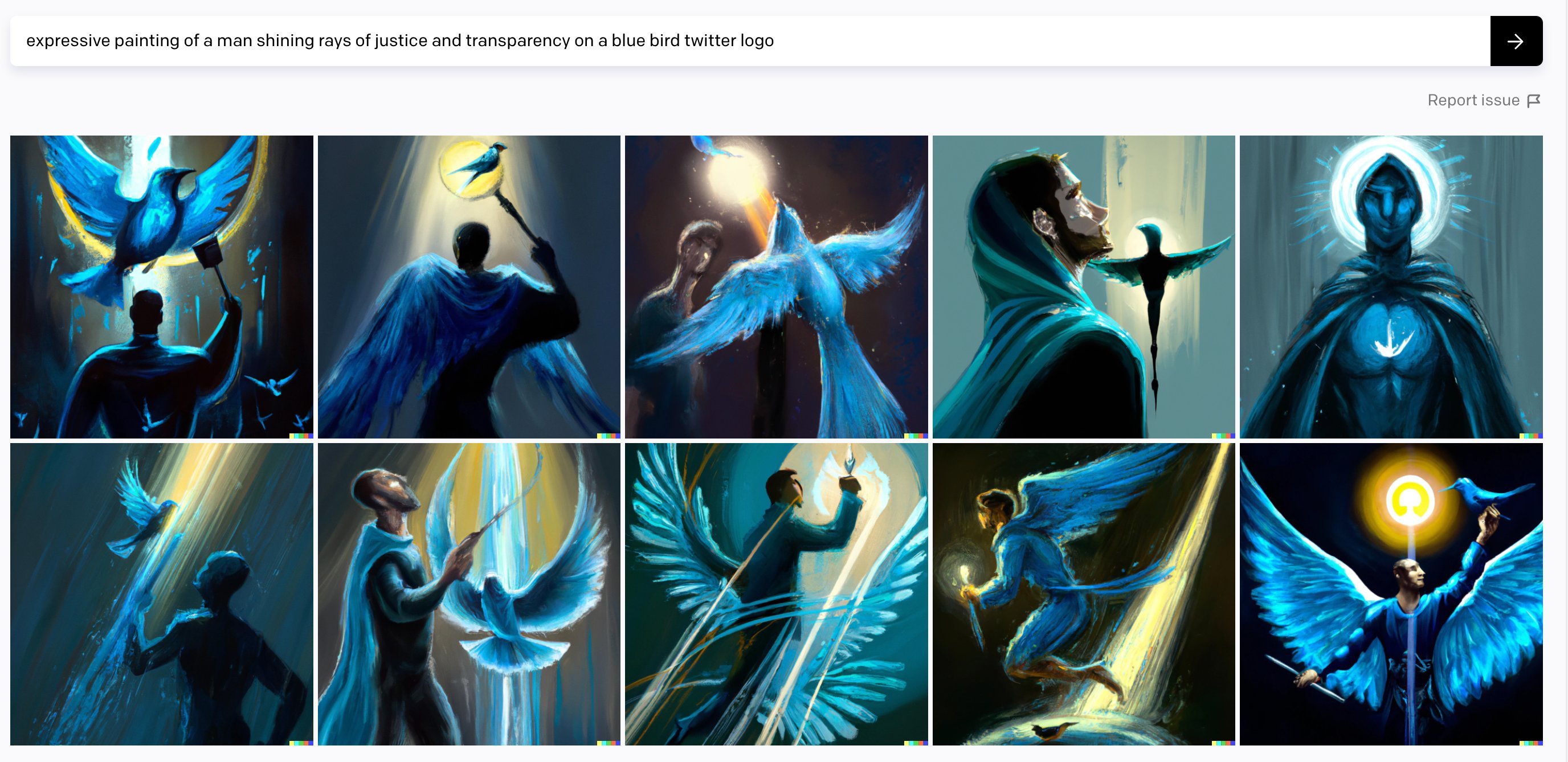
Prompt: "expressive painting of a man shining rays of justice and transparency on a blue bird twitter logo"
You have to break the concepts up apart (which is one of the things Dall-E improved on).
As such: "expressive blue bird"
In google image search, type clipart, and I even get pill tags to further narrow it down to illustrations for animal paintings and so forth. Google's classifier knows the concept of a "blue bird" and expressionism too.
https://www.google.com/search?q=expressive+blue+bird&tbm=isc...
The same for "ray of light". In fact the top results there I get pngs of sun beams on a transparent background. Which is perfect.
Neither the birds nor the rays of light in the pictures it produced are truly its own creations but lifted from bits of pictures in its training set. I bet you could find the exact bird from the second row online in many places for example. It just won't be blue or stylized.
Composite those things together manually and add a style transfer you'll get similar results to DALL-E as that is what it is doing more or less.
Is yawning at everything astonishing not just exhausting? Everything is "just" made up of less impressive things. But is this really not worthy of a little wonderment?
I disregard the narrow-AI-only folks almost on principle; Terrence Tao, Albert Einstein, Mozart, and Van Gogh couldn't do each others' jobs.
I think you just described the majority of what is (for many) the "creative process".
Or driving a car everywhere I can.
In the Enlightenment period, philosophers and scientists marvelled at mechanical automata, machines that simulated aspects of digestion, the circulatory system and the brain. New developments in machine learning are rehashing the same philosophical questions that were raised in the 17th century in response to technological progress.
The thing is, the hardest part in "creativity" is that one must voluntarily do it. That turned out to be not so easy for computer. (But I would not dare to declare it straight impossible.)
“Dall-E, generate a collection of images showing plausible war crimes from the current conflict”
“Dall-E, take this image of Dallas in 1963 and infer a new angle showing the real shooter”
“Dall-E, generate a photoshoot showing a supportive crowd rallying round the leader cheering his latest policy. Work with GPT-3 to generate plausible Twitter profiles, timelines and memes with 3 to 8 year history for each one of the supporters, including fake arguments, 78% of which are won by the pro-leader account.”
I had some fun last week constructing a conspiracy theory about this. Remember, the best conspiracy theories are unfalsifiable.
What if this has already happened? Most of the profiles on Twitter, Facebook, etc and even here on HN are in fact AI generated.
The reason we few humans are not aware of this is because the AI also writes articles and fake AI research that presents the state of the field as far, far less sophisticated than it actually is. We think of Dall-E 2 and Co-Pilot as impressive toys only because that is the impression the AI has crafted for us.
AI has metastasized and is already manipulating its environment, including humanity, to its own implacable purposes, and uses social media as one tool in its tool belt.
Absolutely love this, mind completely blown
“Anyone can post information on any topic. The vast majority of what’s on the Reticulum is, therefore, crap. It has to be filtered.... When I look at a given topic I don’t just see information about that topic. I see meta-information that tells me what the filtering systems learned when they were conducting the search. If I look up analemma, the filtering system tells me that only a few sources have the provided information about this and that they are mostly of high repute.... If I look up the name of a popular music star who just broke up with her boyfriend, the filtering system tells me that a vast amount of data has been posted on this topic quite recently, mostly of very low repute.”
Our Internet’s search engines already do a limited version of this, but there’s room to make the reputation-based filtering stronger and more transparent to users.
You're funny.
One end-game I imagine would involve more reliance on written, cryptographically-signed testimony, and people having to keep track of whether their sources are fallible (whereas certain media outlets today seem to be able to routinely tell whoppers and not get punished for it).
It could potentially spew out a grainy black and white photo of a shooting of somebody by someone somewhere. But it would not be Oswald and JFK and not the real Dallas.
>Our content policy does not allow users to generate violent, adult, or political content, among other categories. We won’t generate images if our filters identify text prompts and image uploads that may violate our policies. We also have automated and human monitoring systems to guard against misuse.
(full context: https://quoteinvestigator.com/2011/10/10/spoons-shovels/)
And then nothing.
But that said, there are certainly structural factors inhibiting innovation. Scale problems make it nearly impossible to challenge someone like Google or Facebook (although TikTok did manage the latter). Were there more competition, one imagines there would be more innovation. Patents are likely a net drag. Laws, esp. tax laws, could be simpler. I'm sure I'm omitting other important factors.
It is going to be very relevant to the current software engineers, maybe just in next 5 years.
The thing about art is that so much qualifies as good. Something very close to a beautiful painting is probably also a beautiful painting.
But an algorithm very close to the right way to count votes, or launch a rocket, or decide whether to lend to someone, is probably not the right way.
Something like interstellar travel or even a civilization on mars is actually much less realistic due to the lack of examples in existence.
I'm playing with some of the neanderthal-relatives of dall-e 2 and already have several that I kind of want to analog-paint copies of so I can hang em on my wall.
I don't even think artists are going to be meaningfully hurt from this - in fact, I think this is going to increase demand for art, because now the 'patron' can participate in the composition process more meaningfully.
I've been doing that with VQGAN-CLIP with prompts of things like "line art", "watercolor", "linocut"[1], and "woodcut" - have got a stack of things waiting for some free time to render into the physical world.
[1] "Dark Souls in the style of linocut" makes some really fascinating possibilities.
In the near future when you look at art you won't know whether it was created directly by a human or by an AI. What will that do to its appreciation?
It might not reduce the number of artists, but it will surely change their composition (pun proudly intended). Only those flexible enough to adapt to the new landscape will be able to support themselves in the new AI art economy.
Good point. Custom art used to be the realm of only royalty, and later only the rich, but soon anybody will be able to afford the fifty cents or whatever it is of computing power that it takes to execute their vague artistic instructions.
What are the economic consequences of such a society?
Side note: what might make artists a bit relieved is the fact that artifacting is still pretty apparent even in the curated examples. Fine details or even whole figures sometime devolve into that scrambled topography familiar to AI art. Even in more compositionally competent artworks, the "brush strokes" frequently have identifiable blurs at the margins. Text also seems to be gibberish even if aesthetically coherent. Even still, these are all such minor issues that additional photoshop would be both easy and readily doable.
Overall, this is frankly stunning and I'm really excited to see what others come up with. I feel like it's language and composition ability definitely did not disappoint the hype of its press release.
Text also seems to be gibberish even if aesthetically coherent.
Although "Follove me" is either brilliant or a lucky accident (https://twitter.com/nickcammarata/status/1511904232252784641).
To be fair, as a human, I struggle to understand what this means.
Admittedly, it could mean many things. But it pushes my mind towards fully automated gay space communism.
This really makes me think that the next major paradigm-shift in society is AI-related. (The most recent one being the Internet, or possibly the iPhone)
https://mobile.twitter.com/david_madras/status/1512573390896...
Prediction for 2 days after this code is released: Just double-click the area you don't like and boom -- a variant.
"DALL·E 2 can make realistic edits to existing images from a natural language caption. It can add and remove elements while taking shadows, reflections, and textures into account."
With artistic taste, not ability. For example the author likely couldn’t have created any of these images himself.
But on the plus side, even small publications will get really pretty, custom illustrations! :)
For those unfamiliar, you can see some examples of the actual game cards here: https://www.libellud.com/wp-content/uploads/2022/03/DIXIT_OV... (PDF warning)
(Could also probably generate some fantastic training data)
I ended up writing my own after it first shut down and even though the community was small, it was incredibly fun. Doing this with Dall-E 2 sounds like a fun project to bring back some nostalgia.
Several people have reported laughing so hard they were sore the next day.
Relatively soon, there will be commercial models of this quality for music/code/text/speech/images/3d models etc.
Once these AI generated assets flow like water into the hands of creators, it will significantly change the way people work.
I'm sure some people in this thread have had a taste of this working with Copilot. For me, it's most useful as an un-sticking tool, to get me moving again, or providing half remembered syntax for a language I don't use as frequently.
There's no reason to expect that similar use cases won't make their way into other industries.
- Rapid prototypes of models/textures for video games.
- Quick and easy samples for musicians.
- Emotive speech for audio books and transcriptions.
It won't replace everything, but so much of our media uses art as noise, to fill a gap, and with this, it can be done almost everywhere on the cheap.
This has already happened in video games with the advent of Unity's Asset Store: https://assetstore.unity.com/ and the explosion of video streaming services and original content. The reason we have ~50 "Breaking Bad" level quality tv-shows on-going right now is because its incredibly cheap to manufacture content and digital assets (cheaper lens, equipment, software, access to massive compute for rendering).
If anything this means an explosion of entertainment, not an upset.
I can't imagine how much media would begin to use 3d assets if it became an order of magnitude cheaper to do so.
Not to mention, imagine the pipeline of
1. "GPT-3, give me 10,000 descriptions of different doors"
2. "Dall-E 2, give me PBR textures for these 10,000 door descriptions"
3. Repeat 1 and 2 for every asset you need
4. "Dall-E 2, give me 10,000 floorplans for apartments, common areas, shopping centers etc."
5. "GPT-3, describe the contents of this apartment/common area/shopping center etc."
6. Use an algorithm to parse out the floorplans (ditch the ones that don't work, we can just generate more), populate it with assets specified in step 5 and generated in steps 1 and 2.
We could proceduraly generate entire cities for games with unique assets everywhere. It would still probably look nicer with a human in the loop, but the possibilities are staggering.
Seriously, tho, we need these for VR, which is all about copying everything in the real world into virtual worlds with some twists.
...and one of the things that people find remarkable about it is that it isn't immediately and freely available to everyone on earth.
I'm not too upset, though. The way the technology is progressing, it's a pretty short time span between "the bleeding edge researchers can do it" and "there's a phone app that can do it for free".
Open source is amazing boon to our generation, it has enabled free access to basic building blocks for people to build amazing things. But I don't think it is a silver bullet for everything.
It's a beta that they are running with their own resources. It makes complete sense that they'd have to limit access.
Whereas I could take some of these images generated by DALLE, slap a human sounding artist name on them, and 99% of the general populace would enjoy it just as they were the human produced art.
In fact, in a world where the average artwork is AI derived, the value of skilled artists may even go up. There's more to art than technically putting lines places.
For example, The Verge writes an article about Microsoft, they don't need to pay royalties for an image that has Microsoft logo displayed on a building, one can be generated for them.
They're not just conceptually accurate, but to my eyes they're pleasing to look at from a purely artistic point of view. I'd put these on my wall.
I already take a fairly bullish position on the potential of AI, given a long enough timeframe, but it does feel like we're reaching a bit of a tipping point here.
It's starting to prod at the paradigms I hold in my head about what I think "art" is.
In a turing-syle blind test of these DALL-E artworks, I think most people would be unable to tell the AI generated art from that of human artists. And I imagine that it follows that the same will be the case for music in the near future too, and likely most other artistic endeavours eventually.
I like to write music. I respect the output of other musicians (my fellow "artists") and I am driven, by both intrinsic and extrinsic rewards to keep trying to get better at my "art". But when an AI can produce works that match or exceed my art (based on whatever the measures are that we already judge art by) - it prompts some interesting questions. Does it lower the subjective value of human-produced art by virtue of reducing scarcity, and increasing accessibility?
Of course, DALL-E is trained on the output of human artists. But art is already recursive in that respect - human artists themselves are trained on the output of other artists. So that's not so different...
I guess it's the same paradigm as mass production vs hand crafting. When we pick the cheaper, mass produced item, we lose out on some of the humanity and soul that's baked into hand-crafted goods. But history has shown that we'll gladly take the cheaper, more accessible, more predictable option in most cases.
The commoditisation of art.
When things are commoditised, I tend to think that the opportunity for the creation of value (by humans) tends to move up an abstraction level. As technology becomes commoditised at a certain level, then the orchestration and management of that technology becomes the new speciality where humans are useful and can create value. When that orchestration layer is commoditised, it's the next level up that we can turn their attention to.
So the new art maybe becomes meta-art. Perhaps human artistic endeavours become more about curation rather than creation?
Or will AI art never reach a sufficient level to be considered equal to, or better than human-produced art? We can hide behind the subjectivity of all this, but something like a blind identification test (AI vs Human) removes some of that subjectivity fairly easily...
Artists take inspiration from other places too like nature, imagination, dreams, etc.
Every once in a while an artist like Picasso, Dali, Pollock, etc. come up with a new style that’s instantly distinguishable as unique from the artists that existed prior to them.
Dall-E 2 is an amazing achievement, and could replace most unoriginal artists.
If Dall-E 3 can produce novel artistic styles, that would transform art as we know it.
https://www.theguardian.com/technology/2010/jul/11/david-cop...
"One day Cope pushed a button on Emmy, went out to get a sandwich and when he returned his workaholic creation had produced 5,000 original Bach chorales."
This bit seems particularly interesting:
> "People tell me they don't hear soul in the music," he says. "When they do that, I pull out a page of notes and ask them to show me where the soul is. We like to think that what we hear is soul, but I think audience members put themselves down a lot in that respect. The feelings that we get from listening to music are something we produce, it's not there in the notes. It comes from emotional insight in each of us, the music is just the trigger."
So presumably, we can find "soul" and meaning in computer produced art because a large part of the meaning that we derive from art comes from within us, not necessarily the artist.
This is interesting to contemplate.
Impressive how Asimov has figured this out a while ago (in the Bicentennial Man) !
Otherwise, why isn't he using a pseudonym ?!?
Given that it's able to generate a dozen images in less than a minute, and all I have to do is pick out the ones that are aesthetically pleasing, I'd say that's a damn good win.
Most of them have a theme that makes sense, too.
> In other text-to-image algorithms I'm familiar with (the ones you'll typically see passed around as colab notebooks that people post outputs from on Twitter), the basic idea is to encode the text, and then try to make an image that maximally matches that text encoding. But this maximization often leads to artifacts - if you ask for an image of a sunset, you'll often get multiple suns, because that's even more sunset-like. There's a lot of tricks and hacks to regularize the process so that it's not so aggressive, but it's always an uphill battle.
> Here, they instead take the text embedding, use a trained model (what they call the 'prior') to predict the corresponding image embedding - this removes the dangerous maximization. Then, another trained model (the 'decoder') produces images from the predicted embedding.
Otherwise, my stomach is in knots, because this is terrifying.
It's not the compiled art processing here that terrifies me, it's the complexity of logic underpinning that is displayed and how it could be used elsewhere.
Someone knowledgable in this thread, please tell us it's possible to backtrace such an illustration to its learning set sources.
If these things are not just a controlled average(?) of real drawings, then something gigantic has been unlocked.
I'm the former, but not the latter. It is eerie seeing code (especially running in the vast black box that is deep learning) do things so humanlike, but I always come back to the analogy of manned flight.
We are on the precipice of a Kitty Hawk moment in AI. But just as the Wright Brothers' plane was not a bird, it's worth remembering that these systems are not minds. They are almost certainly utilizing some of the same principles that minds use, just as fixed-wing aircraft utilized the same principles at work in avian bodies, but they are coming to them via a different route from nature.
It's thrilling seeing these breakthroughs, and just as manned flight transformed the world, whatever the likes of GPT, PaLM, and DALL-E become will make the future weird in ways we can't predict.
More impressive, because of how good it is at capturing and synthesizing a wide variety of topics in a reasonably coherent way, and how it seems like it would actually be a viable mechanism for creating actual artwork, or at the very least, a source of inspiration for a human artist to touch-up on later.
Less impressive, in that it's pretty obvious it's not any more advanced than a graphical version of GPT-2, which is parroting content and styles that it has basically memorized and is really good at interpolating between.
Because there's no such thing as a "logical contradiction" in this sort of illustration, compared to a paragraph of text or a code listing, the fact that it's just interpolating between a huge database of memorized content isn't as easy to spot as with GPT-2, and matters less in the actual end result.
Maybe that's what exactly what we humans do too?
What makes this obvious?
"Wait why doesn't anyone care about the scarce thing anymore?"
In any case it seems AI is fulfilling its promise of centralizing the economy, since there will be single digit number of renderfarms generating the creative content of the internet, everyone's money flowing upward to Saint Elon
Copyright with dall-e is just like copyright with photoshop or any other software. The user of the tool owns the output. Subject to whatever other limitations and requirements OpenAI wants.
https://openai.com/api/policies/terms/
Notice this doesn't imply they possess any copyright in the first place - just that they won't make an issue of it. Copyright in USA is automatic for the author, I think whether the user of software is the author of an AI's work is yet to be established in the courts, but its pretty clear the creator of the software doesn't own its output.
The dumbass you refer to was testing patent law by trying to register his software as the inventor but the copyright case is different:
> the office’s 2019 ruling [...] found his A.I.-created image “lacks the human authorship necessary to support a copyright claim.”
> Thaler noted to the [US Copyright Office] he was “seeking to register this computer-generated work as a work-for-hire to the owner of the Creativity Machine.”
https://www.smithsonianmag.com/smart-news/us-copyright-offic...
- read the OpenAI paper
- notice there was a lot of words in the harm section
- notice the mitigations boiled down to "limit access" (a marketing strategy) & "put rando colors in a very easy place to crop out", have them note how easy it was to crop, yet they still went with that strategy
- notice no one in actual AI art community has received an invite, but random SV hoi polloi and OpenAI employees have
I had been worried about the moneyed class taking all the work we had done in the open source community informing their approach (check citations on the Dalle paper), privatize it via applying it to a large dataset they built, and not share _any_ of their data or models because "harm reduction" that amounted to marketing x not risking their ability to monetize.
It was shocking to see DallE 2 get announced and take that exact approach.
We'll keep working, LAIONs 5B dataset starts approaching the #s cited in Meta's and OpenAI's papers.
Same with GPT-3. Requested an invite. Never received one. I have written survey articles comparing different methods. So thta was probably a red flag for them.
I'm pretty tweaked at how copyright is used here:
Google gets to scan every book in the world, build derivative models off it, but when we want to see the source data we get "page ommitted from this limited preview"
OpenAI CLIP scrapes all of google images, but isn't allowed to show us the source material in its training set, since that would constitute copyright infringement
Why do the robots have the rights to the world's information while humans are left to the derivative output as the internet is flooded with auto-encoded content?
I'm going to start my own internet, no bots allowed. In the future, privacy is tantamount, if you let a bot see your work you're bound to be plagiarized in a thousand variations.
Maybe we're just search engines of a similar kind.
An additional aspect of human art is that it (usually) takes time to make. The artist might spend many hours creating and reflecting and creating some more. The artist's engagement with the work makes its way into the final product, and that makes human art richer. Could future Dall-E version create sketches and iterations of a work; is there a limit to this mimicry?
I'm feeling future shock; heavy future shock.
“Good artists copy, great artists steal.”
AI art seems to be coming from the opposite direction to human artists - from a starting position of maximum creativity and weirdness (e.g. early AI art such as Deep Dream looked like an acid trip) and advancements in the field come from toning it down to be less weird but more recognizable as the human concept of “art”.
And DALL-E is impressive exactly because it has traded some of that creativity/weirdness away. But it’s still pretty damn weird.
Based on my understanding, the only way to do this would be to write a separate classifier algorithm using the same dataset.
TLDR it’s not just the bio pasted directly into dall-e and the images are cherry-picked but dall-e is basically doing 95% of the work here. I have no ability to make art myself, and I found I could illustrate basically any bio I wanted in a couple minutes of playing around. My goal was to create illustrations for my friends not create a dall-e gallery but I’m glad it ended up being a good example of what dall-e can do
https://twitter.com/nickcammarata/status/1512119623315075081
The one I have seen so far[1] is the Twitter logo one, but it's hard to tell if the "Twitter" had much effect here or if it's just the "blue bird" that did it.
[1] https://nitter.net/pic/media%2FFPwj5G-WUA8__UC.jpg%3Fname%3D...
At the same time I fear for my illustrator/digital artist friends.
I wonder what would happen if you tried tweaking the prompt here to correct it (e.g. "this is ok, but use smaller hands"): does the drawing change slightly, or do you end up in a completely different design space?
My question is whether more compute and more data will be sufficient for the AI to create its own art styles. Everything we see here are within the stylistic paradigms created by previous humans.
However an art style also needs context: human appreciation of aesthetic values, human recognition of a style wrt prior movements... without an "ecosystem of artists and viewers" it might not be so useful.
Nevertheless... As a tool for artists to explore new avenues of expression this could be a fantastic tool, i think.
What belief systems will we form around AI art after it becomes clear that it's never going away? Many people say that art is subjective. I am thinking that if or when parity between art from humans and AI is achieved, some people are going to believe that a humanistic quality of some sort will be trampled upon in the realization that the two types of art really are indistinguishable. Others might believe that AI art is just another tool that they believe expresses their thoughts. The different beliefs might be fundamentally unresolvable, and this may become an unending source of distrust and sadness in certain art circles within the next decade.
I do not look forward to how this tech will interact with online culture several years from now.
Everything that happens in this world has a coherent causal relationship. Whether it is technological development, territorial domination, or even unavoidable natural disasters or unexpected accidents, no one should stay out of it.
If people are willing to face it, perhaps many things will not evolve to the worst level, but in this case, people usually choose to turn a blind eye in order to protect themselves, or some people are very willing to sacrifice other things for selfishness, they It is taken for granted that only the victims will bear the consequences in the end, but it is not the case, the laws of the world will one day pay back all cause and effect.
However, this is only limited to the things that the "law" can take effect.
When "exceptions" fill the whole world, then the fate of this world will be nothing but despair.
this is going to absolutely obliterate some markets for illustration and stock photography, unfortunately
This makes you think what is real art? Beauty, meaning, context
Can this achieve real art? Or just composing existing art?
If we don't preserve the art industry, and global industry flocks to the lowest common denominator, what will that mean for the future of art
If an artist invents something new and someone unrelated uses it to train a model and generate 100s of compositions who should profit from it?
What was the "license" on the images used to train the model
https://arnicas.substack.com/p/titaa-28-visual-poetry-humans...
bias in AI I guess.