I’m wondering how “counterfeit aware” payment processors (VISA, Mastercards, etc) are becoming? It seems like counterfeits are only going to become more frequent in the future and payment processors should have some awareness of counterfeits when investigating a chargeback claim.
So even better than that would be a public guide where both the fake and the real are. That, plus somebody who's put in the hours to do a thorough job to explain the differences they've found.
@MTG - Somebody was just telling me the other day about these perfect (or 99% perfect) clones of Warhammer figurines. I didn't even know they can reach $1,000+ figures, but hey, with today's asset products, that doesn't surprise me.
Magic The Gathering, Pokemon games (not cards — we've covered a free guide on that), Warhammer — it seems like sky is the limit really. Whatever can be replicated and is worth $200+ will be replicated IMO
> I’m wondering how “counterfeit aware” payment processors (VISA, Mastercards, etc) are becoming?
A bit more! They trust our Certificate with less pushback these days, more than 2 years ago, when we discovered our Certificate can get people's money back. We guarantee the Certificate nonetheless, so if it doesn't get your money back from the bank or from PayPal, we refund the $60 you paid us.
I know you said payment processors, but it's the banks (exception: AMEX) that are responsible for that segment of the transaction, AFAIK — with chargebacks and what have you
But if there would be an easily integrable solution for banks/payment processors, I can see them moving vertically into that
With an Alpha Black Lotus going for over $500K, it's only a matter of time before undetectable counterfeits exist.
Using a microscope it was pretty easy to tell them apart, based on the different printing technologies making different and hard to replicate pixel patterns (I don’t know the printing equivelent of a pixel).
Each proxy was $2, and you get to pick what you want. At that rate it’s pretty close to the rate you’d get if you bought a standard booster pack.
Maybe the next response to that is "who cares about tournaments. Just play kitchen table magic with your friends." In that case sure, but still don't use counterfeit cards. "Proxy" cards are when a player prints out (or even hand-scribbles on paper) the image of the "real" card they want to use. No one is scammed out of money. It doesn't cost anymore than a sheet of printer paper and some ink. And because the card is obviously not official, there's no confusion as to it's authenticity.
In addition to counterfeits not being tournament playable, they are not collectable either. It feels good to own/play cards which are rare, valuable, and a part of MTGs history.
The headline doesn't help much. They are doing more than "writing order notes". It's a service to check whether an item (watch, purse, designer clothing, etc) is counterfeit, divided into 3 use cases:
-You’re about to buy an item and you’re not sure whether it’s authentic or not
-You’ve already bought an item and you don’t know if you’ve been scammed
-You’ve been scammed and you want to get your money back
We do more than writing order notes in the sense that we now have:
* A Price Comparison tool
* A SaaS for resellers (that sucks. we need to fix it)
* A lot of words written on public guides
* We just started a video library
But ultimately, the bread and butter is our service. And the workflow is:
* People place an order
* We handle it by replying to them via order notes
Should've made it clearer - a mistake on my part.
So you know how there are fakes of Rolex, Nike, Louis Vuitton etc — some are scarily close. We make guides on how to tell the fake from the real item, with the best fakes.
We teach people (for free)
But we also have a service, if they want us to check it for them
I tend to see the following categories overall, and while I'm not at all interested in the label/authenticity side of things, I have a difficult time identifying well-constructed or poorly-constructed household items.
* Real label, high quality. Good to have, but much more expensive than I can usually justify.
* Real label, low quality. Typically when a brand has just been bought out, and is trying to cash in on a reputation while using cheaper construction.
* Fake/knock-off label, low quality. Trash, masquerading as a good deal.
* Fake/knock-off label, high quality. The absolute sweet spot, getting the higher quality build without needing to pay for the social "authenticity" of the brand label.
https://bychgroup.com/wp-content/uploads/2021/05/image-1-102...
What would stop a particularly clever counterfeiting factory from using this service as a 'check list' of things to change, to improve the authentic appearance of their work product? Seems like a bargain for the price.
e.g. for this very item in the screenshot, the guide is: https://legitcheck.app/guides/real-vs-fake-hermes-birkin/
Partly answered here: https://news.ycombinator.com/item?id=27090248
Partly answered by someone else here: https://news.ycombinator.com/item?id=27089111
Most people cant tell the difference between 90% and 99% close to original so they dont need to improve their quality to that point.
Counterfeits are bad for consumers because they are often low quality similes with shoddy attention to details and cheap materials.
If the end result of this site is that counterfeits increase their quality control?
Well, it'll still be illegal, but at least I might be happier with half my Amazon purchases =]
If all it means is that a few rich folks will feel bad because some poorer people have the same handbag as them at a party, I'm okay with that. They could probably do with being a little less materialistic anyway.
I do believe in moats, and I'm trying my best to see what moats I can build on top of what we have to 'protect' the business
Super cool! Thanks for sharing this though.
See one of their guides: https://legitcheck.app/guides/fear-of-god/fake-vs-real-nike-...
1) Becoming the world's leading expert on a topic
2) Share and spread that knowledge, until you have publicly cemented your place as an expert
3) Start charging for services that require usage of your expertise
I was just about to drop FB, but the groups are handy.
At first it was hard to understand what it is all about and sounded like get rich quick scheme but essentially it is about someone building a service to check the authenticity of physical items.
Also unsure why it's flagged when I came back to comment after reading. The vouch button is also missing for me (or is that only for dead stuff? Not sure what the difference is)
I mean it'd obviously benefit me more if we kept the old title, but that'd be too much me, and too little for the community
Title got corrected and I'm actually grateful the post wasn't fully taken down (or that I wasn't banned)
EDIT: And thanks for the comment below saying u upvoted!
(My experience: I collect Harry Potter books. Signed copies were always faked, because it is "easy" to forge a signature. But lately I've been seen fake first printings. Some people buy 2nd or 3rd printings (way cheaper) and change the page with the bibliographical details, which is hard to spot. Other ones even printed the whole book, those are a bit easy to spot because a 25 years old book shouldn't look as new, but if you buy it online seeing only photos, you may get scammed after paying thousdans of dollars)
We don't do art or books, but we do some collectors' items
> What happens when a buyer disputes a counterfeit item with their "message" and the seller doesn't agree?
We ourselves can help if the customer paid via paypal/credit card — we've got the service mentioned in the article, which gets people's money back with 99.9% success rate, which we also guarantee it (so if it doesn't get your money back from the bank or from PayPal, we refund the $60 you paid us)
But yes — if you've been scammed by a malevolent seller, they might even believe the 'message' (they themselves know the item is fake anyway) and not care to do anyhting
A lot of people are ready to pay for a 20$ bag on AliExpress and probably never seen how a real Louis Vuitton bag feels, so they don't see/feel the difference. Same thing for jewelries, watches, shoes, etc. You see a lot of fake Yeezy (for example), and you can probably get a similar enough shoe to the real one, but it'll cost 100-200$, and most people are not ready to pay this price for a "fake".
On r/repladies, I've seen girls pay 1200$ for "fakes" that are very similar to the real product, at a certain point that only a handfuls of people will see the difference.
I work with shoes on a daily basis and have done/do auth checks.
Also, my next thought was that if you actually wanted to buy replicas, and were okay with gambling your money, it would be possible to buy the fake that pretends to be real, and then get refunded, you get a decent fake for free (minus risking your money).
I guess you'd need to create new accounts as the pattern would become obvious over time, but I like the idea of fakers, and platforms that don't prevent it effectively paying the price rather than dumb consumers, especially since it reduces the utility of online shopping for me.
I find it ironic that you are selling authenticity checks, and yet I can't tell if the check is authentic.
* We write public guides (see: https://legitcheck.app/explore-the-library/) - we have about 1m words written on the subject * People are free to contest it. If we're wrong, we'll correct * The more other people link to our guides, the more we get... credentials, I guess?
Can't the infosec community define and setup a "trust" network?
E.g. everybody trusts a number of people, and trust can be transitive (perhaps with weights). Hence when I read some review the network can compute a trustworthiness value. If the product turns out to be fake, the system can do a backprop and adjust weights. Etc. etc.
I just have a difficult time seeing how it could be cost-effective, without being eye-wateringly expensive.
Being able to detect forgeries requires some pretty intense domain expertise, and that tends to come with a lot of experience and schooling. Those folks don't run cheap. Very often, you need specialists in each domain. For example, you can't have a fashion purse expert determining whether an "antique" firearm (where forgery is a big problem) is fake.
I'd assume the biggest value would be to contract with auction houses or appraisers, where the workflow would be familiar. With regular users, the workflow would be all over the place, and I could easily see the whole thing taking hours, because the user keeps sending cruddy photos in a tungsten light, so the color can't be judged, or the focus is off.
But I guess if it's really just sending links to Amazon listings, things are fairly "standardized," so a number of assumptions can be made.
Nonetheless, this is not my area of expertise, and the OP insists that it is a viable service, making a profit, so I must offer kudos.
> I just have a difficult time seeing how it could be cost-effective, without being eye-wateringly expensive.
We write the guides first, which 'earns' us the 'audacity' to claim we know how to authenticate. I thought of the academic world so as to prove the expertise (I'm the complete opposite of an academic)
* We write public guides (see: https://legitcheck.app/explore-the-library/) - we have about 1m words written on the subject
* People are free to contest it. If we're wrong, we'll correct
* The more other people link to our guides, the more we get... credentials, I guess?
> you can't have a fashion purse expert determining whether an "antique" firearm (where forgery is a big problem)
We don't really get that far, into firearms and the such. Currently we do sneakers, clothing, watches, bags and some collectibles (e.g. Pokemon Cards)
> I'd assume the biggest value would be to contract with auction houses or appraisers, where the workflow would be familiar
We've worked occasionally with some (e.g. authenticated a pair of $20,000 Jordans: https://legitcheck.app/certificate-of-authenticity/property-...
But mostly B2C, so it's a consumer-focuseed service
> But I guess if it's really just sending links to Amazon listings
The products we're authenticating are mostly 'asset products', so items that are $300+, most of the time sold-out, have some resale value over retail OR retain more of their retail value than usual items (think: Chanel items)
Fakes can be very convincing and genuine manufacturing processes can be very variable.
Does it really require that? Perhaps for some items expensive enough to have expert forgeries (like with artwork where sometimes you need to test the composition of the paint itself or x-ray the canvas) but I doubt that’s the case for the typical knock-off item where all you need are pictures.
Here’s how I would go about this if I, as someone who knows absolutely nothing about any of this, wanted to setup this kind of business.
First, I would search for images of popular items which have known knock-offs produced. Let’s say the Nike sneakers or the Louis Vuitton bag mentioned. I would gather as many pictures of the known, proven knock-offs as I could. Then I would find official images published by Nike and Louis Vuitton. Put the images side-by-side and it’s simply a matter of going through that children’s exercise where you spot as many differences between the two pictures as you can.
Then given all the differences I spotted, I would start writing up guides documenting all of what my rudimentary exercise discovered. Publish the guides to gain credibility and then participate in various forums where those products are discussed. Pump the free guides and get established as an authority, even though all I’ve done is use my eyes to spot differences.
Then, just as they wrote up, start offering to check people’s stuff for free. When it hits a certain volume, offer priority service, etc. Same playbook for that.
When you get an item you’ve never reviewed before — say, a Rolex watch — ask the customer to submit photos that exactly match ones that Rolex publishes (actually, you should always ask for matching photos to make the work 100% trivial). Rinse and repeat: spot the differences.
You may not find 100% of the differences but you can get close enough to authoritatively state if it’s a knock-off or not. If you hit a wall where you’re not sure if the Rolex is real or not, there are two options. If Rolex is amenable to this, send the images to Rolex and ask them if there are obvious signs of a fake. Then you’re just playing the middleman and if Rolex needs more photos to authenticate, relay that back to the customer. If they’re not, I’m sure it’s not too difficult to locate someone who you know has a Rolex. Or maybe partner with a jeweler and cut them in.
Hey, now it’s not just you anymore and you can claim you have a team of people performing authentications behind the scenes. Customers don’t need to know that your team is really just you and a buddy who can spot differences between pictures, plus occasional ad-how strangers, and maybe even the official companies themselves from time to time.
I’d be somewhat surprised if they didn’t do exactly what I described.
I'm curious if they have or might reach a point whereby you'd need to open up the watch and look at the movement quality?
To expand on this, serious watch collectors will keep service records from authorized dealers as proof of authenticity. For example, many models of Rolex have “service” parts that differ from the parts originally used in the model. Pricing general follows the hierarchy: original parts > oem service parts > non-oem replacement parts. The pricing gap between each of those steps can be in the tens of thousands. So if eBay authenticates a Rolex as original and you later on find out it has some non-oem replacement parts, you’ve likely lost a significant amount of money on that transaction.
It'd help us to open the watch, naturally, but we can still rely on pics. Make no mistake though — the watches can be 99.5% perfect, but (at least for the watches we're handling, which have high values) the compromise in manufacturing processes is spotted one way or another
It's worth pointing out that the discussion about replacing pieces of a fake watch with authentic pieces (making a so-called 'franken' watch, as rep watch connoisseurs call it) is a totally separate discussion
It’s only problematic if you’re corrupt or incompetent and become a means to reinforce the fraud.
If anybody reading this is able to create something that can reach 99%+ accuracy in terms of authenticating items, I've (obvious in the post) got the distribution and the audience to sell this to — DMs always open if you've got something solid
Currently it's a fully manual process.
We have competitors claiming they're 'using AI' but it's a bullshit gimmick for the masses of users. Unless an 'AI' is having 99%+ accuracy, it's probably too risky to implement
They started efforts to curate that, but it's far from cleaning eBay 100%
What you're saying happens, more often than we wish it'd be the case.
That's why we never considered charging for our guides, even something as little as $1 → The point was to allow people to inform themselves about fakes, with as little friction as possible
That way, if we bump the % of people who get scammed by even a few negative points, we'd still be happy for a positive contribution
You claim:
> An authenticator that has public, verifiable proof to their claim of expertise will be assigned to your order.
Can you please share some of that public, verifiable proof?
You are averaging $28 per order and you say you have a 'team' of experts to help you do authentication. Is an expert's time really worth so little that this price point is profitable? Or is authentication really that trivial to do?
You only track revenue and net revenue and not profit. You are getting around $200k in revenue per year. It would be very enlightening to know the costs of the team of experts and now much of that revenue is profit.
You seem to be running something like 6 other lines of businesses at the same time:
- Layered Ink, a new way to do digital writing.
- Price Unlock, a SaaS pricing tool.
- Synergy, something that helps with decision making.
- Dear Mom/Investor, writing up progress/financial number of your businesses for subscribers.
- LegitCheck Price Comparison, a tool to find the lowest prices
- LegitCheck Organizer, a reselling tool (without those unnecessary fees)
To do that many things well would be extraordinary.
Doing some brief investigation into your competitors, this industry seems to be full of companies putting forth an image that they are a large and respected team with real expertise, while further digging suggests they are one person writing their opinions of questionable value and calling them certificates of authenticity. Why should your users trust that you aren't another one of those companies?
You claim expertise in 91 brands. In order to truly be able to authenticate those, it seems like it would require a good amount of expertise and time. You claim:
> Real expertise, not self-claimed.
> Find out the truth about your item and either start wearing it proudly or we’ll help you get your money back. > Our expertise is backed by the 1,000,000+ words we've written on this subject.
but with all due respect, writing lots of blog posts is not a basis for 'real expertise' rather than 'self-claimed'. You could be an expert in authenticity for 91 brands (I have no idea), or you could be a rando on the internet regurgitating (mis)information found on the internet. Being good at something and getting noticed for talking about something a lot are different skill sets. Why should your users believe you have real expertise in all 91 of those brands?
The hard part of success like this often seems to be finding an under-served niche where you have, or can easily gain, some expertise. If anyone knows of a guide or has advice for how to solve that problem, I'd love to hear it.
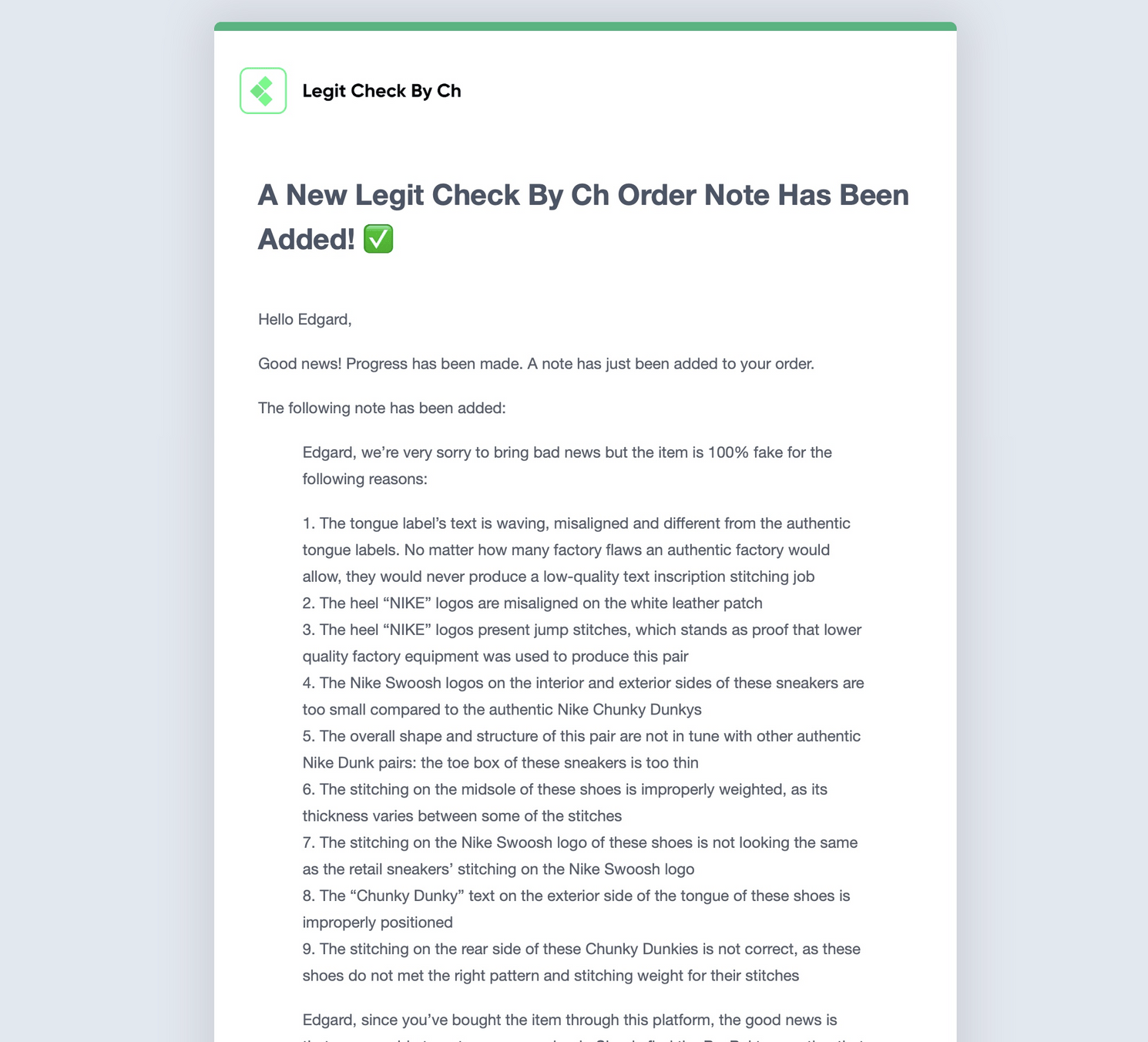
You have to imagine someone paid money for this and is eagerly awaiting a response. Queue "I got an e-mail!":
1) Green checkbox: So the item is legit?
2) "Good news!", so it must be legit?
3) "the item is 100% fake"
You should really consider changing the design and the tone of this message. People literally pay to get one answer so it should be the most obvious thing about the message.