In short, I would just ask people to remember that there are quite a few farmers who would love to stop paying for fertilizer if it didn't impact their yields: all of them in fact. It's one of their biggest costs generally. When an organization says "The Farming Systems Trial was started by Bob Rodale, who wanted scientific backing for the recommendations being made to the newly forming National Organic Program in the 1980s" they've incorporated confirmation bias into their heart.
I'm certainly biased, I'm the CTO of a company that's trying to improve agricultural inputs by financing access to smallholders in subsaharan Africa (Apollo Agriculture, we're actually a YC F1 company also,) but it's worth noting that this is research that's quite a bit outside the normal recommendations that ag scientists believe. I also worked at The Climate Corporation before, to put all my potential biases out on the table.
I live on a 54 acre property: I can picture 12 acres as about a quarter of my property. If I further divide that into 72 plots, I end up with a bunch of little gardens.
What works in a small garden plot is usually totally unscalable at crop production volumes. My experience (over decades) is I couldn't sustain my family for a year on a 1-acre garden plot even if I had the time to work it intensively and used nothing but recycled organic byproduct (compost and, uh, other stuff) as fertilizer. Even if we tried to reproduce the great Kampuchean agricultural experiment of the mid-1970s and put everyone to work in the fields full time we could not feed the world this way.
I don't have a problem with folks idly dallying in this kind of research, and I think useful practices could possibly be revealed, but scale and practicality need to be taken into account when interpreting results.
I find this surprising. I help run an Atlanta-area non-profit that has a ~1 acre organic farm that donates everything it produces. For the year 2020 we have already donated 3120 lb / 1415 kg of food.
We're not trying to produce a nutritionally complete output on the farm, but that's still ~70 lb / 31.7 kg of food a week on average.
Check out “The Market Gardener”[0] if you need help learning how to do far, far better than this. We need more, smaller farms. Biointensive farming and permaculture can save our planet.
That suggests that there's a middle ground, where we shift to more labor-intensive practices to grow some more expensive but better produce that's less hard on the environment, without dismantling the entire industrial system. People could introduce more fresher foods, while still growing vast amounts of highly-processed-maize-and-soybeans for people who can only afford that.
There are a lot of dimensions to that. It's not easy to prove that eating this way is necessarily healthier or easier on the environment. But we do know that the Western diet is bad for people's health, and we do know that it's hard on the environment, so it's worth considering alternatives.
That should give you between 4 tons (for wheat) and 25 tons (for potato) of produce. Surely that's enough?
Aside: it seems we've long been able to feed the world (in terms of meeting caloric and nutritional needs) based on American farm capacity alone, it's just that nobody wants to pay for it.
They have 3 x 2 = 6 different approaches being evaluated
It is divided into 3 overarching systems: organic manure, organic legume, and conventional.
Each system is further divided into two: tillage and no-till, for a total of 6 systems. There are a total of 72 experimental plots.
It is likely that the 6 main approaches have been divided into smaller plots to act as a control for natural soil variations within the area, or, e.g. one side of the field being nearer to a river than the other. This is normal for agricultural experiment design I believe.
I'm no expert, but you cannot maintain a healthy soil without putting stuff back in it - manure, biomass / mulch, etc.
Anecdotal and incomparable, but my backyard (just a few m2 of exposed soil) has had an overhaul in the past year or two; it was very sandy and kinda boring, but mixing in mulch / soil improver made it a lot better. There's worms in the soil now, that kinda thing.
But yeah, you need some kind of fertilizer or the soil will just 'die'. Leave the clippings after harvesting, yeet a load of other biomass on there in between harvests, let it lie fallow, etc.
But I think an issue is that biomass in whatever form is actually quite difficult to get in significant quantities, or hard to balance, so artificial fertilizer is used instead.
Organic fertilizer is generally cow poop. Cows are fed almost exclusively grain corn (and then are admittedly grass finished, but generally the manure you could get is from the grain feed period.) That grain corn is... made with inorganic fertilizer.
To keep making more food, someone has to introduce nitrogen into the system. You can use bat guano (which we actually used to use before inorganic fertilizer) or you can use nitrogen fixing crops (great but typically fix much less nitrogen into the soil then people think!) or something that comes from inorganic fertilizer, whether it's been green washed through a cow's GI tract.
It's also a logistical nightmare as it's much less dense, but that's a separate problem. A huge fraction of the problems of soil health in rural places are logistical.
Joel Salatin has been doing no-till, no fertilizer farming at scale for years and his videos are really eye opening on what is possible. As a layman with a small home garden I do not have the expertise to say if this would work for more people but it is interesting to read about.
I think you are over simplifying here. Of course simply stopping artificial fertiliser will hit yields. The question is whether other methods can be introduced that will sustain yields with fewer detrimental environmental impacts.
Which would be amazing if true, since it basically means "hey, free money". But as you say, it feels a little over simple.
I'd be curious to know what the catch is.
Also if you want to get the most out of your fertilizer you will automatically be trying to reduce erosion. No one wants to put investment into soil that is going to disappear or be lost.
There is also an increasing amount of regulation around controlling runoff of fertilizers in order to control water quality in lakes, rivers etc. Follow what is happening in Ohio and Lake Erie for example.
Seems like erosion has more to do with farming technique, independent of fertilizer use or not.
The soil erosion of the Dust Bowl area was addressed through improved technique. Fertilizers were not a key component of that.
Or is it better to sequester carbon that land? The world is not short of maize supply
Then the answer is no, not any time soon at least. Plenty of other land is available.
- SSA has ~ 1.25B hectares of agricultural land.[0]
- The total harvested area under maize in Africa was around 38.7 million hectares in 2018.[1]
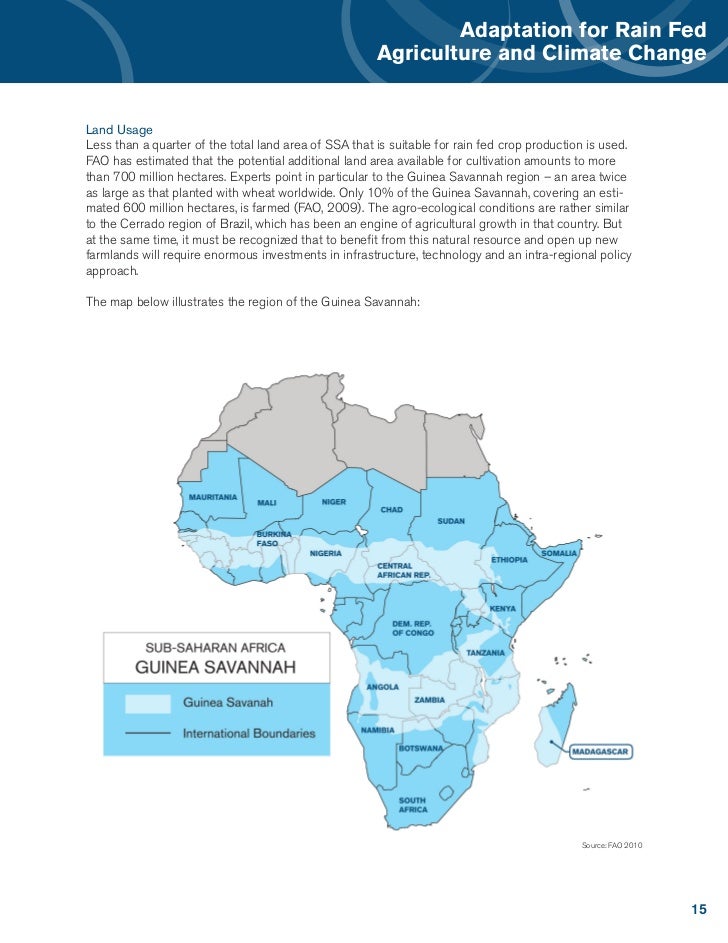
- Less than %10 of the Guinea Savannah region (a region where crops much more lucrative than maize can be grown, ~600M hectares) was farmed as of 2009.[2]
[0]https://data.worldbank.org/indicator/AG.LND.AGRI.K2?end=2016...
[1]https://www.mordorintelligence.com/industry-reports/african-...
[2]https://image.slidesharecdn.com/60366271-evolution-economic-...
Problem is people laugh at that concept and then complain we have overproduction, dwindling soil health, and poor water quality.
Please explain how synthetic fertilizer reduces the yield of nutrient dense food. I can't find anything to support this in my cursory searches.
I do appreciate you pointing out your previous work with The Climate Corporation, but it’s probably also useful to point out that they are a subsidiary of Monsanto.
Why would that be useful?
Yes, but only if you start with degraded soil in the first place. Adding fertilizer to healthy soil just messes it up.
Even when you start with degraded soil, the fertilizer and modern agricultural practices only help up to a point and then diminishing returns set in.
Check out what Gabe Brown is doing on his land: "Treating the Farm as an Ecosystem with Gabe Brown Part 1, The 5 Tenets of Soil Health" https://www.youtube.com/watch?v=uUmIdq0D6-A
So if a practice reduced yield by 50%, for the US it would mean reducing the calorie yield by 1B people? (Ethanol, feed for animals and the like ignored). How much surplus is in the system to support alternative practices?
I'd just like to point out that these are two different continents with completely different conditions, soils, microbiota, seeds, pests, and climate. So apples and oranges.
Also, you count wrong because you don't count the number of acres needed to produce fertilizer.
> I'm certainly biased, I'm the CTO of a company that's trying to improve agricultural inputs by financing access to smallholders
At this point, yeah, your financial incentives pretty much color your entire worldview. If you stand to make O(millions) and this is your primary line of work, that's a one massive grain of salt.
The number of acres to make fertilizer are minimal. It’s very, very small relative to agricultural land under cultivation.
In regards to financial incentives, I mention this specifically so you know I could have a bias and am leaving references to the science so you can make your own judgement. I’m not really in this line of work for the money though.
(To give a few examples of books that have changed my mind, I was a very conservative libertarian growing up in the school of Nozick, but ended up being much more liberal as a result of reading Foucault and his rather compelling recasting of how power dynamics work. I found Peter Singer, Nussbaum and Sen to all be compelling enough writers to basically convince me of what I should spend my life doing. If you have suggestions for science based books, I’d love to read them, but I find religious fiction generally leaves me unmoved and uninterested.)
I bring this up mainly because one of my first thoughts in discussing, e.g., US corn agriculture versus Subsaharan agriculture is whether or not you'd even be able to compare them well because the crops optimally suited to each would often be entirely different. I think often probably so, but at the same time I wonder if things would look different if the same volume of money and resources were put into things that assume different consumption preferences.
I'm not opposed to conventional agriculture, and don't believe in pointing fingers when it comes to food sustainability (in an ecological as well as humanistic sense). I do sometimes wonder, though, if conventional practices are often driven by assumptions or factors that are unwarranted or problematic in themselves.
The reason people don't do this isn't because they aren't aware of such practices, they don't do it because you have to thread a needle as far as precise management is concerned to simply turn a profit. Not that much room for margin in today's agriculture landscape
In that model there is almost no incentive structure for soil maintenance, environmental stewardship, diversification, etc.
Most landowners here aren't even leasing it for the revenue, which is pretty peanuts for cash cropping on smaller plots, but for the indirect benefit of being able to claim farm tax rate instead of regular residential tax rates.
For many years my vineyard, garden, etc. suffered from herbicide drift from next door -- but there was not a single contact I could go to to talk about this, everyone just points the finger, or you can't find the party involved. Responsibility too distributed, etc.
There needs to be economic incentives for farmers AND landowners to adapt these practices. It WILL cost money. See a link to my blog I posted in a different post. I talk about this in semi-depth.
Solve this problem and you can really change the system.
Don't single out ag please
https://thinkingagriculture.io/innovation-efficiency-chemica...
Phosphorus is plentiful, current methods give us a 300+ year supply and other options exist. Potassium is a little more questionable we are likely to need to mine the ocean floors fairly soon which would spike prices, but it could ultimately be a closed loop where we are collecting the runoff.
There is another article on this site about how corn will uptake far more nitrogen than it needs, so cheap, abundant nitrogen isn't really as necessary as we believe.
Would everyone composting solve this?
If anyone was unaware, urine is high in nitrogen and when added to compost is like "adding gas to fire, but slower". I never had an issue with Nitrogen in my compost.
I can see nitrogen going to waste if food ends up in a landfill, but I imagine our sewage systems recycle this for profit.
Is this manageable with habit changes?
[1]: https://www.macrotrends.net/countries/USA/united-states/arab...
The changes you are citing are miniscule. A rounding error.
Older methods absolutely destroyed arable land because they had no robust method of replacing what the crops took besides manure. For example, in the US, as soil east-coast farms were depleted by intensive farming in the 1700s and 1800s, people struck out west for fresh soil. This culminated in the dust-bowl era, and a rethinking of farm management.
With modern fertilizer and testing, farmers can replace and renew their soil in detail with the specific macro and micronutrients which are lacking. Furthermore, no-till methods keep the soil anchored in place while more advanced methods of manure and residue use allow for building up organic matter.
There isn't any more land. Farmers are no longer migrant. It is in their bests interests to protect the vitality of their soil, and they are doing that.
Until about 1870 it wasn't possible to "intensively" farm land. Intensive requires mechanisation. Practically that requires internal combustion engines.
Intensive farming started when tractors became cheap enough for everyone to use. As soon as it was practical to plough hundreds of acres in a day, thats when "intensive" was a thing.
In the US thats roughly the 20s.
The second revolution was cheap pesticides with short half-lives. That was Glyphosate in the 70s.
In terms of your link, it looks like it’s not counted as farmland if it’s abandoned (no intention to farm it in the future). Some of that land may no longer be able to be cultivated, but I’d assume that’s not the only driver of the decrease.
No sane farmer who derives their living from farming is going to take such a huge risk when annualized corn-soy production is heavily subsidized by the government (rightly or wrongly) on the _possibility_ of these practices maybe paying off (someday).
https://thinkingagriculture.io/incentivizing-regenerative-ag...
edit: There is a carefully crafted statement on the OP link saying increased yields in dry years. Outside of 2020 and 2012, the Midwest has been anything but dry. Can't expect people to adapt unprofitable practices
Milk is very subsidized as well. You could pair local dairies with local farmers participating in similar programs.
The 'niche' guys may make good money, but their complexity is probably 1x-5x (maybe more) a 'stereotypical' row crop farmers farmers. That has to factor in somewhere.
You see, keeping cattle takes a lot of work. Constant vet bills for inoculations, treatments when they get sick. Corn-feeding, to maximize their size, means buying a lot of corn. Constant attention and work. And my parents' friend, well, he was tired of it.
So he put his cattle out into a field. And he did nothing. If one got sick, it went to the dog food place. They ate grass that grew in the field. They didn't get as big and he didn't make as much money, but he also got to take things a bit slower, easier.
Then, organic beef became a big deal. He did not give a shit about 'organic' or whatever these strange hippies were talking about. But he was more than happy if they wanted to pay him extra for his laziness.
(Note: I am paraphrasing a second-hand story and while I grew up rural, I didn't raise cattle- mistakes are being made here, forgive me.)
I don't know how he's competing on size, but the claim is that grazing down to the ground is less efficient for cattle, and you should move them long before they get to the bottom of the grass stalks.
For example, a more intensive version of the lazy farmer's method would be to set timed gates around the property to induce herd movement for optimal grazing.
At a talk on regenerative farming, one speaker estimated he was making about $150 an hour based on how little time it took to set and maintain a well designed gate system. This was on leased land.
Over the past century, increases in agricultural productivity (due to high-intensity farming) in North America and Europe have allowed for the 're-wilding' of an area almost as large as France.
The increased yields from input-heavy factory farming can essentially be seen as a loan of yield from the future. If you are overleveraged, and your capital (in this case the nutrients in the soil) is finite then when capital is depleted (leeching into the environment in this case) getting back to square one will require investment or continued increase in leverage.
This is one article I read a while back: https://ourworldindata.org/is-organic-agriculture-better-for...
Can someone point to more good literature on this topic?
In that vein, see your own link:
The organic-conventional debate often detracts from other aspects of dietary choices which have greater impact. If looking to reduce the environmental impact of your diet, what you eat can be much more influential than how it is produced. The relative difference in land use and greenhouse gas impacts between organic and conventional systems is typically less than a multiple of two. Compare this to the relative differences in impacts between food types where, as shown in the charts below, the difference in land use and greenhouse gas emissions per unit protein between high-impact meats and low-impact crop types can be more than 100-fold. If your primary concern is whether the potato accompanying your steak is conventionally or organically produced, then your focus is arguably misplaced from the decisions which could have the greatest impact.
I suspect that the input of cow manure is not sustainable, or not scalable, or not economic. That part of the article is a bit whiffy-washy to me.
Using cow poop is actually very smart. We (society) want meat so it is good to ensure efficient use of everything in that supply chain, using cow poop as a fertilizer is a great way to do that.
Reposting a comment I made a few weeks ago:
A brain dump:
I've been investigating a few systems of agriculture.
- There's Small Plot INtensive (SPIN) which is specialized for market production, emphasizing minimizing labor and maximizing market crops.
https://spinfarming.com/ (Be aware that these folks are selling their system as a course, and this is a sales site not an info site. You can get the details from reading carefully and watching the videos that practitioners have made.)
https://www.transitionculture.org/2011/09/05/spin-farming-ba...
Quitting Your Job To Farm on a Quarter Acre In Your Backyard? https://www.youtube.com/watch?v=SJx1SPClg6A
Backyard Farming: 2 Year Market Garden Update of Nature's Always Right Farms https://www.youtube.com/watch?v=Zpn1oGkQrrg
Profitable Farming and Designing for Farm Success by JEAN-MARTIN FORTIER https://www.youtube.com/watch?v=92GDHGPSmeI https://www.themarketgardener.com/
Neversink Farm in NY grosses $350,000 on farming 1.5 acres (area in production). https://www.youtube.com/watch?v=u5IE6lYKXRw
- Then there's the "Grow Bioinstensive" method which is designed to provide a complete diet in a small space while also building soil and fertility. They have been dialing it in for forty years and now have a turn-key system that is implemented and functioning all over the world.
http://growbiointensive.org/ (These folks are also selling their system, but they also have e.g. manuals you can download for free. I find their site curiously hard to use.)
- Permaculture (which could be called "applied ecology" with a kind of hippie spin. I'm not a hippie but I'm sometimes mistaken for one.) and a similar school (parallel evolution) called "Syntropic" Agriculture.
Both of these systems aim to mimic natural ecosystems to create "food forests" that produce crops year-round without inputs (no fertilizer, no irrigation.) The process takes 5-15 years or so but then is self-sustaining and regenerative.
For Permaculture I find Toby Hemenway's (RIP) videos very good:
https://tobyhemenway.com/videos/how-permaculture-can-save-hu...
https://tobyhemenway.com/videos/redesigning-civilization-wit...
There's a very lively and civil forum at https://permies.com/forums
For Syntropic agriculture: https://agendagotsch.com/en/what-is-syntropic-farming/
(FWIW, I find Gotsch's writing (in English) to be impenetrable, even though I pretty much know what he's doing. Anyway, his results are incontrovertable.)
I'm afraid I don't have a good link in re: Food Forests and eco-mimetic agriculture yet. This "Plant Abundance" fellow's youtube channel might be a good place to start, in any event it's a great example:
https://www.youtube.com/channel/UCEFpzAuyFlLzshQR4_dkCsQ
- If you really wanted to maximize food production and aren't afraid of building insfrastucture (like greenhouses and fish tanks) there's the (sadly now defunct) Growing Power model:
https://en.wikipedia.org/wiki/Growing_Power
https://www.youtube.com/watch?v=vs7BG4lH3m4
https://www.youtube.com/watch?v=jV9CCxdkOng
They used an integrated greenhouse/aquaculture/compost system to produce massive amounts of food right through Milwaukee winters.
- Then there is the whole field (no pun intended) of regenerative agriculture, e.g.:
"Treating the Farm as an Ecosystem with Gabe Brown Part 1, The 5 Tenets of Soil Health" https://www.youtube.com/watch?v=uUmIdq0D6-A and "Symphony Of The Soil" Official Trailer - https://www.youtube.com/watch?v=zXRNF_1X2fU
This is very much non-hippie, very much grounded in (often cutting-edge) science (ecology, microbiology, etc.) and ecologically and economically superior to artificial methods (e.g. Brown makes money. It's actually weird that more people aren't adopting these methods faster. You make more money, have fewer expenses, and your topsoil builds up year-on-year rather than washing away in erosion.)
I currently have two spaces that I have established to try to take advantage of this low water use method. One is a keyhole garden [1] where I currently have a bunch of strawberry plants growing. This is the first time in 20 years of living here that I have strawberry plants that are still alive after summer heat is done. Something is working right.
The other space is one I just completed constructing last week. It is an orchard space using hugelkultur concepts of mounded compostable debris. I don't yet have any idea how that will work but hopes are as high as the summer temperatures in Texas.
I had a lot of logs, branches, limbs, and twigs from various weather events and several piles of composted wood chips and composted yard waste that I used to build the mounds. I had to buy some topsoil since that is in short supply on my place and I bought some composted manure too. I rented a skid steer to manage the construction so that part was easy. Doing what I did with a wheelbarrow would've been a huge job or one requiring multiple weak minds with strong backs or maybe promises of lots of free beer and smoked brisket.
I have a variety of fruit trees planted (avocado, plum, pomegranate, apple, moro orange, lemon, fig) and will be covering the mounds with various deer-resistant plants. Some of the plants will be garden plants - onion, garlic, etc. Others are herbs for home use - mullein, saffron crocus, yarrow, hollyhocks, hyssop, and others.
I chose this method since it seems well adapted to the challenges of growing in rocky soil in an environment where temperatures can get high for extended periods of time, like North Texas. I live on a rock outcrop and nothing grows unless it is in raised beds or heavily irrigated. I get all my potable water from my water well so I'm not inclined to waste it and very much prefer to plant things that are adapted to the area. I have killed off many non-native plants and invasive weeds since I moved here and allowed native grasses and flowers to take over. This saves a huge amount of maintenance since I don't water anything water the first year. It either lives with what the sky gods provide or it becomes a dry twig. I've had my share of dry twigs.
My greenhouse and garden area use rainwater harvested from the greenhouse roof and collected in a tank. The pump we use to fill water buckets is powered by a solar panel with a battery backup. The greenhouse itself is my kids' enclosed sandbox building (I built that a long time ago) modified to a greenhouse since the kids have grown up.
I have followed the Rodale's work since back in the early 90's and have used that over the years to guide my gardening plans and have found information gained to be very useful for those like myself who want to have small gardens for their family use. I'm glad to see they have carried out their long-term tests successfully though I don't know how much uptake they'll get among larger farmers. I do know that the method of maintaining soil fertility is a solid way to guarantee success.
[0] https://richsoil.com/hugelkultur/ - General introduction to Hugelkultur and the construction of the mounds
[1] https://gardeningmentor.com/keyhole-garden/ - Good introduction to Keyhole gardens and their construction
I'll add hugelkultur to the list.
That said, the remaining 10% market is probably a 100B-1T market opportunity (seriously). Not many startups either.
They have shown conventional soil will return to normal after 1 growing season, which is pretty wild.
They even reimburse farmers that make the switch, but don't see the same yields.
Greg Judy and Gabe Brown being some bigger names but Chris from Sylvanaqua Farms is a good Black/Indigenous voice to start listening too.
So.. by no-till they mean occasional till?
My naive thought on no-till is that, in addition to reducing erosion, the soil gains a poorly understood yet very beneficial network of information and nutrient sharing that builds over time (eg mycelium). Tilling destroys that. Also I read it works best with diverse, cooperative planting instead of mono-crop factory farming.
https://geog.ucsb.edu/the-lawn-is-the-largest-irrigated-crop...
“The analysis indicates that turf grasses, occupying about 2% of the surface of the continental U.S.,”
“Agricultural land (% of land area) in United States was reported at 44.37 % in 2016”
Also getting in grazing animals does a great job of prepping land for new growth.
My mother gave me some years ago a late 80s/early 90s copy of the “Rodale book of composting,” which was excellent and I recommend. I have been applying the principles in my own home garden but was unaware of the larger context.
about Ruth Stout and her no-till garden & farming approach.
Admittedly, during her initial year of the garden, she tilled the plot. Subsequent years she used mulch cover (and perhaps some strategic cover crops).
We have to grow good soil and eliminate manual and low paying jobs in Ag. Protect water sheds. Environment and labour...that should be the priority.
And we need to stop making food a speculative game.
The listed caveat that it takes years to return to previous yields is important. Healthy soil doesn't happen overnight. Farmers that already have a lot of debt will struggle to make this switch.
"The Call of the Reed Warbler" is a book that has extensive case studies and stories about people applying regenerative agriculture to their farms. It is especially focused on Australia.
They’ve made great strides domesticating a perennial cousin of wheat which allow use of existing equipment for harvest and doesn’t require replanting each season. It’s Actually a real product called “kerenza” and I have half a pint of kerenza flour sitting on my counter right now (tastes like regular flour)
They have a number of other projects with a lot of potential too!
They’re on Amazon smile also, without even doing anything different than I otherwise would have, (for better or worse) we gave $200 to them via Smile.
They could use your support any way you are able to contribute!
TL;DR: focus on soil health and diversify your crops. His results are stunning.
Weeds? There are very few natural weed killers - hank pick? Robot machine weed picking is getting better and better.
I doubt that this scales. There just isn't enough manure (organic or not) to build soil.