This is a pretty bold claim, at least for now. People have been claiming this is the case for decades, but I still don't see it.
Western (US / EU) demand is what drives China's growth.
Technology in China is still by and large imported / copied.
The West can move manufacturing back home (or anywhere else with cheap labor) and China's economic prowess will be severely undermined.
China doesn't have a whole lot of leverage – it's cheap and convenient, but its cheap labor is easily replaceable, while Western demand (mostly US, really) and its technology are not.
EDIT: Additionally, the balance of power used to change much more frequently back when we didn't have nuclear weapons. From the introduction, it seems this analysis is entirely economic when it ought to also factor in politics (domestic and international), strategy and military power.
When I visited China, I felt like I was in the future. We have fallen behind, and we literarily have shipped the "Arsenal of Democracy" to China. Their airports are bigger and better, the high speed rail was amazing, and the subway system was simple to navigate.
China has innovated in important ways - they have beat us to 5G, and they have weapons systems that could take out our best aircraft carriers and satellites.
And what kind of visit was this where you were inspecting their weapon systems, and ascertained that they could take out the best of what the American military has, based on some knowledge of military technology you magically have?
China's exports are not as much of an influence on it's GDP as you would think. The difference between China and the US is less than 10% of GDP.
China's middle class has grown very wealthy which has undoubtedly reduced China's reliance on exports and stabilized its economy against outside interference.
"Endogenous growth theory holds that investment in human capital, innovation, and knowledge are significant contributors to economic growth."
https://en.wikipedia.org/wiki/Endogenous_growth_theory
> Technology in China is still by and large imported / copied.
For many important technologies, it is either on par, a bit behind, or sometimes a bit ahead (5G, quantum communications) of the west. A few key areas where China still lacks are semiconductors, aviation, and global reaches of internet platforms. These are important but account for far less than half of its GDP.
China's numbers of patents and scientific publications have reached world's no.1 in recent years:
https://en.wikipedia.org/wiki/World_Intellectual_Property_In...
https://en.wikipedia.org/wiki/List_of_countries_by_number_of...
One can argue about the quality of those, but one should not assume that China is substantially behind the west as was the case even a couple decades ago.
China's number of STEM graduates, many of whom are sources of the progress above, is the highest in the world: 4.7m in 2016. The only country that comes close is India.
https://www.statista.com/chart/7913/the-countries-with-the-m...
> ...while Western demand (mostly US, really) and its technology are not.
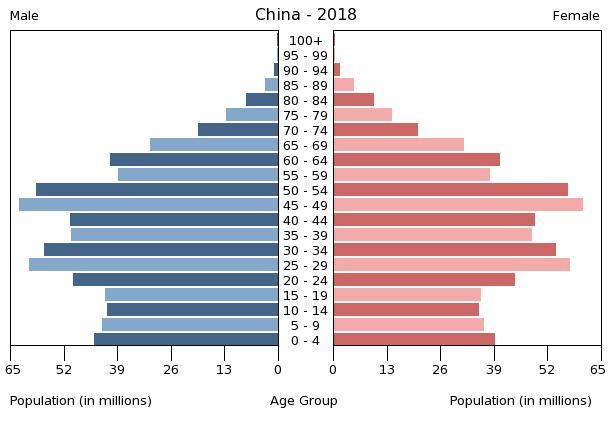
US population: ~330 million; EU, ~450 million => Total: 780 million. China's population: ~1400 million. Domestic demand is clearly not China's disadvantage.
Population size doesn't paint a full picture. China's GDP per capita is still less than a third of the US. A lot of those 1.4 billion have absolutely appalling living standards.
You have to admit that the possibility of a global hegemony is more likely today than ever in modern history. An unlikely event, however, is still unlikely, no matter the rate at which it increases in likelihood. Our prerogative now is to carefully monitor this increasing rate, lest it somehow escape our attention while becoming unavoidable.
https://www.indexmundi.com/graphs/population-pyramids/china-...
Personally I see China replacing a superpower, but the superpower being replaced is Russia. Russia is by nearly every metric declining and much faster than the USA.
The question is whether the USA will remain the dominant superpower or whether China will be a serious challenger by mid century. To really challenge the USA China would have to export more than just goods and services but also ideas and culture. I see a little bit of ideas being exported but very little cultural export happening.
US after Cold War and before 2008 will be remembered as a very special country by history. China or the post great recession US can only imagine that power and influence, they can't match it.
china has 4x our population and growing like a weed. it’s naive to think they haven’t/won’t/can’t eclipse the US economy. it’s another reason we should overhaul immigration policy to attract the world’s best minds while we still have the prestige to do so.
That's exactly what China and the United States are trying to do: To Africa.
China is no longer an export dependent economy, and moving manufacturing away from it, is hard.
The belief that manufacturing is about labor is simply false.
Dalio is pretty smart to smell the trend, maybe just because he is less idealogical driven but data-driven.
The much more critical thing for China is domestic consumption, which is where they focus the most and struggle the most. And a big thing there that has made other developed countries mad is that China's net imports haven't nearly kept up with their consumption growth. China has been meeting consumption domestically, which changes their mix, and makes everyone else understandably frustrated.
The US technically can, but then how many Americans would be able to buy the $2999 iPhone (for example) to keep Apple's current valuation?
It was accelerating before the pandemic.
https://www.scmp.com/economy/china-economy/article/3045141/c...
Steve Jobs told Obama manufacturing is never coming home, but it only partly had to do with cost. Impossibility of scaling like China was the major blocker.
Instead, I can see the world gradually shifting manufacturing to the next cheapest labor pool until there is none left, and then the ensuing equilibrium would have diversified supply chains, with any concentration largely being a function of 1) access to natural resources, and 2) access to expertise.
If it's that easy, it should have happened by now.
Why? It's not convenient. I'm just saying it could be done if necessary.
It isn't convenient because China also offers infrastructure, a rich supply-chain of similarly off-shored labor / parts and it's "the devil you know" vs. e.g. Vietnam
No it can't. An empire is the complexity*robustness of its supply chains, and supply chains are much less modular on the ground than they appear to be from the air.
The import of intellectual property could take decades or lifetimes to truly play out. If a country could take everything we know, without the debt, it would be a stellar starting point, but wouldnt instantly make them us.
Loved reading “Principles” by Dalio. Great read.
I find it apparent that the U.S. is declining while China is in a prime position to reach new heights. The U.S. greatest competitive advantage has been culture which is quickly being copied by the new middle class in China.
The U.S. has allowed the wealth gap to grow to levels that are pretty scary. The U.S. has continued to elect inept and crony politicians who wish to look backward instead of bring the nation forward.
China has scary levels of wealth gap too. I think it is probably has more.
https://blogs.lse.ac.uk/usappblog/2019/04/06/income-inequali...
> The U.S. has continued to elect inept and crony politicians who wish to look backward instead of bring the nation forward
China is perceived to much more corrupt than the US. It is not even a competition. This index is not perfect but this is the closest we have to measuring corruption uniformly across different systems.
https://en.wikipedia.org/wiki/Corruption_Perceptions_Index
If the US is declining and China is ascending, why do we so many Chinese PhDs students (many of them my friends and hate going back) who want to stay back in the US with many years of wait time?
https://www.boundless.com/blog/visa-bulletin/
Let us please stick to facts and data.
(All the falsifiable statements in this parent comment are false but for some reason it is on top.)
If you don’t live in China, don’t speak Chinese, didn’t grow up in China, have no Chinese family, then you simply have to idea what the fuck is really going on there.
We've had to ask you this kind of thing many times:
https://news.ycombinator.com/item?id=22781294
https://news.ycombinator.com/item?id=22543721
https://news.ycombinator.com/item?id=22343386
https://news.ycombinator.com/item?id=21740392
https://news.ycombinator.com/item?id=19010638
https://news.ycombinator.com/item?id=17822100
https://news.ycombinator.com/item?id=20805021
https://news.ycombinator.com/item?id=21667959
... and that's just for starters. Would you please review https://news.ycombinator.com/newsguidelines.html and use HN as intended from now on? I appreciate the good comments you make here and don't want to ban you, and at the same time, there is a problem.
China may need no help from US to jeopardise its ascendancy.
So far, China's progress came at a greatest expense of its political establishment.
For long, people have expected that at some point the people in power will decide that they need to put a leash on the country that gets too far ahead of its political leadership, and prevent it from getting "too successful" for them to manage.
They way Xi's administration not simply acting on that, but like tripling and quadrupling down on it in the last few years is the biggest proof that they have passed that point.
I'd argue it's being the global reserve currency not culture.
There is still a lot of innovation coming out of the US despite it maybe being a bit inefficient.
I believe if we make some changes we can push the U.S. back to being the beacon of freedom that it has the potential to be. We have a lot of brilliant minds here.
Dalio is a successful trader and is beyond wealthy. He’s a smart guy who has a true interest in history. But he is just one opinion of many and he is absolutely not saying things that are uniquely known to him.
I read the whole thing and it’s like, “Powerful countries decline! Declining power leads to social strife!” No shit dude.
I'd read his books on debt cycles. It's novel thinking. Not necessarily correct, but fairly well-researched and presents data in a different view. Nowhere does he say to take the advice as gospel.
I think that describes Ray's work here well. He is talking about a very general topic (the narrative arc of history). It's hard to say anything completely new about a topic like that, but something that is only slightly new is still valuable.
Sure, there are instances of people being right, but I'm talking about "sage" characters that are going around doing interviews and such.
The book discusses the upcoming world order from a geopolitical perspective and gives original insight into potential developments. For example, I wasn't aware the US Navy has been securing the maritime shipping lanes, thus boosting global trade; and if that stops, well, you can imagine the implications.
[1] https://www.amazon.com/Disunited-Nations-Scramble-Power-Ungo...
(Edit: I originally wrote "one of the worst ways to add noise". That was overkill; it gets worse.)
are we going back to colonialism era where everyone build up a navy to escort goods or we are at the point that we can trade goods peacefully without a strong Navy escort.
We have shattered certain assumptions about the world economy to ensure the continuing welfare of the oldest of us. This is an unprecedented act of selflessness by everyone younger than seventy-ish, because we love our elders so.
The real change in the world order is logistical, which has caused significant re-pricings of almost everything (even the things that are roughly the same price are so in a very different set of market conditions).
It is no longer a matter of how nations compete but how they collaborate, and the markets are adjusting accordingly.
I'm quite optimistic, but then I study Science.
[Edit (apart from mis-spellings)]:
The shattered assumptions pertain to debt management by governments, which are trivial compared to the volume of daily trading. We are in for a reckoning on resource measurement hopefully not of catastrophic proportions and this pandemic is merely a spur. In a nutshell: money fails dimensional analysis.
[Edit the second]:
By the way, if any of you would like to get together and discuss type theory and dimensional analysis and maybe reach out to the folk on the n-category cafe and lambdatheultimate and suchlike I'll happily help. We've a problem needs solving and Hacker News is populated by folk who like solving problems. I'll end (cheekily, give it a search engine result) with a reference to Terence Tao: A mathematical formalisation of dimensional analysis. I keep coming back to this blogpost. The subject kinda weirds me out.
[Edit the third]:
Removed the first paragraph as snarky, mea culpa
In financial circles the man is not taken seriously, and allegations of fraud have been whispered for years now.
I would be curious to know why anyone believes that Ray Dalio should be taken seriously here?
If the “financial circles” you run with don’t respect $100bn+ AUM, there not really “financial circles,” sorry.
If you want to make up your own mind, take a look at their work on debt crises. Sometimes hard to see how it connects to day to day trading, but not the hallmarks of a fraud.
https://www.bridgewater.com/big-debt-crises/Principles-For-N...
All that being said, still think he’s wrong about China.
Instead, a deluge of loose money came and went. Banks recovered. Markets recovered. Jobs recovered. Everything recovered. Even if the face of continued fiscal profligacy. There is absolutely no logical conclusion that can be drawn except for fiat currency being one of the greatest accomplishments of the 20th century.
I read a book by him once. It was short and vapid and full of pseudo-profundity. It was cheap and highly rated on Amazon, so I’d given it a try. I didn’t realize he was banking on his name as an investor. Now I understand why anyone would bother reading his writing once, but not why they would read it twice.
https://www.bloomberg.com/news/articles/2020-04-03/bridgewat...
That said, I have no idea what the next few years will look like economically. Probably income inequality will greatly expand and I wouldn’t be surprised if new national alliances occur.
The deficit and the debt seem to be Really Big Numbers, existing in a scope outside of economic reality.
One has the impression that this is not an economic perpetual motion machine.
Maybe covid-19 could sink the USD and usher in a new economic phase.
But seems unlikely, and there further seems zero political will to do anything more sane fiscally.