No one with a straight face can tell me women in entry level tech programs are not incredibly favored. All my below average coder friends that are women got awesome jobs with high salaries extremely easily. Yes, I talk with them and they agree with what I’m saying.
The actual discrimination against women comes in PhD programs, programs where their success is determined by 1 or 2 superiors (mostly men in advanced research programs), areas with primarily male coworkers, and creepy bosses. The area with most discrimination for women is in non major liberal cities. I went to the Midwest twice and saw more blatant sexism in the workforce than I have my entire life. 2 friends confided that they were asked to trade sexual favors for promotions albeit this was 20 years ago and that was the deciding factor for them moving to the Bay. These things are horrible and I can’t imagime the emotional trauma for that.
However, in the Bay Area and the majority of society the pendulum has swung way too far the other way. I don’t care if people think me sexist, these are my observations over my lifetime from both sides and unlesss convinced otherwise this is what I believe.
In the end, we would get 5 to 10 times as many talk submissions from men, accept nearly all of the talks by women (often turning down higher quality talks from men) trying to get diversity numbers and have a much higher cancellation rate form the women for various reasons, especially money. If we were lucky we would get 20-30% women speakers when all of that was done. I've also been told by some diversity activists that, in order to get women to speak and to get higher percentages of women as speakers etc., unlike most of the men, you need to pay for their travel etc., offer free tickets for women attendees, consider offering stipends for women who speak etc..
Others, organizing other conferences have shared similar experiences. It's one thing to fight against blatant sexism which I'm for, but this is turning into something else.
It’s very simple what it’s become: sexist against men.
This is what happens when you aim for equality of outcome instead of equality of opportunity.
I believe we’re in a Kantian second stage. We were sexist against women. Now, we’re sexist against men. The hopeful third step
That said, I have come to see some pushes for diversity in tech as being extortionist. Some of the tactics used by some specific women who push for diversity in tech are blatantly self-serving like offering workplace diversity consulting but also naming and shaming corporations and individuals for lack of diversity.
Maybe it's the result of individuals asynchronously but collaboratively acting to get the most for their class of people. Since there isn't a "council of women in technology" that meets bi-weekly to decide what each speaker should do for each conference, the women speakers act independently much of the time. To get the best for women they know they have to ask for stuff: fees, travel, tickets for other women. Men are not going to just give it to them. They try to do their level best there every time they get an invite. Every so often -- through casual conversation, meet-ups, online communities, articles in magazines, letters to the editor -- there is a chance to communicate about what worked and what didn't. There isn't an easy way for communication to happen about the net effect of speakers' actions for a particular conference when it's happening, or even afterward. There is a ratchet effect and in, addition, a general sense that "there is still more to be done" for women in technology. When the next conference rolls around, still more is attempted...
My daughter who is finishing the primary school has recently asked me if it's okay if she doesn't like math, but likes animals and babies.
Sounds like some pressure is being applied...
edit: thanks for pointing out that I misread which type of pressure is being applied.
It's not that boys will all like math either, but society makes sure they can't like animals and babies. Higher expectations of children (within reason) typically leads to higher achievement.
Maybe, rightly so? It doesn't matter if you like reading, you need to learn it. For a toddler in 2019, I think coding and some math is getting close to this level of importance.
This describes basically every tech job I have ever had. Real life engineering woman here reporting in.
In 2014 I joined a series B startup as engineer #15 and was the only woman in the office other than the admin; food delivery dudes often brought things to my desk, assuming I must be the office mother. When I was late to work one day after being groped by a strange man on Caltrain, my supervisor questioned my commitment to meeting deadlines. When I moved on, they returned to being a 100% straight white male company.
In 2015, I was the first female engineering hire at the new office of a growing mid-size tech company. A second woman wasn't hired until we'd reached a headcount of about 20. Men, especially clients, often forgot my name. E.g. Janice vs Janet vs Jan (none of these my real name, but you get the idea. The point is that I wasn't important enough to these men to remember.)
Fast forward a few years. Now I am by far the most senior of four engineering ladies at the satellite campus of a household name tech company. Total headcount at this office is about 100 engineers.
I have never had a female manager.
For those keeping score, I have never worked anywhere with more than 5-10% female engineers. For my entire career, even as a noob, I have been the most senior female engineer I know.
I count myself lucky because I've never had to deal with anything resembling actual harassment. (It helps that I am not conventionally attractive). But there is a psychological burden of always feeling alone, always being the first or only, worrying that your actions will be taken to represent all people of your kind, and wondering if assholes in your midst think you've only got where you've gotten because you're a woman.
Your dismissive attitude toward women's supposed advantages is as common as it is damaging. Whatever unfair advantages you think your women colleagues have, unless you are black or latinx, it is unlikely you will ever experience the feelings of isolation and otherness that most women deal with throughout their tech careers.
Are you aware this kind of thing happens to everyone? Do you expect people to remember your name just because you're a woman? Or would you rather they remembered your name because you've accomplished something beyond the ordinary? I'm a black male, by the way.
Are these two things mutually exclusive? Women could both have the advantages outlined by OP and feel more isolated.
Honestly I'm terrible at names and people only remember mine because it's ethnic. I wouldn't read too much in clients not remembering your name correctly. Humans are generally just bad at names and it might not have anything to do with their perception of you.
I have to ask though, why do you think you were often one of the few/only women/woman at these shops. Did they actively try to recruit women? Did you see women get interviewed but who just didn't make the cut? The last time I was at a shop where they made me go through resumes, I rarely even saw women in the application stack.
I worked with an amazingly talented woman who started back in the day at RealMedia writing C++ codecs. She told me about several cases of harassment or even things like asking her to wear a certain dress a manager liked when she was at trade shows/booths.
I also worked with an English woman at the same company several years my senior, who's been both a developer and product manager, and who says she hasn't experienced that type of harassment while in the tech sector.
I hate anecdotal stuff like this though, because it just doesn't build a big enough picture, which is why actual studies are insightful.
But going back to my question: do you think these shops were actively discriminating against women, passively (subconsciously) discriminating or there simply weren't enough women applicants (they do tend to get sucked up by the big players like Google/Facebook/etc.)
I want to say sorry, and I will, but I know it's not personally my fault and I know it won't make much of a difference to your circumstances now or in the future. But still, I'm sorry you've had this experience.
I have to be honest and say this, but I think what you've experienced is very much an American culture kind-of-thing. Every time I read a comment like this, besides making me sad and angry, it tends to always come from somewhere in America.
I'm sure something similar has happened and continues to happen here in Australia, but I've seen little of it. That being said, as I sit here now in a very large, well known company, my line of sight gives me a head count of about 30 men and 2 women. This makes me sad and angry, too.
I don't know what to do about this besides encouraging women to come into the industry and protecting them in a none condescending, white-knight, women-are-weak sort of way...
However a distinction must be made between the formal systems (extremely sexist favouring women), informal systems (potentially extremely sexist favouring men) and workplace environment (women are continuously sexually propositioned; pretty overwhelming evidence for that IMO).
Making the formal systems sexist is a stupid response to the informal systems being sexist. I wish that people would stop advocating that and instead work on the informal issue - if it isn't due to innate ability (a safe bet) then there must be something that can be done. The propositioning thing is a bit of a poser though, it is so pervasive that I suspect it points to deeper issues.
Also the anecdotal evidence is that if propositioning was successfully stamped out that would do crazy things to the fabric of how relationships get established. Might be a net good or bad.
As far as trying to address the... over-solicitation issue, I am trying to be constructive with this set of suggestions.
  * Diversify corporate offices to promote mixing in to cities rather than within the company.
  * Have strong work life balance allowing external socialization.
  * Apply political and economic pressure on civic infrastructure to promote:
  * * mass transit (more, better, cleaner, safer)
  * * quantity and quality of housing (lower prices for all)
  * * "livable" cities in general
Specific incentives for FAMILIES (not just women) could include additional career help and planning:
  * Part time work, fully async, from 'home' (or a more local office sometimes) for moms/dads.
  * Remote 'first' (only?) participation; meetings online, rather than by the water-cooler.
  * Have a presence in a given region that is stable
* * with actual career paths in the area, allowing home-buying (rather than renting)(As a white, straight male,) I have absolutely no issue with a woman being offered a role over me as a tie-breaker or an epsilon-advantage. A company who would go significantly farther than that is one that I don’t want to work for anyway as they’re not interested in being competitive.
http://newsroom.ucla.edu/stories/cracking-the-code:-why-aren...
I wish that all people would be open minded and just treat everyone equally by default no matter what they look like, what genitalia they have or their wealth level.
Save the exclusion for people who show themselves to be *s (i.e. who cause harm to others). So ban smokers / drinkers from your wedding not men.
In France there is a dedicated system for engineering studies (Classes preparatoires + Grandes Ecoles).
You do 2 years of intensive Math and Physics (classe preparatoire), than pass a ranking exam, then go to the school of your choice provided you ranked high enough to get into this specific school.
Basically, the ratio was 1/3 women 2/3 men at the "classe preparatoire" stage, and overall it's the ratio for engineer when all specialties are mixed together.
But then you have disparities between fields, CS schools get between 10 to 15% of women while Chemistry is about 50%, other fields like Electronic, Civil Engineering, Applied Physics are roughly in the average of 30%. Only the schools to become a military officer have an higher disparity than CS (and the air branch is actually in the same area).
For those who can read French (or have the courage to decipher) the statistics are available here:
* http://www.scei-concours.fr/stat2018/mp.html (math dominant)
* http://www.scei-concours.fr/stat2018/pc.html (physic dominant)
* http://www.scei-concours.fr/stat2018/psi.html (technic and mechanic dominant)
(Hint: CS == Informatique (often abbreviated to "Info")
What's the percentage female graduates in STEM fields? The 57% may not be representative for the fields which matter for engineers. Not saying the delta is big, I honestly don't know and am curious.
https://nces.ed.gov/programs/digest/d18/tables/dt18_318.30.a...
In 2017 there were 133,761 Bachelor's degrees conferred in Engineering, 20% of which were conferred to women.
Computers: 71,420 degrees, 19% women
Math: 24,073 degrees, 42% women
Physical sciences: 31,268 degrees, 40% women
I know once-English majors with a similar story of a passion for what computing can reveal/create around a discipline that resulted in rich software careers. I am over a decade out of college, and in my personal experience passion for computing is more relevant than having a STEM background in software development. All this to say, I’m not sure % STEM focused is necessarily a reliable indicator of “future software engineer.”
https://www.catalyst.org/research/women-in-science-technolog...
The section entitled "Few Women Are Earning Degrees in STEM, Except in the Life Sciences" states that 35% of STEM undergrads are female. For engineering and computer-related bachelor's programs, this drops to ~18%(!).
Of course, this could have, and does[0] happen in the Bay Area, too - in just the last year even.
[0] https://www.nytimes.com/2018/05/21/technology/uber-sexual-ha...
I think the "me too" thing proved the coastal elite were part of the problem.
What is the graduation rate of women in STEM fields? 57% is not the graduation rate in STEM fields, which makes it sound like you are cherry picking statistics. What fields are all the women graduating in?
Aside from Google, the pay gap still exists and women earn less than men. The WP article estimates 94 cents on the dollar. https://en.wikipedia.org/wiki/Gender_pay_gap_in_the_United_S...
You're right that women are getting positive reinforcements, it's because (whether you agree with them or not) we have affirmative action programs for women. Affirmative actions always have and always will be debated to death, but the question you should be asking and answering before dismissing this issue is, if there's no affirmative action, how do you equalize opportunities for groups known to have been discriminated against? We already tried not having extra programs and not having extra awareness, and the result was lower pay. How would you correct this?
This sounds like an uneducated opinion. Sample size of 1: My department had maybe 1 female professor for every 10 male. The student ratio was pretty similar.
In your sample, you asked "your friends", which is a really biased sample. How did you meet them? Did you only meet them because they already had the high paying job? You aren't accounting for variables, and you are ignoring evidence.
https://www.theatlantic.com/science/archive/2018/02/the-more...
.... and yet, how many workplaces have an engineering team which are 50% female? 25% female? 10% female? 5% female?
This is because we used to have a female CIO that set diversity targets that were mandatory for all levels, so in less than 10 years we went from 15-20% females to 55-60% females by rejecting male new hires and promoting females by the dozen.
No one is forcing them to NOT join a STEM field. Everyone is telling them to specifically join STEM and giving likely billions of dollars in support aiding the increase.
All I can find is data from 2012[1], but <20% of engineering and computer science graduates are female. I help with interviews for the group I work in and just skimmed every job announcement (intern through senior level) to see the breakdown of who applied. In 5 years we had 81 people apply for jobs, which included only 3 women. Although I don't have access to any data, the previous job I had was similar: I estimate that I screened 30-40 candidates over 2 years and only one was female in that time.
Our job postings (and those of my previous employer) were generic descriptions of the work and benefits. Perhaps generic job descriptions are inherently hostile towards women?
[1] https://www.ncwit.org/sites/default/files/resources/girlsini...
It could be that fewer women are entering engineering fields at the top of the funnel (after high school). So every woman who applies for a job in the field could be getting one while on the whole, women still making up a tiny proportion of the workforce in that field.
In any case even if every engineering class in college has women in the majority, and every one of them is getting a job that a man previously held, it will still take a generation for parity to become visible in the workplace.
In fact, that seems to be the problem: no amount of discrimination against men resolves that women simply are choosing careers in a different distribution to what men do, but the only policy lever that can really be utilized is discrimination at various stages of education or employment.
This has left people aiming for a fantasy, and using increasingly aggressive discrimination to try and carry it out, biology be damned.
So you're saying, to achieve parity, we need 80-90% of STEM grads to be female and only 10% men?
Or do you think we should bypass the job interview process for women entirely, until we get a 50-50 ratio in software engineering teams?
Shouldn't we apply this to nurses and teachers (for male equality) as well? That is, have more accelerated job and education programs for men?
Though even if they were, maybe they are making a premium because they aren't adding sexism to their workplaces and exposing their company to the legal liabilities you are.
Because that’s happening all over lately.
Edit: I’m using “me” as an example, I’m obviously not going to do that but I’m trying to make a point that others who speak against the majority opinion absolutely might and there are bad actors who are trying to manipulate that with intersecrionality of their own kind. Just like being against sexism is intersectional with anti racism, gun control, pro choice etc. when someone gets sucked into something seemingly innocuous as this, it’s very likely they’ll start believing a whole lot of similar ideas. That can be good or bad I suppose.
He said they're his friends and they agree with him. Why would you assume that he's lying about people he knows?
> Though even if they were, maybe they are making a premium because they aren't adding sexism to their workplaces and exposing their company to the legal liabilities you are.
By being paid more than their male counterparts while being less qualified for the job, they most definitely are adding sexism to the work place.
Below average AND woman.
https://data.oecd.org/earnwage/gender-wage-gap.htm
The countries with the highest wage gaps are the countries with the most equality in the workplace. Women in Korea are not treated poorly.
The important thing though is the people proposing that the wage gap is a problem has a solution. They are pushing equality of outcome. They want everyone to be paid exactly the same. That's the problem that they have. They don't care that they are comparing apples to oranges. They want pay to be exactly the same.
I'm not sure what this is supposed to mean. Korea most assuredly is not a country with "the most equality in the workplace". It routinely ranks as having the worst gender inequality of any developed nation, and one of the worst in the world generally. It came in 115th out of 149 countries in the World Economic Forum's 2018 Global Gender Gap Report* and has hovered around that number for years.
Your assertion is that Japan and Korea are highly discriminatory against women? That's certainly interesting and I'm not sure I can defend against that position. Perhaps women in japan and korea are extremely oppressed. This is certainly not what I thought after reading for example or just seeing what's portrayed in the media. https://en.wikipedia.org/wiki/Women_in_South_Korea
Meanwhile your source has Rwanda as #6 most equal. I'm very confused about what the data is saying. It's certainly feeling more like a checkbox list.
So let's look at Canada. Both my data and your data have them with poor performance. Mind you my data is just looking at wage gap.
Women in Canada for ECONOMIC PARTICIPATION AND OPPORTUNITY is 27th place behind Brunai and Ghana. This seems quite incorrect. Women have completely the same economic opportunity as men in Canada. So this is a debateable number. Women are educated BETTER than men and certainly work. So I'm not sure how this data was determined. The actual number should be showing discrimination against me.
Women in Canada are 1.0 for education. That's good. Like I just said https://www150.statcan.gc.ca/n1/pub/81-004-x/2008001/article... Women outnumber men. So this is actually false information. They capped the number wrongly at 1.0.
Women in Canada for HEALTH AND SURVIVAL aren't in the list? USA is in 71st place. I happen to know this statistic. Women live longer than men. So they cherry picked and removed this data? https://www150.statcan.gc.ca/n1/pub/82-624-x/2011001/article... This another number completely false.
Women in Canada for POLITICAL EMPOWERMENT are 21st place behind india and nambia. Except we live in a democratic society with no barriers. Women can run for politics. So this should be a 1.0.
So I guess in conclusion I find your study to be biased, false, and wrong.
Let me explain to you what's happening. Women have the CHOICE. They choose careers that they get paid less in. This is a good thing. They have the freedom. The gap is not a problem.
Yeah, I am not sure what to think of the data. It's not what I would expect.
How is US, Canada, Austria having such a large gender wage gap, followed by Canada.
Then Greece, Bulgaria and Romania are all the way on the left. Having lived in Eastern Europe, I would not consider it overall a bastion of women's equality and rights, not according to the West European standards at least. Granted though, during the Soviet times women and girls were studying math and science just as well as the boys even if not better and it was never specifically promoted or pushed via a "women in STEM" or such similar programs I have seen here, it just happened. Perhaps there is a remnant of that mentality and maybe there is something to be learned from there.
When you provide women the opportunity to become anything they want. They choose the careers that they choose. Which tend to me more social related careers. Teaching or nursing for example does not scale well; therefore salaries are limited.
Whereas men pick more "stuff" categories. It's men who work in STEM creating things. A car or an iphone is going to be generally speaking men who design it. These scale very well and salaries can be larger.
By these modern approaches that allow women to go into whatever they want to do. This is what creates the gender wage gap.
That's not a solution, that's another problem.
The mcdonalds cashier should not be compensated the same as someone like a neuroscientist.
If we get replicators invented and everyone can have whatever they please like in star trek. We still don't need communism. Capitalism will still work, stuff will just be free but if you want a PERSON to do something you still would need to pay.
Romania, Costa Rica, Luxembourg, Belgium, Bulgaria, Greece, Slovenia, Italy, Denmark, Turkey, Norway, New Zealand, Colombia, Malta, Hungary, Poland, France, Iceland, Ireland, Mexico, Spain, Lithuania, Cyprus, Netherlands, Portugal, Australia, Switzerland, Slovak Republic, Germany, Czech Republic, Austria, Finland, United Kingdom, Canada, United States, Chile, Latvia, Israel, Japan, Estonia, Korea.
See the pattern there? Neither do I. Usually there is some correlation by continent, cultural area, GDP, HDI, etc. In this case there seems to be nothing. Romania and Costa Rica and Luxembourg are the countries with the smallest wage gap; Netherlands, UK and US are way up there, in company of Chile, Canada and Estonia. Turkey is wedged right in between Denmark and Norway. Netherlands' pay gap is 4 times that of neighbouring Belgium. Mexico and Ireland are the same. Lithuania's gap is half that of Estonia and Latvia. Strange.
Do you know this for sure? Developed East Asian countries are some of the worst in terms of work equality for women, particularly if they want to have children. Not a good example to use.
Technically, everything could be equal, but men and women have much stronger gender roles there, it's very deeply ingrained into culture.
I'm not defending this at all however. I'm perfectly happy to believe that South Korea is worse than Saudi Arabia toward treatment of women.
I do not mean to belittle those career choices (if anything, I myself want to become a k12 school teacher at some point in life). But, there are a certain set of traits that are needed to excel at the 'prestigious' careers. Disposition towards hard work beyond the standard 9-5, an acumen for logical reasoning, ability to retain large quantities of information are all more rare than social skills and empathy, which take precedence in elementary teaching or nursing.
Our culture idolizes the hard working, career oriented person, that sacrifice other things in life to singularly chase this money and fame driven idea of success. This is irrespective of how physically/mentally healthy it is, or if it positively correlates to long term happiness.
IMO, it leads to an obsession to prove that men and women being equal, would have equal outcomes on this narrow benchmark for success. It both neglects the fact that that social norms haven't changed as much and that equal outcome is meaningless without context.
p.s: nice to see someone use 'beg the question' in the correct context.
More people are considered qualified as elementary school teachers than those qualified for university teaching. Same with nurses and doctors.
I'd be fine with a random anesthesiologist teaching my grade schooler, but I'd hesitate to have a random elementary school teacher giving him anesthesia.
Elementary school teaching: a teaching certificate.
University professor: PhD, pre-tenure work & published research (Note that there are less-qualified people teaching in universities that are compensated much less.)
Nurse practitioner: Master's degree (undergraduate plus 2 years)
Anesthesiologist: Undergraduate + medical degree (4 years) + residency (4 years) + possible specialty training.
Because of education level?
A university professor has a PHD. An elementary teacher has a bachelors degree.
If you think a PHD and a bachelors degree should be paid the same. That's perfectly fine, that's called communism. It's perfectly fine to be a communist.
Salary transparency without job descriptions would be akin to showing house prices without describing house details - location, square footage, number of bedrooms, etc.
As a fun thought exercise, imagine that you were the head of a multi-national conglomerate (or working in the interests of a multinational conglomerate) who stood to gain from paying people as little as possible. Would it be in your best interest to: a) standardize pay fairly or b) convince some people that they were being mistreated to the benefit of some other people and watch them fight each other while you laughed from your corner office, puffing cigars lit off of $100 bills?
But that's not how a lot of jobs, software development included, work. It's entirely possible for someone fresh out of school to be a far more valuable team member than someone with ten years experience... yet we would point to a disparity in pay between those two people as [sexist, ageist, whatever-ist]. Now let an experienced employee find out they're getting paid less than someone with far less experience? Hooo boy, talk about creating a toxic environment.
there are plenty of environments where salaries are known and there is not more conflict than anywhere else. For example Congress staffers' salaries are public, there are huge pay differences for the same position but it sill works.
I think most arguments against transparency are spread by employers to keep the information asymmmwetry.In most markets the party that has more information will have the advantage.
Counter-example: pay on commission. Salespeople are "directly compared", but are not doing exactly the same work. Still, the work they are doing is fungible—you can compute the value in dollars both of closing one big account, or ten small accounts, and compare those.
This is essentially how a very small subset of IT people get paid, as well: vulnerability researchers, who make a living off of bug bounty programs.
Attempts have been made to expand this approach. Some FOSS projects have bounties on each issue, where whoever submits a PR for that issue (that gets merged) gets paid the bounty.
The question is how to scale this approach to work that requires more than a single person to complete. (I.e. how to distribute the "spoils" of a bounty among a team.) There are historical examples one could look at of bounty programs where the entrants were teams (e.g. the Netflix Prize), but IIRC in none of them were any of the teams really motivated by the bounty above all; rather, they were just in competition with the other teams to be the first ones to solve an eminently-achievable-but-challenging problem, and it was competition for competition's sake—essentially, a sport.
When I was in industry, our company was a 20-person R&D house that paid everyone equally, from new hires like me to founders of the company. And it worked great!
We would all occasionally compare over the years and it would always come up that there would be a small difference (<$1k) where someone happened to hit a lucky streak of getting promoted in a better % year, and people's feelings would be hurt.
Granted, that probabbly wouldn't stop recruiter spam and of course there is MUCH MORE to a good job than pay.
It turned out there WAS bias - in favor of the women!
"The lawsuit triggered a study. The study results showed that not only were women not discriminated against, but that women had a statistically significant advantage!
Here’s what happened. Some departments had high acceptance rates and some had low acceptance rates. Women applied to more competitive departments. Men applied to more accessible departments. Taken on the whole men had an advantage. When broken down per department it was women who were more favored."
There is simply not enough information presented in this article to know whether there is truly a gender bias (in either direction) regarding how Google pays their employees.
E.g.: Google is 70% men. At 100,000 employees: 70,000 Male 30,000 Female
If 5% of men are underpaid that's 3,500 men. If 10% of women are underpaid that's 3,000 women.
More men are underpaid (3,500 > 3,000). But women are twice as likely to be underpaid (10% > 5%).
Hmm...
"Men account for about 69 percent of the company’s work force, but they received a disproportionately higher percentage of the money. "
So, yes, we do have that information.
Human beings just have very strange presuppositions regarding probability and statistics that are almost always wrong.
Univariate analyses can hide lots of interesting things!
The real reason for the Berkeley study is that the seeming acceptance disparity worried administrators, who proactively asked Bickel to look into it. https://outline.com/2HMrKV
To support this claim the study pointed out that the percentage of male applicants _out of all male_ applicants that were granted admission was lower than the percentage for female applicants, for all (examined) departments.
However, according to the study, there were 8442 male applicants and 4321 female applicants. So while a larger proportion of female applicants were granted admission, it still meant that many fewer women were addmitted.
To clarify, a higher proportion of a smaller number can still be a smaller number. 5% of 1000 is 50, 10% of 100 is 10.
Imagine we split a pie in 10 pieces, you keep 8 and I keep 2. I eat my 2, you eat 4 of your 8 and then you accuse me of hogging the pie because I ate 100% of my share while you ate only half of yours.
That is what the study actually showed happenned with admissions in Berkeley.
_________________________
[1] Sex Bias in Graduate Admissions: Data from Berkeley
https://homepage.stat.uiowa.edu/~mbognar/1030/Bickel-Berkele...
Where does the study say that? I find it saying that 44 percent of male applicants and 35 percent of female applicants were admitted, when totaled over all 101 departments.
https://www.abc.net.au/news/2017-06-30/bilnd-recruitment-tri...
https://mobile.abc.net.au/news/2017-06-30/bilnd-recruitment-...
In a bid to eliminate sexism, thousands of public servants have been told to pick recruits who have had all mention of their gender and ethnic background stripped from their CVs
The trial found assigning a male name to a candidate made them 3.2 per cent less likely to get a job interview.
Adding a woman's name to a CV made the candidate 2.9 per cent more likely to get a foot in the door.
...
Leaders of the Australian public service will today be told to "hit pause" on blind recruitment trials.
> Within a few weeks of Ms. Ellis being hiring, Google hired a male engineer for her team who had also graduated from college four years earlier. But he was hired as a Level 4 employee, meaning he received a higher salary and had more opportunities for bonuses, raises and stock compensation, according to the suit. Other men on Ms. Ellis’s team whose qualifications were equal to or less than hers were also brought in at Level 4, the suit says.
This feels like a part of the issue, but could be really hard to analyze easily.
I worked for around 4 years before joining Google and was also hired as an L3. I'm male.
Two of my new grad friends were hired as L3's at Google too but make like 100k more than I do in total compensation. One is male and one is female.
I'm not saying there isn't sexism but I'm not really convinced by this example. It's pretty common that people get "demoted" when coming in from other companies.
I made the mistake of not getting competing offers (I wasn't actually looking to change jobs at the time).
So the L4 person probably had some better story/negotiation which allowed them to start at L4. It of course could be bias.
It was really frustrating for me to be at the same level as new grads, though on reflection, I was not at a the same level as other L4 employees around. Some transparency around these processes I think could help candidates a lot.
I think the bigger issue is that new-grad phds are almost always hired at L4. They are often less experienced at software engineering than someone with a bachelors and a few years of experience. So unless the person is being hired into an area that actually makes use of their phd, it seems that Google is just willing to pay for the title.
I asked my boss about this and he said it was because this was her first real job. When I reminded him that this was also my first real job he just said "that's different" without further explanation.
Also, a L3 at Google makes ~$200k a year. Someone getting paid that 4 years out of college is not being discriminated against.
You've spent four years of your career doing some crappy data entry job? Undershot. Rejected.
You've been running your own company after the college? Overshot. Rejected.
This is true of most models (in practice - any model which models salary in the real world) yet not every company is being accused of these payment discrimination lawsuits.
> In early 2005, as demand for Silicon Valley engineers began booming, Apple's Steve Jobs sealed a secret and illegal pact with Google's Eric Schmidt to artificially push their workers wages lower by agreeing not to recruit each other's employees, sharing wage scale information, and punishing violators.
https://pando.com/2014/01/23/the-techtopus-how-silicon-valle...
BTW, in the same vein the article could be titled "Google finds it is overpaying many men (or women)" - since unless everybody has the same salary, half of the workforce would be paid less than median - thus being underpaid - and half would be paid more - thus being overpaid. Well, there could be lucky ones being paid exactly the median, but they are too boring to write an article about them.
That can feel rather insulting and demoralizing, and why would anyone want to subject themselves to that? Instead many women just avoid HN—which in turn means that it becomes more male dominated, with more upvotes and mindshare to comments about experiences of "the other" that may not by particularly well informed—because it's not worth the time of a woman to even chime in.
Regardless of your opinions on these specific issues, this dynamic of driving away women decreases the likelihood of everyone gaining a well informed perspective. It doesn't just impact gender issues. It impacts discussions on the importance and potential markets of startups that provide products which aren't just male focused. And you can end up with more things like: https://www.theguardian.com/lifeandstyle/2019/feb/23/truth-w...
Not an easy dynamic to "fix", but a useful thing to remember when thinking about communities, incentives, and impacts...
As a young, middle class, educated, employed, healthy white male, I'm perceived as the "default settings" of society. No groups are advocating for me because I apparently already have plenty of support.
There's nothing I can do to celebrate who I am because the conversation is so zero-sum. If I'm a white guy making a lot of money in tech, I'm part of the problem.
It's exhausting. Instead of being a booster for causes I think are important, I just stay on the sidelines.
I wonder if all the upvoters are just quieter than the down voters.
"Instead many women just avoid HN" - based on a couple of your friends? I am sure lots of people, regardless of gender, avoid HN for a variety of reasons.
No one knows your gender on HN unless you tell them. There's no pictures or even real names to go by. Things get voted up based on merit.
You can have an accurate or inaccurate belief on a question of fact, but “accuracy” is not a measure that applies to matters of opinion.
So how do we solve this? How do we be more inclusive from day zero? Where does it all begin?
I think you'll find these problems stem much earlier in a man's life when the education system helps teach them to be men and helps women be women in the traditional sense. We're all placed in boxes and told to be a certain way.
So what do we do?
It seems like a ripe opportunity to create women-only HN.
If you set initial salaries fairly with respect to gender but promote men more quickly, then you end up with a company where it looks like women are paid more when you control for job title.
Usually it's the opposite but for the same reason: women seem underpaid but when you correct for experience on the job, they make something like 98 cents on the dollar compared to men.
And I think someplace like Hacker news is exactly the right place for the community to discuss the many ways a company can get to a result like this - via Simpson's paradox, via differences in promotion velocity, or via simple economics, based on the fact diverse teams are desirable and women are more scarce.
Attacking someone for suggesting one not-yet-discussed possibility is not helpful to the discussion, imo.
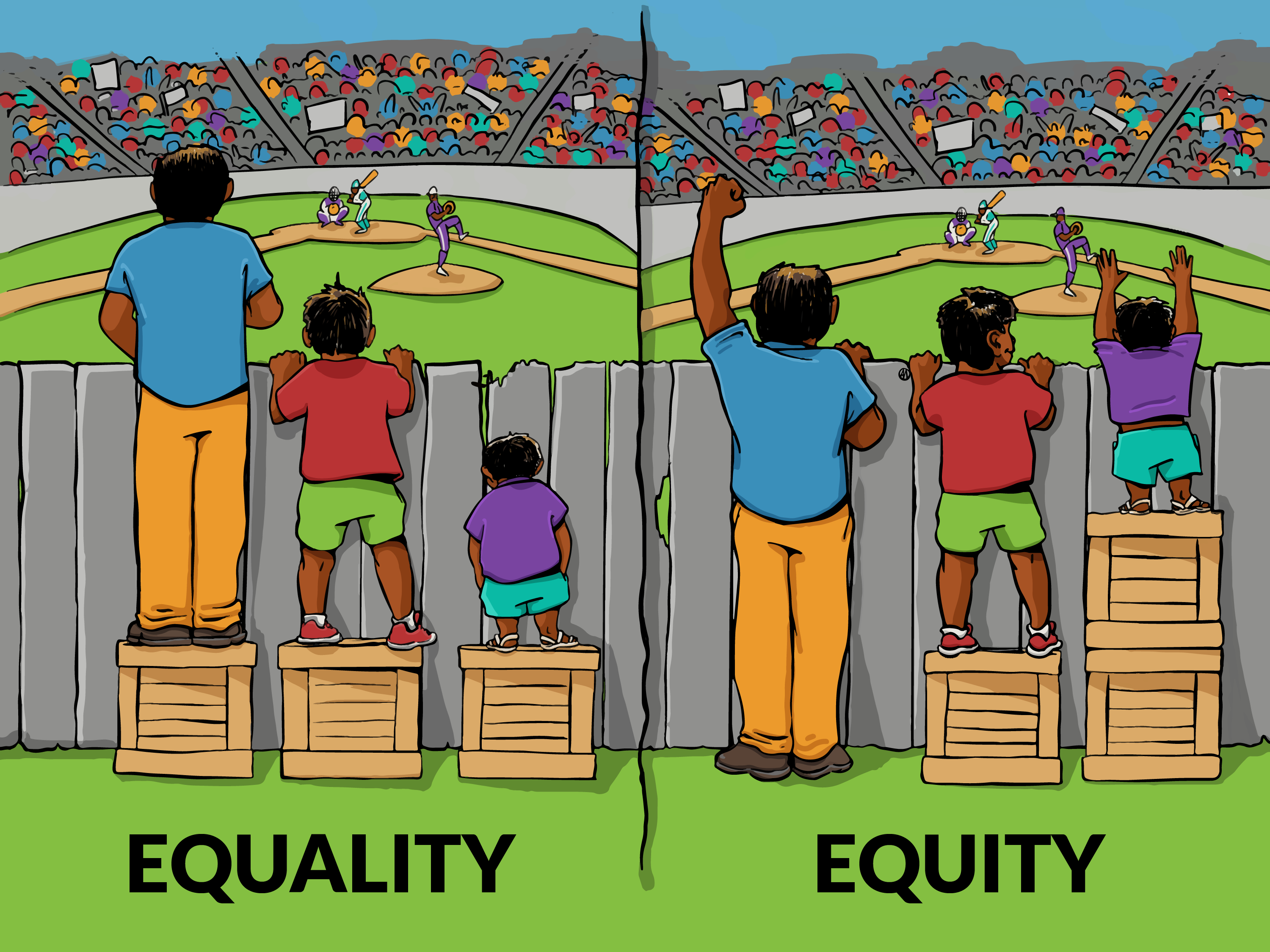
(Equity being what some here are referring to as 'equality in outcome'.)
In this image, it's hard to argue that equity isn't clearly better. In other cases like admissions, it's much more debatable, and personally I think equality ('in opportunity') makes more sense there.
[1] http://spiegel.de/international/zeitgeist/potsdam-university...
Doesn't this imply that men, per capita, were being underpaid more than women?
For example, imagine a company with 7 male employees and 3 female employees. That company has 9 engineers and one administrative assistant. All the engineers are underpaid. The male engineers are underpaid by $1000 and the female engineers are underpaid by $1200. The administrative assistant is a woman who is fairly compensated. That means the men are underpaid by $7000 total and the women are underpaid by $2400 total. Men make up 70% of the employee workforce and are roughly 75% of the underpaid total. More men are underpaid than women. The per capita underpayment of men is $200 more than the underpayment of the average woman. There are plenty of ways to frame this data that make it look like men are the biggest victims and yet woman engineers are all payed $200 less than their male counterparts.
Ideally two individuals in the same or similar roles, with similar performance over time in that role, should have the same salary regardless of background or negotiation ability. The major issue with this is that you can't reduce pay of rockstar negotiators (who may or may not be rockstar performers), and a correction that pays everyone as much as the highest earning equivalent employee might be hard for even Google to swallow.
It is not just about pay equity in a particular level. It is also about the ingress and egress rate of a level.
As the article mentions, some woman was hired as L3 while all of her co-workers were hired as L4. Was she overpaid as a L3? Maybe. But she was underpaid overall because she could've gotten L4.
Similarly, women and under represented minorities also face similar issues in promotions.
But the study did not tell the whole story of women at Google or in the technology industry more broadly, something that company officials acknowledged.
Most significantly, it did not address ingrained issues that, according to workplace experts, cannot be overcome simply by considering how much different people are paid for doing the same job: Women and racial minorities often do not get the same opportunities and they must overcome certain biases when they are hired or compete for promotions.
Etc.
The media really needs to stop this practice of just saying "experts say" without any attribution.
I suggest when reading any article, when you read, "experts agree" or "sources say" or "critics have said" or "others are saying" -- just replace it with, "I, the author of this article, think ..."
I don't think the context is completely unjustified. It just happens to be more complicated than this. The reason that women generally drifted into higher compensation compared to men was that their direct management chain was adjusting their compensation disproportionately (when measured in aggregate, across the company).
You could come up with a lot of explanations for this effect. Women could have been hired at lower levels than appropriate and were therefore outperforming men of the same level, for instance. Or, perhaps, there's a lot of emphasis in the company towards retaining and compensating women fairly, and the effect was that managers were primed to reflect that in their pay raises -- in other words, people were personally overcompensating for the intrinsic biases they were told that they had. Still another reason might be that women just make better engineers, in aggregate.
Google decided that the goal was "equity" here and decided to correct it, for better or worse, and yet it's false to say that we already understand the cause behind the disparity.
Similarly, I think imagine Google will find similar flaws with how these numbers were generated.
This site looks like it has the rules more formalized, if you’re interested. I think it’s something most native English writers do without thinking by adulthood.
[edit: minor wording change; why am I being downvoted? I'm seriously asking]
Unionize and wage equity magically disappears.
a) Google is about 70% men; and b) The "error" in pay (eg how under- or over-paid you are) is randomly distributed
Then it will be trivially true that more men than women are underpaid
If you, in addition to this, assume some level of sex discrimination, such that in addition to (b) there is additional 'error' in womens' pay, depending on the relative strengths of each of these errors, the following two things can both be true at the same time:
1) A higher percentage of women are underpaid than are men. 2) Most of the people who are underpaid are men.
If this is surprising to anybody, they should be taking a remedial statistics class immediately.
To illustrate, assume that Google is 100 people: 30 women, 70 men. assume that 25% of men are underpaid, and 50% of women are underpaid.
That means that 0.2570 =~ 18 men and 0.530 = 15 women are underpaid.
That means that more men are underpaid than women.
That means that 18/(18+15)*100 =~ 55% of the people who are underpaid are men.
So in my hypothetical, is Google biased against men? Or is Google biased against women? Or is Google not biased at all?.
It says that the raises resulting from the study disproportionately went to men. Not just in absolute terms, but proportional terms:
> The study, which disproportionately led to pay raises for thousands of men, is done every year [...]
> In response to the study, Google gave $9.7 million in additional compensation to 10,677 employees for this year. Men account for about 69 percent of the company’s work force, but they received a higher percentage of the money.
I agree with some previous posters that women may be more favoured by formal systems now, while men remain more favoured by informal systems.
I think that part of the issue is that there are more ways to be male and a successful senior engineer or team lead than there are female.
We tend to look towards people who are similar to ourselves to see how we should advance. There are many fewer female role models than there are male ones. Many women who make it to leadership positions are encouraged to act masculine.
Women who make discrimination claims that later ring false are usually villainized. I think it might be useful to think about why these might be occurring. In particular, I think women as a whole still feel a great deal more insecurity WRT their positions in the workplace. The equality that's been won in the last few decades has been to some extent manufactured, so it feels a lot more fragile.
I don't think that a good reaction to this news article is to feel upset that men are now being discriminated against.
Why not? It's good and bad news for men but men definitely shouldn't be discriminated against
Doesn't sound like they were underpaying by very much...
A lot of people (men) here complaining about women getting things too easy in tech. Talk to a woman in tech. Look around you and see how many women there are. Men are still running the show.
If women were underpaid, things are less equal on average. If men were underpaid, as the study suggests, things are more equal on average. That said, would it be fair to keep underpaying some people in order to keep it more equal on average? I think not.
They needed to compare the number of men who were underpaid as a proportion of all men to the number of women who were underpaid as a proportion of all women.
Using bum-pulled numbers, your company has 1000 employees, 667 are men, and 333 women, and they all do pretty much the same job. Your payroll is $100M, and 70% of it goes to the male employees. The mean pay for men is $105k, and the mean pay for women is $90k. Mean pay is $100k--let's say this is fair pay for the work. Overall, the men are overpaid, and the women underpaid.
But the mean is a fool's game; the median is more telling. Now say 445 men get $90k, and 222 get $135k. 2/3 of men are underpaid. Now let's say 222 women get $101k, and 111 get $68k. 1/3 of women are underpaid.
On a per-person basis, a man working for the company is twice as likely to be underpaid as a woman, but the amount by which they would be underpaid is much less. Going by the aggregate numbers, one could say "men at Company X are overpaid, compared to the women" and then any given underpaid man might not even realize they are being underpaid, thanks to the misleading statistic. When one of the $68k-paid women complains (naturally, as the worst-off of the bunch), and the company analyzes its own payroll at a more detailed level, it realizes that men are more likely to be underpaid than women (and also that increasing its payroll by 8% would make no-one underpaid).
This quote would appear to sum up the entire debate, using the term generously.
There is a large and vocal minority in society who abuse the word "equality" to mean "more money and power for women". They don't care about equality. They want inequality, but they know they can't say that, so they simply redefine equality to mean inequality in the Orwellian style and carry on as if the language hadn't just been horribly violated.
Ms. Emerson should stop talking until she can say what she means, although given her job is 'diversity consulting' I'm going to guess she will never be able to say what she means.
>That is not the same as addressing “equity,” she said, which would involve examining the structural hurdles that women face as engineers.
Consider the following situation:
Men get promoted faster than women for similar work. They're seen as more assertive or something. Managers, noting the systemic inequality, take individual action to compensate women fairly for their contributions, despite the failure of the larger system.
The structural hurdle: that women find it more difficult to get promoted, is not addressed. And as a result, they end up paid less for similar work, despite attempts by ground level mangers to address the inequity.
The HN guidelines suggest that you
>Please respond to the strongest plausible interpretation of what someone says, not a weaker one that's easier to criticize. Assume good faith.
I think this should apply to articles posted as well.
Log in or create a free New York Times account to continue reading in private mode."
How obnoxious. (I think trying to make people using private browsing register is offensive. FWIW you can also stop the effect by blocking requests to their graphql subdomain.)
They don't give unlimited access to all content (recipes and crosswords are apparently excluded), but you can read all the articles you want.
There are many factors for why women are paid less than men for the same type of position. Many of these factors have to do with hours worked and expectations around child rearing. And when this is taken out, the women are found to make as much or more than men.
My position can be summed up like this:
The corporate world is about 100 years old, with its crazy commutes and uses of energy just to sit in a chair. This comes at the expense of future generations (fossil fuels), and current family values (taking care of children, elderly, etc.)
Why do we say that women have to keep learning from men on how to move up the corporate ladder, work long hours and get paid more. Perhaps men should learn more from women about how to have a healthy work-life balance, take care of the kids more, and their parents.
Today's kids are overmedicated with methamphetamines for ADHD, there is an opiod crisis among adults, 1 in 4 middle aged women is on antidepressants, the elderly are in nursing homes.
The wages have stagnated largely because both sexes flooded the labor pool, globalization and outsourcing and automation caused everyone to go into a race to the bottom. Now both parents are working for corporations. Fewer working Americans are becoming parents. They're in a Red Queen rat race, 1/3 of Americans are one paycheck away from homelessness. Is this really the best outcome for Americans?
Today's world isn't that of your grandfather, the company man who had loyalty both ways for decades and got a pension. Today we have two year stints, gig economy, part time work.
Andrew Yang wants to do what Nixon almost did, and institute a UBI for all Americans like the Permanent Fund in Alaska (lowest inequality of all states, year after year).
Why do we think Corporate Careers should take so many of our hours a week? Why should we trade time with our children and elderly for more money, just to survive? In the past, indirectly, child rearing was valued because one of two parents simply didn't take the job, so there was less available labor, so one parent could pay for the whole thing.
The system is broken, and we are accomplices by talking about how women can match the men in their "career opportunities" of long hours, instead of talking about parental leave for men like in Scandinavian countries, making the school day shorter, etc.
Read this for more info: http://magarshak.com/blog/?p=286
Gender or any other identity factor is then irrelevant if pay is based entirely upon candidate experience, right?
Edit: I have no knowledge of how Google handles salary. If anyone knows, feel free to share.
1. In countries that empower women, they are less likely to choose math and science professions: https://www.theatlantic.com/science/archive/2018/02/the-more...
2. In the past 30 years women have made gains in traditionally male areas like law and medicine, but have gone backward in software engineering
3. Men are disproportionately on the autism spectrum
It seems to me that aiming for 50% female representation in software engineering is not necessarily something we should be aiming at
The article refers throughout to "numbers" rather than "proportions", or "ratios", "percentages" etc, meaning that it is actually a larger absolute number of men rather than a larger relative number of men who are underpaid, compared to women.
Most of google's engineers are men, so even if equal proportions of men and women were underpaid, the absolute number of men being underpaid would be higher.
Google obviously has people good enough with numbers to know this. However, it's perhaps not surprising to see that there seems no mention of it in the above article. Google is, after all, defending a lawsuit by some of its former female software engineers who allege they were underpaid compared to their male peers. There is a clear incentive to allow a certain lapse from google's usual pride in employing people who understand numbers.
These are openly meant to overpay some employees and underpay others. Though they can be coated in HR-speak to appear neutral and objective, the decisions that come out of them are typically arbitrary; they enforce biases of all kinds. So we should not be surprised at the results.
If women are disproportionately hired at lower levels, pay equity will still be _very_ off, even if the data says otherwise on the surface-level.
Ex: Woman w/ 4 years experience hired at T3. Man w/ 4 years experience hired at T4. Both are "in range" of their median comp per level, but the man is being paid more for his expertise.
Many tech workers think unions cap the maximum achievement and result in people getting underpaid. In reality, we're _already_ underpaid when you look at how much the ownership of a company gets. Additionally, Hollywood's unionization hasn't hurt their pay.
> it found that more men than women were receiving less money for doing similar work
NY Times needs to learn the difference between absolute numbers and rates. This is awful reporting.
So at the end of the day, they weren't severely underpaying employees.
Good to see a company take this step. I had this happen to me at one company I worked for... it actually resulted in a pay increase of over 4 bucks an hour, now THAT was nice!
Say I build some engine and buy a bunch of identical bolts I need: each one obviously costs the same. But now I'm building a business and need some human cogs to run it, why would I have to discuss the particular cost of each one?
Same work, same pay. But... unique person and custom pay? How do we reconcile this apparent contradiction?
Keeping digging this hole and see whose grave you find at the bottom...
>Women and racial minorities often do not get the same opportunities and they must overcome certain biases when they are hired or compete for promotions.
My problem with these kinds of "intrinsic biases" that white men are accused of is that they can only be shown to exist by accepting the fundamentally unproven assumption that we all enter the workforce equally capable in all industries, a position which is clearly untenable at a minimum because of cultural differences.
This is practically the definition of ideological, institutional bias, and the results will either be reduced efficiency across the workforce, or a violent swing of the ideological pendulum.