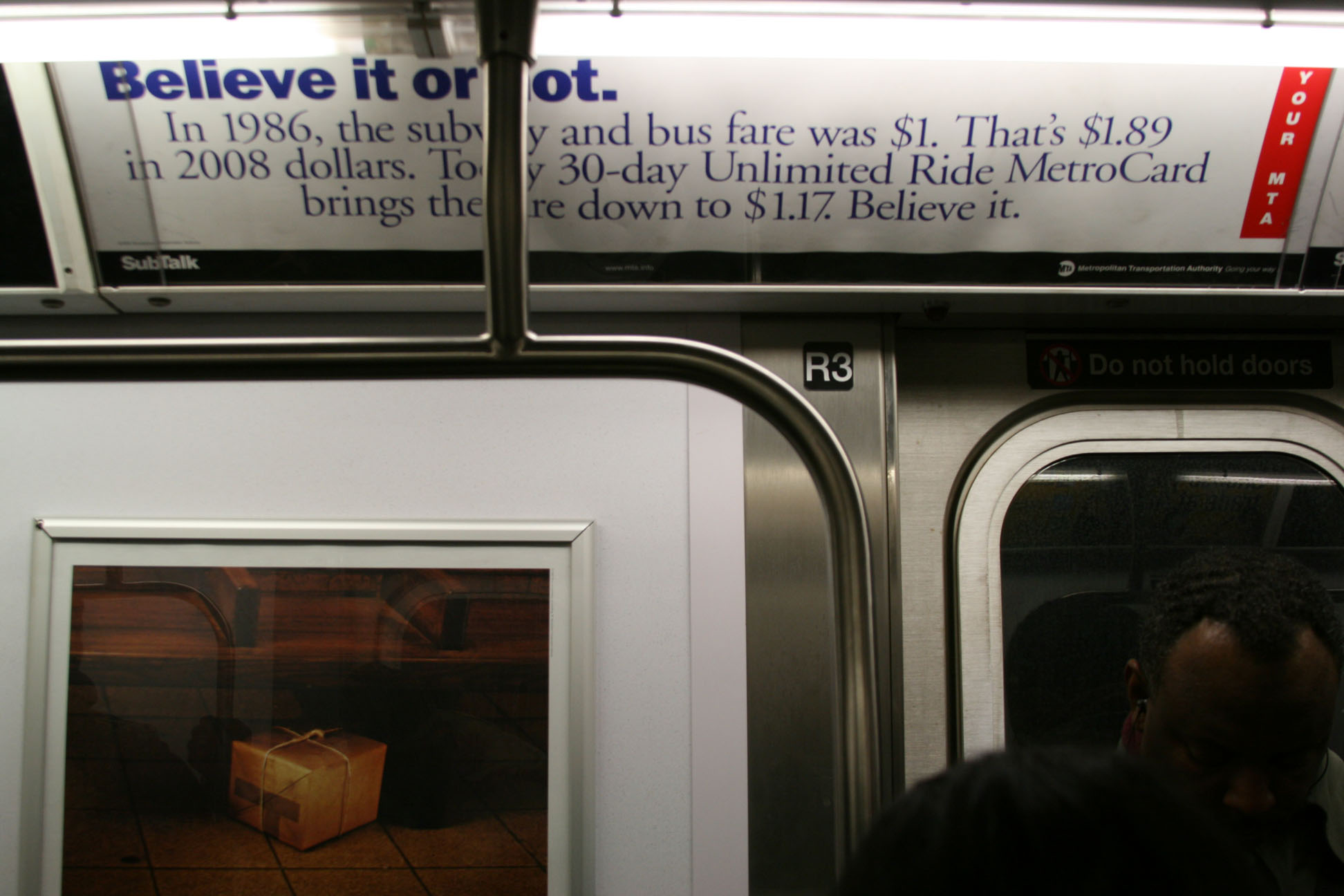
NYC has some of the strongest unions in the country. Everything from hotels to the MTA are plagued by really, really strong unions that only care about their interests -- leaving the city with a shameful transit system, in this case.
Unions make up nearly 25% of workers in NYC[2], that's more than the double the national average. The corruption is rampant[3] and the city is literally powerless against them[4].
[1] https://news.ycombinator.com/item?id=14948921
[2] http://www.crainsnewyork.com/article/20170910/BLOGS01/170909...
[3] https://www.nytimes.com/2017/12/28/nyregion/new-york-subway-...
[4] https://www.nytimes.com/2018/02/16/nyregion/carpenters-nyc-u...
The actual criticism to be made here is the pathology of all New York institutions and the people entrenched among them - the unions that serve the MTA, the people who own, build and rent the real estate, the politicians who effective rule by plutocracy.
The corruption of New York's unions is simply the end state of a city whose underlying mechanisms have all been captured by a small group of people interested only in enriching themselves. Many of those institutions are unions.
Unions sound more like your personal bogeyman than an actual cause.
There are ways to make the union happy and the workers happy it just takes longer term thinking which governments and voters are frightently bad at.
Helsinki metro was planning to have automated trains when the western extension opens in 2014. It opened in late 2017, without automation because of technical difficulties. I have a hard time believing there will be much automated traffic on the roads here (with uneven surfaces, unclear markings, snow, and other traffic) before the metro can be automated (in a dedicated tunnel where there is no other traffic, movement is technically only possible on the rails and there is no snow).
Port Island Line (Kobe) opened as GOA4 (fully automated) in 1981 followed by Lille Metro in 1983 and Vancouver's SkyTrain in 1985.
The US has several GOA4 systems, though they're mostly airport shuttles and people movers (AeroTrain at Dulles, Monorail at Tampa, STS at Tacoma) a few serve actual communities (DPM, Metromover, Morgantown, Las Vegas Monorail).
> Helsinki metro was planning to have automated trains when the western extension opens in 2014. It opened in late 2017, without automation because of technical difficulties.
Wow, that's a bit ridiculous.
That's a bit of a stretch. Muni and BART use automated train control. SFMTA went with Alcatel/Thales' awful SelTrac system that the Docklands Light Rail uses while BART uses its own monstrosity. Both systems have human operators at all times because neither system is reliable enough to run unattended.
SFMTA used to show which modes trains inside the tunnel were running in. They also used to publish detailed daily service reports that revealed just how bad things were. At one point, > 50% of trains were unable to enter the tunnel in auto mode as the VETAG transponders had a roughly 100% failure rate. For many years the trains themselves would destroy the trackside inductive loops as well, periodically disabling the train control system. Instead the MTA chose to sanitize the reports, and eventually stopped publishing the information at all.
The great irony is that Muni's train control system was so inefficient that drivers would routinely drop into manual mode upon approach to the last underground system without even so much as a heads up to the dispatchers. And then, in 2009, one of the drivers passed out and ran his train into the train parked at the platform. Instead of requiring drivers to pass a health check like the FAA does for pilots, the MTA simply forbade manual operation in the tunnel. From the pictures, that driver was easily 400 lbs and Muni only cares about drugs and color blindness. Net result: 5-10 minutes got added to each outbound trip.
BART, of course, has its own maladies -- if you've ever had to wait for the train to be repositioned before the doors open you know why they still keep their drivers around.
At this point, IMO, neither humans nor automation alone can solve the transit problem.
What? Alstom, Ansaldo STS, Bombardier, Siemens, and Thales all have off-the-shelf designs that they will happily sell. And I've probably forgotten some here. I realise none of these are American companies, and "Buy American" is often a constraint on acquisitions in the US, but it's fundamentally untrue that there are no off-the-shelf designs.
See, e.g., https://en.wikipedia.org/wiki/Communications-based_train_con... for various systems using various suppliers' products.
VAL[0] has been a thing since the Lille Metro opened in 1983 and AnsaldoBreda[1] is being deployed all over the world (it's the platform for Honolulu's upcoming HART).
[0] https://en.wikipedia.org/wiki/Véhicule_Automatique_Léger
[1] https://en.wikipedia.org/wiki/AnsaldoBreda_Driverless_Metro
[0] https://en.wikipedia.org/wiki/Bay_Area_Rapid_Transit#Automat...
Interestingly, at the time the Vancouver SkyTrain was undergoing construction, the same tech was being installed in Toronto for the Scarborough rapid transit line. The transit union in Toronto opposed automation, so the trains had to be specially modified to add operator cabins so the trains could be driven manually. Vancouver was able to get away with it because the system was a greenfield project, there was no union of subway workers around already to oppose automating the trains.
"The line operates using fully automated [..]" https://en.wikipedia.org/wiki/Line_4_(Budapest_Metro)
The DC Metro used to have a semi-autonomous mode that's been turned off for years since there was a glitch that caused a crash.
I'm not expecting the DC Metro to go autonomous anytime soon either. It's a huge jobs program for inner city residents. Basically a commuter tax for a social program.
Although I would assume there are conductors in a control centre somewhere?
Of course the reality of it is more complicated, but they are a powerful force (for better or worse).
According to https://en.wikipedia.org/wiki/Vienna_U-Bahn#Fifth_expansion_... it seems that vienna isn't driverless yet.
10-20 years from now isn't exactly "almost"
Summary: Train wreck 1995 and a installation of a safety-first, CYA response that slows down the trains and does not increase safety.
Longer Summary: Train wreck in 1995. Maybe driver was asleep. Start installing new signals that not only automatically stop the trains when there is a train ahead (good idea and already in place), but also when going over 45mph. Trains used to go up to 55mph with no systemic problems. Drivers go even slower than 45mph because the train is automatically stopped when going faster (as you would want to do if there was a train ahead) instead of just giving a warning and letting the train keep going.
As more of the system gets these new signals, more of the system has slower trains. Thus the increase of delays that are labeled generically as "insufficient capacity, excess dwell, unknown" from about 20% of delays in 2012 to about 60% in 2017.
During the age of steam, express passenger trains regularly exceeded 55 mph. For example, during the 1930s the Burlington Zephyr regularly exceeded 85 mph. For example it made the Chicago to Denver run in 1934 in 13 hours rather than the 18 hrs it takes today.
Source: http://www.slate.com/articles/life/transport/2009/05/stop_th...
A long distance train benefits from very high top speeds, because it spends a lot of time at those top speeds. Conversely, increasing the high speed of a subway train is subject to the law of diminishing returns, since the train has to comfortably accelerate and decelerate within the span of half a mile. With subways, the main concern is that every single train operates in pretty much the exact same manner WRT acceleration, deceleration, and speed, since the headways on subways can be measured in minutes, or even seconds.
Is there any protection system that allows the maximum speed to be exceeded with just a warning? Certainly all those I can think of (TPWS, TVM, PZB, or something more modern like ETCS) have a given maximum speed you're allowed to exceed by a small tolerance but nothing more (though, of course, the system may be isolated, but that's not allowed in passenger service).
The failing here sounds like it is setting the line speed to 45mph rather than anything higher.
Additionally, a simple case would be to have circuits which do, after a certain point in time, force slow (but safe) braking into the required velocity---I could see problems with robustness here due to the specific application, but at least in theory this should be possible (we all know the difference between theory and practice, though).
On the general case, this all seems a little weird to me since it seems like such a trivial problem (increase error bands, etc), but may have some deeper reasons that aren't explained in the article(?). It's quite difficult to tell since the primary sources are not provided at any point in time.
---
[0] I'm reluctant to accept this claim since most of these things aren't done in an analog way, anymore. Timing is a matter of figuring out empirical constants and programming them in directly, which, while not totally trivial, seems to have roughly the same difficulty (amortized over all of the lights that need to be put in) as doing the timing for a 'one-shot' light.
This kind of thing makes a huge impact on the quality of life for people living in the city.
The new Elizabeth line is apparently going to go up to 90 miles per hour, but that is probably only for when the train leaves London and heads out to neighbouring towns (it's essentially a subway line that also connects commuter towns to London).
I'd speculate, without evidence, that it probably has increased safety. But maybe it's just a bad tradeoff, compared to other options.
Besides--reduced capacity causes platform crowding which is dangerous and displaces passengers into other modes of transportation like foot or automotive traffic, both of which are more deadly per passenger-mile than the subway.
The whole concept of ”bad things happen to good people for no reason” is extremely hard to bear. Somehow this reminds me of people who believe the right diet will protect them from cancer, the right prenatal care from birth defects, etc.
It's the same mentality that means we have root cause analysis for plane and train crashes but for a car crash, SOP is pretty much to blame 1) whoever died or 2) noone at all, and 3) never the infrastructure.
When a car crashes, we just scrape up the debris and move on, after usually assigning blame to one of the drivers who ends up with higher insurance premiums or a lawsuit, assuming they survived. There's little effort to learn from the crashes.
It's the same thing that powers fears over mass shootings even though, statistically, they are a tiny fraction of overall gun violence. Most of the rest, however, can be avoided by keeping yourself out of bad situations with gangs or drugs...so even though the stats are higher people feel more in control...vs just being in the wrong place at the wrong time.
So if "bad things happen to good people for no reason" is unpalatable and it's the narrative for mass transit, and "bad things happen to drivers for reasons in their control" is the easy narrative for cars, I'd say "bad things happen to good people for reasons that are in our control but we still do nothing" is closer to the true narrative for cars, but it is also unpalatable. There is an element of this in many risk-related scenarios, but it is especially clear here.
15 years ago the MTA was caught maintaining two different sets of books - one internal that showed the agency had a surplus of cash and another set of books for the public which showed the agency as being "cash strapped" and needing to raise fares as a result. See:
http://www.nytimes.com/2003/04/23/nyregion/hevesi-says-mta-m...
The culture of this agency is rotten and its corruption endemic. It's hard to believe it's capable of producing anything other than it's current broken state.
http://cdn.journalism.cuny.edu/blogs.dir/176/files/2010/03/f...
Twice as much for worse service.
How does one realistically reform something like this?
Slowly and methodically.
For starters:
Create legislation that prevents construction firms from making campaign contribution and MTA employees from taking jobs as political consultants. This is probably the largest source of corruption, graft and waste.[1]
The MTA's Board of Directors is predominantly controlled by the Governor of the state. The Board of Directors has long been a political dumping ground. Residents - the people who depend on the train have almost no say. Residents should have representation on the board of directors even if its a only a handful of rotating seats. Having people on the board who actually use and depend on the train would provide an instant feedback loop.
I think you also need to implement a rotating independent oversight committee whom the MTA must be beholden too. One that is democratically elected. The oversight committee should have real teeth though perhaps with veto ability in certain instances.
And yes as someone else mentioned you probably need to fire a whole bunch of people.
[1] https://www.nytimes.com/2017/12/28/nyregion/new-york-subway-...
However, if I remember correctly, they're unionized, which is why this hasn't happened yet.
Since there are credible allegations of crime, is there an inspector general? There should be. If not, bring in the fraud squad and investigate the hell out of them. They'll leave.
There were accidents. They slowed the train to improve safety.
The train is about as safe as ever. Why? Many, many more people are using than the trains than before. It's harder to keep that many people safe, so more caution is warranted.
The only problem I see, if it's true, is that they classified delays stemming from maintenance under the wrong heading. And so far as I can tell, there's no real proof of that.
I don’t know how fair these accusations are, of course.
Thus, overcaution on the trains will kill more people.
1. Outdated signaling system cannot handle current load at high safety threshold
2. Network could not upgrade signaling system due to lack of money
3. Network responses by slowing down critical paths and putting in more locks
4. System capacity drops
So yeah, you still need the money to fix slow things.
My reading is that an accident that was most likely caused by a driver falling asleep resulted in cover-your-ass style changes that have little to no measurable effect on safety, but cause massive real problems with the system that negatively affect millions of riders. And beyond that, they're shuffling blame around and waving their hands to distract people from systemic problems.
I mean, if the delays are caused by slowing the trains down, they should say "we've slowed the trains down due to safety reasons, and that's why there are delays". Then people can either accept that and move on, or do actual studies into the problem to determine if their course of action is correct, and if the trade-offs made are worth it.
I don't think it's some big hush-hush conspiracy; it's just garden-variety corruption and a desire to avoid fixing root causes of problems because they're complex and expensive. Easier to just keep collecting that paycheck while using "overcrowding" as an excuse to get more public money diverted to your agency.
This smacks of corruption or of elements of society deciding that systems aren't going to simply work anymore. The population of New York City when I lived in Queens was 7.3 million when I lived there in 1989. The subways pretty much worked back then. The figure for population of New York City in 2017 I found was 8.5 million. Population increase can't account for the difference. There must have been considerable systemic decay.
1.2 million additional daily riders is about double the entire Washington Metro daily ridership and triple that of BART's daily ridership! Indeed, 1.2 million daily riders is about equal to ridership on the Lex! So I disagree with your conclusion that "Population increase can't account for the difference". This sort of ridership growth would have destroyed any other comparable system in the US. If anything, it's amazing that the NYC subway hasn't fallen apart more than it already has.
[1] https://www.thetransportpolitic.com/databook/travel-mode-sha...
C'mon Village Voice, that's not a log chart!
Growing exponentially has a real meaning and it doesn't mean growing fast.
Both "...quickly gotten worse..." and "...gotten much worse..." are sharper.
(I am not stating that congestion plays any part in it, but you can’t simply write it off.)
[1] http://economistsview.typepad.com/.a/6a00d83451b33869e201a51...
- rate of new miles of roads - rate of increase/decrease in potholes per 10 miles - number of bridges that need fixing - number of people on government assistance - percentage of population in jail - peoples test scores on standardized international tests
its not like things are unmeasureable... just that politics awards those who ignore these things
Modern control systems such as ETCS3 can allocate virtual track segments (moving blocks) to individual trains and adjust the reserved length based on the current speed.
During rush hour, any small delay on one train will almost certain impact every train down the line- there's little time buffer between trains. The bigger the delay, the more trains effected by it. The more passengers per train, the more likely that train will have a delay- loading and unloading taking too long, sure, that can cause a small delay. But consider events like heart attacks, seizures, a fight breaking out- all kinds of major-delay-causing-events that are roughly speaking a linear function from 'time passenger is on the train' to 'likelihood of major delay event'.
If you have twice as many passengers, you have twice the odds of a major delay. If a passenger spends twice a long on a train, you have twice the odds of them causing a major a delay. Delays cause more passengers per train and cause longer time-on-train for each passenger.
It's all non-linear. Any one tiny delay can spark a total breakdown and the longer that delay is the more likely it will cause more in turn.
How on earth does the system ever work at all?
By promising a schedule that doesn't assume nothing goes wrong. Time padding means the inevitable minor delays can be absorbed quickly, and infrequent longer delays are recoverable.
Also, I don't know about Toronto, but most of the big delays in Boston are issues with equipment rather than passengers. Derailment, signal failure, etc. should scale with vehicle traffic rather than vehicle occupancy/passenger count, and big delays decrease how much traffic is going around at the moment.
Same forces seem alive and well today. They just chose to invest hundreds of millions of dollars into building a new stadium.
I wish we built functioning public transportation because its the right thing to do, I'll accept it happening because young professionals demand it.
That's 84 person-years per year, just considering the weekday impact of those thirteen signals. Over a lifetime a year, to save (speculatively) one life per decade? Call me callous, but I don't think it's worth it.
Within the past few months there was a NYTimes article that stated that after an accident in the mid 1990s (?) that they slowed the system down. Thus, the problem wasn't overcrowding, but slowing the system down.
The system has been underfunded for maintenance. When the city went broke in the 1970s (?), the financing was transferred to the state from the city. NY State taxes the city but does not returned the taxed funds to the city for the MTA. Transferring management of the MTA back to the city would help with holding the Mayor accountable, something to think about if they want to be re-elected.