The data shows that for all the selected metrics global living standards have improved, regardless of wealth distribution etc. For example, fewer children are dying today than in 1800 or 1960:
- a child born in 1800 had a 43.3% probability of dying before their fifth birthday
- in 1960 the probability was 18.5%
- in 2015 the probability was 4.25%
The 1800 estimate is astonishing. Almost half the children born in 1800 would probably have died by 1805. To me even the 1960 mortality rate is astonishing. Almost a fifth of all children born in 1960 would probably have died by 1965.
An even bigger improvement can be seen in extreme poverty (defined as living on $1.9 a day adjusted for inflation and price differences between countries):
- in 1820 94% of the global population lived in extreme poverty
- in 1960 64% lived in extreme poverty
- in 2015 only 9.6% lived in extreme poverty
I cannot see how such statistics can be interpreted as anything other than extraordinarily positive, and I just hope the trend continues.
If your narrative is that you need drastic change and increased state powers to commandeer an economy and the individuals in it to reduce poverty, the statistics are not extraordinarily positive at all. They strike at the heart of your ideals. The fact that people are becoming wealthier despite most of the worlds economies tending towards a free market must be vigorously opposed.
Sure, the US poor may have cheap giant TVs from Walmart, but they may or may not have any reliable means of becoming something other than poor, and they may or may not have much control over their own lives.
Earlier in my life I spent a little bit of time in a very poor community in inland California as a volunteer, and nothing I saw convinced me that society is working for those people, and especially their children. The expectations were low, opportunities almost nonexistent.
The message I'd like us to take away from these discussions isn't, "Let's ignore all the improvements that have been made," but rather, "Let's not stop now, there's much more to be done."
Those numbers on childhood mortality are staggering. Hundreds of millions of people have been spared the life-altering grief of losing a child. Let's hope we can drive that number down to 0.
I think that perhaps thats why the article starts with the fact that most people think the world is getting worse. For some individuals, it may be possible that had they been born 50 or 200 years ago, they might have been happier. But it seems much more likely that they don't know what the past was like, in terms of the distribution of lifestyles and life challenges.
I have a feeling that people forget just how difficult things were. We start to take all our modern comforts for granted, as we spend more time dealing with our daily struggles.
There's also the long trend of "The end is nigh! Repent, sinners!" in American culture, that seems to come out from both the religious and non-religious, as well as from all political backgrounds, in these discussions.
I have a feeling the amount of spare time we enjoy today actually plays a part in it. When you have to make your own clothes, butter, etc, you dont have time to stop and think. You just keep working.
I also feel like there is a pattern among pessimistic people. When something new comes out, they weigh the cons heavily, the pros less, and completely ignore the cons of the old way.
I also wonder if memetics and the ease of communication play a part. It seems like people like outrage, so some ideas spread faster. The idea that things are getting worse should cause some outrage, but a lot of people dont seem to think critically about incoming info. They just immediately pass it on.
I'd love to see an experiment addressing these points if anyone knows of anything. Solving these problems would eliminate a lot of suffering in the world.
I think a lot of people answering the survey question:
“All things considered, do you think the world is getting better or worse, or neither getting better nor worse?”
focus on whether their world is getting better or worse, and not the whole world. Most of the improvements in the past few decades have been in developing countries, which have experienced dramatic improvements in standards of living (and developing countries are also home to the majority of the global population). Meanwhile standards may well have been relatively stagnant or declining for many people in developed countries.
If we are talking about whether the world is getting better or worse, expectations based on experiences in India and China are far more pertinent than the recent history of the USA.
If its just that they don't see an optimistic narrative, that this trend will stop and no longer continue, then I would ask why they see it that way. What evidence do they have, and where does it come from? And if it's not evidence, and just ideology, what ideology is that and why do they subscribe to it? I'm genuinely curious.
If there's been such a change in a factor that would cause a substantial difference in the trend, what would you suggest it is?
I hope I live to see the trend continue. The long-term trend, after all, continued towards improvement throughout, for instance, the 1930s and 1940s, which many of us would think of as the worst nightmare humanity ever lived through. And of which, coincidentally, historians and other scholars are warning us that we're lurching into a repeat, like zombies who somehow can't do what everyone agrees would have avoided the last world war, the last Holocaust, the last nuclear bombing.
One way I often think about it - not because it's more correct, but just in order to shift my perspective, is to consider that in 1820 the world population was just over 1 billion, so you had, say, 950m people worldwide living in extreme poverty. Today world population is 7.5 billion, so you have about 750 million people in extreme poverty.
Now, the percentage fall is great...but that assumes that the incidence of poverty would normally stay constant. But another way to think about it is that we've only reduced the incidence of extreme poverty by about 20% even though we've managed to grow overall population by a factor of ~7. Could it be that our economic system depends on the maintenance of a desperately poor underclass from whom wealth can be indirectly extracted and then more efficiently multiplied?
This is an unconventional approach, but bear with me for a moment. It's certainly true that if you're born right now, your probability of being born into extreme poverty is far lower than 2 centuries ago - great. But suppose you're in extreme poverty anyway - are you that much better off today than you were then? It's not as if being in extreme poverty now sucks ~10x less than it did 2 centuries ago - while it is happening to a somewhat smaller number of people in absolute terms, qualitatively you're just as badly off on the individual level - perhaps even worse off, because as part of a smaller minority people have less and less sympathy for your impoverished condition due to simple lack of common experience.
What if, instead of setting a goal to reduce extreme poverty as a proportion of the overall population, we had a goal to reduce the absolute number of people in extreme poverty to almost zero? We would still have people who were poorer than their peers but we might be able to reduce the incidence of poverty as a threat to survival. Currently we take the approach of growing the whole economy, and thus shrinking the percentage of people who are in poverty. but I argue that this is equivalent to growing the part of the economy that's not in extreme poverty and leaving the part of the economy that is essentially unchanged. Suppose, for example, that the lower a person's wealth/income, the shorter the time horizon on which returns were channeled to them? Thus, the benefits of an increase in GDP would be felt (albeit modestly) by the extremely poor first, and that the well-off received their rewards last?
It strikes me that an under-appreciated feature of capitalism is that size of income is strongly correlated with seniority, ie getting paid first, and that this is a Bad Thing. The most basic example of this - so 'normal' that it's rarely questioned - is that rent is generally payable in advance but wages are paid in arrears. Even if the worker's earned output exactly matches the cost of living, the worker is condemned to carry a debt of one calendar unit + interest - a small difference, but little different from a casino that offers 'generous' odds, which just means they'll take your money away more slowly. The worker doesn't enjoy an economic surplus until this additional overhead is paid off (not to mention the additional cost of thing slike rental deposits that are refundable in theory but rarely in practice).
But why should the size of a debt be correlated with seniority? Arguably, the more you can lend out, the greater the level of surplusage you enjoy. A millionaire may lend a friend $1000 without anxiety, whereas someone worth only $1000 would need to think cautiously before lending $100 - the millionaire is risking 0.1% of her wealth, while the poorer person would be risking 10%, 100x as much in relative terms. IF you had borrowed $1000 from a millionaire, and $100 from your poor neighbor, and your investment had paid off, should not the poor neighbor be paid first, to reflect the considerably greater risk undertaken on your behalf?
Of course, economics tells us that one way to handle this is through interest - the lender who is taking on a high risk should demand a high rate of interest for the loan. But having limited ability to supply capital in a competitive market, such lenders would have to be price takers. So if the going rate is 1%/day, the millionaire makes $10 while the poor lender makes $1 - his risk is 100x greater, but his payoff is 10x smaller.
Naturally, one lesson of this is to nor lend more than you can afford, but if you ever work for wages you're basically lending the employer the value of your labor for 2 weeks or a month or whatever the standard pay period is where you live. You're showing up and putting in the time, but you get paid after the work is performed while you are expected to pay in advance for all the things you consume. Anyone who isn't able to accumulate a capital surplus of a calendar period's living expenses is thus doomed to penury. I suggest that if smaller debts had default seniority over larger ones, to reflect the relatively higher risks taken on by smaller creditors, we would reduce the incidence of poverty significantly faster than we are doing now, at minimal damage to overall growth.
Surely the definition of "extreme poverty" has changed drastically in that time period. How can you even compare these numbers?
Look, there's an actual point to be made, that this progress is coming at too high a price to the ecosystem, and the bill will come due (even in human terms) in the not-too-distant future. But the way you tried to get to that point makes you look like a demagogue with an axe to grind, who is looking for any excuse to hijack the conversation to your pet topic.
No, it doesn't. This isn't some intrinsic element of humanity, positive societal change requires dedicated effort, will, and resources.
Your point about flying cars is a joke right?Flying cars would kill thousands more and be a huge liability. Maybe the problem in the developed world isn't that things aren't growing or improving, but that people don't appreciate the standard of living they have.
- anything you experience daily becomes a baseline, so people keep complaining about relative differences within their wealth bracket instead of comparing to less wealthy societies
- a typical person in the West doesn't have that much time to enjoy their standard of living, having to slave away 10-12 hours a day (commute included), being burdened with mortgage and possibly other credits, and being one workplace fuckup from serious economic trouble...
- I was joking about flying cars but i don't understand your objection to them. Cars are a lot more dangerous; i 've never seen 2 birds collide.
- It's a good thing that people "don't appreciate" that what they have is all they could have; that's what generally drives things forward.
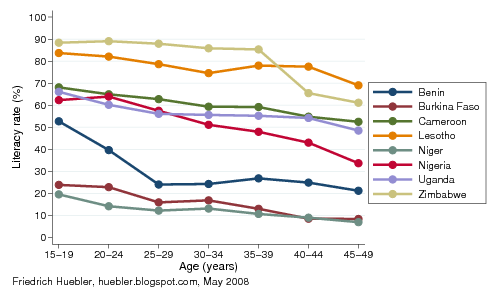
1. https://lh6.googleusercontent.com/-cnalp3t9UeS1QEfNt--ZG6ATQ...
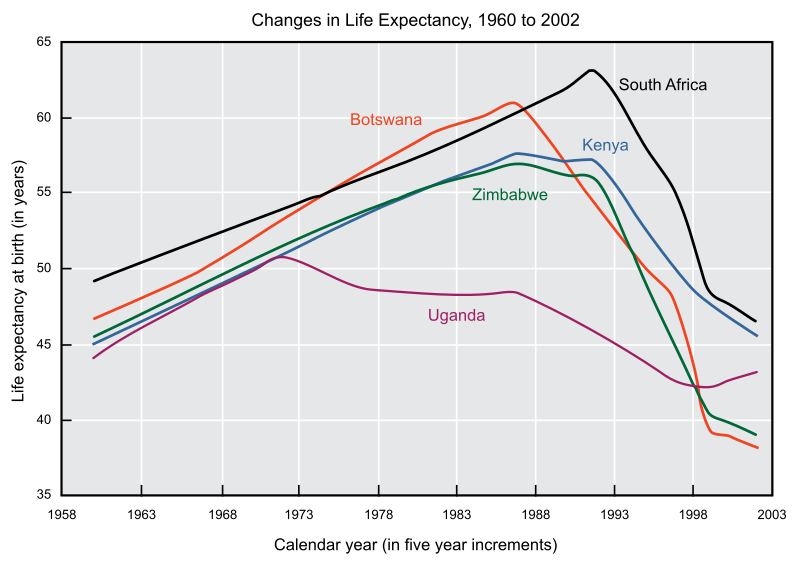
2. http://lh4.ggpht.com/fhuebler/SCW62SGJMiI/AAAAAAAAAU4/nIiCXa...
3. https://upload.wikimedia.org/wikipedia/commons/thumb/3/36/Li...
You can appreciate what you have and still be cognizant of all the problems affecting you and your surroundings. They aren't mutually exclusive. Improvement and change often bring new or novel sets of problems or may have unintended consequences. I don't believe that enumerating those should necessarily imply ingratitude. That's a slippery slope.
If you ignore gadgets, things have gotten worse for the working and middle classes of most developed nations in the past 30 years. Wages are stagnant yet housing and other essential costs have exploded... largely due to asset price inflation driven by financial attempts to reinflate. The problem is that without wage inflation QE only makes housing more expensive.
People in the developed world would be happier with what they had 30 years ago: stable jobs, pensions, a house, infrastructure that is not crumbling.
[1]: http://cessna.txtav.com/en/piston/cessna-ttx [2]: https://en.wikipedia.org/wiki/Cessna_400
We're at a world economic point where it is literally cheaper to send chickens from USA to China, process them there, and send the product back to USA than to process them near the originating farm. It's not that hard (with suitable supply chain management, and accounting for economy of scale) to just send that half of my chicken to some guy in Indonesia.
Women in the past would very frequently die in childbirth. Do you have data to show that childbirth is as dangerous as it was in the path? Or that it was safer in the past? (That would be truly shocking and counterintuitive.)
  Year           Deaths per 1000 live births
  ------------   ----------------------------
  1700 to 1750	 10.5  (British [1])
  1750 to 1800	  7.5  (British [1])
  1800 to 1850	  5.0  (British [1])
          1990    3.8  (Global [2])
          2013    2.0  (Global [2])
          2013   <0.09 (UK [3])
          2013   <0.28 (US [4])
From that same Slate article, child birth is still one of the most dangerous things for young women, despite it being far safer than ever in the past. This means that contraception is actually a health benefit. It makes it much safer to be a young woman.
[1] https://www.ncbi.nlm.nih.gov/pmc/articles/PMC1633559/
[2] http://data.worldbank.org/indicator/SH.STA.MMRT
[3] http://patient.info/doctor/maternal-mortality
[4] http://www.nytimes.com/2016/09/22/health/maternal-mortality....
[5] http://www.slate.com/articles/health_and_science/science_of_...
Showing a graph with improvements in child mortality rate and alluding us to believe in the following is wrong.
1. It happened because of living conditions. 2. Healthier diet — made possible through higher productivity in the agricultural sector and overseas trade. 3. age-old war against infectious disease 4. discovery of the germ theory of disease 5. development of antibiotics and vaccines
While I believe that contraception has improved child mortality rate. We should compare child mortality rate of first 2 children over the past 200 years. Child mortality will obviously be high when women have no choice.
Why? What benefit does that provide to anyone?
Showing a graph with improvements in child mortality rate and alluding us to believe that:
1. It happened because of living conditions. 2. Healthier diet — made possible through higher productivity in the agricultural sector and overseas trade. 3. age-old war against infectious disease 4. discovery of the germ theory of disease 5. development of antibiotics and vaccines
While I believe that contraception has improved child mortality rate. We should compare child mortality rate of first 2 children over the past 200 years. Child mortality will obviously be high when women have no choice.
I believe that we are being mislead about improvements in health, while in reality people have become weaker, less healthier. There are more diseases now than before. We couldn't really find cure for diseases. Discovery of Antibiotics was helpful for a while. Now bacteria is winning that battle with some superbugs among us.
It's also easier to have ten children when you start having them at 15 or sixteen, like my grandmother did, rather than at 30, as many are doing now.
Showing a graph with improvements in child mortality rate and alluding us to believe in the following is wrong.
1. It happened because of living conditions. 2. Healthier diet — made possible through higher productivity in the agricultural sector and overseas trade. 3. age-old war against infectious disease 4. discovery of the germ theory of disease 5. development of antibiotics and vaccines
While I believe that contraception has improved child mortality rate. We should compare child mortality rate of first 2 children over the past 200 years. Child mortality will obviously be high when women have no choice.
Really, the amount of work one has to perform just to be able to have a couple of square meters is amazing.
Light pollution is on the other hand is something people are just used to. Having never known stars why would they care about never seeing them? Never mind the huge impacts of poor sleep that's just the way things are.
Air pollution is again something people downplay. Sure it kills millions but air seems fine where I am.
Progress is eagerly believed fiction.
Your great grandparents might have had some comments on the weapons used in WW1. Assuming they survived.
Progress is eagerly believed fiction.
True or false: you would prefer to have been born in 1900 rather than 2000.
An example particularly in the United States: Poverty levels have decreased in the US. However, cost of living has exploded in certain areas, meaning that people who technically don't meet the official definition of poverty in, say, San Francisco can have their lives completely upended by the fact that they can no longer afford housing.
A related example not in exactly the same vein is neoliberal identity politics: It is ok for people to be oppressed my structurally racist institutions so long as the oppressor class is sufficiently racially diverse. s/race/{gender, orientation}/g Hide the fact that identities are tied to material relationships of economics and power behind a statistic about """diversity""".
Reducing people to statistics is a technocrat's wet dream and a fundamental ideological goal of neoliberalism: Reduce everyone to rational market actors, measure everything with statistics which abstract away actual reality and allow governments and corporations to justify any action they want because they set the definitions, dissimulate coercive power relationships by refusing to measure them.
Vox is faux-progressive propaganda for the worst kind of capitalism.
The poor of the US live better than the median person in India.
Isn't neoliberalism all about being free to be racist (or not racist)? Feel free to correct me about this.
> fundamental ideological goal of neoliberalism: Reduce everyone to rational market actors, measure everything with statistics which abstract away actual reality and allow governments and corporations to justify any action they want because they set the definitions, dissimulate coercive power relationships by refusing to measure them.
I'm biased as a supporter of neoliberalism; but isn't the fundamental ideological goal of neoliberalism maximization of human freedom?
Statistics don't abstract away actual reality; it's the best way to analyze a large number of people. I can't interview all 1.2 billion people in India; instead I can look at the statistics to understand that population.
Neoliberalism is all about minimizing the coercive power relationship between the people and the government.
> justify any action they want because they set the definitions
I wouldn't call it definitions (they're normative); but yes, neoliberalism uses moral justifications.
Yes, life stinks if you're poor in the US. Yes, it's been getting worse. But also yes, life stinks much worse if you're poor in many other places, and for many of the poor in those places, life has been getting better.
The definition of extreme poverty is living under $1.25/day (2005 dollars). You'll note that the chart cited in the article is backfilled to 1820. What does it mean to be living in extreme poverty in 1820? Was 95% of the world starving every day? It's an extraordinary claim that would require extraordinarily good analysis to make, but hey, it's a statistic so it must be true! One way in which this statistic is almost completely likely to be bullshit is that most of the world was no where near industrialized in 1820 and comparing means of living under an industrial mode of production versus a subsistence mode of production is suspect.
Furthermore, much of the misery associated with unindustrialized parts of the world in the time period the chart measures was directly introduced by industrialized nations. One looks at unindustrialized areas of the world today and sees constant conflict, famine, and systemic societal dysfunction and extrapolates it backwards under the assumption that it is the absence of capitalist industrialization that sustains these conditions when in fact these conditions were created in the process of capitalist expansion that largely benefited a few hegemonic nations. Neoliberal ideology rewrites human history so that it can blame preindustrial societies for the misery capitalism and imperialism visited upon them.
> Isn't neoliberalism all about being free to be racist (or not racist)? Feel free to correct me about this.
Neoliberalism is specifically a reprogramming of the elements of liberalism to reduce all human activity to the actions of rational, atomized economic actors in a private market. The erasure of the commons, the marketization of social structures such as education, family structures, personal beliefs, cultural expression, the erasure of power relationships (because everyone is voluntarily participating as a rational economically minded being in everything they do), and the depoliticization of human interactions (there is no political, only the economic) are all hallmarks of neoliberalism. Another aspect of neoliberalism is a technocratic view of government which is antithetical to enlightenment ideals: The point of government is to manage and regulate markets and nothing more. Neoliberalism also paints its mechanisms, which are often driven by heavy regulation, police actions, and military invention as inevitable natural outcomes of human nature: in particular globalization is seen as an organic growth of human economics when in fact it has been fostered and directed by deliberate government actions, not laissez-faire economic development.
I don't know what you think neoliberalism is.
> I'm biased as a supporter of neoliberalism; but isn't the fundamental ideological goal of neoliberalism maximization of human freedom?
Sure, and the Party in 1984's ideological goal was to maximize freedom too. The material goals of neoliberalism are ultimately the class interests of the capitalist and owning class. The ideological goal of neoliberalism is to frame the world so that those who control most of its resources are naturally and inevitably the ruling class and that any objection to the sacred, natural law of the market is invalid. So, freedom is framed not as a political concept, but a purely economic one, and ultimately "I want the liberty to grow rich and you can have the liberty to starve" (Isaac Asimov). Because the market is natural and inevitable, any structure it may have that disadvantages anyone to the benefit of another is natural and thus not an impingement of freedom.
> Neoliberalism is all about minimizing the coercive power relationship between the people and the government.
Somehow it does this by increasing the power of the police state, increasing military intervention in weaker countries, staging coups for violent neoliberal dictators in nations that reject it (e.g. Pinochet), increasing regulations to the benefit of the largest corporations, consolidating industries into fewer and fewer independent entities and creating a close relationship between politician, bureaucrat, security officer, and businessman.
Also, is neoliberalism about dividing people up by minority status and then ensuring diversity in our oppressorship? Or is it about reducing everyone to rational market actors and abstracting away everything else? I can't quite tell.
You can use lots of fancy thought-piece buzzwords but I don't see how it makes the content itself thought-provoking.
For some sub-populations of the US things have gotten significantly worse in the past few decades and we should do something to help. Nonetheless, I think it's worth celebrating a reduction in the global rate of extreme poverty from 64% in 1960 to 9.6% in 2015.
It's also worth noting that the estimates are adjusted for inflation and price differences between countries, so changes in cost of living should not be a significant factor (even though adjusting historic data for inflation is imperfect).
Even if we're exactly the same amounts of angry, xenophobic, and selfish, it's still a better world if my (hypothetical) child has a much greater chance of surviving into adulthood, and not having to deal with that loss. I would challenge you to somehow defend the notion that it isn't.
Or how about the axis of freedom? Even if we're the same amount of angry, xenophobic, and selfish, but are more free, that's still a better world.
If you're going to prioritize just a few very narrow aspects of life, you need to at least explain why these other measurable things have no significance.
I tested it: the whole page rendered as one high quality 1918 x 17591 JPEG file weighs 3.58 MB.
As loaded by the browser, without ad blocking, it does +280 http requests to dozens of servers and downloads 6.9 MB.
If pages were provided as images, we might burn less CPU cycles and produce less CO2. Not so good for clicking ads though ;)
I assume that another ten years of hardware progress will allow web pages to install and boot multiple OSes to display charts and graphs as well.
Do you consider absolutely every single media source the same as every other one?
There are most definitely organizations that have proven to report more accurately than others, and have ethical standards.
If "getting better" means raising the maximum possible quality of life inequality seems unavoidable, since people need an incentive to pursue and propagate technological advances.
What if doing that really would make more people happier on average?
Punishing productivity doesn't work.
This article suggests that vox does not get it right all the time:
https://www.quora.com/Media-Business-in-2015-How-credible-ar...
I have a lot of respect for his work, but I can't really judge it's accuracy without diving more into the data.
I need to read more about the website and where its data is sourced to make a judgement myself, but the above link was informative to me.
Over half of your claims relate to the environment. Perhaps you are too attached to that? Or are you so firmly fixed to your narrative that quality of life is decreasing? I can easily cite many MORE animal species that are not extinct today, but would have been, if it were not for our technological advances and conservation efforts. But of course, this doesn't match your narrative, so you will deny it at all costs.
what good is it to live in a great techno-wonderland if we've traded much greater gifts to get there? i could say perhaps you are too attached to the idea of progress, the idea that because time passes things must get better?
No evidence is given that life at any point in the future will be better than it is currently.
Disappointing and misleading.
Because you cannot say that with certainty. He in fact addresses this very point towards the end:
"Big problems remain. None of the above should give us reason to become complacent. On the contrary, it shows us that a lot of work still needs to be done — accomplishing the fastest reduction of poverty is a tremendous achievement, but the fact that one out of 10 people lives in extreme poverty today is unacceptable. We also must not accept the restrictions of our liberty that remain and that are put in place. It is also clear that humanity’s impact on the environment is at a level that is not sustainable and is endangering the biosphere and climate on which we depend. We urgently need to reduce our impact.
It is far from certain that we will make progress against these problems. There is no iron law that would ensure that the world continues this trend of improving living conditions."
On a very simplistic level, the article can be reduced to three statements:
1) A minority of people today believe that life is getting better for humanity
2) Between 18XX and today, life improved (at least as measured by the examples given)
3) There are challenges facing humanity for the future and there is no guarantee that life will continue getting better
I'm not disputing any of the points or data sets in the article, nor am I disagreeing with the author. I am simply disappointed that at an article which barely touches on the issue of whether life is currently improving or not is misleadingly titled 'Life is getting better for humanity'.
Sure, things are better, but I would argue that there's a greater loss potential. As technological potential grows that means more and more people have a target on their back, dooming them to inevitable irrelevance. Say our technological/societal progress results in us destroying ourselves with some weapon/technology in the year 3000. One would amortize the negative infinity loss through the preceding years. This would result in negative progress each year, right? Of course it's impossible to predict when such a thing would happen.
----
Also, it would be nice to compare things to what we could have achieved. For example, if western civilization really did stunt potential of certain places or people, and NOW they're finally catching up, is that impressive? The alternative could mean we would be where we're at now a few decades ago.
The "humanity" question is really one thing to me. More or less live births.
The mindset of "better" had been passed down our generations and I am greatful for it
Edit. He lived in the US in the mid 1800s