Another thing, is these platforms have more than one kind of participant, ones who utilize them as their main source of income, and those who utilize them as complementary source of income or as a part time/college/uni job.
If these platforms would simply be a platform (who like yelp) let the provider sink or swim based on ratings, then they could avoid the problems stemming from their requirements [which makes the platform less ad hoc and more rule based thus leaning toward employee - yet the fear would be a degradation in service to end users and thus a threat to platform viability]
One thing I'd like to know is whether people doing lyft or über full time do on average better or worse than their yellowcab counterpart.
Edit: For those downvoting...you really think these exact things weren't discussed when Uber & Lyft were deciding how they would comp drivers? Heh.
If they had to reclass as employees, they would just raise prices to end consumer 10-20% to compensate (or fund it via other's money like they're doing now to price out rest of market).
They'd also put a cap on hours per week so drivers couldn't drive more than 30 hours per week. Companies aren't legally required to give benefits to part-time workers (up to 30 hours).
The big draw of independent contractors is that you've just converted labor from a fixed cost to a variable cost. There are tons of Uber/Lyft drivers (namely, anyone not doing it full-time, which is the majority of drivers) who prefer this since they can drive as much or as little as they want.
No, they don't. They might avoid being assessed the payroll tax, but the economic incidence (the reduction in purchasing power after prices have adjusted in light of the taxes) is, per a well known result, independent of who assess the tax on, and completely dependent on the shape of the supply/demand curves.[1]
"Making" employers "contribute" half of FICA is just a shell game. If (on normal employees) you made employers pay all of it, they would (likewise) just cut wages by the exact same amount, as everyone's after-tax income would remain the same and no one would have reason to deviate.
[1] https://en.wikipedia.org/wiki/Tax_incidence
>>The key concept is that the tax incidence or tax burden does not depend on where the revenue is collected, but on the price elasticity of demand and price elasticity of supply.
A good indicator is that most cab drivers (at least in SF) have switched over to Uber. The only ones who aren't doing Uber either (a) got low reviews on Uber and kicked off the platform or (b) have some odd loyalty to cab companies (e.g. maybe they're a part owner in a medallion).
Most taxi cab drivers are treated more poorly than Uber/Lyft drivers. They have to drive to a centralized location to pick up / drop off the car, don't have their own car to take care of, have to pay a per day fee that they don't always pay back if they don't get enough business, etc.
Which makes me want to clarify things. Are über lyft drivers better off than yellow cabs where these platforms have not yet disrupted? In other words, are they better off on über now or yellow cab historically? The answer, I suspect, will remain the same, but its far from cut and dried, I think.
This article seems credible: https://pando.com/2015/01/09/the-hidden-cost-of-being-an-ube...
But, what it shows as the "income after op cost" isn't the real truth. That figure ($12.62/hr in Chicago, $34.04/hr in NYC) would be basically 1099 income. You would have to pay self employment tax (not trivial), and forgo whatever benefits a cab company might provide their employees.
If you look for average salary for cab drivers, and compare to the above, you would gather that cab drivers do better than Uber drivers in Chicago, but worse in NYC.
I can't find any credible sources where it seems 100% clear that the comparison is thorough, and apples to apples.
Why?
Uber is losing hundreds of millions of dollars with "high" fees. So I guess you need an investment of 20 billion or so to compete?
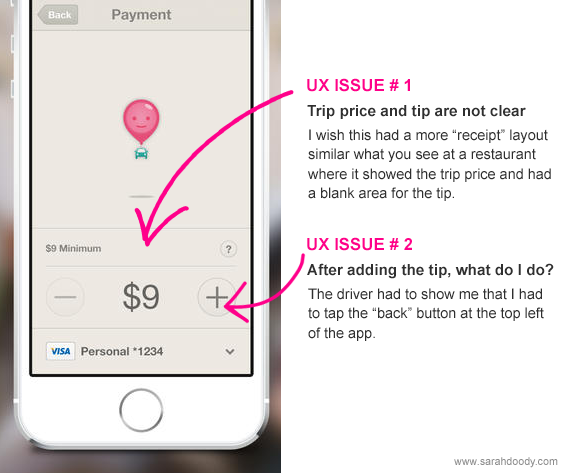
I'm sure that enabling tips would create other issues, but the bump in compensation would probably go a long way toward improving the relationship.
When it comes to tips, I greatly prefer the European model, in which people neither expect nor offer tips under normal circumstances. Pay people to do a job, and pay them enough to want to do that job and do it well. Don't rely on customers to make up the difference.
2. Driver ratings replace the primary function of tipping, which is to incentivize good service and leave feedback.
That said, I very occasionally leave a tip in extraordinary circumstances, and would not be opposed to a way to do that in-app, as long as it was very clear it's not expected (hide behind 5-star rating, call it a "bonus" or something).
http://www.sarahdoody.com/wp-content/uploads/2014/03/lyft-ux...
I wonder how much that keeps it from being used.
http://www.latimes.com/business/technology/la-fi-tn-lyft-set...
But it will make it more difficult to attain the important thing that was sought -- employee status and its protections. I don't see how this isn't simply a case of Liss-Riordan selling out to make sure she got her cut guaranteed, drivers be damned.
The notice has to have an opt out procedure.
Edit: If either of the above applies, you are free to bring your own suit.
There's got to be a way to do this such that drivers don't get shafted, while still making a profit...
We can have a world where (1) costs are transferred to riders, (2) costs are eaten by Lyft, (3) costs are diffused through increased efficiency and utilization of the workforce -- this tends to manifest itself in overworking of employees though (ex: paying overtime rather than hiring more workers, as is often the case in manufacturing)
I suppose that we could have a scenario for (3) where the goodwill entices riders to use Lyft more, which increases utilization of drivers (ex: collecting fares for X minutes / hour goes to X + N minutes / hour) and that can pay for the increased costs.
As a contractor you always pay for your own benefits. Every contractor does this (or chooses not to on their on volition). Every driver KNOWS they are a contractor, they should know what comes with being one, and it's no ones fault but their own if they don't.
Higher taxes are one thing, but if the American government ran essential benefits such as this, businesses can then focus on, well, their businesses.