[1] https://lwn.net/Articles/544543/ [2] http://www.phoronix.com/scan.php?page=news_item&px=MTM0MTM
What good is modifiable software if the hardware will refuse to run software if it's modified? Tell me, Mr Anderson, what good is a phone call when you are unable to speak?
The anti-Tivoization clauses are not as strong as most casual readers of GPLv3 seem to think they are. In particular, they only apply if "you convey an object code work under this section in, or with, or specifically for use in, a User Product, and the conveying occurs as part of a transaction in which the right of possession and use of the User Product is transferred to the recipient in perpetuity or for a fixed term".
A "User Product" is "either (1) a 'consumer product', which means any tangible personal property which is normally used for personal, family, or household purposes, or (2) anything designed or sold for incorporation into a dwelling".
So, as long as you keep GPLv3 code out of the firmware, OS, and bundled applications that ship when you sell your hardware to the customer, you can lock down the hardware and still provide add-on software that is GPLv3.
You are free to build your own hardware.
GPLv2 ensure software is open, you use GPLv2 software, you ensure the software stay open.
It does not try to control other things outside what it gives. "Use my software? Make your hardware open. Use my software? Make your customer service open." No. It's simply "Use my software? Make your software open"
Which is fair in Linus's opinion.
https://www.gnu.org/licenses/old-licenses/gpl-2.0-faq.html#V...
Clause 14 of GPL 3 also clarifies what later licenses can do. They must be "similar in spirit" and they cannot impose any additional requirements on any author or copyright holder.
edit: Okay, after seeing clause 14, I don't even see how a judge would interpret a GPL version without copyleft to be "similar in spirit", so I can't even imagine how that would happen. I think you're ok in accepting newer versions of GPLv3.
This scheme depends on one (main) developer having control over the licensing of a significant part of the code base so it's subject to the "hit by a bus" failure mode.
However, there is no guarantee that I will agree with future versions of the GPL. I'd like to judge them as they come. It's actually really strange to sign up for an open ended contract where a 3rd party is writing the revisions.
You don't have to trust RMS. You can trust lawyers interpreting clause 14 of GPLv3 correctly. This clause says that later GPL versions must be "similar in spirit". It also says that newer versions cannot impose any more obligations or restrictions on authors or copyright holders.
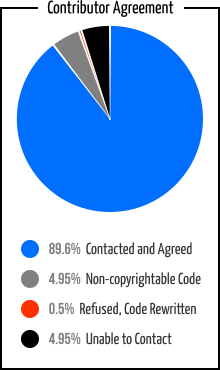
EDIT: disregard; didn't see the graph, and wasn't previously aware of the one person who refused. See https://news.ycombinator.com/item?id=9600204 for the correct answer.
No. Ten were uncontactable, and one refused.
"Refused and Code Rewritten - 1/202"
"Unable to Contact - 10/202"
From the descriptions of the red and black slices of the pie chart - https://dolphin-emu.org/m/user/blog/relicensing/relicensepie...
https://dolphin-emu.org/m/user/blog/relicensing/relicensepie...
Note: "0.5% Refused. Code Rewritten"
If you mouse over that graphic in the article it says 1 person refused. However, the article otherwise completely ignores that 1 person... (unless I missed it, both times ;) )
In the GPL case, the Free Software Foundation states that “The Free Software Foundation may publish revised and/or new versions of the GNU General Public License from time to time. Such new versions will be similar in spirit to the present version, but may differ in detail to address new problems or concerns.” (Section 14 of the GPLv3.) Now of course I don’t expect the FSF to publish something radically different, but they _could_ do so. Even if you trust the FSF now, are you sure you trust the FSF twenty years from now?
So you could say "GPLv2, GPLv3, or any later version approved by ...". Which then means that a future relicense to allow GPLv4 (after reviewing it to your satisfaction) would not require contacting every single contributor.
What is the worst case scenario, by the way? You could say it depends on who you are. One such scenario would be for developers who agree with the FSF's strong copyleft philosophy who are betrayed by a future hypothetical revision that removes all copyleft provisions to make it no stronger than, e.g., BSD. This affects only a subset of those choosing a license for their project. (I.e., if you don't care about copyleft, this purportedly horrific thing doesn't even affect you.) Funnily enough, the subset of those who would be affected are hardly ever the ones I see making the argument you are.
So what terrible things do you imagine the worst case scenario involving?
For example, a community could fork a project and license it under a new'er version, and then the original founder could suddenly want to incorporate the new changes but at the same time not want to use the new license, and the new community refuses request for a license to the old version. I don't think it ever has happen with a gplv2+ project, and it require a quite hostile community to begin with, but as a worst case scenario that would likely be it.
They already wrote legalese that says that they can't do so. This isn't merely an empty promise: it's already encoded into the text of the license. If a later version of the license is radically different and not in spirit of the GPL or imposes upon authors obligations that earlier versions of the GPL do not, then the current version of the GPL already says that later version would be invalid.
Once again the FSF political motives cast its license into dubious territory. Just stay away from the GPL.
Not at all. They say so themselves: GPLv3 adds compatibility with Apache v2, which GPLv2 lacks. This thus removes a restriction.
GPLv3 also clarifies some things from GPLv2, such as being explicit about being applicable not only to software, and giving a clearer meaning of what distributing software means. GPLv3 calls this "conveying".
Yes, there's a benefit that you are compatible with other more strict licenses, but that's like saying moving from GPL to proprietary is less restrictive because then you are compatible with the rest of your proprietary code at your company. Being more compatible with less free licenses is not more free.
Whether you think you should allow Tivoisation or not is a different matter to the plain fact that there are things that GPLv3 allows which GPLv2 does not allow.