It's interesting these rockets are equipped with self-destruct systems. What scenario would warrant a rocket purposely self-destruct?
I can't seem to find any good numbers, but it seems like the F9 rocket should have somewhere around 200 tons of fuel & oxidiser (kerosene & liquid oxygen). That, in addition to the few other hundred tons of rocket landing anywhere public is probably not going to end well.
IIRC, most rockets over a certain size are required to have some form of 'range safety package'[1] which may include a self-destruct capability for exactly these reasons.
In the course of the Challenger shuttle accident, the Solid Rocket Boosters were remotely destroyed by the range safety officer[2]
When they're out of control and could hit someone.
> The more robustly constructed crew cabin also survived the breakup of the launch vehicle; while the SRBs were subsequently destroyed remotely by the Range Safety Officer, the detached cabin continued along a ballistic trajectory and was observed exiting the cloud of gases at T+75.237.
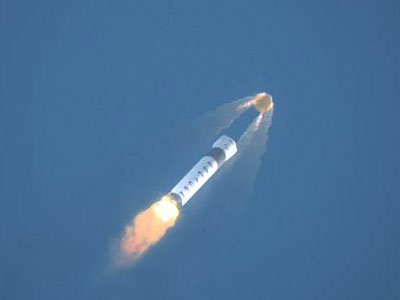
In the images, you can see the solid rocket booster (SRB) following a random path after the explosion.
http://en.wikipedia.org/wiki/Range_safety#Range_safety_in_US...
I read about it in Boris Chertok's memoirs (http://www.nasa.gov/home/hqnews/2012/feb/HQ_12-054_Chertok_R...), which are huge and sprawling, he was there from the beginning, from the mission to get V2 stuff from Germany after WW2, through the Soviet Union's fall.
https://www.youtube.com/watch?v=Zl12dXYcUTo
Then imagine if it was headed for somebody's house (or a city). You'd want to blow it up in the air before it reached the ground.
One can imagine all sorts of instances where it'd be preferable to litter the area with debris rather than missle-ing the rocket into a densely populated area.
The political will to create a private market for rockets is strong in US. So strong that a lot of American public money has been used to save SpaxeX from failure, multiple time.
But concretely, what's the point of it? NASA worked fairly well if well founded. Now for political reasons they prefer to give money to SpaceX, even if they have issues with their job...
[1] Vega launch satellites to Sun synchronous orbit, satellites here are earth observers and usually a few tonnes at most, the majority much smaller. Launches here are very infrequent, so matching spacecraft is difficult. Falcon 9 isn't currently equipped with an appropriate fairing to do dual launch like this without satellites built to stack (which most aren't). Falcon 9 might haul 9 tonnes, but you might not be able to find 9 tonnes of spacecraft to that orbit. Vega payloads are also kept in a clean environment and fairing, something SpaceX hasn't demonstrated. Horizontal integration can be an issue. ITAR issues... The list goes on.
>But concretely, what's the point of it? NASA worked fairly well if well founded...
NASA doesn't build rockets. They have always outsourced the job to aerospace companies.
> Now for political reasons they prefer to give money to SpaceX
I think you'll find that political reasons are keeping NASA from buying more launches from SpaceX.
http://www.usatoday.com/story/news/nation/2014/04/25/spacex-...
EDIT - changed my wording from "very checkered history" to "had launch failures as well" - in my rush to respond, I went from memory and checking the facts found my words too strong.
Ariane 5 is not the predecessor of Vega. They are two very different project, for different payloads. And look at the table of success and failure rate of the Ariane 5 itself http://en.wikipedia.org/wiki/Arianne_5
> SpaceX has had an amazing run in comparison to most other platforms.
Clearly that's not the case.
> I think you'll find that political reasons are keeping NASA from buying more launches from SpaceX.
From that interview: http://www.cbsnews.com/news/tesla-and-spacex-elon-musks-indu...
Elon Musk: NASA called and told us that we'd won a $1.5 billion contract. And I couldn't even hold the phone, I just blurted out, "I love you guys."
Scott Pelley: They saved you.
Elon Musk: Yeah, they did.
NASA is a terrible rocket design bureau good only for pork barrel, which is what is has been doing for decades. NASA had to admit that developing Falcon 9 (100% privately funded by SpaceX and private investors) would have cost more than twice if it was done by NASA (http://www.nasa.gov/pdf/586023main_8-3-11_NAFCOM.pdf).
For things that the government wants to launch from the US, having a second US-based option for space launch will get the US out of the bilateral monopoly that exists with ULA.
[1] http://en.wikipedia.org/wiki/United_Launch_Alliance [2] http://spaceflightnow.com/news/n1408/20rd180delivery/
Also, I was not aware of any Falcon 9 exploding previously. What on earth are you talking about?
First: Falcon 9 so far has 11/11 successful launches. This was not a Falcon 9, this was a test flight of a sub-orbital development vehicle (F9R-"Dev").
Second: "Vega rocket (aimed at the same size of payloads...". Your Wikipedia link says maximum payload to LEO is 1,963 kg, while Wikipedia quotes Falcon9's maximum payload to LEO is 13,150 kg.
And how much do they charge for those 1963kg? Wikipedia quotes 32 million euros per launch, or $42M, corresponding to $21,000/kg, for the Vega, and $4,109/kg for the F9...
Now, that said, this is why we have escape towers on pods (and the escape rockets around the sides of the Dragon 2). In the case of an emergency, those eject the pod from the rocket so that it can be returned safely, even as the rocket is destroyed.
I believe it doesn't matter what the craft is, there is always some manner of self-destruct to ensure a larger population isn't threatened by debris from an exploding rocket.
I would guess each case has to weigh its pros and cons for inclusion of a system. There is such thing as acceptable risk to population. If FAA mandated them carte blanche, Michael Bay movies would become documentaries.
http://en.wikipedia.org/wiki/Range_safety#Range_safety_in_US...
I'm glad I can joke about this because nobody was hurt. Saw the headline at the top of the frontage and it immediately brought back memories of seeing Challenger on the news when I was 9, which rather changed my perspective on space travel at the time.
How NOT to do it. Not that China even bothered to check how many died, apparently.
SpaceX Statement: https://twitter.com/SpaceX/status/502976401729798144/photo/1
SpaceX Statement in full (copied from facebook page):
Earlier today, in McGregor, Texas, SpaceX conducted a test flight of a three engine version of the F9R test vehicle (successor to Grasshopper). During the flight, an anomaly was detected in the vehicle and the flight termination system automatically terminated the mission.
Throughout the test and subsequent flight termination, the vehicle remained in the designated flight area. There were no injuries or near injuries. An FAA representative was present at all times.
With research and development projects, detecting vehicle anomalies during the testing is the purpose of the program. Today’s test was particularly complex, pushing the limits of the vehicle further than any previous test. As is our practice, the company will be reviewing the flight record details to learn more about the performance of the vehicle prior to our next test.
SpaceX will provide another update when the flight data has been fully analyzed.
Well thank goodness. I was so worried that a government agent was not present. All is well. Hail the FAA.
/s
And those rules are the US government's, not SpaceX's.
Also, what's the environmental impact of this kind of accident?
Environmental impact is likely small, the kerosene would have burned anyway and there are little other hazardous chemicals on board. (Unlike for example the Proton failure linked by kryptisk above which is fueled with really nasty hypergolic fuels.)
https://www.youtube.com/watch?v=ZwwS4YOTbbw