My wife, an Aussie and high school teacher with several years of teaching experience in top international schools in Asia, couldn't legally work in the US. So she volunteered teaching ESL at a local adult school. Ironically many of her students were Hispanics who had originally entered the US illegally. Doubly ironically she got a special commendation award for her volunteering signed by George W. Bush's signing machine.
Eventually I got fed up with the bureaucratic farce whereby US visa regulations provide compliant, indentured foreign programmers to US businesses at below market salaries in exchange for the remote possibility that they'll eventually get a green card.
So I left and now live in Australia, where I am self-employed, can take time off to work on my own side-projects, and pay less than $300/month for private medical insurance for my family of four. American exceptionalism? Sure--if you're a sucker.
H1B is totally a sucker's game.
I think if I wanted to I could easily work for 4 days; much easier than in Holland, but that was bigger company. Also, there is no limit on the vacation I can take.
I was working at a research lab that was part of Harvard Medical, therefore they could hire outside of the quota. But the "let's work on a/my startup" bug would bite my again, so I quit my job, moved to NYC and started checking with companies there. Uh oh, can't transfer my visa. Also, forget about unemployment checks, even though I paid for Social Security like everyone else.
Move to Berlin. Job offer in 2 weeks, paperwork finalized in 3 weeks. EU card valid for 5 years. If for some reason I leave this job for another one, all I need to do is notify the Ausländeramt. And anyone is eligible for unemployment insurance after 12 months of work/tax collection.
Social Security is a completely separate system from unemployment; the only conceptual area of overlap relates to disability.
Unemployment is a different system of social insurance which you probably also paid into -- but its insurance against involuntary, no fault unemployment. Both voluntary termination (quitting) and termination for cause generally are outside of the coverage of unemployment insurance.
    I quit my job ... forget about unemployment checks, even
    though I paid for Social Security like everyone else
https://www.nolo.com/legal-encyclopedia/unemployment-benefit...
By the way I worked in Brazil for 7 months and the visa was just as quick. Lovely country. ;)
Having said that, I've started on this path just recently and believe me I am facing difficulties at every step, even the the ones I thought would be the most obvious. But again who said life was easy.
In case you are interested there are ways you can do business in the US on H-1B visa. Is it easy? Hell no! But in case you are still interested keep reading, feel free to reach out to me as I am going through this process right now.
Articles about Entrepreneur H1B:
- http://www.murthy.com/2012/12/17/entrepreneur-h1b-petitions-...
- http://www.uscis.gov/news/public-releases-topic/business-imm...
-http://blog.uscis.gov/2011/08/encouraging-entrepreneurs-and-...
- http://www.uscis.gov/eir/visa-guide/entrepreneur-visa-guide
Further reading:
- http://blog.fosterquan.com/2012/12/09/the-sweet-smell-of-suc...
Success story of Vishal Shah from Traffio:
- http://www.nextbigwhat.com/how-to-startup-in-silicon-valley-...
Business Entity:
- http://www.dailymotion.com/video/x12qxuo_how-to-open-a-busin...
Part of the H1B approval process is that you get paid more than the average salary for the same job in your area. If your salary is below the regional average for your job, then immigration doesn't approve the visa.
I would love to read something like that.
In terms of "starting a business" I just had to register for an ABN ("Australian Business Number"). That may not even be a legal requirement but IIRC it had tax advantages. It's a couple years since I did it but as I recall I did it all online in a couple of hours and it didn't cost much. I then just include that number on my invoice. Very civilized.
At some point I need to register to charge GST but I'm sure I can do that online too. At no point have I had to visit a government office or get a bureaucrat to sign anything to start a business in Australia.
From your sarcasm I read that you never really wanted to build a life in the US? That's fine, but don't start calling names just because you couldn't pull it off.
http://www.us-immigration.com/us-immigration-news/us-visas/u...
EDIT: The principal at the school where my wife was volunteering actually wanted to hire her as she was better qualified than some of the paid instructors she was helping. But at some level higher up the chain they had a policy of not sponsoring work visas, so that went nowhere.
1) Visas & immigration
2) Health
I found this deeply disturbing, as my wife is a skilled professional in another field and if I were to accept an H1B offer, she would had to become a house wife more or less.
1) The visa stuff is a PITA, but if you are in a situation where you can tell some company to deal with it, it shouldn't be too bad.
2) You get pretty good health care working for most companies in the US as a programmer. If you lose your job, you can presumably relocate to where you were before that has a different health care system.
1) My wife has a chronic health problem. What guarantee do I have that if she needed treatment, for that or something else, that insurance wouldn't find a way to weasel out of covering it? Also, eventually I would lose coverage under OHIP, the Ontario Health Insurance Plan, after an extended absence (1-2 years? not sure exactly), so going back to Canada for treatment would not be an option forever.
2) My health insurance would be covered and sponsored by my employer. I'm already dependent on my employer for my income. In my mind, also depending on them for health care coverage is putting too many eggs in one basket.
Dont believe the hype if you work for a company that is going to sponsor your visa, chances are they will provide health insurance. I pay $25 a month for myself and $175 if I had a family of 4.
My girlfriend uses Obama Care and pays $21 for basic insurance. Unless you are self employed then chances are you wont be paying much and now with the new health plans even these plans are affordable.
I used Obamacare for the month of January. My plan cost $507, I received the card on the 30th of the month (so the plan was unusable before then), and they (Blue Shield) were impossible to reach. They have a very understaffed phone line for Obamacare users, separate from their "regular" service for group plans.
I'm from the UK, and if something is wrong, your biggest challenge is making appointments with the right people.
Some of my colleagues from the UK who have had to go and see someone in the US report that it's a minefield of: a) Checking which doctors take your kind of coverage b) Co-pays c) Ensuring you know what you are/aren't covered for d) Random bills that may appear after you visit someone, depending on whether their interaction with the insurance company
I'm from the UK, and did the E-2 application myself (having found that it took as much time to explain to a lawyer as to write the application). My initial investment was $100k (enough to start a software business, provably). I have been renewing that visa since 1999, while living in NYC.
Now, however (partly to do with having a 3-year-old), I've moved with my family to Singapore. Visa process took 3 days, and is valid for 12months (and a 12month extension will be very doable, apparently).
One aspect of the Green Card process (which is, I believe, somewhat achievable even starting on a E-2, is that you get caught in the US tax regime semi-permanently. Which is taxation on world-wide income. That would make moving to another country relatively painful (and that's partly why there are so few Americans in Singapore : there's no tax advantage to them).
Happy to answer any questions.
I'm about to graduated college and go start working in NYC. My parents are currently starting the process to get citizenship and I'm choosing not to do it mainly because I'm not sure if I want to stay in the country for the rest of my life and didn't want to be stuck in the US tax abroad issue.
You mentioned that getting a green card does in fact put you into the US tax regime semi-permanently. Do you have any links or more information about that?
The US E-2 is similar to the (into Netherlands) DAFT, except for the fact that the US doesn't allow for the 'sole entrepreneur' option : You need to fund a business with the plan to employ Americans.
[1] http://travel.state.gov/content/visas/english/fees/treaty.ht...
One crazy thing is : They force you to renew at the Embassy in your home country, in person. So, once your application is in, they give you a date to turn up. But they won't give you any time-line about when they'll send your passport back (with the visa). So you can't really book a cheap return flight. i.e. in order to be the person in charge of a new business in the States, they require you to periodically leave the States for an indeterminate time, and sit in your home country (which is potentially just dead time business-wise).
OTOH, I have found that (i) having prepared the paperwork myself, (ii) actually being an entrepreneur, and (iii) having actual real-life experience of running the business to relate : The embassy person is actually interested in hearing about how things are going, and willing to 'relax a little'. I'm guessing that many people turn up with lawyerly papers, which don't really match the lines they are taught to say, and have marginal-to-misleading reasons for wanting the visa. So an actual real deal entrepreneur is a breath of fresh air.
My initial visa was 2yrs, followed by a 2yr renewal, the 2x 5yrs. So it gets easier. But was always really tiresome.
Now that I'm back in Europe, I've been looking into applying for a J-1 waiver and it's just form after form after form. Additionally, you have to pay something in the region of $2000 according to an immigration lawyer I sought out and with that I'd only be throwing my name in the ring, with the possibility that the State Department would reject my waiver application apparently.
I absolutely fell in love with SF whilst I was living there and would love to make it back now that I'm wrapping up my PhD, but I think it's neigh on impossible given the current bureaucracy involved.
Guess I'm just gonna wait it out and hope for immigration reform to kick in.
You can do it all by yourself and in total you won't have to pay more than $500 ($215 for DS-3035 + fee for no objection letter.) Go for it!
[1] http://travel.state.gov/content/visas/english/study-exchange...
Also look into the O1 visa that doesn't require a waiver, and has no quotas.
With regards to the O1 visa, I've heard that you have to really stand out in your field of research, as the original article states, and unfortunately, during my PhD I haven't really achieved that level of success.
Thanks in any case for the info!
I believe this is only for B1/B2 visa holders and those who are part of the Visa Waiver Program (UK/Aus etc.).
You're not supposed to look for work or attend interviews on a tourist visa.
If an immmigration officer asks you at entry point "So why are you coming to San Francisco?" and you answered "I was going to interview with a few companies"? then they could quite reasonably refuse entry based on the idea that you are trying to gain entry on the wrong visa.
Keep in mind that your current actions can greatly influence how they perceive your "intent" in the future.
I get the impression this is a relatively grey area - I have a BEng in Civil Engineering, in my opinion it's somewhat related, I just wondered if there is a clear guidance on this?
source (anecdotal): I went through the process of obtaining visa(s) with and without legal representation
(IANAL, but:) This is very wrong on at least two counts: there is no fee for enrolling in the lottery and if anyone charges for it, they are a scammer and you should enroll directly on dvlottery.state.gov site (as explicitly stated in its FAQ). Also, simply signing up for lottery is generally not sufficient ground for immigration intent (though being conservative doesn't hurt).
Once you win the lottery, it might or might not be wise to get help, but I don't really know since I didn't win.
I've been heard similarly about the DV lottery and immigrant intent before. That said, if you're from one of the lower immigration countries, apparently the success rate is reasonably high for multiple retries.
Page 12 here has more info on the issue: http://www.wolfsdorf.com/articles/DV_Article_2004-05.pdf
the h1b is a dangerous game. it's essentially a do whatever i say, and i "may" sponsor your green card "eventually", with an emphasize on the may. not everyone uses it that way, and i would would be leaning out of the window saying most do, but it's definitely enough to be a common issue.
i was brought into a university with an h1b under the premise that i could work on my own startup. what didn't tell me was that that what they meant was that i should work for them for 5 years before they would consider sponsoring a green card application, and that they expected me to work unpaid overtime whenever they asked me to.
i've heard from a friend running a consulting company in the area, that a lot of companies bring in workers with h1b's and then don't even have the decency to sponsor a green card after keeping them for 6 years.
to my remembrance there was a house voting sometime last september about an immigration reform. one side of the table was asking for better accessibility to visa's for specialized workers(including cali afair), and the other was asking for more audits.
sadly i can't tell you how much good came out of it, maybe someone else can elaborate on that.
edit: there is a reference at the end of the ops post, but it's not really prominent. eb-3 wait times can be years, which is why it's not really a reasonable choice, but eb-2 is different
But, I don't do any state of the art research, or highly specialized academic work, or anything worth publishing on academic journals.
How hard is to do the Labor Certification for the EB-2 green card?
Edit:grammar
Generally doing the labor certification isn't hard, just time consuming and a lot of paperwork. 1-2 years is not uncommon even with the new PERM system. After that it depends what country you come from.
The main gotcha is you cannot use your experience of doing the position on your H-1B towards your labor certification application if you are currently employed in the position so you'll have go on your previous experience.
As ever consult a lawyer. This goes double for immigration related stuff.
I have been working for american companies remotely for a while, I do fairly regular visits to the american offices, generally 'Work Meeting' will get you straight passed, but I have a few times been questioned exactly what I do at these work meetings and once tiredly and mistakenly mentioning programming, was very close to being refused entry.
The other issue I couldnt find any documentation on how long a visa waiver is valid for, it is given for 3 months, but is that 3 months out of the year or just 3 months at a time? over a full year I occasionally get close to this and was mostly curious.
I don't know specifically about your situation and the VWP but it's not allowed to do things in the country other than your stated purpose, and other than what your visa allows.
See: http://en.wikipedia.org/wiki/B_visa#Uses_of_a_B1.2FB2_visa
Looks like most normal work is not allowed, except for the last provision there. If you follow to the source, it says "These would-be entrants are not allowed to receive remuneration from a US source (other than an expense allowance or reimbursement) and must be customarily employed by a non-US firm that will continue to pay their salary during the temporary assignment in the US.". So there you have it.
Huh. I knew Microsoft did this in Vancouver but hadn't heard about Google also using it although it makes sense. As a Canadian I'm not sure if the country really benefits from it, although I guess it boosts the Canadian offices.
"If you're not on a dual intent visa then you may be asked to prove that you have significant ties to your home country, and no intent to reside in the US permanently or apply for a green card."
It's worth mentioning we will probably marry before she completes her PhD.
Once she has "demonstrated immigrant intent" (i.e. applied for a green card) she can remain in the US with no problem, but if she leaves and tries to re-enter on her F1 visa she can be denied entry. Because it is a strictly non-immigrant visa, if they think you intend to immigrate you can be turned back at the border.
However if she gets Advance Parole (which is part of the green card process) before leaving the US she can use that to re-enter if necessary.
She should talk to her school's international office and if necessary a lawyer if she has any questions.
Generally if you are in the US legally you will have one of those numbers.
I wonder if given the current political, social and economical situation in the US, whether this (still ?) is the prevalent view within the tech community ? Having been to the US multiple times between 2005-2012, I was completely turned off the country. While I agree some of the best companies are based there, I wouldn't like living there.
You can get a "similar to H1B" visa in Ireland in 2 months time and a lot less paperwork. Germany (and other countries I believe) has a similar schema.
With some requirements slightly higher than an H1-B you can be a permanent resident of Canada (maybe Australia and England as well, though I'm not sure how the conditions are on the latter today)
So, why bother?
Better pay and opportunities, it's as simple as that. Having lived in the UK and Canada, I can say that the tech (and particularly startup) industry in the US is simply much bigger and more advanced than other places I've been.
The pay and the opportunities are better, but they may not be significantly better to justify it.
In the valley it looks like everything will get an angel round if it stands still long enough or go to enough CV meetings but it is not all there is to life or a career.
If you've worked for the company in a foreign subsidiary for at least one year in the preceding three years, you may be eligible for a L-1 visa. When the H-1B cap is reached, large companies like Google often look to L-1s instead, moving new employees to their Canadian offices for a year to make them eligible.
The foreign subsidiary must be related to its US counterpart in one of four ways: parent and subsidiary, branch and headquarters, sister companies owned by a mutual parent, or 'affiliates'.
It's a fairly straightforward visa to get if you qualify, and has the added bonus of being dual intent."
Would it be possible to open a US business remotely, then a foreign subsidiary in your country of residence - work for a year there and then be eligible for an inter-company L-1 transfer?
i.e. Both sides of the equation have to be real companies doing real things who have a legitimate need to occasionally bring employees across. Neither of the companies can exist solely to funnel workers into the US.
Software developers are expressly excluded from the TN visa program. If you show up at the Canadian border as an American or the American border as a Canadian and announce you intend to work as a software developer, you will not be admitted. Of course many commit fraud and represent themselves as "Computer Systems Analysts" or "Management Consultants."
L1B visas are meant for those who possess special knowledge of "the petitioning organization’s product, service, research, equipment, techniques, management, or other interests and its application in international markets, or an advanced level of knowledge or expertise in the organization’s processes and procedures." If you announce you intend to work as a software developer you will not be admitted.
“Engineers may not fill computer-related jobs under TN classification unless they have credentials as computer or software engineers from institutions that recognize computer or software engineering as bona fide engineering specialties offering full engineering credentials, such as professional engineering licenses.”
http://www.tnvisabulletin.com/nafta-tn-blog/2010/6/21/degree...
http://www.uscis.gov/sites/default/files/USCIS/Laws/Memorand...
"An application for initial admission, change of status or extension of stay in E-3 classification, however, may not be denied solely on the basis of an approved request for permanent labor certification or a filed or approved immigrant visa preference petition."
It's not explicitly dual intent but the memo makes it clear that they won't kick you out for pursuing PR.
(I am of course aware that it is standard practice in the immigrant fearing bureaucratic world we live in today.)
It would be worth adding a note about Credit history and some simple steps you can do to start establishing a good one. I recall getting a joint-loan with my wife (girlfriend at the time) to get things started. I'm sure there are many other ways.
For instance, does a Masters in CS qualify you for an EB-2 filing? A search shows that the employer would have to give evidence of the advanced degree being necessary for the job. Usually you wouldn't need a Masters degree for a programmer role but I'm wondering how strict this is in practice.
Concretely, if you were to enter the US on a H1-B for a SDE role with BigCorpA and had a Masters degree in CS, could you immediately file for a Green Card under EB-2 category?
As with anything immigration related. Consult a lawyer, not the internet.
1. These visas are for specializations. This implies that the job is unique and pays well above average salaries so a spouse shouldn't need to work.
2. They want to be attractive yet not too attractive. I'm sure in the subcommittee negotiations on quota it came down to spouses or quotas, (we can let 35,000 families or 70,000 workers). If you watch the government channel they negotiate endlessly over petty things like this.
I'm a British software engineer based in London, while my girlfriend of 3 and a half years is an American working for a publishing company in NYC. We've been trying to work out whether we think the relationship will work out in the long term, but the only time we've ever been in the same city for more than 3 weeks was the 6 month stint we were at university together. She's very reluctant to move to London - apparently publishing jobs are hard to come by, and she's loathe to leave the current one. As a result, I've been tasked with finding a way that I can spend some time in New York. It wouldn't have to be long - 6 months would be plenty - but I would have to be able to earn money since she currently doesn't really make enough to support herself, let alone me.
Does anyone have any suggestions as to how I could go about doing this?
For the rest there is the temporary foreign worker program. Your Canadian company has to do labor market opinions and all that stuff - could be time consuming. It is valid for 4 years. After 1 (one) year of starting your job, you can apply for permanent residency under the Canadian Experience Class [CEC] and it is self directed (no employer help needed at that point). Current processing times if you have applied within Canada is 13 months.
If you have not got your permanent residency by 4 years, but you have applied for and have a reference number, you can get a renewable 1 year open work permit that lets you work for anybody.
Computer jobs are covered by CEC, but not all jobs are.
You are eligible for health care after 3 months of being on the job. Until then you can get private coverage.
We went through it and it took about half a year for everything to be ready.
Lucky wife :)
The important difference is that the TN isn't dual intent, and you therefore can't apply for a green card while on it
The H-4 & O-3 mean that I have these options: - Work at a US startup, marry my girlfriend, she has to be a non-working housewife - Work at a US startup, live the rest of our lives in a long distance relationship - Move to work at a big company like Google (not my scene at all) where I could get an L-1 (which has a good spouse visa) - Go for an O-1 or H-1B & hope that my girlfriend can get one in the same batch. - Just give up on the idea of living in the US
I love California; wish it wasn't so hard for me to live there :(
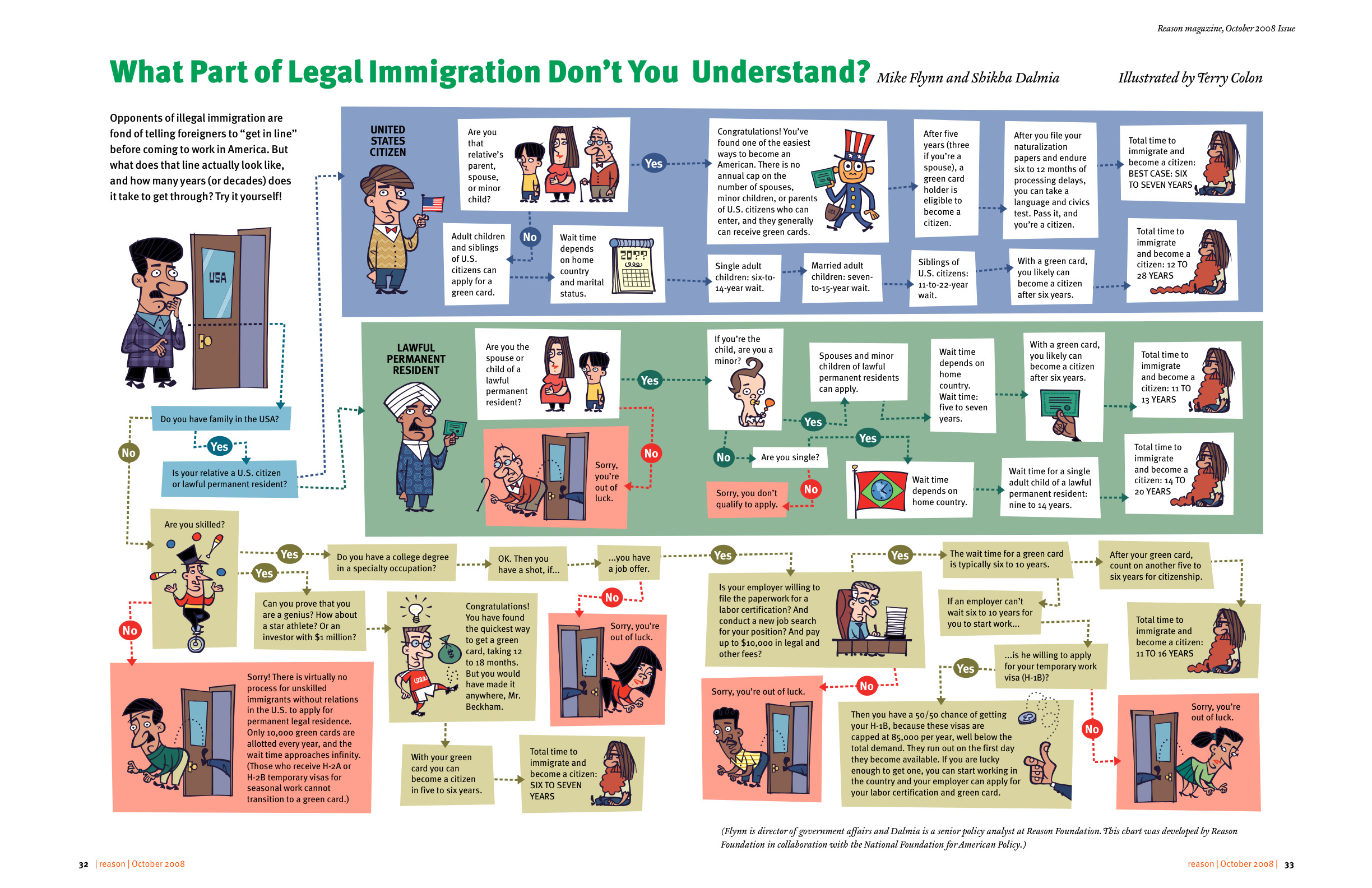
(via http://reason.com/blog/2008/09/24/new-at-reason-mike-flynn-s... )
Obviously not an option for everyone, but if it is available to you, it may be one of the easiest ways, as you can get a green card relatively quickly via that route.
If anyone seeks less-than-a-year-long work, J-1 Visas are arguably the easiest to get if one has some affiliation with a university. (i.e. students)
Proof of concept: I have co-run a non-profit program which connected people in Finland with startups in the Bay Area. I wish there would be more programs similar to http://startuplife.fi (sent close to 100 so far and more than a dozen YC companies have signed up for the program last batch.)
Another related blogpost for the J1 track: http://blog.sendtoinc.com/2013/12/11/silicon-valley-internsh...
"Specialized knowledge means either special knowledge possessed by an individual of the petitioning organization’s product, service, research, equipment, techniques, management, or other interests and its application in international markets, or an advanced level of knowledge or expertise in the organization’s processes and procedures (See 8 CFR 214.2(l)(1)(ii)(D))."
http://www.uscis.gov/working-united-states/temporary-workers...
The definition of "Specialized knowledge" is very broad. Can somebody share their experience of getting L-1B visa?
Also, speaking from the personal experience, the fact that the H-4 visa doesn't allow your spouse to work deserves more emphasis. If there's anything that might drive me and my family back to Chile, it's the H-4 visa.
If you are lucky enough(like my wife was) you will have your green card and visa for the whole family.
Some more info: http://en.wikipedia.org/wiki/Diversity_Immigrant_Visa
My best bet would be a company that really wants me to work for them and arranges all of this.
> Processing time: Weeks
Actually for Canadians the visa is usually given at the border at time of entry. I applied at the US embassy in Bangkok and it didn't take more than a couple of days.