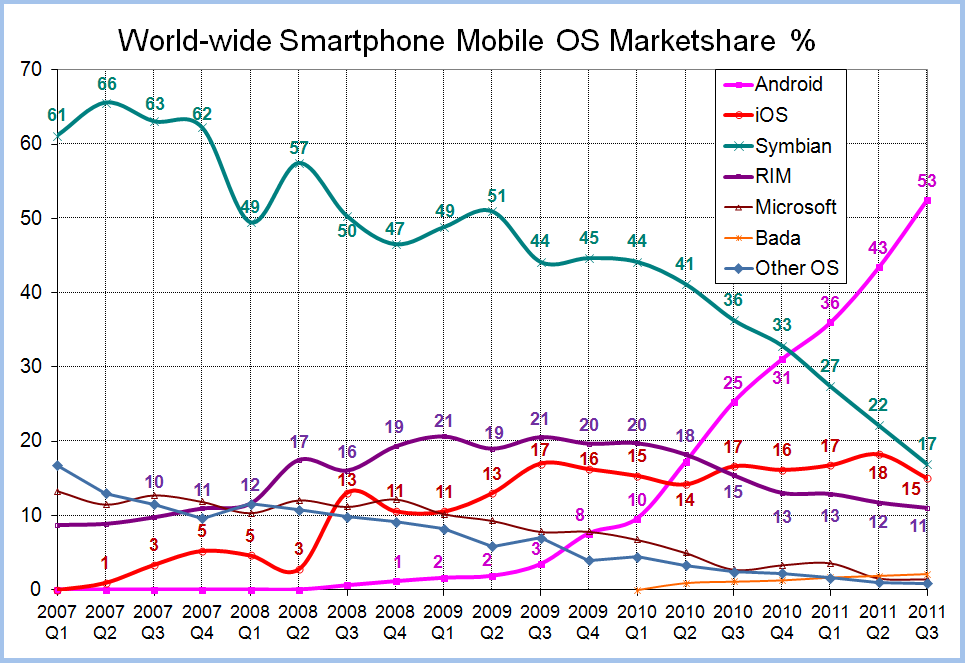
That's remarkably short-sighted. The first iPhone was released only 6 years ago, Android 5 years ago. You really think that Microsoft - a company with nearly infinite runway, an enormous R&D investment and serious history - is going to down tools after a few years of frustration? Not likely.
The prize is too big and consumers too fickle to just give up.
If Android magically evaporated tomorrow Google would be just fine -- the core of their business (ad sales) doesn't fundamentally require that they control the mobile platform, although it certainly makes things easier.
Microsoft, on the other hand, had for decades been the platform company. They've historically tried to grow by pushing out from their desktop beachhead into other territory they think they can control the platform for (i.e. servers, game consoles)
Now suddenly they've found themselves behind in the highest-growth segments of the industry. In fact, just "behind" doesn't do their situation justice: they've had to spend billions just to claw themselves into a distant third place.
I expect that those billions will keep flowing. Microsoft is desperate to win this thing.
I do not agree. They don't necessarily need to control the mobile platform, but they do need access to the distribution channels.
Witness how Apple replaced Google Maps with their own solution, even before their solution was good enough, as if they couldn't wait to get rid of GMaps. At some point not so long ago, they also threatened to replace Google's search engine with Bing by default. In 2009 Google Voice was also rejected from iTunes because it was "duplicating existing functionality".
Google is basically playing Microsoft's own game from the nineties - controlling the platform makes them a valuable distribution channel, ensuring not only their survival, but also giving them leverage in expanding to new markets.
Google is bigger and much more dangerous today because of Android, which IMHO is vital for them going forward.
Just like their search engine? They have been flushing cash down the "online services" drain for years, with nary a profit to show, nor any progress in market share. Why should the phone market be any different? They'll keep subsidizing the "WinPhone by Nokia", and flushing cash down this new drain too.
I'm seeing parallels between their attempt to break into the search engine market, and the smartphone market.
This whole post reads like a warning about the sunken cost fallacy!
The crux of it is Microsoft is not good at R&D today. Microsoft sells products that people still buy. People don't buy Nokia as much. What was the driver? Surely not to turn them around. We know that's not what they do with an acquisition.
And I have trouble understanding why the NSA stuff is relevant here. Believe me, I'm as upset as anyone here about it, but I really don't think that Microsoft is propped as a company by some cash that the NSA gave them to build out some relatively trivial monitoring infrastructure.
[1]http://techcrunch.com/2013/09/03/a-trojan-horse-once-again-s...
Where on earth did you hear that?
Both Nokia and Microsoft are known for producing high quality products and investing heavily in R&D. The don't have a technology problem, they've got a branding, positioning and strategic problem.
> "...I think Microsoft ought to abandon the Xbox. The war is over, and Sony and Nintendo won."
a decade or so ago.
And entertainment business (because the console is just a hardware dongle) is different beast.
I'm not saying that Microsoft doesn't have a chance at all but I think the odds are against Windows phones ever reaching a significant market share no matter how much capital and R&D they stack behind it.
This is the norm. The only thing people give a shit about is their data (and that is usually when it's way to late and they're about to lose it), not the apps.
That said, to pull off an iPhone- and Android-style upset though, Microsoft would need a correspondingly huge difference in user experience though. The UI on Windows Phone is nifty, but it's not enough of a game changer for most people. It'd really have to be something like successful execution of wearable computing or the convergence described here: http://arstechnica.com/information-technology/2013/08/want-t...
I didn't feel locked in at all to the "app ecosystem". Honestly web and email were paramount and everything else is secondary. At some point in the future I believe native apps will be passe in favor of a complete move to web applications making the underlying platform completely personal preference.
...oh.and at one time I was locked into my Palm Pilot. After that my Blackberry. Tell Apple to look at Palm or RIM if they want to know how long being the popular phone on the market lasts.
Windows Phone may or may not have a shot in hell, and things don't look good in the short term. But finding success somewhere in mobile is a strategic imperative for the company.
Doing that through a hardware acquisition seems strange. And to Ben's point, this is a particularly weird "Why buy the cow?" scenario, given the preexisting partnership that served roughly the same purpose.
We'll see what Microsoft is thinking, but I'm scratching my head. Consumers are fickle, to your point, but en masse, they're also creatures of convenience. Android and/or iOS seem like mighty convenient platforms right now, from a consumer's POV.
This sounds like (some years ago) "I think Google ought to abandon their search engine, the war is over and Yahoo and Altavista won"
Now I understand that search engines are a lot easier to switch to than phones etc. but it still makes for a less compelling comparison.
– Android is cheaper than Windows Phone (many phone makers pay Microsoft to be able to use patents used in Android, but even then, Android is cheaper than Windows Phone)
– Android has lower system requirements than Windows Phone
– Android has a thriving app market, Windows Phone doesn’t
Windows Phone low-end phones will only be hit if Microsoft convinces network operators to push them. That could happen if network operators were to regain power over the consumer by doing so. For instance, it could mean that on those phones, the app market is managed by the network operator, customers would pay different rates for different kinds of data, and customers could only use a pre-installed web browser that serves the network operator’s ads.
But at the moment the feature phones and almost-smart phones by Nokia, i.e. the Asha series, are not running the Windows Phone OS, but the S40 OS (which is some kind of Symbian I believe).
There's one notable area where Microsoft has competed and thrived: Microsoft does quite well on the Mac platform, possibly making more money from each Mac sold than it does from each Windows PC sold. And there are in fact more viable word processor, spreadsheet, and presentation program competitors it needs to worry about on the Mac than there are on Windows (Apple's just for starters).
What's short-sighted is Microsoft not being willing to pursue the strategy it has been successful with on the Mac on other platforms such as Android and iOS, and gambling everything on creating another platform it can strong-arm users and developers on -- something it has only quasi-succeeded in doing once (XBox).
I wouldn't call it a level playing field. They've had a lot of time to make inroads into the market by not documenting the office file formats for as long as possible, so people had no choice but to buy their software.
The formats are documented now, but it's very hard for the competition to get people to switch from a product they are already comfortable with.
Clearly the mobile market is far bigger than the game console market, but fact of the matter is that the Xbox got far more traction early on than Windows Phone has ever gotten.
"The war was over" for online search before Google entered in the game.
The war was over for mp3 players until the ipod came out.
The war was over for Apple back in 98.
The war was over for internet browsers until Chrome came out.
(2) Elop arrived in 2010 and Nokia was basically already done for.
As soon Elop announced Symbian death, the whole thing tanked, and I cannot help but feel that Elop is stupid.
You don't announce that you're abandoning your current platform when you haven't developed your replacement platform yet unless you're a moron or intentionally sabotaging your company.
A 5.44 billion EURO transaction to acquire a company that is already in a strategic partnership with you and working exclusively with your platform doesn't make sense.
My vote also goes for Nokia being financially in trouble, and M$ have their hand forced by the fear of a collapse in Nokia would gut the distribution channels for all the flagship windows phone models.
Worse, what if word got out and someone else bought them?
...wait, no, that would mean Microsoft would have some special insider knowledge of Nokia's finances that no one else was party to. Surely not.
> ... adding on a mobile phone business that Microsoft probably should abandon ...
Why should it be abandoned? Just because the author isn't a fan of WP8?
> have argued that Stephen Elop made a massive strategic error by choosing Windows Phone over Android; ... It would have been to Nokia’s benefit to have everyone running Android, including themselves.
Not necessarily true. There's only one manufacturer making money on Android at the moment, Samsung. When Elop got aboard, Nokia was already waaay behind. It's not like he drove them down, he merely tried saving them. Choosing Android might have gone better, but probably not. At least it was better going for WP than sticking to their own, dying systems.
The general public aren't a fan of WP8 either.
Not really an issue if the board approved going to Microsoft with the financial information first. Moreover, when negotiating the strategic partnership, Microsoft may have gotten a right of first negotiation, that would legally entitle it to first dibs on the acquisition and certain "insider knowledge" anyway. Ultimately, shareholders might still have to approve the transaction, but there's no insider trading issue with reaching out to potential acquirers on the downlow.
It seems like the board, since now, has made the interest of microsoft and not nokia.
I believe M$ and Nokia made a strategic agreement around 12 months ago that guaranteed that if anyone were to purchase Nokia, it would be Microsoft. The writing has been on the wall since then. I don't know why people are surprised by this move.
These things don't happen instantly now that so many devices are alike.
By comparison, when we adopted the first iPhone, it was a dramatic departure from previous cell phones and we had to have it immediately. Since then, we've just waited for our contract terms to expire.
Though I would interrupt my contract immediately if someone would deliver on personal application omnipresence, making a cell phone that is just a small touch-enabled view on my network and my applications.
Trouble is, the US is a large and profitable smartphone market. And it's locked up by the on-contract subsidy model.
There is a strong relationship between iPhone market share and subsidy amount. Countries with no subsidies have very few iPhones. Countries with some subsidies have some iPhones. The United States has high subsidies and thus a lot of iPhones.
http://www.tech-thoughts.net/2012/05/proof-of-iphones-depend...
To some extent, Apple has a protected home market. Regardless of how its market share declines overseas, Apple will still rake in enormous profits through the cellphone subsidy in the US.
This is something that Nokia/Windows Phone doesn't have, with its puny 3.5% US market share. They're doing OK in the markets where people look at the price of the phone, and not doing well in the one market where people are happy to have their pockets picked.
That's not a recipe for making large profits in the phone business. And that's why the US market matters. Profits are disproportionately large compared to revenues.
Microsoft now owns all of Nokia's handset business, which is still 90%+ non-WP. As the S30, S40, and Asha base under WP evaporates, WP will have nothing to piggyback on in these markets.
MS gets a device manufacturer, which allows them to compete with Samsung and Apple.
Hindsight is 20/20.
I'll let you know if I see any pigs flying.
MS saw that Nokia is the only player in the Windows market and Samsung is never going to be big on MS. They just bought the hardware and are making Windows phones into closed platform like iPhone is.
I don't think that Samsung and others are going to continue making windows phones after MS bought Nokia.
According to the author, MS should abandon the fastest growing class of computing devices. What kind of a strategy is that?!
Meanwhile, Windows Phone sales are up 77% YoY.
And to be the person for once that posts the obligatory xkcd comic: http://xkcd.com/1102/
Last quarter, iPhone sales were 31 million devices and WP8 sales were 7.4 million devices. If WP8 is selling one device for every 4 iPhones, that is indeed a decent result relative to where they started off from.
His thesis though, that something forced this move, is pretty credible. And the choices being (in order of likelyhood)
1) Nokia filing for bankruptcy - this one clocks up as being most likely for me
2) Someone else was going to buy them - I wondered about this with Apple's Maps fiasco, they had much better maps than Apple did, although I don't think Nokia would go for a breakup with partial acquisition.
3) Nokia switching to Android - this one I hear from people who wish it were true, but haven't seen much from Nokia on it.
Nokia has clearly been hurting for a while. Small flashes of excellence in an otherwise confused consumer experience. They also showed that you could build a competitive experience with Microsoft's phone product but it hasn't been helped by Microsoft's inability to get the developer traction it wanted.
Time will tell if it was able to change the path of Nokia and Microsoft for the better.
Am I reading the news wrong or is this a partial acquisition? It actually looks like Microsoft just made it easier for Apple to buy the part of Nokia it would want (maps).
It would also have been a disaster for Microsoft if Google had bought them, not that I think they were thinking about it.
(Disclaimer: I didn't read the article. I just disagree with the headline).
Microsoft had already made a significant cash injection into Nokia. Plan A would have been for the Lumia handsets to be a massive success, and for Windows Phone to gain significant traction.
Although you could argue there has been some progress towards this, it hasn't been fast enough for either Microsoft or Nokia. Nokia's current strategy with Windows Phone simply isn't working. They're at a point where they either a) change the business plan, or b) find another source of cash to pay the bills.
Since 'changing the business plan' in this case would have been hugely detrimental to Microsoft the acquisition was inevitable, but far from ideal for both parties.
Either Microsoft is completing a long planned purchase, or Nokia threatened to dabble in Android. Other than that the purchase is irrational.
In August, they spent about €2.2 billion buying out Siemens' stake in Nokia Siemens Networks. This could very well have caused some short-term cash flow issues. Which also explains Microsoft's offer to finance Nokia at extremely low interest bonds.
Long-term, NSN is generating positive cash flow and ought to be able to pay for itself.
It also doesn't help that Microsoft has historically had pretty incompetent management, horrible culture between divisions and inside divisions, and it's now in the process of reorganizing and getting rid of its CEO (which was also sudden, and unplanned).
Wow, its times like this when its appropriate to trot out Michael Dell's famous apple quote.
> When asked what he'd do with Apple if he were in Jobs' shoes, Dell said:
>> What would I do? I'd shut it down and give the money back to the shareholders.
I am not a Microsoft fan to say the least, but boy, we understand that this is all your personal opinion, etc.
However, have you ever touched or got near by a pile of a billion dollars, that you allow yourself to make such strong opinion about? Did you ever have 1% of that money, or .1% of that money?
Everyone has the right to have an opinion, but please, assume "they" know facts and figures you don't.