Pretty interesting as far as cars go. I think all of the customization options are really smart, but we will see if that is enough for the average consumer. The number of relatively inexpensive options and ability to customize various details rivals some high end car configuration systems, Porsche is famous for letting you customize every detail.
The way Slate has designed their vehicles, they are making it very easy to change just about anything with the vehicle. I can see this being very popular with young people who cannot afford a lot of car, but still want a highly customized and personalized vehicle that they identify with. We will see if all of the other factors work out in Slate's favor.
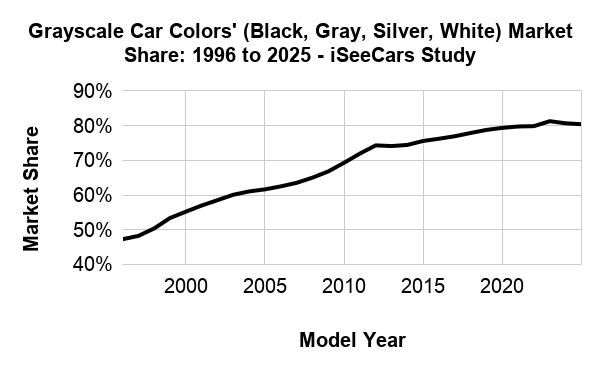
Mind you, when ordering a lease car for the first time recently, I did notice that I was paying a premium for non-bland colours. I suspect the weird financial structure of new cars has - they're often not bought to hold, but leased - has a lot to do with the blandness.
Gen Z & A value uniqueness and authenticity. I think the customization options will resonate a lot with them.
Any mass-market car has practically the same color options. Wraps have existed for a looong time.
It isn't an option here. When you go to pick a wrap it directly states:
> 2 people required. 12-16 hours. A big commitment for a DIYer. We'd recommend professional installation if you're not sure you can tackle it.
The only difference is you're shopping around at wraps at purchase time, you still need to either put it on yourself or find your own shop to install it post-delivery. No different than you driving any other car off the lot and going to the body shop down the street and having them wrap it for you.
People have other colour choices, but they're constantly choosing the most spectacularly boring, neutral colours possible.
The colour thing is neat, but I'm not sure it's going to be a big deal. It might actually lead to the paradox of choice where people basically feel even worse about their options.
https://magazine.northeast.aaa.com/daily/life/cars-trucks/au...
https://www.ppg.com/en-US/autocoatings/color/history-of-colo...
I mean I see the inverse as true, and entry level vehicles seem to have the most colour diversity in their sales. It is cars like the Nissan Versa where you see real colour variations.
Wraps are typically pretty easy to remove. Far easier than removing a paint job.
It's actually a little depressing if you're sitting in traffic, just watch the cars go by and see how few of them actually have a unique color. And most of the exceptions are something like an almost gray blue.
For my part I've found new car styling hideous with little difference between brands my entire adult life. Probably for nostalgic reasons I like the sharp geometric shapes of cars from the 1980s which largely disappeared with a focus aerodynamics for gas mileage. So I'm usually satisfied with whatever color is on the lot since I hate the look by default anyway.
So $0.12 per mile saved in fuel costs implies about 800k miles for break-even.
This excludes costs of servicing, which should be higher on the gas car.
At the same size (17"), going from steel to alloy improves performance but reduces durability. Larger wheels (20") are generally a downgrade for performance and ride quality.
Engineering Explained has a video on this topic: NYvKxsYFqO8
Same conclusion: interesting, but not necessarily interested. Hope they go places though.
The Transit Connect is discontinued in North America and was only ever a plug in hybrid here (outside a 500 unit collaboration in the early 2010s) but maybe one of the newer electric variants of the Transit lines will make its way over some time (e.g. looks like the Ford E-Tourneo Courier is an all electric in Europe).
But, is that likely? Most people buy cars on credit and won't have $10k cash to spend on those bits later. I guess they could put it on Visa, but that's a terrible financial choice.
Can we stop being so out of touch and/or deluding ourselves to believe $35k is “pretty inexpensive” for people not living in a bubble; whether that is the Americas bubble or the tech bubble within the bubble or the urban bubble within that; let alone for a tiny two seater electric truck that has a 200 mile range.
The 45th percentile, i.e., the bottom 90% have a median income of roughly $40,000. $35,000 for a enclosed covered or even hatchback type mini SUV is not reasonable and you know very well when they come out with that, it’s going to be at least $40,000. None of that is inexpensive or even pretty inexpensive. That’s just rationalization and coping, trying to convince ourselves and others of things that are incongruent.
“Pretty inexpensive” would be an enclosed bed version that cost $22,000 maybe.
For additional context; the industry standard measure of income to cost ratio has risen from 9.3 weeks of household income gross pay for a baseline vehicle, i.e., civic, in 1973 to, 16.5 weeks of gross pay in 2024; and that’s based on the fraudulent official inflation numbers.
Yet more context, a civic can seat 5 people and still has a range of 450 miles on a tank of gasoline that you can find all over the place, even in far off rural places OSD puppy can carry gasoline with you if need be.
There is no sense in rationalizing and deluding ourselves about the real limitations that still exists that are real and are why adoption is not matching imaginations.
$35k is not outrageous for a new car, but the Slate is supposed to be affordable basic transportation. Slate is selling barebones, stripped down basic transportation for the price of a middle class family car.
A $35K vehicle will reach $22K on the used market a lot faster than a $60K vehicle will.
I can find electricity in far more places than I can gasoline. It even comes out of my walls. Do you have gasoline piping throughout your home?
But (at least in my experience), that made for a worse product than having factory installation and QA. I bought a brand-new car from a Scion dealer in 2005 and indicated I wanted to add keyless entry. I paid the dealer, they did the install, and I left ... with a car that would intermittently fail to lock some doors with the key fob. I realized shortly thereafter that the dealer had installed an aftermarket system to save money rather than the offical Scion keyless entry system. I complained and eventually got them to install the right system, but jeez, that did not enhance my experience compared to just finding a car that was built in a factory with the options I wanted.
I'm not saying the modular Slate pickup isn't cool. I'm kind of tempted by it. But I wouldn't be surprised if people find themselves with leaky roofs, electrical gremlins and random squeaks and rattles compared to if they just bought some other truck/SUV and left it alone.
But car batteries, brake pads, tire pressure sensors are all becoming increasingly software-locked in. We're lacking open standards for this stuff.
I can charge it at home. The tire discounters by me charges $15 for a rotation if they didn't sell you the tires, and they do the inspection to see if there's anything they can sell you.
It's less that the oil change costs that much and more that they don't want you to show up with a car they've never seen for an oil change when they can make more doing other work in that bay. So it's priced to keep people out rather than to draw people in.
Most people who buy a car would never be bothered to "tweak" it later, upgrade, add stuff. Modularity also constrains the design and could add some reliability issues.
The biggest benefit would be home repairability so I think that's a big driver for why other manufacturers don't do it. EVs already require less maintenance so that's lost revenue.
P.S. Looking at the options on the site, other than the body style everything else is just as easy to have on any other car. Most of the customization is purely esthetic (wraps, decals, rim options, light plates) and even the practical options like light bars or roof racks are common in the OEM world for any classic brand.
If the customization can be done after the fact it lowers the risk of buying.
Makes sense to me.
Want an open air 5 seater in the summer and an enclosed pickup the rest of the year, except for November when you really want an SUV? Sure, no problem.
The modular design is cool though.
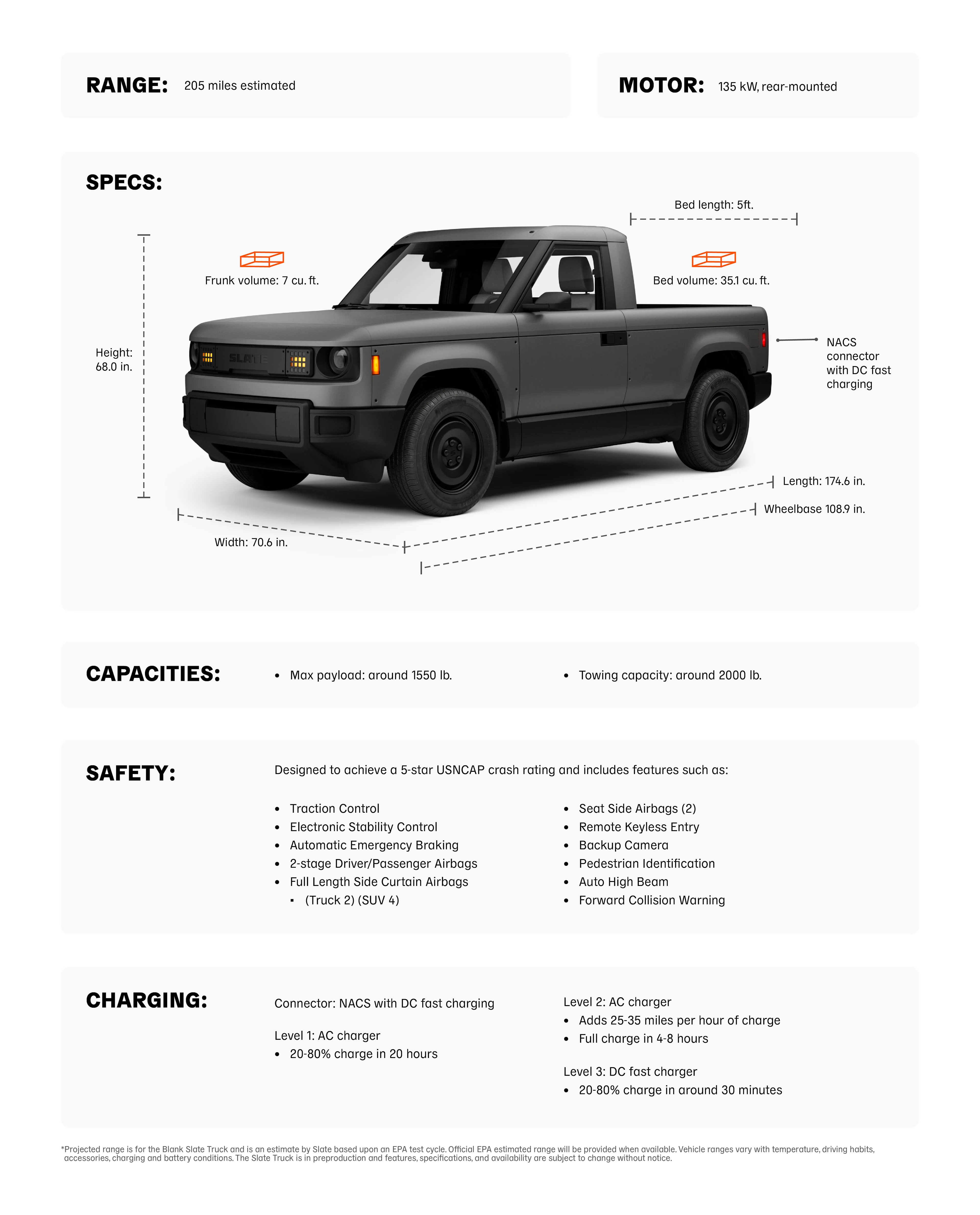
They list some details on the Specs page[1]. They quote 200 miles of range, which is not great especially for a small car. They list a 20-80 charge time of 30 minutes so it's probably a 400V architecture, which is becoming outdated as 800V architectures and chargers exist now.
Seems like a fine about-town car, but probably not a great one for road trips. I think that probably aligns with the NVH[2] expectations you should have for a car of this price.
[1] https://www.slate.auto/en/specs
[2] https://en.wikipedia.org/wiki/Noise,_vibration,_and_harshnes...
A 200mi range means you can comfortably commute an hour to work each day, and then get back and "drive around town" in the evening without any worry.
200mi is definitely acceptable in the US, but it's on the low end of the acceptable spectrum.
Very surprising it doesn't say the battery capacity anywhere and has no option for a bigger battery
High end luxury vehicles are coach built. The Ferrari Luce is a mid end luxury vehicle. Rivian is more like a low end luxury vehicle.
China will sell you fully kitted hilux equivalents with japanese engines for 10k. Even toyota is making 10k trucks in thailand.
US manufacturers are just not ready to face free market competition these days. They're entirely reliant on tariffs protecting them.
I’m not really sure what the solution is at this point. We can’t just drop the tariffs, as that will decidedly end almost all manufacturing that has been propped up by them. On the flip side, the current administration’s recent erratic application and resulting litigation in this area have created an environment where no one in their right mind would invest in building out new capacity. The winds have demonstrated that they are too likely to shift again.
I hope someone can swoop in on this thread and explain how it’s all going to work out. Because I just don’t see it anymore….
And that makes me sad, because I want to love the Slate. Seems great. But I can’t see past how the pricing is tantamount to systemic theft, knowing that it has been artificially inflated by such protectionism.
That’s not a full answer but party of the story.
As a nation we want a local manufacturing base. But as consumers we just want the thing, and it doesn’t matter where it’s made.
[PAGE] https://www.slate.auto/en/specs
[IMAGE] https://images.ctfassets.net/20dhmw20vttc/2wmiW5shOfgAKsd1nF...
The only reason it takes an EV to get this is CAFE.
I love the Tacoma for a lot of reasons, but that Ranger really had a lot going for it in the summer.
That said, lack of 4WD is really a bummer.
Everything about modularity seems awesome, but you can see panel misalignment in several shots. Are the component tolerances really going to be that low?
That said, given the price point and the new-ness of the manufacturer, there's all but certainly going to be fit & finish issues.
If the company is still around 5 years from now, I could see myself getting one of these to replace our current "compact" (but still enormous) SUV.
[1] https://en.wikipedia.org/wiki/Ford_Transit_Courier#Tourneo_C... [2] https://en.wikipedia.org/wiki/Citro%C3%ABn_e-Berlingo
Of course I'm waiting for real world reports, but I'm not going to rule it out yet.
"Just fine" lol. Alright let's go straight back to being 16 years old and doing ghetto shit for the sake of it.
AWD is ubiquitous nowadays. Can get it on entry level vehicles as an option. Electric vehicles are way simpler, as in they could simply strap a motor to the front wheels without much complication.
I already have a 4WD SUV. 4WD is simply superior in the snow, even if I could suffer and survive with RWD.
I mean, that's fine, but... I am on your "About" page, that's because I actually want to know about you. How can I trust you with $25k if all I know is "We’re designed in California and Michigan, engineered in Michigan, and assembled in the Midwest. And our team is spread across the entire country, from Washington state to Florida" ?
What's your funding? Who owns you? Who's the CEO? What are the credentials of your engineers? Basically, why should I believe that you can pull this off?
Normal people make product-buying decisions based on the product.
None of those things are true for a brand new company. Tesla was infamous for having random things wrong with their cars in the early days which the established car companies had figured out a long time ago. And there's a non-negligible chance the company will end up folding before it can give you your product, or before they can fix the product you got.
The amount of money they have, the character of their backers and their CEO, and the quality of their engineers matters significantly.
And the Slate should have better utility, for anybody who needs a truck/SUV vs coupe. And also comes without the Musk stigma.
This feels much more like a spiritual successor to that truck than the actual new Ranger or Maverick. I’m really hoping this succeeds so that they’ll be around to replace our Dakota when it dies!
Hope they can enter India in the next 5-10 years.
https://insideevs.com/news/799667/slate-truck-lfp-battery-ra...
The other common EV batteries suffer increased degradation at the high and low ends and it is generally recommended to stay in the 20-80% range except on road trips. Then charging to 100% just before you start and driving down to 10% if you are going to recharge soon after back to above 20% is OK.
Let's first consider non-road trips. With level 2 home charging and a 200 mile range LFP EV like the Slate, I could actually get 200 miles between charges. I'd be cautious though and try not to let it go below 10%.
That's 180 miles of usable range.
On a non-LFP where I only get to use 60% between charges (80-20%) I'd need a 300 mile range EV. That's more than the 262 mile range of the 2027 Chevy Bolt which is doing fine and costs more than Slate. That's also better than or close to the most popular non-Tesla EVs in recent sales, namely the Chevy Equinox, Ford Mustang Mach-E, and Hyundai Ioniq 5.
For road trips it is a little different because even though LFP won't be harmed going to 100% it, like non-LFP, slows down when you are trying to charge with high power DC chargers, so it is almost always faster to just charge to 80 and get back on the road than charge to 100 to get maximum distance before the next stop. The LFP still punches above its weight on road trips, but not by as large an amount as it does for around town use.
On a road trip, past the initial segment when running on home charge, if we assume the Slate will be going from 80 to 5% and the non-LFP is doing 80-10%, the Slate would be equivalent to a non-LFP with around 215 miles of range.
For people who won't want to use it for long road trips (road trips long enough that you would have to charge before reaching your destination) it should be fine.
BTW, for long road trips charging speed is generally quite a bit more important than range as long as you have enough range to cross the gaps between charging stations. The Ioniq 5 is widely considered to be one of the best long road trip EVs because of its fast charging even though its range is smaller than many competitors. It is 800 V so can accept very high power without excessive heating, and its charging curve stays high for longer than most others. (But you need a trip that has high power chargers, which most Tesla Supercharger stations lack).
Compared to Ford or GM's EV trucks? It's almost 1/3 the price...
The closest comparison is like the Ford Maverick, and that starts at 29.
I know why, the market is nostalgia and it wouldn't sell well if it looked more like a mini kenworth which has a hood that slopes down and in and less like a pickup truck.
That low range is going to turn off a bunch of buyers. I doubt another 10-20 miles of range would capture more buyers than a non-traditional shape would turn off. But I wish the market was that rational.
I love that it is a bare-bones basic vehicle that can made to be whatever you need it to be and that it does not have all the factory owner tracking bullshit in new cars today.
I can see this being useful to my wife and I both as a small truck and as an SUV. For the things that we do every week this vehicle would work fine and would replace our Ford Ranger. It might be able to replace our 90's F150 too.
I do most of my own maintenance so a vehicle that comes with factory manuals at no cost is far superior to any other that I have owned. I have bought factory manuals for all of our vehicles so that I can minimize downtime when doing maintenance. I would also take advantage of a service network in the event that I had more projects than time, which is increasingly the normal case at my house. With that network I could spend my time on things that have the highest impact.
The vehicle's range works fine for my wife and I. As a vehicle for our kids off at college it is not as attractive. The distance from our house to campus is just under the stated range of the Slate so anything that prevented the vehicle from hitting maximum target mileage would cause it to fall short and I would need to tow or trailer it the rest of the way home. That would be a drag (haha, I made a pun). Adding the ability to run from an external battery would be a huge plus since that would eliminate range issues.
I wonder how difficult it would be to add connections and charge circuitry for an EcoFlow or Jackery battery bank so that it could be carried in the cargo compartment and serve as a backup.
I would also probably use solar panels to keep it topped off while in my driveway. I think the existing EV chargers manage that well today.
Edit: damn, bed length: 5 feet. Wonder if they could get an extra foot in the other direction as well, although I'm guessing all that would eat into range.
I wouldn’t be surprised if it gets delayed and inflation pushes that MSRP up.
A new 4wd kei style truck is ~10k, with a bigger bed. I know its apples to oranges, but damn do I hate the ridiculous regulatory capture around small vehicles and trucks we have in the US.
A $20k American-made electric pickup with no paint, no stereo, no screen
And looking at their website now, I see the same thing unfortunately. Why would someone "preorder" a car that only exists as a prototype and digital art? What proven track record do they have of actually being able to manufacture these, and what independent outlets reviewed it?
I'm sorry, but a lot of red flags immediately pop up for me, I'm confident this is 99% a scam.
oh, wait, that is what Americans do.