By comparison, the worst US state for heat related deaths, Nevada - a literal desert - has >10x fewer deaths per capita than Greece.
Heat waves only became a serious problem in Europe in the last decade. The vast majority of buildings predate the need for air conditioning by several decades - and in plenty of cases by several centuries. The buildings are designed around being livable in a pre-climate-catastrophe climate without needing air conditioning - which is perfectly achievable if you aren't stupid enough to build a city in the middle of a desert.
Adapting all those buildings and streets will take time. Blindly putting AC everywhere and forcing everyone to drive from building to building in an ACed car isn't going to work, that kind of wasteful behavior is how we got into this situation in the first place. You need to redesign the heat management, and you need to start with things like mandating shades to prevent heat from entering buildings in the first place, and planting trees to avoid the heat island effect.
AC will indeed be needed to deal with the final heat peak when outside night temperature is in excess of 30C, but it isn't the one-size-fits-all solution for every heat-related problem it might seem at first glance. If your AC needs to run for more than a few days per year, you've seriously screwed up.
Unfortunately I personally live in a highrise, and in a rental unit, so that "small hole and a bracket" definitely isn't an option for everyone.
On the other hand, there are plenty of noise-related laws preventing you from installing an AC loud enough to be a nuisance for your neighbors. But that's solved by getting one with proper sound isolation, or placing it in such a way that the noise doesn't travel to the neighboring properties.
Similarly, you aren't allowed to install an AC on the facade of a protected historical building. But that can be solved by installing it on the rear of the building (where it is invisible), or by placing the unit itself indoors and using hidden air vents.
There's also the issue of landlords and HoAs banning you from making modifications, but that's not really a matter of legality.
Trust me, the rest of the world has figured this problem out a long time ago. The hottest countries in the global south tend to also be the countries with low electrical capacities.
If you live in a country where 3kW is the electrical capacity of your entire house, you just buy an AC that draws around 1kW.
You size the AC units to your circuit you don't size your circuit to the AC.
Another thing that would help is if Europe stopped being so averse to new construction so that people could build new buildings with central AC that matches the current reality of its climate and demographics, rather than the climate and demographics of last millennium.
Yes, exactly: install AC where it truly helps and where it is truly needed. That's the point I was trying to make. Most of the rest is solved far more efficient by things like installing shades. In other words: don't go all-out on giant whole-home AC without first stopping the huge inflow of new heat.
> if Europe stopped being so averse to new construction
We're not, there's plenty of new construction over in Europe.
The difference is that European buildings are built to last, so structurally there's no need to tear them down after a couple of decades. They are perfectly usable for another half-century after a minor renovation (including retrofitting AC!), so why destroy a charming historic district for absolutely no reason?
That doesn't mean buildings are never torn down, of course. Right now a lot of post-WWII rental units are being replaced by new construction, as they are architecturally nothing special and renovating them to modern standards is simply way more expensive than replacing them entirely.
Many buildings already have shades, but please tell me more how those shades and "properly ventilating during the night" (aka not getting sleep half the night due to outside noise) will keep my apartment at a livable temperature when the air temperature outside never drops below 23 degrees for more than an hour.
You can't effectively remove the heat that has pooled in the apartment with a 2-3 degree temperature difference, let alone in the few hours where you actually have that difference.
So because of thinking like the one in your post, we can't have real AC's (because to "protect the environment" we'd first need to install every other system that doesn't help then prove that with a mountain of paperwork), so my only option is to open the well-insulated window so I can stick the coolant hose of a portable unit through it.
I think the "properly installed AC bad" mentality will only change once the entire population of renters has those inefficient portable units (that are de facto impossible to regulate) and even the anti-AC group realizes that encouraging "real" ACs is much better than the workarounds that the status quo forces.
Where are people constructing buildings that need to be torn down after a couple decades? This is a refrain I've heard about construction (in the US?) several times in discussions like these, and I find it very puzzling.
Europe is a continent with a lot of different countries, all with different laws and regulations. Even the ones who are in the European Union have different rules and regulations.
So please realize that any blanket statements about Europe work as well as making one about the Americas (ie North/South).
Agreed. I live in an apartment complex finished in 2020 and they have no provisions for AC, really not optimal. At least add provisions for holes so renters can easily install a mini split.
It does take time, but it MOSTLY takes a shipment of small units to local retailers for normal lower-and-middle-class people to buy for the price of a month's worth of beer. Canada's economy is much smaller than the EU, yet somehow you can walk into a Walmart, Home Depot or Canadian Tire and buy a $150 air conditioner to install in your own home with 15-20 minutes of effort.
Canadian houses and older buildings are built to withstand winter and somehow we manage. We have a lot of 100 year old buildings (my house for example). Office buildings and hospitals are slightly more complicated, but I think Europe invented windows a long time ago
But getting a portable AC unit is relatively simple, they definitely don't need "re-engineering the environment". Sadly most portable AC's here are single-hose units which are not great. They are cheap though with prices similar to yours, cheapest at around €200. Mini-split systems are very common though as a retrofit: On apartments you can almost always put the outside unit on the balcony.
... actually works just fine. How do you think mass AC adoption in the US happened? Window units work just fine. Fancy splits and central ducting can come later.
Don't let perfect be the enemy of the good.
Window units don't work in most of Europe because our windows aren't compatible with them. If they were, I would have one.
And again, it doesn't solve the core cause. If you want to cool down your home, your first step should be to stop heat from entering. If you can get the same result from €900 of shades and €100 of AC as from €1000 of AC, you'd have to be stupid to go for an energy-guzzling AC-only approach.
They'd be more compatible with AC if not required by law to be incompatible. Places like NYC and Boston weren't built with AC either and adopted the technology just fine.
For steam based heat systems there is also cooling options, so that is a fix for those cities with central heat service.
This somehow seems to be beyond today's population and society. How dare this weather impact my schedule!
You can no longer shift your activities when the weather reaches 35C (95f) every day for weeks without noticeably cooling down in the night.
And even if activity shifting was possible, which again, it is not anymore, the authoritative, fatalistic poverty mindset required to demand that one does not actively cool during hot hours is a European mentality not many other cultures, if any, understand.
I do not 'demand' you do the same. I just point out that there were options besides cancelling the meeting, some involved airco, LSE has airconditioned meeting rooms, admittedly without the gorgeous historic atmosphere, some didn't.
And it raises the heat outside of buildings. Not so good for people who have to be outside, think first responders etc.
"just turn on the AC and keep burning the world down" isn't really the answer.
No it doesn't. Seriously, where does this meme even come from? It should be pretty obvious just from a solar insolation map that AC is just noise vs the sun. The energy usage is tiny vs vehicles or non-heat pump heating and only electric. What changes temperature overall is the balance of thermal retention by the atmosphere vs radiation into space, hence why net increases in GHG are so dangerous. And at the ground level similarly how heat is dumped to atmosphere. Greenery, whites, shade etc is good, asphalt, mass standard glass is bad (hence many cities being heat islands). Old, leaky units sure, we absolutely should work to reduce that. But it's astonishing how people claim AC makes the outdoors hotter so consistently.
Is that increase small compared to other things, like surfaces that absorb more solar radiation? Maybe. It depends on a lot of factors, but the amount it increases the heat of the outside is certainly non-zero.
> A significant degradation of external thermal comfort can also be seen in the simulations, as heat released by AC systems warms the outside air (see figure 3). The temperature increases due to AC depend on the time of day and on the characteristics of the heat wave, mainly its intensity. On average, the duration spent under high heat stress conditions in the streets is increased by about 20 min per day because of AC.
https://iopscience.iop.org/article/10.1088/1748-9326/ab6a24#...
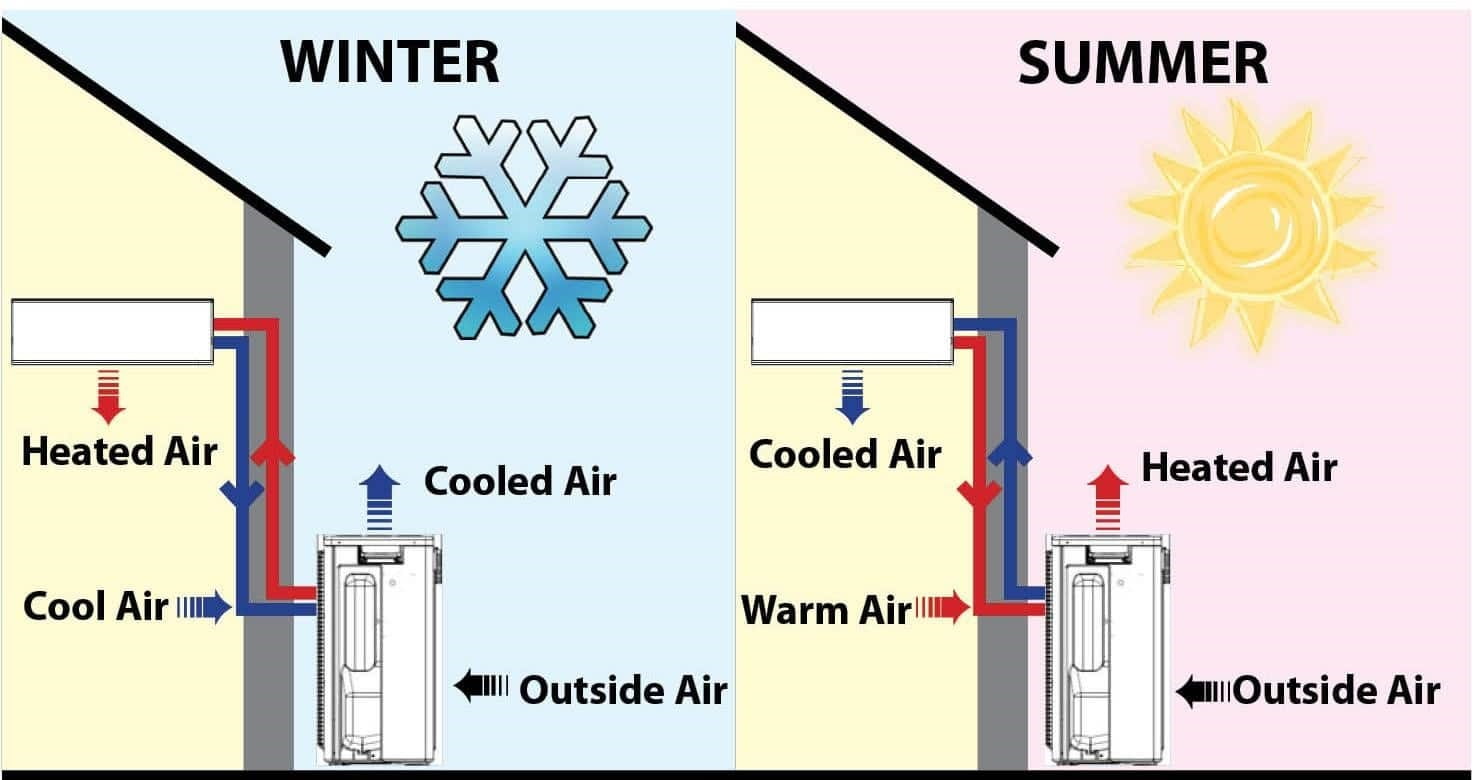
Yes, it does. It may be small temperature increase but AC use increases outside temperatures. It is just physics.
Here is a simple diagram: https://www.lozierheatingcooling.com/filesimages/heatPump.jp...
In reality equilibrium is restored quickly (and the thermal mass we're cooling/heating here is insignificant anyhow).
> provides diagram with zero evidence that AC meaningfully influences temperature
Clap, clap.
This is an outdated attitude. PV solar panel output correlates really well with air conditioning demand, no need for storage. Overcool your thick-walled masonry buildings during the day as a form of energy storage.
They don't create heat. It was there in the first place, just a different location.
Of course air conditioning is reasonably well suited to be a solar load during peak hours, but in most parts of the world if everyone just installed AC units like are common in many parts of the US it would mean a huge amount of extra fossil fuels burnt.
When you start handling that range you've to take into account that these people are going to die because of something, save a guy from heat here and that's an extra death because of cancer 4 years later.
Now I'm not saying it's a thing to be ignored, but be wary of playing quick and dirty with statistics.
I still like to draw a parallel, because they’re both deaths that we have the means to prevent, but the culture perpetuates the problem. That culture needs to change (doable in Europe with regard to AC because heatwaves will snap people out of denial, much harder or impossible to solve the gun culture problem in the US).
Maybe Europe should sell guns to the states - ideally sold in €
It is, because we're not going to be here forever, so might as well make the best of it. Trying to stop entropy by making everyone's lives worse is ultimately futile, but a certain group of activists have certainly been trying...
You'd think the government could subsidize aircon like they did solar for years, and both of those things combined would translate to very pleasant summers spent in energy neutral air conditioned homes.
This isn’t true. I’ve lived in 3 places in London with single glazing. They’re surprisingly common. All new properties come with it but the majority of our housing stock is old.
There’s also little comparison between air con and double glazing. One will be helpful for 4-6 months of the year and reduce my energy bills. The other will be necessary at most 1-2 weeks a year and will cost me thousands of pounds up front. Most people simply can’t afford that.
Of course thinking a cold is caused by being cold doesn't help either...
Edit: Turns out, sash windows are more commonly found in the UK (compared to other European countries), but still not as common as in the US. So, UK = not as hot (so far), thus still probably not worth it (yet) as a market.
The reason would most likely be low demand.
Best of the best is about 15-16 SEER
That's entry level central HVAC efficiency
Minisplits are far higher, 20+
And yes, it's true they're kinda ugly, but it's better than baking in the heat.
For exactly the same reason an evaporative cooler isn't going to work: there's no "space" in the air for the water to evaporate into.
What are the reasons "most of us simply cannot have AC"? Either laws/regulations banning it or making it prohibitive, or living in rentals without proper protection.
There is no reason why heat protection couldn't be mandated for rental units just like heating is required in winter. Or why tenants couldn't have a right to install AC at their own expense.
Meanwhile, because permanent AC units are de facto impossible, the portable Mideas sell out as soon as the heat wave hits, and we're forced to run air conditioners with literally open windows just so we can run the hose through.
(You should get one for next year, by the way. You probably missed the opportunity for this year unless you want to pay a scalper 2-3x the normal price, but they can be installed in essentially any window or balcony, are reasonably quiet, much better than the 'air hose out the window' monoblock units, and they fucking work)
Living in Germany, rental apartments simply don't have AC. Even luxury apartments that are 4k+ per month typically dont. Thats changing very slowly but still a long way to go.
A lot of landlords simply don't give a shit as they're not required to install one and since there is a housing shortage, good luck convincing them of anything.
Even if you own your apartment, installing a split AC requires unanimous approval from the other apartment owners before you can install one because making any permanent modifications to the outside of the building (like drilling a hole) needs their permission.
The older generation (generalising here) often has the opinion that the cold air from ACs is unhealthy and causes cold.
Once you get past all of that, is when price can become the issue. The AC units, even top-of-the-line, cost around 1k-1.8k. Good luck finding someone to install it for you. You need an electrician and a licenced installer.
I own my house so I dont need anyone's permission. The cheapest total cost (including the 1.2k for the unit I want) is 6k. Because apparently drilling 2 holes and, running the wire and coolant pipes is 4.8k.
Same difference.
The AC debate is not an honest one (or just an ignorant take). I really hope Americans can.fix their healthcare system.
Im really curious how this works. Do standalone units not exist?
Freezing to death in winter should be a harder problem at this point right?
Now that I had to explain my personal living arrangement, am I please excused from the constant nagging about europoors and their stupid hangups about AC?
A lot of Americans would be indifferent if it wasn't for Europeans (mostly Germans ime - Southern, Central, and Eastern Europeans are indifferent to supportive) who often try to act all superior about not using ACs or heat pumps because they supposedly "cause colds" or are somehow "unnatural" or try to make it a moral action despite a large portion of Americans using GreenTech to subsidize AC spend.
TBH, a lot of distaste Americans have for "Europeans" is basically a distaste for DACH residents weird sense of superiority (especially racial - you guys don't realize it but you tend to treat Black, Asian, and Hispanic Americans negatively until we wave our passport and Amex Gold/Plat). Most other Europeans are much more pleasant to be around with.
this is also my experience as a north American, sweating is a no-go and they clutch AC at 18C.
- "We don't need AC, It's only hot a few times during the year." - "Oh what a terrible heat, global warming is getting worse every year."
Pair to that the fact that in many places windows don't open all the way due to bureocratic regulations and many interior designs are very questionable in terms of air flow and you get some unpleasant scenarios.
But it's always funny how many people don't really realize how soon the AMOC will likely collapse (probably within the next 30 years - definitely within the next 70 years) and just unlivable most houses will consequently become, as what we currently consider an extreme winter would consequently become a mild one... The infrastructure just hasn't been built for -20°C
E.g. 2 degrees temperature raise did not sound bad to me, untill someone explained to me this is from ground to space, and the actual raise is double or triple that. Then we looked on a map and found current day Morocco seems close to what my Belgium is expected to become in that scenario. I still am not capable of deciding how realistic this is.
So you made me surf to amocscenarios.org, and even if this thing is reliable, it still is hard to interprete. My winter goes from -5 every decade to -18. I've never had either in my life. What does this even mean? Can my ww2 rebuilt house deal with -5, as it supposedly already did? What to do forcdealing with -18?
And that's the opinion of someone knowing a little bit. Now go to someone who has to managed 10 of life's disasters over his lifetime and explain how bad this really is.
It's only slightly related insofar an amoc collapse would make winters in Europe more severe (not in USA) - but it's only "inspired by" such a scenario and should not be seen as a plausible future prediction
Its going to be a huge challenge because the buildings are not designed with that in mind, many buildings are hundreds of years old making these sorts of renovations notoriously difficult and expensive, but it has to start because climate change is only going to get worse and worse.
Most of Europe has a "registered building" system, where buildings above a certain age are considered historic. Renovating those buildings is an extremely difficult, expensive, and bureaucratic process. You generally need to preserve the period-appropriate look and materials. An AC unit sticking out of a wall won't pass muster.
Even newer buildings are problematic. an acquaintance of mine lives in an upper-middle-class apartment complex that was finished two or three years ago, and their architect has some claim in the contract that prevents residents from installing AC units to "preserve the building's unique look."
The US is build around privately-owned housing (and hence creature comforts) a lot more than we are, so AC is a lot easier to implement there.
It feels weird to have to mention this, but although there are a lot of historical buildings in Europe, it's not the norm.
Population grows. There was a noteworthy war not that long ago. The vast majority of buildings are not that old.
Global warming intensifies differences in weather patterns. Hotter hots, colder colds, more intense storms, etc.
Our continent has more extreme weather than Europe... we've adapted accordingly because we value human lives. Have you?
The entire United States had 2,325 heat-related deaths in 2023, which is the all-time high.
Do the math (US pop 340M vs Spain 49M) and it gets really ugly.
[1] https://www.reuters.com/business/environment/spain-records-h...
If we want to reach the climate targets, we need to reduce our yearly CO2 "budget" per capita significantly. It was at about 800kg per person & year for 1.5 degrees a few years ago. As we have resigned that target already, we're at about 1500kg per year & person for the 2 degree target. (estimations of total CO2 budget until 2050, divided by #people on earth).
After 2050, that number per person should go to net zero.
So the way Air Conditioning is used is a significant problem. If the entire world would use it like it is used in the United States, we would get into a runaway situation. And we kind of are heading towards it.
We do a lot of things wrong but AC isn’t one of them.
(Unless you’re in the PNW where they never needed it before recently, and somehow continue to build units without it)
Oh but what's the problem, just add more air conditioning! :facepalm:
Sure we would, since AC has nothing to do with it.
Well, not really ignoring it, more like making it worse while setting giant piles of bills on fire.
By creating and artificial climate in all or our homes we are so disconnected from the world that we think technology will fix it.
Just wait fro the wildfires to blow up this week in the western US. AC will not help.
But climate change is bullshit, right?
I have one of those portable evaporative coolers and they don't need much power (50-100W). I have one and measured ~110F input and 78F on the output side using nothing more than water and a fan, pretty remarkable. The trick is staying out of direct sunlight, and the body can cool itself well with the same mechanism. Sweating is extremely effective due to the low humidity.
Heat as the primary factor, vs heat related deaths is significant.
Heat is a system stressor. There's plenty of people having heart attacks and dying from weight related issues that probably got pushed over the edge by a hot day in Nevada that are missed in official stats.
It doesn't affect life expectancy much, because most deaths are among the elderly (70% over 80 IIRC).
In France, the same exact situation would be reported as a heat casualty leading to heart attack.
IMO even that's not a proper comparison though because you cannot compare Alaska to Texas, or Rome to Helsinki and thus throwing all of these in together for discussing heat deaths us just pure nonsense and rage bait.
Has been on my "to research" list for a while. I agree with you that Europeans should stop being so stingy with AC (speaking as an European who still hasn't an AC, but not much longer), but I do wonder how much they actually do to prevent heat deaths.
Because, how many heat deaths happen at home where people would potentially have AC? As far as I can tell (pre researching it) most, if not all, heat deaths I am aware of, happen outside. So the question would be: What is the effect of having a cool 22C home in regards to suffering heat deaths outside. Does it make it better, because your body can cool down? Does it maybe make it worse, because you step into a harsh difference when leaving it? (The last one is probably an easy no, since plenty of countries with high AC rate don't seem to have that issue).
(Or just general damages from heat, not just heat deaths)
You will not die from sleeping in 30c. What europe will have to get used to is slow down over the mid day when the heat is worst.
Especially as air conditioning are heat pumps.
Would have helped solve the large dependency on natural gas heating for free as a byproduct!
NB: a friend in construction explained this to me so I could be wrong but it would explain why even pretty fancy new apartments with heat pumps have no cooling.
Existing properties are eligible for the Boiler Upgrade Scheme which also now covers air to air (ie. reversible) systems.
There's still a bit of "what? no radiators?!" cultural resistance to overcome, but I'd expect this to fall away quickly as the climate continues to warm.
And then the same people who moralise air conditioning will burn tons of gas all winter for heat.
Oh, and sensible design choices like eaves that block light from windows in summer are blocked by planners in many cases, bizarrely. The houses are brick ovens.
Anyway I got AC installed here in Utrecht last week, really enjoying it
The cynical side of me almost wonders if the current approach is designed to reduce health care and pension costs by disincentivizing installation of a technology that saves elderly people.
It's not just the resistance but the price. There is tremendous price gouging in the AC industry. The real cost of a mini split system is the low hundreds of dollars but good luck finding one for that price in Europe. If it were regulated as a life critical technology and not as a luxury then it could be substantially cheaper.
That’s unlikely to be sustainable for an out of pocket of a low hundreds figure.
Obviously the installation will be more expensive in Europe due to higher wages, but the units themselves should be dirt cheap.
https://vividmaps.com/comparing-latitude-of-europe-and-ameri...
US states like Texas and Florida have no latitude equivalent in Europe. Los Angeles is farther south than all of Spain.
At the same time, the UK, much of Germany, and Poland are farther north than any state in the US lower 48.
AC would not be so much needed if we started reducing pollution and greenhouse gases.
Where is this meme coming from? I'm in Poland atm. Half of my neighbours have aircon. I dont just because I'm on the ground floor and the max temp is 25.5C Every new apartament building is build with holes ready for AC.
There are people who think it's a good idea to aircondition service station forecourts. I find the irony of the situation tragically absurd. There's a little of that in the comment you are responding to.
That said F-gases would have been an issue, EU only recently banned them.
Also most of Europe truly didn't need AC for a long time, growing up temperature above 30C was exceptional and I didn't even know the term tropical night (nighttime temperature above 20C).
(Now that places are getting 10+ consecutive days above 30 with peaks close or above 40)
https://www.euronews.com/my-europe/2025/07/15/these-eu-count...
Heat death affects disproportionately those of old age. Everyone dying at 76 for other reasons is not going to die at 83 due to heat.
While it is true that Europeans don't have air conditioning at home for the most part, it's also true that those old Europeans that die during heatwaves would already have been dead in the USA. I am 99% confident that 98% of the difference in heat deaths can be explained in this way at the 95% CL (!)
Gun related deaths are simply a way for Americans to cope, I suppose! A bit of ragebait. I honestly hope you fix your health system.
Do also note that AIUI in the US only deaths that were officially ruled from heat are counted as such by the CDC (source: https://www.nytimes.com/2024/08/23/us/extreme-heat-deaths.ht...), whereas the EU usually performs estimates based on overall deaths in excess of the expected baseline. So it's not apples to apples.
I do agree that avoidable deaths should be avoided, though, so I'm with you on that.
1. Energy is very expensive relative to the U.S. 2. Houses are old old and retrofitting air conditioning is very difficult 3. Houses are more than 1 story with many small rooms making portable and window mounted units unsuitable for a whole house
All modern apartment buildings in London are built with air conditioning because a central air system and district power make it cost efficient.
If you visit a hot place like Dubai or Bangkok, there are endless indoor malls with air conditioning that serve as a place to shop and a third space. Much of Europe doesn’t have that.
The U.S. specifically is also very car-centric. You walk out of your air conditioned house into your air conditioned car and drive to your air conditioned mall. Much of Europe… isn’t. People walk, you can’t avoid the heat.
Yes, certainly, there is a cultural resistance to air conditioning but adding air conditioning to homes isn’t going to stop people dying, homes are the least consequential part of heat in day to day life. Health advice in a heatwave is pretty much: don't go outside.
Europe has roughly 750 mn people. When you’re in the southern parts many homes actually do have AC.
We’re not stupid. Many new buildings have ACs. The northern parts just haven’t adapted to the increased temperatures at scale yet.
Dont take pieter levels so seriously
Some of that has to do with engineering and age / history. Many older building in the southern part of Europe are built to cope with heat, at least "normal heat", and have done so very well for centuries. In places like Spain and Italy, society has adapted around the worst heat by means of Siestas.
In Northern Europe, there are maybe (during "normal summers) 7-14 days in a year with heat waves, and long dark winters with freezing temperatures so large windows are not uncommon. Houses there are built to trap heat (and cold) with insulation, with current building codes mandating around 350mm (~13.5") of insulation.
I have and old (1970s) house with 100mm insulation in the walls and 200mm insulation in the roof, and that house heats up in the sun. I also have a 2014 "modern" house built to regulations at the time, so around 300mm insulation, and despite a full day of sun, 30C, that house doesn't heat up nearly as much. Insulation by itself obviously doesn't protect you from prolonged high ambient temperatures, and I do have a portable AC for those situations. I think I've used it for 10 days in total over 2 years. Most days, simply opening windows and doors are enough to cool down the house. Having roof windows creates a "chimney effect" letting the hot air out on top, drawing relatively cooler air from closer to the ground.
I also have an older summerhouse (1984), constructed with wood inside and outside, 75mm insulation in walls, 100mm in the roof, and that has a proper mini split aircon unit, Panasonic NZ25VKE, and in the 5 years I've had it installed, it has used 4.75 kWh on cooling. For comparison it uses around 1400 kWh yearly on heating. The wooden construction doesn't trap heat like bricks/concrete does, so even on very hot days simply opening a couple of windows/doors is generally enough to get the heat out, as well as putting the heat pump on "only fans" mode.
And finally, a lot of newer buildings (2010 and onwards) does have climate control, both heating and cooling, but Europe is an old continent, and the buildings are old as well. It's not uncommon to see 200 year old buildings still in use today. 100 year old buildings are quite common. The church in the town I live in was built between 1250 and 1595. It has of course been updated with electricity and other modern commodities, but no air conditioning. The meter thick granite walls keeps it nice and cool.
Ironically, the US' insistence on running on electricity powered by coal, oil and gas is contributing to global warming making the problem worse, emitting about 2-3x as much CO2 as Europe on electricity (https://app.electricitymaps.com/map/live/fifteen_minutes), making the need for AC greater. If anything, the Americans don't get scolded enough for their resistance to renewable energy sources.
What a pathetic