Then I learned that the US Bureau of Prisons had a rule against any calculator (or device) that was "programmable". So I programmed the TI-85 so its startup screen read, "TI-85 NON-PROGRAMMABLE CALCULATOR". Problem solved.
Me in math class in 1996 - I had a TI-82 things are programmable so I have no formal education, my parents are illiterate, and taught myself to program, and I begged them to buy me one.
I spent time learning how to code on it, writing from scratch, the game Spyhunter.
I couldn't figure out how to draw with lines or pixels so I used ASCII or text.
I presented this to my teacher who told me "these aren't for games". I was crushed.
What is the matter with these people.
  h = a
  a = b
  b = h
Since I wasn't able to use computers or the Internet for that time, I did/read/learned a lot of things I wouldn't have otherwise learned. Learned how to make hooch (prison wine), how the law works and how to maneuver the court system (useful for both civil and criminal cases), got more fluent in French by speaking with some native French speakers from Benin, learned how to work out & lift weights (which I still do), and learned the value of freedom.
The TI-92 had recently come out, and it had a QWERTY keyboard and could solve symbolic calculus problems like "find the derivative of 2x^3". This was a problem for the AP exam, since you could just type in the problem and get the answer. They fixed this by banning calculators with QWERTY keyboards. That's just about exactly when the TI-89 came out, which also did symbolic calculus but did not have a QWERTY keyboard, and so it was totally allowed on the exam. Boom, 5/5 exam score for Jorji.
TI-81 (1990)
TI-85 (1992)
TI-82 (1993)
TI-80 (1995)
TI-92 (1995)
TI-83 (1996)
TI-86 (1996)
TI-73 (1998)
TI-83 Plus (1999)
TI-89 (1998)
TI-92 Plus (1998)
TI-83 Plus Silver Edition (2001)
TI-84 Plus (2004)
TI-84 Plus Silver Edition (2004)
In high school my stats teacher told us we had to get a proper calculator. She didn’t set any upper limit so i went down the calculators rabbit hole… and got an used ti-86 from 1999 off ebay for 35 euros (this was in 2007 or so).
I programmed software to solve exercises in ti-basic and spent every lesson doing essentially software testing: basically whenever a classmate was called to the blackboard to solve an exercise I’d input the exercise data and verified I got the right results.
I got 9.5 out of 10 to the immediate next test. The teacher took off half a point because i miscopied a number (0.3 rather than 0.03, i still remember that after almost 20 years). It would have otherwise been a perfect test.
Fun times.
I still have that calculator, i turn it on every now and then.
I remember naming that calculator “Annarita”, like a girl I used to like and that (of course, lol) barely knew I existed at all.
Gonna be pedantic/crotchety about this because I got into advanced math classes but it was my brother who got the 84+ (I had to settle for a 83+). Guess who's the engineer now, and who's the NEET? Your kids pay attention to what (who) you value, folks.
Reason : making due with more scarcity increased independence and critical thinking.
I don't know if that was your point...
I had a TI-85 (maybe 86), unlike the entire rest of my school who had 83s.
There was a difference: when programming in TI-Basic, variable names on a TI-83 are limited to a single character. On the 85, you can make them longer.
But that was pretty much the only difference, and it will never come up if you're using the calculator for school-related reasons.
(For calculus, I had an 89. The differences are much more significant there.)
Somewhat related. My mom once yelled at me for losing a necklace she really liked. Then we were moving her stuff out of her house and found the necklace behind a wardrobe, wedged between it and the wall. It had been there for like 40 years, layered in dust.
When Luther's house in Wittenberg was excavated about 20 years ago, a golden ring[2] was found that must have been deposited there before 1540. It is therefore quite likely that this is the ring mentioned by Luther in 1537.
[1] See WA, BR 8: no 3162 -- https://archive.org/details/werkebriefwechse08luthuoft/page/...
[2] Here is an image of the ring: https://www.zum.de/Faecher/G/BW/Landeskunde/rhein/geschichte...
> 3x Processing Power - Matching one of the speculated options, the calculator appears to use an ARM Cortex CPU, finally retiring the z80 and ez80 family of CPUs that were used in three decades of TI-83 and TI-84 Plus graphing calculators. It's running at 156MHz, compared to the 48MHz of the older calculators. It appears likely that in an unexpected break from over 30 years of TI's operating system codebase, the OS has been re-implemented with new features natively on the ARM CPU rather than using an ez80 emulator to run an updated form of the TI-84 Plus CE operating system.
It looks like TI is finally moving away from the Z80. This must have been a pretty big engineering effort on TI's part. Like the article says, up to this point all of TI's low-end graphing calculators have been Z80 based and use the same system software that has a lineage dating back to the early 1990s. They were previously so wedded to the Z80 that when they introduced Python programming to their calculators, they did so by adding an ARM microcontroller that runs MicroPython, while the main eZ80 CPU acts as a serial terminal.
One thing that I remember vividly was you had no MUL or DIV, so you have to implement them yourself with shifts, adds, subtraction, etc. This was an extremely useful learning experience
Do you think you could remember most of Z80 ASM? I looked at some old ASM I wrote long ago, and it's hard to follow the logic of the program, since most lines are messing around with the registers. But basics like 'ld hl,xyz' and 'jp/jnz' still make sense.
>Kerm Martian
There's some names I haven't heard in a while :)
This is substantially inaccurate.
1) Not all ARM Cortex series CPUs have TrustZone. It is absent on many Cortex-M microcontrollers, for example.
2) TrustZone is an operating mode of the CPU, not an "admin processor". Depending on the part, it is often made accessible to developers. (Whether that includes third-party software developers is, of course, up to the device manufacturer.)
For more information, see:
https://developer.arm.com/documentation/100690/0200/ARM-Trus...
But yes. 99% of what we did with them in class - when we were even allowed to use them - could have been handled by a little solar-powered calculator with basic arithmetic functions.
You're paying $100 for completely antiquated hardware where its core feature is "it doesn't do much".
Pretty much any professional environment that you will need calculations will have access to a computer that can do these calculations significantly faster and better.
I thought my HP was pretty cool in high school, but pretty much the moment I graduated I stopped using it because I figured out how to use Excel and/or a programming language to do number crunchy stuff. Even for CAS stuff, I would just use Wolfram Alpha or SageMath (depending on how ambitious I'm feeling with setting stuff up).
I can't remember the last time I used a calculator outside of showing someone else how to use it.
That unfortunately is also why they can charge so much and people buy them anyway, because at best you'll be on your own to learn how to use anything else (and at worst you won't be allowed to use it at all for tests and such).
I distinctly remember my teachers having a debate around whether or not the functions I had programmed into my calculator were "cheating". On one hand, it was a tool and notes that I had access to my peers did not. On the other hand, I had created those tools myself, and if school was supposed to train me for the real world, wouldn't I be able to use the tools I created in the real world?
Now that I think about it, this could have been a strategy my high school drilled into us as a way to increase SAT scores, since TI-84s were allowed to be used there.
Neither teachers nor school districts have the time or resources to audit every new tool someone wants to use, or to help students figure out how to use their preferred tool to do something - find something that works and just use that
- was cheaper than a TI
- had a primitive CAS system
- teachers had no idea how to put it into test mode
It carried me through AP calc BC, I would’ve gotten <4 off of my own knowledge alone
One perk I found is that if I kept it in RPN mode, people stopped asking to borrow my calculator, which was a valid excuse to learn how to use RPN, which is basically all I use now (and indirectly made me really love the Forth language).
I wouldn’t have been able to function without it in school (20 years ago). But we also didn’t have iPhones.
I suppose it depends if you took advanced math classes or not.
They actually started us on them in 7th or 8th grade.
I use my emulated TI-86 every other day, and prefer it to any other UI I've seen on calculators on phones.
When I have a laptop available, I of course use excel or wolfram alpha for anything demanding, but when on the go, I like my emulated TI-86.
I know technology has moved on and all, but much nostalgic respect to these amazing calculators.
Probably have not touched mine since college.
But my wife is also a high school teacher and one of the most consistent problems I hear about from her is smartphones being a distraction. If she lets a kid use their smartphone as a calculator, odds are they'll soon be scrolling content feeds, playing games, or chatting with others. If her school required students to have a graphing calculator with limited functionality, it would probably be a benefit to her classroom.
* I used the programming functionality of the calculator to get around the rules
* I didn't care much for the math, but my TI calculator was my first programming experience and it's what got me to love programming
My experience is similar. We were allowed to use our TI-85s in class, but we had to go up to the teacher before the test and show him that we were running a factory reset, to prove we had nothing programmed in it to cheat.
My buddy and I had made a two player blackjack game and didn't want to have to retype it after every test. So instead we made a program that mimicked the factory reset process. You would run the program before walking up tot he front.
The only indication something was different was the three little dots in the corner indicating a programming was running, but we just covered that with our thumbs.
Ironically we never used it to cheat, only to not erase our game that we programmed!
Looking back on that experience, I’m very grateful to her, but she also probably didn’t realize I was programming it to also show the individual ‘steps’ to get the solution instead of just the solution.
There's even knockoffs of it for $1: https://www.aliexpress.us/item/3256809744184708.html
I picked one up when the 99 cent store was shutting down. It works fine.
Look what you can get for $20: https://www.casio.com/intl/scientific-calculators/product.FX...
TI is like the Intuit of the education world. I want to love them but this is ridiculous - a N4120 celeron laptop is the same price as this new calculator - it might be a garbage laptop but it's doing a heck of a lot more for your $160 than this calculator is.
Doesn't mean it's not overpriced, but that's one reason and you can get a used TI-83/84 for like $30 or less. They pretty much never break.
-----
1. Okay, the Casio can QR-code-link you to a graph, but if I have internet/smartphone there are better graphing tools anyway, like Desmos.
https://www.walmart.com/ip/Casio-FX-9750Glll-Graphing-Calcul...
The reason you can get used ti's for $30 is because that's how much they're actually worth.
You can get a catiga if you really want for like $17: https://www.aliexpress.us/item/3256809054964211.html
... or you can go with TI for $160 ...
I used this on tests that banned the TI-89.
My Casio could do numeric differentiation and integration. I used this to double check my answers in my exams.
In fact, it still can as I still own and use it to this day.
https://www.amazon.com/Casio-fx-115ESPLS2-Advanced-Scientifi...
Includes GCD and LCM, some of the newer ones don't have them.
If you want graphing, there is the newish fx-CG100 has a nice display, but they removed Casio basic, it now only has micro Python (way too awkward to type on a tiny keypad):
https://www.amazon.com/Casio-ClassWiz%C2%AE-Calculator-Funct...
The older ones that still have basic:
https://www.amazon.com/Casio-fx-9750GIII-Graphing-Calculator...
BTW, here is a review I made of many calculators, measuring keyboard efficiency: (HP-15c still the best)
It’s my favourite calculator and the one I always reach for, despite having a bunch of more complicated 2-line calculators etc. It’s just so easy to use and very fast to do anything I’d want with a calculator. If I need graphing I’ll reach for Desmos. If I need algebra I’ll use Sage. I haven’t used Sage since my undergrad, however.
[1] https://www.casio.com/content/dam/casio/product-info/locales...
[2] https://www.casio.com/ca-en/scientific-calculators/product.F...
Four data points is sufficient to give you a 'good enough' shape and position of a second-degree polynomial. Five or six for a third-degree one. (And you barely see them, and don't learn how to algebraically solve for their roots in high school anyways, because the cubic factoring formula is a pig.)
If you can't tell what a function's plotted shape is going to be at a glance, you haven't learned the material to the degree expected of an attentive child.
I mean, these days kids have smartphones, what's the point of a graphing calculator?
Rant/Aside: Smartphones (or at least Android) are just generally really bad at being... smart, especially out of the box. No dictionary? No thesaurus? To say nothing of built-in encyclopedia (e.g. Wikipedia). Calculator worse than the $1 scientific ones? It's astounding how obvious it is that they're meant to dumb people down and just sell you crap when you look at the complete absence of basic functionality anyone from 50+ years ago might expect them to have.
Many tests will not allow you to use a smartphone. My son couldn't even use the school issued chromebook on his PSAT, he had to get a loaner Windows laptop or use an approved hard calculator.
However to answer your question: phone rules in classrooms vary enormously and the dedicated calculator is faster to interface when you're drilling problems in a homework setting
I finished highschool in the (gasp) 20th century so the modern classroom is certainly something I've had to learn
There isn't one.
The TI-83 is just a $160 tax on every high school student. There is precisely zero use in a graphing calculator before university.
If you ever need a plot of literally any function you'd be plotting in high school, you should be able to do a very quick, very rough approximation by hand. If you can't, you haven't learned the material.
I lost it at some point and got the version 2 and I would occasionally use it for work. I wish it had USB-C because who has a mini-B cable for charging these days
When a calculator is used in a classroom, there's a concern about people using the calculator to replace the skill that's being taught. So, for instance, there's space for a calculator with no CAS, for a class that's trying to teach you to do algebra. That is in some ways easier than "don't use this function of the calculator".
Not that any of this matter anymore as it can be entirely replaced with LLMs in near future.
That screen resolution for one is horrible for 2026.
Also I don’t know about you but these days I welcome stuff that allows me to stay away from the damn phone.
All of the exams listed are either already offered in a computerized format or in a transition phase, with the PSAT, SAT, APs, and ACT all already offering Desmos in their testing apps.
I love handheld calculators, but, especially in a time-sensitive environment, it's hard to beat a large screen and full keyboard.
Why are they still able to sell what is effectively a 30 year old computer for as much or more today than when it came out? Because they managed to get the family informally standardized as "The calculator every teacher in America understands well enough to manage students who use it. Therefore pretty much everything else that could be as or more advanced is effect banned."
It was an amazing piece of kit when it first came out. No doubt you could make something 100x better and 10x cheaper today if someone really tried. But, they would fail commercially because you can't design-in 30 years of legacy in the US school system.
tests like SAT, ACT, and some AP exams are using Desmos, yes
however:
- this means you have to fiddle with a popover window and can't always see the full problem (especially when the reference sheet is also online)
- you have less muscle memory and often take longer
- harder to multitask (you use paper anyways, and the paper to calculator friction is lower than the paper to trackpad friction
- trackpads on school computers are usually worse, which compounds the problem
- some specific functions just don't exist
essentially using Desmos is like using a physical mouse/trackpad, while using your calculator is like using VIM motions and keyboard shortcuts with a concave split keyboard. it's technically more intuitive and can help in certain scenarios, but it's useful to have both.
this sounds trivial, but it's not, especially on tests where you have about or less than a minute per question
ideally you have both a handheld calculator and Desmos though
15 year old me in math class programming my loaned TI-82: CHALLENGE ACCEPTED!
For a lot of people it introduced them to TI-Basic which was quite capable, and for others you could get into Assembly which allowed for more powerful applications. There were 2 parts of the memory, BASIC programs were in regular memory that could be easily erased, and another part which was Flash Apps.
I later upgraded to the 89 which had a better CPU, screen resolution and processing power and it was phenomenal in helping me understand every single math class, including EE/EECS. It made me sad to see them banned in exams, because having a 83+/89/any calculator was in no way helpful in any of the exams I took, but it was more of a "control the students" thing in college. The Math department determined that because they couldn't prove that people were not using the internet/portable PC's in their calculators, that they could not guarantee the fairness of it all.
Weird argument to make knowing that a 20 year old student was engineering a full internet capable PC into a calculator at the time would have been the envy of the world (and every engineering program).
This all depends on the quality of education and not simply handing out problems that require rote memorization of the methods to solve an equation and instead derive or figure out the equation yourself after understanding the problem after which you're free to use the calculator to "plug and chug".
One day, vexed by something, I vented my frustration by composing a profanity-laced rant into the Feedback window of the TI Connect app. (I don't recall the proximate cause, but I remember complaining that the product itself, which is still $110 today, is a total ripoff.)
I was certainly surprised when the (sole?) TI Connect developer responded by e-mail taking umbrage at my complaints.
0: https://education.ti.com/en/products/computer-software/ti-co...
For instance, we compare the phone calculator. My phone fills a lot of really important roles besides being a calculator, ones that necessitate a password. So first I have to unlock my phone. Then I have to leave whatever app I had open before. Then I need to find the damn calculator app.
That's 5-6 seconds of friction, depending on how responsive my phone feels like being and how many times I fatfinger my password because the concept of "muscle memory" on a touch screen is practically an oxymoron. Not to mention, you cant just walk away from the desk for a moment with the calculator app left open on your phone, ready to come back at a moments notice, like you can with a dedicated calculator. Phones are just too important for that.
There's arguable pros and cons to using your PC over a calculator, but I think that discussion is a lot more nuanced. Either way, a PC is definitely less portable than your phone or a calculator.
Maybe I'll be convinced to upgrade at whatever point they add usb-c and a rechargeable battery to their lowest trim model. Not before that though.
Or are we all just using software on our computers now.
That would be sad.
(I've had a Casio fx-991EX on my desk for a few years, that replaced a broken Casio fx-991ES. Though designed for academia, its operation is burned into my brain at this point.)
Handheld calculators are nice, but outside of exam settings, I could use a smartphone or a computer, though calculators are nice when I want to work distraction-free through something that requires performing calculations. I believe this is why HP largely exited the calculator market: HP's target market was professionals, and cheap computers and smartphones killed the calculator market for them, similar to how electronic calculators killed the slide rule. Texas Instruments, however, is still in the calculator business, largely due to their successful courting of American middle and high schools, as well as ETS and other testing agencies, beginning in the 1990s. I don't know the situation in Japan regarding calculator usage, but I see Casio scientific and graphing calculators proudly displayed at electronics stores such as Yodobashi Camera and Bic Camera.
  HP-35 (1972, first scientific, first in space) - in leather case
  TI-30 (1976, first low-cost scientific)
  HP-12C (1981, financial, c. 2000 remanufacture)
  HP-15C (1982, advanced scientific) - in leather slipcase
  HP-16C (1982, computer programming) - in leather slipcase with manual
  TI-30 SLR (1982, TI’s first solar-powered scientific)
  HP-17B II (1990, financial)
  TI-85 (1992, TI’s first with link port)
  TI-82 (1993)
  TI-92 (1995, TI’s first with computer algebra system)
Anything that goes beyond what that calculator's UI can reasonably handle is going to end up in a Jupyter notebook or something like that.
[0] https://thomasokken.com/free42/ I should send them a donation.
[1] https://literature.hpcalc.org/community/hp42s-om-en.pdf followed by https://literature.hpcalc.org/community/hp42s-prog-en.pdf
I still have my TI-85, but I essentially haven't used it since I left college. For 99% of what I need, I use either Python, or what's built into Firefox (e.g. unit conversion), or DDG. For that last 1% (e.g. full CAS functionality), I tend to grab whatever web-based non-AI tool is handy.
honestly, I think it makes no sense to spend more than 30$ on a calculator if it can't do symbolic math.
The way you input things like division, integrals, matrix, etc. on newer calculators like the nspire is far superior than the older calculators (eg. ti-84, ti-89, etc.). They look like how you write them on a blackboard instead of relying on purely parentheses or "," and ";" to separate parameters. It's like going from Excel to Mathcad
At that point I’m either using the stock iOS calculator or iHP48, HP48 clone.
It mostly depends on which page of apps I’m on and which is closest.
I like the unit conversion on the iOS calculator, easier to use for trivial calcs than the HP.
Biggest gripe on iOS is a single memory. On the HP I’m mostly hooked on the infinite stack, and that’s why I use it over the HP-42 clone app I have as well.
Or often just a python repl
> python repl
Hmm...
> The keypad layout removes clutter and makes commands and shortcuts easier to see, so you can work faster with fewer steps.
I don't see it. I compared a screenshot of one of these to a older T-84, and it looks like they have same number of buttons, and the buttons are just as cluttered (except the EVO has secondary labels on the keycaps instead of the case).
That's a good thing, since one of the best things about calculators is they typically have a ton of buttons for quick access to a lot of functions.
https://ids.si.edu/ids/deliveryService?id=NMAH-DOR2014-05202...
I'm not sure such a device really improved any understanding of the underlying mathematics that I was taught. In fact, in more advanced mathematics these machines can't even keep up.
Oh no.
…LLM-isms are like nails on chalkboard I swear. Instant turn off the moment I read them.
Even if they’re maybe not lol, doesn’t matter my visceral reaction is negative.
...which perhaps says a lot about the corpora that the models are trained on.
You might say why not use Python or Matlab?! It‘s true that you don‘t need a small handheld device to do engineering calculations where there is a ton of other much stronger and free options out there. But the thing is, a calculator is a pure dedication to one thing. You turn it on, you do your calculation, get the answer and move on. It gets out of your way. Plus it is a better feeling to type stuff using the dedicated buttons in a calculator than using a keyboard.
At no point was there a need to work with hard numbers or to learn to work with a physical calculator (I haven’t seen one in the wild in years).
But yes I would agree. So much time spent making sure people don't learn to use the tools they'll always have on hand. Programming exams on paper and that kind of inane bullshit.
2 dinners out for a family of four would cover the cost of this calculator. If my kid's school required this for math, I wouldn't bat an eye at purchasing one.
I needed a Ti-83 for school in 1996-1998. If you couldn't afford one, the school would loan you one for the semester. Band instruments were the same way.
Well, it is ;) The Swiss Micros clones are pretty awesome:
https://www.swissmicros.com/products
These are clones of various older calculators.
With phone emulation, I probably need half a calculator. I have three.
That said, I find it really hard to believe that they can't provide better specs and feature set for the cost. User-available memory of 3.5MB is incredibly low, especially with Python support. These could be really cool handheld computers if TI put more effort into their devices that already have a massive install base.
Currently, most of their popularity in my experience is "lock in" effect from teachers who are familiar with TI calculators and lab / curriculum materials that are specifically built around teaching through TI calculators. At this rate they're charging a lot and resting on their near monopoly status in education, which I'm sure is very profitable for TI.
There used to be a great app called WabbitEmu that emulated these devices on Android. I think they got a cease and desist but it was pretty neat to have back in the day
I'm thinking something that could be a major upgrade in spirit to the long-in-the-tooth (released a decade ago) Casio FX-CG500.
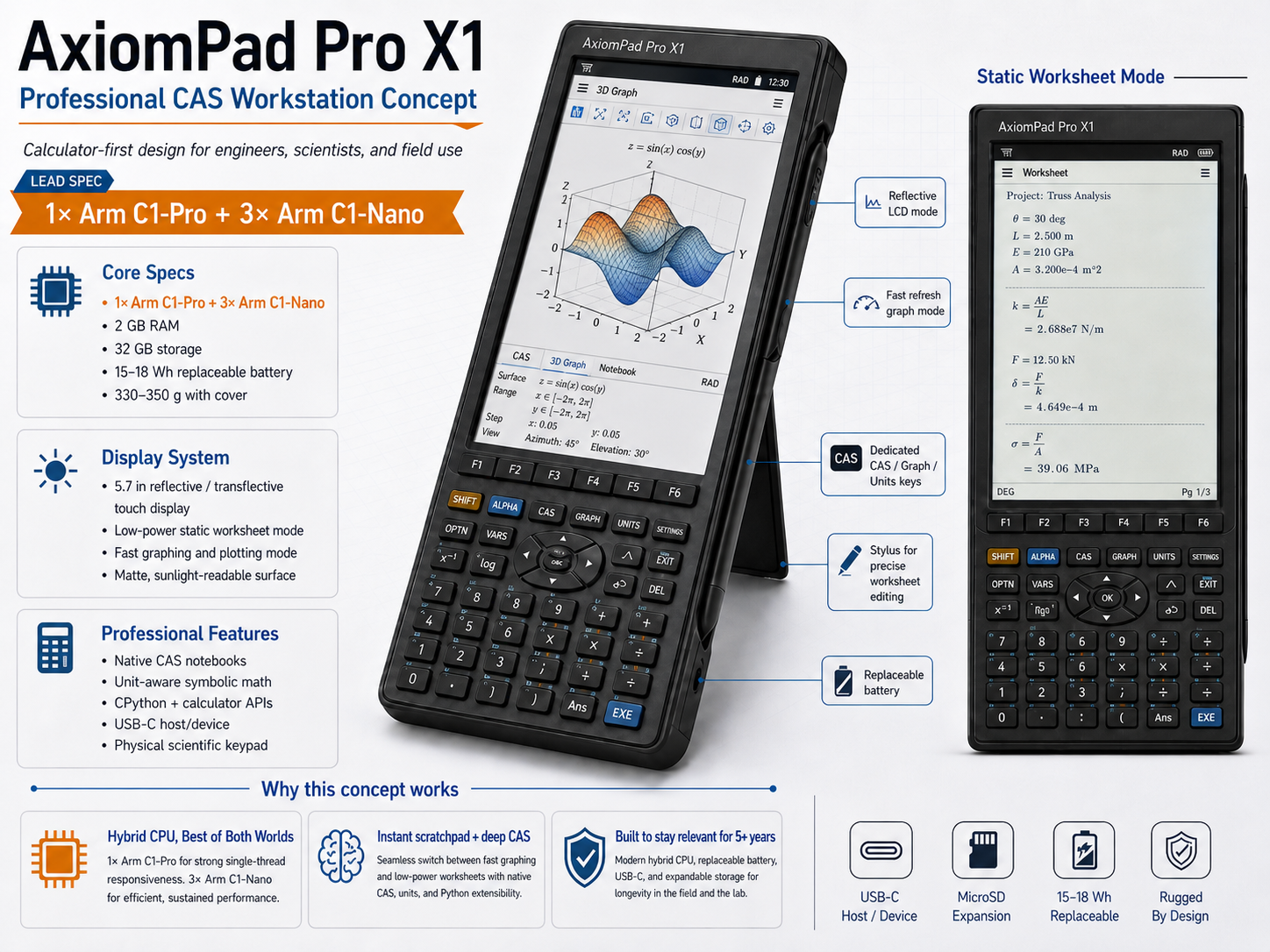
Could use the soon to be released ARM C-1 Nano and Pro cores in an SoC with stacked 2GB LPDDR4, USB-C charging to a large battery, high-res transflective LCD...
Mockup "AxiomPad Pro X1": https://enia.cc/out/axiompad-cas-mock.png
Not as bad as I would've expected. Also, apparently it includes a very simple Python environment? https://education.ti.com/en/product-resources/eguides/eguide...
I will buy one anyway because calculators remain a modest luxury that I want to indulge.
As an engineering student at CMU, I had an HP 15c like everyone else. A few years back when I found out they are coveted, I sold mine on ebay. I have an emulator on my phone.
I assume that calculators will continue to evolve and that my grandchildren will have a Propædeutic Enchiridion.
Any MCU out of their portfolio should be fully capable of driving the display, reading the keyboard. And the math should be lightweight for even the smallest processors nowadays.
Also, drug wars, x wing vs tie fighter, and all sorts of other awesome games were definitely the fun thing to do with these.
I still have my ti89, and my brother's 83. My kids will learn to write text based dealer simulation in ti-basic, then 68k assembly, like real men^.
^ they're boys so that cliche works
"Online calculator included (four-year subscription) •($80 value)"
https://education.ti.com/en/products/calculators/graphing-ca...
EDIT: oops, conflated with HP-35, from a decade earlier. 10c was programmable. HP-35 was not.
They clearly haven't met a classroom of high school kids. Then again... I didn't have access to the internet in my pocket when I was in high school so....
For some reason qwerty keyboard calculators are banned in tests.
Generally limitations in education on what was allowed led to more limited feature sets. Where as full feature set that could be upsold with qwerty keyboard was aimed for different users.
10yrs ago they would have been 4 to 5 figures.
Now they are what? A couple hundred?
How in the world is a TI graphing calculator still $160? These 30yr old calculator chips apparently hold their value like gold…
National exams will be wild for the kids capable of programming or vibe coding.
Unfortunately, ever since, they seem to have decided to imitate smartphones and focus on making restricted devices for exam taking, rather than tools to empower the user.
There should be a cheap open source calculators for schools and exams. It’s ridiculous that TI is still charging this.
I hate what AI hype is doing to peoples' brains here.