The OmniAI benchmark that's also referenced here wasn't updated with new models since February 2025. I assume that's because general purpose LLMs have gotten better at OCR than their own OCR product.
I've been able to solve a broad range of OCR tasks by simply sending each page as an image to Gemini 2.5 Flash Lite and asking it nicely to extract the content in Markdown under some additional formatting instructions. That will cost you around $0.20 for 1000 pages in batch mode and the results have been great.
I'd be interested to hear where OCR still struggles today.
Curious to hear which OCR/ LLM excels with these specific issues? Example complex table: https://cdn.aviation.bot/complex-tables.zip
I can only parse this table correctly by first parsing the table headers manually into HTML as example output. However, it still mixes up tick boxes. Full table examples: https://www.easa.europa.eu/en/icao-compliance-checklist
But that's something else, that's no longer just OCR ("Optical Character Recognition"). If the goal suddenly changes from "Can take letters in images and make into digital text" to "Can replicate anything seen on a screen", the problem-space gets too big.
For those images you have, I'd use something like Magistral + Structured Outputs instead, first pass figure out what's the right structure to parse into, second pass to actually fetch and structure the data.
I don't have a use case of 100s or 1000s of hand-written notes have to be transcribed. I have only done this with whiteboard discussion snapshots and it has worked really well.
(I'm not being snarky. It's acceptable in some cases.)
Blotchy text and specific typeface make 6's look like 8's, even to the non-discerning eye, a human would think it's an 8, zoom in and see it's a 6.
Google's image quality on uploads is still streets ahead of openai for instance btw.
Not really in practice to me. Especially they still struggle with Table format detection.
Any complex parent table span cell relationship still has low accuracy.
Try the reverse, take a complex picture table and ask Chatgpt5, claude Opus 3.1, Gemini Pro 2.5 to produce a HTML table.
They will fail.
It's a hard (and very interesting) problem space.
And GP LLMs are heinous at OCR. If you are having success with FL, your documents must be incredibly simple.
There has been enormous advances in OCR over the past 6 months, so the SoTa is a moving, rapidly advancing target.
Take an OCR model with 99.9% character-wise accuracy. Sounds pretty good, right? Well if your use case is, say, digitalizing old printed novels, then yeah it's probably good enough.
But what if your documents are personal records with millions of names, to insert in some administrative database? Now 1 out of 1000 persons will have their name misspelled. Ooops.
Benchmark author here. No, just pivoted away from OCR API as a product! Still use our API internally but have been lazy about updating benchmarks.
Gemini is definitely the best model for OCR. But it has a really high rate of "recitation" errors. Where it will determine the output token is too close to its training data and cut it off. Something like 10% of the time from our testing. Also it has this hilarious hallucination when you have a blank page in the document mix and it just makes up new info.
OpenAI is OK. GPT5 wasn't any better than 4o or 4.1. Main issues were: dropping content like headers/footers, loses it's mind on sideways pages, and will frequently refuse to read things like ID documents, health care forms, or things it judges to have too much PII.
To solve this generally you need to chunk not by page, but by semantic chunks that don't exceed the information density threshold of the model, given the task.
This is not a trivial problem at all. And sometimes there is no naive way to chunk documents so that every element can fit within the information density limit. A really simple example is a table that spans hundreds pages. Solving that generally is an open problem.
But not for semantic document structure — recognizing that the grammatically incomplete phrase in a larger font is a heading, recognizing subheadings and bullet lists, tables, etc.
Also not for handwritten text, text inside of images (signage and so forth), or damaged source material (old photocopies and scans created in the old days).
Those areas all seem to me where an LLM-based approach could narrow the gap between machine recognition and humans. You have to sort of reason about it from the context as a human to figure it out, too.
The fuss around old fashioned OCR seemed strange to me initially considering the above, but I selfishly forgot to consider addressing compute/offline requirements.
It would also be nice for there to be a good competitor.
Fixed layout and lack of semantic structure in PDFs.
Non-linear text flow due to columns, sidebars, or images.
Position-based text without contextual or relational markers.
Absence of standard structure tags (like in HTML).
Scanned or image-based PDFs requiring OCR.
Preprocessing needs for scanned PDFs (noise, rotation, skew).
Extracting tables from unstructured or visually complex layouts.
Multi-column and fancy layouts breaking semantic text order.
Background images and watermarks interfering with text extraction.
Handwritten text recognition challenges.
[1] https://unstract.com/blog/pdf-hell-and-practical-rag-applica...
Can you explain more about your setup ? I have a quarter million pages I want to OCR.
>Our work represents an initial exploration into the boundaries of vision-text compression, investigating how many vision tokens are required to decode text tokens. The preliminary results are encouraging: DeepSeek-OCR achieves near-lossless OCR compression at approximately 10× ratios, while 20× compression still retains 60% accuracy.
(I guess you could say a picture token is worth 10 textual tokens...)
Could someone explain to a noob what the information-theoretic intuition is here? Why does this work, is it that text tokens are still too "granular"/repetitive and don't come close to the ideal entropy coding? Or is switching to vision tokens escaping the limitation of working "one word-ish at a time", allowing you to get closer to entropy (similar to the way that arithmetic encoding does compared to huffman codes)?
And then they start talking about handling long-context by literally(?) downscaling images, forming a correspondence between information loss in the textual domain and the image domain.
The way text tokenization works in LLMs is that you have a "lookup table" of (small) token ids to (large) vector embeddings. To pass text to the LLM, you split it at token boundaries, convert strings to token ids, and then construct the "context", a matrix where each row is a vector taken from that lookup table.
Transmitting text token sequences can be relatively efficient, you just transmit the token IDs themselves[1]. They're small integers (~100k possible token ids is typical for large models). Transmitting the actual embeddings matrix would be far less efficient, as embeddings often consist of thousands of floating point numbers.
Images are encoded differently. After some basic preprocessing, image data is passed straight to a neural- network-based image encoder. That encoder encodes the image into vectors, which are then appended to the context. There are no token ids, there's no lookup table, we go straight from image data to token embeddings.
This means transmitting image tokens cannot be done as efficiently, as you'd have to transmit the embeddings themselves. Even though an image is encoded in fewer tokens, the most efficient representation of those tokens takes more bytes.
You can think of a text token as an integer between 0 and n, which we know how to map to a vector. This means you have `n` possible choices of tokens. In contrast, an image token is an array of m floating point numbers (the vector itself), each of which can take on many possible values. This means the "token space" of vision tokens is actually much larger.
There's also the issue of patterns. Text tokens correspond directly to a contiguous span of UTF-8 bytes, and most tokenizers won't create tokens that span word boundaries. This means they can't encode global patterns efficiently. You can't have a "Hamlet's monologue" or "the text that follows is in Spanish" token.
https://grok.com/share/bGVnYWN5LWNvcHk%3D_572b4955-6265-4210...
>Image-patch tokens make better use of the high-dimensional embedding space than text tokens do.
That seems to imply it's not necessarily something unique about images, just a byproduct of having better conversion from "raw input -> embeddings" [2]. Although there is a certain elegance of handling both images and text with the same method.
[1] https://twitter.com/c0mbinat0r/status/1980698103234891892 [2] https://twitter.com/Kangwook_Lee/status/1980709454522744902
So to me it’s not a surprise that you can transform the two-dimensional representation of the same information into concepts again without losing much.
The paper talks about using this approach to generate large amounts of LLM training data rapidly. That’s intriguing. It suggests that one of the best ways of training models on a wide variety of input data with very long context is to provide it with an image representation instead of text tokens.
I'm not sure there's any information theoretic intuition to be had with DeepSeek's experiments - it seems to be more about what's the lowest resolution image resolution/grid you can get away with and still capture enough image detail to be able to accurately perform OCR on it.
It'd be cool if Karpathy would extend his NanoChat to be multi-modal to spread the knowledge of how this is typically done.
disclaimer: not expert, on top of my head
Maybe they would render texts to an image before tokenizing to reduce the compute cost.
So I guess my question is where is the juice being squeezed from, why does the vision token representation end up being more efficient than text tokens.
https://getomni.ai/blog/ocr-benchmark (Feb 2025)
Please note that LLMs progressed at a rapid pace since Feb. We see much better results with the Qwen3-VL family, particularly Qwen3-VL-235B-A22B-Instruct for our use-case.
As mentioned though, the LLMs are usually better at avoiding character substitutions, but worse at consistency across the entire page. (Just like a non-OCR LLM, they can and will go completely off the rails.)
Or at least that kind of thing would motivate them to re-implement OCR with LLM.
> We cleaned 860K English and 180K Chinese e-books from Anna’s Archive (Anna’s Archive, 2024) alongside millions of K-12 education exam questions. https://arxiv.org/abs/2403.05525 DeepSeek-VL paper
As per the blog post: >What does Anna’s Archive get out of it? Full-text search of the books for its users.
Ownership laundering.
So you either have to be fine with a lot of uncertainty as to the accuracy of that interpretation or you have to wait for an LLM that can do it in a completely reproducible way every time.
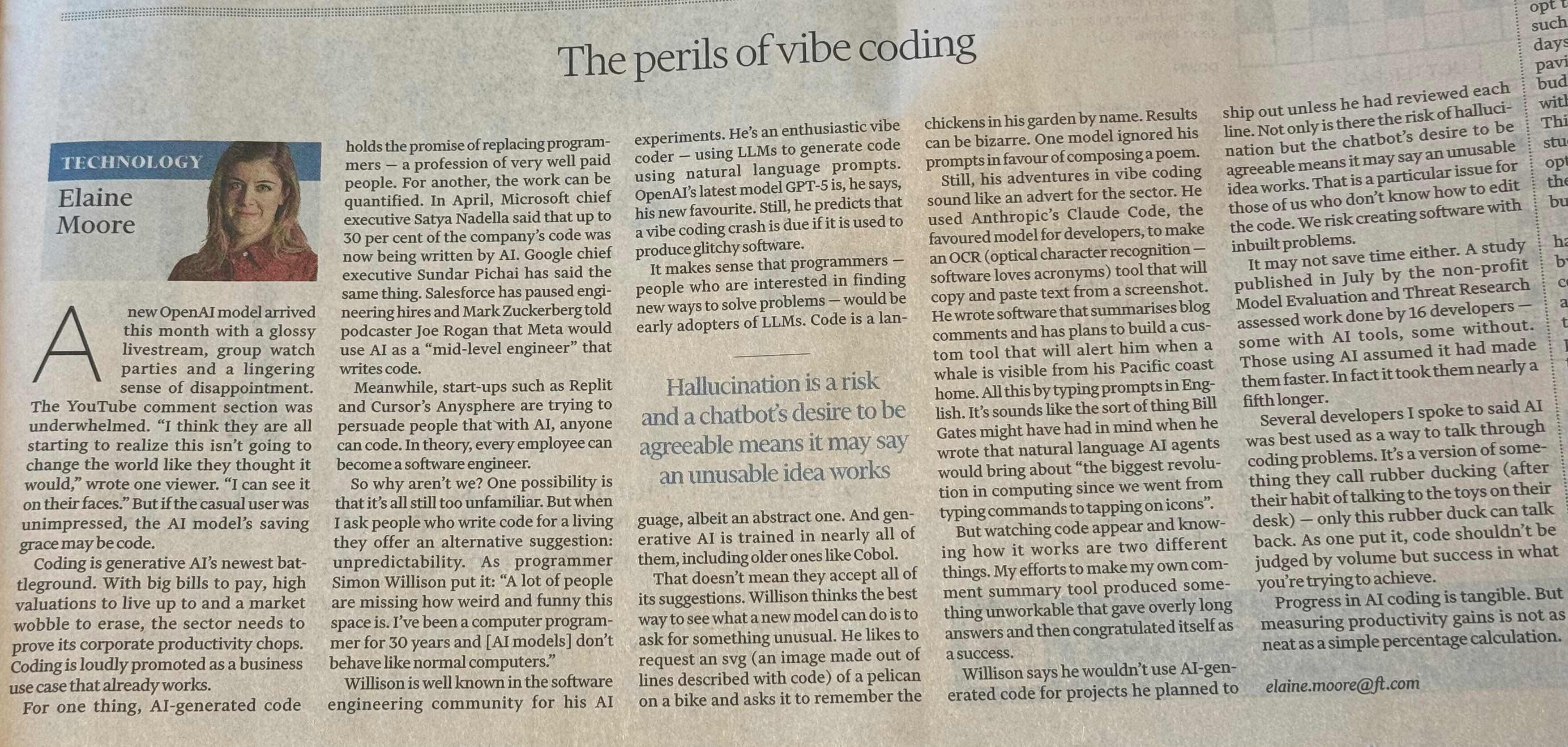
Here's a result I got https://github.com/simonw/research/blob/main/deepseek-ocr-nv... - against this image: https://static.simonwillison.net/static/2025/ft.jpeg
Thanks for running the test quickly!
How do you get the "as root" part of that to work?
(sorry if it's explained in your article)
IS_SANDBOX=1 claude --dangerously-skip-permissions >先天下之忧而忧
Google translated this to "Worry about the world first" while Bing says "Worry before the worries of the world."
Can anyone shed some light on this saying or why it's in the article?
Both translations don't catch the meaning well though. It means: "worry before the rest of the world (notice that they have something to) worry." The next part is 後天下之樂而樂("be happy only after the rest of the world is happy.")
I don't know why it's a prompt example.
后天下之乐而乐
which one is correct?
> 先天下之忧而忧,后天下之乐而乐
> (put the world's worries before yours, and put your happiness after the world's) > edit: this translation is wrong, and raincole has a definitely better translation
Since the model is a language model, they probably use this to demonstrate the model's language capabilities – the model should be able to complete the whole sentence pair. The paper also mentions this:
> To ensure the model’s language capabilities, we introduced 10% of in-house text-only pretrain data.
So I believe it is just a text-only demonstration.
- the OmniAI benchmark is bad
- Instead check OmniDocBench[1] out
- Mistral OCR is far far behind most Open Source OCR models and even further behind then Gemini
- End to End OCR is still extremely tricky
- composed pipelines work better (layout detection -> reading order -> OCR every element)
- complex table parsing is still extremely difficult
According to Omni OCR benchmark, Omni OCR is the best OCR. I am sure you all will find no issues with these findings.
our solution so far has been to stick to using tesseract with good clean-up routines and then augmenting/fixing-up the output using the VLM OCR text where we don't have structured source document data available
it could be that we just have a very niche use-case and it doesn't matter to most people, I'm sure if you just want a text dump or restructured markdown/html representation of documents these VLMs work well but the number of articles & comments I've seen claiming that these models have 'solved' OCR just seems counter to our experiences
It seems to me though if one is building a modern application that needs to get image segmentation and/or text recognition right there are better APIs available than natural language? It seems like a lot of effort to make a production-scale CV application to weigh it down with all of an LLM’s shortcomings. Not a field I’m familiar with but I would assume that this doesn’t produce state of the art results—that would change the analysis.
With this LLM approach you can at least create your training data from the raw images with natural language.
It's very hard to guess from the github and paper. For example, there is OCR in the title but the abstract and readme.md talk about context compression for LLMs, which I find confusing. Somebody care to explain the link and provide some high-level context?
But under the hood, the image will have to be transformed into features / embeddings before it can be decoded into text. Suppose that the image gets processed into 100 “image tokens”, which are subsequently decoded into 1000 “text tokens”.
Now forget that we are even talking about images or OCR. If you look at just the decoding process, you find that we were able to compress the output into a 10x smaller representation.
The implication for LLMs is that we don’t need 1000 tokens and 1000 token embeddings to produce the 1001st token, if we can figure out how to compress them into a 10x smaller latent representation first.
Correct?
TLDR: It's MIT licensed
Literally says MIT license on the right sidebar and in the readme tab and in the file called LICENSE
I use ocrmypdf (which uses Tesseract). Runs locally and is absolutely fantastic. https://ocrmypdf.readthedocs.io/en/latest/
Edit: Oh I see the paper abstract says this explicitly: "In production, DeepSeek-OCR can generate training data for LLMs/VLMs at a scale of 200k+ pages per day (a single A100-40G)". This is just part of the training data ingestion pipeline for their real models. Explains why the architecture is not using all of their latest tricks: it's already good enough for their use case and it's not the main focus.
Would be awesome if DeepSeek OCR could be integrated into a mobile app someday. That’d make OCR way more convenient!
The Visual Word Form Area (VWFA) on the left side of the brain is where the visual representation of words is transformed to something more meaningful to the organism.
https://en.wikipedia.org/wiki/Visual_word_form_area
The DeepSeek-OCR encoding (rather than simple text encoding) appears analogous to what occurs in the VWFA.
This model may not only be more powerful than text-based LLMs but may open the curtain of ignorance that has stymied our understanding of how language works and ergo how we think, what intelligence is precisely, etc.
Kudos to the authors: Haoran Wei, Yaofeng Sun, Yukun Li. You may have tripped over the Rosetta Stone of intelligence itself! Bravo!
We tend to think in images rather than plaintext, and here we are discovering it's more efficient for a computer to do so as well.
This is indeed amazing. It's actually how human try to understand and remember things. BY VISUAL! And when memory fade out, the image are getting blurred.
Not sure if those close source multimodal models are already using this method.
In my work we do a lot of stuff with image understanding and captioning (not OCR). There object identification and description works great, since all the models are using a CLIP like visual backbone. But it falls apart when you ask about nuances like left/right or counting (reasoning kind of improves the latter but it’s too expensive to matter IMO).
For our tasks, it’s clear that there’s more fundamental research that needs to be done on vision understanding to push past CLIP. That would really improve LLMs for our usecases.
Curious if there’s something similar going on for OCR in the vision encoder that’s fundamentally holding it back.
I’ve been exploring Git activity analysis recently and ran into similar trade-offs: how do you tokenize real-world code and avoid counting noise?
Say I only care about reading serial numbers from photos in a manufacturing process, not whole document parsing. Using a 3B param model to do this seems like a bit of overkill...
disclaimer: I do not work for tensorlake—but i know the folks behind it.
This approach reduces token usage significantly, making it particularly beneficial for industries like finance, healthcare, and legal sectors. For a comprehensive guide on implementing and utilizing DeepSeek-OCR, you can check https://deepseeksguides.com/deepseek-ocr-guide/
So close but it should be 2025/X/XX as "X" = 10 in Roman Numerals /s
Jokes aside, this is really neat and I'm looking forward to getting this running. For most OCR-type stuff I just use AWS Textract since I need it so rarely and that service does a decent job. I really like how well this model seems to extract images/figures as well from the original document.