I wouldn’t expect parity with an M4 machine, but it doesn’t seem unreasonable to think they should be competitive with the much older M1.
I have the same complaint with Lenovo (I usually buy ThinkPads). Where are the fast, fanless, hidpi, long battery life laptops?
Kind of unreasonable. I mean which Intel or AMD cpu can be run fanless and perform well?
On the topic of displays, my understanding is that they "kind of use what they can get". That's how there can be a 13 display with rounded corners in a straight edge case.
What you're asking are the things I'm looking for, though still every time I go into their forum I see enough thermal, fan noise issues and AMD firmware bugs, that I'm still on the fence on buying one.
I wish them luck with the 12, for me sounds like a model for "true believers" because it doesn't seem to compete well enough with run of the mill chromebooks (or an Air) that are more established in the students segment.
What that really determines is multi-thread performance. Fanless laptop that can dissipate the power of one core? No problem. Fanless laptop that can dissipate the power of all the cores? For that you have to lower the clock speed quite a bit. Which is why you see AMD chips on older TSMC process nodes getting better multithread performance than Apple's fanless ones.
The cost/benefit ratio of adding a fan is extremely attractive. The alternative way of doing it is to add more cores. If you have 8 fanless cores at 2 GHz, how do you improve multi-thread performance by 50%? Option one, clock them at 3 GHz, but now you need a fan; cost of fan ~$5. Option two, get 16 cores and cap them at 1.5 GHz to fit in the same power envelope, but now you need twice as much silicon, cost of twice as many cores $500+.
The number of people who pick the second option given that trade off is so small that hardly anybody even bothers to offer it.
Apple continues to do it because a) then they get to claim "see, they can't do this?" even when hardly anybody chooses that given the option, and b) then if you actually want the higher performance one from them, you're paying hundreds of dollars extra for more cores instead of $5 extra for the same one but with a fan in it.
Depends on your metric. A fan makes noise, attracts dirt that needs cleaning, needs more space ...
I really love my fanless devices, even though they never will reach the speed of activly cooled ones.
The number of manufacturers or the number of people? Apple was on the path to laptop irrelevancy before the M series, it doesn't seem clear to me at all that people don't care about noise and heat along with performance.
Anecdotal, obviously, but disabling Turbo-Core [0] on my AMD Framework 13 stopped all of my fan noise and heat complaints, with no noticeable performance impacts. It went from being so loud that my wife on the other side of the room would ask if my computer was okay to quieter than my ThinkPad, and from noticeably hot to just slightly warm.
Kind of ridiculous that it takes messing with an obscure system file to resolve it, but not any more ridiculous than issues I've had with other brands.
[0] It's `echo 0 > /sys/devices/system/cpu/cpufreq/boost` or something like that, and `echo 1` to turn it back on when you want that extra performance.
The problem is that manufacturers don't put much thought into building good cooling systems.
Lenovo, for instance, has so many SKUs that it's really random. A few are great, but some sound like a hairdyer or rev up too aggressively.
Apple gets this. By having a small product line, they usually polish all those details.
For example, AMD Ryzen 7 8840U or 7840U can be configured for the same 15W TDP as Apple M1. At 15W, the overall performance going to be about the same as M1.
Lunar Lake.
I don't follow CPU news and have no idea what lake they're at now, but I'd be surprised if Intel and AMD didn't have a chip competitive with an M1 by now.
When I google "fanless amd intel laptop cpu" I find this old thread https://news.ycombinator.com/item?id=31142209 which does suggest some fanless machines exist. That's from 3 years ago so surely there are even more options today, no?
You'll have to wait for Framework to offer a Snapdragon instead of Intel/AMD but they haven't announced anything yet.
It pretty much has that though? 1920x1200 at 12.2" is 185.59 PPI. Standard DPI (PPI) is 96. HiDPI to my knowledge isn't properly defined, but the usual convention is either double that or just more than that - the latter criteria this display definitely clears, and the former (192 PPI) is super super close, to the extent that I'd call it cleared for sure.
It's pretty hard to not clear at least the latter criteria on a laptop anyways. You'd see that on 720p and 768p units from like a decade or two ago.
186ppi is designed for 1.5×, an uncomfortable space that makes perfection difficult-to-impossible, yet seems to have become unreasonably popular, given how poorly everything but Windows tends to handle it. (Microsoft have always had real fractional scaling; Apple doesn’t support it at all, downsampling; X11 is a total mess; Wayland is finally getting decent fractional scaling.)
Apple's HiDPI is "2x scaled" on Retina and >= 4k displays. But you can still pick a virtual resolution that isn't exactly 0.5x your display's native resolution, and it will look great.
For example my external monitor is 3840x2160, and has a default virtual resolution of "1920x1080", but I run it at "2304x1296". My 14" MBP display has a default virtual resolution of "1512x982", but I run it at "1352x878". Neither looks scaled, neither has a slow display, weird fonts or weird graphics. I never even really think about it. In other words, light years beyond the experience on Ubuntu and on Windows.
1.5x looks ok mostly (though fractional pixels can cause issues in a few circumstances), but across platforms nothing is handled as well as 2x, 3x, etc is. I have a 1.5x laptop and wish it were either 1x or 2x.
This might sound like a nitpick but I really don't mean it to be. These are proper well defined concepts and terms, so let's use them.
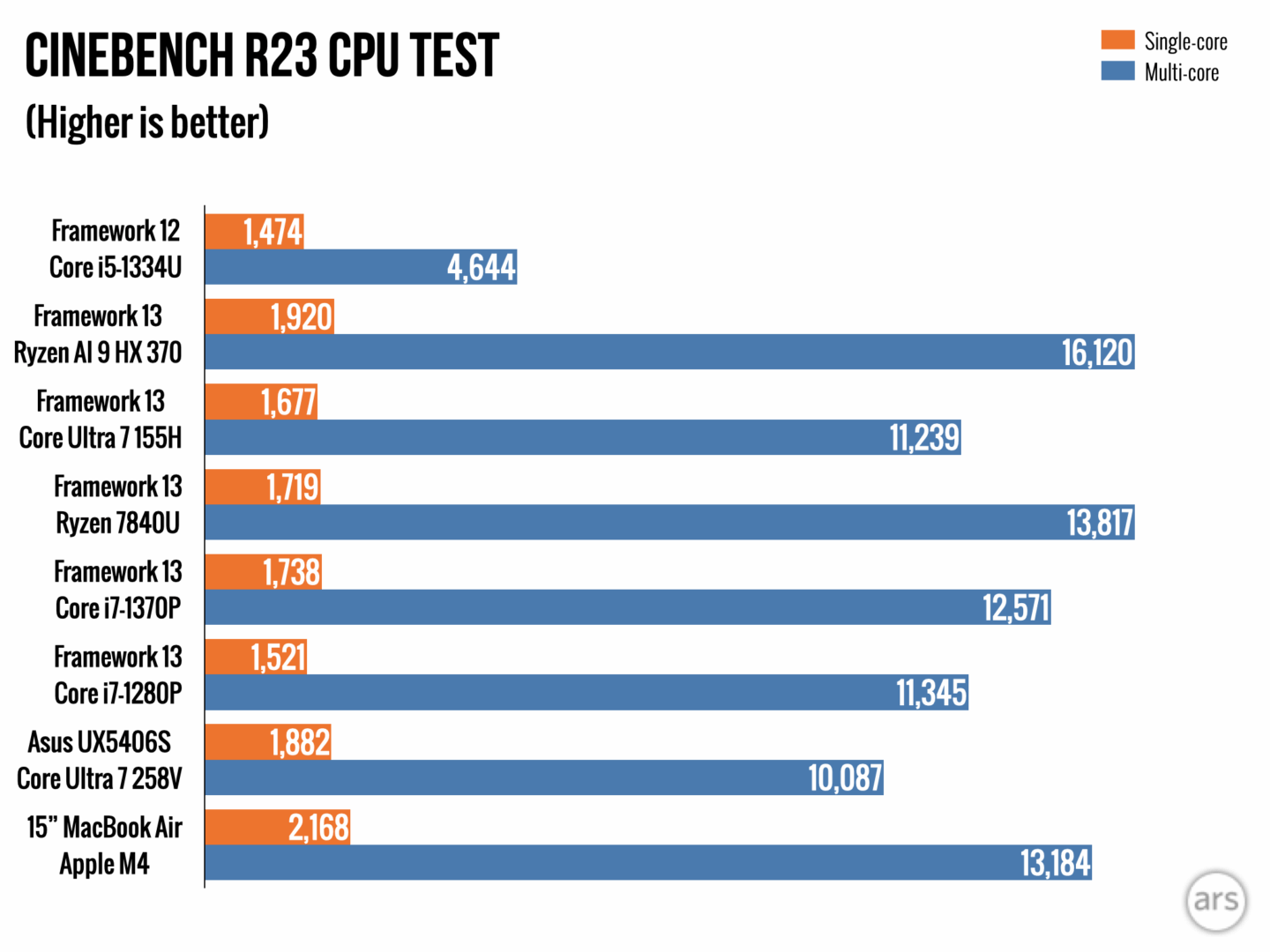
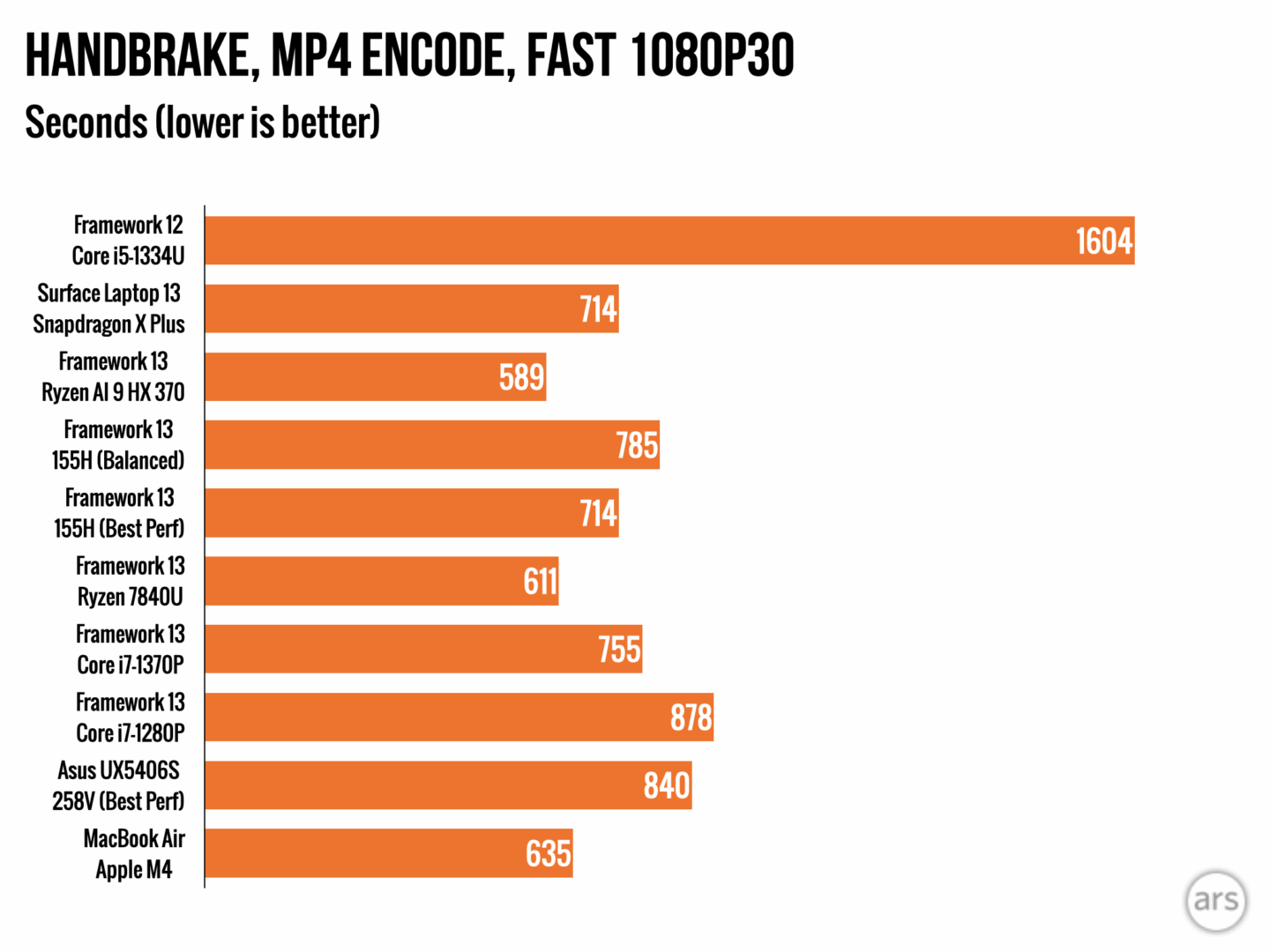
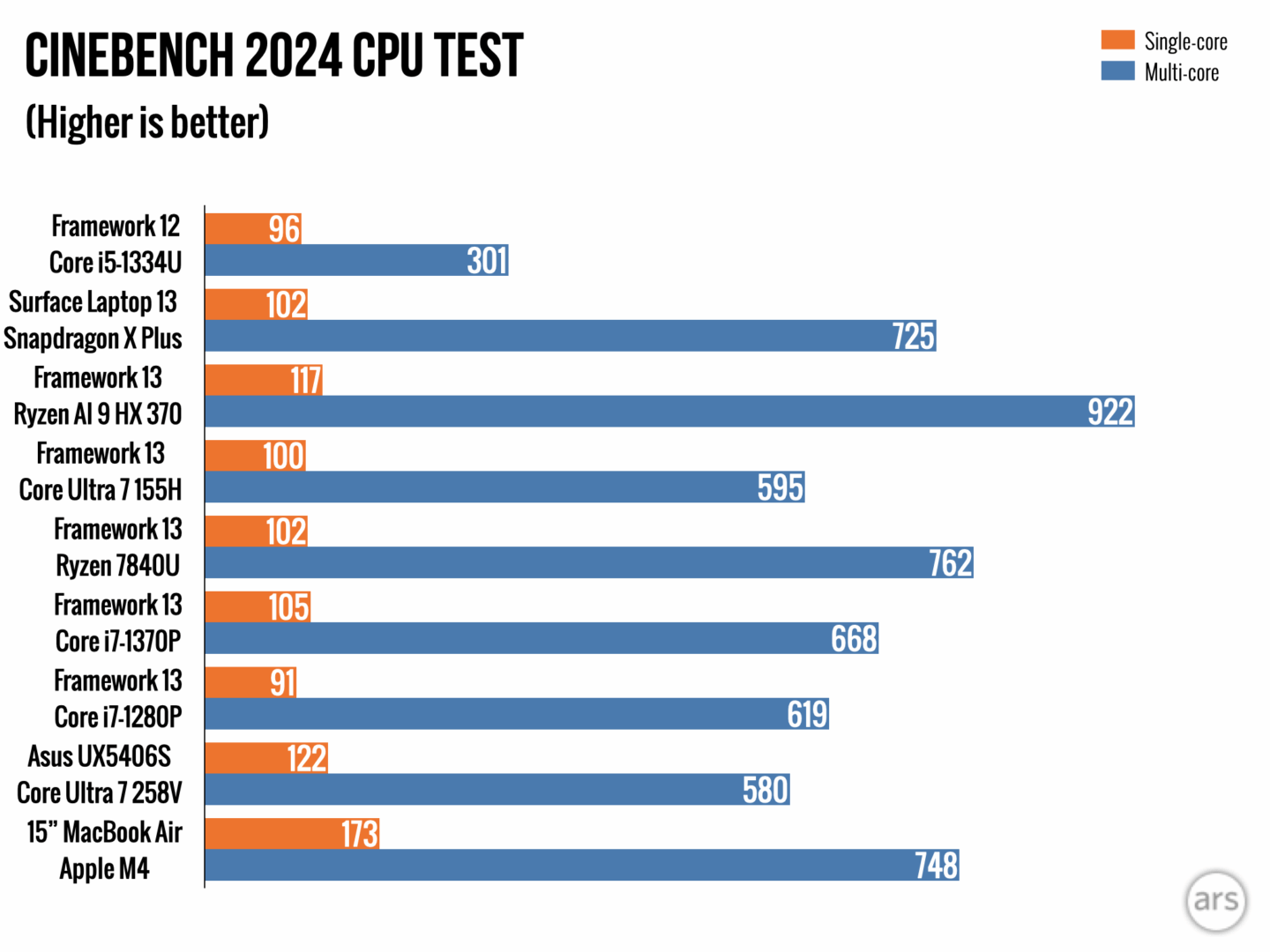
The article shows a few charts where a Framework laptop is faster than M4 Air both in single and multicore CPU benchmarks.
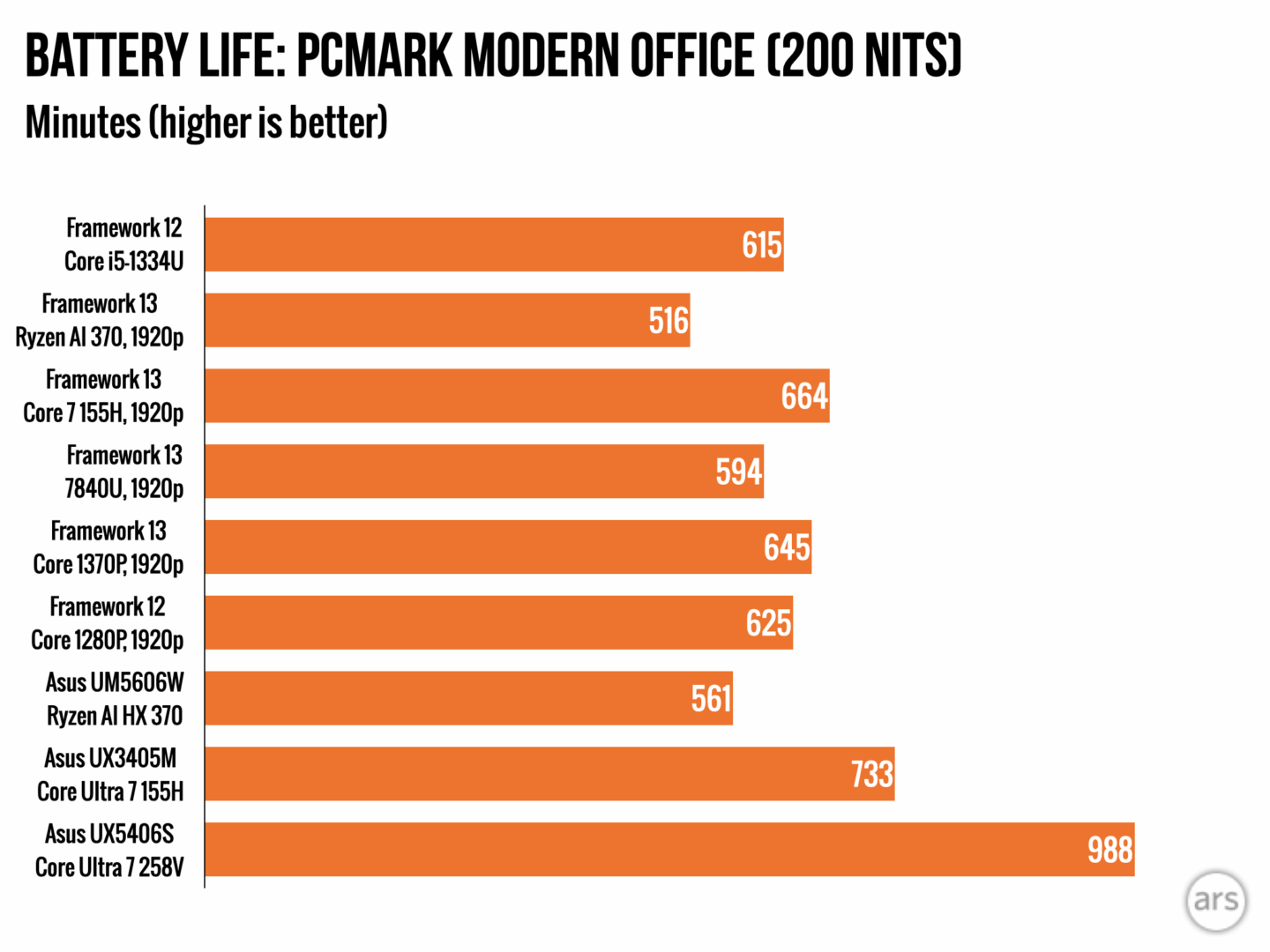
Their office suite benchmarks puts it at almost 10 hour battery.
See Framework 13 Ryzen AI 9 HX 370.
To me, being able to run native Linux alone is worth its weight in gold, even if it was slower.
Every single chart in the article showed the M4 MacBook Air beating the Framework 12 by a large margin.
I don't know what charts you were looking at.
That the Framework 12 is not extremely lagging behind the M4 (subjective comparison) might lead one to believe that it would be competitive with an five year old M1 Air. Taking a quick look at "Cinebench R23" from 2020 [0], Macbook Air M1 comes in at 1,520 and 7,804, which compares favorably to 2025's "Cinebench R23" in which the Framework 12's i5-1334U scores 1,474 and 4,644.
The answer is it isn't competitive performance-wise. Given the M1 seems to have some native Linux support through Ashai, the Framework's advantages over the 5 year old MBA M1 seem to be user accessible hardware changes, touchscreen and longer hinge throw.
0. https://arstechnica.com/gadgets/2020/11/hands-on-with-the-ap...
https://cdn.arstechnica.net/wp-content/uploads/2025/06/Frame...
https://cdn.arstechnica.net/wp-content/uploads/2025/06/Frame...
https://cdn.arstechnica.net/wp-content/uploads/2025/06/Frame...
And for battery life:
https://cdn.arstechnica.net/wp-content/uploads/2025/06/Frame...
I’m searching for a new laptop, I want unix, so either linux or macos. I was looking at framework, system76, tuxedo and slimbooks, and mac air. I want an ANSI keyboard, which seems an oddity in Europe (there is English iso, which viscerally hate)
If you want thunderbolt ports, and some good specs, mac air is cheaper. And I’ve heard with arm processors you can tun linux at almost native speeds… I’m almost decided for Mac Air…
If somebody wants to add something to make me change my mind, you are more than welcome.
BTW I’m replacing a 2016 Macbook pro, which was buggy as hell, and I learned to really hate it. Also I’m not a fan of MacOs… but !4$ I cannot beat it.
In a lot of ways it's better than the M2 max macbook pro I had before (better screen for one). It was also, uh, 1/6th the price.
Thanks. I will search in that direction.
I don’t get these comments in general, sure the MacBook is much better, and I use one as well. I still prefer native Linux on my machine sometimes and the Aura is probably the best Linux laptop I ever owned.
And M1 laptops are what about three years from the vintage list? They'll be e-waste at the end of this decade even while other laptops fail to match it.
If PC vendors can’t match some important specs from multiple years ago on an Apple laptop, isn’t that kind of a problem?
Sure you can get a faster laptop than an M1. But can you get one that’s faster and silent at all times?
You can get a bigger battery. Or screen or whatever. But all those trade off some other desirable quality.
Has anyone matched the full package? Speed + size + weight + battery life + noise + specs?
Shouldn’t framework be able to match that, especially if you’re willing to give some on the weight or cost? If not, why?
Does the Thinkpad X1 Carbon Gen 13 Aura Edition not meet these requirements? (It does have a fan but runs fairly cool according to reviews.)
This is the one undisputed example though where we can put a definitive number on it. So far Apple is 4 years ahead of their competition on this very particular metric (High performance, low energy, fanless CPU)
It isn't all that high performance compared to other laptops, but sure.. fanless and low power it has. I just would rather plug in a laptop to get my workload done in 1/2 of the time it would take on an M1 laptop.
The Dell laptop we got runs at 55W (Intel Core i9-13900HX) and is faster than the M1 Ultra 20-core at 60 Watts, which you can't even get in a laptop format. The benchmarks don't lie. That intel CPU is as fast as the fastest M4 16-core CPU, and the M4 runs at 90W (so far as I can tell from a google search).
>Guessing you're in the "not at all, it's all PR bullshit" camp, which is fine.
I'm guessing you're in the "reality distortion field" camp. Nevermind, I know you are.
"Repairable" is a bit of a fool's errand. It really hinges on availability of spare parts, supply chain, etc. They will never sell enough of this niche product to nerds to make that a long-term reality.
An old MBP is far more repairable because so many were made there will never be a shortage of parts on eBay.
While an emphasis on repairability is noble, the false prophet of brick-like pluggable USB modules ain't it.
The newest Apple laptops all have easily replaceable ports that do not require replacing the logic board, so that novelty is even more useless.
Similarly, if I spill orange juice on a Framework, I can just buy a new keyboard and install it in a minute. If it were a Macbook, I'd probably throw away the whole thing, since I'd have to disassemble all of it to get to the keyboard, and it would take me hours, if I even managed to not break something.
So, "Macbooks are more repairable than Frameworks" is quite the take.
Or, upon spilling the juice, realize you can get a Surface Go on sale at Walmart (which this seems to be a clone of) for a bit more than a replacement keyboard and your time (which is way more than a minute) and toss it in the trash anyway.
I don't think that's the case - there are plenty of people who realise that eWaste is a problem, and I've lost count of the number of times I've been asked why a laptop can't just have a "new CPU" fitted to speed it up when everything else works. In reality this means a new system board, but Framework does this.
>An old MBP is far more repairable because so many were made there will never be a shortage of parts on eBay.
That's not comparing like with like. I've done a -lot- of fixing of old (2012-era) macbooks and secondhand parts are always a crap shoot. Plus there are lots of minor changes between otherwise identical-looking parts which mean they don't fit (such as the higher-DPI screen connector between 2011 and 2012 for otherwise identical-looking parts which are indistinguishable until it doesn't quite fit.
>While an emphasis on repairability is noble, the false prophet of brick-like pluggable USB modules ain't it.
That's adaptability and means you can get the IO you need. The computer could be entirely non-repairable and have this, or it could be framework where everything is available brand new as a spare part if you need it.
>The newest Apple laptops all have easily replaceable ports that do not require replacing the logic board, so that novelty is even more useless.
I think you might be misinformed here. Lots of stuff is now serial locked and won't work even if you swap it over. And that's not counting some of the terrible low-level engineering stuff which people like Louis Rossman highlight (such as placement of higher-voltage lines right next to direct-to-cpu lines in display connectors). And I'm sure you know about the simple voltage controller that fails that Apple won't allow the original supplier to sell to anyone else.
Even replacing the battery in my 2022 MBP (which I'm using now and absolutely love) would be a trial compared to the framework. One of the USB ports has always been dicky and I've just left it as is precisely because this is a can of worms.
Watch some dosdude1 repair videos of examples of how much work and skill is needed to do something such as upgrade the storage in a MBP/Air. And compare this to the framework. They are several orders of magnitude different in terms of skill level.
Also, on a Mac if the memory or storage dies, you need to replace the whole motherboard, that isn't true in a Framework laptop. You can't even say that those parts will be difficult to get in the future because they're off the shelf parts.
I will not even start on the fact that replacing other parts that commonly break in a laptop like the screen or the keyboard are hard to do in a MacBook (needs to disassemble almost the whole laptop) vs doing it in Framework that is much easier and probably takes 20 minutes even without experience.
Where "value" is purely monetary, I think that pretty succinctly sums up my experience/views on the Framework product line.
They make good laptops, but you can generally get more for fewer dollars. If you're shopping on price, you can probably just skip right over their entire product line.
That doesn't mean that their offering doesn't have value. It has value has a vote with your wallet for sustainable, repairable products. It has value as an easily repairable and customizable laptop. It has value in some esoteric use cases it can be customized into (e.g., 4xM.2 NVME slots).
Would love to see some reviews just get this out of the way up front and spend more words on the product itself.
Personally, I'm glad there's a company out there serving a market niche besides being the lowest cost, most value-engineered product. I don't mind paying a bit extra for that in exchange for the other value I get out of it.
(And all that said--at the high end specs their prices get a fair bit more competitive. The price to upgrade a laptop from 16GB -> 128GB on Dell's site is _more than an entire FW16 w/ Ryzen 9 + 96GB RAM_.)
As an example, I recently bought a car, and went with a small crossover SUV because I wanted something that could handle light off-road duties on the weekend. One of the reviews deducted points because the car's clearance was too high and it meant the car didn't hug the road. The clearance is the point of that car. The manufacturer literally took one of their other models, raised it an extra 9cm, and stuck some minor cosmetic bits on.
In the same way, nobody buys a Framework laptop because it's competitive on price. This review does acknowledge that, sort of, but I think it discounts that someone might not be able to afford a Laptop 13 but might still pay a small premium for a Laptop 12 because they like the ethos or they benefit from the customisable design.
Is that group a bit enough niche for profitability? I'm not sure, but I think the review should either directly ask that question or put it to the side.
How many times have I thought, maybe i should get 2tb just in case, and then end up using 500gb. With framework, I'll buy the 1TB and the cost to upgrade is very low if I ever need to.
Same thing with memory. Maybe i need 16, maybe 32, maybe 64. I tend to buy more than i need out of fear. I just don't have that fear with framework.
Oh, and don't even get me started with repairs. If my screen breaks, i know the time to fix is however long their shipping lead time is, since the repair itself will take me 15 minutes.
In general, i think that value depends on how you see a computer. $1000-2000 is a lot to spend on something you use for fun. It's really not much to spend on something you use every day for work. And it's even less if your company is paying.
I'd kill for a fully transparent phone or laptop shell.
I'd pay $1000 more for this aesthetic. Double if it's in the florescent neon colors of 90's /00's Nintendo / Apple designs.
I love the idea of Framework, but the upgradability seems questionable to me. I base this off my experience with desktops where I've rarely over the decades upgraded more than the hard drive and RAM. When I'm looking at upgrading the motherboard it seems I just end up going all the way and getting a new case/ps/etc at the same time. Maybe that's just me though?
If you're a Framework customer it's not entirely unlikely you buy a case for your older mobo and now you have a power efficient home-server (or something) at your disposal.
I'm pretty happy with the Framework 13 form factor (though, after 3 years of use, I'd still probably prefer a 16:9 or 16:10 screen over the weird 3:2 they ship with), and absent any future catastrophic damage to it, I don't see a reason to replace the chassis.
And I've already upgraded a few things in it: I have a newer mainboard (well, to be fair, I got it due to a warranty repair where they decided it was cheaper for them to upgrade me to the 2023 model), and I upgraded the built-in speakers and the webcam. I'm thinking about upgrading the screen as well at some point. In two years I'll probably replace the mainboard and RAM (not that I want to replace the RAM, but I have DDR4 now, and I'll presumably need DDR5).
I haven't checked those %s but just using them notionally.
I'm curious if you have a different experience where you ditch a laptop after less than 3 years because a single part has broken as you imply.
Also, while I can repair laptops myself, I for sure don't want to.
For me cheap storage is the only sell and even that I can mitigate with tiny flush external SSD stick and/or NAS.
Framework has released fairly consistent upgrades for the Framework 13, but there's no guarantee that they will continue to do so, will release upgrades for the Framework 16, etc.
I think in a few years when they've been in business for closer to a decade than not and released updates across the whole product line, it'd be pretty hard for anyone to make an argument that that _shouldn't_ be factored in.
Also being the most Linux friendly laptop also means they have very long update lifespans and being well built tend not to break…though there are plenty of repair parts and spares.
One could even allow other manufacturers to offer parts and do certification for a fee.
It should be possible to push down prices and make update paths more appealing.
https://community.frame.work/t/community-market-category/522...
Sure, I might have spent a few hundred more on my Framework 13 back in 2022, but if I'd bought a Dell XPS 13 instead, I probably would be fully replacing it with a new machine in 2026 or 2027. But with the Framework, I'll instead only buy a new mainboard and RAM. My "next laptop" will cost ~$1000 for the same specs as something that would cost ~$2000.
So sure, it's going to take me a bit longer to realize the savings, but there still will be savings, and I appreciate the sustainability aspects too.
The author of the fine article’s strategy of used Thinkpads is more sustainable because reuse is among the most sustainable practices and there is an abundance of Thinkpad repair parts and spares machines.
Of course, Thinkpads are not terribly upgradable. But upgrading is often the opposite of sustainable…in many cases CPU’s, etc. are fast-fashionesque.
If they stop delivering, ill not buy their next thing, and ill be sad.
Here is the “ugly” part of the Ars summary (as in good/bad/ugly):
It's just too expensive for what it is. It looks and feels like a lower-cost laptop, but without a dramatically lower price than the nicer, faster Framework 13.
But, the premium paid is high. And, their warranty support was, in my opinion, not a good experience. The expansion cards, which are just USB dongles internal to the computer, are gimmicky and waste space that could be used for something useful, like a slot for a second SSD, or larger battery.
I ended up sending back the Framework 13, I recently purchased, because of the warranty support experience for a mechanical issue with a single expansion card (usb dongle). Framework support had me jump through hoops for a week, repeating tests, asking me to answer the same questions again and again, and finally, "now do everything again and make a video and upload it to youtube" [actual request from Framework]. All for a part that retails for $9. The experience spooked me, and I sent back the laptop for a refund during the 30 day return window.
The Dell I replaced it with has an inferior screen*, a slightly inferior keyboard, vastly inferior CPU cooling (the Dell thermal throttles under heavy load), but Dell was half the price, and it arrived at my door 8 hours after I ordered it. And, unless things have changed, Dell warranty support was always excellent.
Hopefully Framework fixes the issues with their warranty support process. I hope they succeed.
* Dim screen on Dell mitigated by using the money I saved on the laptop price, to buy a portable 13" e-ink monitor which is vastly superior to the Framework display when working outdoors.
Other Brands Notebooks are not upgradable, not repairable and the most frustrating part are the batteries - which framework offers an original replacement for.
"Modern" office notebooks don't have to be that powerful. I'm still using a T480s which will only render unusable as soon as the battery dies with no <100 bucks replacement parts available.
I think buying a framework is an investment for people planning to keep the device for 5+ years and/or want to support the right to repair movement.
I'm really suprised and impressed they managed to ship such a great device and keep their promises for so long even if it is not the besteht bang for the buck (short term). Keep up the great work.
Beyond practical repairability and sustainability, I appreciate the possibility of swapping out a mainboard for another with a completely different arch
[0] https://frame.work/products/deep-computing-risc-v-mainboard
[1] https://store.deepcomputing.io/products/dc-roma-risc-v-mainb...
And the upgradable internals sound like more of a hassle than a benefit - especially since buying a different device will be cheaper and probably a better experience since they don't have to engineer for replaceability.
Theoretically you'd get the option to plug in stuff not available in other laptops like strix halo - but then they still don't offer that in laptops. So meh.
My work laptop (Fedora Linux, Dell XPS)is over 5 years old. I haven’t bothered to replace it, but will next year just because. The old one will become a retro gaming device for the kids.
And upgrading laptop components after 5 years just doesn't sound like a good value proposition.
sigh.
How about in five years from now when all of that is still fine, but you just want to replace the mainboard.
What about when framework comes out with upgrades down the line? The great thing is because they’re so modular you can just buy that and slap it in without having to buy an entirely new machine.
That’s the appeal
Some of the business lines are better, but the ultrabook styles that Framework is competing with can be pretty difficult to work on because the internals are so optimized for performance in a small space. The big manufacturers also tend to change the internals enough between models/versions, that if you want to fully gut and swap the insides, or maybe just replace the keyboard, the chassis is incompatible. Framework is designed to service over a longer period of time.
There is a tradeoff, because the super-optimized layouts of the big manufacturers are often superior. But for me at least, the Framework is good enough, and when I do need to make changes, it's a better experience. I'm also voting with my wallet for the change I want to see, even though the cost is probably a slightly worse laptop.
RAM, SSD, and battery are also the very minimum in terms of serviceability on a laptop, they've been traditionally user-serviceable. It's components like the touchpad, display, ribbon cables, etc. that haven't been traditionally easy/possible to replace.
I really don't like this design though where the left/right keys are full size (or other designs where they put things like page up/down buttons above the left and right buttons). I don't mind that the arrow keys are a squished inverted T shape, but I really do think they should get to be an inverted T shape. When I do want to use arrow keys, I want to be able to easily locate them by touch without looking down at the keyboard.
Sharing the arrows w/ Home/End is awful, though. I don't know how anybody could live with having to use a modifier key to get those. I already combine modifiers with Home/End a ton. Having to add 3rd modifier (Ctrl-Shift-Fn-Left) to get "select from here to the top/bottom" sounds like painful hand gymnastics.
(Yes, I could map this elsewhere, but I use too many different machines.)
[1] https://en.wikipedia.org/wiki/Fn_key#Fn_and_Control_key_plac...
[2] https://en.wikipedia.org/wiki/ISO/IEC_9995#Function_keys
To me, it makes no sense to me to make less-reachable the key that gets used the most. To reach the current CTRL key, I have to bend and twist my hand so that the pinky finger can reach the CTRL key. I never use the CAPS LOCK key, which is sitting under and adjacent to where the pinky rests.
Ctrl | Fn | windows | alt
Which matches what one should expect from a desktop keyboard (Ctrl is the left-most key)
... as long as the keyboard has the proper layout, with ctrl in the far bottom left. One thing that Apple gets wrong and this keyboard gets right.
Memory used by various apps:
docker VM take 8Gb for simple supabase images
Firefox take 5-8GB
BasedPyRight takes 2GB
Nextjs server takes 2GB
Web development has devolved to the point where now you need 32 GB to view a Chinese take-out menu.
If you use Linux, then you're not stuck pre-dedicating a big block of RAM to a VM to run docker in, you're just using whatever the container is using.
Install htop/btop and be more conscious about what your machine is actually doing. Needing more than 32GB RAM to develop a website is absurd
If so my best advice is to not use Docker for day-to-day development; reverse-engineer the docker-compose.yml/etc and run what you'd run in containers locally.
As a web developer I've been getting away with doing this for almost a decade now. It's a one-time cost to review what containers the app needs and then map that to a native world (install Postgres/etc via homebrew, adjust the env vars, etc).
The only time I run Docker nowadays is when I actually need to work on the Dockerfile itself and need to test it locally.
> the Laptop 12 can only fit a single DDR5 RAM slot, which reduces memory bandwidth and limits your RAM capacity to 48GB
According to this post from a Framework team member, a single 64GB SODIMM will work too and just didn't exist yet at the time Intel wrote the 13th Gen spec, so they only advertize 48GB: https://community.frame.work/t/64gb-ram-for-framework-12-sin...
> Old, slow chip isn't really suitable for light gaming
I wish the reviewer would specify what phrases like “light gaming” mean to them. My FW12 is in a later batch that won't ship for a few more months, but I'm coming from a ThinkPad T470s where I already do “light gaming” (mostly TBoI Repentence and Team Fortress 2 with mastercomfig medium-low). I can't imagine the 13th Gen graphics would be worse in that regard than my old laptop's 7th Gen.
Not having Thunderbolt seemed like kind of a bummer to me too, but then again my T470s has it and I can't think of a single time I ever actually used it for anything. I tried one of those external GPU enclosures once, and it was kinda cool just to see that such a thing was possible, but I've never been one to want to tether a laptop with a thicc cable lol
The system requirements for TF2 are 1GB RAM, a single-core 1.7GHz CPU and a graphics card with 64 MB of VRAM [1] - the game is 18 years old.
If a review told me a laptop exceeded those specs, it wouldn't tell me much :)
Even these feel a little suspect (minimum Intel HD Graphics 3000? no way) since I had to do some tweaking to avoid my framerate tanking on Intel 7th Gen iGPU when playing the PvE mode (Mann vs Machine, waves of robots on the other team far larger than any PvP match would ever be), and/or when other players use cosmetics or weapons with flashy particle effects:
https://developer.valvesoftware.com/wiki/Team_Fortress_2/Par...
https://developer.valvesoftware.com/wiki/Team_Fortress_2/Par...
Since we're in plastic/budget territory, is it absurd to consider a color matching sticker/wrap over the basic modules?
Wait, are 64GB DDR5 SODIMMs finally out? I’ve been monitoring that for ages but almost lost hope.
Just about all of them had some kind of issue, which is really fun when your PM has a USB port not work randomly.
Ended up going back to HP laptops, 30% cheaper for the same specs and they just work consistently.
Would love to hear a hobbyist perspective, Frameworks are not a good choice for a business but I would be interested to hear if the replaceable parts / ports provided value for someone. My gut feeling is that something that can't be replaced easily in the Frameworks will die and it'll just end up being cheaper to replace the whole laptop.
After nearly two years (two years!) of back and forth with support, including a mainboard replacement that didn't fix the problem, they finally upgraded me to the 13th-gen Intel mainboard, and the problems immediately went away.
Right now I'm struggling with a keyboard issue; a few of the keys intermittently don't register presses. I have a new keyboard that I ordered that I hope will fix the problem, and need to install, just haven't gotten to it. (I'm not sure if this is a result of a defect, or of one of my cats walking on the keyboard and possibly damaging it, so I'm not ready to blame Framework for this one.)
Aside from that, I haven't had driver issues, random crashes, or any problems with the USB ports. But I assume you're talking about Windows; I use Linux, so that's not an apples-to-apples comparison.
> My gut feeling is that something that can't be replaced easily in the Frameworks will die and it'll just end up being cheaper to replace the whole laptop.
The mainboard is of course the most expensive part, but it's still gong to be cheaper to replace it than the entire laptop. I don't believe there are any available replacement parts to the laptop that cost more than the full cost of the laptop.
I don't really think it's tremendous value if you're purely talking about laptop per dollar. I probably could've bought two similarly performant laptops for the amount I've spent on the Framework over the years, maybe two and a half. But it is incredible peace of mind to know that the same machine I already have will keep working even if some part of it breaks, I don't have to worry about reinstalling or losing anything or losing the stickers I have on the thing or whatever else. The old mainboard I upgraded from is now a home server with a nice 3D printed case. There's way less e-waste, one thing going wrong doesn't make the whole device a brick. And there is just a genuinely enjoyable novelty to how easy it is to take apart.
It's a hobbyist device through and through. It's for people who like using desktop Linux, because they feel empowered by being able to fix their problems, with the occasional side effect that sometimes they'll have to.
I want to love framework, but their prices just don’t justify the switch for most people.
Another example, I didn't need an HDMI port anymore, and wanted an extra USB-C instead. Just a few bucks to swap with Framework, but impossible with other laptops.
I did have an issue with one of my USB ports on the Framework however. It was solved by removing the module and updating the bios firmware. Can't say I've ever had that happen with another laptop. I agree they're probably not ready for business use yet, where cost is the primary measurement.
Not saying it's perfect but it's a far cry from just swapping a module.
I currently couldn't recommend them to anyone except users (developers?) who want to run Linux specifically. Otherwise a Macbook is going to be a much better computer at a better value, or just get any boring Windows laptop provider.
Pros compared to Macbook: - Runs Linux - amd64 makes some legacy software work easier - Easy and commodity prices to get 96gb of RAM and 2tb SSD.
Macbook pros: - Massively better battery life - Snappier/faster in general usage - Much more polished than Linux
I evaluated Thinkpads as well but trying to find one with the right configuration that wasn't too expensive or worse than the Framework was pretty hard.
* https://asahilinux.org/docs/platform/feature-support/overvie...
My desktop is 11 years old. It's an i5 3.2ghz quad core, 16 GB of memory, SSD machine that I built from individual parts for ~$850 in 2014. It has been running 24/7 since then. It handles 4k and 1440p dual monitors without issues for all of my programming / video editing needs. The only thing it doesn't do is run modern games.
I only say all of that because I've never upgraded individual parts on it. Every X years I build a new machine that lasts. I've been doing that for around 20 years now. The only thing I replaced once (not this machine) was a PSU that got nuked by lightning and not having a surge protector.
Personally if I were going the laptop route I'd much rather get something 80% as fast as the framework but at half the price (or less). There's a ton of laptops in the $600 range that crush my desktop in specs. Things like a Ryzen 7 7730U (16 threads @ 4.5ghz) with 32 GB of memory, 1 TB+ SSD, reasonable display / ports etc..
Might still be worth it if they keep producing spare parts for a decade or more, every single time my laptop's battery goes dead it's a after the manufacturer has stopped production of that model entirely and it becomes impossible to buy a new one lol.
For me, they are great, and I plan to continue to support them. But not everyone is interested in the tradeoffs inherent in their philosophy, and that's also fine.
One of my mentors had the great sentence: "I dont buy laptops- they suck, because they are tailored to transport. I buy desktops- and connect them via internet to flat transportable terminals. And desktops can be upgraded, merged, reused and send to the closet as server at the EOL-"
And he was kind of right. For almost all purposes, even for gaming in a way- a remote desktop is kind of superior. Yes, stadia is dead- but for everything else- this shall do.
I do think the plunge to leveraging a desktop/server across devices does require an understanding of ssh/rdp and tailscale/reverse proxies though, which is why it isn't as popular as it could be.
I think the comment about the "transporttax" on hardware, ergonomic and cooling still holds up though even in a world where things like steam-deck exist.
Even more so, if you may have lightweight ar-headsets one day, with a glorified cellphone + mouse and keyboard.
People will pay untold thousands for a Mac, but God forbid when a PC manufacturer charges more than $599 for a laptop. If you're whining about the price, Framework isn't made for you. Go buy that Acer that you really want. The Framework is Sam Vimes' expensive boots that are made to last[1], and I've happily paid in full to get a pair.
The article compares the FL12 to laptops of the same price range, including other framework laptops to note that it falls short.
The FL12 has worse performances and battery life than an M1 Air, for more than an M4.
The point of the article is that the 12 should either be a lot less expensive or it should be a lot better. It's not whatever nonsense you're dreaming of.
Repairabilty and modularity come with tradeoffs. Not everyone is going to value those tradeoffs and therefore shouldn't buy a laptop where those are the priority. But some people do value those things, and telling them to "get a MacBook" is just silly.
To repair (or upgrade) a Framework, you buy the part and install it. That's worth something to me!
Incidentally, I also have a last-gen ThinkPad P14s Gen 5 AMD and it's a flimsy POS. Already needed a new motherboard and battery and spent three weeks sitting at the service center while they rounded up the parts. Wish I'd bought another Framework 13.
The SD card is a big bottleneck on the Pi.
In terms of phones, I largely disagree with the conventional wisdom that repairable, upgradeable, Androids are better for the environment, more cost effective for the user, etc than iPhones. It's true you can't upgrade the battery yourself, but that's a different quality from whether the battery can be upgraded. And iPhones have a much higher resale value, so they're going to end up in landfills more slowly. I personally bought and use a used iPhone 11 that came with a replaced battery, and it's great! Old iPhones have a long useful life after trade in and resale, even if people buying new models here don't see it.
So I'd love to know how much this is the case for laptops like these as well.
For example, "repairable" is useful to the extent that repairs actually need to happen, and it seems to mean "self" repairable, though again that's a different dimension from whether a service center can do it. And whether you need self repairable is not a thing about longevity, environmental impact (since repair centers suffice for that), but rather convenience and possibly price. But price isn't the factor here because the thing is so damn expensive to begin with.
"Upgradeable" is useful if you want to.... improve a piece of it but not the chassis? Screen? How necessary is this? Do people really do that? I've been happy to use a laptop for half a decade or more, until finally upgrading everything all at once.
And how many people end up upgrading the battery is yet another quality. I would suspect a small fraction of phones with upgradeable batteries actually gets battery upgrades. Having upgradeable internal components generally correlate strongly with recyclability... however once again, in my pessimistic estimation, only a small percentage of recycling actually amounts to anything.
I only paid $250 for my used iPhone 11, and that's not even as old as they go.
I imagine most of HN is shielded from the flourishing secondary market of old phones because they can easily afford the latest and greatest (counting even a couple years back). But at least where I live in Indiana, there's a pretty thriving ecosystem of yard sales and reuse, and people are not just going to simply throw away a functioning phone. An iPhone that's almost a decade old still has value, and there are repair shops that could put a new battery in it to keep it going for a little while yet.
If you don't think batteries get upgraded, what do you think happens? Do people really just throw their phones in the garbage?
Also, I haven't been on Android in a few years, so maybe I'm wrong and this isn't a problem anymore, but it certainly was in the past.
Can you provide examples of important work you perform with mobile devices that cause you to prioritize them so heavily? I don't use my phone for any important work, so for me, as a Linux user, choosing macOS as one's primary OS because of its integration with iOS is like someone choosing Windows as their primary OS because they have an Xbox with Game Pass.
I guess I'm not the target customer for this. I can see myself tinkering with a desktop, but I'd rather just have a laptop that runs fast and long enough, and stands up to abuse for 3-5 years.
EDIT: I haven't felt the need to spec a programming laptop like that. 16/512 feels fast enough, and 32/512 would have room to bloat... er, I mean grow. But I don't use a local LLM, and I don't know whether the difference between a heavily-quantized thing that fits in 16 GB and whatever you can fit in 48 is significant versus the ones running on absurd data center CPUs.
They just aren't really delivering on the promise of "Future upgradeability" in any kind of meaningful way so far, and I just can't see the value in purchasing what's undeniably a wildly overpriced machine based on promises that have yet to be delivered upon. They've had plenty of time to communicate when, or even if, new GPUs are coming, yet there's been absolute radio silence from the on this front.
Personally I think they need to focus more on actually delivering on the fundamental promise of the brand, that being future upgradeability, than on releasing new devices, as until they can demonstrate they are committed to delivering on their promises, I won't be buying any of their devices.
Pretty good laptop, the screen is great even, colour-calibrated 2880×1800 IPS configurable to 60 Hz refresh rate. However, the up/down arrow keys are not full size, their height is smaller.
Edit: Just noticed the full sized arrow keys part, don't think Thinkpads have that.
1. Using substandard digitzer tech (something as performant and economical as Wacom EMR is needed). One cannot compromise here. I get that this might also be a licensing issue.
2. Making the device too big. 10.3 inch or smaller is better; the possibility of using the device in a train's or on a plane's fold-away tray table, just to be stashed away in a cross-body or small messenger bag after use, is still a killer feature. More real estate (by way of screens, ultraportable projectors, et cetera) can always be thrown into the mix later.
3. Choosing a wrong, or to be more precise obsolete, form factor. It needed to be a detachable for more modularity and flexibility. So, it's just another, admittedly very maintainable, premium-priced classic convertible. Its attached keyboard is a design-compromising dead weight and/or wasted space whenever not in use, very much like (the unused) maneuvering jets on older VTOL aircraft while in conventional flight.
4. The display is not of primary importance here, but there's no need to make it that bad. Top-notch, wide-color, flicker-free IPS displays do exist.
5. Sturdy but lightweight metal, not plastic.
And so the search for a well-designed, modular SFF general computing device continues. They nailed the colors tho, and hopefully continue to set an example in Linux support. I wish them plenty sales, I'm sure the machine will find its fans.
Any good non-apple devices have that?
1. Lenovo Legion Go 2: Windows (and possible Linux adaptability), Switch-like, will for some bizarre reason probably get an OLED display, might be at least Wacom AES compatible, pocket rocket with yet unkown but likely sketchy battery life, 8.8 inch. Not out yet.
2. 4th Gen Lenovo Y700 (AKA Legion Tab): Android (don't know how well de-Googleing etc. on Lenovo devices works), outstanding IPS display according to all the relevant ads and brochures, Snapdragon Elite, plenty memory, no 3.5 mm audio jack but mSD card slot and two USB-C ports, possible Wacom AES compatibility, etc. Display size also 8.8 inch, and also not out yet.
3. Samsung Galaxy Tab Active5 Pro: 10.1 inch, semi-rugged, Wacom EMR penabled, hot-swappable dual battery configuration, 3.5 mm audio jack, mSD card slot, USB-C 3.2, TFT LCD (120 Hz, 600 nits), Snapdragon 7s Gen 3, a measly 8 GB RAM, Android with Samsung's patented shackles (i. e. very hard to de-Google), corpo long-term support, etc. Essentially a slightly enlarged, but largely performative update of the Active5 below.
4. Samsung Galaxy Tab Active5, a classic example of corporate bean counting to the highest degree: 8.0 inch, semi-rugged, Wacom EMR, removable battery, 3.5 mm audio, mSD... but only USB-C 2.0, 8 GB of RAM, a rather weak processor, and rather meagre accessory support. Also available in a MIL-SPEC version with some extra goodies thrown in.
5. I'm also looking at some semi-rugged Dells and Panasonics. None have Wacom EMR capability. The only other established device makers that serve my use case at least in terms of display size are Chinese knock-offs with questionable support. Outside of that there's only the Steamdeck experience with integrated gaming controls, a form factor I have zero interest in, or small indie-engineered Linux hopefuls (e. g. the 7-inch version of Soulscircuit's Pilet UMPC)... which often suffer from poor energy management and therefore battery life, as well as "enthusiast-grade" support. ;)
- the touchpad is atrocious
- battery life is mediocre
Then again, you end up with underpowered hardware; I don't think something in an 11" MBA form factor would have the beefiness I require these days.
This is the key. Framework 12 is a model aimed at schools and corporations. I wouldn't be surprised to see a ChromeOS version of it appear for schools. Which is great if they can tap into that market.
All these people talking about MacBook Airs are missing the point. None of the schools around me have MacBook Airs as allowed laptops for kids BYOD and even if they did, I'm not sure they'd have a long life getting the kinds of hits and knocks that will happen being carried everywhere in high school by a 12 year old.
This laptop is obviously for this use case. I know of no other laptop that really covers this use case well. Typically laptops aimed at this segment are cheaper, but not rugged, not easy to repair, and not really very nice. I strongly suspect that I'll only have to replace the screen or keyboard once before the total cost of ownership works out compared to a normal laptop.
After reading everyone's comments about price I expected it would be much worse. I might consider it after my current laptop dies.
EDIT: Yes, it looks like matte is an option and they don't charge extra.
I would buy a Framework but the keyboard is as junk as every other laptop keyboard out there right now. The whole "MacBook" trend of laptop keyboards has ruined the entire industry.
I want the old style low travel keyboard we had which still had some travel, a dense layout and actual shape to the key caps.
But I have a dream that Framework will change one thing that seems so trivial, and which would make my relationship with my Framework laptop and purchase decision so much simpler.
If they can't ship replacement parts for faults/design flaws outside of their supported regions, which is understandable even if frustrating, at least allow me to use freight forwarding! I'm now living in a country Framework don't ship to, and so every small fault I have ever had with their product is permanent. I had goodwill for years, but being stuck with their design fault with the backup battery system has tipped me to no longer recommending buying from them. Obviously most people don't move countries, so this won't be an issue for them, but it's the feeling that they didn't seem to try hard to find a solution. It's the opposite of what I felt early on when I found their excellent documentation on faults, and their BIOS updates which addressed every complaint (adjustable brightness of power LED, limit charging capacity to a percentage).
That feeling, and an effectively non-repairable laptop, are things I could have bought from anyone!
For people who just don't want to think about this stuff (generally not HN readers), I'd suggest trying to find the minimum Apple laptop which would get you by for a few years. Their base level computers feel like amazing value, but the prices to upgrade RAM and SDD are brutal at purchase, and it's impossible afterwards.
For anyone who I think would have the appetite, refurbished corporate laptops are very solid, quite repairable, and good value.
I think those both those options are actually very high bars to beat, so if Framework hasn't jumped straight to beating those yet, that's still not necessarily a terrible thing.
It’s OK, but I’m not sure I would make the same selection today.
Their price is just too high.
I don't need to go to a 16, the only laptop they sell with the proper arrow key arrangement. I need something small and cheerful as a secondary Linux laptop, and ugh, the 12 and the 13 come so so close, only to trip right before the finish line.
There were some passable gaming models from others but with the usual QA issues of non-business products, and mostly one-off experiments/no refreshes.
Dear HA, tent mode in a laptop is great, please generate more enthusiast demand.
1. No full AMD options. I don't trust Intel's thermals and performance for several years now. Maybe they have rebounded but I no longer care. For me it's "AMD or get away from me".
2. No backlit keyboard. There is no excuse for this in 2025! I can forgive a lot of things, lack of biometric auth included, but no backlit keyboard is a cardinal sin.
I don't care about price. At this point I am ready to pay extra for libre hardware that is 100% open/free source ready and even working best with it. I would easily pay Macbook prices for a machine. But going for Intel and for no backlit keyboard -- nope.
Hope somebody from Frame.Work is reading. AMD has better thermals! (Or had, a few years ago, again, haven't checked in a while.)
In nature, even supposedly ugly things look OK, but in the artificial industrial world, things look ugly and out of place. I don't know how they achieve this. But it must be something around, 'Oh, this part costs so much', or someone who has power over things he/she shouldn't have, so we instead create these horrendous-looking monster machines that suck our souls.
It looks fantastic aside from that, though.
I never knew they made screens that bad anymore.
* https://dogemicrosystems.ca/pub/Sun/media/logos/Sun-Microsys...
If I'm going to throw money away on overpriced underpowered laptops it's going to mnt's pockets. At least that's trying to be open hardware (reform).