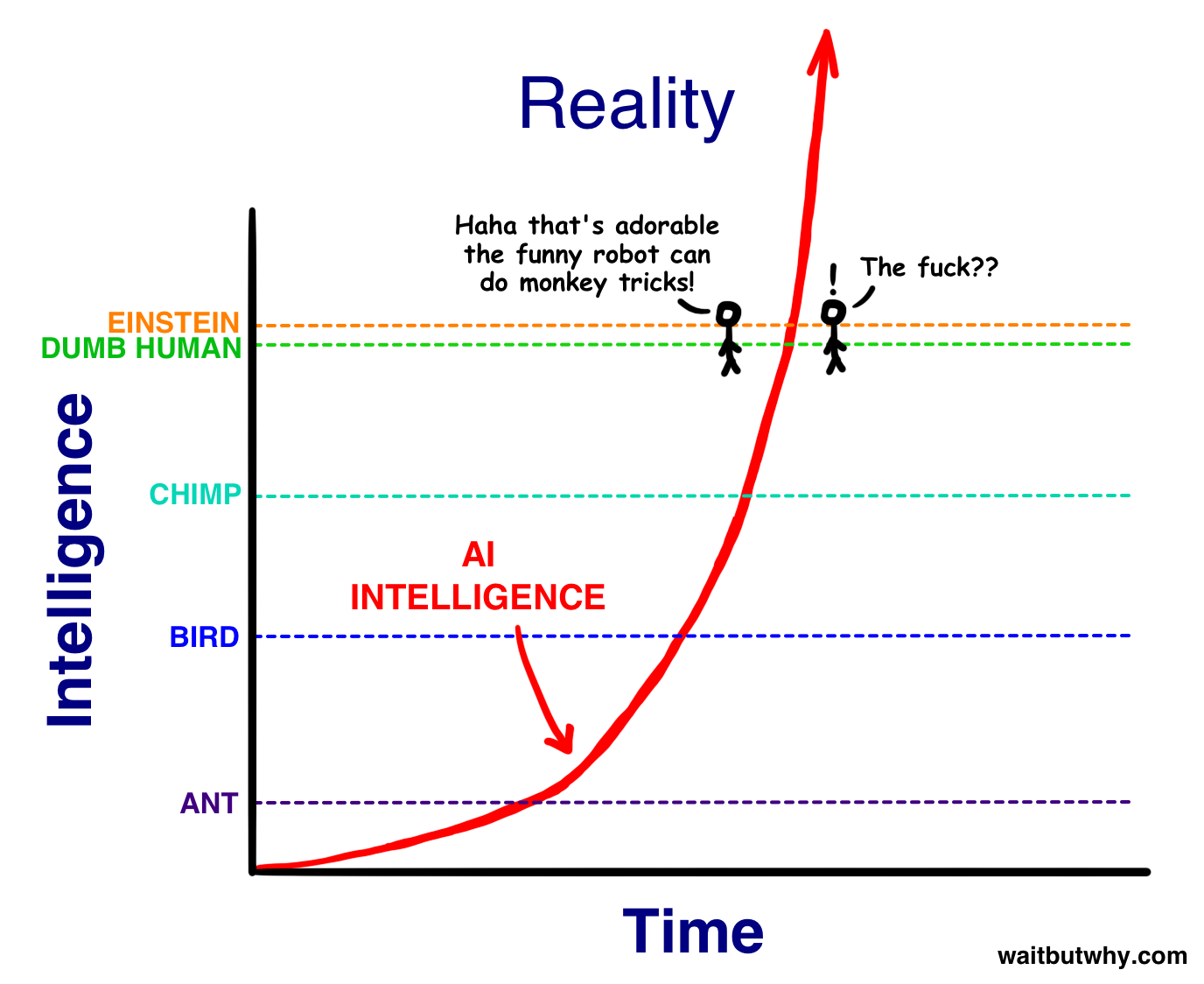
I lead a team exploring cutting edge LLM applications and end-user features. It's my intuition from experience that we have a LONG way to go.
GPT-4o / Claude 3.5 are the go-to models for my team. Every combination of technical investment + LLMs yields a new list of potential applications.
For example, combining a human-moderated knowledge graph with an LLM with RAG allows you to build "expert bots" that understand your business context / your codebase / your specific processes and act almost human-like similar to a coworker in your team.
If you now give it some predictive / simulation capability - eg: simulate the execution of a task or project like creating a github PR code change, and test against an expert bot above for code review, you can have LLMs create reasonable code changes, with automatic review / iteration etc.
Similarly there are many more capabilities that you can ladder on and expose into LLMs to give you increasingly productive outputs from them.
Chasing after model improvements and "GPT-5 will be PHD-level" is moot imo. When did you hire a PHD coworker and they were productive on day-0 ? You need to onboard them with human expertise, and then give them execution space / long-term memories etc to be productive.
Model vendors might struggle to build something more intelligent. But my point is that we already have so much intelligence and we don't know what to do with that. There is a LOT you can do with high-schooler level intelligence at super-human scale.
Take a naive example. 200k context windows are now available. Most people, through ChatGPT, type out maybe 1500 tokens. That's a huge amount of untapped capacity. No human is going to type out 200k of context. Hence why we need RAG, and additional forms of input (eg: simulation outcomes) to fully leverage that.
Yes there seems to be lots of potential. Yes we can brainstorm things that should work. Yes there is a lot of examples of incredible things in isolation. But it's a little bit like those youtube videos showing amazing basketball shots in 1 try, when in reality lots of failed attempts happened beforehand. Except our users experience the failed attempts (LLM replies that are wrong, even when backed by RAG) and it's incredibly hard to hide those from them.
Show me the things you / your team has actually built that has decent retention and metrics concretely proving efficiency improvements.
LLMs are so hit and miss from query to query that if your users don't have a sixth sense for a miss vs a hit, there may not be any efficiency improvement. It's a really hard problem with LLM based tools.
There is so much hype right now and people showing cherry picked examples.
The theory behind these models so aggressively lags the engineering that I suspect there are many major improvements to be found just by understanding a bit more about what these models are really doing and making re-designs based on that.
I highly encourage anyone seriously interested in LLMs to start spending more time in the open model space where you can really take a look inside and play around with the internals. Even if you don't have the resources for model training, I feel personally understanding sampling and other potential tweaks to the model (lots of neat work on uncertainty estimations, manipulating the initial embedding the prompts are assigned, intelligent backtracking, etc).
And from a practical side I've started to realize that many people have been holding on of building things waiting for "that next big update", but there a so many small, annoying tasks that can be easily automated.
The scaling laws may be dead. Does this mean the end of LLM advances? Absolutely not.
There are many different ways to improve LLM capabilities. Everyone was mostly focused on the scaling laws because that worked extremely well (actually surprising most of the researchers).
But if you're keeping an eye on the scientific papers coming out about AI, you've seen the astounding amount of research going on with some very good results, that'll probably take at least several months to trickle down to production systems. Thousands of extremely bright people in AI labs all across the world are working on finding the next trick that boosts AI.
One random example is test-time compute: just give the AI more time to think. This is basically what O1 does. A recent research paper suggests using it is roughly equivalent to an order of magnitude more parameters, performance wise. (source for the curious: https://lnkd.in/duDST65P)
Another example that sounds bonkers but apparently works is quantization: reducing the precision of each parameter to 1.58 bits (ie only using values -1, 0, 1). This uses 10x less space for the same parameter count (compared to standard 16-bit format), and since AI operatons are actually memory limited, directly corresponds to 10x decrease in costs: https://lnkd.in/ddvuzaYp
(Quite apart from improvements like these, we shouldn't forget that not all AIs are LLMs. There's been tremendous advance in AI systems for image, audio and video generation, interpretation and munipulation and they also don't show signs of stopping, and there's possibility that a new or hybrid architecture for the textual AI might be developed).
AI winter is a long way off.
The > 100 P/E ratios we are already seeing can't be justified by something as quotidian as the exceptionally good productivity tools you're talking about.
It's been a while though, we've had great models now for a 18 months plus. Why are we still yet to see these type of applications rolling out on a wide scale?
My anecdotal experience is that almost universally, 90-95% type accuracy you get from them is just not good enough. Which is to say, having something be wrong 10% or even 5% of the time is worse than not having at all. At best, you need to implement applications like that in an entirely new paradigm that is designed to extract value without bearing the costs of the risks.
It doesn't mean LLMs can't be useful, but they are kind of stuck with applications that inherently mesh with human oversight (like programming etc). And the thing about those is that they don't really scale, because the human oversight has to scale up with whatever the LLM is doing.
Nobody who takes code health and sustainability seriously wants to hear this. You absolutely do not want to be in a position where something breaks, but your last 50 commits were all written and reviewed by an LLM. Now you have to go back and review them all with human eyes just to get a handle on how things broke, while customers suffer. At this scale, it's an effort multiplier, not an effort reducer.
It's still good for generating little bits of boilerplate, though.
Certainly not.
But technology is all about stacks. Each layer strives to improve, right up through UX and business value. The uses for 1µm chips had not been exhausted in 1989 when the 486 shipped in 800nm. 250nm still had tons of unexplored uses when the Pentium 4 shipped on 90nm.
Talking about scaling at the the model level is like talking about transistor density for silicon: it's interesting, and relevant, and we should care... but it is not the sole determinent of what use cases can be build and what user value there is.
Is there an AI tool that can ingest a codebase and locate code based on abstract questions? Like: "I need to invalidate customers who haven't logged in for a month" and it can locate things like relevant DB tables, controllers, services, etc.
Yes, existing LLMs are useful. Yes, there are many more things we can do with this tech.
However, existing SOTA models are large, expensive to run, still hallucinate, fail simple logic tests, fail to do things a poorly trained human can do on autopilot, etc.
The performance of LLMs is extremely variable, and it is hard to anticipate failure.
Many potential applications of this technology will not tolerate this level of uncertainty. Worse solutions with predictable and well understood shortcomings will dominate.
More realistically it’s like a really great sidekick for doing very specific mundane but otherwise non deterministic tasks.
I think we’ll start to see AI permeate into nearly every back office job out there, but as a series of tools that help the human work faster. Not as one big brain that replaces the human.
IMO we've not even exhausted the options for spreadsheets, let alone LLMs.
And the reason I'm thinking of spreadsheets is that they, like LLMs, are very hard to win big on even despite the value they bring. Not "no moat" (that gets parroted stochastically in threads like these), but the moat is elsewhere.
I wasn’t able to get it do it with Anthropic or OpenAI chat completion APIs. Can someone explain why? I don’t think the 200K token window actually works, is it looking sequentially or is it really looking at the whole thing at once or something?
And while Qwen2.5-Coder-32B-Instruct is a pretty advanced finetune — it was trained on an extra 5 trillion tokens — even smaller finetunes have done really well. For example, Dracarys-72B, which was a simpler finetune of Qwen2.5-72B using a modified version of DPO on a handmade set of answers to GSM8K, ARC, and HellaSwag, significantly outperforms the base Qwen2.5-72B model on the aider coding benchmarks.
There's a lot of intelligence we're leaving on the floor, because everyone is just prompting generic chat-tuned models! If you tune it to do something else, it'll be really good at the something else.
However, this is better thought of as "business logic scripting/automation", not the magic employee-replacing AGI that would be the revolution some people are expecting. Maybe you can now build a slightly less shitty automated telephone response system to piss your customers off with.
If indeed the "GPT 5!" Arms race has calmed down, it should help everyone focus on the possible, their own goals, and thus what AI capabilities to deploy.
Just as there won't be a "Silver Bullet" next gen model, the point about Correct Data In is also crucial. Nothing is 'free' not even if you pay a vendor or integrator. You, the decision making organization, must dedicate focus to putting data into your new AI systems or not.
It will look like the dawn of original IBM, and mechanical data tabulation, in retrospect once we learn how to leverage this pattern to its full potential.
I.e. can it ruminate on the data it's ingested, and rather than returning the response of highest probability, return something original?
I think that's the key. If LLMs can't ultimately do that, there's still a lot to be gained from utilising the speed and fluidly scalable resources of computers.
But like all the top tech companies know, it's not quantity of bodies in seats that matters but talent, the thing that's going to prevail is raw intelligence. If it can't think better than us, just process data faster and more voluminously but still needing human verification, we're on an asymptotic path.
As a developer, I'm making much more progress using the SOTA (Claude 3.5) as a Socratic interrogator. I'm brainstorming a project, give it my current thoughts, and then ask it to prompt me with good follow-up questions and turn general ideas into a specific, detailed project plan, next steps, open questions, and work log template. Huge productivity boost, but definitely not replacing me as an engineer. I specifically prompt it to not give me solutions, but rather, to just ask good questions.
I've also used Claude 3.5 as (more or less) a free arbitrator. Last week, I was in a disagreement with a colleague, who was clearly being disingenuous by offering to do something she later reneged on, and evading questions about follow up. Rather than deal with organizational politics, I sent the transcript to Claude for an unbiased evaluation, and it "objectively" confirmed what had been frustrating me. I think there's a huge opportunity here to use these things to detect and call out obviously antisocial behavior in organizations (my CEO is intrigued, we'll see where it goes). Similarly, in our legal system, as an ultra-low-cost arbitrator or judge for minor disputes (that could of course be appealed to human judges). Seems like the level of reasoning in Claude 3.5 is good enough for that.
My mental model is always "low-risk search". https://muldoon.cloud/2023/10/29/ai-commandments.html
I'd love to hear about this. I applied to YC WC 25 with research/insight/an initial researchy prototype built on top of GPT4+finetuning about something along this idea. Less powerful than you describe, but it also works without the human moderated KG.
But the knowledge system here is doing the grunt of the work, and progressing past it's own limitations goes right hack to the pitfalls of the rules based AI winter. That's not a engineering problem, it's a foundational mathematics problems that only a few people are seriously working on.
For coding LLMs certainly are helpful, but I prefer local models instead of anything on offer right now. There is just much more potential here.
Imagine that our current capabilities are like the Model-T. There remains many improvements to be made upon this passenger transportation product, with RAG being a great common theme among them. People will use chatbots with much more permissive interfaces instead of clicking through menus.
But all of that’s just the start, the short term, the maturation of this consumer product; the really scary/exciting part comes when the technology reaches saturation, and opens up new possibilities for itself. In the Model-T metaphor, this is analogous to how highways have (arguably) transformed America beyond anyone’s wildest dreams, changing the course of various historical events (eg WWII industrialization, 60s & 70s white flight, early 2000s housing crisis) so much it’s hard to imagine what the country would look like without them. Now, automobiles are not simply passenger transportation, but the bedrock of our commerce, our military, and probably more — through ubiquity alone they unlocked new forms of themselves.
For those doubting my utopian/apocalyptic rhetoric, I implore you to ask yourself one simple question: why are so many experts so worried about AGI? They’ve been leaving in droves from OpenAI, and that’s ultimately what the governance kerfluffle there was. Hinton, a Turing award winner, gave up $$$ to doom-say full time. Why?
My hint is that if your answer involves less then a 1000 specialized LLMs per unified system, then you’re not thinking big enough.
But understanding how likely it is that we will (or will not) see a new models quickly and dramatically improve on what we have "because scaling" seems valuable context for everyone in ecosystem to make decisions.
everyone is looking at llm scores & strawberry gotchas while ignoring the trillions of market potential in replacing existing systems and (yes) people with the current capabilities. identifying the use cases, finetuning the models and (most importantly) actually rolling this out in existing organizations/processes/systems will be the challenge long before the base models' capabilities will be
it is worth working on those issues now and get the ball rolling, switching out your models for future more capable ones will be the easy part later on.
That is, other than me using them to bounce ideas off of and create small snippets of code.
I know we absolutely have not, but I think we have reached the limit in terms of the Chatbot experience that ChatGPT is. For some reason the industry keeps trying to force the chatbot interface to do literally everything to the point that we now have inflated roles like "Prompt Engineers". This is to say that people suck at knowing what they want off the rip, and LLMs can't help with that if they're not integrated in technology in such a way where a solid foundation is built to allow the models to generate good output.
LLMs and other big data models have incredible potential for things like security, medicine, and the power industry to name a few fields. I mean I was recently talking with a professor about his research in applying deep learning to address growing security concerns in cars on the road.
The application is far from reaching the ceiling.
Could you define "code changes" because I feel that is a very vague accomplishment.
Name your platform. Linux. C++. The Internet. The x86 processor architecture. We haven't exhausted the options for delivering value on top of those, but that doesn't mean the developers and sellers of those platforms don't try to improve them anyway and might struggle to extract value from application developers who use them.
I'm surprised that any of these companies consider what they are working on to be Artificial General Intelligences. I'm probably wrong, but my impression was AGI meant the AI is self aware like a human. An LLM hardly seems like something that will lead to self-awareness.
Is that "intelligent" or "understanding"? It's probably close enough for pop science, and regardless, it looks good in headlines and sales pitches so why fight it?
For example, in this article it says it can't do coding exercises outside the training set. That would definitely be on the "AGI checklist". Basically doing anything that is outside of the training set would be on that list.
"Artificial General Intelligence (AGI) refers to a theoretical form of artificial intelligence that possesses the ability to understand, learn, and apply knowledge across a wide range of tasks at a level comparable to that of a human being."
Altman says AGI could be here in 2025: https://youtu.be/xXCBz_8hM9w?si=F-vQXJgQvJKZH3fv
But he certainly means an LLM that can perform at/above human level in most tasks rather than a self aware entity.
Nah, at best we found a way to make one part of a collection of systems that will, together, do something like thinking. Thinking isn’t part of what this current approach does.
What’s most surprising about modern LLMs is that it turns out there is so much information statistically encoded in the structure of our writing that we can use only that structural information to build a fancy Plinko machine and not only will the output mimic recognizable grammar rules, but it will also sometimes seem to make actual sense, too—and the system doesn’t need to think or actually “understand” anything for us to, basically, usefully query that information that was always there in our corpus of literature, not in the plain meaning of the words, but in the structure of the writing.
The "hard problem", to which you may be alluding, may never matter. It's already feasible for an 'AI/AGI with LLM component' to be "self-aware".
People use the term in different ways. It generally implies being able to think like a human or better. OpenAI have always said they are working towards it, I think deepmind too. It'll probably take more than an LLM.
It's economically a big deal because if it can out think humans you can set it to develop the next improved model and basically make humans redundant.
Or did you mean consciousness? How would one demonstrate that an AGI is conscious? Why would we even want to build one?
My understanding is an AGI is at least as smart as a typical human in every category. That is what would be useful in any case.
Interesting essay enumerating reasons you may be correct: https://medium.com/@francois.chollet/the-impossibility-of-in...
If it doesn’t lead to AGI, as an employee it’s not your problem.
The best engineering minds have been focused on scaling transformer pre and post training for the last three years because they had good reason to believe it would work, and it has up until now.
Progress has been measured against benchmarks which are / were largely solvable with scale.
There is another emerging paradigm which is still small(er) scale but showing remarkable results. That's full multi-modal training with embodied agents (aka robots). 1x, Figure, Physical Intelligence, Tesla are all making rapid progress on functionality which is definitely beyond frontier LLMs because it is distinctly different.
OpenAI/Google/Anthropic are not ignorant of this trend and are also reviving or investing in robots or robot-like research.
So while Orion and Claude 3.5 opus may not be another shocking giant leap forward, that does not mean that there arn't giant shocking leaps forward coming from slightly different directions.
Sure, that's tautologically true but that doesn't imply that beyondness will lead to significant leaps that offer notable utility like LLMs. Deep Learning overall has been a way around the problem that intelligent behavior is very hard to code and no wants to hire many, many coders needed to do this (and no one actually how to get a mass of programmers to actually be useful beyond a certain of project complexity, to boot). People take the "bitter lesson" to mean data can do anything but I'd say a second bitter lesson is that data-things are the low hanging fruit.
Moreover, robot behavior is especially to fake. Impressive robot demos have been happening for decades without said robots getting the ability to act effectively in the complex, ad-hoc environment that human live in, IE, work with people or even cheaply emulate human behavior (but they can do choreographed/puppeteered kung fu on stage).
The lack of progress with self driving seems to indicate that Tesla has a serious problem with scaling. The investment in enormous compute resources is another red flag (if you run out of ideas, just use brute force). This points to a fundamental flaw in model architecture.
Cool, but we already have robots doing this in 2d space (aka self driving cars) that struggle not to kill people. How is adding a third dimension going to help? People are just refusing to accept the fact that machine learning is not intelligence.
Tesla is selling this view for almost a decade now in self-driving - how their car fleet feeding training data is going to make them leaders in the area. I don't find it convincing anymore
Nor does it mean that there are! We've gotten into this habit of assuming that we're owed giant shocking leaps forward every year or so, and this wave of AI startups raised money accordingly, but that's never how any innovation has worked. We've always followed the same pattern: there's a breakthrough which causes a major shift in what's possible, followed by a few years of rapid growth as engineers pick up where the scientists left off, followed by a plateau while we all get used to the new normal.
We ought to be expecting a plateau, but Sam Altman and company have done their work well and have convinced many of us that this time it's different. This time it's the singularity, and we're going to see exponential growth from here on out. People want to believe it, so they do, and Altman is milking that belief for all it's worth.
But make no mistake: Altman has been telegraphing that he's eyeing the exit, and you don't eye the exit when you own a company that's set to continue exponentially increasing in value.
The best minds don't follow the herd.
Or because the people running companies who have fooled investors into believing it will work can afford to pay said engineers life-changing amounts of money.
It's almost like saying "we've already visited every place on Earth, surely Mars is just around the corner now"
I probably disagree, but I don't want to criticize my interpretation of this sentence. Can you make your claim more precise?
Here are some possible claims and refutations:
- Claim: An LLM cannot output a true claim that it has not already seen. Refutation: LLMs have been shown to do logical reasoning.
- Claim: An LLM cannot incorporate data that it hasn't been presented with. Refutation: This is an unfair standard. All forms of intelligence have to sense data from the world somehow.
1. more data gets walled-off as owners realise value
2. stackoverflow-type feedback loops cease to exist as few people ask a public question and get public answers ... they ask a model privately and get an answer based on last visible public solutions
3. bad actors start deliberately trying to poison inputs (if sites served malicious responses to GPTBot/CCBot crawlers only, would we even know right now?)
4. more and more content becomes synthetically generated to the point pre-2023 physical books become the last-known-good knowledge
5. goverments and IP lawyers finally catch up
Why do you think "they" have run out of data? First, to be clear, who do you mean by "they"? The world is filled with information sources (data aggregators for example), each available to some degree for some cost.
Don't forget to include data that humans provide while interacting with chatbots.
Just increase the temperature.
Is this certain? Are Agents the right direction to AGI?
Goodbye, Mr. Anderson...
Right. If you generate some code with ChatGPT, and then try to find similar code on the web, you usually will. Search for unusual phrases in comments and for variable names. Often, something from Stack Overflow will match.
LLMs do search and copy/paste with idiom translation and some transliteration. That's good enough for a lot of common problems. Especially in the HTML/Javascript space, where people solve the same problems over and over. Or problems covered in textbooks and classes.
But it does not look like artificial general intelligence emerges from LLMs alone.
There's also the elephant in the room - the hallucination/lack of confidence metric problem. The curse of LLMs is that they return answers which are confident but wrong. "I don't know" is rarely seen. Until that's fixed, you can't trust LLMs to actually do much on their own. LLMs with a confidence metric would be much more useful than what we have now.
People who "follow" AI, as the latest fad they want to comment on and appear intelligent about, repeat things like this constantly, even though they're not actually true for anything but the most trivial hello-world types of problems.
I write code all day every day. I use Copilot and the like all day every day (for me, in the medical imaging software field), and all day every day it is incredibly useful and writes nearly exactly the code I would have written, but faster. And none of it appears anywhere else; I've checked.
In general, this is not a good description about what is happening inside an LLM. There is extensive literature on interpretability. It is complicated and still being worked out.
The commenter above might characterize the results they get in this way, but I would question the validity of that characterization, not to mention its generality.
There was another one that claimed to get rid of hallucinations. They also said it takes 50-100 epochs for regular architectures to actually memorize something. Their paper is below in case people qualified to review it want to.
https://arxiv.org/abs/2406.17642
Like the brain, I believe the problem will be solved by a mix of specialized components working together. One of those components will be a memory (or series of them) that the others reference to keep processing grounded in reality.
A lot hangs on what you mean by "significant". Can you define what you mean? And/or give an example of an improvement that you don't think is significant.
Also, on what basis can you say "no significant improvements" have been made? Many major players have published some of their improvements openly. They also have more private, unpublished improvements.
If your claim boils down to "what people mean by a Generative Pre-trained Transformer" still has a clear meaning, ok, fine, but that isn't the meat of the issue. There is so much more to a chat system than just the starting point of a vanilla GPT.
It is wiser to look at the whole end-to-end system, starting at data acquisition, including pre-training and fine-tuning, deployment, all the way to UX.
P.S. I don't have a vested interest in promoting or disparaging AI. I don't work for a big AI lab. I'm just trying to call it like I see it, as rationally as I can.
Going from 10% to 50% (500% more) complete coverage of common sense knowledge and reasoning is going to feel like a significant advance. Going from 90% to 95% (5% more) coverage is not going to feel the same.
Regardless of what Altman says, its been two years since OpenAI released GPT-4, and still no GPT-5 in sight, and they are now touting Q-star/strawberry/GPT-o1 as the next big thing instead. Sutskever, who saw what they're cooking before leaving, says that traditional scaling has plateaeud.
This is supported by both general observations and recently this tweet from an OpenAI engineer that Sam responded to and engaged ->
"scaling has hit a wall and that wall is 100% eval saturation"
Which I interpert to mean his view is that models are no longer yielding significant performance improvements because the models have maxed out existing evaluation metrics.
Are those evaluations (or even LLMs) the RIGHT measures to achieve AGI? Probably not.
But have they been useful tools to demonstrate that the confluence of compute, engineering, and tactical models are leading towards signifigant breathroughts in artificial (computer) intelligence?
I would say yes.
Which in turn are driving the funding, power innovation, public policy etc needed to take that next step?
I hope so.
They are driving the shoveling of VC money into a furnace to power their servers.
Should that money run dry before they hit another breakthrough "AI" popularity is going to drop like a stone. I believe this to be far more likely an outcome than AGI or even the next big breakthrough.
But when I hear that models are failing to meet expectations, I imagine what they're saying is that the researchers had some sort of eval in mind with room to grow and a target, and that the model in question failed to hit the target they had in mind.
Honestly, problem with sentiments like these is on Twitter is that you can't tell if they're being sincere or just making a snarky, useless remark. Probably a mix of both.
Where do these large "AI" companies think the mass amounts of data used to train these models come from? People! The most powerful and compact complex systems in existence, IMO.
The irony here is astounding.
I don't know much about LLMs, but that seems to indicate a sort of dead-end. The models are still useful, but limited in their abilities. So now the developers and researchers needs to start looking for new ways to use all this data. That in some sense resets the game. Sucks to be OpenAI, billions of dollars spend on a product that has been match or even outmatched by the competition in a few short years, not nearly enough time to make any of it back.
If there is a take away, it might be that it takes billions, if not trillions of dollars, to develop an AI and the result may still be less than what you hope for, and the investment really hard to recoup.
Sometimes other outlets do copycat reporting of theirs, and those submissions are ok, though they wouldn't be if the original source were accessible.
Not quite that wording. More we know which way to head. I think he's sincere.
Meanwhile, the existing tech is such a step change that industry is going to need time to figure out how to effectively use these models. In a lot of ways it feels like the "digitization" era all over again - workflows and organizations that were built around the idea humans handled all the cognitive load (basically all companies older than a year or two) will need time to adjust to a hybrid AI + human model.
This exactly. And as history shows, no matter how much effort the current big LLM companies do they won't be able to grasp the best uses for their tech. We will see small players developing it even further. I'm thankful for the legendary blindness of these anticompetitive behemoths. Less than 2 decades ago: IBM Watson.
So the models' accuracies won't grow exponentially, but can still grow linearly with the size of the training data.
Sounds like DataAnnotation will be sending out a lot more LinkedIn messages.
EDIT: here's the paper https://arxiv.org/abs/2404.04125
On the other hand, a lot of these frameworks and languages have relatively decent and detailed documentation.
Perhaps this is a naive question, but why can't I as a user just purchase "AI software" that comes with a large pre-trained model to which I can say, on my own machine, "go read this documentation and help me write this app in this next version of Leptos", and it would augment its existing model with this new "knowledge".
AlphaGo - self-play
AlphaFold - PDB, the protein database
ChatGPT - human knowledge encoded as text
These models are all machines for clever interpolation in gigantic training datasets.
They appear to be intelligent, because the training data they've seen is so vastly larger than what we've seen individually, and we have poor intuition for this.
I'm not throwing shade, I'm a daily user of ChatGPT and find tremendous and diverse value in it.
I'm just saying, this particular path in AI is going to make step-wise improvements whenever new large sources of training data become available.
I suspect the path to general intelligence is not that, but we'll see.
I think there's three things that a 'true' general intelligence has which is missing from basic-type-LLMs as we have now.
1. knowing what you know. <basic-LLMs are here>
2. knowing what you don't know but can figure out via tools/exploration. <this is tool use/function calling>
3. knowing what can't be known. <this is knowing that halting problem exists and being able to recognize it in novel situations>
(1) From an LLM's perspective, once trained on corpus of text, it knows 'everything'. It knows about the concept of not knowing something (from having see text about it), (in so far as an LLM knows anything), but it doesn't actually have a growable map of knowledge that it knows has uncharted edges.
This is where (2) comes in, and this is what tool use/function calling tries to solve atm, but the way function calling works atm, doesn't give the LLM knowledge the right way. I know that I don't know what 3,943,034 / 234,893 is. But I know I have a 'function call' of knowing the algorithm for doing long divison on paper. And I think there's another subtle point here: my knowledge in (1) includes the training data generated from running the intermediate steps of the long-division algorithm. This is the knowledge that later generalizes to being able to use a calculator (and this is also why we don't just give kids calculators in elementary school). But this is also why a kid that knows how to do long division on paper, doesn't seperately need to learn when/how to use a calculator, besides the very basics. Using a calculator to do that math feels like 1 step, but actually it does still have all of initial mechanical steps of setting up the problem on paper. You have to type in each digit individually, etc.
(3) I'm less sure of this point now that I've written out point (1) and (2), but that's kinda exactly the thing I'm trying to get at. Its being able to recognize when you need more practice of (1) or more 'energy/capital' for doing (2).
Consider a burger resturant. If you properly populated the context of a ChatGPT-scale model the data for a burger resturant from 1950, and gave it the kinda 'function calling' we're plugging into LLMs now, it could manage it. It could keep track of inventory, it could keep tabs on the employee-subprocesses, knowing when to hire, fire, get new suppliers, all via function calling. But it would never try to become McDonalds, because it would have no model of the the internals of those function-calls, and it would have no ability to investigate or modify the behaviour of those function calls.
This methodological growth could make LLMs more reliable, consistent, and aligned with specific use cases.
The skepticism surrounding this vision mirrors early doubts about the early internet fairly concisely.
Initially, the internet was seen as fragmented collection of isolated systems without a clear structure or purpose. It really was. You would gopher somewhere and get a file, and eventually we had apps like like pine for email, but as cool as it was it has limited utility.
People doubted it could ever become the seamless, interconnected web we know today.
Yet, through protocols, shared standards, and robust frameworks, the internet evolved into a powerful network capable of handling diverse applications, data flows, and user needs.
In the same way, LLM orchestration will mature by standardizing interfaces, improving interoperability, and fostering cooperation among varied AI models and support systems.
Just as the internet needed HTTP, TCP/IP, and other protocols to unify disparate networks, orchestrated AI systems will require foundational frameworks and “rules of the road” that bring cohesion to diverse technologies.
We are at the veeeeery infancy of this era and have a LONG way to go here. Some of the progress looks clear and a linear progression, but a lot, like the Internet, will just take a while to mature and we shouldn’t forget what we learned the last time we faced a sea change technological revolution.
I don't think anyone doubted the nature of the technology. The bits were being sent. It's not like we were unsure of the fundamental possibility of transmitting information. The potential was shown very, very early on (Mother of all demos was in 1968). What we were and to some extent still are unsure of is the practical impact on society.
AI and LLMs in particular are not even at the mother of all demos level yet notwithstanding the grandiose claims and demos. There is no consensus on what these models are even doing. There is (IMO) justified skepticism surrounding the claims of reasoning and ability to abstract. We are in my opinion not yet at the "bits are being sent" stage.
With my user hat on, I'm quite pleased with the current state of LLMs. Initially, I approached them skeptically, using a hackish mindset and posing all kinds of Turing test-like questions. Over time, though, I shifted my focus to how they can enhance my team's productivity and support my own tasks in meaningful ways.
Finally, I see LLMs as a valuable way to explore parts of the world, accommodating the reality that we simply don’t have enough time to read every book or delve into every topic that interests us.
Learning from data is not enough; there is a need for the kind of system-two thinking we humans develop as we grow. It is difficult to see how deep learning and backpropagation alone will help us model that. For tasks where providing enough data is sufficient to cover 95% of cases, deep learning will continue to be useful in the form of 'data-driven knowledge automation.' For other cases, the road will be much more challenging. https://www.lycee.ai/blog/why-sam-altman-is-wrong
I wonder what this would mean for companies raising today on the premise of building on top of these platforms. Maybe the best ones get their ideas copied, reimplemented, and sold for cheaper?
We already kind of see this today with OpenAI's canvas and Claude artifacts. Perhaps they'll even start moving into Palantir's space and start having direct customer implementation teams.
It is becoming increasing obvious that LLM's are quickly becoming commoditized. Everyone is starting to approach the same limits in intelligence, and are finding it hard to carve out margin from competitors.
Most recently exhibited by the backlash at claude raising prices because their product is better. In any normal market, this would be totally expected, but people seemed shocked that anyone would charge more than the raw cost it would take to run the LLM itself.
Amazon and Google didn't mess with their core business by competing with the players using it until they REALLY ran out of ways to make money.
So the problem is more in the algorithm.
This smells like it’s mostly based on OAI having a bit of bad luck with next model rather than a fundamental slowdown / barrier.
They literally just made a decent sized leap with o1
The Information reporting was a bit more clear on this. Orion is better than GPT-4, it's just that they were expecting a leap in capabilities comparable to what we saw going from GPT-3 to GPT-4. In other words, they were expecting essentially a GPT-5, and Orion wasn't that good.
Up to a certain point, a conditional fluency stores knowledge, in the sense that semantically correct sentences are more likely to be fluent… but we may have tapped out in that regard. LLMs have solved language very well, but to get beyond that has seemed, thus far, to require RLHF, with all the attendant negatives.
At the very early phase of the boom I was among a very few who knew and predicted this (usually most free and deep thinking/knowledgeable). Then my prediction got reinforced by the results. One of the best examples was with one of my experiments that all today's AI's failed to solve tree serialization and de-serialization in each of the DFS(pre-order/in-order/post-order) or BFS(level-order) which is 8 algorithms (2x4) and the result was only 3 correct! Reason is "limited training inputs" since internet and open source does not have other solutions :-) .
So, I spent "some" time and implemented all 8, which took me few days. By the way this proves/demonstrates that ~15-30min pointless leetcode-like interviews are requiring to regurgitate/memorize/not-think. So, as a logical hard consequence there will.has-to be a "crash/cleanup" in the area of leetcode-like interviews as they will just be suddenly proclaimed as "pointless/stupid"). However, I decided not to publish the rest of the 5 solutions :-)
This (and other experiments) confirms hard limits of the LLM approach (even when used with chain-of-thought). Increasing the compute on the problem will produce increasingly smaller and smaller results (inverse exponential/logarithmic/diminishing-returns) = new AGI approach/design is needed and to my knowledge majority of the inve$tment (~99%) is in LLM, so "buckle up" at-some-point/soon?
Impacts and realities; LLM shall "run it's course" (produce some products/results/$$$, get reviewed/$corrected) and whoever survives after that pruning shall earn money on those products while investing in the new research to find new AGI design/approach (which could take quite a long time,... or not). NVDA is at the center of thi$ and time-wise this peak/turn/crash/correction is hard to predict (although I see it on the horizon and min/max time can be estimated). Be aware and alert. I'll stop here and hold my other number of thoughts/opinions/ideas for much deeper discussion. (BTW I am still "full in on NVDA" until,....)
And I think the latter is good enough for us to do exciting things.
This might be acceptable for amusing us with fiction and art, and for filling the internet with even more spam and propaganda, but would you trust them to write reliable code, drive your car or control any critical machinery?
The truly exciting things are still out of reach, yet we just might be at the Peak of Inflated Expectations to see it now.
https://paperswithcode.com/paper/most-language-models-can-be...
The appearance of improvements in that capability are due to the vocabulary of modern LLMs increasing. Still only putting lipstick on a pig.
AGI=lim(x->0)AIHype(x)
where x=length of winter
For example recently I asked it to generate some phrases for a list of words, along with synonym and antonym lists.
The phrases were generally correct and appropriate (some mistakes but that’s fine). The synonyms/antonyms were misaligned to the list (so strictly speaking all wrong) and were often incorrect anyway. I imagine it would be the same if you asked for definitions of a list of words.
If you ask it to correct it just generates something else which is often also wrong. It’s certainly superficially convincing in many domains but once you try to get it to do real work it’s wrong in subtle ways.
So it's interesting that when AI came along, we threw caution to the wind and started treating it like a silver bullet... Without asking the question of whether it was applicable to this goal or that goal...
I don't think anyone could have anticipated that we could have an AI which could produce perfect sentences, faster than a human, better than a human but which could not reason. It appears to reason very well, better than most people, yet it doesn't actually reason. You only notice this once you ask it to accomplish a task. After a while, you can feel how it lacks willpower. It puts into perspective the importance of willpower when it comes to getting things done.
In any case, LLMs bring us closer to understanding some big philosophical questions surrounding intelligence and consciousness.
Certain OpenAI insiders must have known this for a while, hence Ilya Sutskever's new company in Israel
1. Find more data.
2. Make the weights capture the data and reproduce.
In that sense we have reached a limit. So in my opinion we can do a couple of things.
1. App developers can understand the limits and build within the limits.
2. Researchers can take insights from these large models and build better AI systems with new architectures. It's ok to say transformers have reached a limit.
It will be like StableDiffusion 1.5. This model can now run on low end devices, lots of open research use this model to build something else and inspire by this.
These LLMs can be used as a foundation to keep improving and building new things.
I was really looking forward to using "synthetic data" euphemistically during debates.
And there's a number of reasons why, mostly likely being that they've found other ways to get improvements out of AI models, so diminishing returns on training aren't that much of a problem. Or, maybe the leakers are lying, but I highly doubt that considering the past record of news outlets reporting on accurate leaked information.
Still though, it's interesting how basically ever frontier lab created a model that didn't live up to expectations, and every employee at these labs on Twitter has continued to vague-post and hype as if nothing ever happened.
It's honestly hard to tell whether or not they really know something we don't, or if they have an irrational exuberance for AGI bordering on cult-like, and they will never be able to mentally process, let alone admit, that something might be wrong.
Is it just me or does $100 million sound like it's on the very, very low end of how much training a new model costs? Maybe you can arrive within $200 million of that mark with amortization of hardware? It just doesn't make sense to me that a new model would "only" be $100 million when AmaGooBookSoft are spending tens of billions on hardware and the AI startups are raising billions every year or two.
I don't get it...
That doesn't mean this article is irrelevant. It's good to know if LLM improvements are going to slow down a bit because the low hanging fruit has seemingly been picked.
But in terms of the overall effect of AI and questioning the validity of the technology as a whole, it's just your basic FUD article that you'd expect from mainstream news.
> I suspect the path to general intelligence is not that, but we'll see.
I think there's three things that a 'true' general intelligence has which is missing from basic-type-LLMs as we have now.
1. knowing what you know. <basic-LLMs are here>
2. knowing what you don't know but can figure out via tools/exploration. <this is tool use/function calling>
3. knowing what can't be known. <this is knowing that halting problem exists and being able to recognize it in novel situations>
(1) From an LLM's perspective, once trained on corpus of text, it knows 'everything'. It knows about the concept of not knowing something (from having see text about it), (in so far as an LLM knows anything), but it doesn't actually have a growable map of knowledge that it knows has uncharted edges.
This is where (2) comes in, and this is what tool use/function calling tries to solve atm, but the way function calling works atm, doesn't give the LLM knowledge the right way. I know that I don't know what 3,943,034 / 234,893 is. But I know I have a 'function call' of knowing the algorithm for doing long divison on paper. And I think there's another subtle point here: my knowledge in (1) includes the training data generated from running the intermediate steps of the long-division algorithm. This is the knowledge that later generalizes to being able to use a calculator (and this is also why we don't just give kids calculators in elementary school). But this is also why a kid that knows how to do long division on paper, doesn't seperately need to learn when/how to use a calculator, besides the very basics. Using a calculator to do that math feels like 1 step, but actually it does still have all of initial mechanical steps of setting up the problem on paper. You have to type in each digit individually, etc.
(3) I'm less sure of this point now that I've written out point (1) and (2), but that's kinda exactly the thing I'm trying to get at. Its being able to recognize when you need more practice of (1) or more 'energy/capital' for doing (2).
Consider a burger resturant. If you properly populated the context of a ChatGPT-scale model the data for a burger resturant from 1950, and gave it the kinda 'function calling' we're plugging into LLMs now, it could manage it. It could keep track of inventory, it could keep tabs on the employee-subprocesses, knowing when to hire, fire, get new suppliers, all via function calling. But it would never try to become McDonalds, because it would have no model of the the internals of those function-calls, and it would have no ability to investigate or modify the behaviour of those function calls.
To be clear, I don't think a near-term bubble collapse is likely but I'm going from 3% to maybe ~10%. Also, this doesn't mean I doubt there's real long-term value to be delivered or money to be made in AI solutions. I'm thinking specifically about those who've been speculatively funding the massive build out of data centers, energy and GPU supply expecting near-term demand to continue scaling at the recent unprecedented rates. My understanding is much of this is being funded in advance of actual end-user demand at these elevated levels and it is being funded either by VC money or debt by parties who could struggle to come up with the cash to pay for what they've ordered if either user demand or their equity value doesn't continue scaling as expected.
Admittedly this scenario assumes that these investment commitments are sufficiently speculative and over-committed to create bubble dynamics and tipping points. The hypothesis goes like this: the money sources who've over-committed to lock up scarce future supply in the expectation it will earn outsize returns have already started seeing these warning signs of efficiency and/or progress rates slowing which are now hitting mainstream media. Thus it's possible there is already a quiet collapse beginning wherein the largest AI data center GPU purchasers might start trying to postpone future delivery schedules and may soon start trying to downsize or even cancel existing commitments or try to offload some of their future capacity via sub-leasing it out before it even arrives, etc. Being a dynamic market, this could trigger a rapidly snowballing avalanche of falling prices for next-year AI compute (which is already bought and sold as a commodity like pork belly futures).
Notably, there are now rumors claiming some of the largest players don't currently have the cash to pay for what they've already committed to for future delivery. They were making calculated bets they'd be able to raise or borrow that capital before payments were due. Except if expectation begins to turn downward, fresh investors will be scarce and banks will reprice a GPU's value as loan collateral down to pennies on the dollar (shades of the 2009 financial crisis where the collateral value of residential real estate assets was marked down). As in most bubbles, cheap credit is the fuel driving growth and that credit can get more expensive very quickly - which can in turn trigger exponential contagion effects causing the bubble to pop. A very different kind of "Foom" than many AI financial speculators were betting on! :-)
So... in theory, under this scenario sometime next year NVidia/TSMC and other top-of-supply-chain companies could find themselves with excess inventories of advanced node wafers because a significant portion of their orders were from parties who no longer have access to the cheap capital to pay for them. And trying to sue so many customers for breach can take a long time and, in a large enough sector collapse, be only marginally successful in recouping much actual cash.
I'd be interested in hearing counter-arguments (or support) for the impossibility (or likelihood) of such a scenario.
xd
IMO this will require not just much more expansive multi-modal training, but also novel architecture, specifically, recurrent approaches; plus a well-known set of capabilities most systems don't currently have, e.g. the integration of short-term memory (context window if you like) into long-term "memory", either episodic or otherwise.
But these are as we say mere matters of engineering.