Regardless, one thing I find maddening about chess.com is the time architecture of the game. I haven't seen the underlying code, but it feels like the SERVER is tracking the time. This completely neglects transport time & latency meaning that 1s to move isn't really a second. Playing on the mobile client is an exercise in frustration if you are playing timed games and down to the wire. Even when you aren't, your clock will jump on normal moves and it is most obvious during the opening.
This could also be due to general poor network code as well. The number of errors I get during puzzles is also frustrating. Do they really not retry a send automatically?? <breath>
Chess.com has the brand and the names... but dang, the tech feels SO rough to me.
This is one of the many, many things but imo it's the most telling. They can't even add a clock counting down the 6 minutes to their web client.
TBH this is what I expected for all online chess. How else to reconcile the two players' differing clocks and also prevent client-side cheating?
I do recognize that fps games utilize predictive algorithms and planning to estimate future player positions but still, turn based networking with 100ms accuracy should be a solved problem
Is there a point in preventing cheating, really? I can just make a bot...
Seems right.
If you export/download games from lichess, they use the .pgn (Portable Game Notation) format, which is a standard plain-text format circa 1993, used by pretty much everyone for describing a chess game.
Lichess follows the specification to the letter, and as it only technically allows one-second accuracy, lichess only record moves with one-second accuracy. It seems insane, but that's how they do it.
Chess.com also exports PGN files, but they add a decimal place, allowing subsecond accuracy. No one has a problem with this. There is no software which cannot handle this. But Lichess refuses to "break" the spec.
lichess PGN export example:
> 1. d3 { [%eval -0.15] [%clk 0:01:00] } 1... g6 { [%eval 0.04] [%clk 0:01:00] }
Chess.com PGN export example:
> 1. d4 {[%clk 0:02:58.6]} 1... b6 {[%clk 0:02:59.2]}
According to this blog post, this doesn't appear to be the case since at least 2017:
https://lichess.org/@/lichess/blog/a-better-game-clock-histo...
"Move times are now stored and displayed with a precision of one tenth of a second. The precision even goes up to one hundredth of a second, for positions where the player had less than 10 seconds left on their clock."
It's super annoying and the reason I only play blitz+ on chesscom.
[1]https://www.chess.com/forum/view/help-support/mate-in-one-qu...
Just a wild guess: might be intended to lower the implementation barrier for new open-source software clients on new platforms, and/or preempt them from implementing subtle logic bugs that only show up much later.
The rules of chess are a bit tedious to implement, and you can easily get tired and code an edge-case bug that's almost invisible. Lichess itself did this—it once had a logic error that affected a very tiny number (exactly 7) of games,
https://github.com/lichess-org/database/issues/23 ("Before 2015: Some games with illegal moves were recorded")
(I apologize I couldn't find the specific patch that fixed this)
Naturally, it's not possible to view this move anymore, but this game (https://lichess.org/XDQeUk6j#48) has everything up until the last legal move right before the illegal castling happened.
Also that linked game is pretty entertaining. It's not a good game, but it can be fun watching lower ranked players make moves that you'd never see in higher level games. Like, who plays Bb5+ against the Scandinavian? Amazing stuff.
(the broken code checked that the only pieces on the king's path to its new position were kings and rooks of the appropriate color)
Validating a submitted move is distinct from listing valid moves. I assumed the server would need to validate regardless of providing a list to the client.
A bit of surprise consideration … is that even common in these days of overfancy web sites.
Interesting that they accumulate and periodically store game state. Unfortunately it is not very clear, where they store ongoing game state - in redis or on server itself. Also cost breakdown doesn't have server for redis, only for DB.
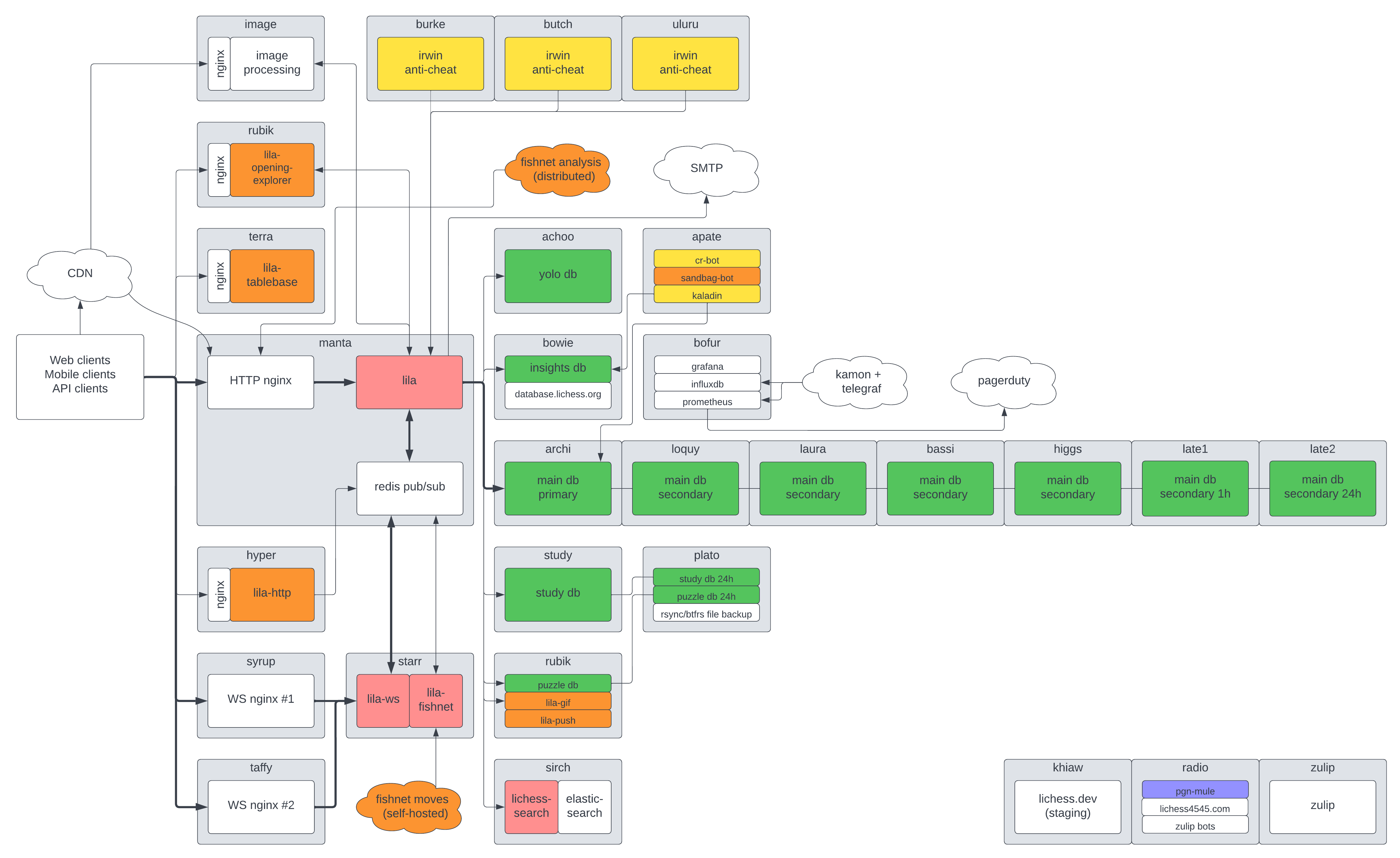
BTW, their github has better architectural picture, than overly simplified one in the article: https://raw.githubusercontent.com/lichess-org/lila/master/pu.... Unfortunately, I'm afraid, drawing something like that during interview may not land a job at faang =(
Note that they have cost per game fairly low: $0.00027, 3,671 games per dollar.
Their cost breakdown, for ones who are curious https://docs.google.com/spreadsheets/d/1Si3PMUJGR9KrpE5lngSk...
p.s. I'm not saying that Lichess's approach is the best or faang is the worst. Remember, lichess had 10 hours outage exactly because of the architecture chosen (single datacenter dependency). https://lichess.org/@/Lichess/blog/post-mortem-of-our-longes... . And outages like that are exactly the reasons why multi-datacenter and multi-region architectures are drilled down into faang engineers.
My point is is that there are cases when this approach is legit, but typical interview is laser focused on different things, and most probably won't appreciate the "old style" approach to the problem. I'm sure that if Thibault will ever decide to land in faang he will neither do whiteboard coding nor system design.
Yet another reason to be skeptical of the quality of hiring in faang if anything.
I tried this and not all the messages I sent arrived.
Edit: also includes move count but not repetition.
https://en.wikipedia.org/wiki/Forsyth%E2%80%93Edwards_Notati...
I will have to take a look, because whatever it's doing, it works very well!
Well, except for that one major outage where everything shit the bed due to some misconfiguration of IP multicast in the datacenters, or so I was told.
So, maybe if your mission isn't life critical, you can just wrongfully assume exactly-once delivery.
[1]: https://en.wikipedia.org/wiki/Pragmatic_General_Multicast
Even though nowadays I hardly have time to play, I'm still happy to support such a delightfully honorable and usable(!) open-source project.
It's a weird trend. Altruism truly does not exist
(I donated btw) (Probably more than you) (But who's counting)
There are many aspects in which they are not the best.
Ad-free, compute intensive, non-CRUD, massively scaled, complex cheat moderation, infinite puzzles/analysis, educational (studies/tactics/openings explorer), etc. All this for free. I'm curious what's the best website in your opinion
What still isn't great is the ecosystem and the build-tooling compared to Rust (part of it because of the JVM). But just language-wise, it basically has all the goodies of Rust and much more. Ofc. it's easier for Scala to have that because it does not have to balance against zero-overhead abstraction like Rust does.
Still, Scala was hyped at some point (and I find it wasn't justified). But now, the language is actually one if not the best of very-high-level-languages that is used in production and not just academic. It's kind of sad to see, that it does not receive more traction, but it does not have the marketing budget of, say, golang.
> all the goodies of Rust
Does it prevent me from using a non-thread-safe object in multiple threads? Or storing a given object which is no longer valid after the call ends?
Does it have a unified error handling culture? In Scala some prefer exceptions (with or without `using CanThrow`), some prefer the `Either` (`Result`) type.
Does it have named destructuring?
I don't understand why the author didn't just look this up in the source code. Lichess is open source and we can see exactly what this field is here, it's the average lag:
https://github.com/lichess-org/lila/blob/45b5f0cfbbf6c045ad7...
  send = (t: string, d: any, o: any = {}, noRetry = false): void => {
    const msg: Partial<MsgOut> = { t };
    if (d !== undefined) {
      if (o.withLag) d.l = Math.round(this.averageLag);
      if (o.millis >= 0) d.s = Math.round(o.millis * 0.1).toString(36);
      msg.d = d;
    }
    if (o.ackable) {
      msg.d = msg.d || {}; // can't ack message without data
      this.ackable.register(t, msg.d); // adds d.a, the ack ID we expect to get back
    }

    const message = JSON.stringify(msg);
    ...
  private schedulePing = (delay: number): void => {
    clearTimeout(this.pingSchedule);
    this.pingSchedule = setTimeout(this.pingNow, delay);
  };

  private pingNow = (): void => {
    clearTimeout(this.pingSchedule);
    clearTimeout(this.connectSchedule);
    const pingData =
      this.options.isAuth && this.pongCount % 10 == 2
        ? JSON.stringify({
            t: 'p',
            l: Math.round(0.1 * this.averageLag),
          })
        : 'null';
    try {
      this.ws!.send(pingData);
      this.lastPingTime = performance.now();
    } catch (e) {
      this.debug(e, true);
    }
    this.scheduleConnect();
  };

  private computePingDelay = (): number => this.options.pingDelay + (this.options.idle ? 1000 : 0);

  private pong = (): void => {
    clearTimeout(this.connectSchedule);
    this.schedulePing(this.computePingDelay());
    const currentLag = Math.min(performance.now() - this.lastPingTime, 10000);
    this.pongCount++;

    // Average first 4 pings, then switch to decaying average.
    const mix = this.pongCount > 4 ? 0.1 : 1 / this.pongCount;
    this.averageLag += mix * (currentLag - this.averageLag);

    pubsub.emit('socket.lag', this.averageLag);
    this.updateStats(currentLag);
};To do that, the server needs some measure of “how long does the client think the player actually took to make a move”, to later subtract latency not attributable to actual thinking from the clock.
Saw CF had some paying solution, but was wondering about a free solution
Cloudflare has a lower latency product called Argo Smart Routing [1]. When we tried Argo in 2020, we still saw 10+ ms increased latency across the board, which is unacceptable for competitive multiplayer games. That said, Discord voice still (or used to) uses Argo for voice, so there are certainly less latency-sensitive games where it would work well.
The other issue with sockets over Cloudflare (circa 2020 on business plan) is they get terminate liberally with the assumption you have a reconnection mechanism in place. I'd imagine this is acceptable for traditional WebSocket use cases, but not for games.
Services like OVH & Vultr also advertise "DDoS protection for games," but I've found these to be pretty useless in practice. We can only measure traffic that reaches our game servers, so I have no way of knowing if they're actually helping at all.
Your best bet is getting familiar with iptables and fine-tuning rules to match your game's traffic patterns. Thankfully, LLMs are pretty good at generating these rules for you nowadays if you're not already familiar with these tools. Make sure to set up something like node-exporter to be able to monitor attacks and understand where things go wrong. There have been a few other posts on HN in the past that go into more depth about game server DoS mitigation [2] [3].
I built something in the same vein for my startup (Apache 2.0 OSS, steal our code!) [4] that runs a series of load balancers in front of game servers in order to act like a mini-Cloudflare. In addition to the basics I already listed, we also have logic under the hood that (a) dynamically routes traffic to load balancers and (b) autoscales hardware based on traffic in order to absorb attacks. We're rolling out a dynamic bot attack & mitigation mechanism soon to handle more complex patterns.
[1] https://www.cloudflare.com/application-services/products/arg...
[2] https://news.ycombinator.com/item?id=35771466