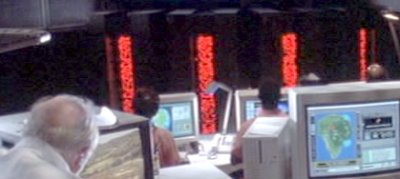
Also, the T-shirts! [2]
[0] https://www.tamikothiel.com/cm/cm-tshirt.html [1] https://www.teco.edu/~diener/
I've got docubyte's poster of the PDP-7 and it's great.
[1] http://www.starringthecomputer.com/snapshots/jurassic_park_t...
At the computer museum in Alpharetta Georgia, none of the computers are on but the connection machine panel is on.
It seems like the reason it's on like that is because it used to belong to the NSA so they took all the insides out and destroyed them when the machine was donated. The blinkenlights are driven by Raspberry Pis or something similar.
I wish this idea would take hold in academia. So many papers seem to bury simple and often powerful ideas in jargon.
We are still in touch, and have learned much from each other.
2. The purpose of a scientific paper is not to communicate it to general audiences. It's to describe, in detail, a study you performed so that others can attempt to reproduce it. The audience of a scientific paper is other scientists in the same field. Communication of the results to a general audience is another matter.
In the end none of it mattered because it was next to impossible to achieve significant fractions of the quoted "peak" performance for real world/non-embarrassingly parallel algorithms. Especially with the CM-2 and 64 bit floating point.
2. If you don't ever cater to general audiences your field is less accessible in many important ways. Which seems like intentional gatekeeping given the economic realities of #1.
Yes, exactly. I was specifically referring to publishing, because OP was specifically referring to publishing:
> I wish this idea would take hold in academia. So many papers seem to bury simple and often powerful ideas in jargon.
> If you don't ever cater to general audiences your field is less accessible in many important ways. Which seems like intentional gatekeeping given the economic realities of #1.
I never said to not ever cater to general audiences. I said that catering to general audiences is not the purpose of a research paper. Separation of concerns. Communication to general audiences is still necessary and worthwhile.
In fact, there's a feedback loop between science, technology, and capital. Not communicating results from academia breaks or reduces the effectiveness of this feedback loop. So, yes, you are absolutely correct that academic papers should be communicated to general audiences.
this statement has to be wildly exaggerated, it was a hardware project and he was a green software "kid". Anybody from Thinking Machines know what his actual job was?
The article also states that he was "lead engineer on the Connection Machine", the main product of the company. Given that he had just graduated with a bachelor's degree and the high profile startup was filled with PhD engineers and managers with experience... it's just not possible. Possibly, he was lead engineer on WAIS. 98.13.244.125 (talk) 02:54, 30 July 2019 (UTC)
8 years ago, 32 comments <https://news.ycombinator.com/item?id=12283614>
8 years ago, 61 comments <https://news.ycombinator.com/item?id=13762614>
3 years ago, 49 comments <https://news.ycombinator.com/item?id=28981275>
14 years ago, 46 comments <https://news.ycombinator.com/item?id=2079473>
6 years ago, 33 comments <https://news.ycombinator.com/item?id=18987188>
11 years ago, 11 comments <https://news.ycombinator.com/item?id=5660763>
10 years ago, 23 comments <https://news.ycombinator.com/item?id=8681061>
14 years ago, 23 comments <https://news.ycombinator.com/item?id=1205500>
16 years ago, 15 comments <https://news.ycombinator.com/item?id=191212>
15 years ago, 10 comments <https://news.ycombinator.com/item?id=723361>
16 years ago, 12 comments <https://news.ycombinator.com/item?id=311454>
17 years ago, 5 comments <https://news.ycombinator.com/item?id=31834>
Amazon's book look-up is by ISBN, which is fixed at time of assignment, and would be unlikely to change. You can look up the ISBN on any similarly indexed site.
Wikipedia's Special:Booksources page is one of those, and points at other resources including Google Books, Open Library, Amazon (recursion!), and numerous others:
<https://en.wikipedia.org/wiki/Special:BookSources?isbn=03933...>
Great moments in management, and proof that Feynman had a well developed sense of humor or this would have been a shorter story. "One of the best minds on Earth just showed up, what do we do?" "We need pencils."
When they ask him to do something not concrete, that was his answer :) so he was preferring fetching pencils to thinking about applications of some technology…
Every great man that I have known has had a certain time and place in their life that they use as a reference point; a time when things worked as they were supposed to and great things were accomplished.
I've met a few people who overdo this, though: they try to map everything new to a past success situation, but sometimes this is obviously a bad idea/poor match. So great people also have an internal compass that tells them "this situation is _different_."
I aspire to work with people that carry the ambition to seek such seminal events in their lives (rather than "business as usual" and finishing early), events that are worthy of serving as such reference points later. Life is short, and you only have one, so you had better not waste it.
Published on Sunday, January 15, 01989 • 35 years, 7 months ago
This is why he is spoken of with such reverence and why his insights have profoundly impacted both scientists and non-scientists alike. Few Nobel laureates have achieved such popular influence.
Wow, I was not disappointed.