In my own budgeting, my direct deposit can go to multiple accounts - and I do. Part goes to my "allowance" account and part goes to my "savings" account. Other people have alimony, child support, or similar withholdings from their wages.
So the question I have for the example budget on the page, can you have the freelance work go directly to savings? Or 300 be taken out of salary and go to child support without hitting the main account? If you have two incomes in a household and the breakdown is "two personal accounts and one shared account - each person contributes 10% to their own and 10% to the other person's personal account, and 80% to the shared account," can that be shown that way rather than one "main" account?
You can see an example I quickly created for this here: https://sankeymatic.com/build/?i=OoQw5gpgzgBA2gFgKwAYC6MAqIA...
For example if I earn $500 from freelance work, but spend $200 on marketing and $400 on transport to do that, then a Sankey diagram like the one on the front page where everything gets intermingled in a main account and expenses get deducted at the end make it seem like this freelance work is a good thing and I should probably do more. In a good Sankey diagram I would immedately deduct the expenses from the freelance work, and see that instead of freelance income reaching my budget I'm actually subsidizing freelance work from my salary income.
Similarly in your example it's immediately obvious that if the wage would vanish a lot of the taxes would also vanish
An example of one that disappoints is https://www.reddit.com/r/dataisbeautiful/comments/15f01pb/oc... where that one big bucket of 'total applications' loses a lot of data. Was everything from Dice ghosted? That would be useful information. I would contend that there's no value in the 'total applications' bucket in there at all other than to sum up the leftmost column - which can be done separately.
One big bucket isn't necessarily wrong, but if one is trying to show off the features of the Sankey diagram, showing it with the stronger representations that it is capable of doing can be useful.
Having seen countless poorly done ones with an everything bucket in the middle that squashes valuable relationships between the inputs and outputs... and that's a turn off for me when they are presented that way.
It'd start to be a layout algorithm at that point, but example input arm 1 being orange (everything else blue) and the orange then subdividing into its ultimate destinations. Eg. 20% of this output, 15% of this one...
The people I know who could benefit most from budgeting do not think of money as fungible. They mentally allocate different incomes to different spending categories
This seems like an opportunity for a tool to break the mold and offer a solution that fits how people feel about money vs how they “should”
If I made $3000 this month and $300 of that went to a retirement account and $1000 of that went to tax withholdings and another $300 went to child support, and of the remaining $1400, I had direct deposit put $1000 in savings and $400 in allowance... how would that be represented?
I contend that for this (these numbers are purely made up for ease of talking about):
    (income 1)
    $3000 -> $300 child support
          -> $300 company retirement plan
          -> $1000 tax withholdings
          -> $300 allowance -> {various 'fun' expenses}
          -> $1100 savings  -> {various 'not fun' expenses}

    (income 2)
    $2000 -> $700 tax withholdings
          -> $200 allowance -> {various 'fun' expenses}
          -> $1100 savings  -> {various 'not fun' expenses}
Having $2000 and $3000 go into one big bucket of a 'main' account, while working under the 'all money is fungible' fails to capture some reality of how money flows. For example, if income 1 loses their job, child support goes to $0 (not $300 from income 2) as does the $300 for retirement and the $1000 for tax withholdings.
Money itself is fungible, else you'd be marking every single dollar bill specifically with some unique mark.
But still, I'm curious what you mean by your last paragraph, do apps that utilize the envelope method such as You Need A Budget not already help you do this?
- health saving accounts
- pre-taxable gross income
- tax rate for FICA (social security income tax)
- medicare tax
- medicare premium
- SSDI additional income tax (5-stage)
- 401K withholding
- stock matching by its company (3-stage)
- flow disruption by separate activation of retirement benefits (9-stage)
- long-term disability tax
- any local/state income tax and their eccentric stages.
What you want to avoid is a straight line to the "budget" bucket but instead toward a "taxed cash-on-hand" and "untaxed cash-on-hand" in general-ledger-speak.
So you have several Sankey groupings like:
- individual earnings
- pretaxed lockup
- taxes
- deferment to next year's tax return
- taxable benefits (payout of SSRB, 401k, annuity, student saving accounts, interest earned, capital gains/losses (including recent "bitcoins"
Then you can fan out to crazy spending stuff: I don't bother with that part myself.
Also, you can configure the flows completely freely, so each case you mention will work easily!
When you say freelance goes directly to savings, are you saying you want something like "no matter what I earn from freelance it goes to savings"?
Yes. Or another account so that you have clear accounting for tax purposes. "This account gets freelance money and this money was spent for home office expenses related to the freelance work which is deductible from that income stream."
Child support obligations come out of one income as a percentage of that income - but not the other. A two income family where the husband is paying 10% of wages to child support for example - its 10% of his $1000 / month that never hits the main account, but her $500 /month is untouched and goes to the shared account. This could be complicated if she was a 1099 worker and needed to keep track of that money separately so that it could have the proper taxes taken out of that and have the resulting "actual money" that is spendable go into the "can be spent" bucket.
While money is fungible, the depiction of money flows when it hits a "one big bucket" makes it so that the value behind the Sankey diagram is lost. Is all the money that your household makes taxed the same way? Do you file jointly or separately? Is there a separate account for isolating certain expenses for reporting purposes?
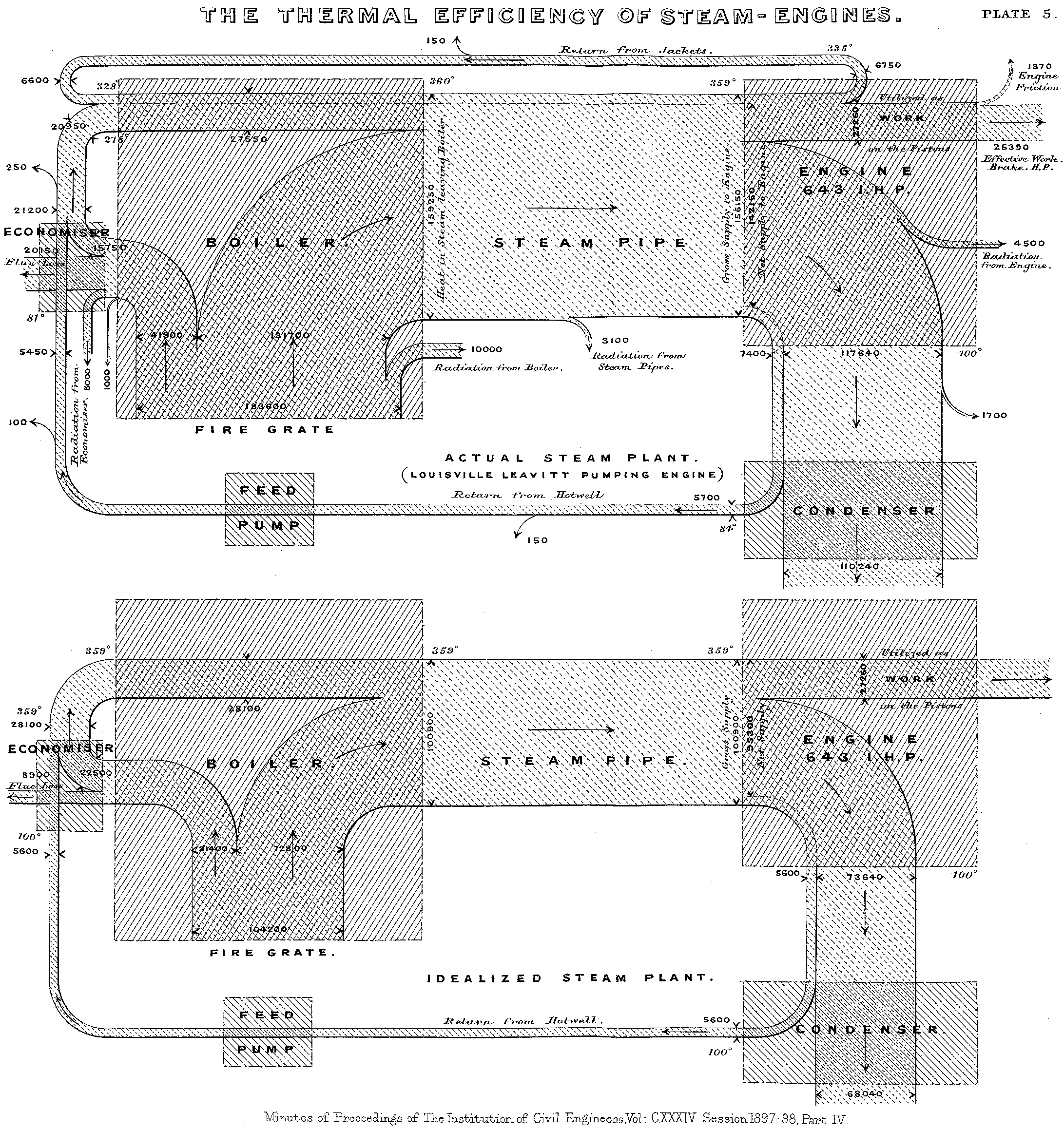
https://alternativeenergyatunc.wordpress.com/wp-content/uplo... is useful and one will note the lack of a big bucket. Or consider the original one - https://upload.wikimedia.org/wikipedia/commons/1/10/JIE_Sank...
There is information lost when it goes to one big bucket.
I referred my sister last week and I got a discount. So I am going to throw this out there in case anyone wants to try it:
Speaking just for myself, I've looked at personal finance Sankey diagrams on Reddit many times and never understood what use they were to anyone, what actionable insights were provided that you didn't already get some other way.
Different people consume data in different ways. For some, data is easier to understand when arranged in tables, black on white, as they can skim through a lot of datasets quite easily.
Others benefit by a colorful, graphical representation, which Sankey provides.
From my experience in consumer facing applications, I'd assume that a colorful, flashy, nice-looking Sankey could boost sales. People prefer things that look nice.
OFX is one alternative to CSV for transaction data.
ofparse parses OFX: https://pypi.org/project/ofxparse/
W3C ILP Interledger protocol is for inter-ledger data for traditional and digital ledgers. ILP also has a message spec for transactions.
https://www.budgetflow.cc/privacy_policy
and ToS:
I did hire a lawyer to write one for me and got some nonsense irrelevant references to mobile apps and user created content, full of typos, so back to the start... (to be clear, the extra clauses weren't the issue, but a template full of typos seems inherently less trustworthy to me than a random template without typos)
``` Blue Oak Model
Each contributor licenses you to do everything with this software that would otherwise infringe that contributor’s copyright in it.
You must ensure that everyone who gets a copy of any part of this software from you, with or without changes, also gets the text of this license or a link to https://blueoakcouncil.org/license/1.0.0.
``` MIT
Permission is hereby granted, free of charge, to any person obtaining a copy of this software and associated documentation files (the “Software”), to deal in the Software without restriction, including without limitation the rights to use, copy, modify, merge, publish, distribute, sublicense, and/or sell copies of the Software, and to permit persons to whom the Software is furnished to do so, subject to the following conditions:
The above copyright notice and this permission notice shall be included in all copies or substantial portions of the Software.
[0] https://fastpathlicense.com/
The naming is really hard, the where first called "nodes", but that was hard to understand for many. I habe to analyze this again, maybe you are onto something by just naming them income/expense/account/grouping etc.
The idea to take or send a percentage is very interesting, basically a generalization of how it currently works.
Really valuable feedback, thank you!
/s
Budgets are useful for savings goals, but it's difficult to plan day-to-day spending beyond very high-level categories.
I personally find retrospective diagrams more useful - a breakdown of what my actual expenses were so that I can update my mental model and find subscriptions (or habits) to eliminate.
It is a great graphing tool!!!
It’s essentially a personal finance app plugged with Plaid, autocatergorization and whatnot, and the dashboard automatically dynamically updates a Sankey chart of your monthly spending.
Example https://imgur.com/a/olpW97s
Shameless plug, https://www.conquest.money/
But I like the idea of automatically generating a sankey from your expenses, good job on that!
Why is there no company / legal entity / contact information on the home page?
It's an interesting idea, but if you want budget information about people, you need to excel at being above board.
The data is stored in a database that is on the server which serves the page!
Sadly I don’t have enough time next to my day job, so progress is slow. I am hoping that it might gain some popularity, so I can maybe start allocating more time to this project!
The "main account" is just thrown in to provide some sort of intermediate step. In most people's cases, it's just about income and outgoings.
Edit: Found it, happens on the landing page when not logged in. Thanks!
[0] https://www.apptio.com/products/cloudability/true-cost-explo...
* Disclosure - I work for IBM
    3500 in -> go to parents house -> 1000 into bitcoin
                                   ->  100 into speculative coins on bull market, or making sorts in bear markets
                                   ->  300 into gold
                                   ->  600 to stocks with dividend growth
                                   ->  400 to real state or REITs
                                   ->  200 to speculative stocks
                                   ->  500 to your bank account (with some interest)
                                   ->  200 to cash, for those days you go out of your parents home
                                   ->  200 to presents for your parents
Repeat and reinvest benefits into non correlative actives.
Once you reach a balance of ((90 years - your age) x 12 months) * (3500 * N), maybe you can leave your parents home (not mandatory), and try to race with your yearly benefices, against the *real* inflation. N is a magic number, to cover the compound inflation during all those years, without penalizing too much the first years.
Maybe next year 3500/month is still ok, but in 30 years it won't.
If you're over 70's, do not follow this advice, take the 3500 and live la vida loca each month. Like in the "latin" song from the country that did never ever speak "latin".
Have a nice day.
Now seriously: The real important stuff when working with budgets, is to "see" the "estimate Vs real" thing.
Edit: Back alive :)
So yeah I'm not sure how this is different from other budgeting apps since I never used them, but this was the one that made me actually do that. Thank you so much.
In my case, we do project level budget and it has to flow upstream so I need to ensure that the numbers add up. From my preliminary test, it does not look like I can do that with this tool (yet?). I want to enter the leaf / most granular level numbers and then do the group hierarchy and not have to enter every number from top to bottom.
I'm wondering about how budgeting tools like this help with planning vs budget auditing? Or maybe what I'm thinking of has a different name?
When I think of budget planning, I'd like a tool to tell me what would happen to Y if I did X (e.g. how would buying a car today [purchase plus recurring costs] effect my maximum home down payment in 12 months)? Or if I want A, what can do to B, C, and D to make it happen (e.g. if I want to save for a trip to New Zealand next year, how could adjust my budget to reach my goal)?
I'm not sure if what I'm describing is planning or not, but I can imagine visualizations helping with it!
Hope it improves though so thumbs up