Our global energy consumption in 2008 was estimated to be 474 exajoules. The total energy received by the earth from the sun during a year is about 5 million exajoules, a fraction of which reaches the surface. 5 million is much more than 474. But at a seemingly modest 2% per year growth rate (as it was between 1980 and 2006), our energy consumption will match those 5 million exajoules in less than 500 years!
Think about that: if energy consumption growth continues at the current pace, then in 500 years we'll either be using ALL solar energy received by the earth (leaving none for the biosphere), or we'll have figured out some magic technology to produce 5 million exajoules of energy per year. Assuming the magic technology, where are we going to get rid of all that extra heat? It would effectively be like having a second sun on earth, cooking us in place.
edit: I copied the numbers above from a post I wrote in 2010, so it may be a bit out of date. But Sabine Hossenfelder recently made a video where she talked about a similar timescale, i.e. boiling oceans in 400 years: https://www.youtube.com/watch?v=9vRtA7STvH4
Maybe a few hundred years from now, Internet archaeologists will find your comment as one of the first harbingers of the coming World Energy Crisis, much as we see the 1912 Rodney & Otamatea Times "Coal Consumption Affecting Climate" snippet today.[0]
Then they'll find this comment...
----
[0] https://paperspast.natlib.govt.nz/newspapers/rodney-and-otam...
A computer today costs roughly the same as a computer in the 1980s, and it also consumes roughly the same amount of energy as a computer from that era. We got faster computers because we got better at making transistors.
If we look at laptops, a device which consumes 200W already gets hot enough that it is uncomfortable to actually place on your lap. A 1kW desktop computer is pretty much impossible to cool.
At our current population, those 5 million exajoules a year is a constant power consumption of roughly 16 megawatt per person. For comparison, that's about the same magnitude of energy you'd need for every human to launch a Falcon 9 to eat lunch in the ISS. Once figures get this big, you simply run out of things to do.
It's been well known since at least The limits to growth[1], 51 years ago.
https://paperspast.natlib.govt.nz/newspapers/ROTWKG19120814....
Maybe in 1950 people would have argued that soldering all those vacuum tubes would be too difficult, and they'd have been correct, but transistors and CAD changed the entire reference frame.
If only collective intelligence could rise above it all we might be well on the way to enjoying the creation of a more efficient, less wasteful, and more worthwhile future. . . but that too mentally taxing to engage with. . .so it goes
The world population is predicted to peak about 30% above where it is now and then fall back -- maybe to 7 billion people sustained. We seem to need about 200 GJ per person to be really happy [1], so let's assume 300 GJ per person.
We should be able to get by, happily, on 2000 EJ per year sustained. By your figures, that's less than 1% of what the sun provides.
[1] https://esajournals.onlinelibrary.wiley.com/doi/10.1002/ecs2...
Then at that rate we'd have 100,000 years of Tidal energy available even if we used it for the totality of our energy needs (and 10,000,000 years if we use it for 1% of our needs as taken in the paper). And that was basically the point of the person you're responding to: it's not so much that tidal energy is non-renewable, the problem is that the paper assume exponential consumption growth, and exponential growth is unsustainable no matter what.
If my maths is right, that's about 40,000 kcal per person per day, or about 15 times the energy consumption of an average adult.
I'm trying to figure out if that's a lot or not. On the one hand, not: this ratio is not strictly bounded in any way, and the human energy consumption is an arbitrary denominator. Still, a very rough interpretation is to say, we consume daily, on average, the fruit of work of 15 people.
Of course, that is very skewed. I wonder what the ratio looks like for an average American or European - must be much more.
It goes to show what a gilded life we live (on average!!!). Before industrial revolution, all energy basically was muscle power, and it's like for every 1 person alive, we have 15 servants turning the generator for us. I suppose some of this number is literal service providers, fed by food produced by powered agriculture.
Is there a logical upper bound to this number? Is there some energy amount we can't use given sufficient supply? Ultimately, all energy we produce is spent on humans so our energy consumption is a yardstick for human energy needs.
But that's not quite right either; a lot of energy is wasted. I wonder how much of this number is clothes that go straight from factory to landfill, AC left overnight, inefficient engines and energy storage.
I don't really have a point, other than I think this is an interesting fraction to look at.
I got some numbers form a random result in google: http://www.ejolt.org/2012/12/human-energy-use-endosomatic-ex...
Endosomatic energy (i.e. food): 3.5GJ/year/person
Exosomatically energy (i.e. firewood, electricity, solar, fossil fuel, whatever):
hunter-gatherers: 20 GJ/year/person (i.e. x6)
agriculturalists using animals: 60 GJ/year/person (i.e. x17)
industrial society: 200–300 GJ/year/person (i.e. x57-x86)
As someone with a physics background... well... it's within an order of magnitude or two, so that sounds close enough to be probably accurate.
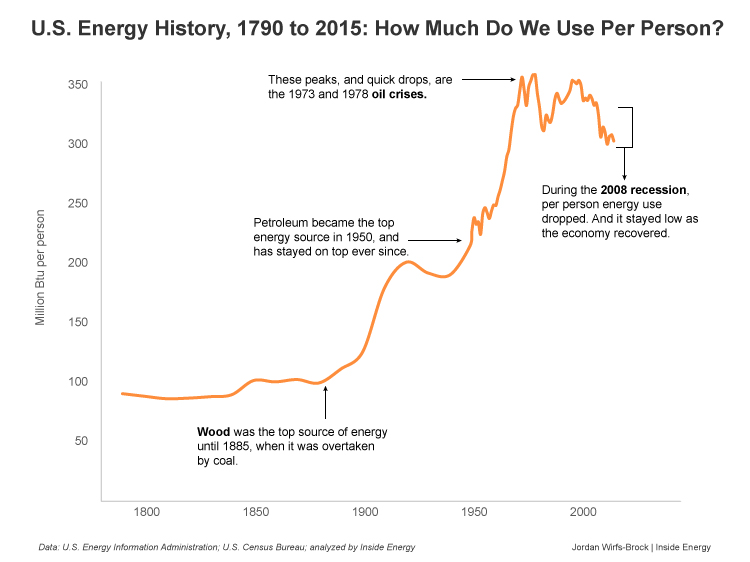
http://insideenergy.org/wp-content/uploads//2017/01/historic...
from:
This doesn't account for all the “imported energy” that comes when you outsource your industrial production abroad. Granted even then the energy consumption doesn't increase exponentially anymore, but it's not flat either.
The implausibly is staggering, we'd run out of resources to build extractors way before causing any meaningful shift in the rotation: if the monstrous land barriers of the continents take millions of years to drain a small percentage of the energy, we have zero hope of achieving much more with the solid mass available to us on Earth, short of a Dyson sphere-level breakthrough in "moving mass around", oh, and by the way it has to happen deep underwater as well, and we need to channel all the energy somewhere useful! Way harder than just making a ginormous but thin solar array in space, which is almost certainly what we'd do instead from a "energy cost to arrange matter" optimization POV.
Earth's mass is 10^24 kg.
E_earth = mc^2 = 9 * 10^40 J
E_current * 1.02^x = E_earth
474 * 10^18 * 1.02^x = 9 * 10^40
x = 2357.91 years
At a modest 2% growth we would be using up the entire Earth's mass in energy per year in only 2358 years.
So this is a bit of much ado about nothing. We're not going to exceed low single digits percentage points of the energy reaching the planet from the Sun.
Heat dissipation is relatively easy if we use 1% equivalent of Solar energy on Earth: the water cycle can speed up in response to positive forcings and slow down in response to negative forcings. This is why the planet's climate has been so stable in the sense of being a random walk centered on an optimum that supports the sort of life that we have on the planet. Similar observations explain Mars' and Venus' inhospitability: there's not enough atmosphere, much less liquid water on Mars to drive a similar thermostatic system, while Venus' climate is pegged at a maximum, with albedo as high as it can reasonably go, and it can't cool itself significantly with anything like a water cycle.
Imagine the sphere of a civilization expanding in space at some speed, in all directions. The volume of this sphere would equal time cubed (t^3) times some constant.
Now suppose this civilization has a magical power source that allows them to keep growing power consumption exponentially. So power consumption would equal 2^t (where time unit = one doubling time, 35 years in the case of 2% growth) times some constant.
2^t will always overtake t^3 no matter the constants, so power density of the sphere trends to infinity, so the civilization will cook itself in waste heat.
But yeah I expect we’ll not make it 100 years let alone 500. Our ability to change our behavior to avoid obvious problems is poor bordering on suicidal.
So nuclear?
It's the same reason that the Earth radiates exactly as much energy as it receives from the sun, just a larger number of lower energy, higher entropy photons. What the sun really provides is a source of low entropy.
Energy consumption has decoupled from population growth rates and economic growth.
How much energy will we consume in 1,000 years? Most projections of the population have it stabilizing at around 15 billion. But continuing at its current growth rate (an optimistic assumption I think), gets us to about 150 trillion humans in 1,000 years.
And at 2% growth rate, each of those humans will consume 20,000 times more energy than a circa 2023 human.
Now state of the art technology wastes about 80% of the energy consumed, so this is equivalent to 100,000 times more useful energy consumed per human.
So the physics in this page is a good examination of the surprisingly large compounding effects of unchecked exponential growth.
There's a 2nd big assumption:
That tidal energy extracted is additional Earth's rotational energy loss above what Earth does by itself.
According to the paper, tidal energy is dissipated through friction between ocean water & the seafloor. This dissipated energy subtracts from Earth's rotational energy. And some rotational energy is transferred to the moon (which makes the moon move further out). Ok so far.
Author's 2nd assumption is that as tidal energy is tapped, this is extra energy that subtracts from Earth's rotation.
But is it? It might also be that tidal energy extracted by humans, comes out of some fixed 'budget', and the remainder is dissipated naturally. More tidal energy extracted by humans -> less tidal energy dissipated through ocean vs. seafloor friction.
Kind of like solar influx: it's a huge but (apart from fluctuations) fixed amount. We can tap some % of that potential, but what's available doesn't increase. And what humans don't tap, gets absorbed / radiated out by other natural processes.
I won't even hazard a guess. But it would be interesting to figure out which of those applies.
Maybe I'm naive and simple minded. But that just seems insane.
If I'm doing the math right, at 2.3% growth = we produce more energy than the Sun in 4500 years.
It doesn't matter how many years it is. It's never happening.
Just look at how damn hot and inhospitable the sun is. We're not producing more energy here!
It'd be infinitely more plausible to build a Dyson sphere around the Sun, and call me naive on that, too, but I'm skeptical that's ever gonna happen either.
Not so. The calculation of the 1031 years is equation 19 and assumes the decrease in rotational energy all goes to human purposes.
The flaw in the OP is the assumption that human consumption keeps rising at .02 per year for 1031 years: we would probably boil the oceans away because of the waste heat from using that much electrical power.
Intuitively, if we extract energy from the tides, tides will be less tall and the speed of water will be smaller. Ocean currents will slow down too.
What I don't know is, less friction on the seafloor means that we would actually make Earth slow down less faster than it would do if left alone?
I keep posting this link here on HN but, once again, it seems very appropriate:
> The upshot is that at a 2.3% growth rate (conveniently chosen to represent a 10× increase every century), we would reach boiling temperature in about 400 years.
https://dothemath.ucsd.edu/2012/04/economist-meets-physicist...
Edit: The link points out that in 1,400 years we'd be using energy at the rate produced by the sun and in 2,500 years at the rate of the entire Milky Way. Even if we solved the heat radiation problem, it seems unlikely we'd be able to obtain fuel for our fusion reactors at a sufficient rate given the speed of light and the density of matter in the universe.
Although the link is useful for the thermodynamic calculations, there are two major problems with the argument as presented:
1. Right up front the physicist arbitrarily bans space travel. The economist, being an agreeable man who'd probably rather be making smalltalk with a pleasant member of the opposite sex rather than defending his whole profession to a bolshie physicist, accepts this limitation, but he shouldn't have done. Nothing in economics is predicated on a space travel ban. We are already obtaining economic growth from space via satellites and that era has barely got started. None of the physics arguments work if you make the relatively small leap to putting factories, power plants etc on moons, asteroids, space stations or other planets. This doesn't require colonization assuming progress in robotics.
2. Much more seriously, the physicist doesn't understand what growth or wealth mean in an economic context. The economist tries patiently to explain this to him many times, and he just doesn't get it. This is a very common problem when talking about economics because people aren't used to the expansive definition of wealth economists use, so often conflate it with other things like money or (in this case) energy.
You can increase wealth indefinitely even with a stable population and stable energy/resource usage. This isn't controversial or weird, it's just part of how wealth is defined. The VR example is one attempt, dessert another attempt to explain this to him, but he just doesn't get it until the next day when he suddenly has an epiphany but decides it wasn't his fault because he personally distinguishes between "growth" and "development". No such distinction is recognized by actual economists for valid reasons. But you don't get to claim there's a problem with economics just because you failed to understand the lingo of the field.
However photovoltaic and wind does not produce much waste heat. Arguably solar and wind cannot scale 1000x but then you could have non thermal fusion like Helion's https://www.helionenergy.com/technology/.
Btw, thermal power is already showing limits (rivers overheating in summers), we don't have to wait 400 years to see its failure.
Long-term ongoing economic growth, expressed as a constant percentage, is baked in to most current orthodox economics and economic policy. Even apparent mavericks such as Thomas Piketty assume that growth will continue interminably (noted in Capital in the Twenty-First Century).
Rather than being a critique of Liu, you've actually written a criticism of those he himself is generally addressing.
Whether it is or isn't, the optimal strategy for a nation is likely exponential growth until it can't, and then switch as quickly as can be done with the least problems.
Since nations are competing, and we're talking about exponentials here, the cost for cutting off exponential economic growth too soon is likely to become irrelevant to the future, which every nation is going to strive to avoid.
Cryptocurrencies are kind of going in that direction, where the "value" that is reported as economic growth doesn't correspond to any kind of real-world matter or activity, but is simply assigned to some specific group of bits.
I can kind of believe that this virtual kind of growth could continue a long time without boiling the planet, but of course that doesn't make things less absurd, as the "value" would represent nothing objectively useful and would have to be maintained artificially - either through scarcity mechanisms like PoW etc, or through locked-down devices and ecosystems.
So that kind of "growth" could go on forever without burning the planet but would probably be a step back for civilization.
It’s like saying “you can’t imagine a bigger number than I can.” A person can always imagine a bigger number, and the marginal cost of doing so is merely what is necessary to store the larger number in a ledger.
As a forecast which may or may not happen? Yes.
As an actual outcome that has been decided a priori? No, not at all. Only planned economies tried to do that.
so far it has been the case with human economics across all countries/economies. yes some shareholders will be zeroed out during recession, but others will continue on the growth journey
I suppose spacefaring humans might use that kind of power but if they are living in space they are no longer part of the biosphere of Earth.
Sure, why not?
It's absurd today for the average person, but it's the kind of thing rich people get to do already, and looking at the rich today is a decent (though imperfect because inflation and invention don't work like that) hint for what normal people can afford in a richer future.
That's literally the billionaire lifestyle.
Meanwhile cryptocurrency is seeing decades of power efficiency undone as miners bring old power plants online and want to burn tyres to power their scams.
In the future, we might use a lot of energy for the we cannot imagine today.
In the future, we might stop using every the way we do today.
In the future, we may produce and consume substantial energy in places other than earth's surface.
In the future, the concept of energy itself might be different, much like people couldn't imagine the type of energy involved in nuclear fission.
In reality we're already certain to hit a population maximum in just two+ decades, and not only that but the world is very likely to be on a negative population growth curve after that for some time. And we're going to need some new tech revolution to drive energy demand in developed countries up much more than it is, and the developing world's per-capita demand will not likely exceed the developed world's once fully developed.
I.e., we're not growing forever, the end of population growth is around the corner, and the end of energy demand growth is not much further.
I realize the big issue is settled here but just to scope this detail: the total land area of earth is coincidentally approximately 150 million km^2
At 150 trillion humans each human would get just about a square meter. Many of those square meters are uninhabitable.
Similarly solar isn't renewable because at some point the Sun is going to run out of hydrogen, and if you made a dyson sphere to capture all of the Sun's energy you would wipe out life on earth.
[1] https://www.un.org/en/global-issues/population
[2] https://earth4all.life/news/press-release-global-population-...
For that to happen we need almost complete automation, which would provide cheap food, cheap housing, cheap healthcare, and lack of worry about the immediate future.
Even if you can sustain 1% increase in population per year, 1000 years of prosperity will result in
(8 billion)*(1.01^1000) = 167673 billion = 167 trillion people
(1% is roughly the current population growth, but it's slowing down)
https://en.wikipedia.org/wiki/Projections_of_population_grow...
Technically-technically, no forms of energy "generation" (technically just conversion) are 100% efficient so something is always lost to heat. I guess the important question is, what is the net effect in changing that kind of energy into purely thermal energy?
That is, there's a constant incoming energy flux. That's not to say that there isn't some maximum amount of available wind energy, or some maximum amount of energy that can be extracted from wind without causing other effects (even excepting, say, bird strikes and the like).
But wind isn't "used up", there will be more wind tomorrow, so long as the sun shines and there's an atmosphere.
Look up Hadley cells. https://groups.seas.harvard.edu/climate/eli/research/equable...
Warm air rises near the tropics, rotating with the Earth. It then goes towards the temperate zone, still rotating with the Earth to form the jet stream. It then falls, creating the trade winds as it slows down. It then is sucked back towards the tropics, creating a reverse trade wind because it is only going as fast as the temperate zone. And then it rises, completing the cycle.
The prevailing wind in both temperate zones and the tropics is therefore due to the Earth's rotation.
It would take quite a lot of planning and work but maybe there are ways to mitigate these losses by balancing out the effects between different processes. Typically nature finds such dynamic equilibria as a matter of course -- I suspect anything humans attempt to control will not be as resilient or sound.
The question few seem to ask is should we be this (literally) power hungry in the first place?
No we shouldn't be this power hungry, we've effectively never replaced an energy source by another... we keep on stacking the new ones on top of more of the old ones [1].
[1] https://ourworldindata.org/grapher/global-energy-substitutio...
Absolutely!! Reducing excess consumption will always be easier than making up for it later because the latter inevitably causes losses which become heat from which "useful work" can never be recovered. We can avoid those losses by simply never requiring them in the first place.
But too many have the Myth Of Progress burrowed deep into their core ideologies and will fight tooth and nail to keep the trivial conveniences they've built their daily routines around.
On your first point, though, I'm not sure it will be a net negative considering the human component in the equation, and anyway, outdoor cats are orders of magnitude worse for birds than wind turbines are, not to mention concrete jungles with no trees and high average noise levels.
Nobody asks because the answer is "no" - huge parts of our lives are absurdly inefficient, wasteful, or just gratuitous when it comes to energy usage. Heating, transport, all of it. Computing, too.
However, bird strikes can be mitigated via careful placement, etc. Also, we are not close to the point where wind farms impact wind currents.
I'm lazy, so I'm hoping some geologist will stop by and educate me.
See https://www.pnas.org/doi/abs/10.1073/pnas.1517943113, "Delayed fungal evolution did not cause the Paleozoic peak in coal production"
Stop burning petroleum and wait long enough and it will re-form just fine.
Post humanity, post-earth time scales might not be relevant to most discussions.
Until one runs out of the feedstock one is using to make more fissionable material. You're not recycling actually burned fission fuel. You're making more fission fuel out of isotopes that don't fission at all.
Important safety tip.
Current tidal generators work either by inserting a turbine into the moving water; or by a dam that captures the high tide, then releases it through a turbine at low tide. Depending on the exact details, it could slow down the rate at which the current later flows over the seabed, which would reduce the energy dissipated from friction with the seabed. But, there's no guarantee that this would compensate for the energy taken by the tidal power generator.
You could imagine a different type of tidal power generator: covering the seabed with a giant treadmill. As water flows past, it drags the surface of the treadmill, generating power. My guess is this would dissipate less total energy than the natural friction of the seabed does. But, it doesn't sound very practical.
(Anyway, all of this is a moot point. As other commenters have noted, if human energy consumption actually were to grow 2% annually for 1000 years, we'd have way bigger problems than the moon becoming tidally locked.)
[1] https://en.wikipedia.org/wiki/Tidal_acceleration#Angular_mom...
>it will take about 10.468 billion years for Earth to lock to the Moon naturally.
Expecting a deviation from this is kinda “climate change will slow down in the 2000s and 2010s from green energy” level magical thinking.
An important caveat: this article assumes that energy consumption will continue to increase exponentially to get the 1000 year timeline of draining the rotational energy of the Earth.
https://news.ycombinator.com/item?id=37122796 | https://www.mdpi.com/2673-4060/4/3/32
https://news.ycombinator.com/item?id=37313586 | https://medium.com/@samyoureyes/the-busy-workers-handbook-to...
https://overshoot.footprintnetwork.org/newsroom/country-over...
https://en.wikipedia.org/wiki/Planetary_boundaries
There are 8 billion people in the world, and we’re on track to have 10 by end of century. Which is more likely? Everyone lives like a European (from a consumption perspective)? Or a bunch of people don’t or die while some do?
But so what if we made a more reasonable assumption that annual energy usage will stabilize at, say, 5X of what it is currently, and the (unreasonable) assumption that we get 100% of that energy from tides.
Then how much of a rotational slowdown do we get after 1000 years?
Equivalently, after 1000 years, we'd see a rotational slowdown of around 0.001%.
So maybe not technically renewable, but many orders of magnitude more renewable than e.g. fossil fuels...
This theory is very interesting, although the author presents it with too much confidence for such big claims.
> The Earth's rotational kinetic energy is about 10²9 J, and the world uses something like 10²² J/year, so you could power the entire world for millions of years before you'd run out of rotational energy.
(my phone somehow has a ² but not a ^9; the first number is supposed to be 1e29)
You understand incorrectly. Wind is largely a form of solar energy. The sun heats the earth and its atmosphere at different rates depending on the location, and wind is primarily the result of temperature differentials.
The Coriolis effect can definitely affect how wind behaves, but it doesn't provide the energy. E.g. a hurricane's winds travel in a circle/spiral due to the Coriolis effect, but a hurricane is a heat engine that gets its energy from the sun heating the oceans.
This is the case with solar energy: the Sun's energy output doesn't change depending on whether we use it or not. Renewable doesn't mean perpetual - that'd be physically impossible for all we know.
If we reach peaked our energy consumption in merely 250 years, that's less than 150 times our current consumption. I didn't do the math, but would date to suggest this gives us a few years more time on this planet.
The world used 9,717 million tons of oil equivalent in 2017.
Plugging in our growth rate that would mean the world used the equivalent of 13 tons of oil in 986 which is 515.84 million BTU.
US residents making <$20k and having wood as their primary heating fuel source use 50 million BTU of wood a year.
While we can argue specifics 10 households worth of fuel sounds a little low for a world with a population of 390 million.
Eh, who am I to criticize? They say that your early grad school years are a time to publish large amounts of papers that you don't think are likely to stick. This is a little bit out there even by this standard though.
The abstract sounds... lets go with "not completely implausible" but the assertion that extracting 1% of the Earth's energy from the tidal sloshing would slow the earth and tidally lock it in 1000 years feels extreme. Of the extreme assertions require extreme evidence variety.
The world's energy consumption was about 5.67x10²⁰ Joules in 2013.[18] This number has increased by more than 2% per year on average in the last 50 years. The average world economic growth rate in the last 50 years is about 3%, which requires a corresponding increase in the energy supply. So, the 2% growth rate for world energy consumption should be a conservative assumption.
Four billion times as much energy as we do today. I don't think there's much risk of us growing our population to that degree, nor of us being that power hungry if our population stabilizes. We'll be either extinct or back to a sustainable agrarian population far before we reach that upper limit. Honestly, if we produced that much power, I suspect we'd have long since boiled the oceans, making the whole argument moot.
TL;DR: Don't extrapolate FAR into the future based on a small (relatively) set of data points.
This is bananas. I stopped right there and closed it. I see somewhere else in this thread that they tried to do that by extrapolating an exponential growth curve through an outlier (the industrial revolution!) for a thousand years. Maybe that explains it.
But... that's not an error. That's just bananas. Absolutely insane.
Some quick googling, FWIW, gives the earth's rotational kinetic energy as a quite plausible 2.1e29 J (though a little of this will not be extractable tidally, as the earth will lock to the moon at a few percent of rotation speed), and the total world energy consumption as 22.8 TWh/year. So the back of my envelope says that at current consumption we have a hair over... two trillion years.
His doomsday scenario of total tidal locking would never occur -- as energy is removed from the rotation of the Earth, the maximum power level that can be extracted would decrease. Also, the cost-efficiency would also drop.
There would be a point where the day is "merely" longer, the Earth is not yet tidally locked to the Moon, but extracting more tidal energy is no longer worth the trouble.
The original point however is still valid. Even if the rotation was slowed to just 1/2 of what it is now, the Earth would have a 48-hour day and that would obviously cause absolute havoc with the environment.
Rather than fluffy repetitions of the slogans of in-groups, it's an attempt to explore long term impacts using fundamental scientific principles, none of which are individually too complex.
And if we don't agree with the 2% annual energy growth rate for 1000 years then that's fine, we can fiddle the numbers for what we believe, and the same analysis can be valuable even if it ends up supporting a different conclusion.
I'm interested by the language style as well, it reads like they put it through a filter to generate "simple English" as a deliberate choice.
Even 100% clean energy, if infused into the system may increase temperature, or speed up circulation of currents, and other effects.
Of course, it's not nesessary all energy goes into temperature. Some can be conserved, e.g. as chemicals.
But in general, the more energy we have in our disposal, the more potential for damage.
We will dig deeper, smelt more ore, etc, etc.
But that is not really correct. it would be but there are large land masses interfering with the process. Ocean tides are better conceptualized as water sloshing in a bathtub.
[EDIT - Reversed AI's rewrite of my humble English, raw best with all its flaws, and whilst AI version good, just had an air of sterility and not me.]