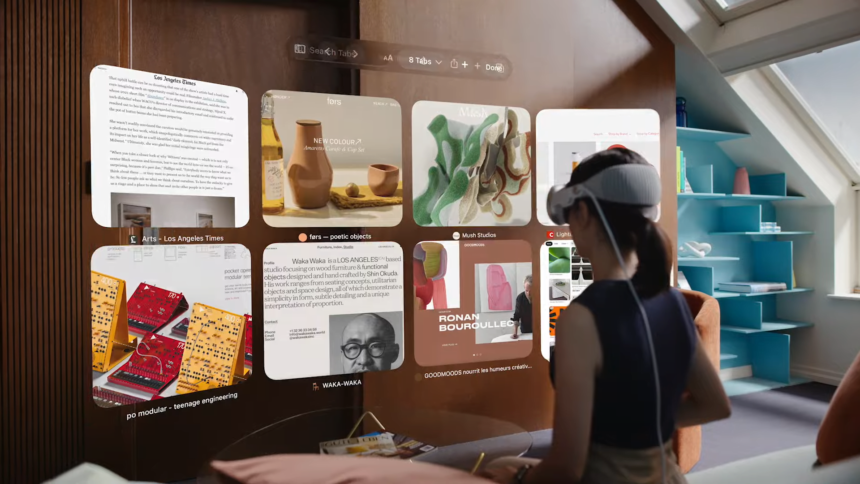
We hope & expect consumers to love the Apple headset(!), because it seems better/more focused on productivity use cases than the gaming headsets currently on the market. But in order for it to "actually replace a laptop", bringing iPad/iPhone apps into VR isn't quite enough, in our opinion.
Given that this is a full-blown M2 on-board, I think relegating it to "just like an iPad" is a little lacking in foresight, but I guess we'll all see how it pans out...
I did but all I saw was a virtual mirror of the Mac's screen. Not apps. The mirror is the app, more like running a remote desktop app on the 3D world.
I didn't see VS Code running on its own virtual window. I didn't see iTerm running on its own window, separate to VS Code's. I didn't see a Mac's Firefox running on its own window, separate to the other 2. Sure, you can run visionOS's Safari, and probably even visionOS's Firefox in the future, or their iPad counterparts, but they're not nearly as powerful as the desktop's.
You can already mirror your Mac to an iPad. In fact, you can use the iPad as an extra screen for your Mac. In that sense, AVP is in fact not much more than an iPad with a spatial interface.
You can already do that with something like XReal Air for 10x less (both the price and the weight).
> Given that this is a full-blown M2 on-board, I think relegating it to "just like an iPad" is a little lacking in foresight
The ability to have multiple virtual monitors with a mac? Thats a game changer (potentially). The ability to run multiple virtual monitors with an iPad? Pretty cool I guess, not sure what I'd use them for though. It'd be nice for watching movies, but again, see above, XReal (and probably a load of others by now) already has that covered.
Put it this way, theres a reason sidecar lets you use your ipad as a second display for your mac and not the other way around
This product is in the position to make that all super streamlined, but it seems that it won’t be.
To be fair, my experience is in games and non-gaming apps might not be as bad.
Also, I don’t personally own a Mac. I have a PC, and while I might be willing to plop down the money for the Vision Pro if it worked completely standalone but I absolutely won’t get it and a Mac.
why would you try to run a powerhouse app on a computer strapped to your face vs running it on the hardware it's designed to run on and share the screen of that system to the one strapped to your face? Just like they demonstrated being a key selling point. powerhouse apps tend to make the hardware run the fans from all of the heat being generated. no way would i want that near my face
This is what you should do. Copy Apple. Make your headset work with Android. Allow Linux and Windows to also be able to work through the headset with existing computers, by providing virtual screens. In the future you can offer a version of your headset with either Linux or Windows, but Android must definitely be in the first version of your headset. This is the only chance you have.
If you are developing novel AR experiences why wouldn't you want to be building them in a fully 3d environment, with new tools that can take advantage of all that brings? Instead we are forced back into the world of 2d, which shows an unfortunate lack of conviction on Apple's part.
If we are serious about this being the future of computing we need to build native tooling. This is a virtuous cycle, tools beget tools, but Apple needs to be willing to relinquish some control.
Would you not have said the same thing about iPhone 1? It was absolutely the “future of computing” (whatever the hell that means) in terms of mobile ubiquity, but you could develop anything on the device itself at the time (or really, even today).
Every professional I know who owns an iPad also owns a macOS/Linux/Windows computer. If an iPad is a computer replacement… then it should replace a computer.
Why else would they mention those things?
> While a premium VR headset built over iOS apps is a step in the right direction, we worry it could seriously hinder the device's ability to serve as a true laptop replacement. This is because the iPhone/iPad iOS is more driven towards the passive consumption of information than it is maximally productive work.
I was just agreeing with and rehashing the article
This remains the holy grail for work focussed headsets. Can I truly replace my laptop with it?
It seems the Vision Pro allows you to pair and cast screens, but not replace an entire macbook pro. A disappointment for sure but maybe it will be available in V2, V3, etc.
They claim full desktop office suite support, but it won’t run Excel. iPad runs Excel - and Logic and Final Cut and Photoshop and Affinity Designer and Outlook and…
But regardless, VP is clearly positioned as a laptop display replacement, which is I think more realistic; iPhone can also be a laptop replacement (it is for many iOS users who don’t have computers) but realistically many people find a lot of value in both computing paradigms.
The big question is if MS has a special Vision AR VR experience
I would happily spend $3.5k on an insanely portable, wraparound, multi-monitor setup for my $1k MacBook.
If this thing works anywhere close to as well as they say it does for that use case, I won’t be able to get my credit card out fast enough. The fact that it could be used independently is just a cherry on top.
Even if it's MacOS, what do you think the answer to that question will be?
You'll work near to your laptop. Programs will run directly on the laptop, but the windows (not the entire desktop) will stream to the headset. Vision Pro will manage "the space" and your laptop/desktop will run the heavy lifting.
The CPU in Vision Pro is more than powerful enough for most tasks; It's the exact same CPU that Apple are shipping in many of their laptops.
With the continuity workflow, I'll always need bring both my headset and my laptop with me if I might want to do anything beyond what the headset can do by itself. I'm also concerned about the additional latency that continuity will probably introduce.
Yes, continuity is a useful feature for when I'm doing stuff that does actually need the extra processing power of a proper workstation, but it shouldn't be the only solution.
(The cynical part of me is pretty sure it know the answer. Apple wants a locked down ecosystem just like they have on the ipad and iphone)
Development, Design, Video Editing, etc, etc still require additional capacity than what the Vision Pro is offering.
>Critique #2: The Vision Pro seems to be built on top of Apple's iPad/iPhone ecosystem, which could hinder it from becoming a true PC/laptop replacement.
These are both indicators and flexes of Apple's strengths. Apple doesn't want to tell users what the hard specs are on their headset. Not because they're trying to deceive the user, but because they don't want the user to care. They don't want the experience to be hampered by comparisons to other products or considerations of "how real" the experience can be. They want it to be it's own experience. An experience where the conversation isn't ever "Which programs can I run on this..." or "how fast does it go?" because it's holistic. A big confirmation of this is how often Apple compares its products to their predecessors instead of competitor products.
When they were trying to sell the new mac pros as AI/ML devices they underlined a lot the technical specs of those Macs. Or when they introduced Retina displays they all went into PPIs and pixel numbers. Or when they introduced M1s to show the performance and wattage boosts.
But in general, it's much more nuanced. I have both a desktop with a Ryzen 7700x and a mac book pro m2, my coworker has a 13900k and a m2 max, the performances aren't really always comparable.
There's many tasks where you are looking at a much less capable machine. Compiling and IDE performances are still way better in general on x86 linux than a notebook macos. You may not care about that 0.5second more lag every time you save and EsLint reprocesses your entire file, and the watcher restarts some application after and you're looking at 5/6 seconds instead of a couple. I do.
There's no doubt that Apple produced a great CPU, but when you get into considering costs and performance there's still a huge lag. There's no doubt that the crown on laptops is in Apple hands right now. That's not every use case out there.
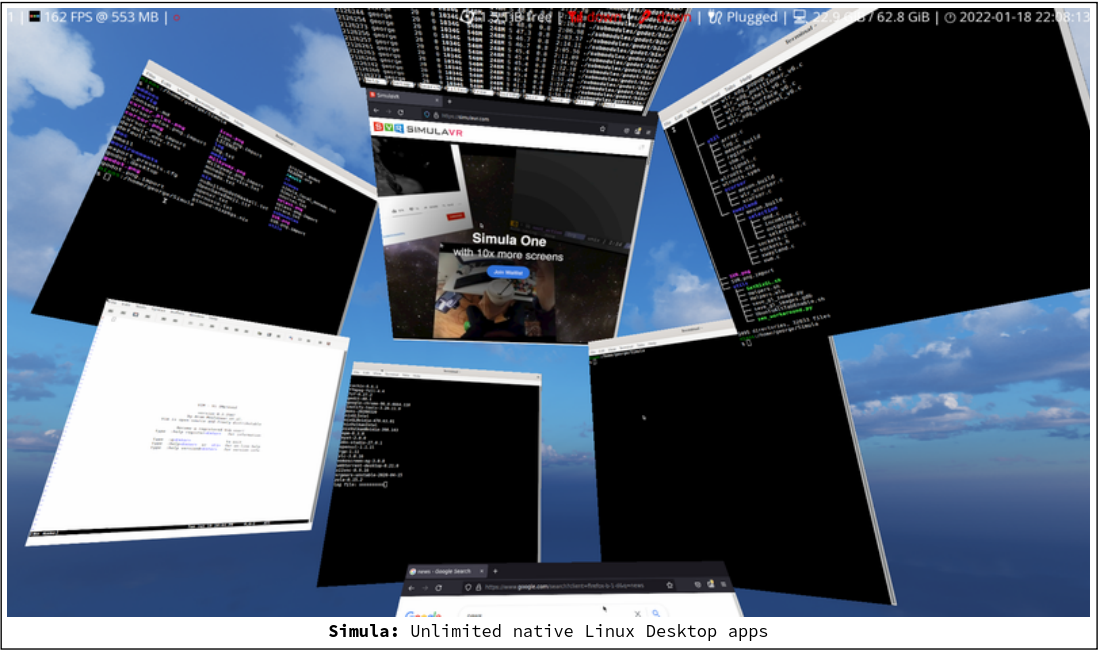
Also, this -- https://www.wolframcloud.com/obj/george.w.singer/simula/png/... -- is the "year of the linux desktop" of VR. I imagine someone wants that, but no.
This opinion is deeply subjective. I have a Varjo Aero, and I can use it as a daily driver (for productivity), no problem. The Vison pro looks to be lighter... and so would have better ergonomics.
Notice, I don't even mention eye strain... because I personally don't experience any.
Anecdotally I've worn the Oculus S for extended periods and didn't notice any eyestrain, but also "extended periods" obviously wasn't a full workday so can't be too confident yet.
This is not a controversial take. Yes, there are tech bros who will insist that this is all fine, but the actual feedback from the majority of the population is that extended wear of pretty much all VR helmets anyone has bothered to look at causes the same eyestrain issues.
There are always people who will put up with discomfort or for whom the discomfort is relatively lower (or they are younger and it is less of an issue), but these products are not going to replace monitors. Resolution is not the only issue, just the one that is most notable when you first put the helmet on.
In addition, the weight of the helmets is an issue. Extended wear is a problem and one of the few notable, repeated comments from the carefully-managed 30-minutes-max Apple Vision Pro demos is that the weight started to get annoying. Seated demos under 30 minutes.
There's also VAC ( https://en.wikipedia.org/wiki/Vergence-accommodation_conflic... ) as an issue depending on the UI in use.
I want VR to happen as much as anyone, but the Vision Pro is an entertainment-light device for media consumption with a nod for people who want to check their laptop (and I'm sure, eventually, their phone or tablet) while watching faux-bigscreen movies.
I'd order one right now if I could believe this was good enough for coding. But my only experience with VR is with an HTC Vive XR Elite headset with 1920x1920 per eye, and that turned out not to be nearly good enough to read comfortably at a reasonable font size. I'm quite willing to be convinced, but apparently the only way to do that now is to be a prospective angel investor in the company and wait for the single review unit to be passed around.
But yeah, the problem at this stage is getting one to try.
I don't have time to dig in and grab the exact spot, but I'm pretty sure they didn't go into detail much beyond what I said. My guess is text rendering is as good as it can be with state of the art displays, from a software stack standpoint.
In "mirror" mode (aka a single giant screen), it feels like working on a 1080p projector. Not great. Not terrible.
In "nebula" mode (aka virtual desktop), it feels like I'm working on 3 720p screens. Great when I need to reference multiple different sources (like during development). If I'm just focused on a single document/window, a laptop screen is better.
----
I think the tipping point is going to be at about 100 ppd. That seems like it will be the point where you can simulate a 1080p screen at roughly arms length while maintaining excel clarity.
It's more literally a head mounted display, rather than a virtual reality headset, with its 46° field of view.
I hope they're able to stick to their ambitious production schedule and they hit the shelves around the same time (early 2024). I've never rooted for any product harder than I am for SimulaVR, and that's saying a lot considering my dark days Kickstart-ing video games...
*: If you disagree and love your VR games, tell me: how often do you break it out in favor of a traditional monitor? My experience tells me not very often, unless you have a great setup or are into a seated timesink game like Elite Dangerous.
Strapping a heavy laptop tightly to your face is the farthest thing away from "convenient" I can think of, especially when compared to a laptop.
Then, the huge waste of compute power needed to run two separate displays showing 99.9% the same information, and to do it at huge resolutions to avoid seeing pixels up close, and then even more wasted cycles on filming, interpreting, compositing, and rendering your surroundings won't leave much room for a "powerful" device either.
Criticizing XR for displaying redundant information feels a little like criticizing smart phones for needing expensive multi-touch screens. Or laptops for not hooking up to your desktop where all the power is. Or personal computers for not hooking up to the school's mainframe. In other, less snarky, terms: the cycles aren't wasted if they get you 9 monitors IMO :)
EDIT because apparently I'm obsessed with this topic: at my latest company the only program we ran on our laptops was chrome, and all computing happened in the cloud.
Obviously not an option for all jobs/people/locations, but I'm confident such a setup would work for many of the current owners of heavy expensive "Pro" laptops. LLMs and their need for datacenter-level compute during training may accellerate this among certain dev circles, too.
That is not the reason to have huge resolution. You can have a 2x2 display with enough blur in the optical stack to make it impossible to see the pixels. No one wants to use such a low resolution though. Resolution and sharpness are different things.
This isn't like the rise of smartphones, where iPhones and Droids were a mostly additive experience to the dumb- and feature-phones people were using before.
But for extended sessions of computer work (a healthily sized market, to say the least), I would be very surprised if I didn't love having 9 monitors instead of 3. And that's to say nothing of the 3D/spatial computing modalities that will develop as the platform evolves away from its 2D roots.
If you're not convinced and haven't watched the awesome video/scrolling ads the marketing wizards at Apple worked up, I highly recommend it. Brings a tear to my eye ;)
Probably never happening. I will, however name my own "iBalls" when I get it :)
Critique #1 is about unknown implementation details, and we'll know that soon enough. In the meantime, an article on IEEE Spectrum says, "…journalists who’ve tried the device say it’s competitive with other AR/VR headsets, which offer a FOV between 100 and 120 degrees. That should place the headset’s pixels per degree around 50 to 70 PPD."¹
Critique #2 talks about the massive ecosystem advantage of the Apple Vision Pro, but I think the thesis — that HMDs will not replace PCs/laptops — is the wrong way to think about their value.
For the majority of users, including most professionals, I think they absolutely will. What hurdles do you see?
Most people don't need high end workstations or gaming PCs. A good majority of the "heavy" work could technically be put into the cloud (or already is, for professionals).
I read the comment as there being some fundamental limitation, a need, that will prevent people from moving to XR, and I would like to understand what that is. Perhaps I was being too charitable, and it's actually an opinion about others preferences, based on the first gen of a device that can replace a computer.
But, you could call me "biased" (or maybe experienced) since I've been working in VR for a couple of years now. I see it as a very obvious transition, in computing, once headsets (including the vision pro) get lighter.
that was how apple justified the cost of the device, so I think its a fair critique.
[Citation needed]
Ummm.. "walk"??
Reminds me of that funny Google glass parody video. https://www.youtube.com/watch?v=t3TAOYXT840
Setting aside that griefers would pull it off your head and destroy it, why not? If you're using it for directions, it seems safer to keep your eyes on the environment than it does to split your attention.
But the video explains it pretty well :)
Another one getting pumped with VC money and inevitably going to push this project for an exit.
First Bitwarden, then GGML, and now SimulaVR.
Not again.
We're looking for venture backing because getting a consumer hardware startup off the ground is really expensive!
Apple just validated their market, which reduces a lot of worries about its long-term viability, and may kick off a big wave of highly-funded competition. It very well may become "keep up or die", and using your existing lead is often your best tactic.
I have been closely watching this company since they first announced the headset and I really hope this isn't the beginning of the end.
What are you using it for?
I didn’t get that impression at all. You can stream your Mac display to it and at that point you have a real Unix system in AR/VR. That’s good enough for many of us.
It seems that Simula is betting on people wanting to not need the external laptop and I think it’s a losing bet. There aren’t all that many use cases where having a Mac streaming wirelessly to your headset isn’t good enough.
The use cases where having a connection to a laptop isn’t feasible are probably the same ones where you are mostly going to do be using it somewhat passively. Doing things like working in a coffee shop will probably still be done on a laptop because who wants to be a glasshole isolating themselves from an environment wearing a ring of cameras on their head? I don’t think I’d be comfortable doing that or being around somebody I don’t know doing that.
>There aren’t all that many use cases where having a Mac streaming wirelessly to your headset isn’t good enough.
It's not $3500 good enough. Its the same solution cheaper headsets use, and don't require full laptop hardware in the headset to do it.
Also, the SimulaVR shown is a prototype. Pretty obvious that comparing it to the Vision Pro is comparing apples and oranges at this point.
If I was advising these founders, I'd be advising them to do some deep soul searching right now. I can't see this going well for them at all, building a niche VR system for the 40% of developers who use linux and at the same time looking for VC funding (implying this will be a scaled business not a lifestyle business) seems like a recipe for disaster.
Often, the defining characteristic of a scalable company is the ability to replicate, create multiple copies of a similar product or service without substantive modification rather than “one-of-a-kind” items. This can lead to decreasing marginal costs where, as production increases, the resources needed to make the next item or provide the next increment of service go down.
How much money do you figure a startup like Simula needs to bring it's product to market just at the minimum? I was at DigitalOcean in the beginning, so I have a sense of capex heavy business. In the early days, we needed hundreds of millions of dollars to scale up the hardware, this had to come from venture AND banks. Additionally, in the instance of DO, we're talking extremely generic off the shelf hardware, nothing custom, our supply chain wasn't complex.
If I was these guys, I wouldn't try to build a scaled business in a space that is emerging in the way this space is. I'd either call it a day or try to no have any investors at all, find something extremely focused, get to a small profit, and enjoy a life style business the founders can live on for the next 60 years.
Of course, I'm always happy to be wrong and if they push forward I hope they win!
Also it's always fun to randomly remind myself that I'm talking to people of "at DigitalOcean in the beginning" level of expertise on this site - keeps me humble :)
And on the Simula product page:
> • 35.5 PPD pixel density (higher than any other portable VR headset on the market)
Microsoft Hololens 2: 47 PPD (1)
Varjo VR-3: 70 PPD (2)
Food for thought.
Varjo is pretty high up there, and they're able to compete in the clarity department. But their headset is non-portable and only supports Nvidia+Windows (at least last time I checked).
Simula is not a shipping product, which to be fair means I should be comparing it with any announced but not yet shipping product, and probably not with products that were announced 4 years ago.
(1) https://kguttag.com/2020/07/08/hololens-2-display-evaluation...
- “they didn’t give us detailed specs”
- “it seems to be tied to the iPhone/iPad ecosystem, not the macOS one”
Neither of these is certain to be a negative of the product.
That, combined with the repeated “we’re looking for investors” makes me wonder whether this company will survive.
The other big elephant in the room for SimulaVR is Valve. Valve is working on a standalone headset, and it probably runs Linux. It's probably going to be open enough that you could get a Linux desktop environment running on it, and I'm sure many people will work on that for free. It's going to be tough for SimulaVR to survive.
Not good if you want people to throw away the old headset and buy a new one, perhaps good if your selling point can be longevity and its associated advantages of cost and environmental friendliness.
Given that I don't use a laptop very much anymore, I've refrained from buying a SimulaVR machine. But I'm really, really tempted to, and depending on how it evolves I might just yeet it and get one anyway.
You are also mistaken in thinking Mac OS can't work with Vision Pro, because it can. Apple has put a trojan horse in Vision Pro by giving us any number of screens we want to use with our Macs. In the future Apple will bundle Mac OS and iOS in Vision Pro. It is the ultimate evolution of computing. This is my prediction. Vision Pro will replace both the iPhone/iPad and Mac. All of it can coexist perfectly in Vision Pro.
This is what you should do. Copy Apple. Make your headset work with Android. Allow Linux and Windows to also be able to work through the headset with existing computers, by providing virtual screens. In the future you can offer a version of your headset with either Linux or Windows, but Android must definitely be in the first version of your headset. This is the only chance you have.
My advice in no particular order (I know you probably already know all this but I already typed it so I'll post it):
1. Get something shipping ASAP. This space is rocketing forward now at an electic pace and the ecosystem for the average person is going to get locked behind walled gardens if something open doesn't get out there. If it were me I would try to get beta units available soon and let the open source community and early adopters run with this thing while you stabilize/polish. Don't rush to "stable" too quickly, but also don't prevent shipping too long that competitors beat you to the release line.
2. When you market this to consumers, don't hide the "Linux" part since people like me will be very attracted by that, but don't emphasize it either because most people don't know what it means. Just describe "computer workstation on your face" rather than "linux machine on your face."
3. Provide factory images so people can hack with the hardware but still escape back to supported territory. If you do this, there will be a ton of open source interest and efforts and they will not only develop awesome apps for you, but they'll port a lot of stuff too. If I were you, I'd be making open source collaboration a huge part of my strategy.
4. I would also be looking at things Valve did with the Steam Deck for tips/guidance.
There's nothing to suggest that powerhouse apps won't be developed for visionOS. The hardware is capable and at this price point it seems that the point of apple's hardware+platform is for the Autodesk/Adobe/Avids of the world to bring 3D-first workflows to professionals.
At the moment we use flat 2D paradigms to design 3D output. The VR era provides developers the opportunity to shed 2D design paradigms and operate directly in the third dimension.
If the objective is to just run 2D macOS apps on VR hardware, then VR is nothing more than an expensive novelty. A VR headset can be so much more than an expensive alternative/second display.
What VR is missing is "Developers developers developers", and attracting developers requires significant investment and commitment to a platform, not just a product.
This seems like a mistake. I'd be more intrigued if the vision was for seamless experience across workstations, laptops, phones, vehicles, tablets and kiosks with or without a stylus, and immersive computing with or without a headset.
but they are prohibitive. expensive and require you to operate within a corporate walled garden.
it is more about segregation.