Is this his schtick? Does he just say the world is ending all the time, or is what he's saying true?
I noticed this a lot in 2020. COVID was (and is) awful, but there was so much shit that Doomers claimed would happen that year that just didn't. They seem to have a bias towards always considering the worst case scenario the most likely.
They serve an important function in society to keep us aware of just how fragile things can be and that we need to be vigilant about understanding the second order affects of our actions as a society.
[0]: Ones that generally rely on nonpartisan facts / science / evidence for making their claims, without resorting to debunked information to further their claims and/or not relying on conspiracy theories, for instance.
[1]: I'd put alot of technologists in this group, for an example. People who constantly hype real breakthroughs and advancements as proof that we will always be trending upward as a species
see also: the book of revelations
There will always be people fixated on The End, some because they think we all deserve it, others because they can't seperate their own existential crisis from potential global crises
I wish more people would take a reasonable middle approach like that. Are we still, as a society, allowed to do things like that?
The reality is rarely "as bad as we imagined" OR "nothing is wrong at all".
Hmph. I want to scoff at how easy he has had it on this subject. And I guess I am.
I didn't get any "alarmist" signals from this post of his until near the end. If all the data is as it suggests there really does seem to be something going on this year in particular in addition to a trend. But then he said "Infrastructure will break beyond repair." which jumped out as alarmist to me. Like we can't fix or build more infrastructure? I wish people wouldn't do that, as it makes me react with "dude calm down" when they otherwise seem to have a point.
When he says "infrastructure" he means the nature that we draw on (to build our infrastructure) i.e. the weather, the trophic chains etc.
I would doubt that everything from one type of infra can be translated to the other. E.g. when it comes to nature some things are simply almost irreversible, whereas there is no such thing for man-made infra.
I am definitely not an expert on infrastructure or civil engineering in general, but I’ve heard lots of stories about heat being bad for our infra, e.g. warped rail lines in the UK. “Beyond repair” seems within the bound of reason
EDIT: also, obligatory dont-look-up-ication:
"I didn't sense any 'alarmist' undertones from this post of his until almost the end. If all the data is as it suggests, there genuinely seems to be an extraordinary astronomical event headed our way this year on top of other celestial trends. But then he said, 'Civilization will crumble beyond repair,' which struck me as alarmist. Like we can't rebuild or adapt our society? I wish people wouldn't resort to such extreme statements, as it prompts me to respond with 'dude, calm down,' even when they otherwise seem to have a valid concern."
- No, we won’t hit scorched earth Venus-like runaway warming.
- If we don’t reduce emissions drastically, greenhouse gas warming plus various feedbacks will cause extreme weather, render some parts of the world unlivable due to wet bulb temperature, and overwhelm unprepared infrastructure, costing huge amounts of money and creating millions of migrants.
So, not the end times, but definitely dark times.
If you sprinkle a bit of pessimism about current politics it’s not a stretch to assume we probably won’t handle those impacts gracefully, or achieve the drastic emissions cuts required to avoid them.
This message doesn't serve the interests of billionaires, and Gates is no exception.
"We (the ultra-rich) won't experience a scorched Earth ending"
- Real.
- Influenced by human activity, both positively and negatively.
- Difficult to study, because we only have decades of hard data for what is a phenomenon spanning eons.
- A narrative pushed by Western economies to discourage economic development of the Global South and maintain hegemony. If the former were actually serious about mitigating it, it would harshly regulate planned obsolescence which causes astronomical amounts of waste and pollution. Instead, they browbeat poor countries for building durable infrastructure.
- Classic fear-mongering as a means of maintaining control ("follow me or everyone will die").
- An expression of aging "hippy" eschatology; we have one of the most individualistic generations in human history reaching old age and projecting its death onto the world as a coping mechanism.
- A polarizing topic that lures engagement.
I think blogs like this are a manifestation of the latter two or three.
Which one do you think is winning?
(Also, when you say the Global South, do you mean the Global South that tends to be exempt from, or subjected to less stringent carbon limitations than the developed world? Or do you mean the Global South that everyone starts complaining about as soon as I mention that maybe we should reduce our emissions...)
These two things aren't necessarily mutually exclusive.
Compare this to the collective action problem of everyone, including rapidly industrializing poorer countries, spending trillions to decarbonize their economy and it's pretty clear which outcome is more likely. The only question is which country (or countries) will be first to attempt it, and what will trigger them to act.
Climate-driven austerity isn't going to happen, because it's an intractable global-scale collective action problem.
If you believe that anthropogenic climate change is going to be a global disaster, you should probably reasonably assume that some country in the world is going to allocate serious resources to mitigating it.
There are 50 countries in the world with resources exceeding that of Portugal or New Zealand. Any of those countries could fund and implement a large-scale geoengineering project. No mechanism exists to ensure that any of those countries get permission to do so.
So it doesn't much matter whether we think it's a good idea. Either:
(1) Anthropogenic climate change isn't going to impose unacceptable costs on the industrialized world, and we'll just blow it off, or
(2) Some country is going to intervene directly in the climate.
I wouldn't say we make things worse, I think we make things our own. Is that worse? I'd tend to disagree. I prefer human environments over the deep wilderness. Most of us love nature, but we love the human version of that.. groomed trails, modest temperatures, light breezes, and having all the human comforts within reach. Humanity does certainly do things wrong, but we also do things right.
I put 'novel' in quotes because it's a really weird novel.
The capability + motivation factors certainly point to India as the most likely candidate, since they're among the closest to disastrous wet-bulb temperatures and have a domestic nuclear umbrella that allows them to say "and what are you going to do about that?". If a heat wave makes it impossible or deadly to harvest crops at a critical moment, panic is a possible outcome.
https://www.nytimes.com/1991/11/09/news/new-paint-new-cars-a...
If all you have to trade off is comfort, maybe you can't.
If you were one of the literal HUNDREDS OF MILLIONS of people who are living in parts of the world that could become unsurvivable in the next few decades, or get flooded by rising sea levels, you'd have a different perspective.
For what it's worth, I agree with you that reckless geoengineering could easily cause more harm than good. But aesthetically desiring a blue sky is a bit silly when up to a billion human lives are on the line (and that's a low estimate)
I've always naively thought that climate disaster was still 10-20 years out, but it seems like it's going to begin in earnest now and instead be completely catastrophic after these next 10 years.
What can I as an individual do? Move to Saskatchewan or Alaska? I already know from a friend in Alaska that the melting permafrost is causing many native villages to sink and collapse, and it's only gotten worse in the past few years. Check out this article on Newtok, AK by National Geographic from 2019: http://archive.today/1enHh
Sweden average rainfall seems to be trending up on a 100-year scale. https://tradingeconomics.com/sweden/precipitation
> We've got drought and fire here in Sweden already
Forest fires in Sweden are a complex dynamic and the risk factor from climate change is only one part. Here is an interesting discussion https://link.springer.com/article/10.1007/s10113-020-01718-2
Droughts in Sweden have been on a downtrend for the last 60 years, with quite a bit of variability. https://www.sciencedirect.com/science/article/pii/S221458182...
Climate change is a long term problem. We're going to see hundreds of millions of climate refugees before the end of the century, but the bulk will be after most of us are dead.
Slow-moving crises are not crises, they're problems, not emergencies.
----
Here, have some literature, down-voters! ----
[1] Nine long and nearly continuous sea level records were chosen from around the world to explore rates of change in sea level for 1904–2003. These records were found to capture the variability found in a larger number of stations over the last half century studied previously. Extending the sea level record back over the entire century suggests that the high variability in the rates of sea level change observed over the past 20 years were not particularly unusual. The rate of sea level change was found to be larger in the early part of last century (2.03 ± 0.35 mm/yr 1904–1953), in comparison with the latter part (1.45 ± 0.34 mm/yr 1954–2003). The highest decadal rate of rise occurred in the decade centred on 1980 (5.31 mm/yr) with the lowest rate of rise occurring in the decade centred on 1964 (−1.49 mm/yr). Over the entire century the mean rate of change was 1.74 ± 0.16 mm/yr. [0]
----
We compare estimates of coastal and global averaged sea level for 1950 to 2000. During the 1990s and around 1970, we find coastal sea level is rising faster than the global average but that it rises slower than the global average during the late 1970s and late 1980s. The differences are largely a result of sampling the time-varying geographical distribution of sea level rise along a coastline which is more convoluted in some regions than others. More rapid coastal rise corresponds to La Niña–like conditions in the tropical Pacific Ocean and a slower rate corresponds to El Niño–like conditions. Over the 51 year period, there is no significant difference in the rates of coastal and global averaged sea level rise, as found in climate model simulations of the 20th century. The best estimate of both global average and coastal sea level rise remains 1.8 ± 0.3 mm yr−1, as found in earlier studies. [1]
----
Kemp et al. (1) note that recent Intergovernmental Panel on Climate Change (IPCC) reports emphasize sub-2 °C scenarios. Simultaneously, IPCC reports also overemphasize catastrophic scenarios, as does broader discourse. For example, the cataclysmic Representative Concentration Pathway 8.5 (RCP8.5) and Shared Socioeconomic Pathway 5-8.5 (SSP5-8.5) scenarios—now widely considered implausible (2)—account for roughly half of the scenario mentions in recent IPCC Assessment Reports’ impacts (Working Group II) sections (Fig. 1A), similar to underlying scientific literature (3). The SSP3-7.0 emissions pathway, which Kemp et al. (1) use in their analyses, assumes a world in 2100 heavily reliant on coal and with no climate policy—an implausible future (3, 4). It projects vastly higher emissions than the International Energy Agency (IEA) stated policies scenario, which has continually been revised downward in recent years (4) (Fig. 1B). [2]
----
[0]: https://agupubs.onlinelibrary.wiley.com/doi/full/10.1029/200... [1]: https://agupubs.onlinelibrary.wiley.com/doi/full/10.1029/200... [2]: https://www.pnas.org/doi/full/10.1073/pnas.2214347119
Cherry-picked because hey, why not?
Who do you trust? Bankers or the "experts".
You can hardly be blamed for that, they've been saying it was one way or another since at least the 1970's.
Literally none of their doomsday scenarios have occurred as stated yet.
My bet is, rather than bovine farts and air for plant-life, the major climate driver will turn out to be what it always has been... 1 million earths-worth chaotic searing nuclear eruption, boiling atop hidden internal processes 4b+ years.
And if there is a human aspect to it, I'd first investigate the large-scale weather-modifying experiments creating and directing precipitation in arbitrary and unaccountable ways over large landmasses for decades. Eg, look at China's.
(Cue the brigade claiming sensible observations are madness because there's a "consensus"... among only scientists that agree...)
lol
> sensible observations
Please share how you've conducted your observations in a rigorous way, no one will blame you for it, that's how science progresses...
> "consensus"
lol
Never, because systems are dynamic, and it's chaotic. Now, if anyone (the State powers and corporate interests) actually WANT to "solve" this "problem," it's, uh, very very clear where to start. Nuclear.
But like many other scissor issues, it will continue to be used as a lever to slice apart groups so's they can fight each other.
When was the last time you asked yourself "What made and or makes me confident in my belief that this is actually a crisis? Why?"
Which papers and statistical analyses have you written? Are you "trusting the science?" Are you versed enough to truly understand how we'd even be able to measure this? Or is it just esoteric enough that it can be used as an engine of disruption, corruption, etc...
Climate (long term parameters) isn't.
As an example of how this can be so, consider the classic images of spinning wingnuts in space ( Dzhanibekov effect | Tennis racket theorem ).
The tumblings of the wingnut, moment to moment, are chaotic and unpredictable.
The long term trajectory of the wingnut is clear to see, the centre of mass arcs in a smooth manner and the eventual impact point on the hull can be marked in advance.
( In answer to your question, I've spent decades in geophysics and related disciplines, I've measured gravity, ground radiation, cosmic radiation, continent scale tides to determine mean sea levels, etc. )
Anyone who is interested in having a deeper understanding of climate change I would recommend checking out IPCC AR6.
https://www.ipcc.ch/report/ar6/syr/downloads/report/IPCC_AR6...
> By cleaning up shipping fuels, massive regions of the world’s oceans that were protected from heating by shipping sulfate aerosols are now experiencing rapid warming. This includes the main shipping routes between Asia and the Western US as well as the major routes from the Easter US to Europe and the Middle East. And that’s where the warming is happening. This rapid heating is known as “termination shock,” and it appears to be what’s happening right now.
It's frustrating that we've argued a lot about the hazards of intentional geoengineering responses without reaching a consensus that we should do it, and meanwhile the shipping industry was cavalierly doing it along-side their other emissions. Yes, we need to rapidly cut emissions. Yes, we need to in parallel invest in carbon capture. But if every fraction of a degree matters, shouldn't we also be at least continuing if not scaling up these these albedo-increasing changes?
(edited for grammar)
Acid Rain is also a bad thing with bad consequences.
While I'm not necessarily that opposed to cautious attempts at some geoengineering, I don't think "scale up the sulfate emissions" is a viable solution.
I'm not pretending that cooling via sulfur emissions is without costs -- but e.g. if living at 2018 levels of sulfur emissions (which were already 90% down from peak) can give us 0.5C of cooling, that's a deal I'm willing to take, especially in light of how hard it is proving to reduce carbon emissions. It especially seems like we're hitting a number of tipping points with warming, and if sulfur emissions (or any other albedo-increasing intervention) can keep us from crossing those lines, we should, in my view. Would we be better off with 2014-level sulfur emissions? 2008? At _some_ point, trading sulfur emissions for cooling becomes a bad deal, and we shouldn't scale up without limit. But is it a good direction to move from where we are now? I think so.
[1] https://www.acsh.org/news/2021/07/09/whatever-happened-acid-...
> But if every fraction of a degree matters, shouldn't we also be at least continuing if not scaling up these albedo-increasing changes?
Humanity is running the experiment in real time with a sample size of one. Aerosol dimming is good but acid rain is bad: we have a bad vs a worse choice so someone will be harmed, thus any project has liability and the default of doing nothing happens.
https://arxiv.org/abs/2212.04474 if you want some light reading.
Another example, the war in Ukraine is accelerating the clean energy revolution in Europe, cutting down on air pollution. How's that going to help their drought? Will the EU act on national interests?
Maybe in the long run it helps, but right now, not really:
"European coal-fuelled power generation climbed last year as countries scrambled to replace Russian gas, but the increase was smaller than feared as renewable energy helped to plug the gap, ...Outright coal generation in the EU increased by 7%, or 28 terawatt hours (TWh), in 2022, pushing up power sector CO2 emissions by nearly 4%."
https://www.reuters.com/business/energy/eu-coal-rebound-smal...
It's relatively much easier, especially politically. And the entities most poised to begin it are exactly the behemoths who benefit from fossil fuel use in the first place. It'll rapidly become another money-and-PR funnel for the same couple hundred individuals who got us here in the first place.
In the 21st century if you have to frame your solution as a fight against something, you're part of the problem not part of the solution. "Fighting" is now a bigger problem than the contested topic. Idiots fight and the bigger the idiot, the bigger the fight. So the contest is over two extremes that have nothing to do with reality and whomever is doing the real discussion gets labelled as the enemy by both camps because they don't belong to the extreme.
Was there a debate about this that the IMO ignored? As a layman, I have heard before that cutting emissions of certain particulates could increase global warming in the short term but I don't recall seeing any real discussion of its dangers or strong calls against it. I mean at a societal level - I'm sure there has been discussion of it within the scientific community, but what were the conclusions of that discussion and how were they communicated to the IMO and the rest of society?
I worry that this could further undermine public support for climate change initiatives. The skeptics will spin this as "they said we should cut emissions, then we did and now they are saying that cutting emissions led to climate change". You and I both know that's a flawed message but that's the story they will tell and a lot of people will probably buy it.
This articles data.
Incredible floods in Pakistan.
Heat domes over the PNW.
Fires in Australia, Canada, California.
And now a warming event in the North Atlantic unlike any other.
All of that and this is likely to be one of the coolest summers for the remainder of our lives. Its only getting warmer from here (barring geoengineering).
What about this is not alarming? As disheartening as it is, this is what is needed for action at this point.
Please don't use California as an example here. It's supposed to be on fire. Several species of trees and plants here cannot germinate without fire. The loooong known problem [1] is mismanagement, building houses where places burn, and blaming the wrong people, which leads to overgrowth from lack of fire. Fires aren't, by any measure, optional. If you impede them, they will come back harsher the next time around, which has very recently been addressed with laws to help increase the frequency of fires [2][3].
I don't see how it's possible to even measure global warming impact with the mismanagement that has accumulated.
[1] https://www.nbcnews.com/news/us-news/decades-mismanagement-l...
[2] https://www.aljazeera.com/news/2021/12/3/new-california-law-...
[3] https://www.latimes.com/california/story/2021-10-07/newsom-s...
Canada, on the other hand, is a powder keg waiting to blow. The ecosystem is too wet to have any fire adaptations and as the peatlands dry, they expose meters thick layers of undecomposed plant matter that are dense enough to be used as a cheap and dirty fuel in some parts of world. It’s one of the largest carbon stores on the planet and we’ll soon have months long fires a the peat burns.
The fire season is longer, the droughts are worse, the fires are more intense, fires are happening outside of their historic range, and trees are not surviving the fire assuming they weren't dead already due to drought.
Timely article, "Anthropogenic climate change impacts exacerbate summer forest fires in California" (https://www.pnas.org/doi/10.1073/pnas.2213815120)
The strongest and most accurate evidence for global climate change are GLOBAL indicators, such as sea level rise, global average temperatures, etc...
Every weather event you list, can probably be countered with a mild weather event somewhere else. It's mock science, and it's the most obvious sign of hyperbole.
Last year's floods in Pakistan that displaced millions (barely reported on in the west) were such a local event.
Saying "oh, this is fine, because somewhere else the weather was mild" is disturbing.
The whole reason why climate change is so problematic is that the change in the global indicators will cause many many "individual weather perturbations", as you call them, which will displaced millions and disrupt supply chains.
The fact that there is some mild weather event somewhere else doesn't offset these negative effects in any way!
It is not mock science!
What I am trying to say is you cannot use specific weather events to talk about climate. And of course once you go into statistics, you will lose 55.3% of your persuasiveness.
Assuming I'm exactly average, that means 50% of the population won't understand it either. Of that 50%, how many will actually care? Nothing will happen until it is too late.
His final words weren't encouraging and I can't say I feel any better either.
> As we enter Northern hemisphere summer, large regions of the planet will experience record heatwaves, fires, storms and flooding. These events will set records in intensity, duration and frequency. The planet’s overall temperature will spike to new highs for the modern era, with 1.5°C in sight for 2024. Antarctic polar sea-ice will continue its retreat from “normal”, exposing more open ocean to incoming solar radiation and heating. Crops will fail. Infrastructure will break beyond repair. Climate migration will spike. And all of this is already happening.
That’s the crux of the dilemma. It’s too hard. Nothing in our daily experience gives us an intuition for it.
For instance, the media often says “solving climate change requires lowering emissions”. Which gives the impression that if we lower emissions we solve it.
But lowering admissions merely slows the speed at which the problem worsens. To solve the problem we would need to go to zero and then actually suck extra co2 from the atmosphere.
And total global emissions, the only number which matters, are at a record high.
Drawing a line in the sand is useful for policy (We should target staying under 1.5C above historical records), but the other piece needs to be the why of it all.
So sure, from the figures given in this post we're seeing record antarctic sea ice anomolies, record sea surface temperature anomolies and record temperature mean anomolies.
But what does this mean for the average person?
What portion of our farmland is no longer serviceable? What places can people no longer live, what portion of our fresh water sources no longer work?
How many people will have to move, find other sources of food/water? What other severe downstream effects are coming that I'm not even aware of? Severe weather? Flooding? Ecosystem collapse?
I understand that this blog is likely more dedicated towards the science behind climate rather than communication of the consequences to the layman, but it seems that most science communication is more interested in communicating the science behind predictions (and often failing) than communicating what the outcomes are likely to be.
The North Atlantic heat flux of the air-ocean interface changed and some one more knowledgeable might tell how many terajoule stay in the atmosphere a little bit longer probably altering the weather pattern as we like to know them.
https://www.researchgate.net/figure/A-conceptual-Flettner-sp...
What is actually beyond my understanding here, is that an international organization implemented a very strict environmental standard, one that probably applies to notoriously uncooperative countries (hint: China), one that applies to a notoriously uncaring industry (cue the oil-spills and dirt ships transporting crap around the world), and, _somehow_ , the standard was respected, and the restriction had the "desired" effect (less SO2 in the air.) ?
That's my WTF: since when do environment standard work ?
What did the IMO do ?
Why didn't the cargo coorporation simply bribe and cheat and lie, as usual ? Didn't using "cleaner" fuels cost _more_ money ? How did they let this kind of communist nonsense of a regulation happen ? Where are the freedom fighters ? Why don't we have an "airpollutionskeptics.org" site that denies the link between cargo ships and SO2 level in the air, on the ground that SO2 levels have always changed in the past, and that the IMO is an evil governement body of elitists who want to take again our gunships ?
Or is it only that we're slaves to irony, that no good deed should go unpunished, and that the only way we can solve any environmental problem is by inadvertently making another one even worse ?
Your _really_ don't want your vessels to go uninsured so you better comply and the big insurers are in europe/usa (not that I don't think that there are some black sheep). That's also the mechanism by which sanctions work in regards to maritime traffic (like against russia last year [2])
[1] https://link.springer.com/article/10.1007/s43546-022-00334-y
[2] https://www.reedsmith.com/en/perspectives/2022/06/eu-sanctio...
Regulation works remarkably well in many spaces. Skepticism is warranted as usual but the cynics that claim it almost never works usually have a hidden agenda.
However, the data seems to be real...
This caught my eye as a potentially much worse catastrophe in the short term than the extreme temperatures. That Saharan dust feeds several ecosystems like the Mediterranean and the Amazon with crucial micronutrients like iron and phosphorus. If that transfer stops for very long, they could start to collapse
I’m just coming back from a trip to the Caribbean where during my trip the sky was hazy for some days and all of the locals were claiming the weather effect to be the Sahara dust.
I’m not a local so I don’t know if it is more or less than usual, but my personal experience makes me take issue with the “never come” part.
Whatever the effect of the Saharan dust, it's not going to be all manifested in "some days".
Just as in years of overall climate warning there can still be record cold streaks too.
It would definitely have an incredible effect on the climate if you could magically make Africa into a Forest again though. Might even make some parts of Europe uninhabitable with that cooling alone. Not gonna happen though.
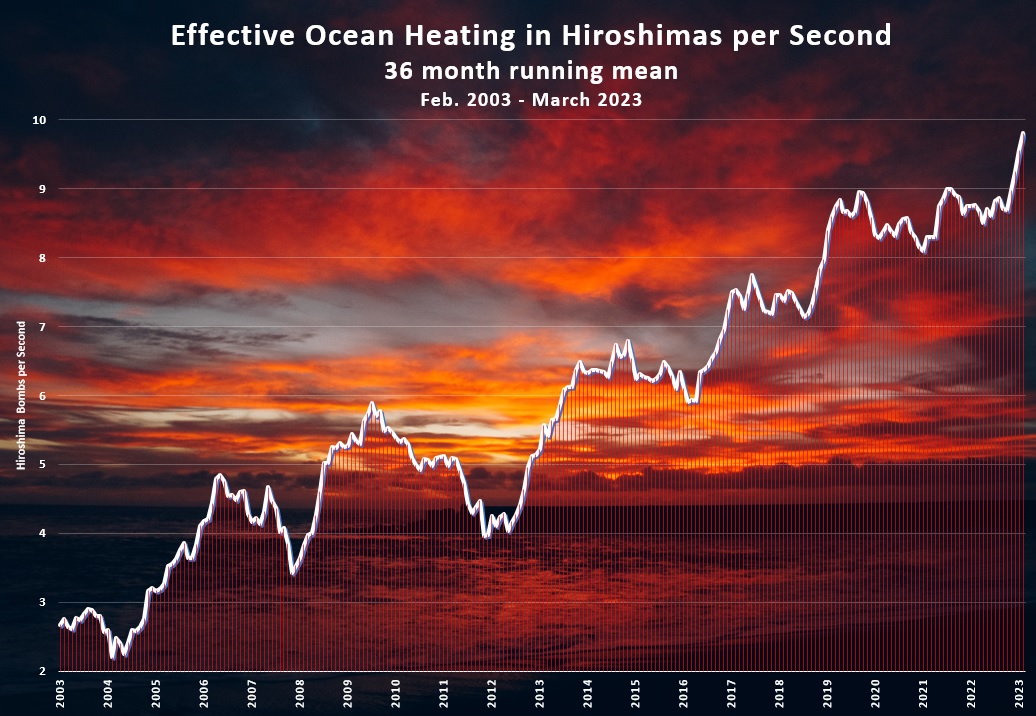
A Tsar bomb or a long number with an unit attached won't be as graphically understood as this one. Scientists may grasp those numbers, but they already know how bad this is, you must reach everyone else.
Derivation: Hiroshima: 129,000–226,000 deaths. E(death_Hiroshima) ~= 180k. 9/11/2011, NYC: 2,753 people died. 180k/2753 ~= 65.
That's a pretty terrifying ending. Many of these trends (reducing sea ice causing increased ocean warming, burning of forests and permafrost) may be irreversible once things pass a certain point. At very least we may need to engage in some sort of large-scale solar radiation management project to stop them, and worryingly we may need to start that project very soon before it's too late.
That's what everybody insisted for the past 20-30 years, so must be true. All we need to do is keep expanding consumption/production!
But a few thing I'm missing are: - second (higher) order availability: even if the hospital you need to go to is within biking distance, is the hospital itself sourcing it's materials (needles, plasters etc.) locally? Otherwise you might end up at a hospital that can't treat you - in your modelling you only accounted for weather effects and elsewhere assumed that, hopefully, immigration will somehow be managed well. Suppose it will not - how will you manage that and ensure you will not loose everything, when everyone suddenly moves to where you are and all wealth is taken from people who have some? Is Traverse city perhaps sufficiently insulated so that people won't easily reach it? Does it have a strong police?
Lastly, I'm recommending the "nodes of persisting complexity" article, if you're interested. They carry out an analysis like you do, but at country level. Sadly, the US doesn't score too high.
This level of alarmism is dangerous because thoughts of others imprison us if we’re not thinking for ourselves... why would a young person care about the climate if it's already too late.
When the best we can do is to "not make it worse", then it's very hard for people to see the benefits of the changes we have to make.
So alarmism is good and necessary, we just need to make sure that we also need to take action based on it.
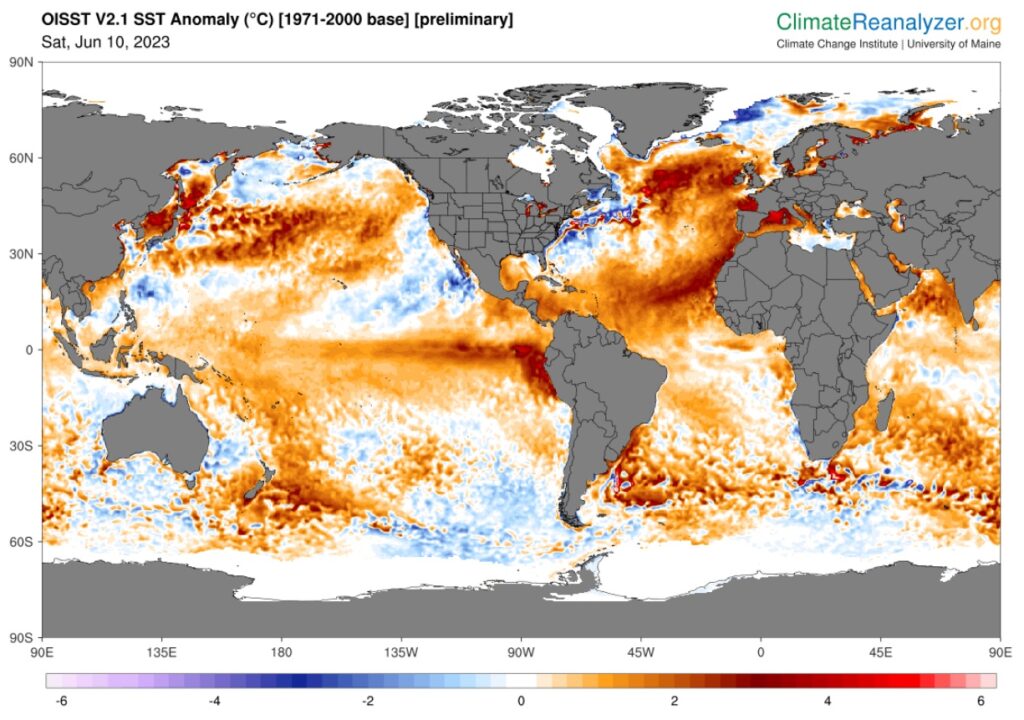
From the note on that page:
The page provides time series and map visualizations of daily mean Sea Surface Temperature (SST) from the NOAA Optimum Interpolation SST (OISST) dataset version 2.1. OISST is a 0.25°x0.25° gridded dataset that estimates temperatures based on a blend of satellite, ship, and buoy observations. The OISST data product includes SST anomalies based on 1971–2000 climatology from NOAA. The datset spans 1 January 1982 to present with a 1 to 2-day lag from the current day. OISST files are preliminary for about two weeks until a finalized product file is posted by NOAA. This status is identified on the maps with "[preliminary]" showing in the title, and applies to the time series as well.
Which further references <https://www.ncei.noaa.gov/products/optimum-interpolation-sst>
can haz cooky plz?
to me collapsing thousands of observations to a single average loses most of the signal
"we had ice age in the past", "we had warming in the past", 1990 is too close, -2m years is too far, the sun is closer (it's not), "numbers can say anything", "oooooh spooky graphs ;)" &c.
https://apnews.com/article/bd45c372caf118ec99964ea547880cd0 https://www.nytimes.com/1995/09/18/world/scientists-say-eart... https://nypost.com/2021/11/12/50-years-of-predictions-that-t...
Regarding your specific complaint, let's look at the AP article. The article is based off an interview with a director, not a scientist. I'm not sure if it's poorly written or the director poorly communicated the issue. The article implies that by 2000 we'd see all of these extreme outcomes, that wasn't what was intended to be communicated. Instead it was that we had until 2000 to stop these events from happening in the future. Which is a very different message. Regardless here we are in 2023 and we are getting ever closer to those events occurring, with some leading indicators already taking place.
https://en.wikipedia.org/wiki/Montreal_Protocol and others for example
(besides, "Will happen" is very different from "Could happen")
Can we please have a realistic discussion on climate change? I'm so sick of these "scientists" acting like we're in "Day After Tomorrow" and every normal weather event is suddenly a precursor to the Armageddon that'll take us all out in the next decade or less. You scientifically cannot look at individual weather events and determine they're climate change, that's pseudoscience.
People like this author only manage to turn rational individuals into deniers due to their over the top claims that never come true.
No we can't, because of the people who actually care about it, half are "everyone is going to be dead before your toddler goes to college unless we dismantle capitalism across the globe" and half are "humans haven't caused any warming at all and dumping trillions of tons of CO2 into the atmosphere has zero measurable effect I bet you voted for Biden." Both are idiots, but the problem is if you're not in one of those camps, and you want to have a rational discussion about climate change, you're in such a small minority you look like the crazy one.
Even here where I'd like to think the users are generally intelligent, the thread is either jokes, apocalyptic predictions about billions of climate-migrants, or nonsense about communism.
It would be interesting to compare this trend in US politics as a whole and how it can also be applied to this specific issue (and other divisive issues like gun rights or abortion rights) if it wasn't so goddamn depressing.
San Francisco and the PNW being covered by smoke every summer is not a normal weather event, and now it is starting on the East coast. The east and southeast is also being hit harder by hurricanes, and they are not stopping at the Gulf of Mexico any more. These are just the events people have been able to see in the US in past years and they're not normal and with ever-increasing carbon output it is undoubtedly going to get worse.
I'll take the entire northeast being covered in smoke as an "over the top" claim that just came true.
> By cleaning up shipping fuels, massive regions of the world’s oceans that were protected from heating by shipping sulfate aerosols are now experiencing rapid warming. This includes the main shipping routes between Asia and the Western US as well as the major routes from the Easter US to Europe and the Middle East. And that’s where the warming is happening. This rapid heating is known as “termination shock,” and it appears to be what’s happening right now.
However, the problem with this system is that the second you stop, you get a huge bump in temperature. Like a whip, you get a quick increase.
Turns out, the shipping industry may have been inadvertently geoengineering and now that there are regulations on the amount of sulfur expelled, we may be experiencing that snap to warmer temperatures.
You may think "Let's just spray some sulfur of our own," but there are unintended consequences associated with it. In my mind though, the biggest issue is that without a reduction in emissions, you'll need more and more sulfur sprayed into the atmosphere and eventually it will not be effective. Supposing you've continued to emit all that time and are still emitting, then the snap would be even greater.
https://climatecasino.net/wp-content/uploads/2023/06/GLOBAL_...
https://en.m.wikipedia.org/wiki/Intertropical_Convergence_Zo...
I wonder what parts of world are still going through the pandemic. Without citations, some of the facts in article come up as alarmists.
All those GPUs need cooling somehow.
This is really what stands out to me when people on HN suggest that global warming is totally solvable with just enough technological innovation. The sad truth, and what this article is really driving home, is that while we're waiting for a deus ex machina, we continue to trash our planet, as if we can just move to Mars or something when earth is done.
I'm quite skeptical about the whole "collapse of industrial civilisation" schtick, but I am worried, most of all for my children and their generation.
When I had my first kid, the environment and what our Earth would look like when she was my age really got to me. I realized that small, individual actions aren't going to cut it (ex turning off a light). It's not to say I don't do those things, but I had to do more, things that may actually move the needle.
I pay for Bullfrog power to my house (https://bullfrogpower.com/) and I now email my local representatives to make sure they know their constituents care about this. What will you do today?
Most of us (me included) just lurk on HN and post the odd comment, without pushing for change. We're pathetic!
1) The war in Ukraine - changes in air travel routes will affect cloud cover.
2) Wild fires in Canada - this is really huge at the moment.
3) That giant blob growing in the Atlantic Ocean.
Sunshade:
https://en.wikipedia.org/wiki/Space_sunshade
I'm not too concerned with climate change destroying us all within a 100 years.
I'm excited to see the innovations and discoveries to be made while we develop technology to mitigate disaster.
Edit:
Furthermore I am excited to see the ROI I will receive from investing in mitigation technology.
Picking two examples from the Wikipedia article you linked, the Fresnel lens is a proposed object that would float in space between the Earth and Sun, approximately 1000 km wide and only a few mm thick. The article notes "at a science fiction convention in 2004, Benford estimated that it would cost about US$10 billion up front, and another $10 billion in supportive cost during its lifespan." Lol. This idea is pretty hilarious, just in general. A lens so wide as to span the entire US state of South Dakota. Please explain how you'll launch and/or assemble that at the L1 point. (This was a subplot of a Simpsons Episode by the way: https://en.wikipedia.org/wiki/Who_Shot_Mr._Burns%3F#Part_One)
Or there's the "Lightweight solution", "a distributed sunshade with a mass on the order of 100000 tons, composed of ultra-thin polymeric films and SiO2 nanotubes", which "estimates that launching such mass would require 399 yearly launches of a vehicle such as SpaceX Starship for 10 years." Also lol!
Skeptics have been raising questions like yours for decades. If you are truly interested in answers then it is only one or two google searches away. In short scientists have already factored those concerns into their analysis.
https://www.nytimes.com/2023/06/11/us/dead-fish-texas-climat...
We already knew that it would get this bad, but then some other curveball came and made it worse.
In other words just another Monday in the 2020s.
This isn't going to age well.
His response? "I don't read articles starting with 'WTF'".
I wish people were in general more intentional in writing for a broad audience.
That is good right? Watch the PART 2: https://plandemicseries.com/ (Event 201)
Putin captured media headlines. Speaking of Putin, Russia is probably the only country that benefits from melting Arctic - opening Northwest Passage - figured it out after debating with a bunch of climate change deniers on Twitter.
(I enjoy debating, I had fun doing it, at some point they were quitting, if they were like me they would continue debating)
In all seriousness, I'm working on Metacrisis - a new term reaching mainstream consciousness:
— Runaway climate change + food system + global hunger
— Economic inequality + compound interest + exponential growth on finite planet
— Nuclear proliferation + pandemics + lost trust in media + lost trust in government
— Regulation of AI + polarisation and engagement metrics + mental health
Problem well defined is problem half solved
* This is why Co2 do not have any effect until it reaches the high troposphere. That takes 20 years. The average climate we have right now is caused by emissions from 2003. *
However: we never had this meteorology scenario before. We cannot predict what will happen this summer. Yes, if you're a public servant or work with them or whatever, prepare for the worst please. But ultimately, we cannot know. we started an experiment that will bring us fast changes, lead us to discover retroaction loops and a lot of different things. Some will help, some wont, we can't know. If it wasn't this dangerous and violent, the uncertainty would be fascinating (it still is, somehow).