So energy to mine the materials, energy to assemble the battery, energy to recycle the battery after it's useful lifespan (5-10 years)... None of these are ever counted in people's calculations. I tried to find data on energy required to produce the batteries and they still didn't count the mining cost.
I'd wager that hydrogen is more energy efficient over the entire lifespan of a vehicle.
https://www.theguardian.com/commentisfree/2021/jun/14/electr...
Lithium mining is expensive and you need to move a lot of dirt to get a little lithium...
100 billion tons of waste and never mind the waste aspect, it takes a lot of energy to move a ton of dirt.
Recycling li-ion is currently a booming business because it requires much less energy than processing raw ores - see Redwood Materials for more info.
Everyone takes these calculations into account because batteries come under intense scrutiny from people with ulterior motives.
That question needs to be qualified with a date and time. It's a moving target. Generally: number go up.
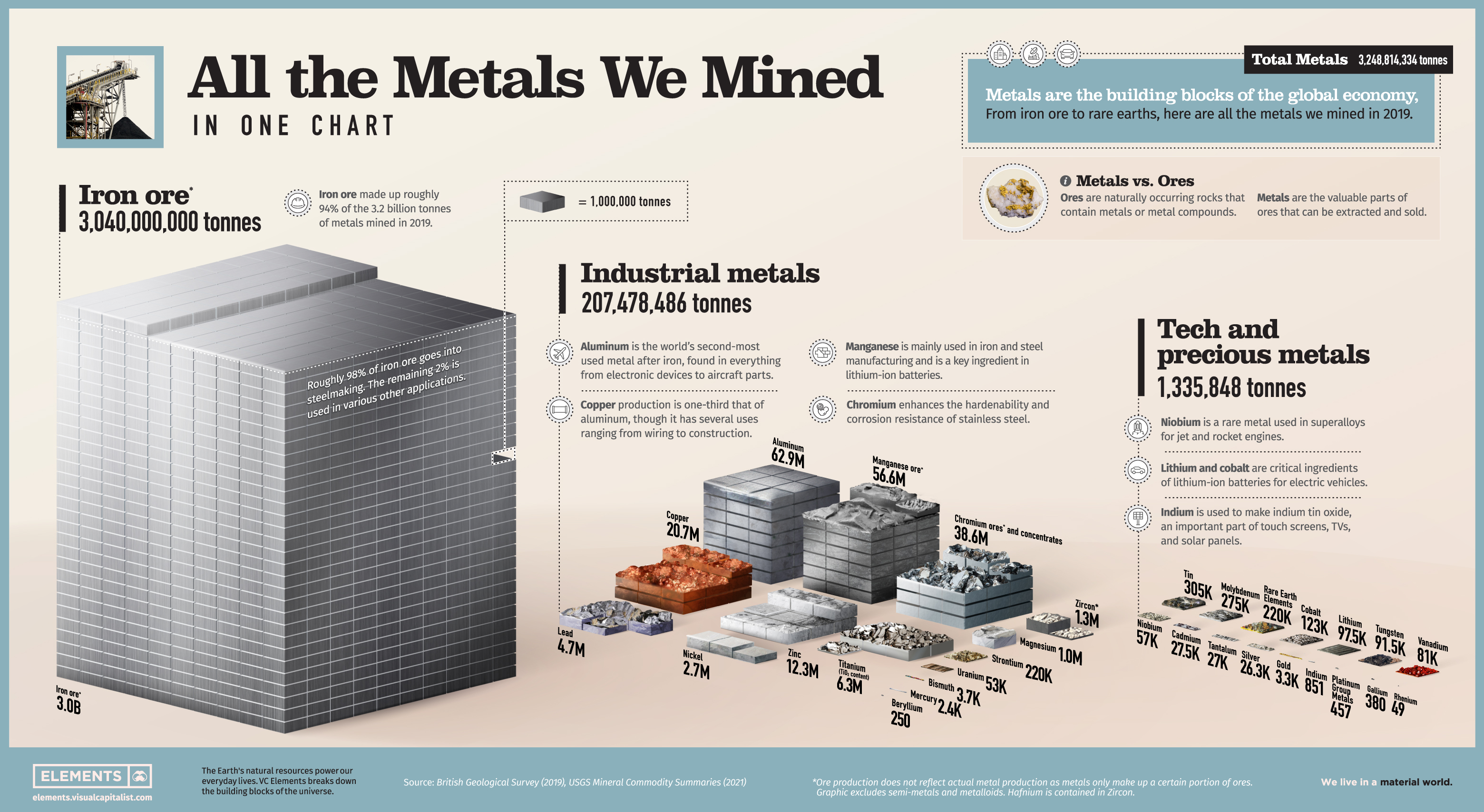
https://elements.visualcapitalist.com/wp-content/uploads/202...
Electric cars use lithium, just now, and a bit of rare-earths. (They are used in wiper and window motors.) Cars are their own thing, which we would be better off with less of.
Obviously before you have built out wind and solar, you don't have much yet. It is a vacuous observation. Instead, look at the rate of deployment, which follows a classic exponential curve.
5 billion tons of coal gets mostly burned up.
Meanwhile 50 THOUSAND tons of lithium is produced per year. For which maybe millions tons of waste gets created.
Hmmm, 500,000 litres of water per ton of lithium. Electrolysis required to create lithium metal. Plus the required dirt being moved, water being moved, energy for electrolysis, etc...
Sounds very energy efficient...
/s
But still, that 5 billion tons of coal gets mined, transported and then burned to produce energy once.
A kg of coal contains about 8kWh of energy which it can release once. This is the best kind of coal. Also you only get about 40% of it as electricity.
A kg of lithium will store about 1.1kWh energy in a battery .. thousands of times before it needs to be RECYCLED.
Your efficiency is off by many orders of magnitude.
This is a standard component of LCA databases and puts the ESOI in the 50-100 range for the first generation of batteries. Subsequent generations are higher.
Electrolysers also require mining, as do fuel cells, as does any source of heat for reverse gas shift or similar.
Your fud about rare earths is also a lie for any chemistry proposed for grid storage. None of them involve rare earths in any measurable quantity (nanoscale films on semiconductors for controllers and such are insignificant)
Hydrogen (or rather hydrogen derived molecules) are a viable method of seasonal storage, but that doesn't mean most of the hype doesn't exist to greenwash gas or that your talking points aren't propaganda.
Hydrogen cars are worse than BEVs and much worse than transit or active transport.
Yes that's the number I found WITHOUT accounting for mining the materials... Just manufacturing the battery.
> Electrolysers also require mining, as do fuel cells, as does any source of heat for reverse gas shift or similar.
Yes but there's far less of those materials required than the sheer amount of battery cells being produced for automobiles.
> Hydrogen (or rather hydrogen derived molecules) are a viable method of seasonal storage, but that doesn't mean most of the hype doesn't exist to greenwash gas or that your talking points aren't propaganda.
Greenwash gas? The whole point of hydrogen is to create it using renewable sources of energy... The whole problem with renewables is storing the energy since they don't produce reliable baseline energy. Hydrogen accomplishes that.
Are you sure you are reading the study right 'manufacturing' in standard LCA methodology also includes embodied enery/carbon of the ingredients?
You can also fermi analyse it. The absolute cheapest form of energy is lignite burnt at the mine front which is about $5/MWh. Before shortage induced price hikes, the 100 or so grams of lithium in a 1kWh battery was worth $1-2. The battery can store around 5MWh in its lifetime. This puts a fairly hard upper bound of 4-8% of the cycled energy. Phosphorus and iron are less scarce, copper might be significant. Any cost that isn't the cheapest possible energy pushes the lower bound down.
Green hydrogen is fine in niches where it's suited, but most of the hydrogen-for-everything schemes rely heavily on fossil fuel derived hydrogen whenyou look under the hood and ignore the amount of methane, CO2, and H2 that will escape at various stages. H2 is not a greenhouse gas on its own, but it makes methane much worse.
> Yes but there's far less of those materials required than the sheer amount of battery cells being produced for automobiles.
And if you look at the quantities required to replace the role of BEVs rather than as an adjunct, it's worse.