dsp@diydsp:~/sim$ bc -l bc 1.07.1 Copyright 1991-1994, 1997, 1998, 2000, 2004, 2006, 2008, 2012-2017 Free Software Foundation, Inc. This is free software with ABSOLUTELY NO WARRANTY. For details type `warranty'. 5510^9 ( 3.17*10^-8) 1743.50000000000000000000
  $ math ‘5510^9 (3.17*10^-8)’
  1743.5000
It’s a wrapper around bc, but it’s one of my most-used scripts. Doing some quick math in the terminal without opening a repl is nice.
55 billion animals? only in the US? Jesus
I still like chops.
I'd argue human factory farming practices are far worse than anything other predators do. Even cats that play with their food are better. At least that's relatively quick (a few hours at most). Humans frequently cause their prey to live their entire lives in tortuous conditions. The fact that the act of death itself is relatively painless is rather besides the point.
We are not like other animals in this regard, we have the option to do better.
Nature, red in tooth and claw.
https://en.wikipedia.org/wiki/Kuru_(disease)
Luckily, scrapie doesn't seem to be infectious to humans.
The argument that animals suffer so we can eat them tells me that sentimentality has its limits.
Just as we evolved to mostly eat cooked meat rather than raw meat, we can also evolve to stop eating killed meat altogether.. A more environmentally sustainable & compassionate world is critically important for our future well-being (and possibly survival).
Humans definitely aren't meant to eat human flesh, regardless of the taste, thus your argument is invalid.
Though to be honest, the German wikipedia article paints a way more visceral picture of the systematic murders. The english version does not scare the reader, which I see as an oversight.
Edit: The German version includes the deception of the victims, to keep them calm, which is what reminded me of the article.
[0] https://en.wikipedia.org/wiki/The_Holocaust#Gas_chambers
Warning: Horrifying: https://de.wikipedia.org/wiki/Gaskammer_(Massenmord)
https://en.wikipedia.org/wiki/Temple_Grandin
https://www.bbc.co.uk/programmes/b00791tq
Who went to great lengths to make it easier for Cows to be slaughtered, perhaps I missed something, it talks about her efforts to empathise with the cow, at what might disturb it as it is moved into the slaughter house.
It just seemed quite jarring about being so empathetic to cows, yet making it easier to be slaughtered, a strange disconnect. I eat meat, and indeed spent summers on the family pig farm, but this documentary just seemed very strange, yet no I know of thought it was strange.
[0] https://www.nytimes.com/2019/08/06/dining/butchers-meat-vege...
Modern hunt is all about instant killing, but traditional hunting techniques (ie prior to firearms) were all about exhausting the prey by chasing it on foot for hours.
Probably still better than factory farming, but very stressful for the animal.
This plays out in ugly ways in that business -- they either hire psychos who enjoy being cruel _because_ then know that the animals suffer, or the people doing the work convince themselves that the animals are too "dumb" to understand what's happening, and are incapable of suffering. Grandin complains that workers often undo her changes after the fact (e.g. removing a piece of metal that blocks a view of the killing bolt) because they don't understand that the changes aren't to make _their_ jobs easier, and the workers are either constitutionally incapable of understanding how those changes serve the cows, or that the cows deserve any consideration at all.
Any fisherman will tell you that fish can't suffer.
"When the going gets weird, the weird turn pro." -Hunter S. Thompson
Related aside: I used to raise beef cattle, and the amount of products cow "stuff"/byproducts goes into is amazing. There's nearly nothing simply thrown out (except blood, I suppose).
Eg. single column access, remove direct sight of blood, steps to "guarantee" the painless death, etc.
But there is nothing what can be done with the smells and sounds, all animals know beforehand they're gonna be killed, and with the nature of the killing job causing unnecessary 'mistakes' and violence. It's something different to see her talking in a meat processing facility, cleaned up and ready for filming, and then see hidden recording of the process (won't describe it here, it's too gruesome).
And she can do nothing for the slaughtermen and their families themselves. They have a plethora of psychologic problems themselves, have to see a shrink every 3 months, if i'm not mistaken, and their families often have higher numbers of domestic violence than normal.
[0] Having OWS raided in the middle of the night with flashbangs and killdozers made me seriously reconsider who you support politically. Thanks Obama!
https://en.wikipedia.org/wiki/Judas_Iscariot
Another facet of this reference is that Jesus was called "the Good Shepherd", and there were analogies of protecting and leading his flock in a caring and benevolent way, rescuing a lamb who was lost, etc.:
https://start.duckduckgo.com/?q=good+shepherd&iax=images&ia=...
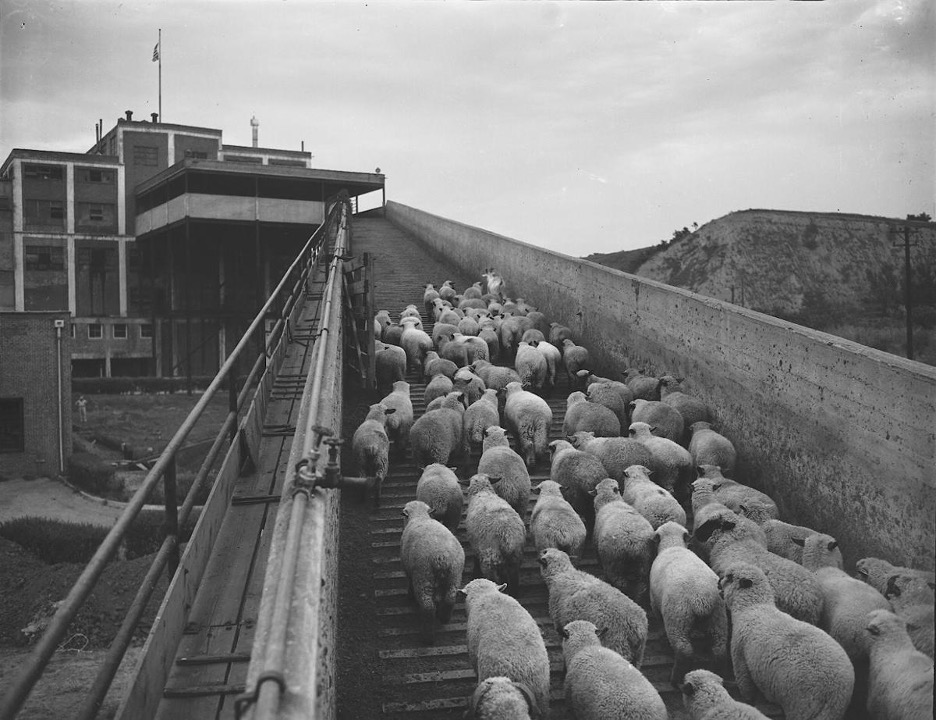
Judas, an apostle (kind of an apprentice) of the Good Shepherd, when a slaughterhouse goat leading literal sheep to their deaths, sounds like a very Bad Shepherd.
Shepherds work in the life stock industry, a Shepherd that doesn't bring sheep to slaughter is eventually going to have too many sheep.
> Assembly ship, also known as a Judas goat, a bomber aircraft used by the U.S. Air Force in World War II to lead formations.
Imagine being the pilot. Funny name.
(I tried pasting the link too, but apparently the back button no longer remembers input text on iPad. If only there was a kill buffer. Regardless, it’s via the bottom of that page -> Judas goat -> disambiguation.)
Amazing. I've been reading WWII history for decades, and I hadn't heard of this until today.
Probably still so now. Judas is the betrayer par excellence in American culture.
It's a massive plot hole in the NT, that a person whose mission can only be fulfilled by a death/resurrection cycle (to the extent of making sure none of his other allies prevented the death, nor making even a cursory attempt at defence in either of the two trials) would regard Judas as a betrayer.
And yet, he is named as such even before the deed. Although, looking at this text, I assume a wild mistranslation happened somewhere and that the original word which became "betray" had a much more general sense of causing harm rather than violating trust or confidence:
> After he received the piece of bread, Satan entered into him. Jesus said to him, “Do quickly what you are going to do.”
Also there're people which acts like sorters, they decide which human goes to meat factory and which to mines and then to meat factory :D.
Once was enough for me. I never want to see either of them again.
Including the director himself making a cameo.
I can feel its pull on me: especially around the bike, as I would like to be off the ground more but don't -really- wanna drop twice what I paid for my first car on one.
Apparently if you bring a flock to a bridge, they all hesitate until one finally tentatively steps onto it, and then they all go.
You can see the obvious analogies to first-mover human behavior.
Sometimes this happens because people are on their phones or otherwise zoning out, and only realize it's safe to cross when somebody else starts doing it.
But I think the big reason this happens is because, if someone else starts crossing the road, then it must be because either nobody is coming, or because the drivers on the road have already indicated their willingness to yield to the pedestrians. In the latter case, it makes sense to cross directly behind somebody else who is crossing, because a yielding driver provides a short window of opportunity for crossing safely.
In general, watching somebody do something that you thought was risky tends to be a subconscious prompt at the thing was perhaps not as risky as you thought. It's a little more subtle than "animal brain bad, look at the lights you dummy".
[0] https://www.latimes.com/archives/la-xpm-1990-05-03-mn-439-st...
Goats are inherently social, and so a lone goat will find a new group to interact with. What you end up with is a single, ultra-traumatized goat repeatedly finding a group of friends who all get murdered by a flying machine. I suppose it's worth it because otherwise the whole island ecosystem collapses?
There was a wonderful radiolab episode about this in the galapagos[0]
For some reason I found this hilarious and tragic at the same time.
Problem is people often don't like or know how to live with proper apex predators so they get killed off and we have to artificially control animal numbers.
However, in many places, we have introduced non-native species that never had natural predators. Then what?
> The term is a reference to Judas Iscariot, an apostle of Jesus Christ who betrayed Jesus in the Bible.
https://en.wikipedia.org/wiki/Judas_goat
A perplexing omission given its verbosity.
"You liar! You Judas!"
Which is a pretty clever little joke
regarding the bacon - is that really correct? I thought bacon-making was a longer, more involved process that would probably have been done off-site (brining,curing,smoking,etc).
These days they use radio collars to achieve the same.
But it's not so much about attracting other goats out in the open, it's using the desire of the Judas goat to be with other goats to make it easy to locate herds.
I've always felt a bit sorry for the Judas goat, all their new friends keep dying.
https://nypost.com/2022/11/17/sheep-filmed-walking-in-circle...
To hear that it happens in the animal kingdom too kinda crushed me a little bit.
Though given the scope of these events you'd expect to see every variation of human behavior many times over, so of course there are countless situations of betrayal and subterfuge, and these stories tend to resonate with people as they're highly personal and emotionally charged. People in more developed societies (or maybe just societies which emphasis individualism and individual moral agency, like many Western nations) find it difficult to fathom how such brutality could unfold at the hands of individuals without the interpersonal drama to help contextualize and connect to their own experiences.
On one hand, this headline is so densely obscure, I had no idea what the article would be about until I started reading it.
On the other, it is absolutely dazzling, in the truest, entrancingly disorienting sense of the word. The cocktail of eyebrow-raising lexical connotations it whips up is sublime.
Clickbait for sure, but it really delivered
This somewhat sums up a cynical view of mass movements in human history.