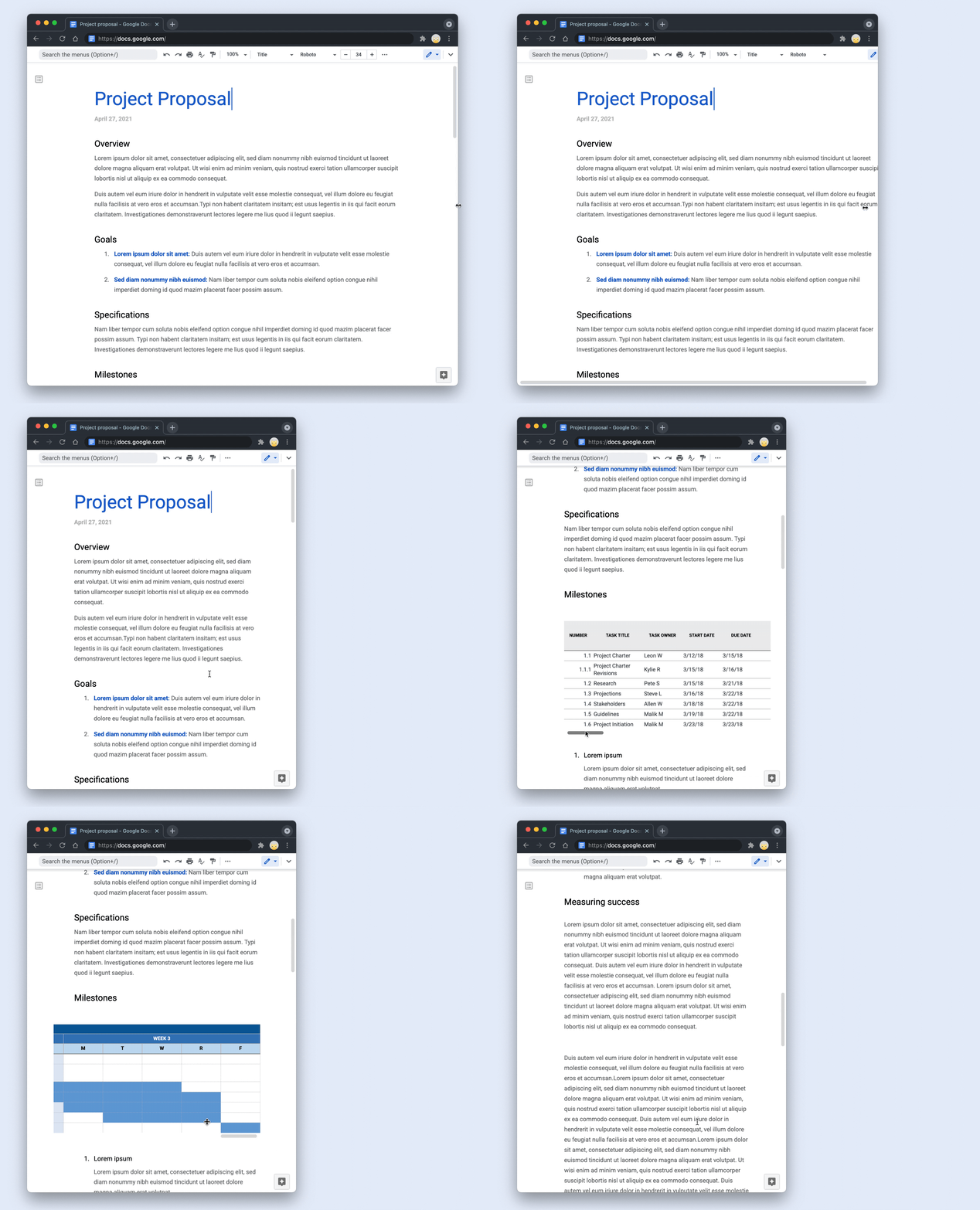
It's interesting how the documents industry is moving from print oriented legacy softwares (Google Docs, Word) to block based, app-ish, smart canvases (Notion, Coda, etc).
Also both Microsoft & Google have adopted completely different strategies to compete in this market. Microsoft launched Loop as an entirely new app while Google is incorporating these blocks as smart chips in Google Docs itself. Both strategies have their own pros and cons.
My bet is on Google Docs style, because this means a group that's already invested in traditional document making skills (legal professionals, academic professionals, etc) will be able to incrementally step up their game without their workflow being completely destroyed. Sure, this will slow down the pace with which Google Docs can innovate and evolve - but overall it helps the older generation to smoothly transition over to the new age document editing, which is great.
Also in the industry. My bet is on all of them. Some people prefer block based, some prefer text, some prefer Markdown, some don't care. Writing a book on Notion is impossible for now, but building beautiful pages is much easier in Notion.
Microsoft and Google (And Atlassian) have all adopted the same strategy which is "Look more like Notion".
I don't think that Microsoft should be worried about Notion. But things are different with Google Docs, which is really threaten by Notion. At the end of the day, most Google docs can be created in Notion without any difference, and I actually doubt Google docs will be able to evolve enough to prevent that.
The strongest advantage of Notion compared to Google docs is not its text editor but it is his list feature. And there are a lot of list porn people. When you have 10% of your workforce being "hardcore list porn people" and 90% of the others being "dont care people". Then it makes sense that the full organization goes closer and closer to Notion
EDIT: "porn list" -> "list porn"
I'd agree with you, and add that there are are a lot of other details that make Notion nicer to use. We made the move from Docs to Notion at work a year or two ago, and I've recently switched for personal use as well. Some of the differences are power-user things (e.g. easier to manage certain types of formatting from the keyboard), but a big thing for me is that Notion makes it a lot easier to manage multiple pages. Both the left-hand navigation list, and the ability to nest pages, are game changers when you're trying to manage a large collection of information.
Also Notion just feels cleaner; I haven't really tried to analyze why. And it seems like pages load faster, though I'm not sure whether this is literally true or just something about the experience makes it seem that way. Either way, it makes a difference.
As a word processor, Notion is still pretty immature. It's not very good at handling cross-block selections, using cut/paste to manipulate bullet lists often results in a dropped bullet, etc. There are a lot of little fit-and-finish touches that are table stakes for a mature word processor, but don't seem to be a focus for Notion. I'm hoping, but not confident, this will improve over time. Docs is better at this (ever since they threw away our our original hacky contenteditable code and built the entire editing experience in JavaScript), but that's not enough to make me switch back from Notion, just enough to make me wish Notion would put some energy into this.
Let's say, text editors. In the last 2-3 years we have been told AI driven auto-complete or code companions will "disrupt" the entire experience of writing text and code. Before that we had the plugin saga of VSCode and Jetbrains and what not telling us more features means more convenience. Before that we had GUI and cursor based text editors that were simple to use. Before that we had VI and emacs.
But is there any kind disruption? Not really. People still like what the use and feel comfortable with. They don't need to switch environments but they can comfortably add features that they think is necessary. For people who are comfortable with Vi text editor the process is Vi > VIM > Neovim and not Vi > Notepad++ > VSCode > Github Copilot.
It feels like Notion's demographic just dont need to share documents as documents. Notion would likely have put more effort into that feature if they did.
Ah well, I built it in my first week or so as part of a hiring trial process, back when the company was 16 people in a remodeled auto body shop. Before that, the “PDF Export” feature just opened the browser print dialog.
One fun thing about working at a startup is that you solve a problem for 90% of your users, but after a while of user growth and demographic shift, that remaining 10% ends up being bigger than the original 90% was in raw numbers.
Sharing has been done in two ways as far as I remember: straight making the page public when it was open information, or using Notion as a common draft and reformatting the text in Docs (+ adding headers etc.) before sending it to the partner.
I think instinctively anything “serious”, like a legal contract for instance, goes into Docs, even if Notion or another tool is used as a first step for collaboration.
Seems like it's touted as an innovation, but the only thing I see is that page breaks are gone.
Which isn't bad, I mostly use Google docs for online articles and to maintain a todo list, so things are now a bit cleaner.
But it doesn't seem like a big change...
So I can see this change having a big effect on consumers. If by "how big a change" you meant "would anyone even care", I think people will care, yes. Including me.
How big a change was it to implement? I don't know.
Note in addition to not having page breaks, it appears to have several "responsive" features added too (from the OP description, I haven't played with it yet myself). Lines wrap at whatever your screen size is (including zoom level), and there is apparently some screen-size-responsiveness to at least some images too.
I couldn't say how difficult this was to implement, having no idea what the code is like, and knowing that large legacy codebases can make naive predictions of how difficult a given change might be unreliable.
So yeah, I welcome this change big time.
Limiting my docs to a IRL format doesn't make much sense to me, page breaks make no sense, with H1/H2/H3 etc you can just navigate the doc that way, and internal links work etc. No need to say "check out the flurple widget subsection on page 92" you just slack/email them the link to the subheader or H3 or whatever and bam they're there reading what you need them to look at, similar to markdown docs on github, but with all the manual formating GUI'd away.
No connection to Zoho other than being a happy mail customer
We do have paid plans in case you need to onboard a team and want access to a bunch of other apps as well - https://www.zoho.com/in/workplace/
https://www.zoho.com/workdrive/pricing.html
One piece of UX/design feedback -- the red color on 'START WRITING" triggers an automatic response that I've done something wrong or that a site is trying to warn me about something. I don't think a lighter shade/different color would trigger the same response
My selfish reason: take the most popular paper format - PDF. A PDF created thirty years ago, is viewable today and will be preserved intact and viewable thirty years from now. I won't be able to say the same about a Coda or Notion doc. With all that dynamic blocks pulling data from all over the internet, I don't even think it's possible.
I would love to meet these mythical legal professionals that use anything other than track changes in docx. :D
EDIT: parents -> patents
eg. I print / save websites' ToS to PDF all the time. Over the last few years (especially from Chrome) the result looks increasingly garbled, nothing like what's on my screen. God forbid figuring out how to produce them as exhibits for litigation.
Paper-sized, static content also tends to be a convient dimension for reviewing material of substance (eg. think academic papers).
Often during tax season, or when reviewing database models or complex business logic workflows I'll print the spreadsheets / ERM / flowcharts across large 11x17 sheets that get tiled up on the walls or littered across the floor effectively giving me infinite screen space. Humans are built for working spatially like this rather than clicking back and forth endlessly between tabs. (And incidentally, coworkers have been amazed how much more efficient we become being able to crowd around such an exposition together). I'll keep doing that until wall-sized, surround-you-on-four-sides touchscreens become commonplace (or VR ergonomic enough you can't tell you're in it) along with annotation tools that match the intuitiveness of cutouts and sticky tape.
And if I have to read hundreds of pages worth of literature I still prefer to do it on paper and save myself the eyestrain.
Not bashing the new tech, it sounds cool, I just fear it will make rendering to more traditional layouts more difficult.
I implemented the full Zoho suite a couple times at different companies, in 2016 and 2018-2019.
What hurt most are the endless papercuts on the core CRM tool. Ultimately the pains for my users weren't worth it.
Try to open a Word document with a zip program, all you will see is a lot of folders with XML and blob images.
Latex and Word is XML. Notion is database.
The benefit of database: History, scale better, multiple users, merge text as diff is simpler +++
It doesn't really feel that impressive or new age to include a basic and imo required feature from the competitor so very very late!
Is there some sort of consensus on why Google hasnt really made a real effort to compete with MS Office?
It seems the "live recompute everything" ala Brett Victor (and previous) is spreading, do you agree ??
It really feels like they haven't developed the product in the past 10 years. This is the first significant feature change that I can recall in a very long time other than minor UI tweaks.
It’s also frustrating because if Google played to their strengths, Docs could be best-in-class; the real problem that everybody is struggling with is internal knowledge management. Why can’t Google build me a privately indexed knowledge graph of my internal docs, then let me use Google’s search to answer questions? It’s insane that this is not their product strategy for Docs. This should be “easy” to wire up, they have all of the tech already for google.com search.
People like notion because it is easier to structure nested Wiki docs quickly, but you still have the same problems eventually of needing to curate your knowledge base, and things becoming too hard to find past a certain scale.
Instead we get Data Loss Prevention and a bunch of other box-ticking features which, sure, are how you close enterprise deals to displace Microsoft. But I think they are sleeping on their vulnerability to disruption plays from the bottom of the market, and they need to invest more in building a moat here. Make the free/SMB customers delighted, and you starve potential competitors of the oxygen they need to grow into a competitor at the enterprise level.
But if we look at release notes for the past year, we see a sequence of smaller features.[1] These include ML-driven quick replies for comments, being easily add smart links to people/docs/lists, being able to add image watermarks, and Japanese grammar suggestions. These announcements are in small blog posts [2], and are usually covered by the tech media [3] (largely summaries with a bit of flavor or - cheekily - instructions on how to turn features off). It is hard to feel like there's major progress in Google Docs when features, even useful ones, trickle out like this. Perhaps the big release every year model isn't that bad, for communication purposes. It's just not in the DNA of Google or any online service, however.
If you look at the roadmap for Google Workspace, it's very much about collaboration.[4] This plays to the brand and strength of the online-first vision of Google Apps - it's easy to jump in and collaborate on docs, the suite works well together. I think companies that choose Google Workspace do so to transform the way they work. It's not really about just replicating the Microsoft experience on the web.
That said, I think Microsoft has done an amazing job pulling their apps to the web and adding collaboration/sync. Their online version of Word has basically no caveats, and their realtime editing is even better than Google Docs in some edge cases. So its unclear which way the market will go. Perhaps Microsoft has effectively fended off the online-first threat and can use its inertia and muscle to keep Office at the top. In any case, we'll move to a more heterogenous world where many suites or even individual tools are viable businesses.
[1]: https://support.google.com/a/table/7314896?hl=en
[2]: https://workspaceupdates.googleblog.com/2021/10/easily-add-t...
[3]: https://9to5google.com/2021/10/20/google-docs-menu/
[4]: https://cloud.google.com/blog/products/workspace/the-future-...
Disclaimer: I work at Google and used to work in the division that develops Google Docs. These are all my opinions.
Kudos to salesforce on a great tool, and great enterprise positioning.
Headers and footers are print-oriented, but losing footnotes is not ok. They could have displayed on the side, or highlighted in some way to display on mouse over or click. Whatever, just make them available...
I've used the new pageless style for a while and losing footnotes was a little annoying at first, be we adapted. I don't have a perfect solution to it, there are alternatives you can do (glossary or something at the end, with a bookmark on each item, so you can link directly to it).
If you make heavy use of footnotes, don't use the new feature (as others have said). It's a tradeoff, and I mostly prefer pageless, especially when embedding images that are larger (width wise).
I would look at them as sort of a content enrichment. Like a comment applied to the text.
Pageless has comments. Why would it be so bad to place footnotes alongside with comments? Or perhaps on the left side, below the headings index?
I'd even go as far as say Headers and Footers should be preserved but just included once at the very top and very bottom. Unless you toggle back to page mode and then everything just works. No data loss.
Seems like an easy improvement to make to pageless mode in the short term.
https://edwardtufte.github.io/tufte-css/#:~:text=Sidenotes%3...
Instead of creating web pages in html, css, and js, people will now create them using familiar "word processing" and "spreadsheet" apps on Google Drive.
And these web pages come with nice fine-grained access controls -- authors can specify who is able to view, comment on, and edit their documents with a few clicks.
Makes perfect sense.
Most people would not set up something like a git repo to track changes and comment on the content for example.
[1] https://github.com/rocdata/rocserver/blob/main/website/views... [2] https://github.com/rocdata/rocserver/blob/main/website/views...
Edit: I also thought your comment was sarcastic, my bad
But I'd love to have an option to keep the "paper" shape, albeit an infinite strip (toilet paper style).
All this white horizontal space distracts me
- It breaks tables that cross pages in weird and confusing ways.
- It messes up spacing that crosses pages.
- It interacts poorly with footnotes.
- In results in weird gaps when images need to get pushed to the next page.
It is what I used before, but it is clearly a quick hack rather than a proper solution of actually not having pages.
Minor note, they actually made that switch 12 years ago.
https://drive.googleblog.com/2010/05/whats-different-about-n...
https://cloud.google.com/blog/products/workspace/delivering-...
They also feature a table in a little GIF they have on that page.
https://storage.googleapis.com/gweb-cloudblog-publish/origin...
Some features are not available on pageless docs: columns, page numbers, headers and footers, page breaks, etc
I'm the founder of BeeLine Reader, and we are looking for an alternative platform that we can steer our customers (which include major universities) toward.
1: https://chrome.google.com/webstore/detail/beeline-reader/ifj...
Docs largely feels like an abandoned product, newer features don't address actual issues people have. They just add nice to haves that I could use if it wasn't so embarrassing to use docs in the first place.
There are exceptions, where a company has developed a font internally and owns the font directly, but those are far and few between. Even when a company has commissioned a font from a foundry, they’re usually licensing it from the foundry rather than owning it themselves as a work for hire.
(Source: googler, used to work on workspace, and through a random series of events ended up working closely with the google fonts team on this problem)
EDIT: also, you should be able to use apps script to do document generation from templates, that’s a pretty common use case.
Because of this, docs could already able to be too big to be useful.
"But outlines..." Not helpful since you can't specify to leave out sub-headings. Which means manually editing the outline every update.
That's why I've moved 1000+ pages of docs to Obsidian.md this year. I highly recommend, especially if you might be adhd.
Edit: to anyone interested, this YouTube channel[2] is a great primer on Obsidian.
[1] https://stackoverflow.com/questions/24190618/collapsing-elem...
[2] https://m.youtube.com/channel/UC85D7ERwhke7wVqskV_DZUA/video...
Later, I turned on pageless mode. Now the tables all had horizontal scroll bars. From TFA I see that I could change the view to medium or wide, which is a personal setting. Thus, if I use pageless mode with wide tables my view may be fine. Everyone else has a miserable experience until they find this setting.
I use "view > text width" to change the text width to medium or wide. This is a personal setting. It looks better for me but is still miserable for everyone else.
Suppose I forget that I changed "view > text width" and some time later I go about creating more documents that require this setting. Now, I'm unintentionally creating content that is difficult for all others to read with no idea of the misery I'm spreading until someone complains.
Not quite as good as native support (e.g. doesn't update dynamically), but otherwise it's pretty solid.
observer: You mean...like a web page?
google: no, no...its like...its like...well, its...Um, content that can be authored by non-techies which consumers can view online with lots more flexibility and freedom...Hey, these consumers can increase/decrease font sizes, etc. Cool, right?
observer: So...Um, its like MS Frontpage?
google: No, no, its more sophisticated than that. Um, maybe we're not explaining it right. Its more complex than what somrything like Frontpage can make...or well, actually its just easier for content creators to use...i guess.
observer: Oh, so its like Dreamweaver circa-early-2000s??
google: Yes, exactly! Oh wait...crap.
/s ;-)
We try to break this approach with OrgPad (https://orgpad.com/) and propose an alternative way of working with and thinking about information. In OrgPad, you have cells (nodes/ vertexes) and connect them with one or more directed or undirected connections (links/ edges) or can leave them without a connection. This is all done using a mouse and dragging or clicking. 7-year-olds don't have a problem doing that. The cells have optional title and optional content, yes, they can be empty which show just a little square. If the cells have a title, you can hide the content, which is visually suggested by raising the cell so it drops a bit of a shadow. The cells can contain anything, text, images, files even whole websites in iframes. You can add pages inside the cell, useful e.g. when learning vocabulary. If there is only an image in the cell, we analyze it for alpha color and render a bit differently so there is no extra canvas and the image pops out more. We support links on such images too. With this, it is possible to build simple websites actually and OrgPad can mostly replace e.g. Linktree. We will improve this even more in the coming days.
Of course, when you have created an OrgPage, you have split the problem into atomic ideas mostly contained in singular cells or a groups of cells. You can with a few clicks create a presentation by basically setting up a path of views on your graph. There you go, Prezi is also covered sufficiently well. Then you add our physical animations, just the overall clean design and powerful keyboard shortcuts and you can do pretty much the same work like with Google Docs Pageless, Miro, Padlet just a bit differently and we feel with less hassle.
Also, it's pretty shocking that people forgot the term "rich-text".
I think of something like creating a good looking resume, which may include light graphic design elements like divider lines, and might not have a strictly linear layout and put some information in a sidebar. Making something look good in Word can be really frustrating, and require jiggering with margins and column layouts. It may fall apart when you try to add a new job. It's almost a joke that if you want a good looking resume, you should use LaTeX, but that's incredibly inaccessible. So many more people know basic HTML and CSS!
I think a lot of website builders (like Webflow [3] ?) expose a lot of underlying HTML/CSS, but I suspect they also support a lot more ad-hoc graphic design elements that can really make the underlying HTML document a total mess.
[1]: https://en.wikipedia.org/wiki/WYSIWYG
[2]: https://developer.mozilla.org/en-US/docs/Web/CSS/@media#prin...
[3]: https://webflow.com/
I run into the same thing with Inkscape, where it seems to assume I am drawing on a piece of paper and I have to jump through hoops to not see the stupid page borders.
Confluence is among the pageless-natives, but their PDF export looks horrible and there’s no way to fix that as a user. I reach for it when I need to, but I almost always use https://docs.new when I’m ready to start capturing an idea or notes. So I’m happy to see Google Docs offer pageless and their recent additions of slash commands. I’d rather publish more Docs and less Confluence content. Having both at a large company does create a fair measure of bifurcation but neither seems to be able to replace the other.
As a result, I write in page mode as a hedge against the people who like pages since it’s easier to write in page mode than to do the boring reformats after the writing is done.
These are major updates but aren't too intrusive.
Project management is still not really available the same way it is on Asana, ClickUp, and the likes, but it's really making us do more in Google Workspace.
I always use 125% because things are too small otherwise and it always switches back to 100%.
I remember it didn't have page breaks by default and it took them a while to implement that.
I created a doc just now with three different pieces of content:
1. Text - stayed within the text margins, as expected
2. Table with lots of columns - used the full window (i.e. ignored text margin)
3. Wide image - stayed to the right of the left margin (i.e. ignored only the right text margin)
So the image only used 60% of the browser width.
But why is there such a huge left indent of text?
Perhaps footnotes should convert to notes like the ones you have on Google sheets.
Pages are human meaningful location references. Stop making this stuff harder!