I remember this was one of the things I tried countless times as a kid. It never worked - the books showed these nice, clear crystals but all I ever got was a crust of dried salt and maybe one tiny crystal a few mm across.
I'm sure most of those "science for kids" book authors never tried a single one of their experiments.
my grandma saw and told me to use the rest of the string and sugar I had, enough for 12 more tries, and do them at once but in different areas of the house
only two actually grew but i learned the value of spreading risk and unknown unknowns ( much later, on reflection :) )
They should at least recommend distilled water because tap water impurities vary greatly from place to place.
On the other hand, there was one time I had to do a short no-iodine diet and it was pain in the ass. I had had to go out of the way to find non-iodized salt and good luck finding any pre-packaged food without iodized salt...
I’m not sure about purity or anti-caking, although some brands are advertised as high purity. You can even get it delivered in the US: https://www.amazon.com/s?k=pool+salt
Perhaps look at the 20kg bags of food salt sold at wholesalers, which might not be iodised. I recall seeing one at a Chinese store, but I’m in New Zealand, so I’m unsure about the US.
On the other hand, being the competitive person who excels in science projects is often a very good predictor for being able to handle the tedium of a scientific lab job.
These can be two different things:
1. Constructive help from parents has (at least) two components. First, it shows your child you care. This may seems small, but it’s not. Second, and I think this is what a lot of HNers would appreciate, is to help your child to develop good processes. There is a lot that goes into this, and it can be parent-centered or child-centered, but having your child reflect on process and (ideally) implement some good processes can really set them up for later in life. Imho, parents should have to write a short narrative about what involvement they had in their child’s project, if any. This is required at some of the local schools where I live.
2. Having the parents do the project for the child is just silly. Most decent teachers can see through this (assuming they care). Congrats to the adult parent for winning elementary school or middle school as an adult. :-/
As such I love DIY science like this.
Regarding crystals, I have scanned in and cleaned up two projects relating to crystals:
http://underlandia.com/index.php/2017/09/24/things-of-scienc...
http://underlandia.com/index.php/2020/08/21/things-of-scienc...
Of course, I'd not want to do her work for her, but more than equally, I'd be quite happy to have a '5% We-encouraging' in her vocabulary when it comes to her explaining herself. What parent wouldn't, if they can?
I wish my parents had shown interest in stuff like this and supported me to some degree. It’s not about doing the whole project for the kids but showing interest is super helpful. I often gave up on stuff because my dad would basically say “what’s this nonsense for?”
I noticed this when read books about Steve Wozniak and Richard Feynman. Their dads showed interest and encouraged them to explore the world and also challenged them from time to time.
It took me many years later to understand that those kids were actually getting help from their parents and I was not that bad actually
Perhaps it's you taking this children's assignment too seriously. Was the goal really to find who could grow the best sodium crystal, or was it to teach them how to manage a small project and learn a bit of chemistry? Did your daughter learn anything about those things?
That teacher has a bunch of other kids to educate. Maybe they don't care, or maybe you just have your priorities screwed up a bit.
But perhaps also a good life lesson because that happens all the time. It’s good to try and develop a healthy self-driven passion. Oh, you don’t care? That’s fine because I do and I learned a lot.
It doesn't sound as suitable for a take home project
We just accept this as normal. Nothing is less normal than a bunch of children growing up in a building sitting in chairs all day. In an environment that is strictly controlling with harsh limitations on freedom of speech, no tolerance policies for all sorts of relatively innocuous things, and a forced secularism as to ingrain in students the unimportance of spirituality, physical health, personal liberty, and nature. And lets rid ourselves of this notion this is about education, because it isn't. Every step of school is focused on obedience and preparing them for the next step so they will be able to get a job. It is the perfect way to mold a child into an obedient wage slave.
I am picturing you over a mortar and pestle crushing the salt of your enemies whilst a single tear falls into the mix - and en-vigorating (filling with life) - the salt of your defeated enemies..
Check out his copper sulfate crystals if you want something really visually impressive: https://crystalverse.com/best-way-to-grow-copper-sulfate-cry...
I know what I’m doing this weekend with my crystal-obsessed daughter and the bag of copper sulfate I forgot on top of the fridge.
You'll need potassium hydrogen tartrate (cream of tartar), sodium hydrogen carbonate (baking soda), and calcium chloride (sold as DampRid or Pickle Crisp).
Add a spoon full of baking soda and a spoon full of cream of tartar to a glass of distilled water. They should fizz together as the baking soda neutralizes the acidity of the cream of tartar, releasing CO2. This is what you want, since the mixed neutral salt of tartaric acid is more soluble in water. Stir and wait for the fizzing to die down, then gradually stir in small portions of more cream of tartar until the additions stop dissolving. Let the solids settle in the glass.
Meanwhile, dissolve a spoon full of calcium chloride in a second glass of water. It should dissolve readily with a bit of stirring.
Once residual solids have settled in glass one, decant the clear liquid into another glass.
Now pour the clear decanted liquid into the calcium chloride solution with stirring. Within seconds, you should see sparkling needles rain out of the solution. These are your crystals. The transition is especially striking in direct sunlight. The crystals can be saved and seem to remain stable in air regardless of ambient humidity.
I unfortunately have not seen this demonstration written down elsewhere so I can't offer a citation. I came to it by personal experience when I was on a crystal growing kick as a kid. (Though it may well have been written down somewhere that I have never come across.)
[1] Like in this video: https://www.youtube.com/watch?v=AO67MnZaAvQ
Get a bottle of good red wine, 2010 or thereabouts. Uncork and drink it. Now look at the bottom of the last glass, if you still can, and - voila - potassium bitartrate.
If you don't find any, don't despair and try another bottle.
http://srjcstaff.santarosa.edu/~yataiiya/E45/PROJECTS/Homebr...
The sodium carbonate needed is otherwise known as "washing soda" in addition to being called "soda ash".
With sensitive compounds, sometimes you can't just let things evaporate. Also as the article states, weather conditions might mess you up. IMO the coolest trick we had to solve this was osmosis of an anti-solvent into a saturated solution.
A small sealed container with a saturated solution of your compound/salt is punctured, and put in a bigger sealed container containing a worse but miscible solvent for the compound under study. Slow diffusion into the inner container causes very reproducible crystal growth, as long as you can control the temperature.
Ahh, X-ray crystallography, a.k.a. the field of modern (bio)chemistry that most closely resembles medieval alchemy.
The excellent 2009 documentary "Naturally Obsessed" [0] is about how difficult, time-consuming, and frankly irrational it can be to successfully crystallize certain proteins and protein complexes. The film is about how some PhD students spend the entire five-ish years of their degree programs trying (and mostly failing) to find the secret recipes (protein purity/additive ingredients/temperature/humidity/phase of the moon) that will allow their proteins to crystallize, and thus granting them data with which to populate their dissertations.
Why irrational? In one case, the secret ingredient is pickle juice.
This is amusingly accurate and makes me wonder if our understanding and techniques will ever advance to the point where crystallography no longer feels like medieval alchemy. Surely the process is largely deterministic and we simply can’t control the relevant initial conditions with our current methods.
Interested now to try this experiment but with ethanol to better control the crystal formation.
Will be a fun xmas experiment to do!
A) you sometimes spend weeks working on the materials that go into the solution, seeing them feels like a "my god finally" kinda thing
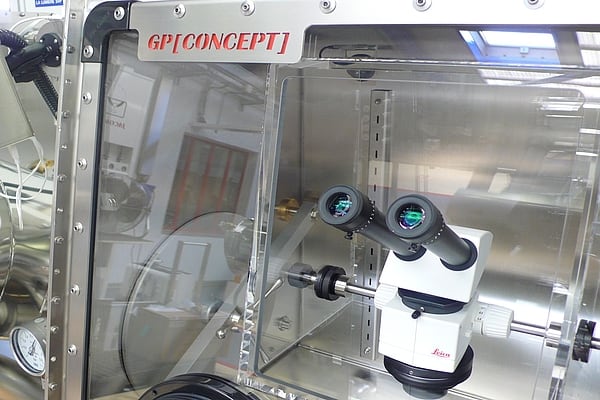
B) under a microscope crystals are especially beautiful, even small crystals. We had a microscope set up in an inert atmosphere for sensitive compounds, see eg.
https://www.jacomex.com/wp-content/uploads/2019/08/microscop...
About timing: this could take anywhere from days to months... really dependent on how fast you can go without making ugly intergrown xtals, on how well you select solvents, etc. Experimental science can be cruel.
Plain white sugar is also interesting. Alum (used to make pickles, can often be found in the herb and spice aisle at the store) makes neat crystals.
If your kids are old enough to be trusted not to eat the experiments, copper sulfate (used to kill roots that are growing into sewer lines) makes beautiful crystals. It can be found at Home Depot-type stores.
Edit: I see this author has a link to another article on growing copper sulfate crystals down at the bottom of this article. Recommended!
I had a chemistry set as a kid, it had copper sulfate. The only crystals I've managed to grow :)
Thank you for the answer, I still remember my alum crystals for the grade school science fair.
Fast-forward many years, and my daughter wasn't having much luck with salt, sugar, or even copper sulfate (that one looked like a melted smurf).
I remembered my alum crystals, which she tried, and lo and behold...nothing! Desperate (on the night before the assignment was due), I remembered someone mentioning that you can make crystals with mothball flakes. We picked a bag of flakes up and heated them up in a dish, and were able to make long, beautiful crystals on the bottom of a cold glass over the heated solution.
The only problem was that as soon as we moved the glass away from the solution, the crystals evaporated, so she took a picture of the crystals as they were forming and received full marks. A happy ending, but the house smelled of mothballs for a few days!
ADP
https://en.wikipedia.org/wiki/Ammonium_dihydrogen_phosphate
and MKP
https://en.wikipedia.org/wiki/Monopotassium_phosphate
and Alum
https://en.wikipedia.org/wiki/Potassium_alum
but probably table salt is cheaper..
I really like Adam's videos, he does a ton of research, and has a very descriptivist approach to cooking in general
The rest is light transport, e.g. lensing via index of refraction: https://courses.lumenlearning.com/boundless-physics/chapter/...
Here's a cool article on a piece of an old spectrometer: https://utsic.utoronto.ca/spectroscopy-beyond-the-visible-sp...
More information from a distributor of optics: https://www.knightoptical.com/stock/default/windows-and-diff...
Guess we gotta grow some!
When visitors remarked on the specimen, my wife often explained that it was a natural salt crystal. Nobody could resist licking it just to be sure.
Still got a beautiful color, but it's got about the same feature definition as a gummy bear...
https://www.appropedia.org/Single_Crystal_Turbine_Blades#Man...
So you probably did get lucky, but depending on the conditions maybe not extremely lucky.
Well that ends the experiment for me before it even began. AFAIK by law, all salt sold in my country is iodised.
A teacher said, they found it in the woods.
Some crystals just never form. I know folks who spent 7 years trying to get their protein to crystallize and left grad school with a masters degree instead of a PhD because they failed, no fault of their own.
If the same holds true in 3D, maybe some of these proteins simply do not form crystals.
Sucks to be a PhD student hitting such a protein.
Anyone got a location on picture 5?
This is a content-less comment but... great article, thank you for submitting.
Largest I was able to find was about 2cm to a side, maybe a bit less.. Is there any fundamental reason they don't get bigger than this/lose transparency and form as they grow larger, or is it more that no-one bothered doing growing them larger than that?
TIL it takes a long time to grow a perfect salt crystal of any size.