Adopt modular nuclear reactors, and produce hundreds/thousands of them yearly.
Electrify transport.
Figure out how to get to a global population of 4 billion: ie massive family planning drive in Africa/West Asia encouraging 1/0 children. (Keep in mind this is just the population level from 1974).
- You can create electricity but how do you deliver it? The existing power lines, transformers, and other parts aren't enough. The grids need to be upgraded. This takes time, planning, and money.
- Many people don't have the income to buy new vehicles. Especially at the costs for electric cars today. They often buy low cost used cars. Low cost electric used cars often don't have range due to old batteries. The car costs aren't working for a large chunk of the population.
- Buses, construction equipment, worksite/home generators, and a lot of other things run on gas and we don't have functional replacements for them right now. Cars are the easy part. There are a lot of other gas powered things that are harder and still need viable solutions.
If we really wanted to do the environmental thing we'd focus on public transit. Moving lots of people at low costs and environmental impact. This would work for cities and suburbs. It would have a better environmental impact than moving people to electric cars.
The lack of looking at things holistically makes me wonder what the real goals are and for whom.
We can start by mandating EVs-only for vehicles priced $100,000 and higher, and lowering that threshold by $10,000 yearly. We entirely overhauled our manufacturing in WW2 with much less technical capability than today - we just need the political and social willpower (which I guess war provided).
Electric busses are already here. Those other uses require minimal levels of fossil fuels in the scheme of things.
Public transit is not attractive because its not point-to-point, and you have no control over the other passengers on your ride. Autonomous minibusses with demand-driven routes, private subscriptions, and passenger reviews are the solution. Or, just plain old electric scooters if we can get rid of enough street parking/car lanes and install bike paths.
Outside of anthropogenic climate change we know earth and humans can suffer catastrophes and extinction events from many other sources, so it's very wise to have redundancy.
I think your comment also brings up the "weak men create hard times" quote; part of the reason why many in the developed world seem to be floundering is probably due to our unprecendented safety and comfort
And, why Africa and West Asia? Why not, you know, everybody?
And what are you going to do if they decline to be planned according to your idea of how they should be planned? (Which I suspect they hare very likely to do...)
Why in those countries, when countries in the west that have already completed demographic transition aren’t even at that level and have policies that actively resist fertility rates that low.
Why not encourage development in Africa and west Asia, immigration in to western countries, and family planning in places where headwinds are much weaker (and where a shrinking labor force can be bolstered by immigration).
For instance is it problematic to just import Africans to Japan until there are no more ethnic Japanese left?
It seems like what you are proposing would just lead to the most developed nation's peoples just dieing off and being replaced with groups that are slowest to educate and provide a high standard of living for their women, which would be awful for human cultural diversity in the long term
We have this, they just go in ships and submarines.
US shipboard reactors use highly enriched (93%, literally weapons-grade because it was originally produced for warheads) uranium, that's not really desirable to distribute throughout the territory.
Even "low-enriched uranium" in a naval context just below 20% (which is the official boundary between LEU and HEU). By comparison regular "civil" nukes use 3-5% uranium.
> Adopt modular nuclear reactors, and produce hundreds/thousands of them yearly.
Nuclear reactors need fossile fuels to work (in the supply chain): To sustain nuclear you need to have a thriving militaro-industrial complex, which in all sorts of manner requires vast ressources which you must somehow buy (or steal depending or your political views) from global south countries.
The problem here is very simply framed: we've thrived on tons of cheap energy and now this source is tarishing. It's pretty clear there is no miracle alternative: nothing around us is going to have the same combination of cheapness, massive volume, energy density and ease of use (neither nuclear nor renewable). We can improve some alternative stuff but there's really nothing on the same level. That is a fact. Now if you're running short on something, you spare it. And in fact it's pretty practical. One should be blind not to see how a small part of the world is hilariously over-consuming (energy, raw material, food, investment). Knowledge has exploded and it's now easier than ever to build things that last. That are passive in energy during use, that are cheap to produce in terms of energy input and non-renewable material contained. This will of course be at expense of economic growth since it will drive consumption down. But that is actually what we need. Of course it needs cultural changes, but like seriously, who is satisfied with the current doxa? Trust in institutions in dominant countries is at record low, there is gonna be a (obviously more or less gradual) reboot, with changes in lifestyle and social order. So we better choose it instead of having it imposed.
> Figure out how to get to a global population of 4 billion: ie massive family planning drive in Africa/West Asia encouraging 1/0 children. (Keep in mind this is just the population level from 1974).
Ugggh. You and me are the problem, not some poor smuck in Nigeria or Bengladesh, who's energy consumption in a year is probably comparable to ours in a month. We're the one that are making them badly extract their ressources, who are paying for them to work, to whom they ship broken things, who are doing tourism in their countries. Think about it for one moment and then please stop using this colonialist talk point which is fallatious ("poor people reproduce uncontrollably"). There are numerous reasons for that to happen and our domination on them (past and present) is a big one.
Precision: of course we have to "help them" up their materialistic well being, and that encompasses having better healthcare support for women, contraception etc. But it's improductive and actually violent and authoritarian for us to do it directly and without giving away power, money and knowledge. And perhaps we could start by not hindering them to do so, like EU countries are currently doing with Covid vaccines (i'm saying Covid but this is routine mafia racket work which is pervasive in all industrial domains).
edit: i even forgot to answer to one of your points:
> Electrify transport.
This is a moonshot. For one, autonomous transport needs high density energy storage and has locality between source and use. Too bad electricity is like impossible to store directly and has as main benefit to be transportable quite easily over long distances. Our vehicules are designed for fuel, they just cannot be reused as is with such a different energy source. The one way electricity is useful for transport is if you manage to profit from its benefits: trolleybus and rail. Again if you go back enough in your assumptions and think about the real problem there's one solution which is always overlooked: scale it down and do less transportation ffs. Globalization has enabled some radically new stuff which need planetary scale to actually be possible. But these things are a minority: it's high-tech stuff. Let's just make every local group of countries produce it's own simple things locally again (as in: what is needed to have 80% of our lifestandard) and we'll cut global transport by X%. Stop designing cities like everyone has their personal car. Stop depleting countrysides from local services (yes, it's local human-labour intensive to maintain).
---
All the things i presented are actual solutions which would need some thinking to go through and lots of reorganizing, but crucially they aren't depending on some magical technology popping up. We know they can work. The real question is now: do we want to keep the worlds power structure and thus depend on a moonshot to make things work or do we accept to stop doing what has been central to maintain the domination of global north on global south and just do the easy obvious thing? It fine to defend the second choice, but you gotta know what your defending.
Indeed, it is very dissapointing to see people talk about Africa as if it's the problem, while a single western nation consumes and pollutes more than the entire coninent combined.
"Nuclear reactors need fossile fuels to work (in the supply chain): To sustain nuclear you need to have a thriving militaro-industrial complex, which in all sorts of manner requires vast ressources which you must somehow buy (or steal"
Nuclear does not depend on any rare materials.
This is only true in a sence that nuclear requires heavy industry to build, and heavy industry depends on oil.
But so does production of train and bridges, solar panels and large wind turbines. In fact wind requires more total built infrastructure than nuclear does. We have to transition to carbon free industry either way, so I am not seeing how this argument works.
"we want to keep the worlds power structure and thus depend on a moonshot to make things work or do we accept to stop doing what has been central to maintain the domination of global north on global south and just do the easy obvious thing"
I think this is a big brain bug, people often reject ideas that challange existing power structures as just too crazy. The trouble is most do it without realising what they are defending and why.
Quick way to start a war, and not one that could be won without committing grave crimes against humanity which would obviate the need for such a policy to begin with.
We should be carpet bombing Africa with books, higher-ed, and investment.
No genocide necessary.
The only problem with this plan is that it is far too boring/liberal/naive for a significant portion of decision makers.
Edit: If you disagree, please let me know why. I would love to hear why I'm wrong about this.
1. https://www.eia.gov/todayinenergy/detail.php?id=45096 2. https://www.azocleantech.com/article.aspx?ArticleID=1114
You’ll get better expected returns from working to avert disaster than panicking about it.
But there is also much discussion on peak oil and climate change that apply 'collapse' differently, as shorthand for a simplifying of the economy and civilisation as a result of no longer having the cheap abundant energy needed to sustain the level of complexity which it has grown into during the age of fossil fuel extraction.
If (and it's a big if) you anticipate the fossil fuel boom ending without the advent of an equal or greater replacement energy source, collapse by the latter definition is a useful term to discuss what that might look like. It's certainly true that we have extensive supply chains, dense living, abstraction from the fundamentals of survival, and many aspects of our current way of living exclusively dependent on fossil fuel and petrochemicals. So it follow that without equivalent or better energy source to sustain those things there must come about, either by choice or circumstance, a simplification (or collapse) of many aspects of present-day civilisation.
[0] https://www.youtube.com/watch?v=0uKihKkx0eY&list=PLRgTUN1zz_...
[1] https://www.youtube.com/watch?v=xliyZMPJvjk&list=PLRgTUN1zz_...
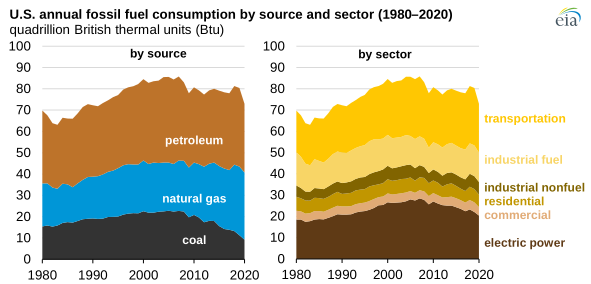
1 - for example, in the US: https://www.eia.gov/todayinenergy/images/2021.07.06/chart2.s...
This looks like the new normal is that fossil fuel usage drops in a recession, then stabilizes after.
Isn't that what's happening now?
I don't know what the cost difference is between heating from an efficient natural gas furnace and heating from an efficient heat pump, so I'm not sure if natural gas has exceeded the price of electric heating.
https://www.cnbc.com/2021/09/09/natural-gas-prices-are-risin...
I know humanity lived without fossil fuel for thousands of years before we found coal, but there were societal systems in place then that supported that type of lifestyle. We weren't all driving cars to big grocery stores filled with 10000 mile products [1]. And a lot more of us were farmers [2]. Hopefully as fossil fuel resources dwindle we can restore some of those older systems, or figure out better ones. But that depends on how fast the oil production declines. And if it takes a while to set up new systems you might need to provide for yourself in the interim. What to provide is up to you. What do you need and what would you not want to live without?
1. https://cuesa.org/learn/how-far-does-your-food-travel-get-yo...
How will we able to heat our homes? I can’t imagine how much more electricity it would take to replace national gas, it could be many times our current electrical production.
This isn’t even a new idea, most homes in Russian cities are heated using district heating. At scale it’s so efficient that they don’t even bother metering the heat.
Additionally with a district heating system, geothermal, and ground source heat pumps start to make a significant amount of sense. Their both technologies the benefit significantly from very large installations.
Don't worry Canadian-bro. Texas has you covered. An alarming amount of the natural gas produced in the Permian Basin is flared or manages to sneak out of leaky fittings and tanks as fugitive emissions. We put off building out the infrastructure necessary to capture and use this resource because it was expensive to build and natural gas prices were low. Since our state government would never make a corporation or an industry self-fund anything expensive, there was never any money in the budget to build it.
We're doing the easy work of pumping the whole atmosphere full of methane so that everyone can stay warm, even our friendly neighborhood Canadians.
/s of course.
https://www.alberta.ca/natural-gas-overview.aspx
You're gonna be fine.
Also a return of the proper coat as casual indoor wear?
Before that: smaller houses, closed off rooms, wearing sweaters inside all winter, sitting around a fireplace/stove most of the evening, and using thick down comforters half the year (if you could afford one).
Can you honestly see droves of people doing this by choice? I can't.
When was a proper coat last casual indoor wear? 200 years ago it wasn't. In a cabin with a fireplace you don't need this.
Insulation and design standards need to be stepped up, with passivhaus the standard if it isn't already.
This is already done in Russia
Though it's expensive to install in an existing house, and needs a lot of land (or a well).
Mitsubishi's heat pumps with their "Hyper-Heat" feature are able to work at 76% of their capacity down to -25℃. If those colder periods aren't too long, a heat pump combined with good insulation might be enough to get through that.
New homes built to A++ standard need so little heating people are just opting to use electricity and use saved cash to build solar plant (provided your grid lets to store power long term).
Asking because I have no idea and would love to know from someone who has some insight/experience on that front.
The state government subsidized efficiency and other measures to reduce peak demand just to slow growth and control price escalation.
Nuclear is a shitshow to build and realistically requires federal action. Similar to how the FCC declared 5G a national security priority and took away local government oversight of infrastructure siting, the Feds could do something similar.
Unfortunately, since the US has a political party that believes that political consent comes from control of geography, the coal mines and gas wells are better represented in Congress than people. The US will not be leading this transition, and we’ll be second fiddle to those who do, likely in Asia and Africa — as there is no alternative for them other than persistent poverty.
https://www.rolls-royce.com/innovation/small-modular-reactor...
We need to be ramping up these immediately... and targeting production of at least dozens per year. Its the perfect industry for a country like the UK to pump money into right now.
> As economists Professor Tim Jackson and Dr Andrew Jackson of the University of Surrey have shown, there is now abundant scientific evidence that the decline in EROI is an underlying driver of the decline in economic growth.
> This suggests that the last two decades of global economic turbulence are closely related to the global economy’s continued structural dependence on fossil fuels: a dependence that, if it goes on, will guarantee a grim future of energy and economic decline amidst mounting environmental crisis.
It argues that increasing EROI has led to decreased economic growth, and therefore we should switch to renewables before EROI increases for oil in order to make sure we fuel economic growth.
But it ignores how EROI decreases growth (mentioned in the article they link to), it does it through increased energy prices. But a switch to renewables is not going to decrease energy prices, if it did we wouldn't need to subsidize renewables.
Decreasing, not increasing. EROI = The amount of usable energy delivered from an energy source versus the amount of energy used to get that energy resource. So if we consume 1KwH of energy to make 20KwH of energy available, that's an EROI of 20x.
Your point about price is partially correct but what matters is the future projection. If fossil fuel EROI is only going down in future, that means price will only go up. If renewables EROI is projected to improve, stay the same, or even decline but not to the same extent as fossil fuel, then there comes a point where you want to be on renewables and away from fossil fuels. Since that transition takes time and re-aligns a whole bunch of major things in our economy and society, it would be foolish to wait for the cost balances to have flipped. And this is the purely economic argument, putting aside the climate change/environmental impact stuff.
Renewables are still rapidly developing, and prices are falling precipitously. The subsidies are achieving their goal of funding and encouraging investments renewables and their rapid improvement. Every year the MwH price of renewables falls, the opposite is true of fossils.
Even now Solar and wind outcompete a number of fossil technologies on price. So your point is completely wrong and totally misunderstands the purpose and achievements of renewable energy subsidies.
According to IMF report, in 2020 fossil fuel industries received $5.9 trillion in direct and indirect subsidies.
Not a typo. $5.9 TRILLION
You're partially right: we wouldn't need to subsidize renewables if they were playing on even field.
But they are not. Fossil fuels receive orders of magnitude more subsidies.
And things would be even more in favor of renewables if we addressed externalized costs (BP oil spill and such) by doing e.g. carbon tax.
https://cleantechnica.com/2021/10/19/oil-coal-gas-got-5-9-tr...
For me, that casts some serious doubts on the accuracy of the $5.8T figure.
Well, it kind of is?
> Rather, it’s because they are increasingly eating themselves to stay alive. The oil and gas industries are consuming exponentially more and more energy just to keep extracting oil and gas.
i.e. we’ve drilled all the easy-to-extract (cheap) oil, and now all that is left is the hard-to-extract (expensive) oil.
The thrust of the article is still correct though: the answer is to redouble efforts to move to non-fossil energy sources.
Expensive oil might be the sense of urgency we need.
Organic keyboards and Zero plastic displays may be a thing in 2040 but petroleum has touched every aspect of modern life.
No, the answer is to consume less energy. Reducing energy consumption (and consumption in general) is the only answer that's compatible with a sustainable future.
Bad maths warning - I think this means that for a given activity that uses oil, say driving a mile, ignoring all the energy that went into the car etc. you're burning 12.5% on top of what you put into the tank. Whereas in 1950 this was only 2.3%. Seems like a noticeable chunk of efficiency improvements are cancelled out just to keep polluting at the same rate as before.
If we can remove our dependency on fossil fuel energy, then we can turn around economic growth models which is really exciting.
https://www.amazon.com/Limits-Growth-Donella-H-Meadows/dp/19...
I don't buy it, because as demand for oil drops, the supplies that will be taken off line are the low EROI ones. So a drop in demand should actually reverse the trend of declining EROI.