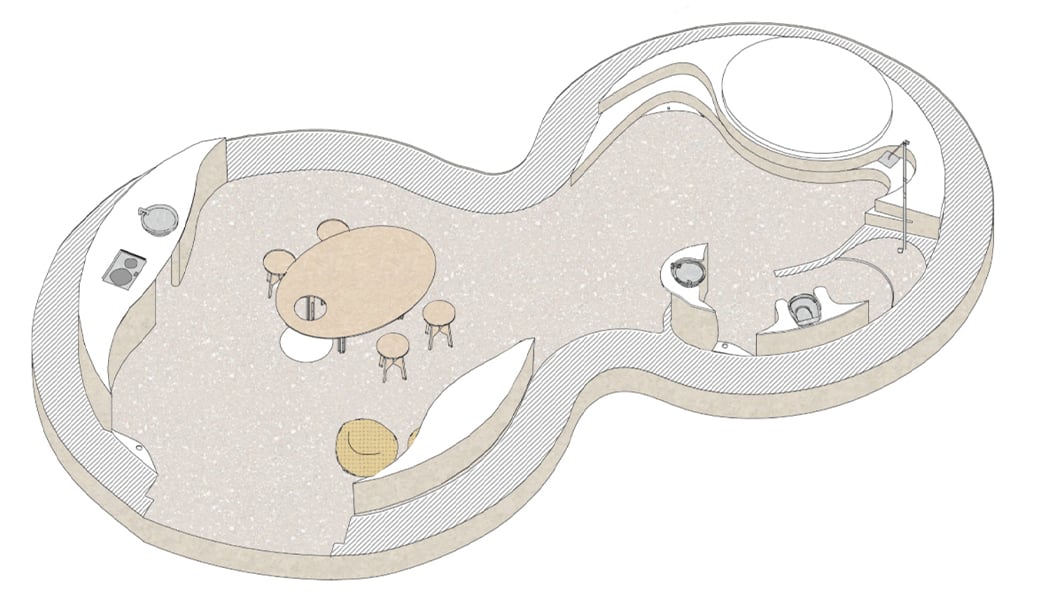
The HN community is more likely to provide a check on these claims - I think that's valuable. You'll find the acerbity is triggered by exaggerated claims, humanitarian claims, and lack-of-discussion of downsides. The TECLA page is filled with lines like this: "TECLA, a 3D printed global habitat for sustainable living". It sounds manipulative, makes me not trust them, and based on past experience, pattern-matches to most of their claims being false or exaggerated.
"Hey you are into 3d printing, right? Have you heard about the new technology that allows us to print houses?!?"
Yes I have ... no it won't change the world ... yes this has been done for years now.
What I am more interested in is that robot arm on a truck that "automatically" lays bricks with mortar (substitute) inbetween.
In HN terms, this is a “rewritten in Haskell.” It demonstrates someone understands a bit about 3D printing. It demonstrates some ideological purity. It doesn’t demonstrate a better solution to existing problems.
The complexity of the logistical chain precludes wide spread application where housing is a basic need. You don’t just need the printer machine. You need a fleet of other machines to keep it full of ink. Shovels won’t do.
In the 1950’s, my mentor the late David Crane, FAIA was a young man. He enthusiastically designed precast concrete shelters for post disaster housing. Running the economics at the end of it, its viability was mostly limited to lower Manhattan.
People have been solving housing for millennia. Stick lumber and reinforced concrete are real breakthroughs by virtue of their commoditization.
This is wrapped up in secret sauce. Beautiful as with the myriad other beautiful ways to build.
Most choices are not between bread and cake. They are bread or nothing.
* People have been solving transportation for millenia
* Horses and trains are real breakthroughs
* The complexity of logistical chain (gas, mechanics, paved roads) precludes widespread application where transportation is a basic need
* You need a fleet of other machines to keep it full of fuel. Oats won't do.
* It does not demonstrate a better solution to existing problems
"It doesn’t demonstrate a better solution to existing problems."
"They are bread or nothing."
And this guy starts off his reply with "The negativity is no more unwarranted than positivity."
Why do I always see these kind of comments on the top?
Does HN scrutinize everything based on the "practicality of things"? This article is multiple galaxy away from making such a claim. Why do people respond like the next million dollar housing solution is being advertised here?
Hey, that's me! I want one! I'm here to know if plumbing is included and if the exterior can look better, but I love this style on the inside. Its a mixture of Pierre Cardin's bubble palace and another aesthetic I've seen where the rockface of a mountain makes up the backwall of a contemporary home! I love it!
This seems like a cheaper way to do that, and I love the hue lights.
Its obvious that there is some metal and other materials that did not come from the earth at that site, and that therefore it cannot have zero waste as the company claims
but who cares, this guy (me) that can easily exchange earned resources for shelter does not care! I like the pictures and read it can be done in 200 hours. Uh, hello!
What HN is doing here is internalizing cliches, responding to hyperbole/tropes they (we) assume is in the article. Also, the artsy-philosphical terms used by architects pisses off nerds. "Humane Architecture" and whatnot.
This is HN being silly, not HN being smart. We do both here.
Meanwhile, how is transporting materials vs equipment a Hard Problem?
https://hn.algolia.com/?dateRange=all&page=0&prefix=true&sor...
You make a factory that builds prefabricated panels then deliver them onsite. With prefab, you don’t need to transport an expensive piece of equipment to remote parts of the world and have onsite experts there to supervise and repair it. You don’t have to deal with tear down and setup of the equipment at every site and installers have predictable channels to install any power/ water infrastructure.
I suspect the reason this is popular is more because they are aesthetically pleasing and use new/ special technology than anything else.
It’s not something you could measure on a spreadsheet but it’d be immensely cool to be a part of that, maybe even somewhere remote where you don’t really want to bring much more than absolutely necessary.
Who'd think that a proof-of-concept doesn't yet compete with existing solutions?
>I suspect the reason this is popular is more because they are aesthetically pleasing
We are talking about places people can live in. Aesthetics matter.
The ability to produce something aesthetically pleasing on the cheap and at scale matters.
There is a reason Soviet architecture is the butt of so many jokes. They were rapidly building post-war, with the idea that those buildings will be replaced in two decades.
Many of those buildings are still there.
This is a proof of concept and surely it will be refined to make more efficient construction processes.
The goal here is obviously to build an experimental building, and isn't even explicitly related to affordable housing. Meanwhile, this building method produces a different building to the one you suggest. It's an irrelevant comparison for that reason alone, but there are lots. What if the factory is far away? The fact that transport needs are totally different is actually useful.
Also, what's with this static mindset? Don't you think there are no new building methods to be had?
Personally, I'm quite interested in these printed structures. They're not ready for major use yet, maybe they won't ever be. Practicability will (or won't) be proven when large projects are attempted. You need small projects first.
TLDR, of course they could have just parked an RV there. That's not the point.
A buddhist monastery in my area managed to build beautiful structures using bricks made from local raw earth. No fancy giant 3D printers necessary.
If you go onto the various engineering and construction subreddits, along with subscribe to various construction trade magazines, these "experiments" pop up all the time. "New" methods. "New" materials. They're "new" if you've never seen them before. However, there's a good chance a real scientific approach to this was done half to a full decade earlier and abandoned for a good reason, which is never mentioned. Unrealistic, fanciful designs are great ways to hide the flaws and look cool because of uniqueness. Too many of these projects detract from more practical methods all in the name of, "We're out to save the world, throw money at us and question nothing!" Basically, think Theranos. Detracting from real, practical, truly well-meaning but unsexy projects is where I get angry.
There are 3D concrete printers out there. There's an Aussie one that escapes me that's just about commercially viable if it isn't already. There are plenty others, but the Aussie one was in the lead last I knew. Another company does an arm that can pick/place brick/blocks. While a bit slow, in like a 36 some odd hour non-stop cycle, it can build a regular, practical, normal, everyday, conventional 2 bed-room house. There are other solutions that are proven. Past experimentation. Past testing. Past prototyping. In production. Ready to go... except attention and investment is given to art projects. Which then hurts the image further for REAL projects because investors will immediately categorize them with these doomed to fail art projects. Remember, construction folks don't really care about form, it's all about function. Cost-effective, practical construction methodology for cost-effective, practical buildings that meet up to local building codes and requirements. Not art projects.
As a separate example of the silliness I'm describing: There's a really fun "innovative material" made from mycelium (fungus) that pops up as "brand new" every quarter. The main substrate does change every now and then, but generally it's a sawdust brick with a fungus allowed to spread into it and form chitin. This new magical brick is biodegradable and uses waste material... except no one likes to mention that they can only maintain ~40 PSI of compression while a standard cement block is rated for a minimum of 3,000 PSI. That's why it's always used in very artsy-fartsy designs to hide the limitations. Oh, and the one thing a building shouldn't be is "biodegradable". Also known as engineered-failure in about a 2 year timespan. We haven't even gotten to viability in windy, swampy, monsoon, seismic, freezing, high freeze/thaw cycles or any other special building conditions.
I so incredibly hate these art projects with a fiery passion because normies imagine, "This will help the poors". No, it won't.
So yes, in the end, negativity is warranted. It's a nice line of logic and experimentation... but earthen homes are a niche and 200 hours isn't that impressive (8+ days). A handful of people can build an impact earth home of the same size in a week by hand with no machinery. Just hand tools. This is on the scope of a cannon against a mosquito level of practicality.
The difference is that Alexander’s method was rooted in self-sufficiency. Do-it-yourself without an architect or contractor.
This almost reads as an onion article with the headline “brilliant scientists figure out how to overcomplicate the construction of mud huts similar to our earliest human ancestors”.
Continuing to develop this tech could make it useful for setting up buildings in hostile environments. Initially deserts and the arctic/antarctic.
But eventually using unattended robots to construct structures on the Moon and Mars.
I think the relevant Onion article is this classic from 1998: "New $5,000 Multimedia Computer System Downloads Real-Time TV Programs, Displays Them On Monitor" https://www.theonion.com/new-5-000-multimedia-computer-syste...
20 years later analog TV is long dead. TVs are now computers.
This probably won't add up to much in the next 20 years. But it's early tech and there are exciting long term possibilities.
To add to this: If you've ever been to these embedments after the fact, they can leave behind a lot of waste/trash. Namely, concrete (pads, walls, etc). Much of which cannot be easily re-used and breaking it down is expensive/hard.
You use 80% locally sourced materials, if the base just gets left, and starts to breaks down, all you wind up with is mostly original dirt from the area instead of toxic concrete dust.
PS - Although Hesco barrier[0] has also made very positive inroads here, replacing concrete with mostly local dirt, chicken wire, and fabric. But it cannot be used for dwellings, only perimeter wall.
As far as practicality, I'd be more interested in the long term stability of the material. But you likely can do the same thing we did with my friends earth ship style domes, which was to coat them in fabric and then spray a few mm thick layer of cement all over it.
Here's the result. As you can see this is something that would appeal to quite a few people. Pre COVID he had no problem booking airbnb guests for this every night for months out.
https://www.instagram.com/p/CCWtTEQDJ1_/
https://www.instagram.com/p/CCJnAB7DUfK/ (click through to second pic)
I wouldn't be so quick to be dismissive of this general concept. Particularly in Mediterranean areas where wood framing materials are more expensive, this may a perfectly reasonable approach.
But this approach for building a house on Earth to house humans seems way off the bell curve of potential to scale.
You realize there are lots of brick houses out there and those things aren't run through the brick walls either right?
2x4 dimensional lumber framing is used inside and those are run through the studs.
I just cut the wall, run my wires inside and cover with plaster.
Have you seen architecture in like, any warm part of the world, especially Italy? Masonry/concrete techniques dominate.
If anything, this is far easier to integrate with utilities, since it can be incorporated into the 3D design.
It also seems easier to drill through than traditional masonry/concrete.
This technique is even more labor-saving than filling formwork with local materials, because formwork is very labor intensive, and you can't readily incorporate unusual utilities, windows, shapes, etc.
It's pretty hard to beat traditional methods and anything new typically has to be measurably quite a lot better.
If a person wanted to drive down costs, I'd probably tend more towards larger prefab components.
Maybe it's not so different from software in these areas.
In any case, it's an interesting experiment that should provide good data and observations toward a more "complete" house prototype.
[1] https://www.lemoniteur.fr/photo/le-pise-ressort-de-terre-a-l...
If any engineers out there have links to tests or studies please do post them.
It's always "here's a shell we made". I'd like to see the finished house, with fixtures in place and working.
After that, the only challenge is making sure you have plumbing connections at the bathroom and kitchen sites. But modern pex plumbing makes that pretty easy. You're just running flexible rubber tubes from the multiplexer. In this sort of design, I'd imagine you can just pre-print the holes for the tubes, or punch through where needed.
It reminds me a little of an old Grand Designs episode. [0] Different, in that (AFAICT) the 3D-printed house isn't designed to have high thermal mass (the 'earthship' concept) but it gives an idea how a fully-functional house can be crafted from a lot of earth and work quite well.
[0] https://www.granddesignsmagazine.com/grand-designs-houses/97...
really, though, you can finish them like any other house; there's nothing special about the kitchen, bathroom, or walls that precludes it.
aside from the striping, i imagine there's not that much different about building internal structures into a house like this than there is into more traditional rammed earth housing.
How well it going to work in practice is another matter (and here's where am skeptical).
Using current pre-fab techniques a half dozen builders can raise the core structure of a single family house in a few days. A friend of mine is in the process of building a house and raising the core structure was the fastest and easiest part of the whole process. I don't see this being either cheaper or faster.
The bulk of the cost in many cases is things independent of the actual house, like purchasing the land, doing the ground work and the foundations and pulling in water and sewage.
That's blatantly false, the structure is the easy part.
This illustrates the bath and kitchen areas. Looks as if there's a cooktop but no oven. The bath includes a sink, shower, and WC.
https://www.yankodesign.com/images/design_news/2021/02/a-3d-...
Imagine homes that are printed with a 20 year life expectancy. Especially in America where I don't know many families that remain in the same house for 20 years. We could start going to the Japanese model of razing the house as an expected part of the land purchase. This has the added benefit of making it significantly easier to keep houses up to modern code.
We used to make homes out of bricks, and we could do that again, now that lumber is expensive.
The raw earth used for traditional building techniques like rammed earth, can be re-used just by adding some water after razing the earth walls, as long as no cement/lime additive was initially used. This is also the Achilles heel of these traditional techniques: moisture will destroy the structure of a rammed earth wall when not appropriately protected with a large roof + above the ground foundation to avoid capillary rise.
My 3D printer is compatible with ~5 very specific types of plastic. Traditional construction can be done with plastics, metals, masonry, wood, composites, and many others.
Consider as one example low income areas that are filled with housing built in the 40's and 50's which can now be razed and replaced without inadvertently causing gentrification.
I'd rather see that we built really solid houses that are fundamentally designed for ease of renovation, rather than routinely raze and rebuild from scratch. Code improves over time but not on a timescale that makes 20-year rebuilds sensible.
This wasn't a bad series: https://www.youtube.com/watch?v=QA5fh29rhLs
Put me in the 'shipping containers make shitty houses' camp.
Cut out a whole side wall? That's a very different story.
https://www.3dwasp.com/en/3d-printed-house-tecla/
I think its safe to assume that the raw clay has been processed into a material more suitable for masonry.
The material used probably involves some form of binder, rammed earth is also an option but it doesn't look like rammed earth from the photos.
This is also a complex cultural problem here as well because even though there are obvious ways of making even comparisons such as time and money spent before receiving a use permit the culture of construction likes to focus on a single innovation while leaving the rest out. There is a modular apartment building near me that took only hours to assemble from the component modules. However, doing that took many months of site preparation and module delivery and after the several hours construction it has still been months to get finishing done, construct sidewalks, and the rest. Without some general agreement about how to measure construction costs and time it is easy to present innovations that are either minor improvements or actually steps backward.
I think the bigger advantage to 3D printed architecture, though, is that you can make drastic changes to the design of a building without having to consider whether a contractor with the necessary skills is available to do the work or spend any effort trying to communicate the design to another human. For example, if I'm an architect and my client wants their living room to look like a gothic cathedral, I could design their living room to look like a gothic cathedral without having to worry about whether I can find a builder who knows how to construct a vaulted arch ceiling. I'd just have to make sure it's within the capabilities of the construction machine and conforms to structural requirements. That opens up a lot of possibilities, especially when it comes to organic shapes, curves, and non-right-angles.
I'm not aware this method has any real cost savings though compared to wood frame construction.
If you were an architect with those kinds of clients you would have a list of potential builders with track records of successfully completing similar work. It’s among the kinds of expertise architects have.
And you would look at this with the jaded cynicism that an architect’s experience inevitably produces...for you will have seen simple concrete pumps break down...seen concrete mixed with extra slump to make it easier to work...and endless product presentations that sounded too good to be true.
And most importantly you would know that right angles are almost always the right answer...
Maybe centering such infrastructure around self containment would prevent some of that but in itself seems wasteful (everyone needs their own water pump, sewage system and electrical generation management equipment?)
This was quite eye-opening to me once I had to actually attempt to find some land to build on.
Did you call it off completely?
[...] the value of the average Japanese house depreciates to zero in 22 years. (It is calculated separately from the land, which is more likely to hold its value.) Most are knocked down and rebuilt. Sales of new homes far outstrip those of used ones, which usually change hands in the expectation that they will be demolished and replaced. In America and Europe second-hand houses accounted for 90% of sales and new-builds for 10% in 2017. In Japan the proportions are the other way around. — The Economist
There are old Wattle and Daub[1] houses near me that haven't been washed away by the UK weather.
Sound yes, heat not so much. While it can store heat due to it's thermal mass, it will release it quickly due to a low R-value, depending on moisture content the R-value could be below 1 per inch. Cellulose has around 3.5 per inch.
Without adding additional insulation to restrict thermal transfer, you need to build very thick walls. In sunny desert climates where days are hot and nights are cold, you can build your wall in a way that allows it to go through the heat exchange synced with the 24hr sun cycle, and then it's very efficient. Thinner cob walls need to be wrapped with insulation to slow down heat transfer.
You could say the same thing for houses now, which are built out of wood...
Up until last 40 years ago people didn't want to live on the ocean. Now they can't get enough. US has a huge swaths of land empty, especially in the Pacific Northwest.
Can you expand on this please? What do you mean by 'people didn't want to live on the ocean' and also, what do you mean by 'vast swaths of empty land in the PNW'. Are you talking east of the cascades? I don't think there is a whole lot of land there with an oceanic climate?
But raw earth is porous and will store moisture, hence behaves like a two-phase material. Water in the earth may vaporize or condensate in the pores, which helps in regulating indoor moisture levels, and explains the high thermal storage capacity of the material. Since earth is cheap, it's also possible to build thick walls and get a high thermal storage capacity in the building envelope. Sun heat will be re-radiated a few hours later at night during winter, and some the cool of the evening nights will be available indoor during summer days. Because of this high thermal capacity, raw earth buildings are good at this so-called thermal phase shift. But raw earth is still a poor insulating material.
Out of curiosity, could you suggest what material would be best for storing heat from the sun? I am going to build a greenhouse that will face the south and have a wall on the north side to absorb heat. I have seen some people use clay with a black metal wall and some use black barrels of water. I want to be able to extract some heat from it using pipes. Any thoughts on what might be even better?
https://www.engineeringforchange.org/news/finally-credible-p...
You generally use the old tried and true methods to handle moisture, water and rain. "Good hat. Good boots." Well coordinating landscaping. And appropriate interior ventilation in critical areas.
However, that their "water-repellent" provides "waterproofing" does not clear things up.
But, if you build a house and it collapses on top of you, who's responsible? Who pays for your medical expenses?
Even worse, if the house collapses and it falls on top of your guests, who's responsible? Who pays for everyone's medical expenses?
That's just one random example, there are many ways a house can fail.
I always feel like this sentiment sounds like nostalgia some express about the "sturdy" cars of the 60's. Sure, you can hit them with a hammer without a dent, but the engineering is crap.
Domes look cool, so of course fiction is full of them. They are not impossible to build so a few people have built them. They are not a good shape though, so they won't catch on.
Both houses look very cool to me!
I see that is has low carbon footprint, is made of local materials. But is that what they are defining as "humane" architecture?
So I guess the lime prevents erosion.
30 story building build in 15 days - prefabricated skyscraper: https://www.youtube.com/watch?v=ajlUVSiUvWg
Second thought is that the interior looks very Star Trek / Star Wars like.
Some confirmation of the non-leakiness of the walls would be good, but otherwise looks extremely promising as a concept.
'That's nice but I was thinking of something... square. I'm into right angles'
Very cool looking structure.
That looks like good substrate for some kind of fat polymer coating.
Needs windows.
How does it stand up to the wet?
An underappreciated thing is how easy having straight walls makes construction. Having lived in a boat with curved walls, I would never consider a land home with curved walls. The beauty of the curve does NOT make it worth it, unless you plan to hire someone at great expense to do all the work for you. Yes, it's that bad, your 4 day cabinet project will become 4 weeks in no time. Instead of being able to simply plop in premade components (windows, benches, cabinets, beds, etc etc) you'll now need to custom build absolutely everything. Even the parts that seem simple are not. Laying flooring in a square room is simple enough. In a small curved room, you'll have to cut a ton of pieces with a strange curve. Then you have to lay them to meet up with the curved walls. It's a nightmare. You're also negating part of the eco-friendly aspect, by the way, when you have to discard huge amounts of curvy pieces of material (trust me, you'll cut large pieces wrong more than a few times.) That's one reason why I find this 3D printing clay project quite cool - you can simply 3D print benches, cabinets, walls etc to nestle right up to the curve.
I'd be very curious to hear from anyone here who tried to save money while building a home, but I would suspect that the answer is to go small and minimize labor. Even minimizing labor, you're going to need permits, a foundation, electrical, HVAC, a roof, etc, so it's not going to be nearly as cheap as you think.
If anyone is interested in a good cost breakdown of house construction costs, I like this one: https://www.nahbclassic.org/generic.aspx?sectionID=734&gener...
You'll notice that the sum total of framing + exterior finishes (framing, exterior wall finishes, roof, windows and doors, etc) come out to around 30% of the construction cost of a new home, or around 18.5% of the total cost of a new home. So this machine can save you at maximum 30% of the construction cost. The rest is pretty much fixed: landscaping+deck+driveway = 6.8%, interior finishing = 25.4%, plumbing/electrical/HVAC = 15%, foundation = 12%, permits/sewer/fees = 6%.
Which gets to my last point: the issue with technologies like these is that people compare their best-case projections for one part of the system to the total costs of the existing solution (traditional stick built construction) in the same way people make arguments for Gadgetbahn type projects. You see that the average new single family home costs $485k and suddenly a $50k shipping container home looks really appealing. But that's ignoring two things - one, the costs that are not included in that $50k, and two, that you're comparing a projection to reality. Compare apples to apples, and you'll realize that a stick-built kit for several hundred square feet can be had for $29k: https://allwoodoutlet.com/LARGE-CABIN-KITS/Allwood-Avalon-54...
To be sure, this is really cool—breakthrough even. But the headlines are just factually inaccurate.