Because they have family obligations that take priority.
Because they live outside high-income countries.
Because they have no access to support network, so when they fail, they fall all the way to bottom.
Because they may have made a crippling mistake in their pasts that now prevents them from reaching their full potential.
And so on and on. While I would still recommend everyone to pursue the dreams over never trying to do so - being poor is the single most powerful force that prevents people from doing that.
Imo forget being "rich", just growing up in a relatively sane environment is an advantage.
Somehow I have a wider range of friends and family than most people, and the thing that is missing from this conversation is that most people by far don't know anyone wealthy, especially if they're not themselves wealthy.
The issue with that isn't just the money and connections themselves. There's a cultural gap of "I couldn't do that, only people on TV do that" whether it's starting a startup or pursuing one of those one in a million type careers like acting or sports.
There's a risk behaviour that is also affected by background. Basically you're pushed to not take too much risk: your parents' entire productive output has gone into your education, you can't just take a chance on it.
Case in point is my family. The parents all got spread around the world as refugees back in the 1970s. Everyone worked really hard but they told their kids to go the safe route.
I have a cluster of cousins in the bay area, what do they do? None of them do startups. Doctors, nurses, and Google.
Thank you for this. I love when HN provides a view outside a typical Western middle-class cohort.
At a larger scale, I think the same thing could be said to an entire society. In a poor society, your small mistake might lead to loss of healthcare, loss of voting rights, arrest by secret police, mob lynching, public shaming, or other forms of social bullying. There are many rich people who live in such a society, but they're always in a somewhat precarious position. I don't envy that.
That said, I'd love to have a graph or model (or book even) to describe the tipping point at which things become increasingly better and easier.
I observed that in the crypto bubble. Once you lifted off (fortune by accident maybe) you can comfortably ride the game from the back seat and pick what kind of new wealth you're gonna pick up this month.
I live in a country which will be categorized by western countries as a developing country.
There is no social support system in my country, you are pretty much on your own. Nobody is coming to help you.
And I have made serious mistakes when I was in school which resulted in not being able to go to a good college which makes things in my country ten times more harder. Even today if I were to apply to a good company (There are Google, Amazon Dev centers in my country), my resume would not get through the first pass, because I do not have a good college name on my resume.
I make 5 times what my school mates and my college mates make, which makes me a lot more successful, atleast financially.
When I meet anyone from my school or college they tell me the same things that you are writing here. They attribute my success to -
Having no family obligations - Which is BS, My parents are middle class, I have been taking care of them since I got a job.
Having good parents, support network - I have zero support from my parents, they were downright abusive. Since, I have been a teenager, there has not been one week where my father has not told me that I will be failure in life. My mother tried to pressure me to commit suicide on numerous occastions.
Getting Lucky - I had the same education that my peers had, same economic level. Same razor thin opportunites that they had.
The only differentiator is that whatever tiny opportunity I got however small, I fought tooth and nail to capitalize on it. Worked for 15 hours every day, only 5 hour sleep. Ate one meal a day to save money and time.
I hate it when people like you, my school friends, my college friends try to attibute it to some external factor. You will attibute my success to anything in the world, except my relentless hardwork.
I have taken huge risks whose downside was total ruin. There is no social security checks, some benevolent relative waiting for me to fail. If I fail, I die, my family will perish. That's how high the stakes are.
Everything I had, I earned it with blood, sweat and tears. I have spent 12 hours coding in high fever just to make the release.
I will close off this rant with one last statement.
It all comes to down to how much you want and how much are will sacrifice and work hard for it. Rest are just excuses.
This sounds like a motivational cliche but it is true.
Most people don't have family and friends able to lend them a few thousand dollars, let alone tens of thousands, to invest in a complete moonshot (given that we all agree that most startups fail, i.e. lose the investment).
This makes the startup scene extremely self-selecting. Even if you pretend that Elon Musk is a rags to riches story because he says he had to sleep in the office when he started out, he wouldn't have had the millions of dollars to invest in Tesla if he hadn't had an extremely lucky exit with Global Link and then again with X.com. Not to mention that he had previous access to both UPenn and Stanford, which also means massive networking opportunities (assuming he had access to those networks, which again requires a certain inherited status).
Rich people with supportive networks of course can pursuit their goals easier.
Occasionally people from not very good families can do this as well because they're so screwed by the environment and tried to get rid of everything in (the book 'Masters of DOOM' is an example assuming it doesn't try to be too dramatic).
It's much harder to do the same as middle classes with a lot of life obligations, distractions, and most importantly they are by default need to follow linear career developments - it's much harder to be adventurous to had drastic improvement compared to previous categories.
Wealth is not synonymous with intelligence. And certainly not with motivation.
A lot of people who are wealthy will never be as smart as ... nor as motivated.
For me and probably most of the people I know, I do not know where to begin, most average income people networks are not investors type, so we do not have a clue, where to even find people who are willing to listen for a five minute pitch, without feeling that you are begging for money...
In that regard poor or middle class will never be the same as rich, it is amount of struggling to keep up the daily needs. If rich person gets bankrupt, he can easily bounce back, with connections he has, he can turn few phone calls and again pop up on the ladder, issue with other people they are not even close to ladder, until you get to ladder, there is path through swamp, forest, dark cave, and dragon on two ...
How can you compare Elon or Steve Jobs wealth level to well anyone?
There are CEO's of successful companies that worked their whole lives and never got to that level. Aiming for that is well crippling. People should aim to have a good life...
There's a severe lack of small businesses in the USA. Totally fixable. So many low hanging fruit. Affordable health insurance and childcare would be revolutionary.
I forfeited my fledgling software startup, just as it started to gain traction, once we got pregnant. I needed insurance for my family.
For decades, young parents have struggled with health insurance, day care, and other really basic stuff. 30 years ago, cost of childcare was ridiculous, and very hard to find. Today, it's completely insane.
Of course new business formation is at historical lows. (Pre-pandemic, of course, in anticipation of the inevitable pedantry.)
Sometimes being less fortunate is what motivates people to become rich. The truth is I had a huge amount of stuff holding me back as a child, and still do, but imo that is why I managed to succeed (relatively at least) where others I knew who had similar intelligence and better backgrounds did not. Even in my own family the difference between my sister and myself is massive, she's probably in the bottom 10% and I'm probably in the top 1-2%, yet she has almost the exact same background as myself.
Being poor might just be the single greatest motivator. It also teaches people a lot of valuable lessons for acquiring wealth such as how to save and ration. If you look at wealth statistics in the UK some of the wealthy people here are immigrants or second generation immigrants from India and East Asia which doesn't really fit with this narrative of rich people get rich, while poor people stay poor.
I understand sometimes people are so unlucky that the obstacles in front of them are insurmountable, but I also don't think this paints a full picture. I also generally agree with the article, although I think it's easy to criticise without providing answers. It would have been nice to see some suggestions on how to fix the problem of wealth inequality, because unfortunately many of the popular solutions (raising taxes, expanding welfare programs, etc) could just make things worse.
Amassing that type of wealth depends on many other people embracing your ideas, and random events that are entirely beyond your control working out in your favor. There are ways to improve your odds of reaching this level of success - if you never start a business, your odds are zero. But luck is the ultimate decider of who becomes a "self-made" billionaire out of those that are actively trying to become one.
You can be the “Elon musk” of your world, that is you can hit the ceiling of what you were offered. Don’t compare yourself to Elon musk, compare yourself to what was possible for you.
Maybe that’s depressing for some people but I see it as liberating.
IMO this is what offsets the dystopia of the coming human IPO market. Many millions of humans would economically benefit from having their own board of directors.
It doesn't matter if wealth acquisition was "fair" or "warranted".
It doesn't matter if the process that allowed wealth to be acquired resulted in a net gain for society.
When a group of people become incredibly more wealthy than the general population, their interests diverge and it breaks society apart.
It's even worse when said group is not diverse but is instead composed of just the same privileged people as it has always been.
As for Jobs, he started Apple for a few hundred bucks. It's a pretty low bar.
If they (in the above story) were so smart and motivated (towards starting corps and getting rich), why'd they:
Make a family and let that get in the way of that?
Not H1B or student-visa / postgrad it to "high-income countries"?
Not cultivate and create their support network?
Not overcome "crippling" mistake?
And so on? And endless list of weak excuses for why they'll only ever be mediocre, but hey, they're just as smart as Elon Must and Steve Jobs. That idea can buzz off. If they were, they'd be doing like them.
Did Musk and Jobs always "have it easy"? No, they got back up. Take 100 Musk and Jobs clones, I think only 25 will make it to the same approximate place they did. The rest will get done in by random stuff, and scattered across various levels of successful but not super successful. But I think only 1 or 2 will be "failures" or "average people" without any major success.
That's the character of these people. Succeed anywhere. But the "story" about it in the above comment, this story make it like choices don't matter.
A story to excuse "they"s own failure. A smug content, well, "coulda shoulda woulda" while wrongly taking the responsibility away from "they" and the "Musks and Jobses" for what they each got.
Consolation that disempowers. It's bad to do so. To tell people "poor is a state that something else decided for you. You have not much power to escape."
A person I think must have had it so easy to never have to work out how much you can accomplish if you commit and persevere.
This sort of "smug, content, rich country attitude" that people in "high income countries" can afford to take, because everything, even the "poor levels" are so comfortable.
Easy times, so they never have to get pushed to learn to take themselves higher. Symptom of privilege and an easy, unchallenged life to have these armchair opinions that success is meted out by powerful forces outside the ken of individuals and their choices.
If one comes from adversity, one is more likely to learn their own power. But the easy-rich-country folk can choose to give themselves adversity to make up for this. Sad to see delusions like the above story. This delusion is the poverty of privilege, a sickness of the easy-riding armchair theorists content to coast through effortless existence.
Adversity does crush, and does demoralize, but I bet you 10 folk from "low income countries" have twice the mettle, grit and heart that 100 folks from easy-riding "high income countries" with their easy excuses, and zero-cost "regrets" can afford. Give me 10 of the first lot anyday, better than the whining mewling of ne'er-do-wells too lucky to know how impoverished they really are in spirit, and how much they could have accomplished had they wanted it more.
Heavy sigh. All these loser excuses the above "story" describes here pathetic and not the stuff that these "Musks and Jobses" would let get in their way. I think from the way you write about it, you have no idea. I think you, and many others, are blind to the absolute smug arrogance (and waste via consoling thinking) of telling yourself sure that guy could be as good as Musk but he didn't set it up that way, and made all these mistakes he couldn't recover from, is blaming externalities when he had choices. How dare you take that from them. How dare you take that from yourself. What you chose.
Musk's hardships: awful father, abusive father-son relationship, no SA support network, social anxiety, had to leave SA over "crippling mistake"
Jobs hardships: didn't know his real father, never felt belonged to the adoptive family, no support network had to go his own way, had child early and paid for the "crippling mistake" of abandoning that family, no money in 1976
Bezos hardships: didn't know his real father, bullied in high school, had kids early, made plenty of mistakes
Others: Keanu Reeves, Meghan Markle, you think you can take these people and just say, "they had it easy, the cream floats to the top", any woman who's been successful (has to have 10x the grit of men to move through all the shit they get), any person who gets successful (has to have 10x the grit of non-successful people to get there, and stay there).
Again, I'm sorry this is not at you, but this story that poor stops people, is such a broken story.
Free enterprise seems to allow some tiny fraction of such highly motivated geniuses to excel, lets say 0.0000001%. Other systems seem to allow 0% of these people to excel, or at least to do so anywhere near their full potential. The comparison seems to be between a horrible system where almost nobody can excel and more horrible systems where absolutely nobody can excel.
You occasionally get historical anomalies where bureaucratic or authoritarian states innovate, such as when the state machinery of the US and USSR raced to the Moon or the burst of innovation in Nazi Germany. In that case the forcing function was war (or Cold War in the US/USSR sense), and war seems the only thing capable of motivating bureaucracies. I guess the other source of historical anomalies is when you have the explicit blessing of a king or someone really close to the throne, but the bandwidth for that is strictly limited and you often get long periods of idiot kings where nothing happens.
Without war or extreme will at the top all you get is meetings to plan the meeting to do a study on the effectiveness of more meetings. In more militaristic/fascist state regimes you also get a perpetual "game of thrones" at the upper echelons.
Maybe what we need is a more egalitarian socialist system coupled with a perpetual threat of alien invasion? Wait... isn't this sort of how you got the Star Trek socialist utopia? We need some Klingons.
Edit: the trouble, I think, is that innovation and achievement are antisocial. We often like the result, but the act is always a form of rebellion. It's often a rebellion limited to the mind of the actor, but it's rebellion nonetheless. All human social systems act to suppress deviance, so what you need for innovation is a system that tolerates deviance and manages to do so in a peaceful way.
Interdependent social structures of any kind suppress rebellion and channel human effort into social game playing such as the "meetings about meetings" and "game of thrones" phenomena I mentioned.
Capitalism is the only system I know of that allows non-violent antisocial acts of innovation at scale. By violence in this context I am including lies, bureaucratic subterfuge, and fraud. (Yes you do get those in capitalism but they're not required. There is a way to get there without them.) In all the other systems you have to hack your way out of the social jungle with a machete to innovate... or you have to be king and there's only one of those.
In any other system Elon Musk would probably have had to engineer a coup at the space agency by getting its present head thrown in prison for "corruption" (as they do in China) to assume his position and have an opportunity to get Falcon or Starship built. To get them across the finish line he'd probably have to focus a great deal of his energy on planting knives in the backs of his bureaucratic challengers. There would be only one space agency so there would be only one such throne to fight over, so if Elon's approach failed there would be no Blue Origin or RocketLab.
Basically we suck at politics. Every political system is horrible. I think this is largely because politics is still pre-scientific. We think in terms of political ideologies (fantasies more or less) dreamed up in an irrational evidence-free manner by arrogant mountebanks or populist meme wars. Instead we should start with game theory. AFAIK game theory and simulation have never even been leveraged to cook up a hypothetical political system.
I don't know any of these guys, but I know plenty of people who got much farther in life than me because they were simply better than me in some respect.
I also know some people who got farther by pure luck, but the thing is, when I look around me, I find more cases of merit- than luck-based advancement.
So, yes, this, or that or that can hold you back in life. But, conversely, when you don't succeed in life, we always find excuses, don't we? It's never "I wasted hours on social media sites", it's "I didn't have the same connections as Gates".
Bartz for instance "Bartz was born in Winona, Minnesota. After losing her mother at a young age, she moved with her brother to her grandparent's farm in Alma, Wisconsin. She took a job at a bank at age 15 to help support her family. Good grades in high school earned her a scholarship to William Woods, a prestigious all-girls college in Missouri. She transferred to the University of Wisconsin-Madison and worked her way through college as a waitress. In 1971, she earned her degree in computer science."
Being poor can work as the single most powerful force for people to get out of poverty and pursue their dreams.
Not to be rude, but for those who want to find excuses will find excuses. Those who want to break out and go get things done, will find no excuses.
>being poor is the single most powerful force that prevents people from doing that.
IMO absolutely wrong. The real reason is people dont try and risk it all. And they search for reasons why they would not be able to make it, including the oh so unfair starting points in this "game". Yes its unfair very very unfair even. But it is so for almost everyone. And more importantly it can not be changed and even if it would, it would not retroactively have an effect on existing people.
Everyone has one life and the number one reason to not reach a set goal is if it was not set and not attempted. You can make up all the good reasons why you would not attempt it because life is unfair but that doesn't change the fact that you yourself reduced your chance to reach it to zero by your own decision to let circumvention stop you from trying.
>Because they have no access to support network, so when they fail, they fall all the way to bottom.
Failing is an possibility if you try, if you dont, its certain. Also what exactly is so "scary" about failing? Do people think they end up homeless under a bridge or something? I see a practically zero chance that could ever happen to someone who fights. You need to have some serious mental health problems and probably drugs to fall this deep. And given that health in unfair too you may get this anyway so even more reason to get yourself in a poison where health problems wont make you fall to the bottom.
Ive financially failed before, as long as zero is the bottom (I dont make debts) is just a setback its not stopping me. I certainly had a good start in life but money was never given to me. I started form zero as a teenager and I almost went back to zero in my early twenties partially do to circumstances outside of my control partially due to bad decisions. I could have another 50 years trying so why would that stop me. My goals a higher than ever and the speed at which I chase them only got faster.
>Because they have family obligations that take priority
This is on you. If your serious about it you should see this coming. Elons familial situation isn't exactly all flowers and roses. A lot of my friends who managed to start successful business started yong precisely because they saw this coming and new it would be difficult to do with a family. I would argue the exception is if you have parents who are sick or need heavy financial support or whatever. If this is the case, would be a fair argument in favor of being rich (or at least middle class) helps you get rich.
>Because they live outside high-income countries
I would argue this goes both ways. If anything a lot of countries are trying to pile into developing countries now cause that's where the growth is. Similarly I used to work in hk where living costs are absurd. Then I was relocated to China and after a while I quite my job to try my own thing because it was affordable to take the risk. You could live decently by being frugal with some savings and the benefit is still vastly in favor of being an owner than an employee. Access to education might be a differentiator but so many things are available for free online now.
>Because they have no access to support network, so when they fail, they fall all the way to bottom
I think this is related to two somewhat. It's also totally feasible to position yourself so that even if you fail you can still land on your feet, you just have to be conscious of it.
>Because they may have made a crippling mistake in their pasts that now prevents them from reaching their full potential
Again this is the same for everyone and is on you personally. Don't do anything stupid.
But like I said, I generally agree that being rich or middle class definitely helps you become rich, but if you can go on and on about all these reasons your probably want to adjust your mindset as well
Inequality is only bad if you're in a zero-sum game. The rich do have the power to extract rents and "rig the system" to cement their wealth and power. Those are things Graham is clearly against. But an entrepreneur who gets rich by reducing waste and improving productivity by harnessing technology deserves our praise. They're not causing the "poor to get poorer".
And comparing the wealth distribution of today to that of 1980 is pretty silly. We're in a global economy now, so if you want to be fair, you need to look at it from a global perspective. Almost all Americans are going to fall in the top 10% of earners globally. And global poverty has collapsed since 1980. Yes, you no longer get a comfy middle class life just by virtue of being born in the US (regardless of skills) anymore. I personally don't believe that an unskilled worker in the US deserves to be paid 10X what an equivalent worker in Bangladesh makes just because they were lucky enough to be born here.
You could have this today in the US, it exists elsewhere. Yes, it would probably cost a bit more for the wealthiest people.
Until then, I believe we should not try to justify inequality based on irrealistic theoretical arguments. I see just a ploy to preserve the current situation by people in a good situation.
Because inequality and poverty is all too real. It hurts real people, unfairly. In the US. And it could change.
I strongly disagree with this and I think it runs counter to human nature. You're looking at quality of life as if there were some kind of absolute measure of it, but it really doesn't work like that. Quality of life is always measured relative to the people around us or to whom we are exposed in media or social media.
If you look at modern Americans they have fabulously lavish quality of life in comparison to 19th century factory workers or 11th century peasants. Even people in the poorest quintile have access to safety, food, housing and entertainment that would have made people from centuries past gasp in awe. Antibiotics! Virtual reality! Same day shipping!
But what really counts is how we perceive we are doing versus people we can compare ourselves to. That's where the suffering comes from. You have running hot water but your neighbor has a spa tub. You have the iPhone 6 but a friend just got the 12. You have a safe job that pays your bills but a classmate vacations in Portugal. I've been in other countries where the average quality of life was much lower than the US, and no one knew the difference or had any shame or sadness in their smaller cars, smaller bathrooms or lower square footage.
If there were trillionaires but they all lived on Mars or some faraway continent and we knew nothing about them then they wouldn't cause us social suffering.
This is a crucial point that gets missed in these debates. Labour price inequality is a driving force of globalisation. That is how Nike pays 1$/day wage to Bangladeshi labourers to manufacture shoes and sell them at $500. And the reason people in Bangladesh are OK with it is because they don't have alternatives and the government is happy to flout all sorts of labour and environmental rules to retain Nike.
To elaborate, there are two conditions under which globalisation works to generate massive profits. Low barrier for the international movement of goods and capital and huge barriers (insurmountable in most cases) for free movement of people across the border. If one follows international trade agreements and immigration policies over last 40-50 years a clear pattern emerges where trade/capital movements restrictions have been continuously whittled down and immigration criteria have been tightened. The net result being incredible profits for multinational corporations.
For sure, the manufacturing countries have benefitted from the newly created jobs. India and China are good examples. China, in fact has been enormously benefitted to an extent where hundreds of millions have emerged out of poverty into middle class. To an extent where China's middle class now is a forced to be reckoned with and many believe the next wave of growth will be driven by Asian consumers.
The flip side though is the divide between rich and poor has reached unheard of levels in, paradoxically, the richest country on earth. Not only that, the poor just don't have a community or governmental support to fall back on. It boggles my mind to see the richest nation's health infrastructure crumble in the wake of COVID-19.
Isn't it? Even when taken to extremes?
Wealth inequality is in direct conflict with a core value of democracy: one person one vote is reduced to a bit of a joke when there are people who can easily afford to pay an army of hundreds of political operatives to flood public discourse with their opinion.
A little inequality doesn't hurt, but the existence of billionaires (even 100 millionaires, really) is a problem for democracy.
So you're saying we need a 100% estate tax? Because the same applies to those lucky enough to be born into rich families.
Extracting more work from the poor is often veiled under the guise of "improved productivity", so this measure of praise is not particularly helpful.
When companies measure labour productivity by the bottom line "Revenue output per Wage input" rather than "GDP output per worker" this ignores a subtle distinction that has severe societal impact.
There are ways to mitigate the negative effects there, but you can't get rid of it entirely; there's only ever so much land around. The more money the affluent have, the worse off the working class are, even if the working class' wealth itself stays constant.
You tend to see this with home prices in booming areas: if your income stays constant as the metro's economy booms, you'll end up worse off than you were before, unless you managed to buy a house before the boom.
Most people are still at the mercy of the zip code they live in. The "global" economy has pushed wages down and made cheap goods cheaper, but claiming that a bottom 10% American has a good life because they are still the top 10% globally is idiotic.
A full-time worker deserves to be paid enough to live, period. Unskilled or not. They deserve a roof over their head, food on the table, and basic healthcare. Cost of living varies greatly based on locale, and comparing that number to the poverty wage in Bangladesh is what the invisible hand does, yes, but it's absolutely not what's fair or what's deserved.
It's also worth saying that a very easy way of increasing the QoL of those at the bottom is to take a tiny fraction from those at the top.
And generally, people aren't talking about the average small business owner who makes $200k/yr profit. We're talking about people who have more than $50m in a big money vault. It's a straw man to replace people like pg with like, the people who run email octopus or your local credit union.
You are looking at this from a world where that isn’t the case. Money would be worth less in that scenario, and that 10% owns 99% of the wealth, which is still going to cause problems.
Which we are, because inequality enables advantages in grabbing pieces of various natural monopolies. Land is a prime example; real estate is a zero-sum game (the oblate spheroid we call "Earth" has a finite geographical area, and therefore so does any portion thereof), and rich people are able to play it by "investing" in real estate (read: hoarding land with the understanding that its value will increase perpetually on average due to the fixed supply and population-scaled demand). This is inherently exploitative of anyone lacking such an ability, and inherently results in the transfer of wealth from the working class to the ownership class - both directly (via rent) and indirectly (via opportunity costs).
But that doesn't account for the decline of opportunity in the USA. As the article points out at the end, just because the rich aren't directly inheriting their wealth doesn't mean that they aren't inheriting opportunities that are restricted to a narrow class, and there's a lot of data showing that to be the case [1].
[1] https://www.weforum.org/agenda/2020/09/social-mobility-upwar...
The French Revolution disproves this.
IIRC it's only extreme poverty (i.e. living off $1.90 a day) that has collapsed; other poverty has seen more modest reductions.
These sorts of discussions also always seem to skim over the surface in many ways. For example, you make statements like this -- "an entrepreneur who gets rich by reducing waste and improving productivity by harnessing technology" -- as if the reasons someone got rich are by reducing waste and improving productivity, in a way that is clearly demonstrable, when the validity of this assumption is the very thing in question. There's a circularity to these kinds of assumptions that is of the form Person A is rich by virtue of their position at X, which has been associated with an increase in efficiency; therefore Person A caused the increase in efficiency at X, and therefore deserve to be rich. The problem with this argument is that not only is the "do they deserve such wealth given the other assumptions?" complex, it's also the case that the "did they cause these desirable things" and "did they alone cause these things?" is in question.
I agree inequality isn't necessarily a problem in itself. What is a problem is inequity, or lack of correspondence between income and "true merit" in a idealized sense (including one with true competition). My sense is that this is the real argument: is it fair that someone like Bezos has the wealth he does, even as one of his workers is struggling to make ends meet? (Consider what would happen if all Amazon workers left their positions simultaneously and permanently, and could not be replaced. Is Bezos responsible for Amazon's operations?) The inequality per se is one level of argument, but the real argument is something more like "is Amazon a good or bad thing? Should Bezos as an individual deserve the credit for whatever net goodness Amazon has accrued? Is it the case that whatever credit he does deserve, do to his actions per se, or the circumstances he found himself in?"
I suspect that in a fair world, incomes would be much less disparate, even globally, and there would be much more movement up and down, and back again. There's too much idolizing of the individual, as a static unchanging thing, one way or another. I think a lot of societal ills stem from this sort of perniciousness, including "cancel culture" and many other things: the fruit you see beneath the tree is due to that tree, and will never change one way or another, and cannot be changed.
I think the lives of the bottom 20% could be improved, and I think that we should ask those at the top 10% to help them out.
I think there are other more specific things we could worry about, like house prices out of control, nobody is paying to clean up the waste they produce, governments baling out rich people etc.
Talking about "inequality" in the abstract is not worthwhile.
You're correct, but inequality would be far, far lower than it is today.
Check this out: https://en.wikipedia.org/wiki/List_of_countries_by_wealth_eq... Inequality has nothing to do with standards of living, freedom and human rights, or how well developed a country is. It's a completely irrelevant thing. Sweden has more inequality than the Ukraine and most of the world; however, many people will vote to live in Sweden than anywhere else.
And yet, I think the simplicity of PG’s arguments is going to convince a lot of people. Simplicity sells, even if it deliberately obscures the truth.
Because they are young? But they are the same as the robber barons of old.
> Having figured out a font and mastered Altman’s Ratio, your next step is to find something to say. For outsiders this can seem daunting, but it’s very easy, since every one of Silicon Valley’s self-styled radicals thinks exactly the same way. In fact, when you study their output carefully, you’ll find endless variations on the same three ideas:
> Free speech is under attack.
> A wealth tax is a bad idea.
> To beat China, America must not become France.
0 - https://thebaffler.com/salvos/how-to-become-an-intellectual-...
I cannot imagine any founder being deterred to start a company because of this wealth tax. With or without it you'd be very rich under PG's assumptions
I suspect these two things will happen on the market:
1. You'd need to have a wealthy enough buyer for the assets - it's going to be kinda hard to convince the wealthy to buy back their own assets. 2. In the absence of sufficiently large market makers, the prices of these assets will certainly tank since these assets will have to be liquidated.
So where is the government going to find the buyers of the assets? What are the economic effects?
Well, we can look to Switzerland for that answer. It is one of the only countries that have wealth taxes, but it's on the canton level (the equivalent of the state level). It has no national wealth taxes. The difference in wealth tax rates makes a huge impact on the behavior of citizens and the wealth distribution:
"According to our baseline estimate, a 1 percentage point drop in the top wealth tax rate raises reported wealth by 43%." https://voxeu.org/article/wealth-taxation-swiss-experience
"The evaluations with both datasets lead to similar estimates: an increase in the wealth tax rate by one tenth of a percent, whether this be at the cantonal or municipal level, reduces the amount of declared wealth by around 3%. This implies that the tax elasticity of wealth is at least twice as large as that of personal income.4 In other words, wealth reacts more sensitively to taxes. Our estimates also exceed the wealth tax elasticities of other studies, which is presumably due to the higher quality of the data available to us (panel data) (Seim 2017; Zoutman 2015)." https://www.ifo.de/DocDL/dice-report-2018-2-bruelhart-schmid...
In essence, it second article highlights your point: the behavior isn't changed much in terms of productivity because wealthy people simply hire competent accountants to minimize their wealth tax burden with better accounting structures.
BTW, we do have a wealth tax in the US in terms of private property. Most states have private property taxes which are a form of wealth tax. The effect of that is that each person has to generate an income high enough to afford the tax or else they will get a lien on their assets.
You need to account for interest in this situation, but that should be less than the growth of the company.
PG's story doesn't even hold water in dollar terms.
Simple example that I use to wrap my head around: What are the implications on equities? If you hold a lot of stock in a hot market you have to pay taxs on that stock this year (?) What would happen if next year the stock went to half of that? Imagine there was a wealth tax during the dot com era. Maybe it would curb speculative markets?
I also think your point on first order and second order effects is also interesting. The ramifications of something like this, while appearing to be quite fair and simple is likely to be anything but once implemented.
Also - I don't disagree with fixing wealth inequality - but a wealth tax is a fundamental shift in how everyone thinks the government derives money from the population.
I think you completely missed another important point hidden in PG's article, besides the obvious compounding effect, and that is that unrealized gains would be taxed under a wealth tax regime.
To simplify with a ridiculous example: suppose I have $0 to my name and I inherit a family art piece from my grandmother that happens to be valued at $2 million. The next year, under a wealth tax regime of 2% above $1 million, I owe $20,000 to the tax man even though I don't have the money in my account.
That is why I think a wealth tax is a stupid idea. Why not just impose greater capital gains and dividend taxes above a certain threshold, for example? That's where wealth is realized. Until then, you're talking about taxing "imaginary" wealth. (edit: or more generally speaking, taxation should happen on transactions, not on an assumed wealth "state")
Are you saying that the wealth tax proposed does not apply to assets and only applies to actual liquid cash holdings?
This isn't even a downside. In a savings glut this is actually a desired outcome. Of course we don't want literally everyone to leave, only those on the margin.
Someone who builds a company worth 100m didn't have to steal money from me (or anyone else) to do it. If they did steal, then that's what needs fixed. Prevent the stealing.
The individual who has 100k to invest can watch that 100k grow if they invest wisely over time. They can pile the earnings on top of their savings from their salary, and get richer faster than someone without the 100k invested. The rest of us who don't have 100k to invest don't see that same benefit--but merely because the 1% chooses to invest and to watch their money grow isn't a bad thing. Now if they're doing corrupt things with that money, then yea--fix that.
This concept of a wealth tax "fixing" income inequality is folly. It won't fix anything. It's at best a band-aid attempting to treat a symptom caused from underlying issues. We need to treat those underlying issues--not the symptom. Wealth tax happens to garner a lot of support though because many of the 99% love the idea of receiving something for free that's taken from the 1%. But it's not the governments job to legalize theft and pick the winners and losers, it's the governments job to fix the underlying issues.
Wage theft makes up the major part of all theft in the US [1]. At least some part of the value of companies is coming from this theft. As an example, look at Amazon and how they treat their warehouse and delivery workers. They're not just working them like this for the sake of it, but rather it's an example of concious wage theft in order to save money and, thus, increase the value of the company.
1: https://www.tcworkerscenter.org/2018/09/wage-theft-vs-other-...
The question then is: why does this happen, and how do we fix it? There are broadly speaking two options: either the economy is performing poorly and not generating enough wealth for everyone to thrive, or it is generating enough wealth, but the spoils are being distributed unequally. The fact that we have huge inequality points to us being in the second situation, and the solution is, accordingly, redistribution.
As an aside, I'm quite curious what you mean by "underlying issues".
The underlying problem is that the economy is breaking basic macroeconomic equations, namely that savings must be invested. A wealth tax would force such an outcome. This is unpopular for republicans. Government investment would force such an outcome. It's still unpopular for republicans. Building more houses would force such an outcome, it's unpopular for democrats. Deeply negative interest rates for consumers would force such an outcome except that cannot happen because people will just hoard cash.
I can list more and more things. The pattern is clear, all the options are disappearing and we are left with nothing to do. The reason why economics doesn't work isn't that the textbook is wrong, it's that people come up with more and more sophisticated ways to prevent the textbook rules from functioning.
An action doesn’t have to be illegal for us to condone it. Do you like income inequality? No? Then let’s take measures to stop it.
Second. If you have 1B to invest, and I have 1k to invest and we both invest... there is no stealing, and you're getting richer much faster than me. Now you're not to blame for having that money, or investing it, but it is undeniable that the wealth inequality between the two of us is only ever going to grow, all things equal.
Third. Ever heard of lobbying? Who do you think lobbies and for what purpose? Hey, Let's use the free market and have people pay as much as they can for insulin. Let's make it legal to do that. Let's say that's 500€/month. Welp. A poor person just lost half their monthly savings. A rich guy? Barely a blip. You know who's also a rich guy? The owner and co. of the company of makes insulin. Where is the stealing?
Cmon. Saying that unless there is stealing then it's ok is so uninformed I have no words for.
It is not. Ownership, wealth, money is an outcome of processes of the government -- like the existence of police and military, and that the majority of the population (in a democracy) agrees to only the state having a monopoly on violence, and agreeing on who owns what.
In a democracy, one asks everyone to agree a) that violence is monopolized, b) to protect ownership.
If wealth is then superconcentrated -- why would that work? Why would or should most people participate in that specific social arrangement?
A problem with capitalism without any form of wealth tax is that it is fundamentally unstable mathematically -- those with a lot already have more opportunities to get even more, making wealth more and more concentrated.
Without wealth tax, there is no stabilizing force.
This is about mathematics more than right or wrong. There just isn't a way a system that only concentrates wealth can keep working without mechanisms to redistribute wealth.
At some point, majority of people are slaves or starve and there isn't a way for that economy to progress further.
This is not hyperbole... it is human history. Historically, devastating wars and/or revolutions have been the mechanism to reset wealth distribution and happen all the time.
Tax on wealth isn't about "fair vs unfair", it is about whether one wants to construct a system that can be stable over more than a few hundred years.
So in other words, don't try to paper over the flaws of capitalism by instantiating a welfare state from taxes; instead abolish capitalism directly?
Probably not what you meant, but it could be read that way.
I think there is also another factor that plays a role in the de-democratization of wealth. In the olden days you could be the biggest fish in your pond, but as that pond grows it's becoming more and more a winner takes all ocean.
> As more occupations become scalable, jobs that were previously stable are becoming risky. Telehealth enables superstar doctors to serve customers in markets that were previously inaccessible to them. Connected fitness devices like Peloton allow superstar instructors to serve thousands of customers at a time, making the average instructor in your local gym redundant. The same dynamic applies to many other service and knowledge jobs.
The problem is, there's too big of a labor market force pushing wages down in the low-income segment.
Sure we can get "5 personalized minutes" with that superstar doctor or fitness instructor, but maybe we're missing out on more human connections with average locals.
Put your money where your mouth is and fund the wealth tax.
Personally, I vehemently disagree with the 10x programmer narrative in IT. It fuels " management provides more value than replaceable workers". If there were no workers, then management is just sitting there coming up with random ideas. Everything else is management lingo which is fine and good but we all have 24 hours in a day. One thing doesn't make you more valuable than the rest.
Own a lot of land or a big house = pay a lot. Use a lot of fissile fuels = pay a lot. Leave your wealth in the bank and living like a hermit = pay very little. Basically align the tax system with your (or your company's) environmental footprint.
Why not fix the income tax? At least try fixing it using the existing system, before creating this huge new boondoggle.
Hint: the top income tax bracket is about 400K. It was 500K in 1913 (~13 million today adjusted with conservative, CPI-based inflation figures). There's your problem. Nobody should be making 10 times more than the top bracket in a year. If they are, you add a new bracket and skim an extra few percent. Right now, the wealthiest make ~10,000 times more than the highest income tax bracket, plus they are typically paying the capital gains bracket, which is even worse, so they end up paying less than doctors and engineers.
When politicians clamor for a wealth tax, it's because they are either A. clueless or B. don't actually care about the problem, but want more power and votes. I think it's the former for Bernie and the latter for Warren.
Eh? It's the 10X programmer narrative, not the 10X manager narrative. The lesson is that some workers are vastly less replaceable than others, which is quite empowering for talent.
Given in Graham's essay he comes out and discusses the Gini coefficient, it doesn't seem like a "thinly veiled" anything. The point of the essay is to discuss how much inequality itself matters (as opposed to, say poverty, lack of access to health care, or other things other people are raising as legitimate concerns).
> What he fails to mention is that concerns about wealth inequality aren't concerned with how wealth was generated but rather the growing wealth gap that has accelerated in recent decades.
My take away from Graham's article is that, all else being equal, we should care about how wealth was generated, and the gap itself is less important.
> Tech has made startups both cheaper and easier but only for a small percentage of people.
This is probably true, but again I think it misses the point that Graham is making: Creating a new company is overall simpler today than it was in the 1970's and 1980's, and so the "small percentage of people" who can start companies now is larger than it was 40 years ago.
> Paul paints a rosy picture but doesn't mention that incomes for lower and middle-class families have fallen since the 80s.
For a more thorough and balanced analysis of what this author refers to, see Russ Roberts's series on these questions: https://www.youtube.com/playlist?list=PLRZf05zFBLXIKLD3blbnn... . There are several factors that make these long-term trend analyses hard: changing family compositions, changing quality of goods, and challenges with price indexes.
I don't understand this. How does finding out what caused the wealth gap — and then nodding appreciatively that's it exists for the "right" reasons — help the bottom four-fifths who are getting more and more left behind?
If all that matters is that those attaining wealth are doing so now more "meritocratically," will it still be fine if the number of people becoming wealthy dwindles down to a smaller and smaller percent of the population, so long as they are all Bezoses who made their own companies?
> so the "small percentage of people" who can start companies now is larger than it was 40 years ago.
First of all, I'm not sure of your evidence of this — it may be "easier" in some sense, but is there actually more class mobility now, and is the percentage of people becoming wealthy actually growing? I think not [1] — but more importantly, if it's on the backs of the lower four-fifths of the population's wages stagnating or decreasing, how is it a good thing if one or two more percent can become wealthy?
The probability of the average American earning equal to or more than their parents is lower than it has even been. [2] So are these families supposed to be happy that a couple more MBAs are able to make ten million dollars selling an app that lets you apply augmented reality to your cat?
1. Long-term decline in intergenerational mobility in the United States since the 1850s: https://www.pnas.org/content/117/1/251
2. https://www.weforum.org/agenda/2020/09/social-mobility-upwar...
So what PG's saying now is "a rising tide doesn't really lift all boats, but the important thing is that the boats it does lift really deserve it!"
Paul, that's you and all your buddies' boats. Why does society need people who get insanely wealthy if no one else benefits? That seems like a bad deal for society. Society is waking up, and it's not listening to horseshit self-justifications from rich people anymore.
what? what makes the gap less important? its a big deal if the rich get richer while the poor keep getting poorer. so what: we should just ignore that gap, and instead praise the rich because they are so smart, and talented?
If you've got a $300 million fortune, why can't you just go enjoy life already? It's not like enjoying your life by spending your money isn't going to also create jobs for other people. You don't need to be "a job creator" and build some huge business empire. In fact, it might create better jobs, as you want to buy better things--better furniture, a better home, art--that are not factory-produced crap made by slave labor in other lands. We'd have a better society if rich people could chill out, IMHO.
For a lot of the people that get to that level of wealth, it was never about the money. It was always about something else. I don't think the Bezos, Zuckerbergs, and Musks of the world wake up every morning wanting to make more money. They find fulfillment in their work. The external recognition is not bad either.
I think you're right that some people who want to continue making money are mentally ill, but there are other reasons people continue working. For some, the money is just a byproduct.
They started GrabCar, which killed off the taxi industry with higher wages, higher quality services, lower prices. To win the war against Uber, they'd lie about how long it took for a car to arrive, and they'd deceive drivers as well. A driver might be promised a $100 bonus for driving into an inaccessible area. And for the bonuses they could claim they'd be paid 70% because their fee was deducted from the bonus. Sometimes they'd ban a driver for small reasons like a customer complaining about leaving a water bottle. Not only would they fire you despite your 4.7 star rating, they'd take all your earnings.
Eventually, they outlasted Uber, acquired them. They didn't raise prices but they no longer offered discounts. Now they're simply called Grab.
They still hold on to the idea that they are the good guys who are improving the lives of others, but whose lives? It's billionaires getting rich off the hard labor of others. Don't get me wrong - the billionaires worked hard and took risks, but is it as hard as the drivers that they kick off the platform?
No haggling, no bad routes. No overcharging.
The reason uber and grab worked was because these taxi were so bad and rated so low for consumer experience.
Everyone keep talking about taxi people but there are far more consumer who are not getting fleeced everyday.
https://russroberts.medium.com/do-the-rich-capture-all-the-g...
He also talks about "what happened in 1972" is more about demographic shifts due to divorce, single parent homes, and children leaving home sooner:
[1] https://www.weforum.org/agenda/2020/09/social-mobility-upwar...
Like, middle class income growth has been stagnant for several decades now despite steadily increasing productivity, how can you explain that whole period using demographic shifts around 1972?
He thanked me and I am quite of proud that I saved his life. Going to write a book now.
Peasant: Umm... food?
Yzma: Ha! You really should have thought of that before you became peasants!
How much did Bloomberg sink into his own race, as well as into backing the Florida Democrats, and also into backing McConnell's opponent in Kentucky? In excess of a billion dollars, and all of his backed candidates including himself failed spectacularly in their races.
I think the limit should be put when that power and status becomes physical violence.
(1) is pertaining to wealth, not income.
(2) shows that middle-class wealth has increased since the 1980s, not "decreased"
If my neighbor has more then me, how is that an issue?
Now, I do understand that:
* Doing something illegal is wrong, but if someone aquired wealth legally, I don't see the inequality a problem.
* Poverty is a problem but poverty is a problem whether 100% of the population is poor, or is a minority of the population is poor, or the majority of the population is poor; because the problem is poverty, not the inequality
* I can also see how a different taxation philosophy would alleviate poverty, but then again that is a solution to poverty, not a solution to wealth inequality.
So, why is "wealth inequality" a problem?
If you are rich enough, you can influence what is illegal. I don't know of a system of government that is robust to this kind of problem.
Is "illegal" the complete set of "wrong", in your opinion? I.e. is it possible to do something "wrong" that is legal/not illegal? If so, then it follows that it is possible that some have accumulated wealth "wrongly". For example, by exploiting laborers.
In those cases, it makes sense to really consider the implications of a system that supports that.
The essay read to me like, "Oh, you are white guy, your parents are well off, you must have been studying in some tier 1 school, why not risk 1/2 yrs of your life to start a company, while you are in college. Chances are you may get some money from us too! You should try a lot. Infact the more you try, the better we earn."
edit: What PG misses is worldwide perspective. Everything in his essay is limited to Silicon Valley and the social circle around it. Some people from east may have connections with the valley, and that can benefit them.
He even goes to mention, startup succeed because of social factor. There is a very small chance that people in US would trust a revolutionary product built outside. So unless the product is able to bootstrap itself in the home country, the chances are slim. And not every part of the world is as fortunate as SV folks and have startup culture.
You may say, why not move to one with good culture. My answer, "Goodluck getting out of third world country."
Maybe it's not that revolutionary after all?
"Data for families in the first quintile (bottom 20%) are not shown. Their median wealth was as follows: 1989 — $0; 1998 — $0; 2007 - $36 and 2016 — negative $1,099."
BOTTOM 20%. Has has zero or negative wealth. And that has only changed for the worse during the last 30 years.
If one FIFTH of your country has $0 or negative wealth, and your country is the richest country in the world, I would say there is a significant problem.
After I finished school, as a software engineer I bought a home and a car (by taking a loan) and effectively I had negative wealth. I was by no means in a bad situation, I just consciously took a loan against my future earnings to improve my life quality now rather than after I saved up.
Many of these charts ignore this.
I really wonder why we haven't seen so many pitchforks yet.
That's just not true. There are billions less people struggling to meet their basic needs now, than there was in 1982.
World is much more equal now than it was in 1982.
This is listed as a quote from the PG essay. It seems to represent a fundamental misunderstanding of what “labor” means here. When the left fights for “labor” it is for all laborers to get a fair shake. PG seems to be talking about the fact that a tiny fraction of laborers get wealthy for their work. But that is not at all what the left fights for.
It’s amazing that rich people convince themselves they are so right about the world and they don’t even understand the critique of their position. For PG to say that the left should be happy with a tiny few getting super rich is to demonstrate a complete lack of understanding of what “the left” even means.
I’ve long wondered if even a single billionaire on Earth actually understands even the basics of Marxism from a Marxist perspective and I bet the percentage is very small.
It was the age of wisdom, it was the age of foolishness.
It was the epoch of self-made tech billionaires, it was the epoch of stagnant median wages.
It was the season of free knowledge, it was the season of credentialism.
It was the spring of Hope, it was the winter of Nope.
Instead of reading Down and Out in Paris And London, PG is more likely to reread 1984 and use it to complain about getting cancelled on Clubhouse.
Exercising too many ISOs and incurring the AMT to the tune of $350,000.
I have talked to probably a dozen various professionals - accountants, lawyers, wealth managers, liquidity providers, etc - and they all give the exact same advice:
1. Borrow from family or friends.
2. Leverage existing assets (mortgage, stocks) to pay it.
Every one of them has mentioned those 2 ways are how "most people" in my situation deal with it. Neither are an option for me.
To put it another way: already be rich. Whether personally or by proxy.
Paul Graham also neglected the necessity of the wealthy in creating new wealth because he is one of those gatekeepers. Whether they're the VCs benevolently funding your startup, or the "rich uncle" floating you a 1% loan for a year to pay AMT: it's much easier to become wealthy if you're already wealthy or have access to wealth. You need the wealth to fund your startup. You need the wealth to exercise your ISOs. You need the wealth to cover your AMT obligations. All of this is after you've managed to get the capital for a good education and everything else that goes into joining startups.
Oh and the wealthy get a cut every step of the way. The AMT may be flawed, but the wealthy also tax the rest of us. Not only that, but if we do get rich, since they've done you so many favors, now they have a new wealthy friend in their network to fall back on or raise capital from or obtain liquidity from. So many people who get rich from startups give their money right back to VCs to join funds. It's almost seen as an obligation to help out others. It's not. There's plenty of capital out there. Let the VCs risk their own, not yours. Build affordable housing or bootstrap your next thing; don't effectively give VCs their money back.
And let me be clear: if I do become wealthy from these lottery tickets I'm jumping through hoops to attain: it will be luck. I'm just one of hundreds of people who have built this startup, and if we do exit: the value will be as much more a factor of external market dynamics than intrinsic value created by the company and its labor. It's luck. It's lottery tickets. Don't let anyone fool you otherwise. A good product is one tiny piece of it.
If this was true in reality, then why are there so many new wealthy people that didn't come from wealth? [1] How do you define "access to wealth"?
[1] My definition of wealth: having more money than you can spend in a lifetime.
Of course, any VC, accelerator, or angel investor who desires success is going to work hard to make their investments identity-blind. But you can’t ignore that a startup’s success is affected by the breadth and depth of the cofounder’s network. Given two startups with equal talent, wouldn’t it be wiser to pick the cofounders who are sons and daughters with deep connections to the rich and powerful rather than the sons and daughters with no network? Objectively this is probably a rare edge-case. But startups are notoriously hard to evaluate objectively — it almost seems like a throw of the dice. This dynamic only strengthens the temptation to make judgments based on identity, as it is an easy and accurate judgment to make — are you one of us?
A large part of YC’s success is that they were able to choose winners based on merit rather than identity, because PG and team’s domain knowledge was “what it takes to be a successful startup.”
Is that the case today, when YC highlights their Alum network as a significant benefit to their startups? Presumably, YC has built a network based on merit rather than identity. But is the network itself strong enough to resist the temptation of relying on easy identity-evaluation rather than on hard merit-identification? Concretely — will two YC companies enter into business with one another due to shared identity rather than on measured merit?
There’s something really fascinating and subtle occurring here: the assumed coupling of merit with identity. Just as a good VC will try to avoid the lazy-thinking of identity-bound evaluation, I’m sure the YC alums strive to evaluate one another without reference to their shared heritage. But the temptation for a YC startup to outsource their decision-making to identity is amplified by the cognitive dissonance of trusting in their own YC-identity-as-merit while being skeptical of the other alums.
The aspiration to evaluate merit rather than identity is great, and is part of what makes America feel special to itself. But seems to me to be quite difficult to live up to that aspiration.
Paul is a smart guy; to paraphrase Richard Feynman, that makes it easier for him to fool himself. There is a genuine debate to be had about how to balance wealth equality with freedom, but the amount of motivated reasoning on display is enormous.
> Paul paints a rosy picture but doesn't mention that incomes for lower and middle-class families have fallen since the 80s.
If you don’t know the difference between wealth and income, maybe you shouldn’t be blogging about these topics.
This is not meant to be some low-brow dismissal. How can you have any serious discussion when two completely different things are used interchangeably?
P.S. a chart that shows shares each class’s percentage shares of total wealth is pointless. It doesn’t actually tell you if the middle class is getting poorer. The middle class and lower class can have a constant inflation adjusted wealth (or even wealth outpacing inflation) and this chart will still look bad if we have more people moving into the upper class.
I agree with your criticism but it doesn't seem entirely honest when the "hollowing out" of the Middle Class has been a well observed phenomenon for at least the past decade if not several more.
The creation and adoption of new technology has decreased the wealth of people obsoleted by new technology. Additionally, our system has grown many oligopolies including healthcare, education, utilities, etc... that increasingly leech off the system.
Poverty not only makes it harder to become wealthy but can also be debilitating. Some poverty has been alleviated by the social system but poverty's effect is lives long.
It is possible to retrain people who have been obsoleted by technology but in many cases people will end up with a lower pay than before.
I don't trust either side (this writer or Paul Graham) to come up with good solutions because both are partisan. The wealth redistributors focus on redistribution but actually cause wealth to be destroyed since they disincentize the creation of wealth for all. The other side does not spend enough energy on eliminating misery and dysfunction.
There has never been any evidence that taxes disincentivize wealth creation. That's a nonsense myth that doesn't hold up to historical evidence nor to a few seconds of personal introspection. You really think a wealth tax or a 70% tax on income over $10 million would make people like Jeff Bezos go "okay screw it I'm not going to do an Amazon anymore -- the world doesn't deserve my genius!" and just John Galt out of existence? That's nonsense.
By taxing people properly?
Wealth beyond a certain point is highly deflationary. At some point you are earning so much you cannot possibly spend it all. Any factor that accelerates the growth rate of your wealth just makes it worse because the spending portion goes down as a percentage of your wealth.
Wealth is just savings which represents deferred consumption. Therefore either you invest your money (keeping money in the stock market isn't the same as actual economic activity, you still have to do something with the money) or someone else has to give up their savings because your lack of spending also caused a lack of employment on the other side.
Yes, savings are zero sum if the savings aren't investment. If one person saves and doesn't invest, then some other person has to lose out. Inflation exists to force investment and to punish those who refuse to invest.
I've seen lots of HN comments about indexing capital gains based on inflation, they just want to flee the obligation to invest their money.
And when you own the stock, you own more of the means of production in the economy, and get more money that would have gone to other investors.
"It's not greed that drives the world, but envy.".
I don’t envy the rich. When I see the rich, I see pitiful humans that work too much, that have a miserably family life, who hate dogs, and have ugly houses built for them. If I ever become a person like that, I would hate my self.
Money Flow:
Public Investors, Mutual Funds
V
Investor Round X
V
Investor Round ...
V
Investor Round A
V
Founders/Seed Investors
Each level of this Ponzi pays for the previous level, plus a healthy spillover. So when the IPO happens, everyone prior in the chain wins big.
Before the IPO, each funding round pays the previous investors up the chain to the founders/seeders (unless you made a foolish arrangement with one of the VC rounds).
The magic here is that all of this can be done without the company ever making a profit. That's where things have really changed. In the past, you had no hope of an IPO unless your company had a track record of reasonable profitability. Uber is the best example of how the general investing public got fleeced in order to pay each level of investors which basically fleeced the next. It was all a money shuffle.
It's a great system to take money from questionable regimes and pour them into this shuffle (Softbank).
    the survival of the fittest is a means by which creatures may evolve from one species to a superior species. The challenge before us now is not how we could evolve further but:

        to live together in a society and achieve the greatest amount of happiness for the greatest proportion of the worlds population

            this could never be achieved by imitating the survival of the fittest

    it happens in nature, it's just the way of the world

        your child failed the SAT, so natural selection has taken place and we're feeding her to a pack of hyenas

    we are human beings, with consciousness and a unique ability to see things from another person's point of view

        the survival of the fittest created species

but what makes a decent society is the responsibility of the fittestI was thinking the same when I read PG’s essay. Unfortunately, I sensed arrogance and entitlement rather than humility and reasoned thinking behind his words.
It’s a shame, really. This world needs not only more successful people, it also needs more compassionate people, too.
I don't think it's nefarious, but I suspect he's been incubating startups and nouveau riche, so his essays might map the territory he sees.
That is barely touching the surface of the problem. Having the bandwidth to become an entrepreneur is the least of anyone's problems.
I know many people who have gone to extraordinary lengths (like working non-stop 24/7 nights and weekends in addition to their day job) starting a startup, building a great product but it just doesn't grow.
There are a lot of monopolistic forces which prevent a startup from growing when you're not in the 'Silicon Valley Club'. Receiving VC funding is not even about money, the most important part about raising funding is the social aspect; that it makes you part of the club. The product you're working on doesn't matter at all. It's all about being in the club...
To join the club is all about your appearance and personality and not about skills.
Perhaps most billionaires did not come from other billionaires. But can we really act like tech billionaires didn't have enormous advantages?
Gates: Parents were quite well off and influential.
Bezos: Same, parents gave him hundreds of thousands to start.
Musk: Father owned an emerald mine.
I could go on, but I won't, because you get the idea. How many people in the wealthiest 1000 came from families in the bottom 50% of wealth/tax brackets? How many from broken homes?
And for the most important point, this doesn't even matter: the issue is that it is our financial and tax system, not talent or social contributions that allows billionaires to exist while others struggle. This system could just as easily say that nobody can control that much wealth and ensure a more just distribution, and many think it should. The whole article is a deflection and distraction from the point that a few people are unfairly awarded a disproportionate amount of resources.
But what is disingenuous in the article is fact that it compares "wealth" I don't care about how wealthy someone is. If I can afford house and food having a better car is just a bonus.
Graphs going down for middle income does not mean that "rich people" are taking homes of middle income people and throwing them to the streets to die.
What Paul Graham is writing about, is that Economic Mobility has improved with internet and computers. Rich got a lot more rich but loads of people are out of poverty.
We all should focus on educating people and getting them out of poverty not about taking down ultra-rich.
Facebook and Google are not tech companies. The own all the best advertising real-estate.
Amazon owns all the best store-front real-estate.
And so on. There is no limit to how much of the relevant real-estate these can companies can own. Therefore exponential distribution of valuations.
"Tech" is not a big part of it. For example, there is no way of competing with these companies based on tech.
Hm. What about taxation of domain names based on revenue?
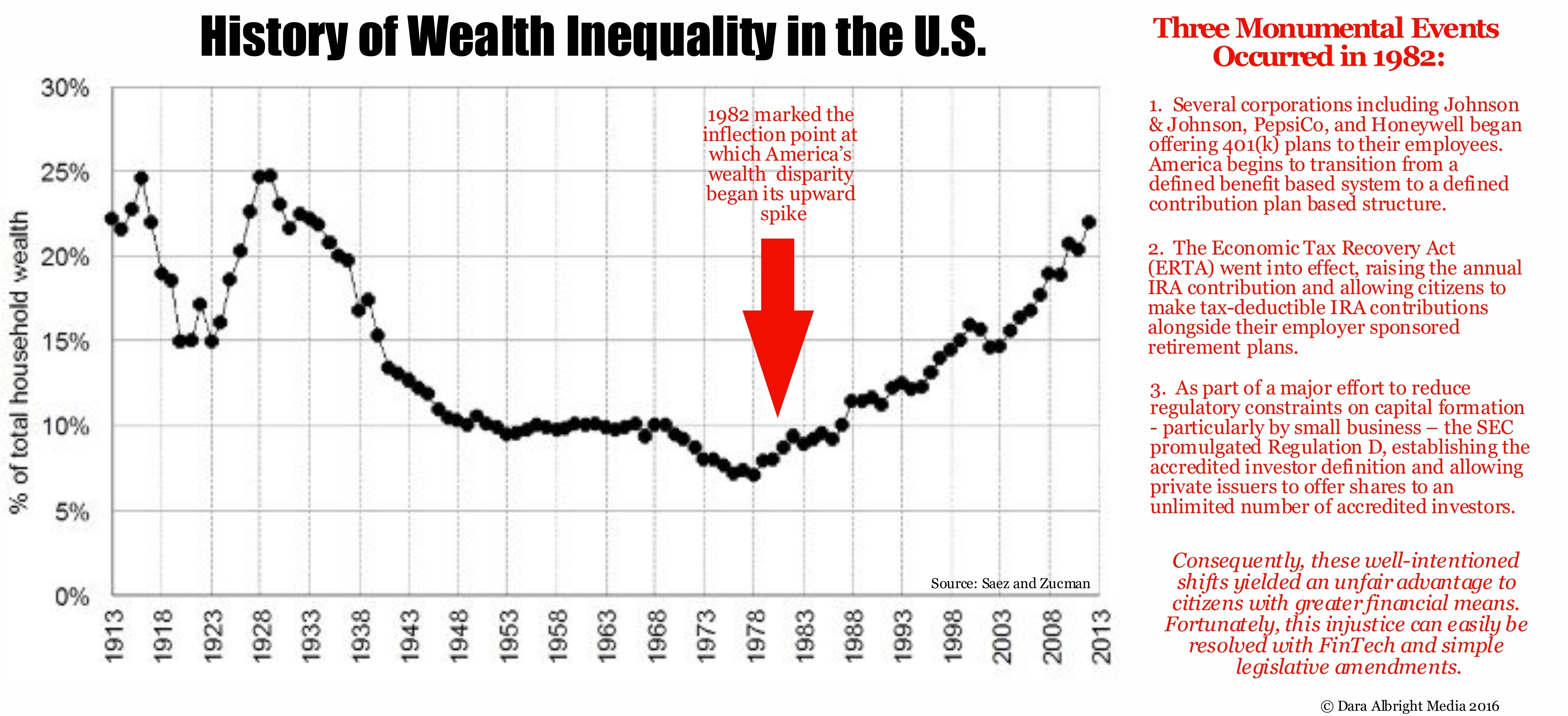
https://daraalbrightmedia.com/wp-content/uploads/2016/08/His...
What's happened is the uber-rich are becoming hyper-rich due to tech, and in RELATIVE terms everyone else is growing less quickly.
But that's literally exactly what you'd expect and it doesn't harm them one iota - the cheaper and more plentiful tech, however, helps them.
"Paul paints a rosy picture but doesn't mention that incomes for lower and middle-class families have fallen since the 80s."
And then goes on to present wealth charts.
However, wealth =! income.
The pew research source of data which is here: https://www.pewresearch.org/social-trends/2013/02/21/appendi...
Points to this article from the fed: https://www.federalreserve.gov/econres/notes/feds-notes/weal...
which defines wealth = "difference between the market value of assets owned by a family and the amount owed in debts..."
OR restated succinctly, household assets - liabilities.
The definition from the fed says nothing on income.
Now that we can state the problem the author has cited is regarding wealth inequality, let's talk about it.
One would expect wealth inequality to keep growing, perhaps infinitely, since the people earning income to buy more wealth (w2s , 1099s) have to contend with a continuously depreciating currency, which is not a problem for longtime wealth holders.
Inflation alone does not hurt stocks, real estate owners, etc. It hurts pensioners and labor directly, though.
In that era you're either a farmer or an entrepreneur. America had a literal explosion of engineering, innovation, and entrepreneurship such that by Lincoln's death America was already the top global economy GDP (including per capita) and spearheading the industrial revolution.
This was much due to generally high edu levels especially technical education, specific regions of innovation (e.g. CT river valley creating interchangeable parts), and a lot of openness and mobility in the culture (and probably the general cultural obsession with commerce).
America doesn't exist like this anymore however it's a blueprint how inequality could be lowered... bring back a radical culture of entrepreneurship and innovation (not "go have a career at someone's company"), bring back widespread technical education, and bring back a whole lot more of our former industrial-manufacturing economy (which was like 80% of our economy in 1950 to like 10% today; "knowledge economy" is not going to get us there).
Wealth at its core is a proxy for quality of life. Today, as compared to 30 years ago, here's what even most low-income households can afford: * airline flights that cost a small percentage of what they used to * immediate access to any information via the internet * vastly improved medical care & surgical procedures, ranging from cancer treatment to lower infant mortality rates * the ability to easily keep in touch with loved ones wherever they are in the world * high definition flat-screen TVs and the ability to watch any any show or movie as soon as desired * online videos to learn how to do almost anything, for those motivated enough to learn * digital cameras in our pocket that allow us to always be ready to capture an amazing moment or scene for our memories
Wealth disparity is only a problem if it is due to theft.
Instead this piece justs blames the fact that rich people also defend their interests. It's nothing new.
Everybody with a semblance of economic literacy should recognize that a wealth tax causes a lot of problems for what little income it creates. It is a distraction.
For the past decades, wealth inequality has been driven by asset price inflation, which is caused by the easy money policy required to finance government, corporate and private debt.
If interest rates were raised significantly, trillions would disappear off the balance sheets of all the billionaires. Immediately, all of us would be "more equal". The dollar would appreciate, and purchasing power would be restored to the average wage earner. Buying a house would become feasible again.
There's just one catch: Raising interest rates makes existing debt unservicable, causing a massive wave of bankruptcies and layoffs. At some point, even the US would have to default on its debt. The only way to avoid that would be to just print the money - and then we're back at square one.
This is misleading.
https://www.cato.org/cato-journal/winter-2019/us-median-hous...
>>Average household size declined from 3.28 persons in 1967 to 2.62 by 2000 and 2.54 by 2017 (Census 2017b). Larger households can be expected to have greater income earning potential from the availability of more potential workers. It is thus important to adjust for household size in assessing the long-term growth of household income. Otherwise, the larger households at the beginning of the period would tend to exaggerate the income levels relative to household incomes toward the end of the period.
He argues that the rich do much for the underprivileged, but what they never do is challenge the system which made them so rich in the first place. Philantrophy and the associated virtue signaling has the perverse effect of keeping the very system alive, which is (so he argues) fundamentally broken to begin with, and needs major overhaul. I think it's relevant to the discussion. https://en.wikipedia.org/wiki/Winners_Take_All:_The_Elite_Ch...
I found his conversation with Andrew Yang to be quite interesting https://youtu.be/2Ye-Jkql_jA?t=1742 (not pitching it out of ideological / political affiliation to either).
I personally am torn. From "the left" I think that personal responsibility often gets too little credit. The last thing you want to tell people is "it's not you, it's your situation, the government will fix it". The government is bad at fixing things, and you create a race for handouts, and a perverse game of victimhood claminig, to get sympathy and handouts. "I don't succeed because of X and someone else has to fix it" is not an empowering message. But many rich and privileged people are really blind to the sociological complexity in what determines success. Abundance of wealth doesn't necessarily make one happy, but lack of wealth and financial security makes one unhappy. And stressed. Stress in and of itself diminishes intellectual reasoning, decision making, affects mood, can be associated with psychological disorders, etc. "Well he's a truck driver, unhealthy, fears for his job due to automation? Well, he should become an app developer, or something similar. There are free courses everywhere, there are so many things to do. If he applies himself, he will find something, it's competition and our market system, which has made us so rich to begin with..."
I'm caricaturing ... but I don't know by how much.
Branko Milanovic:"Homoploutia is a neologism I invented (after some consultation w/my Greek friends). It indicates that the same people (homo) are wealthy (ploutia) is the space of capital & labor; your neighborly CEO who is in the top 1% by labor income and also in the top 1% by shares he owns."
Second question: What would it look like if the person wondering about this lived in a land that expressed very clearly that there are rules for thee, but not for me? Would not that make many of the assumptions of a solid baseline not solid at all? And make the attempt at living within this structure rather flimsy, at best?
As I attempt to navigate forward, I find that many of the previous base assumptions no longer hold true...
This is core to their argument, but it's false. Looking at the mean income of the lowest quintile in the US, historical and adjusting for inflation:
    1980  $4,310  $13,757
    1990  $7,166  $14,420
    2000 $10,190  $15,563
    2010 $10,994  $13,260
    2018 $13,995  $14,658
(And, of course, internationally income has improved dramatically)
Most of those people are regular people with regular incomes with good saving habit, and/or got lucky because the house they bought 30 years ago happen to be in a boom area.
The ways to break thru from 500gs to a million is immense and less competition. And most of these depend on the money from the lower classes.
What I meant to say is the system we all need to be in to get rich creates a feedback loop to keep the poor poor, it incentivize moat creation to stifle competition
I reject this.
I've tried countless times to analyze the philosophical belief of those people, and it often is about social darwinism, a refusal to help the weak, individualism, and extending the concept of the survival of the fittest to society.
People at the top refuse to admit they are dominating others through opinions that favors them.
You would think civilization would let humans get out of their state of nature, but instead you end with people who prefer to imitate nature and dismiss the mutualistic aspect of society.
If that trend continues it's expected to witness social unrest and a diminishing trust towards capitalism.
I’d really like to see cold hard data on this. As best I can tell it is false- tech has made starting a business way easier and cheaper for more people from more walks of life than at any time in history. Sure, we should work to push that to more people.
Stop Being Poor T-shirts using Paris Hilton's likeness on various overseas ecomm platforms.
If you care so much, how about even considering some solutions? Should we raise the minimum wage more? Public healthcare?
Increasing taxes gets the government more money but does nothing to actually decide how to spend it. And given the huge amounts the govt spends on military, or covid this past year, the problem seems to be a lack of agreement and political will on how to spend money to effectively reduce inequality, not a lack of tax dollars.
It seems to me the right place to start raging is against half the government which doesn’t believe in spending money. Which in turn is supported by the ~50% of the US who votes republican and hates the idea of handouts.. so the root is a society wide disagreement, not scrooge mcduck.
If we remove tech startups, the poor wood get poorer just as fast.
The difference would be that there would be less tech-rich people to calculate the Gini coefficient.
The real question is: "why poor are getting poorer?"
It is a very complicated question involving taxes, capitalism and hundreds of broken policies and institutions, like mass incarceration that is guaranteed to make people poor.
Complex questions never ever have simple answers.
Here he understates his own point. The rich are getting richer and everyone else is getting poorer. The people getting poorer the fastest are the middle class.
>"People who don't look any deeper than the Gini coefficient look back on the world of 1982 as the good old days, because those who got rich then didn't get as rich. But if you dig into how they got rich, the old days don't look so good. In 1982, 84% of the richest 100 people got rich by inheritance, extracting natural resources, or doing real estate deals. Is that really better than a world in which the richest people get rich by starting tech companies?"
And my answer to that question would be, arguably yes. Why? Because at least old money understands the concept of noblesse oblige. The real sinister psychological thing going on behind the Graham argument is that it's not at all about meritocracy, it's that this mentality of earned wealth completely rids the owner of any sort of responsibility.
The aristocrats and oligarchs of the olden days might have been corrupt, debauched and half-useless, but at least they knew it. This new, self-made entrepreneur class does not only think they have earned their money themselves, which as a sidenote is also kind of a fiction, but that they're intellectually superior, morally superior and virtuous in ways that anyone else just can't understand.
Old money might have ignored you and thrown a party, but Silicon Valley money wants to remake people in their images, they have a Protestant zealotry associated with their money that makes any oligarch look straight up sympathetic in comparison.
C.S Lewis:
"“Of all tyrannies, a tyranny sincerely exercised for the good of its victims may be the most oppressive. It would be better to live under robber barons than under omnipotent moral busybodies. The robber baron's cruelty may sometimes sleep, his cupidity may at some point be satiated; but those who torment us for our own good will torment us without end for they do so with the approval of their own conscience. They may be more likely to go to Heaven yet at the same time likelier to make a Hell of earth. This very kindness stings with intolerable insult. To be "cured" against one's will and cured of states which we may not regard as disease is to be put on a level of those who have not yet reached the age of reason or those who never will; to be classed with infants, imbeciles, and domestic animals.”
It's policy, like lowering interest rates, promoting financialization, driving people to invest their savings in the stock market, squeezing out basic saving strategies and causing people to seek higher and higher risk investments (while socializing the risk of the upper class) that's driving a wedge.
100% of this is public policy (often in the guise of helping out main street "saving jobs" e.g.). Capitalism is just responding, but as always with unintended but predictable consequences.
In fact, the Industrial Revolution that he claims to be the last "time of entrepreneurship" created the the Dickensian's work conditions and such a strong class divide that lead to the worker's revolutions of the 19th and early 20th century, to the corresponding fascist counter-revolutions, and to two world wars. It is precisely in the following "boring time" of Keynesianism and the cold-war that the west and "the second world" experienced the highest sustainable growth period ever and that the masses had access, for the firs time, to minimally decent working conditions to create that thing we call "the middle class".
So in fact, Graham is right in that we see now again, like in the Industrial Revolution, a simultaneity of great technological disruption combined with a hegemonic neo-liberal ideology. This is leading lead a new rise of world-wide hyper-concentrated capital, job instability, more and more limited access to basic goods like housing, climate catastrophe, and a new class of capitalists that believe that they are above any sense of morality.
There is nothing to celebrate here but more of the opposite: good reason to be really scared of the future to come.
Those who do read history are doomed to misinterpret it.
Few points: 1. "The rich are getting richer and the poor are getting poorer." - author does not understand the difference between statistical categories and real flesh and blood people. If he did, he would have known that real people move between statistical categories over time, which makes absolute sense: you start career with no experience and debt to pay if you have a college degree, then over years you gain skills that allow you to get better pay. There is no "rich" and "poor" when judging statistical categories, because in this sense there always be newly graduated people starting their careers at lower payed jobs. That's how the world works, you can't get Staff Software Engineer position in Google without proving that you're at least have skill for Junior.
2. "Most people don't have the safety net or mental bandwidth to even consider entrepreneurship." - Entrepreneurship is tough and definitely not for all. But, not having money at first was never a problem. Reading some history of big companies you may see that they often started on campus or in garage. Therefore main prerequisite is mental toughness, and building of something people want.
3. "It's less a tutorial or analysis and more a thinly veiled attempt to ease concerns about wealth inequality." - PG correctly pointed out that individuals become wealthy by creating giant amount of new wealth and then capturing some small part of it. For example Amazon, you use it everyday, it has the best pricing, so get immense value from it. Bezos captures some part of the value that Amazon created for all consumers.
4. "basic needs" - It's often a tactic of demagogues to hide behind undefined terms to push their vision. Having a fridge or microwave is a basic need? Is having a car or 2 cars also a basic need? Both of these would have been considered luxuries 50 years ago, and still people were living without them. The point is that setting arbitrary standards imposed by third-parties is not basic needs. In this case, you could define anything as basic need and always have 15-20% of people that don't meet your arbitrary standard.
5. "a small minority of people" - And again, PG provided an approach that will work for every individual. If you create something immensely valuable, and capture some small fraction of it, you get rich. If you do not create, then you don't become rich. But, that is not the problem of society that you yourself did not create anything.
As is usual with such types of articles, the author positions himself on some moral high ground. He claims that his aim is to help the poor, but since the author did not create big amount of wealth and he could not donate large sums to philantropy (which wealth individuals do a lot), then the only approach is to steal money from people who created it with hard work, and give to people who did not work, did not create wealth and likely will never do.
Even if they did have the resources to go into entrepreneurship, if most people did so, they would run out of employees and markets. Not everyone can be a CEO, at some point you need workers as well, and there's room for only so many Ubers and Facebooks before starting a new one is unprofitable.
There are so many nice number games to play, like the stagnant wages. Those usually fail to mention that the workforce has increased significantly, so the sum of wages paid has risen significantly. Buying power also tends to be not factored in. People couldn't buy iPhones 50 years ago.
Also if anybody is unhappy about some tech company, they are free to not do business with them.
Both factors are almost entirely determined by a person’s genetics.
As per the chart literally included in this piece, middle-income median wealth rose over 10% since 1983 (inflation adjusted).
High-income wealth rose much, much more. But the argument PG et. al. seem to make is that the economic order that drives inequality also drives economic growth overall and for the median person. Granted, China might be a more convincing example of this. Median quality of life in the US has declined in some key areas.
Income in the US has increased for all brackets since 1967[0][1] (at least). The argument is really about who is entitled to more of the increase. But it's framed by the charts as a zero sum: Rich gaining and poor losing. It's not true. All brackets are gaining.
The actual risk is that super-wealthy use their wealth to affect political outcomes. They can influence politics, but were not elected by anyone to do so.
[0] https://www.advisorperspectives.com/dshort/updates/2020/09/1...
[1] https://en.wikipedia.org/wiki/Personal_income_in_the_United_...
In almost all measures of the Gini coefficient two significant flaws exist:
1. Incomes are counted on a pre-tax basis
2. Incomes are counted on a pre-government transfers basis
The consequence of this is that income inequality appears to be increasing _regardless_ of the level of social subsidies and redistribution.
When you correct for these measurement flaws, income inequality in the US has been decreasing over recent decades.
If you are in the “Tax the Rich” camp as a result of looking at the Gini coefficient, you may need to strongly update your priors.
Sources:
https://www.wsj.com/articles/incredible-shrinking-income-ine...
https://www.economist.com/briefing/2019/11/28/economists-are...
These things are real. However, I want to point out that there are other very real things going on too. Particularly, there are real, and strong, effects from natural selection. The people who tend to succeed really are smarter, harder working, healthier, stronger, etc. The natural selection at work is obvious to any scientist thinking about it, but it's difficult or impossible to talk publicly about it these days. Hating on such an obviously true thing in order to show off to your friends is unfortunately very trendy :-( This is a problem because it means we look for invisible boogeymen rather than having a correct understanding of the situation and going from there.