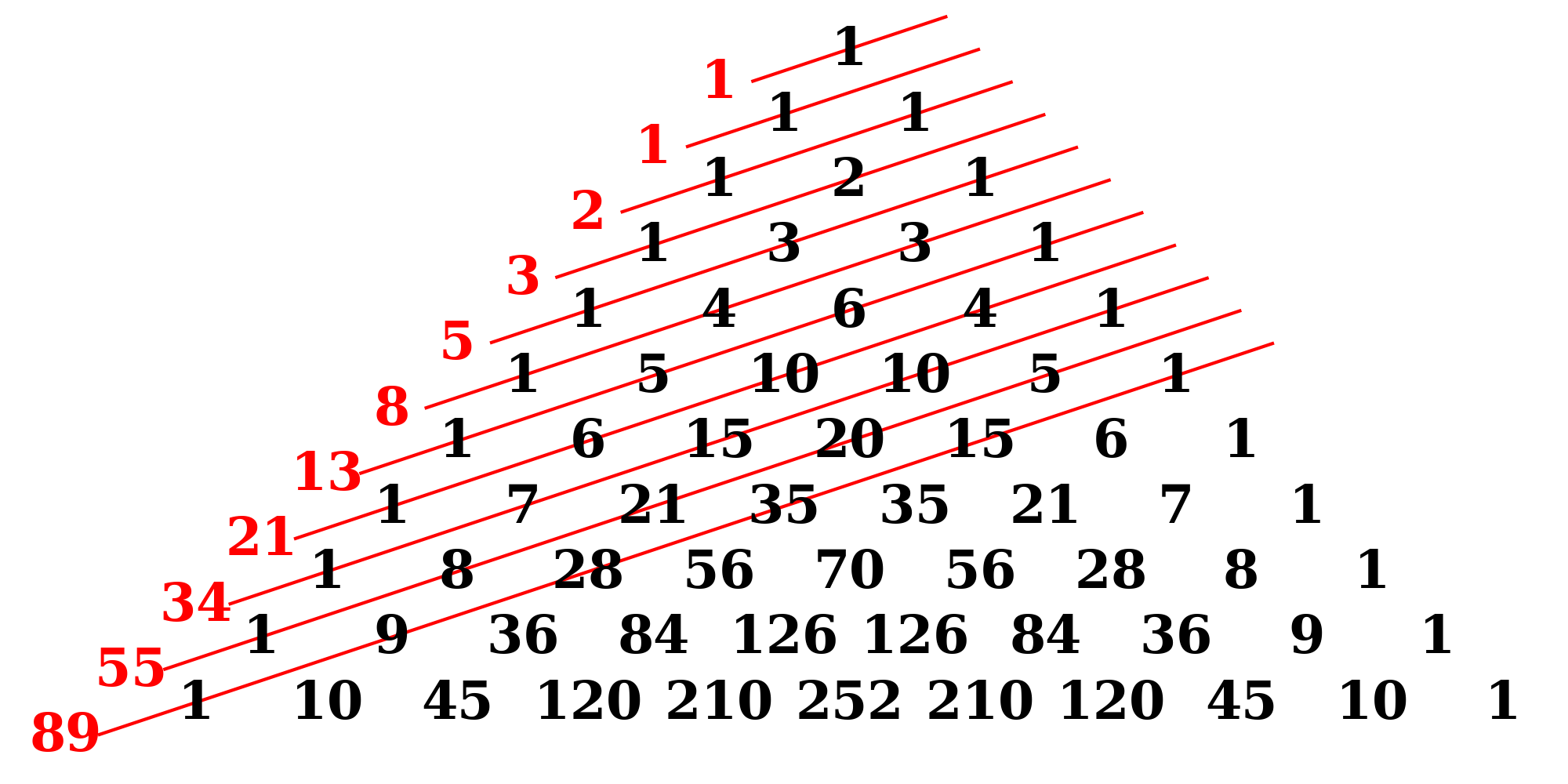
But the world of numbers seems to be full of these neat coincidences. So do any of the math folks here have a theory or explanation of why?
> The interesting number paradox is a semi-humorous paradox which arises from the attempt to classify every natural number as either "interesting" or "uninteresting". The paradox states that every natural number is interesting. The "proof" is by contradiction: if there exists a non-empty set of uninteresting natural numbers, there would be a smallest uninteresting number – but the smallest uninteresting number is itself interesting because it is the smallest uninteresting number, thus producing a contradiction.
[0]: https://en.wikipedia.org/wiki/Unexpected_hanging_paradox
1/(1 - x - x^2) = 1 + x + 2x^2 + 3x^3 + ...
where the Fibonacci numbers are the coefficients on the right. Try writing it out! The basic idea is that because F_n = F_{n - 1} + F_{n - 2}, everything will neatly cancel out.
This is an example of a "generating function". Anyway, plug in x = 0.1, and then divide by 100 to see the behavior described in the post.
One also gets
1/9899 = 0.00010102030508132134559046368320032326498...
1/998999 = 0.0000010010020030050080130210340550891442334...
and so on.
You can also use this to easily find generating functions that satisfy other starting conditions.
x_n = cα^n + dβ^n,
where α, β are the roots of the quadratic x²−ax−b; c, d are solutions to the system
c + d = x_0 cα + dβ = x_1.
If the series Σ x_n⋅10^n converges then its value is
10c/(10−α) + 10d/(10−β) = ((100−10a)x_0 + 10x_1)/(100 − 10a − b).
If a, b, x_0, x_1 are all rational then the above series converges to a rational number, too. This is the case for the Fibonacci sequence, with a=b=1, x_0=0 and x_1=1.
https://www.amazon.com/Penguin-Book-Curious-Interesting-Numb...
The caveat here is "for some value of 'interesting'."
tan(1 degree/55555555555)
Nice
Now, imagine you write a query, like, say, "SELECT number WHERE number = .01 * FIB[1] + .001 * FIB[2] + .0001 * FIB[3]" and so on until you get what the article discusses.
It isn't necessarily that surprising that you might find something with an uncountably infinite numbers to pick from.
Now, consider all possible "interesting" queries you could run, along with all their results.
There result is an inconceivably large sea of queries. Most of them are, in fact, utterly pointless; SELECT statements that return no values, SELECT statements that return all values (equally pointless), SELECT statements that return complicated sets of values but have essentially no mathematical interest because there is no practical way to represent them as anything smaller or more interesting, etc.
In this massive sea of results, you should expect a lot of interesting things to exist. Finding them is tricky; in percentage terms they make up 0% of the results, but we have mechanisms for finding some of them.
Basically, there are so infinitely many mathematical statements that there can't help but be a large supply of "interesting" statements like this.
For an interesting view on that, see https://en.wikipedia.org/wiki/Mathematical_coincidence . These are true statements or almost true statements (near equalities) about a wide variety of numbers that are essentially meaningless... it's just there's so many ways of putting things together that there are inevitably large numbers of these things (the wiki page is just a sampling).
You can even generate these mathematical coincidences yourself. Create a program that will systematically iterate over abstract syntax trees of mathematical expressions involving whatever combination of mathematical operators (+-×/, sqrt, log, sin, whatever) and numbers you like (the first ten integers, e, i, pi, whatever else you like), store up a table of results and emit any two expressions that are, say, within .01% of each other. You will rapidly find a ton of results, because it turns out that even with modest numbers of operators, there are far more mathematical expressions than there are small numbers for them to result in separated by more than .01%. If you think about it, this program can't help but emit a lot of results. Some of them will be humanly "interesting". A few of them will even be mathematically interesting (e.g., this procedure will generate the famous Euler identity relatively quickly if you included the relevant operators and numbers).
On a larger scale, this is also known as the Strong Law of Small Numbers: https://en.wikipedia.org/wiki/Strong_Law_of_Small_Numbers The previous paragraph is a very bite-sized example of why this holds that you can code up yourself if you are interested.
There are numerous examples of such queries which are far from pointless, such as "SELECT number FROM reals WHERE number = sqrt(-1)" for the former, and "SELECT number FROM reals WHERE number = number * 1".
I would call those results interesting, insofar as they're absolutely required to do any interesting number theory.
Not to detract from your interesting post! I enjoy the conceit, and could see myself using it in conversation.
By the way, I appreciate your use of U+0305 combining overline. Did you enter those manually or do you have some neat way of doing it?
If you do the calculation, with each step it goes towards 0.124999999999
However, you have to be a special math something to have any of these kind of number "oddities" be anything meaningful. I wear mine like a badge of honour
edit: Dont know the format for proofs but heres a try.
1/49 = i=1 towards inf
sum 2^i*100^-i
Imagine my amusement when I ran across a Project Euler problem where those digits were the answer. I recall just looking at it and thinking I __know__ this one, there's no need to code anything. An easy point, but I didn't feel like I cheated on it.
So the property it has is:
1/n = n (2/b^2 + 4/b^4 + 8/b^6 + ...)
    1/n = n / (b²/2 — 1)

    n² = b²/2 – 1
Calculating some of these out these appear to be the Newman-Shanks-Williams numbers [1], the next one is 41 in base 3364, where
1/41 = {0}.{82}{164}{328}{656}{1312}{2625}...
But, supposing that we just like the idea of starting with some digit d and then the next digit being k times that and the next digit being k times that, we get a more general set of numbers,
    d/b + dk/b² + dk²/b³ + ...
      = d/(b - k)
1/98 = 0.01020408163265...
So for example we want to think about 1/7 in base-12, this suggests that maybe we should look for things that quintuple base 12, but that rapidly overflows base 12. So we do the same trick as 1/7 where we take pairs of digits, and maybe things quadruple base-144 (since 144 - 4 is 140 which is divisible by 7), and so we find that
1/7 = 0.{20}{82}{41} repeating
1/5 = 0.{2}{4}{9}{7} [repeating]
The other base that I really like is nonnary, if we met aliens we might find that they count in balanced nonnary with digits -4, -3, -2, -1, 0, 1, 2, 3, 4, (so like 7 is actually {1, -2}, 7 = 9 - 2), but it's harder to search for patterns in that because you really feel the cap of having only half the base to count up to before you carry.
=14285712
+0000000224
=1428571424
+000000000448
=142857142848
+00000000000896
=14285714285696
+0000000000001792
=142857142857....
"The linked page misleadingly suggests that a certain Cody Birsner discovered the relationship between the series and the fraction, whereas it had been known for a considerable time before".
Günter Köhler, 1983 (published in the The Fibonacci Quarterly, 1985; who cites earlier papers from 1977 and 1981): https://www.fq.math.ca/Scanned/23-1/kohler.pdf
[0] https://en.wikipedia.org/wiki/Talk%3AFibonacci_number%2FArch...
It's like asking who was the first person to discover that all multiples of 11 have the same parity in the respective sums of their odd and even digits.
Fun fact: take any two numbers (e.g. chosen randomly), and use them as the seeds for a Fibonacci-like sequence by summing the last two terms to generate the next term. The ratio of any two consecutive terms in that series will tend towards the golden ratio.
a_(n+2) = a_(n+1) + a_n
  k^2 = k + 1
  (k - 1/2)^2 = 5/4
  k = (1 +/- sqrt(5))/2
  k = φ or -1/φ, where φ is the golden ratio
Because |1/φ|<1, we find that asymptotically a_n ~ Rφ^n as n grows. Therefore the ratio of terms tends to φ in the limit.
My thought is surely crackpot but I'll explain how my idea arose :
A fraction eg 1/3 describes a decimal number to infinite accuracy but creates a challenge for base 10 calculations.
I thought about the precision necessary for learning the math of the quantum particles and the experimental way we're trying to figure out how they behave to infer their properties. (Higgs was the other way around but I am optimistic that we'll predict much more in future instead of this convoluted observations rigmarole) and I started wondering if you could approximate extremely high precision decimals to fractions in non decimal bases and from there simplify calculations with far greater resolution.
How much more capable would Nyquist - Shannon sampling, if we could clock with the precision of infinite decimal fp digits but handle only a short simple "one third" input or do visor?
My silly mind wandered off to imagine particles jumping between different base based universes just as a sequential progression through the precision of their infinitessimal steps through space and time.
Remember, integers are integers are integers, because they represent the intrinsic "whole quantity" of something; this is as concrete as logic will get, the idea that there are "ones", it's pretty hard to imagine a universe that doesn't have that.
Once you have integers, then you're going to do math in an integer base; and making too high of a base has a diminishing value at at certain point, so it's unlikely we'd see higher than maybe 60. Non-integer bases exist - https://en.wikipedia.org/wiki/Non-integer_base_of_numeration - but it's clear to me that I'm too stupid to use them, and so probably most other people are too. This tells me that it's going to be a comparatively rare Many World that chooses to do this.
Choosing a number like 12 or 60 with a lot of divisors would have been nice. 1/3 in base 12 is "0.4", which is a lot nicer than 0.333... and would probably help make a lot of younger math education way easier.
Combining that with skipping "degrees" entirely and using radians from the start would probably have been wise choices. We'd have been much better equipped to divide things! I imagine a six-fingered being would have had an immediate advantage in that regard, but, alas.
Now, would some of those number constants look particularly different? Not really. Pi in base 12 is "3.184809493B91866", for instance, so it doesn't look like that would be much easier. E and other numbers similarly just end up with different expansions.
Remember, you can use whatever number base you want to, in this universe. The key is that it's just a way your brain interprets the symbols to represent a quantity; don't confuse the map for the territory. Five, the quality of having five whole entities, exists the same when it's 101 in binary or 10 in base 5 or 11 in base 4; either way it's all still just five, and so the right thing to do is to use the base system that most intuitively works for you so that it becomes transparent.
> 1,1,2,3,5,8,13,21,34,55,89,144,...
then does 1/144 work in base 11, and 1/233 in base 12?
Assuming we of course translate the base-10 number 144 to the appropriate base-11 number (121) first. I'm too bad at math to do this anymore, maybe someone else can tell us ;)
The nth and (n+1)st fibonacci numbers can be written as a system of two equations in the nth and (n-1)st numbers:
  F(n) = F(n)
  F(n+1) = F(n) + F(n-1)
The question is then to show that (note that the indices under F are actually wrong in the OP...):
1/89 = .01F(2) + .001F(3) + .0001F(4) + ... + 10^(-n)F(n) + ...
  [ F(n)   ] = [ 0 1 ] [ F(n-1) ]
  [ F(n+1) ] = [ 1 1 ] [ F(n)   ].
In other words, we've reduced the problem down to the question of investigating the properties of the matrix A ! Now, the sum we were looking at, originally, can be written (in terms of x(n)) as the first entry of (note that x is a vector as we've defined it!)
x(2) + .1x(3) + .01x(4) + ... = x(2) + .1Ax(2) + .01 A Ax(3) + ... = x(2) + (.1A)x(2) + (.1A)^2 x(3) + ...
(I - .1A)^(-1)x(2),
-----
[0] If
  y + By + B^2y + ... = z converges, then we can multiply both sides by B to get

  By + B^2y + ... = Bz
y = z - Bz = (I - B)z,
y + By + B^2y + ... = z = (I - B)^(-1)y,
Obviously though they would have limited resources and couldn't keep growing indefinitely.
See discussion on math overflow here: https://math.stackexchange.com/questions/656183/why-does-fra...
In the same period I "discovered" an error detection technique which is commonly known as Hamming codes. I would never dare to claim I invented them or discovered them.
In '92 and '93, I was heavily in to the BBS scene, some people had 56K modems, others had 14.4K. With verifiable evidence of written notes and digital artifacts (a BBS door and protocol for AmiBBS and Citadel and a couple of others) , I created a technique whereby multiple peers with low-bandwidth connections could transfer small fragments of a larger dataset to a peer with a lot of bandwidth.
If you were heavily in to the warez scene and/or part of Fate, it is probably you made use of this protocol to transfer pirated software between FTP sites. A warehousing server would tell each peer who had what part of a piece of data, and any peer could make requests for any piece of the data from any other peer who happened to have a copy of that data. Today, a very similar protocl is commonly known as BitTorrent.
I would not say I "discovered" or "invented" the protocol as my work was based on the various X-, Y- & Z- modem protocols. There was a TCP/IP packet to -Modem packet translator so that a BBS talking over that new fangled internet thing could take advantage of a T1 (1.5Mbps) connection for instance, which really helped with spreading the warez around the various FTP sites by the couriers.
I doubt the veracity of the claim by the author to have "discovered it as original" in 1994 before anybody else.
1/(1-x) = 1 + x + x^2 + x^3 + ...
More generally, we can compute numbers with decimal expansions of the fibonacci numbers with 10^-2n / (1 - 10^-n - 10^-2n). Notice that this is just the z-transform of the recurrence relation of the fibonacci series, with 10^n replacing z:
  Z(f(n)) = Z(f(n-1) + f(n-2) + δ(n-2)) (δ is the kronecker delta)
     F(z) = z^-2 / (1 - z^-1 - z^-2)
  Take φ± = (1 ± √5)/2
  Then F(z) = z^2/(z - φ+)/(z - φ-)
            = ( φ+ z/(z - φ+) - φ- z/(z - φ-) )/√5 (by partial fraction decomposition)
Z^-1(F(z)) = f(n) = (φ+^(n+1) - φ-^(n+1))/√51, 5, 11, 19, 29, 41, 55, 71, 89, ...
Searching it on the OEIS (a great resource for mathematics) gave
http://oeis.org/search?q=1%2C5%2C+11%2C+19%2C+29%2C+41%2C+55...
It turns out that these are precisely the first values of the Fibonacci polynomial n^2 - n - 1
I haven't verified this fact, but it seems like it comes from an application of the generating function of the Fibonacci numbers.
I posted my code in another comment
11/89 should be 11/8900
This can be verified by using the following Sage code (simply go to https://sagecell.sagemath.org/ to avoid installing sage)
  b = 10

  A = Matrix([[0, 1],[1/(b**2), 1/b]])
  I = matrix.identity(2)

show((I - A).inverse() * Matrix([[1/b**2],[1/b**3]]))Given the decimal expansion of 1/89, is there any way to directly retrieve the Fibonacci sequence from it? (that is, not using any knowledge of the sequence itself)
I'm assuming it can't be done because different sets of fractions can sum to 1/89, but maybe I'm missing something.
Typo: 1/89 = .01123595505...
.01123595505617977528
   >>> .01 + .001 + .0002 + .00003 + .000005 + .0000008 + .00000013 +  .000000021 +
   .0000000034 + .00000000055 + .000000000089 + .0000000000144 + .00000000000233 +
   .000000000000377

0.011235955056107002987654312/123456789 = 8
And this works in any base.
89 being a fib itself is quite a coincidence though?