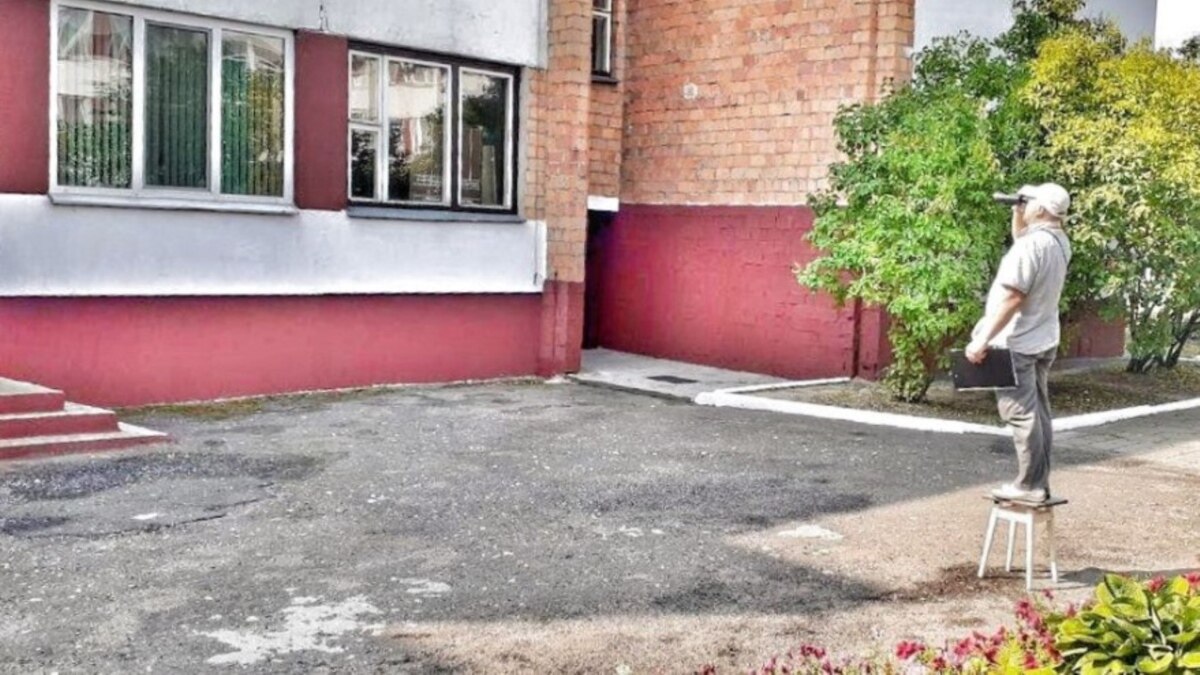
- Based on data collected by from only some polling places, there is a huge discrepancies in results comparing to official ones. Most poling places refused to post results. People, who demanded to post results (as the law requires), were arrested. You can read more about it at belarus2020.org
- A lot of journalists left state media. Replacements were brought from Russia's state's propaganda media.
- While police is involved in some cases, the bulk of arrests, beating, torture is done by special forces where most of them wear full head covering at all times. In the few episodes when such head covering is removed during the altercation, these enforces were running away hiding their faces with hands 1) https://www.youtube.com/watch?v=zspZj5wPtaQ ; 2) https://www.youtube.com/watch?v=vj5cV8Dl7jA
- Often, special forces use plain clothes and act like criminals. The only suggestion that they are law enforcement - they often have a baton and full head covering. They never tell you their names, departments, etc.
- Last Sunday Belarus saw its first business glass door shattered as a result of protests (protests started on Aug 9th). That door was broken by special forces because some protesters tried to hide from beating there. People donated to the business owner to buy a new door and were standing in the line next day to buy a coffee from that place - https://www.youtube.com/watch?v=Z3I8dxAwybE
- To avoid beating by special forces, some running away protesters had to jump into the river. Water is quite cold. They were saved by the rescue team worked on the river, who brought them to the other bank of it. As a result, the whole rescue team was arrested - https://www.youtube.com/watch?v=sqA3deW_-Yg
There is a lot more going on, just wanted to share a few things to explain the atmosphere of it.
https://news.tut.by/society/699561.html
That glass door was broken by the chief of the narcotics and organized crime unit.
Whatever country you're in, this is a good time to think about becoming a poll watcher. The exact arrangements vary but elections nearly always have a place for volunteers to watch the count somehow.
https://gdb.currenttime.tv/180604A0-D026-4424-8214-7E00D4B60...
https://www.statista.com/chart/22512/belarus-presidential-el...
Then they were absent this year, and the official result was the exact same 80%.
The elections in Belarus can hardly be called that. There really isn't that much to observe besides the obvious. No number of observers could have changed the results.
For example, thanks to the independent observers we know that the number of ballots reported by the voting place were greater than the total number of people who visited the place during early elections days. Even pushed outside of the building, observers can count number of people walking in and compare to protocols published.
There is a reason that the word 'clandestine' exists. Opposing the government in the open works only when the government is not yet a dead zombie corpse.
It's either pointless because nobody wants to fake results or you're another obstacle to remove.
Pro-Serbian regime tried to fraud, but with the help of international observers, they got shutdown, votes have been reorganized when needed, and the sole presence of neutral observers acted as a strong deterrant. Now Croatia is a prosperous country that we enjoy spending vacation to.
Because of this act of courage, my brother got hired by the UN. From taxi driver in 1990 to now diplomat in 2020. He served in Darfour, Afghanistan, Mexico, Guatelama, Irak, Senegal, Sudan, Tanzania. Saved countless refugees from certain death, negotiated with dictators, put pressure one step at a time.
I understand your concern, but don't take courage for foolishness. My brother is not a fool, he is an idealist and will probably have more lasting impact on the world than me.
A worse pain is inflicted under dictatorship over a longer period anyways so why not rip off the band-aid now?
The underlying cause is a mistake of our founding fathers. Because of the winner-take-all structure of our elections, our political parties are forced to be forkophobic. The fact that we can't have a real Tea Party, to say nothing of the Greens and Libertarians, causes our civil war proclivities.
A first step is a proportional House. In this proposal, every state stops drawing House districts, which also kills gerrymandering (although gerrymandering by itself does not cause our civil war problems). Instead, parties must register with the state with a list of N names, people in the state vote for the party rather than an individual, and after the election we first off exclude any parties who have not gotten at least 4% of the vote, then allocate the rest by the Webster method that we already use to allocate House seats among the different states. So a party has 10% popularity in California, that means they receive about five California seats, so the top five names off their pre-published California list go on to the House. Forking a political party is now possible, politicians have spines again at least in the House, and Washington starts working again, hopefully.
This probably does not require a constitutional amendment, just a federal law.
Aside from property damage I've seen over 1000:1 ratio of police brutality content to protestor violence content in the US over the last several months. Presumably the ratio is somewhat lower than that, but I imagine it still leans this direction.
As a specific illustration, in just a month police shot like 7 protestors' eyeballs out. The cost of these alone is incalculable.
If one side (an authoritarian oppressor) is not afraid to use violence, and the other is prevented from using any response, the oppressor will win. This is why major changes usually require civil war.
This is also why authoritarians definitely do not want their population to have access to weapons. (The U.S. couldn’t even control Afghan farmers with guns...)
Countries that are already mostly democratic don't need violent rebellions?
No, it doesn't. Recent history tells us exactly the opposite:
1) Rise of democracy in Latin America in the 70s and 80s (Argentina, Uruguay, Paraguay, Chile, Brazil)
2) Collapse of communism on Eastern Europe in the 80s and 90s.
3) Democracy in Eastern Asia in the 80s (Indonesia, Korea, Philippines, Pakistan).
4) Nigeria, Spain, Greece
These were achieved through pacific means. The cases of dictatorships that became democracies through violence are very few: Portugal, Romania...
Prior history of violent conflict is precisely what led to dictatorships hardening (leftist guerrilla groups in Argentina, Chile, Brazil and Uruguay, tentative coup in Indonesia, etc.)
Also, violent reaction against dictatorships quite often leads to other dictatorships (e.g.: Nicaragua, Cuba, Iran).
Edit: again, my point is that violent reaction against oppressive regimes is foolish and leads to the opposite of freedom. Violence is the authoritarians' favorite game because it provides them an excuse to do what they do best: brutal repression. You are already loosing when you play their preferred game.
i'm puzzled to say the least. Aren't the 70s and 80s were the bloody decades of dictatorships there? For example:
https://en.wikipedia.org/wiki/Dirty_War
"The Dirty War (Spanish: Guerra sucia) is the name used by the military junta or civic-military dictatorship of Argentina (Spanish: dictadura cívico-militar de Argentina) for the period of United States-backed state terrorism[1][2][3] in Argentina[4][5] from 1976 to 1983 as a part of Operation Condor, during which military and security forces and right-wing death squads in the form of the Argentine Anticommunist Alliance (AAA, or Triple A)[6] hunted down any political dissidents and anyone believed to be associated with socialism, left-wing Peronism or the Montoneros movement.[7][8][9][10]
Up to 30,000 people disappeared, of whom many were impossible to report formally due to the nature of state terrorism."
Yes, but they weren't the cause of the dictatorships' collapses. As I pointed they were actually an argument for their hardening.
By the time those dictatorships fell the guerrillas were mostly exterminated.
Again: my point isn't to deny that repressive regimes repress. It is to point that their collapse wasn't due to a violent reaction but a peaceful one.
So, when guys with guns depose a dictator it gets a little harder to argue that it is very peaceful.
However I thank you for bring up the fact that there was no blood.
Again and again: my point is that the democratic forces opposing the dictatorship didn't engage in violence.
The violence in the crisis that led to the collapse of the dictatorship of Colonels was by the dictatorship itself and the war against Turkey.
All repressive regimes repress. My point is how the democrats should respond.
https://en.wikipedia.org/wiki/Yugoslav_Wars 130000 dead
I concede in Romania, but that is an atypical case. The overall case of collapse communism was peacefull: Poland, Hungary, East Germany, Czechozlovakia, Bulgaria, Albania, ...
Logistically, it is an absolute nightmare to invade a city of 25% armed and trained citizens versus invading a city that is 1% armed and trained citizens. Access to drones and missiles and tanks doesn't help nearly as much as many people would believe.
* General education (ideally, not state mandated)
* General self defense (fitness, martial arts, firearms training)
* Technological counter measures - TOR, crypto, crypto currency, and IMO we should be pushing for electronic voting systems (not shitty ones, but truly great ones) *
*Edit: By great ones, I mean ones that allow us to validate our vote was both counted and correct after the fact. There are crypto voting systems that do not allow anyone (including the government) to know if you voted or what your vote is (identifying you), but still allows tallying and validation.
Experts in electronic voting systems are discouraging the use of this technology for high stake elections, even with state-of-the-art schemes: https://www.belenios.org/faq.html
One example that is working on such a thing is: https://voting.works/
Are they safe against "rubber hose cryptanalysis"? Such as forcing you to verify your vote while I can see you?
This way you can be intimidated to vote and verify a certain way, then after your intimidator leaves you alone, you simply cast another vote. And after the deadline passes any record that you personally casted a ballot have been erased.
Maybe as a further safeguard keep traditional in-person polling open, wherein showing up to you automatically nullify you previous crypto vote, and only your paper ballot counts.
Even beyond any theoretical security measures one huge benefit of in person voting is it limits the available attack. With IPV to steal an election you have to find a way to either physically bring enough people to enough polling places to swing the election or corrupt the poll watcher system and steal it in the counting phase. With electronic voting anyone in the world has a chance to attack you. Anything that requires Joe/Jane Citizen to reliably or securely operate their computer is kind of doomed for a long time IMO.
The first two are relatively non-controversial, but also won't do much against security forces with tear gas and rubber bullets. I suspect the last would be controversial in the US as gun control/ownership is a very polarized issue.
In the protests where you see people covering tear gas canisters with cones or hurling them back, more likely than not those are martial artists or other athletes who train regularly. Your ability to act decisively and correctly in a scary environment greatly improves.
This is hardly a citizen revolt against dictatorship and is one of the several proxy-war these two guys (US/Russia) are playing worldwide.
I endorse bringing guns to peaceful protests in a state where unmarked officials are kidnapping people in broad daylight. That is exactly the sort of reason that the right to bear arms is planted deep within our constitutional rights.
Let me ask you a direct question. Are you advocating for a full on civil war in Belarus in the middle of Europe? If a Belorussian read your comment, got a gun and killed a bunch of policemen/government supporters/Russians would you be content?
Don’t take this as a personal attack. I just think comments like yours are irresponsible given that the people of Belarus themselves chose the path of nonviolent resistance and protest - maybe they don’t want their country to end up like Ukraine or Syria.
What is worse, is that if someone insinuated on this site that for example people in the US should buy guns and start shooting policemen when they think that the police are oppressing them all kinds of voices would drum up and shut that down. I guess inciting violence in one of those “shithole countries” is ok, but god forbid if that kind of stuff happens in your own country.
The very idea of democracy threatens the power structure.
I disagree about why the EU isn't a major player in this. Economically, and even militarily the EU is quite powerful. In terms of political stability, the EU is on par (or perhaps even better, at this particular moment) than the US. Certainly more stable than Russia.
The issue is that the EU does not see itself as a polity, in this sense. I do think it's starting though.
A big problem is that it's hard to be effective. Sanctions rarely work.
And if you mean "diplomatic hostiles" in that the US is angry at the EU for not cooperating with the sanction process against targeted countries or meeting their military obligations so that they qualify to vote in international politics, then I guess you're right.
If you can't find an overwhelming abundance of literature to back up the previous poster's claim, I'll search and update this thread with a representative set.
https://www.thedailybeast.com/trump-administration-battles-n...
https://www.theguardian.com/world/2019/jan/27/us-lifts-sanct...
This is not a real thing. Voting at the UN is not contingent on military power in any way.
As an ordinary person, solidarity is important. It may seem wishy washy, but history has shown many times that solidarity can matter. If we could replicate the same solidarity European cities saw in support of the George Floyd protests, it would put some wind behind Belarusian democrats.
In terms of government/official action... I think the priority should be to discourage Russian intervention with any diplomatic clout available. The UK and France are in the most important position, IMO. France primarily, as a member of the EU which borders Belarus.
Vladimir Putin recently wrote an article about the importance of the Security council. To put this in his own (kinda) words, Russian security intervention on behalf of Lukashenko is entirely not acceptable to three council members. In the interest of world peace, keep your troops inside your own borders.
That is not to say Russia should be treated as an enemy. They are a party, and their concerns need to be heard too.
Ideally, Russia and the EU (not NATO, imo) should negotiate a framework for peaceful transition.
[0] https://en.wikipedia.org/wiki/Democracy_Index#/media/File:De...
As a European, I feel that we are too disconnected from this affair. Just as with the Ukrainian civil war and Crimean annexation, a big part of this conflict is a conservative, repressive, Russia/Putin sponsored regime at odds with a population that identifies more with European/EU values... especially younger people.
Russia see the dignity, prosperity and freedom of several nations as trivial relative to their "vital concern" of having a buffer between them and "The West."
I'm not saying that we can or should escalate recklessly vis-a-vis Russia. I am saying that they are our neighbors too, not just Russia's. We have our interests too, and more importantly our solidarity. The Lukashenko regime is anachronistic, brutal and failed.
This is not a foreign affair.
I understand and even sympathize with Putin's concerns on encroachment. He lays them out clearly enough. I will also admit that mistakes have been made, and the the US played its hand too aggressively in the 1990s. I also think that the EU (and NATO, if the US is willing) should negotiate a peace treaty that addresses these. I also genuinely believe this is possible.
For that to happen though, we need to take a much firmer stance. We need to be as interested in our neighbors as Russia is. The whole premise of the EU is peace and sovereignty. Those values need to be represented here.
Ukraine was abused because of their desire to join the EU, and we treated it as above our paygrade. Now, Russia is openly propping up Lukashenko. Next year it will be Lithuania, Estonia. Putin might decide to intervene on behalf of Victor Orban. We're in this one way or another.
source: Current and previous gfs were Belarrusian and we had these discussions a lot (both before and after this whole thing)
edit: And both parents of both women voted for lukashenko btw, as well as some of their friends (not saying he won or anything, but it isn't also like 100% are opposed to him)
That said, I don't think it really matters what how the average Belarusian sees it. Russia (specifically Putin, and probably many of his generation) sees a democratic revolution as 1989 stuff, and as a weakening of their "buffer."
Nothing is ever 100% but I think it's likely that most want Lukashenko gone. We can't know for sure without a free election. That's the point.
As I said, I do think mistakes were made in the past. Ukraine's simultaneous moves towards NATO and the EU were a bad idea, for world peace. That did not justify Russian intervention though, and it does not justify it now. It may even be for the best if the US stays at arms length. The EU, imo, should not. This concerns our interests and security just as much as it concerns Russia's.
And I agree that EU should put more pressure on the whole subject. I see the eastern countries like Lithuania, Poland and Latvia trying to make waves/raise concerns, but central and western Europe not so much (ask a Portuguese where Belarus is, and he won't know) and are more invested in the BLM issues than what is happening at the EU borders (in Portugal, most don't event know what is going on there when I talk with them.
I wish all the best to the belarussian people, and they have shown to the world their desire but also their alues by their way of correctly and peacefully way to protest and demand change. I hope it is not for nothing.
Here, fixed that for you.
Edit: Updated to reflect that company was founded in Minsk and later relocated to SV. Still dangerous.
... In 2012 company was founded by Mikita Mikado and Sergey Barysiuk in Minsk, Belarus. In 2014 company headquarters were moved to the Silicon Valley...
Yes, it is dangerous. But the party making it unsafe is the fascists. Outrage should be directed there.
https://encyclopedia.ushmm.org/content/en/article/martin-nie...
Dangerous for who, though?
It was the founders who were supposedly acting against the Belarusian government, and the employees who are paying the price. The founders are safe in San Francisco.
My outrage is certainly directed at Lukashenko, but the commenter above us may have a point about whether it was responsible to be acting against a dictator while your employees are subject to his government. It's a tough situation.
And yes, it is tough. It's a very difficult & complicated situation that I am thankful I don't have to experience.
Pretty much spot on except "ultranationalism". The amount of nationalism varies from time to time depending on the current needs. When dictator needs to get something out of Russia, he would either claim nationalism, or goes other way, depending on circumstances.
They were also used to censor the web in Egypt but nobody on the US end seems to give a shit that local companies are facilitating dictators
[0] https://www.bloomberg.com/news/articles/2020-08-28/belarusia...
Slightly fewer than half the electorate in the US is excited to vote for an authoritarian president in their own country who has repeatedly talked about not giving up power due to term limits [0] or election results [1], a guy who praised Xi for just naming himself president for life and said he'd like to give it a shot [2].
It follows that a lot are indifferent to dictators abroad.
0 - https://www.thedenverchannel.com/news/election-2020/trump-sa...
1 - https://www.cbsnews.com/news/trump-election-results-white-ho...
2 - https://www.reuters.com/article/us-trump-china/trump-praises...
Why would they bother? Money from their US taxes is already being used to kill people overseas. I don't think that preventing some Belarusians to use Instagram is worse than that.
In Russian: https://t.me/rt_russian/44353 (translation below is mine, ask Google Translate for the skipped parts and/or for a better translation :)
"... I warned my senior friend and brother Putin - it is impossible to fight against.
Why? - How are you going to fight Telegram channels? Do you have a capability to block the channels? Nobody has such capability, even the ones who created all that web. Americans. You see what is happening there. And telegram-channels are playing the main role there too. [...skip...]
To remove the Internet and like that ... Even if Internet is removed today, the telegram-channels will be working from Poland. So, don't you get relaxed. You also have some specific political events coming, and may be right out of the blue..."
When coronavirus took hold I got laid off and the team was cut loose. Not sure how they are holding up over there but damn I hope they are alright.
And fuck Lukashenko, I hope the man chokes on a cheeseburger.
This kind of low-effort comment belongs on Reddit, not HackerNews. It's not insightful/up to the standards of typical content for this community.
EDIT: sorry, Belarus does not directly connect to Kaliningrad, there is a gap of about 50 miles with Lithuania and Poland on either side. But the general point still stands
If that happens, the Baltic states should be worried.
In my opinion, it won't though. It's neither a threat nor a direct strategic advantage. It won't connect Kalinigrad. Belarus is landlocked. The population did not and is not asking for Russia assistance in any way, only Lukashenka did. While not super friendly, they're friendlier than to the EU bloc. I think it's just not worth the trouble and an eventual net-loss.
Unless, they have bigger plans, of course.
Protesters say they are pro Russia - but in my opinion this is a grave mistake, and Belarus will soon find itself as a Russia-controlled state.
> Moscow offered Minsk economic benefits in December if it complied with a 1999 deal that envisioned a union state with a common currency, legal system and a joint defense and foreign policy.
> The Russian-Belarussian economic confederacy entails the creation of a single tax code, civil code and list of foreign trade rules, in addition to unified oil, gas and electricity market regulators, by 2022, Kommersant reported Monday.
https://www.themoscowtimes.com/2019/09/16/russia-belarus-to-...
If the protesters said they're against Russian influence, they'd be shot down hard by the Russians (with Lukashenka's assent, obviously) to preserve Belarus as a buffer zone towards the West. If they are pro-Russian / pro-status-quo as far as foreign affairs are concerned, there is at least a (slim) possibility of Putin not keeping Lukashenka in office by any means. But considering previous Russian engagements, it seems extremely unlikely Putin will allow anything other than what he'd consider "stable authoritarianism", because the foreign attachments of a democracy (even a bad one) would be too fluent and thus too risky for him.
We ran the Belarus' post-election survey. Over 10,000+ respondents.
Here are the results:
- Результат опроса «День Выборов Президента Беларуси» — https://surveymonkey.com/results/SM-W9PZGD9B7/ - Панель индикаторов «День Выборов Президента Беларуси» — https://www.surveymonkey.com/stories/SM-RKSGN36D/
Here are the results for pre-election survey:
- «Кандидаты на пост президента Беларуси» — начать опрос — https://surveymonkey.com/r/IMBELARUS-5 - Результат опроса «Кандидаты на пост президента Беларуси» — https://www.surveymonkey.com/results/SM-VRQR539G7/ - Панель индикаторов «Кандидаты на пост президента Беларуси» — https://www.surveymonkey.com/stories/SM-VMNFBZ3D/
Тихановская Светлана - 87,68% - 7,639 (Sviatlana Tsikhanouskaya, removed from the country)
Others:
Дмитриев Андрей - 0,59% - 51
Канопацкая Анна - 0,25% - 22
Черечень Сергей - 0,38% - 33
Etc:
Против всех - 2,80% - 244
Предпочитаю не говорить - 3,66% - 319
I don't want to take away from the point of the article, but this made me chuckle.
Are we talking about the same "reputable" EY that has been auditing Wirecard for years and years while a giant scam reported on by the Financial Times was happening right in front of their eyes? They might not be held accountable financially, but I think we can and should stop calling them reputable.