Or is it like gold reserves, people just hoard these digital numbers until they are ready to cash out.
I'm really curious for the hoarders, if they're doing it as a hedge against global financial collapse, how exactly do they expect to redeem their bitcoin for anything tangible?
These are serious questions, I've given bitcoin only a minimum of thought. It seems a great way to move value out of a closed economy like China, or for drug dealers to move cash across borders, but who else uses it?
1. This is all 100% speculative at the moment. Anyone who tells you otherwise is a charlatan. You may make someone money if you're patient, but the point is acquiring a decent stake while it's still affordable on the off (IMO, not 0%) chance that Bitcoin or one of its derivatives become a secondary and then primary spending currency. Realistically, I see a boondoggled attempt by governments to create their own digital currencies with Bitcoin being used primarily as a store of value, a la gold.
2. Technologically, Bitcoin is an intelligent solution to the financial problems created by government mismanagement and greed. It's not perfect, but it's pretty damn creative. With time, most of the major issues seem to be fixable.
3. Also technologically, Bitcoin is not ready for the prime time. The lightning network being implemented at a large scale would be the first warning shot that Bitcoin could see massive, stable use. Until you match transaction volume of Visa, Amex, etc., it's not going to take.
4. The likely timeline this plays out will be loosely correlated with the government's intervention negatively impacting the purchasing power of the dollar (speaking relative to the U.S.). The current situation is actually surprising; I didn't expect anything like this to happen for at least another 2-3 years.
5. Due to the way that humans tend to overestimate change in the short-term, the likely timeline for this to all play out is throughout the 2020's and early 30's, with the mid-to-late 2030's being the "even grandma pays with Bitcoin" moment. I'd say right now is the 97'-98' era for Bitcoin if we're using the internet as a parallel.
6. The current marketing and messaging of Bitcoin is, to be blunt, a freakshow. Painful as it may be, normal folks don't want to be associated with things that seem grimy, shifty, or subversive. The only way to overcome this is to demonstrate that using Bitcoin is easier than the current payment options, or, not having it would mean seeing all of your financial assets rapidly devalue downward toward 0 (which means the U.S. is collapsing and is a whole other bag of chips).
> Technologically, Bitcoin is an intelligent solution to the financial problems created by government mismanagement and greed.
That is complete nonsense. Bitcoin solves no actual problems, and instead tries to revert back to a previous monetary system that was abandoned because it was failing. The consensus among economists is that a deflationary currency is a terrible idea. This is the equivalent of medicine going back to routinely performing lobotomies: it doesn't solve anything, but causes a huge amount of harm.
There is not much actual legitimate usage. It is pretty bad for privacy as the whole idea is that the entire transaction history is public and permanent.
To make an definitive statement like this, with no sources, shows the inherent bias you have.
In reality, apparently a lot of people use BTC for quite a bit of actual business.[1][2]
[1]: https://bitpay.com/blog/bitpay-growth-2017/ [2]: https://news.bitcoin.com/bitpay-reports-processing-over-1-bi....
you are thinking of the US Dollar :)
Yeah, I get that there aren't a lot of options besides Bitcoin for unbanked transactions, but there are a lot of potential ramifications around the radical publicity inherent in blockchain-based currency.
If whoever held the coins 3 transactions ago ends up getting in big-time hot water, should I expect the feds to try to confiscate them? I would at least be under additional scrutiny in order to determine what association I had with the illegal enterprise, being so close in the chain. Bitcoin tumblers and mixers only do so much to prevent this, especially as people have started discriminating against "tumbled" btc.
Personally I think Bitcoin has great historic value and may become a collector's item similar to how a denarius still has value now, but its properties make it pretty bad for everything you would want a currency to be, except that it's deflationary and well-known. For anything you would want to do with it other than speculate, there is probably a better cryptocurrency (based on the actual tech/design of the currency) or non-crypto tool - it's like the Model T of crypto.
Ease of use for Lightning is not to the point where I think it is good enough for the average user. However, in the early days getting on the Internet was also not easy (remember dialup, PPP and SLIP? I do). I think Lightning is interesting because anyone has the ability to set themselves up as a merchant and receive payments. Right now it is complicated and a bit clunky but it is actually possible.
But out of all the people I know with crypto, they treat them like potions in Skyrim. One day, I'll need all of these different coins. Until then I'll just hold them in my wallet.
So, to answer your question, yes, apparently a lot of people use BTC for conducting actual business.
[1]: https://bitpay.com/blog/bitpay-growth-2017/ [2]: https://news.bitcoin.com/bitpay-reports-processing-over-1-bi...
and I only know, because I use bitcoin!
does dude expect an article every time someone does?
As for fees, however, Bitcoin does not care how much BTC you're sending in a single transaction, whereas VISA charges 1-2% as a fee. So, if you want to transact in large amounts (tens of thousands to millions of dollars) across borders, it's hard to beat Bitcoin.
Personally I have more faith in Ethereum community to solve the scalability problem with blockchain vis-a-vis zkRollups, Optimistic Rollups, and Sharding. Ethereum already scales to 2,000 TPS and after ETH2 is launched, will exceed 100K transactions per second.
Nope he was right about that. What changed is blockstream took control of bitcoin development. They dont agree that on chain scaling is possible, and instead push proprietary alternatives to scale bitcoin where they can extract fees.
Also, see valiu.co
Purchasing Bitcoin legally is a pain. If you have an online bank account, most of them do not allow cryptocurrency purchases via debit or credit. Even some traditional banks will not allow cryptocurrency purchases via debit or credit. If you have to go the route of bank transfers, you'll have to pay transfer fees and sit through 1 - 3 days of BTC price fluctuations. If you want to use cash or bank deposits via LocalBitcoins, you'll be paying a significant markup over Bitcoin's trading price, and most sellers have a KYC policy that would allow them to easily steal your identity.
Say you have a credit or debit card that can be used to buy cryptocurrency. Registering with an exchange is a hassle requiring a camera, a phone and multiple forms of photo ID. There is a waiting period before being allowed to purchase cryptocurrency. Exchange fees are high, as are transaction costs. I bought a small amount of BTC and wasn't allowed to transfer it from the exchange for 24 hours because of fraud protection.
I did the math and I would lose more than the 15% discount would have saved me just by buying and transacting with Bitcoin. On top of that, the entire process was unpleasant.
Also, the idea is that you get Bitcoin before you need it.
I agree with you that the on-ramp can be a pretty unpleasant experience.
I leave it to you to guess what those things are. BTC is about spending freedom. It and cousins like XMR, etc. are becoming better at it every day.
But over the last few years, bitcoin has gotten _harder_ to use for transactions, as the blockchain has gotten more crowded. In theory, the "lightning network" is fixing that problem, but at this point I usually transact in other cryptocurrencies - there are plenty of them that have stable enough prices for that! But I still own bitcoin as speculation and as a sort of savings account :shrug: It's been a good investment so far
>Does anybody actually use gold? And by use I mean transact actual business, and not just speculate.
If there was money less trusted than the US dollar that was widely accepted, and US citizens had it, they would choose to spend that money before US dollars.
In countries with very poor fiat currencies, people will hoard USD and spend their local fiat currency where ever they can, only spending their USD when they are forced to, because it's better money.
Governments still demand payment in hard money. Venezuela has been raiding their gold reserves to pay Iran for gasoline https://www.aljazeera.com/ajimpact/maduro-tap-dealmaker-sanc...
This is true in more than one way. with a 350k daily transaction limit, the more people that try to use it as money, the harder it is to use as money.
Modern portfolio theory says you can’t predict the market; however, you can be absolutely certain people in a group will overreact and over buy or sell an asset group. This is a well studied fact. You can capitalize on this. It’s called volatility harvesting. Look into risk parity portfolios. That said if everyone did this, the hard stance on modern portfolio theory would hold true. At this time humans aren’t capable of acting rationally as a total group.
Bitcoin itself is obviously unsuitable to replace cash (or banks, etc) in general, but I've been fascinated by cryptocurrencies since the David Chaum days, so I like to play with it. Speculating on it is more effort than it's worth, to me.
My USD$25 in bitcoin holdings did require me to check a box on my tax forms this year, though...
You can sell and buy in OpenBazaar [1] or Purse.io [2] for example. In my opinion growing the native cryptocurrency economy and decoupling it from fiat currencies is the most important step to take for their adoption.
The value of gold, bitcoin, land, etc is simply there is a stable amount of it. The price may jump wildly due to speculation but it's more likely to go up than down over the long term just because the amount of fiat in circulation is constantly increasing.
I was unable to buy the pixel in bitcoin, I wish I had been able to. The fragments left behind I donated to charities online (the FreeBSD foundation)
I saw vendors actually removing Bitcoin support.
There is a distinction between HODLing and merely speculating, although there is overlap in these uses. A speculator is typically somebody who wishes to see their USD holdings increase in the short to mid term as a result of exchanging bitcoin on the market at the right time. A HODLer is somebody who expects their 1BTC to still be 1BTC in 1 year, 4 years, 40 years, ...
There is no implication that there needs to be a financial collapse. There is only the implication that fiat money is guaranteed to be devalued through inflation, which is decided upon by self-interested, unelected, unaccountable men in the shadows, who benefit from being the issuers of new money at the expense of the later recipients of the new money (The Cantillon Effect).
If $1 now is worth more than $1 in 1 year, or 4 years, or 40 years, then anybody of sound mind is not going to save in dollars because their purchasing power when they come to spend the money will not be worth the effort they underwent to earn it. One option for people wishing to save over a long period is to invest in risky enterprises - which is speculation, as much as any investment in bitcoin is. Those other markets are also subject to manipulation, insider-trading and other ill-doings which don't benefit regular savers.
But bitcoin presents an option which is intrinsically different from all of the others: it has an absolute maximum supply which is directly measurable by anybody, which means that its value is subject only to the subjective opinions of market participants trading bitcoin for other commodities and any shadow bankers are absolutely powerless to change this.
The BTC/USD exchange rate is not what is interesting. There are potentially infinite dollars, but there are potentially only a maximum of ~21M bitcoin and no more, ever (but possibly less). There has never been such a hard form of money in history, and even the closest analogue, gold, has been subject to inflation on the discovery of new gold mines, or even through manipulation of the matter (fools gold, coin clipping, etc). Unlike gold, Bitcoin is also easy and cheap to verify for anybody.
It gets more difficult to release new bitcoin with time due to this block subsidy decrease. There is a race to accumulate as much as possible as early as possible under the concern that it will cost you much more later (either in money, or in labour) to obtain the same amount. You're effectively bidding for a share of the potential maximum of 21M, and those shares are getting harder to obtain. To give a historical account: if you had purchased 1 BTC in dollars 10 years ago, it would've only cost you 1/8000 the amount now. Translate that into labour, and it means you'd be working for several months to years to obtain the same share which could've been obtained for 5 minutes of work if you'd done it sooner.
There's still ample possibility that Bitcoin could see 10x, 100x or even 1000x gains over the next years/decades. If you hold fiat money in a bank account, you are risking missing out on all of that. Are you willing to take such risks? How is holding dollars no less of a risk than holding bitcoin?
Proposed by PlanB [1] it is a source of constant derision/hope/skepticism/dismissal by the Bitcoin community, and the halving of the reward gives it its first non-backtested novel prediction.
Roughly it predicts [2] that the price will settle into a band around 30,000 USD sometime next year.
[1] https://twitter.com/100trillionUSD
[2] https://cointelegraph.com/news/bitcoin-halving-will-be-make-...
Imagine if a publicly traded company announced that in 1 years time, they would buy back half of their outstanding shares (not a great analogy but its the best I can think of). What would happen to the stock price?
All securities prices in publicly traded markets are essentially priced as discounted cash flows over the next 20-30 years. The current price reflects all available public information about those cash flows.
I'm not saying efficient markets is 100% true all of the time, of course the world demonstrates that it isn't, but the level of disbelief you have to have in the hypothesis to believe that a well-known public event affecting Bitcoin will result in a 3x price increase is lunacy, IMO.
Orthogonal, but I do enjoy how every time I see a statement like this, it comes with a different year set of years. This one is 20-30 years, saw one yesterday at 50 years, Investopedia will tell you 5-10 years is the standard [1].
[1] https://www.investopedia.com/investing/pitfalls-of-discounte...
"Imagine if a publicly traded company announced that in 1 years time, they would buy back half of their outstanding shares (not a great analogy but its the best I can think of). What would happen to the stock price?"
The irony is that a bunch of companies are and did do EXACTLY this with trillions of dollars designed to bail out the economy.
Think of it like a differential equation where a steady state is changed... like a spring that has been held in a certain position is released. There will be a shock as the system seeks to find a new equilibrium.
The fact that the system has been shocked means that there is some predictable craziness that will happen soon. It is basically guaranteed fun no matter how it turns out.
I've been following bitcoin a long time, and was excited for the halving. But I'd never heard of the model you described and could care less about it.
After all the last halving was in July 9 2016. Since then the production has been reasonably constant while the price has been a complete rollercoaster.
With logarithmic scales and big enough error bars you can fit anything into anything.
>If you're wondering why your friends who are into cryptocurrency are in a tizzy
Being into cryptocurrency is reason enough to be honest.
- John von Neumann
This is a pretty good visualization: https://i.redd.it/qfekfq88qwp31.png
Keep in mind that this is logarithmic and error bars are generally .1 to 10x the actual price.
No, it predicts it will be at $30k at the end of this year, and $100k this time next year [0]. I'm pretty comfortable saying that no, it wont. If I though there was a reasonable, legitimate way to trade against that outcome occuring, I absolutely would. For reference, in the past year, BTC has increased in price by ~$1450 or 20% - getting to $100k would be over 1000% increase.
https://docs.google.com/spreadsheets/d/1qgqvFR6HeVNkw2fxLgdr...
My own prediction is to observe that the price has been in a wide band around $10k for the past year, so will continue to hover around that, with gradual upslopes and sudden dropoffs of 5-30% for no apparent reason that cannot easily be post-hoc linked to events.
You have my curiosity. What is the prediction that Stock-To-Flow made about the effect of the halving?
2) I'm forced to cut my security budget in half.
3) ??????
4) I'm now twice as secure.
Basically it is a way to show that there is similar movements in the value even when the ranges they move in are completely in different scales.
I'm not wondering that, because none of my friends are in a tizzy. Are your friends in a tizzy? Am I just outside the social connections to the tizzy club?
https://m.youtube.com/watch?v=64R918K-3L8
With the extreme uncertainty globally, this model cannot be reliable.
https://share.cryptowat.ch/charts/bqsr58eein8u9uevh370-krake...
What is the halving or halvening?
The event is known as the “halving” or “halvening,” and occurs every four years, where the rewards for those who support bitcoin are slashed, quite literally, in half.
So-called bitcoin miners expend tremendous amounts of computing power to verify transactions and link them, digitally into a block, hence the term blockchain. Miners on the blockchain — the digital ledger technology that underpins the currency — receive a precise number of bitcoins for their efforts in solving a complex puzzle.
That computing effort is at the very heart of the digital currency that was created 11 years ago by a person, or persons, identifying themselves as Satoshi Nakamoto.
Is Bitcoin now half as valuable? Did mining it get easier/harder? Less profitable to mine, but existing Bitcoins still have same value as before?
Whomever solves it get's a reward + whatever transaction fees happened since the last solution. That reward was initially 50 BTC, it has halved 4 times now, 50,25,12.5, now 6.25.
Something like a lottery that gets drawn every ten minutes, but instead of somebody rewarding you, you just have to show the network that you found the solution.
After the halving, the reward per round is... well cut in half.
This affects mining profitability. Puts lots of hardware in locations at negative profitability so they'll have to shut down and buy new hardware, find cheaper electricity, etc.
Whatever happens, difficulty will be adjusted so the same 10ish minute block reward time is maintained.
What does this do to value? Eh, the bitcoin market isn't very rational or consistent. Miners will have less to sell, certainly, but people will have all sorts of ideas of what it will do to the price of bitcoin and since so much of bitcoin is speculation and so little is using it for any real transactional purpose, who knows?
> Is Bitcoin now half as valuable?
Bitcoin's value, like any currency, is dictated by the market.
> Did mining it get easier/harder?
The difficulty hasn't changed (although it might if this causes a significant drop in the number of miners).
> Less profitable to mine, but existing Bitcoins still have same value as before?
It is less profitable to mine bitcoin. The impact this will have on the value of Bitcoin remains to be seen.
It makes mining less rewarding. It's not ½ because miners also get transaction fees.
easy to understand right?
"So-called bitcoin miners expend tremendous amounts of computing power to verify transactions and link them"
If this is true, shouldn't the ability to mine be limited by the computational resources needed to perform these tasks? Instead, it seems people increase computing power with no apparent limit in order to mine, and the "demand" for that power is never met.
Bitcoin's security relies on the true blockchain having more Proof of Work in it than any attacker could create. A Proof of Work value is a proof that you had a computer spend about a certain amount of processing time tied to a specific input value. Someone with one computer can't produce Proof of Works as fast as someone with multiple comparable computers. Someone trying to take-back a Bitcoin transaction and create an alternate blockchain with their transaction removed can't create Proof of Works as fast all of the world's Bitcoin miners working together (unless they have a secret god-tier supercomputer, or somehow convinced most of the world's existing Bitcoin miners to work for them instead).
What matters to an individual is their percentage of the overall mining power, not their computing power in absolute terms.
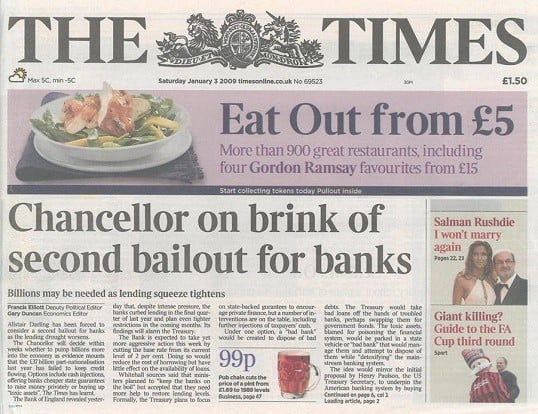
> The Times 03/Jan/2009 Chancellor on brink of second bailout for banks
Back then it was a response to the 2008/9 financial crisis, which is what makes this new message relevant.
The subsidy then was 50 BTC
The reality is that the market expects solvency for the foreseeable future, and tether solves a market problem (liquidity in environments that do not impose the KYC laws required by the US government to trade USD), thereby allowing Bitcoin users to achieve a level of anonymity while still having liquidity. It also, of course, allows a wider variety and leverage range of financial instruments.
It would be amusing to go through all the posts from 2017 on the subject.
https://news.bitcoin.com/wp-content/uploads/2019/01/0Td4BmI0...
And yes the website has changed the title.
Gold may have a finite supply, but it's been mined for millenia and has slowly increased its supply rate over time, and will likely continue to do so in our lifetime.
In contrast, Bitcoin's emission which ranges from 2009 through 2140 is heavily tilted to the first few years.
Its final century from 2040 through 2140 accounts for only about 0.5% of emission.
The only point of the halvings is to be able to claim "finite supply". A constant reward would still have the yearly supply inflation rate (stock to flow ratio) going to 0, albeit more slowly. So crucially, supply would still be scarce, would be more predictable (time independent), more fair to late adopters, and be much closer to Gold's emission over our lifetime.
It would also avoid the inherent instability [1] of mining rewards dominated by transaction fees, and avoid lengthening confirmation times to maintain security against doublespending [2].
If we further consider the fact that coins inevitably get lost, then even a constant reward will yield a softcap of supply, where yearly emission merely serves to balance the yearly losses.
Unfortunately, practically all cryptocurrencies subscribe to the notion that early miners must receive greater rewards, even when they often already enjoy lower difficulty.
[1] https://www.cs.princeton.edu/~arvindn/publications/mining_CC...
[2] https://www.coindesk.com/the-halving-exposes-bitcoin-to-51-a...
On a secondary note, who can claim that it is a good thing that money can't be printed if necessary? The crisis of 2008 was a liquidity crisis, without the ability to print money it could've turned into a great depression. Making the money supply fixed is just throwing out one tool out of the toolbox.
But there is a limited supply of user attention to be divided up between all available cryptocurrencies and it's not divided equally by any measure; so cryptocurrencies are constantly competing with each other for that attention and this is where they derive essentially all of their value. Underlying technology at this stage has almost no value.
In our economy, even an untalented fool speculating on random projects can generate a profit if they have capital; this fact makes talent worthless and means that capital and network effects are EVERYTHING.
This habit of disproportionately rewarding early adopters is a universal feature of our economy and doesn't only apply to cryptocurrencies. The reason why it's like this is simply because it's extremely difficult to get any project or company off the ground; the risk of failure for an early adopter is ridiculously high so rewards also need to be ridiculously high to justify those risks.
This is because most economic activity today is focused on seeking rents and building moats; so this has made the environment extremely adverse for newcomers; it lowered their probability of success and forced early adopter payoffs to skyrocket. We live in an age where the moats are so wide that that even offering customers a solution which is 10x better isn't going to cut it anymore in terms of being able to turn any profit.
One might think that cryptocurrency would be immune to this; after all, the entire point of the blockchain movement was to fix such kinds of socio-economic problems - But having worked in the space for several years, I can say with confidence that incumbents in the cryptocurrency space have become part of the same problem which they were originally claiming to solve. Development in the space is slow, inefficient, lacks a clear vision and the incumbents of the cryptocurrency space lack any incentives to give newcomers a fighting chance. They will happily let the most promising new projects drown in the noise of popular mediocrity.
The hypocrisy of it all is unmistakable. I've seen the ugliest side of human nature in this industry. That said I'm still cautiously optimistic but it's clear that something has to change at a social level in order to move forward.
We could call the entity that adjusts the rate of issue a "central bank" and they could perform this "inflation targeting" to keep the value of the currency stable through economic shocks.
Atleast what the designer intended/predicted if I remember correctly, is for the reward value over time to be the same. This is of course not backed by mathematical equation of sort. I would way super early mining is more similar to being the first employee of a startup that pays you in equity only.
Well, it's a great way to get people to be invested in your new cryptocurrency.
The irony is that no matter what you do there will only ever be a finite supply of any currency, fiat or otherwise. It's a finite universe, so "finite supply" is inherently imposed by the laws of physics.
> practically all cryptocurrencies subscribe to the notion that early miners must receive greater rewards
That's the real objective. Like all startups, cryptocurrencies want to encourage early adoption by, among other things, FOMO. If there is no benefit to being an early adopter, no one will adopt early, and if no one adopts early, you will never get to critical mass.
I'm not so certain that holds true. You could, in theory, either in a game or in real life, create a currency item that represents infinite currency. There would a finite number of physical representation of such items (if done is real life), and people would only place a finite value on it, but it would still representing an infinite number of whatever currency. You could even digitally create an infinite number of such infinite currencies.
Depending upon exactly how they behave, it would quickly make the currency worthless about as fast as people conceptualized what infinite means, but at the core there would be an infinite amount of money.
The reason why is that electricity for mining is priced in national currency, so interest in mining bitcoins depends on a miners future expectation of the value of bitcoin price in national currency when they sell the bitcoins to pay the electricity bill. The current wisdom is that the halvening decreases the amount of bitcoin that miners receive while increasing the USD value of bitcoin because it decreases market supply and the perception of market supply.
If the price of Bitcoin now doubles presumably no miners will be turning off their machines. If it doesn't double, some fraction of all mining setups just became unprofitable.
Fees are still not near dominating the rewards so we do expect to see miner revenue drop due to this.
I don't really understand the economics of this, but it seems there are a few possible outcomes:
A) Prices double because miners refuse to sell at a price that gives them less than $100k a block and demand for coins is inelastic.
B) Fees go up 10x because miners now need to make $50k in transaction fees instead of $5k per block to make up for the lower block reward, and demand for transactions in inelastic.
C) Difficulty and prices drop because neither transaction demand nor coin demand is inelastic, and miners will begin turning off rigs that are no longer profitable at $50k per block.
D) Some combination of the above.
It's a chaotic system by design which makes it really hard to predict what will happen in the long run.
This means that without sufficient demand for transactions, a majority of miners would have to abandon the network, which would indeed put network security at risk.
Therefore I predict that the miners will make the supply of Bitcoin unlimited, should that situation occur. They already got their way with keeping the Bitcoin block size fixed, which kept transaction fees high.
They haven't been correlated to block reward AFAIK.
It's totally possible that the price might go up, but the reason for that rise would be the irrational behavior of other market participants and people should acknowledge that.
Perhaps this is glib, but it's worth remembering that bitcoin isn't a rational market. At no point in its history has the market reacted rationally to any event.
It only appears rational in hindsight, if at all. But "rational" implies a causal link between an explanation and a subsequent event. Those explanations almost never turn out to be true.
BitCoin is gambling where big players intentionally alter the price and small players hope to sap some $$$ like fleas on a dog.
Rationality, for economists, simply means that when you make a choice, you will choose the thing you like best.¹ This is very different from the way we normally think about rationality. Usually when we talk about rationality we use it to mean sensible, or reasonable. To economists—as long as you’re doing what you want given your situation, you’re acting rationally.
[1]read.hipporeads.com/what-an-economist-means-by-rationality/
Yes, current prices include anticipated future events (or at least speculation on those events, as well as anticipated behavior of market participants based on those events, yada yada), to an extent. What prices can't anticipate is the behavior of market participants at any point in the future, much of which will be irrational; or the events in future history that may or may not trigger that behavior.
Yes, there is alpha to be gained based on data collection/processing -- things like news, weather, twitter, satellite images of traffic or parking lots, etc. The more you know and can effectively analyze that other market participants don't know or can't effectively analyze, the better. But no one really knows the future, only what traders are statistically likely to do in the near future based on current events.
Having a periodic “The Halvening” ritual every four years allows Bitcoiners to reconcile and forgive each other’s trespasses for one, it also gives Bitcoin a nice bump of attention in the media and on social media, and finally it gives the Bitcoin High Priests an opportunity during the ritual to re-iterate the Bitcoin Commandments (eg. “Thou shall worship fixed monetary supply” and “thou shall not worship other consensus rules”). All this strengthens the community, and thus, the consensus, and a strong consensus is part of the main selling point: to get filthy rich.
Bananas are bad for you! Bananas suck! Bananas are a scam!
You're going to have to elaborate on this. I don't understand how the adjustment of future mining rewards has anything to do with past "trespasses."
>it also gives Bitcoin a nice bump of attention in the media
It gives bitcoin negative media attention, because people on the outside will read the headline as "Bitcoin's value is cut in half," which is not the case.
For specific examples of who is reconciling at this specific ritual, just look at this thread! Hundreds of comments from hundreds of strangers around the world, all coming together.
2. All press is good press!
Another fact that supports the ritual hypothesis is the fact that this “event” has to be a big event every four years. Why not simply adjust down the reward at every block? Because then we’d have no ritual, and thus we’d have a weaker community.
the top comment on the 2012 one was about someone seriously concerned about the 2.8GB blockchain download to get started, and a debate about the scalability of bitcoin.
since then:
- light clients have been created. no mobile or desktop user worries about blocks, keeping only references to a few prior blocks.
- merchant services which are full nodes use pruned clients, which mean their servers only use 25gb or so. (while the blockchain is 10 times larger)
- compression of transactions have improved, so each tx takes up less space on the blockchain.
- validation time of the blockchain is much faster, even if you have to download the whole thing from scratch
- there is still a large and growing community of actually full nodes that do invest in the appropriate hardware for decentralization.
- and mining full nodes and their pools have fierce competition to keep their constituent miners, continually distributing transaction validation even if the pool operator is just a centralized single full node.
- Bitcoin continues to improve.
On a serious note, that's a good summary, thank you!
Some may be speculating that miners dropping out is bad for bitcoin because it reduces the security of the network and may give people weak hands if they're concerned that their money may not be as safe as previously assumed. Miners dropping out of the race would also release more mining hardware onto the markets at discounted prices, and some of it may go towards attempting to attack bitcoin. However, if you do the sums and work out how much it would cost to attempt and sustain such an attack, and how much can be gained from it, you quickly realize that such an attack would never be attempted for monetary gain - it is in the miner's best interest to play by the rules. The only other motive for attack is to cause temporary denial-of-service, at the expense of the miner, but this could only plausibly be conducted by a nation state due to the amount of work done in Bitcoin.
during some periods of time the price falls and it takes longer for all of that to happen, with existing miners being slowly replaced by more well capitalized miners
We're years into bitcoin and I feel that people still don't understand the basic premise that with an adjusting difficulty it literally doesn't matter how many people want to mine. Difficulty will adjust to about the break even point for miners that can run at scale (likely in a place with cheap electricity).
The price of bitcoin is still based on supply and demand for bitcoin. Whatever THAT clearing price is will determine whether or not it is profitable to mine. If it is not profitable to mine, miners will drop out until the difficulty level falls enough that it becomes profitable again.
Miners will want to cover the cost of mining, and to achieve that they will want to sell coins for higher price than they were selling it before for.
If the law of supply of demand carries any predictive power, BTC should see a compounded rise.
It continues to amaze me that I struggle to set up a 5-node database cluster without one going out-of-sync or split-braining every few weeks, yet the bitcoin network manages to keep thousands of miners in-sync. This has to be the best example of eventual consistency in a production network.
I prefer calling it a distributed mechanism for emergent consensus. Consensus is not achieved explicitly - there is no election or fixed moment when consensus occurs. Instead, consensus is an emergent product of the asynchronous interaction of thousands of independent nodes, all following protocol rules.
Bitcoin (BTC) is classed by the US Federal Gov't (IRS) as property, not currency.
That wasn't some kind of mistake or tax technicality on the IRS' part - a lot of analysis went into this in 2013, along with DHS and FinCEN. This is the definition for BTC in the US.
That means what happened today could be described as: The first and oldest decentralized, distributed, cryptographically-secured record of digital property ownership (Bitcoin as a network) is producing cryptographic keys (the property, BTC) at half the rate it was yesterday. There is now less of the digital property (BTC) being created by the network daily, and this is due to an artificial scarcity strategy built into the Bitcoin source.
Hope that helps
Early settlers are incentivized to grab large swathes of land quickly and cheaply, to get the system bootstrapped. Later settlers have to fight over smaller tracts of land, because after all the land is finite (you eventually reach the ocean). However, the land is also nicely divisible into smaller and smaller sub-plots, so units can be adjusted as needed.
The rules by which this "westward expansion" are governed are written into the Bitcoin protocol. But unlike land and the ocean which are natural facts for the most part that we take for granted a priori, with Bitcoin the "border"/limit here is also defined as a theoretical construct (and hence, could theoretically be changed, but this would be a hard fork and people would have to reevaluate the value of a new network with a new set of boundaries/rules).
Ethereum launching their "ETH 2.0" and transitioning to staking will be a bigger event in the crypto space later this summer!
https://medium.com/@vijayboyapati/the-bullish-case-for-bitco...
I guess Satoshi thought that would be a good schedule when the code was written. It must have been hard to see how the future would pan out.
in a nutshell: miners group transactions into block (ie mine). whoever manages to form a block (you need to solve a computationally expensive problem that has the transactions you want to include as inputs) get a reward. up until today the reward was 12.5 bitcoins. Starting today it's half of that 6.25.
speculations about what this means and where BTC is going follow from this.
There is no BitCoin economy, only people watching the BTCUSD sticker price because only the real economy matters.
I'm also willing to bet the network resilience is not as high as techno folks want to believe and if some governments want it shutdown it will be pretty close to shut down and the FX rate will go towards $0.
In many ways BitCoin is not an anti-globalist or anti-anything response. It is a product that exists due to globalization. And the high prices are a result of some economic stability and prosperity that allowed the population to play with shiny things. The coming depression will put an end to such trivialities.
This event was (modulo + or - a month) pre-determined from the very first day bitcoin was launched (and so is the next halvening and the one after that).
The coinbase transaction is the first one listed in the block. It has no explicit payer, and can be valued up to/including the sum of:
- the block's aggregate transaction fees
- the block subsidy (6.25 BTC starting with block 630,000 today)
There's some technically detailed information on coinbase transaction/money stock edge cases that have occurred over the years here:
https://bitcoin.stackexchange.com/a/38998
Also see this discussion of a jaw-dropping miscalculation of the block subsidy (even though dated April 1, it's for real):
https://github.com/bitcoin/bips/blob/master/bip-0042.mediawi...
Seems like an successful experiment to me. I am excited to see what next gen tech in this space will bring.
Bitcoin fans claims the price should go up. Conventional financial wisdom is that the price of something contains expected future events, so the price should remain the same.
I believe this is the theory behind expecting a price increase. Whether or not it materializes time will tell.
As of 10 blocks past halving it doesn't look like total hash power has decreased much.
It'll certainly be interesting to see if mining power drops off in the coming month.
Long term I'd love to follow something that simply warns when there's enough rentable or assumed dark mining power that 51% attacks on bitcoin mainchain is a realistic threat.
Edit: Feel free to reply with your guesses (good as mine) for a good laugh in 4 years