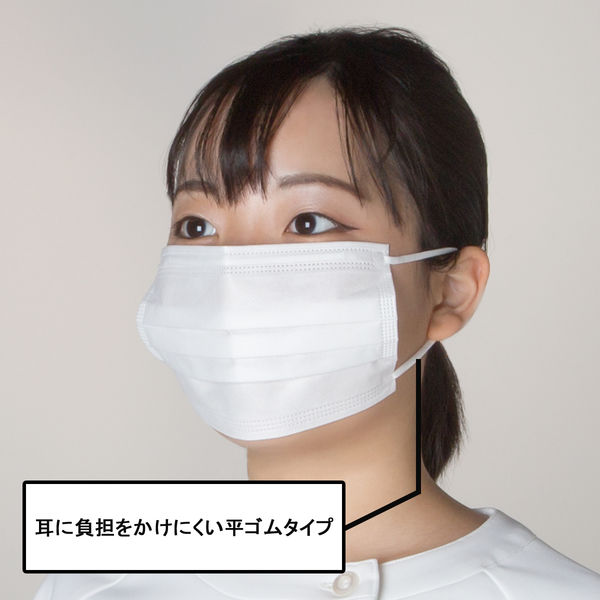
Surgical masks aren't about protecting the wearer from everyone else, they're about protecting everyone else from the wearer [1]. They may provide the wearer some protection, but that's not really the point.
The emphasis in the rhetoric about masks needs to change. It should not be about individualist self-protection, but about doing your part to protect the community. I think they should be recommended for that reason [2].
[1] Respirators are devices for protecting the wearer, and the N95 type has been much discussed. Everyone should learn the difference to de-confuse the general conversation in this topic:
https://www.youtube.com/watch?v=JR2uLfEVD2w
https://multimedia.3m.com/mws/media/956213O/differences-betw...
[2] If there's enough supply. It seems like surgical masks are getting drafted into the role of PPE for medical personnel (which they're poorly suited to) due to the N95 shortage. It's unfortunate that the US hasn't developed a culture where you wear a mask to protect others from your illnesses, so they're not widely available outside of healthcare settings.
Face protection must surely have the side-benefit as well that it signals to others to keep your distance and that this is a serious situation.
So yes once you've removed all non essential contact masks add another layer. But people are fairly stupid on average and need simple messages right now.
Most (if not all) distributors and manufacturers of masks has been prioritizing health care systems and governments over retailers since January. Just as they should do. Were there any that weren't? I didn't see any reports of that, but if so of course the proper thing is to report them and talk to them. Not to blame random joe for having a mask.
The fact was since January retail supplies were only existing stock, which as we know was quickly sold out with a lot being sent back to family overseas (no judgement there). And I haven't seen any masks being restocked at any hardware stores or pharmacies since. At no time did I hear about authorities going around every pharmacy or home depot to try to collect any masks. Why? Because they knew there were no supplies and what was there was so small it'd make no dent in the problem. So blaming the public is grossly irresponsible and even put people in danger. I have an immune compromised friend that was responsibly using masks but got harassed for wearing masks "that don't work". And there were plenty of similar reports of such behavior from others.
- The messaging (in Spain but looks similar everywhere) has been that you should wear one if you are sick or, more importantly here, if you are at risk. This is a clear indication that they do help protect against being infected. This should have prevented everyone from harassing anyone wearing one ("they must be a risk group"). The fact that people did that is indication that people are not acting responsibly.
I personally hate being told something that is patently false, but I totally understand that, collectively, we need to be lied to for our own protection, because collectively we become a bunch of idiots.
It appeared to be very common for citizens to wear masks in eastern Asia long before this pandemic. I'm not the least bit surprised they were more prepared to scale up production.
They still haven’t done this to date. Beyond frustrating.
If you look at almost all of their actions, they continually clamp down on things that might work because they have not been proven.
It seems to me that they are led by academics and theoreticians with very little operational capability at the top decision making channels.
"In the middle of the 20th century, a cadre of credentialed experts was created to replace citizens. This was a mistake. The selection mechanism for entry into this cadre selects against bravery and original thinking. Experts should be consulted, but what use is an expert unwilling to consult on a grand vision? The American system of the 2020s through the city, county, state, and up to the federal level has been staffed with people who know how to speak and make themselves appear blameless, but not how to act."
https://americanmind.org/features/the-coronacrisis-and-our-f...
The messaging around masks has been so aggravating to me that I got together with a couple of colleagues to write a detailed, scientific mini-review / commentary:
https://medium.com/@matthiassamwald/promoting-simple-do-it-y...
The benefit of widespread mask usage by the general population is source control [0]. This works even if the person wearing the masks makes mistakes such as touching their face more while wearing the mask.
Also, it should be obvious that there is no downside to wide-spread mask usage by the general population. The countries that have so far the most control over the virus' spread are the ones where wearing masks is normal and often done to protect others when sick.
Importantly, if the goal is source control, then all sorts of makeshift mask designs can work. People in Japan and other countries are already getting really creative [2,3].
Of course, the problem that medical personnel might face even more shortages if everybody starts wearing medical grade masks is real and must be taken seriously. But that's not the only option we have.
[0] One reference amongst many, this commentary in the Lancet: https://www.thelancet.com/journals/lancet/article/PIIS0140-6...
[1] Compare growth rates here: https://studylib.net/coronavirus-growth
[2] https://www.cottontimemagazine.com/page/10
[3] https://mobile.twitter.com/nekohnd/status/122368673365439692...
Have spare masks? We are trying to get them to the people who need them most: https://findthemasks.com/
We are presently listing hospitals accepting small-scale donations in 28 states, growing fast.
CDC’s continued insistence that face masks don’t work is disingenuous at best. Leading way to a global recession at worst.
Had they changed their guidelines to saying that face masks can help inhibit spread at the very least, especially from asymptomatic carriers who are wearing masks, US gov could have contracted mask manufacturers to with millions of dollars worth of mask orders. Spurring then to produce masks, eliminating this shortage of masks.
Instead, gov plan has no mask protocol, so the only other option is a global shutdown of “non-essential businesses”. Causing an essential shutdown of the economy. The cost of which they have obviously not calculated.
ISTM a moderately tightly woven or knit hydrophilic mask (e.g. cotton) could be quite effective. Knits could have the added benefit that droplets would need to take a twisty path to get through. And there is plenty of such material around.
This shouldn’t be that hard to study in a lab. Find a sick person, have them cough through different masks, and measure viral concentrations on nearby surfaces.
https://www.nytimes.com/2020/03/17/opinion/coronavirus-face-...
And some data back from SARS: "Always wearing a mask when going out was associated with a 70% reduction in risk compared with never wearing a mask. Wearing a mask intermittently was associated with a smaller yet significant reduction in risk."
https://wwwnc.cdc.gov/eid/article/10/2/03-0730_article
I saw a lot of people sanctimoniously talking about fit tests in normal healthcare settings as if an imperfect fit dropped effectiveness immediately down to 0% from 100%.
If we consider a place like South Korea, or Singapore, the executive actions contrast wildly with the executive actions that our city, state, and federal governments have taken.
If I'm not mistaken, in Singapore they even went so far as to distribute packs of masks to each and every family. I don't ask for that level of efficiency, but it does illustrate an example of effective executive action during times like these.
“Origami” tea cloth mask with rubber bands https://www.instagram.com/p/B96rcR8neYv/
In China, it's pretty much contained now, and everyone wears masks on the street -- The thing is, there are 1.3 billion people, of course there are a lot of people couldn't buy or afford surgical masks, let alone N95 masks.
It turns out people wear regular masks, or even they don't have any mask they sew their own mask.
Also, most surgical and N95 masks are disposable, in China, people cover their hand sewed mask outside, covering the disposable masks inside and try to reuse them, and disposes the hand-sews masks. This hack, of course, have potential risks, but it might help for people who are running out of masks.
Sorry to nitpick, but it's N95 respirators not masks. There's be a lot of terminology confusion on this topic, and I think it's making communication significantly more difficult on this topic.
https://www.youtube.com/watch?v=JR2uLfEVD2w
https://multimedia.3m.com/mws/media/956213O/differences-betw...
YES, we get it, but what about protecting others from your cough since most people don't even know they're contagious. Even a 20% decrease from a crappy solution is interesting when dealing with exponential curves.
Drives me mad.
If you are caught without a mask you get fined.
How else can people get the virus? Perhaps people shed the virus through their skin? Or touch their face and get it on their hands? So people can wash their hands before touching their face. Also people can get it in their private homes. But those groups don’t mix all the time.
So I am just wondering... N95 masks are for the person who doesn’t want to get the virus. But what about everyone else?
I understand that you could wear the mask crooked and there are problems with application. But mass producing N95 masks and giving them out and MANDATING everyone wearing them like women in Saudi Arabia seems like a better policy.
In countries where the epidemic is controlled, pretty much everybody wear masks, including handcrafted one in case of shortage. The goal is not to prevent from being infected, but to prevent infecting other, by limiting the amount of saliva you spread everywhere. Especially since tons of carriers are asymptomatic, or starting to be contagious before becoming symptomatic. And even a poor mask in front of your mouth is better than nothing, at least if everybody wears one, and if you don't become careless on other measures (distancing, washing the hands, etc.)
So there is an availability and potentially a cultural problem, but that can and should be fixed. Because this will be far less costly than infinite lockdowns.
As an alternative see Hong Kong, where they are encouraging the population to improvise masks: https://www.consumer.org.hk/ws_en/news/specials/2020/mask-di...
Cat meme because it was reposted to Chinese Quora. Obviously consider that Asian countries have no mask shortage due to existing cultural practices. Masks should be prioritized to prevent collapse of medical capacity when there is shortage - the policy suggestion most western countries are seeing. The TL;DR of the guide: the only scenario not to wear (normal surgical) mask is when you're alone. Surgical masks for almost every other situation, N95+ for high risk situations. On efficacy for public health, The microbiologist Yuen Kwok-yung, from HK who was a key figure in SARS and one of the expert teams on Covid response:
>Given this novel coronavirus is so "cunning", with probably many infected but asymptomatic people moving around in communities, how should ordinary citizens protect themselves?
>We can only rely on telling everyone to wear a mask, wash their hands frequently, use alcoholic sanitiser. I had called for everyone to wear a mask when I was in Beijing, but many people disagreed, saying that the World Health Organisation (WHO) said healthy people don't need to wear masks unless they go to crowded places. Nevertheless, if people wear masks only when they feel sick, then the eight infected people on the Diamond Princess would have transmitted it to others because they were not feeling uncomfortable. Wear a mask to protect not only yourself but also others, because if you are infected but asymptomatic, you could still stop the spread by wearing a mask.
>In our experiments previously, we found 100 million virus strands in just one milliliter of a patient's saliva. Therefore, scenarios with the potential for exchanging saliva are generally quite dangerous. The temporary success of virus control in Hong Kong this time is not only due to population controls, but also contributed by the early advocacy for mask-wearing, hand-washing, and social distancing. Otherwise, with such a dense population in Hong Kong, the epidemic would very likely have spread the same way as in Italy or Daegu in South Korea.
https://www.straitstimes.com/asia/east-asia/exclusive-qa-wit...
Google translate of guideline:
The general public
(1) Home and outdoor, no people gathered, well ventilated. It is not recommended to wear a mask.
(2) Being in a crowded place, such as office, shopping, restaurant, conference room, workshop, etc .; or taking a box elevator or public transportation. In low- and medium-risk areas, it is recommended that you wear spare masks (disposable medical masks or medical surgical masks) with you, and wear them when in close contact with other people (less than or equal to 1 meter). In high-risk areas, disposable medical masks are recommended.
(3) For those with cold symptoms such as coughing or sneezing. It is recommended to wear disposable medical or surgical masks.
(4) For those who live together with those who are separated from home and discharged from rehabilitation. It is recommended to wear disposable medical or surgical masks.
Personnel in specific places (1) It is located in densely populated hospitals, bus stations, railway stations, subway stations, airports, supermarkets, restaurants, public transportation, and community and unit import and export places. In medium and low risk areas, it is recommended that workers wear disposable medical masks or surgical surgical masks. In high-risk areas, it is recommended that workers wear medical surgical masks or protective masks that comply with KN95 / N95 and above.
(2) In prisons, nursing homes, welfare homes, mental health medical institutions, school classrooms, construction site dormitories and other densely populated places. In medium and low-risk areas, it is recommended that you always wear spare masks (disposable medical masks or surgical surgical masks) with you daily, and wear masks when people gather or come into close contact with one another (less than or equal to 1 meter). In high-risk areas, it is recommended that workers wear medical surgical masks or protective masks that comply with KN95 / N95 and above; other personnel wear disposable medical masks.
Key personnel
Suspected cases, confirmed cases, and asymptomatic infections of new coronavirus pneumonia; close contacts of new coronavirus pneumonia; immigrants (from entry to end of quarantine). It is recommended to wear medical surgical masks or protective masks without exhalation valve that conform to KN95 / N95 and above.
Occupational exposure
(1) Medical personnel such as general outpatient clinics and wards; emergency medical personnel in medical institutions in low-risk areas; administrative personnel, police, security, cleaning, etc. engaged in epidemic prevention and control. Medical surgical masks are recommended.
(2) Personnel working in the ward and ICU of patients diagnosed with a new type of coronavirus pneumonia, suspected case patients; medical staff at designated medical institutions for fever clinics; medical staff in emergency departments of medical institutions in middle and high risk areas; epidemiological investigations and experiments Room testing, environmental disinfection personnel; transfer of confirmed and suspected cases. Medical protective masks are recommended.
(3) Operators engaged in the collection of respiratory specimens; staff who perform tracheotomy, tracheal intubation, bronchoscopy, sputum suction, cardiopulmonary resuscitation, or lung transplantation, pathological anatomy in patients with new-type coronavirus pneumonia. Suggestion: hood-type (or full-type) powered air-supply filter respirator, or half-plane power-supply air-filter respirator with goggles or full screen; P100 anti-particulate filter should be used for both types of respiratory protection Elements and filter elements should not be reused. Use protective equipment after disinfection.
https://courses.lumenlearning.com/boundless-microbiology/cha...
The flu virus is typical: ...the flu virus is .17 microns in size.
https://www.envirosafetyproducts.com/resources/dust-masks-wh...
Masks work by trapping flu particles. The 95 in an N95 mask is shorthand for "this masks traps 95% of particles of size .3 microns.
There are also N99 and N100. N100 trap 99.7%. N100 when it is used in an air filter is called HEPA which I believe stands for High Efficiency Particle Attenuator or Arresting.
There is also a level above that found mostly in Europe called ULPA which pushes the decimal out further to 99.9997% . All of these aarea measure of the masks ability to trap particles of 0.3 except ULPA which is a measure of trapping particle 0.17
https://www.globalspec.com/learnmore/manufacturing_process_e...
Masks are matted fibers designed to trap particles on their fibers. They do this using 3 mechanisms which all masks share- diffusion, impaction and inertial impaction.
Diffusion happens when a particle is so small it is in Brownian (random) motion. These particles are trapped because they constantly change direction randomly as they pass through the mask and eventually run out of luck trying to dodge fibers. Such particles are less than 0.03 microns in size. (I should inject here that even though virus are smaller than this, there's more to the story as detailed below).
Inertial impaction happens when a particle is larger than .03 and owing to its size and momentum cannot change its direction of travel fast enough to stop itself running into a fiber.
Impaction happens when a particle comes within 1/2 of its radius of a fiber and touches it, becoming trapped. This is the most difficult size of particle to capture (as it happens) and that's why its the reference particle size for safety masks.
In the above I acted as though the particles were "trying" to avoid being trapped, but of course that's just a stub for the underlying physics off motion and magnetic attraction/repulsion which underlie these facts.
If you want to DIY some sort of mask to reduce your exposure, you have to consider that the weave of most cloth is far far wider than .03 and anyway not in layers (a cloth like yarn is the exception to the second property).
Just guessing but rags scarves etc lack the required fiber density to function as safety masks. It is possible that the virions would sail through them even under Brownian motion. But that is not really how virions are transmitted- they are transmitted mixed in with saliva particles which are hugely larger than the virions themselves. The size of a particle of saliva in a sneeze was examined here- tldr: a bimodal distribution of sneeze particle size all over 50 micrometers.
https://royalsocietypublishing.org/doi/full/10.1098/rsif.201...
Some other studies have put the size as small as .35 micrometer. https://www.ncbi.nlm.nih.gov/pmc/articles/PMC4676262/
What is really astonishing is how fast the particles travel- 200 MPH. https://www.livescience.com/3686-gross-science-cough-sneeze....
https://www.texairfilters.com/what-happens-to-the-particles-...
So all in all we can say this-any mask covering is better than no mask because it's an odds game with virus particles and saliva.
The less able you are to breath through it, the better it functions as a barrier.
Ordinary cloth is just not woven tightly enough to substitute for a p95 mask.
If you had to choose between multiple layers of x number of fibers and a tighter weave of the same fibers, it might be better to go for a tighter weave because even though individual virions would travel under Brownian motion, that's not how a spray of sneeze which is the transport mechanism of the virus is going to travel.
Some sneeze particles containing virions have a particle size of 5 microns and will stay aloft in a still room for a long, long, long time. If someone sneezes and three minutes later you walk through where they were, you could very well become the unknowing, unwilling next host of the virus.
That last - horrifying - fact is one of the the reasons why they're telling people to maintain social distancing and just stay home.
You cannot expect the general population to adhere to the standards of a TB hospital. It cannot be done, even if it was a good idea. For example, standard practice is that a mask is meant to be worn for only 8 hours and that is under the assumption that you have no reason to believe you were exposed. If the mask becomes wet, damp, or if you have any reason to believe you've been exposed you're supposed to immediately doff it carefully and dispose of it. Typically PPE is used only once per exposure, or is reused for exposure to one patient at a time.
There are so many variables at play here. From the efficacy of the masks themselves, the best allocation of resources, the different varieties of masks, the techniques for proper fitting, the decontamination processes, other PPE. Does this mean masks are not useful? No. And you won't find many experts making this claim. It's clear that masks help.
Think critically about this. It is not as simple as "masks good" or "surgeon general lied." There are manifold hysterics going around -- please don't contribute to it.
COVID19 is worse than flu, but not as bad as it could have been. We could get hit with something worse in the future. Imagine a strain of Ebola that gestates asymptomatically longer, or another coronavirus with higher mortality rate. This outbreak is good preparation for that one.
Anytime you’re dealing with a harmful exponential growth process like an outbreak, the best way to handle it is to overreact early, quickly and briefly. Kill it hard while it’s still small and easy to kill, or it will get out of control fast.
Put everything on lockdown/shelter-in-place for a few weeks - [max(gestation period|time to develop and deploy test kits) + safety factor] - test extensively, isolate and treat the infected, stop the outbreak, and then return to normal. Outbreak stopped dead in its tracks, economic damage is minimized and mostly short-term.
This is basically what South Korea did and they got their first COVID19 diagnosis the same day as the US:
https://www.reuters.com/article/us-health-coronavirus-testin...
That needs to be become a social and political norm everywhere, not just the Asian countries that have faced a widespread outbreak before.
People were worried that overreacting (in particular if the outbreak fizzled out, in which case any reaction would have been an overreaction) would damage the economy. Personally, I viewed that as a positive - a decently resilient economy would absorb such short-term shocks without any long-term issues. Easiest way to force-create such an economy? Stress tests (c.f. Netflix’s Chaos Monkey). If governments overreacted 1-2 times every year, people (travellers) and companies (supply chains) would get used to occasional flight blockade, border closure, discontinuity and disruption. We’d build a much more anti-fragile world.
> Personally, I viewed that as a positive - a decently resilient economy would absorb such short-term shocks without any long-term issues.
That’s my sense of it too. The markets may fall in the short term, but as soon as the outbreak is stopped, roughly a month later, the markets will recover most or all of their losses.
Politicians so afraid of any stock market fall that they try to minimize the problem instead of treating the root of it are more likely to cause an even bigger market collapse.
People were already warning us years ago about a pontential pandemic and its impact (including Bill Gates), but we all ignored it.
A real pandemic seemed to be the only way to teach us. So I'm really happy for all of us that it's this moderate one, because it could have been a lot worse.
You can't manage what you can't measure.
To this date, I have seen no reliable data on how fast the disease spreads, or how dangerous it actually is. Testing only 'people with shortness of breath and high fever for more than 4 days' is so biased it's not even funny. There could be 10x or even 100x more people with milder symptoms that are never considered for testing. Reporting '10% of people tested die' is also very misleading, since we only tested people with severe symptoms in the first place.
We can poll 5 times a week for the chances of Biden or Sanders or Warren to become Trump's challenger in fall. Perhaps we could also perform randomized tests every week and get a better sense of the shape of the danger we're facing. Yes, testing for coronavirus is more expensive than calling a phone number, but shutting down the country indefinitely is orders of magnitude more expensive.
I’m sure there will be lessons here too. The difference in response of between countries is one obvious comparison. But I think another lesson will be how the virus spread globally. With this virus, we have much more information about how the virus was able to spread globally so quickly.
They aren't staying home. Restaurants, bars, and events are still open. Trains are still packed at rush hour. Festivals are still happening. They're planning on starting school in April.
I can only see a few possibilities
(1) the numbers are false and Japan's death rate is going to accelerate
(2) the numbers are true but it's still coming
(3) Something about Japanese culture already limits the spread.
I don't believe this one. Japanese might wear masks but not all of them wear masks and they are not N95 masks. Japanese are also known to go to work sick, go to cafes sick, visit friends and family sick. Places are crowded. Open and over crowded offices everywhere.
(4) Something about Japanese genetics makes them less likely to have a strong reaction
I have no idea how to tell which of those it is except to see where they are in a few weeks. If the death rate rises it was (1) or (2). If not then it must be (3) or (4)?
Here's their latest graph. The 2 shallow lines at the bottom are Singapore (bottom) and Japan (2nd from bottom). The rest are Italy, Spain, Germany, France going left to right at the top.
https://rpr.c.yimg.jp/im_sigg.R1UwQuI2tgBhV1fzJ5o7A---x799-n...
Substandard masks are better than no masks, and many people wearing masks is better than few people wearing masks. These are not "all or nothing" matters.
https://www.againstcovid19.com/singapore/dashboard https://www.againstcovid19.com/taiwan/dashboard
This is vs the ~110 British cases and ~50 American cases the two countries have seen collectively.
Flight volume from Japan to both countries is normally quite substantial so this is evidence to suggest that Japan's case is not low solely due to undertesting.
This is a very western belief. Why do we continue to think that asians wearing masks are stupid?
Most importantly, say masks prevent 50% of transmission, and the majority of transmission is via the air (highly plausible), then that would mean drastically less transmission.
Even an N20 mask that reduces risk by 20% would make a huge difference to a population.
It is my prediction that masks are the single most effective means of dealing with the virus at present. Japan’s low infection rates are because they wear masks.
Wearing a bandanna over your mouth and nose just makes sense.
https://smartairfilters.com/en/blog/best-materials-make-diy-...
https://askul.c.yimg.jp/img/product/3L2/8475270_3L2.jpg
That is not a N20 mask.
Further they don't all wear them. < 50% wear them.
The majority of people wearing masks in Japan are for hay fever.
https://www.politifact.com/factchecks/2020/mar/17/instagram-...
https://www.politifact.com/factchecks/2020/mar/12/joy-behar/...
That said, calling the situation a hoax was beyond redemption.
Your link: https://www.politifact.com/factchecks/2020/mar/17/instagram-...
I just did a search for news articles from the end of January to the end of February, and only found articles like this one[1], where politicians are criticizing the Trump administration's communication, but aren't callng for stronger efforts or mass mobilization (and the article has a quote from Pelosi saying she has confidence in how the CDC is handling things). Congress wasn't passing legislation to fight the pandemic as things were heating up, and governors don't seem to have made effective plans. The media didn't consider it to be a major disaster until recently (it didn't get brought up in the presidential debates until a couple weeks ago, IIRC). Issues like our lack of emergency stores for things like masks and our lack of an ability to manufacture them here is an issue that goes back for years, as is the poor safety net that leaves Americans so vulnerable in times like this.
Hopefully this crisis will encourage people to look at the poor leadership America has had across the board. Simply getting rid of Trump and calling it a day is just rearranging deck chairs on the Titanic.
[1] https://www.washingtonpost.com/us-policy/2020/02/05/some-law...
Well, "other countries" also did the same. Spain, for example, seems to be the 3rd country with most infected and I got pneumonia about 2 weeks ago. Called the agencies here but they still didn't want to test me, even with pneumonia! Still got a cough since then and they still won't test me.
So, the US is not alone. And it does make a bit sense, I didn't require hospitalization, so makes sense they want to save the resources. But I feel like the article author could have done some better research.
I don't say that to diminish the importance of testing, my point is that the anecdotes aren't necessarily very informative.
From the actual descriptions of patients that have gone through it and been hospitalized, there are much worse symptoms, and maybe they should be addressed more immediately. The main one I've come across is the heavy chest pressure. I don't understand why, in the US at least, there isn't more specific messaging so that we can make sure people with more severe or COVID-19-related symptoms have the ability to get through. Not to mention the BS here of having to 'call your doctor' first before getting seen. There are a lot of people out there now without primary care doctors or that can't afford a visit. There have been no federal instructions on how we would get waivers for visits, testing, and possible hospitalization. If you've ever had to fight with medical billing in the US, it's frustrating and will be even more so after all this dies down.
On a side-note:
I was turned away from donating blood yesterday because I admitted to having a runny nose and a bit drainage that caused some coughing. I have seasonal allergies - it's March, it's been raining and plants are blooming, etc. I understand the caution but I had no fever (tested at 36.6 C / 97.8 F), which is about the same temp I've had for the past week (I've tested that and my blood pressure daily, just in case). I was a bit frustrated, because I really wanted to do something immediate to give back but so be it.
While walking home, it did make me wonder why they even bother taking 'healthy' people who could be asymptomatic if it's such a concern. They admitted to having no way to test the blood.
I think there's a lot that needs to be fixed and I hope that this crisis will provide a better future for us all. Epidemics aren't going to go away. We can learn and plan better.
If you don't have the tests, you don't have the tests. I get that.
But then just say, "Sorry guys, we can only test critical cases and emergency personnel right now because we don't have the tests."
What's concerning is that it's possible to reach a point where a person presenting with pneumonia, is not a critical case.
It's pretty much the same story with the masks, which is a political scandal in France at the moment.
More importantly, the U.S. could and should have provided global leadership as it did for the 2014 Ebola outbreak.
Yeah, we in the rest of the world is very aware of that and frankly a bit tired of it. But my grief about that is nowhere as big as South American or countries in the middle east.
> the U.S. could and should have provided global leadership
Realistically, I don't don't think the US would be able to provide global leadership. Your leaders were denying that this outbreak was even real and the person responsible for the containment is a person who believes prayers can actually solve things. So I don't think anyone is expecting the US to have any real play on the world scene today.
The experts are f* this up and it is going to have long term implications for already eroded public trust in institutions.
(1) Widespread testing is key. Testing symptomatic people is too little, too late. (2) You can't rely on people to self-quarantine. (3) Infected people need to be isolated from their households.
So now we have a massive, economy-strangling quarantine that is not even going to provide any relief, killing the economy and still not flattening the curve. All the pain with none of the benefit.
Anything I’ve read indicates China screwed up at almost every step only to have to do what the rest of the world is being forced to do now. Axios did a good timeline that leads me to believe the Chinese aren’t that special and if anything their government acted in such a way that doomed the rest of the world.
https://www.axios.com/timeline-the-early-days-of-chinas-coro...
Watch one of the now-daily press conferences and you'll see Dr. Fauci trying to gently (so he doesn't get fired) correct inaccurate information from the President, in real-time from the same room.
Take a look at this editorial written by John Ioannidis. Excerpt that is relevant, though the whole thing is a worthwhile read:
>If COVID-19 is not as grave as it is depicted, high evidence standards are equally relevant. Exaggeration and over-reaction may seriously damage the reputation of science, public health, media, and policy makers. It may foster disbelief that will jeopardize the prospects of an appropriately strong response if and when a more major pandemic strikes in the future. [0]
Quick BIO rip from wikipedia:
>Ioannidis studies scientific research itself, especially in clinical medicine and the social sciences. He is one of the most-cited scientists in literature. His 2005 paper "Why Most Published Research Findings Are False" is the most downloaded paper in the Public Library of Science, and has the highest number of Mendeley readers across all science."
>Ioannidis is a Professor of Medicine, of Health Research and Policy and of Biomedical Data Science, at Stanford University School of Medicine and a Professor of Statistics at Stanford University School of Humanities and Sciences. He is director of the Stanford Prevention Research Center, and co-director, along with Steven N. Goodman, of the Meta-Research Innovation Center at Stanford (METRICS). He is also the editor-in-chief of the European Journal of Clinical Investigation. He was chairman at the Department of Hygiene and Epidemiology, University of Ioannina School of Medicine as well as adjunct professor at Tufts University School of Medicine.
[0] https://onlinelibrary.wiley.com/doi/pdf/10.1111/eci.13222
It's worth reading [the rebuttal that followed][1] (as long as we're doing credentials: "Marc Lipsitch, D.Phil., is professor of epidemiology at the Harvard T.H. Chan School of Public Health and director of Harvard’s Center for Communicable Disease Dynamics."):
It agrees that the basic lack of good information is a failing and also certainly creates risk. But we have seen at least twice now the outcomes of doing nothing or almost nothing:
> First, the number of severe cases — the product of these two unknowns — becomes fearsome in country after country if the infection is allowed to spread.
> So acting before the crisis hits — as was done in some Chinese cities outside Wuhan, and in some of the small towns in Northern Italy — is essential to prevent a health system overload.
There are clearly no truly good choices available right now.
---
[0]:https://www.statnews.com/2020/03/17/a-fiasco-in-the-making-a...
[1]:https://www.statnews.com/2020/03/18/we-know-enough-now-to-ac...
Some of them still are. Bolsonaro went on TV to downplay the virus and is actively trying to reduce state agency because state governors aren't waiting on the federal government to protect their citizens.
tl;dr archive.is wants Cloudflare to implement ECS, Cloudflare refused due to privacy concerns, archive.is doesn’t allow queries from 1.1.1.1 to resolve correctly.
CDC: Our test is going to be so much better than the WHO's, we'll test for SARS-CoV-2 in two samples and also test for other simultaneous infections in this third part!
FDA: Approved
Hospitals: Hey, we can't get that third part to work!
CDC: That's ok, just use the first two parts, that's all you really need to diagnose COVID-19. Though I'm sad I won't get any data on simultaneous infections, apparently that was a problem in Northeast China and we want to figure that out for our guidelines.
FDA: Only running the first two tests is not what we approved! Verboten!
*
Laboratory: Let's develop our own SARS-CoV-2 test!
FDA: Sure, just make sure to fill out these forms, be sure to send them to us by mail rather than email, and oh, make sure to test against the original SARS to make sure your test doesn't give a false SARS-CoV-2 reading if they patient just has that.
Laboratory: Uh, sure. Hey, CDC, can I have a sample of SARS to test against?
CDC: NO WHAT ARE YOU CRAZY I'M NOT GIVING YOU THAT! THAT'S SUPER DEADLY!
Exactly why it matters that there was no one in the Whitehouse whose job it was to coordinate the Coronavirus response. Our current situation was predictable. This was written in 2018:
Around the same time that the administration proposed rescinding the funds, the National Security Council dissolved its biosecurity directorate, a small team focused exclusively on global health security threats and led by a director often referred to as the Ebola czar. Again, it’s worth remembering why that office came into existence — a hard lesson. Without a central office to coordinate federal efforts by many agencies, progress was slow the last time the world confronted Ebola. “It took months of wrangling to put things in place,” Mr. Konyndyk said. “If the only way to get resources is through long negotiations with committees, you are giving disease a head start.” It was based on that realization that the Obama administration established the biosecurity directorate and named the first Ebola coordinator.
https://www.nytimes.com/2018/05/22/opinion/ebola-outbreak-tr...
> Laboratory: Uh, sure. Hey, CDC, can I have a sample of SARS to test against?
I've been trying to stay on top of the testing saga, but it's been hard with all the daily changes.
Do you have news links that describe this hypothetical exchange taking place?
EDIT: in particular, the part around the FDA requiring testing against a sample of SARS.
>The officials at the FDA instructed him to test his test against the MERS and SARS viruses, which are also coronaviruses. It wasn’t a terrible idea, Greninger thought. Why not develop a test that catches all these deadly coronaviruses all at once? It did seem strange, however, that the FDA was asking for this in an emergency use application: by this point, COVID-19 cases had appeared in six states. (The FDA did not respond to a list of questions about the process.)
>Still, Greninger complied. He called the CDC to inquire about getting some genetic material from a sample of SARS. The CDC, Greninger says, politely turned him down: the genetic material of the extremely contagious and deadly SARS virus was highly restricted.
https://www.gq.com/story/inside-americas-coronavirus-testing...
Perfection is the enemy of the good. The amount of medical waste is shocking - as if tools went from 100% effective 100% safe to 0% effective 100% at midnight.
I suppose there is a strong cover-your-ass factor at play, that can only be overridden when they have some skin in the game (as in, risk being infected due to 0 mask)
“3M 1860; 3M 1870; 3M 8210; 3M 9010; 3M 8000; Gerson 1730; Medline/Alpha Protech NON27501; Moldex 1512; Moldex 2201.”
https://www.cdc.gov/coronavirus/2019-ncov/release-stockpiled...
I was talking with some physicians and providers when I said that I think this will be the Chernobyl like moment of our era: where the truth is hidden from people to prevent a panic paradoxically exacerbating the current crisis. Shockingly, almost all agreed with me.
Call it hyperbole, but the Spanish Flu killed millions because the public was not told the truth soon enough. We were likewise told this was nothing to worry about for months, and now we have ~30%-50% of the US quarantined.
China has ramped their mask production to 200 million masks a day.
Had US government had the foresight and common sense to contract mask manufacturers to even produce half of what China is producing - let’s say 100 million masks, we could have had enough for everyone to have a mask in 3-4 days.
Universal masks for everyone (not only health care workers) together with hygiene protocol should be the way to “flatten the curve”. This would at the very least inhibit spread by those who have coronavirus but don’t know it yet (asymptomatic).
But instead, we’re having these mass shelter in place orders that are destroying our economy, killing businesses and destroying people’s livelihoods.
And I still haven’t heard of massive government contracts to mask manufacturers at the scale needed to provide masks for everyone.
Understandably the Chinese government would be unwilling to contract their strategic supply of manufacturing out when they need it for themselves.
We know from basic economic theory that there are manufacturers who would either ramp up production or go into production if the demand increased. With China seemingly out of the US mask business for who knows how long there are also fewer available suppliers — another motivator.
Domestic manufacturers should be happy to take our money — it’s simply a matter of timing. We knew of the mask shortage at least by January. I know this, because I was following the news around then, and went to the local stores and saw with my own eyes that they were out of stock. I could only get them at Home Depot. Not Walgreens, not Target, not Wal Mart. Had we been contracting manufacturers to produce masks starting then, we wouldn’t be experiencing as many shortages as we are today, assuming it doesn’t take 2 months for pre-existing manufacturers to ramp up production.
The botched timing in ramping up domestic production in response to a known shortage is the biggest issue, not the fact that China hasn’t been taking new orders for going on 3 months.
https://www.washingtonpost.com/business/2020/02/15/coronavir...
What do mechanisms for accountability here look like? Will they be used?
Edit: And more importantly how will we prevent theses same mistakes from happening again?
My sense is that a lot of the bad decisions don’t necessarily rise to the level of negligence, so civil/criminal penalties are unlikely.
This is very different from guidelines in general. Encouraging people to avoid large crowds, wash their hands and wipe surfaces, and possibly self-quarantine could have made a huge impact earlier on.
Instead, people kept going to bars, concerts, and traveling. A lot could have been done, and testing is only part of the story.
(Submitted title was "CDC Guidelines Hid the Coronavirus Epidemic")
Italy is flattening and exponential growth becomes exponential decay.
Italy new cases did flatten to 3500-4000 per day for a few days this past week, but they have since resumed increasing on a daily basis. So I don't think they are out of the woods yet. It may not be exponential, but it is very much super-linear
The devices to do this are getting cheaper faster than Moore’s law. Just takes the will to set up the programs
They said they had no ability to get her tested, that we should not be concerned at all that it might actually be COVID-19, and she should visit a clinic. The clinic said it was probably just the flu, and told her to go ahead and fly back but to wear a mask.
This was absolutely criminal incompetence on the CDC's part.
(via https://news.ycombinator.com/item?id=22656060 but no comments there)
It disproportionately impacts the homeless. The problem appears to have started in San Diego and spread outward from there.
I'm aware of the issue because a reporter from San Diego contacted me and interviewed me via email in September 2017 because I run the San Diego Homeless Survival Guide.* Another reporter contacted me when it reached Los Angeles.
I received an email last September from something I'm subscribed to indicating it had reached Washington state, though my county was not listed.
On a per capita basis, the small town I live in has a worse homeless problem than the big cities that routinely make the news for it. If I had any real power, I would be trying to come up with the means to do a free hygiene event for the homeless and give away hand sanitizer and free haircuts and Hepatitis vaccines, something I had on my mind before covid19 became a thing.
I've seen relatively little in the press about it. I have seen at least one article about the resurgence of "Medieval diseases."
To my mind, our homeless policies are actively creating a health hazard for the entire nation. CDC policy looks to me like part of the problem. They seem to be sitting on the data about the spread of hepatitis and intentionally not making an effort to publicize it.
I imagine it will get swept under the rug entirely in the face of covid19. This seems to me like a good means to compound our problems.
I have no idea what do about it.
* https://sandiegohomelesssurvivalguide.blogspot.com/2017/09/f...