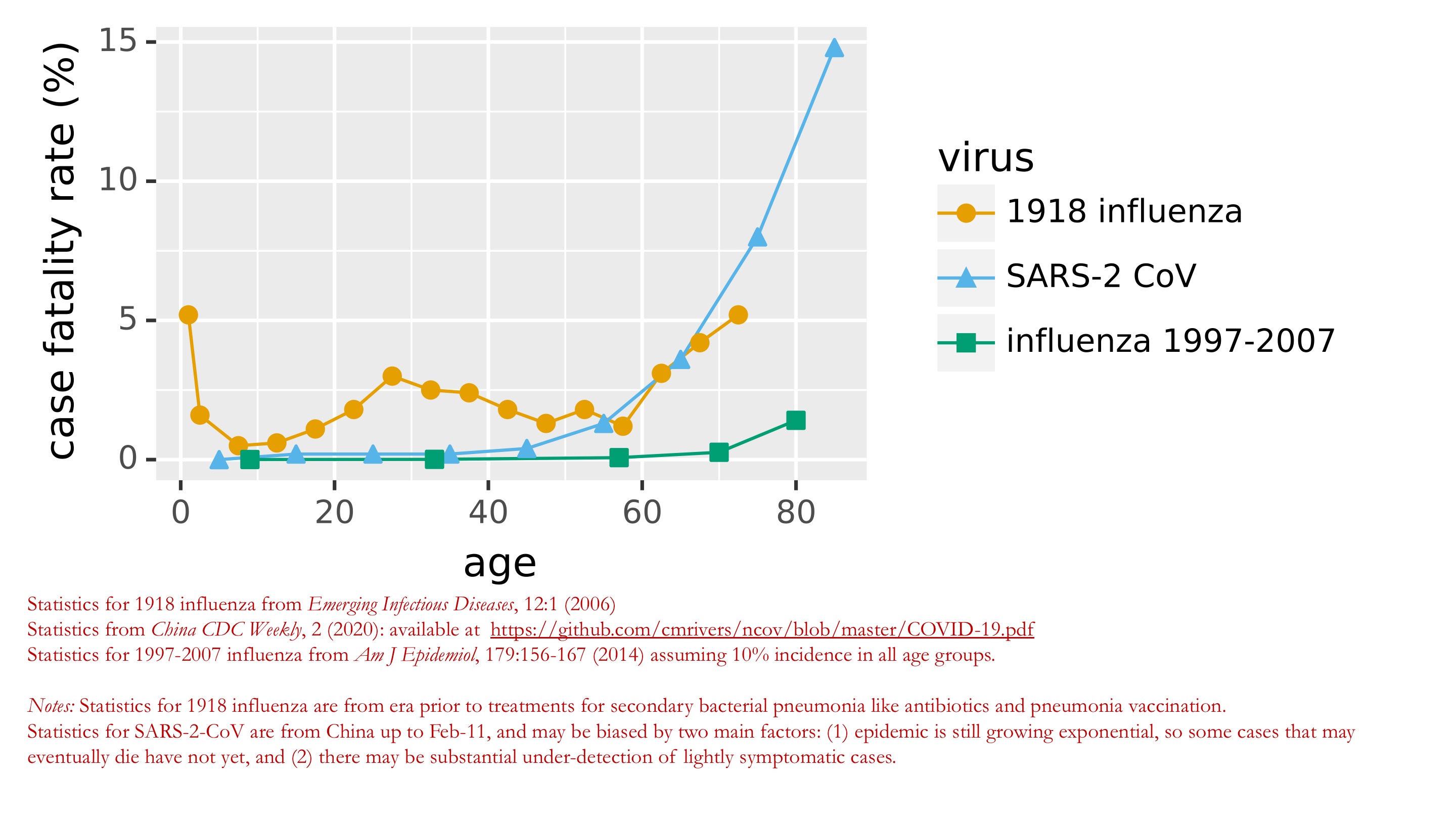
> COVID-19 seems to be most severe in older adults.
The median age of deaths is 75. I guess that’s technically “older adults” but I think “elderly” would be a better description.
https://www.nytimes.com/2020/01/23/world/asia/coronavirus-vi...
> there are a number of indications that it will be very much like the 1918 Flu Pandemic
The New England Journal of Medicine has a different take:
https://www.nejm.org/doi/full/10.1056/NEJMe2002387
It sounds increasingly likely that the fatality rate is less than 1%, potentially a lot less, as were now hearing that 80% of people don’t even get sick enough to seek medical attention, and many have no signs of illness at all — which means the denominator in the death rate is likely much higher than is accounted for in the common 2% metric from the first data.
> Expect people you know to die.
Aside from this likely being inaccurate, is this language even remotely helpful?
With reports of people being infected in nursing homes, there's a possibility that even the elderly are being silently infected and symptoms aren't severe enough for them to seek treatment. It seems like there's some unknown factor that makes some people extremely sensitive to it, while others feel nothing at all.
I have 4 living grandparents - which means that odds of my attending a funeral in the next year or so is at least 35%.
That's horrifying.
The major problem is systemic risk from many people requiring intensive care all at once.
The author of the linked blog post didn't mention an important and unsettling feature of the Spanish flu. It came in three waves. The first looked very similar to a bad seasonal flu or the current SARS outbreak. The second was the one that killed, by inducing a cytokine storm and immune overreaction in otherwise healthy, younger people. Deaths sometimes occurred in a matter of hours after the first appearance symptoms. Having an incredibly infectious virus cause a pandemic is one thing. Let's hope that we can monitor it's evolution to ensure that strains that it develops aren't significantly more dangerous. Its infectivity means that it will have a massive environment in which to evolve. Evolution rate is largely determined by population size.
http://www.cidrap.umn.edu/news-perspective/2020/02/study-720...
While the specific r0 and cfr are still under debate, there's no doubt this has rapidly absorbed hospital resources in hotspots in ways other coronaviruses haven't.
I don't think panic is the right answer, but people should prepare for the possibility this impacts their lives, judging from regions with cases and the continued spread to new regions. Quarantines, social distancing, fewer public activities, and extended hospitalizations of some older family members are all realistic scenarios.
If enough people get it badly enough to require significant medical care, that will quickly overwhelm hospitals, and the fatality rate among those turned away will be much higher. We're more likely to follow the Iran pattern (CFR = 5.5%) than that from Japan or South Korea or even China.
> Aside from this likely being inaccurate, is this language even remotely helpful?
If it is accurate I appreciate someone informing me in brief and plain terms.
https://raw.githubusercontent.com/jbloom/CoV_vs_flu_CFR/mast...
Some context:
https://twitter.com/petrakle/status/1234587264904318978
This is based on data published so far.
A̶n̶t̶i̶b̶i̶o̶t̶i̶c̶s̶ ̶w̶o̶n̶'̶t̶ ̶h̶e̶l̶p̶ ̶w̶i̶t̶h̶ ̶C̶O̶V̶I̶D̶-̶1̶9̶,̶ ̶b̶u̶t̶ ̶w̶e̶ ̶h̶a̶v̶e̶ ̶a̶ ̶l̶o̶t̶ ̶o̶f̶ ̶a̶n̶t̶i̶v̶i̶r̶a̶l̶s̶ ̶n̶o̶w̶ ̶t̶h̶a̶t̶ ̶m̶a̶y̶ ̶h̶e̶l̶p̶,̶ ̶a̶n̶d̶ ̶m̶u̶c̶h̶ ̶h̶i̶g̶h̶e̶r̶ ̶s̶t̶a̶n̶d̶a̶r̶d̶s̶ ̶o̶f̶ ̶c̶a̶r̶e̶.̶
Edit: Thanks for the correction below, I misunderstood why antibiotics could be of help.
As I have said before, if you are going to make a bet, you need to know the odds. We don't know the odds yet.
This also means that we can't be sure of any of these numbers.
Maybe the correct way to think of this isn't "people you know will die" but rather "people you know may die, so we need to be paranoid and prepare."
> Whatever the number is, it's gonna take a toll. If it really does spread as widely as that projection says, and that's what I think is likely to happen, then there are gonna be millions of people dying. And I don't think there's any way to get around that. And so I think there's real reason for people to be concerned. I also think that we can turn that concern into actions that will make the situation better.
I think pieces like this and the linked interview with Marc Lipsitch, which are clear-eyed reads on the situation from experts, should break through to the general public so they can take some action.
[1] https://www.cbsnews.com/news/coronavirus-infection-outbreak-...
You seem to have a very unconventional estimate of the world population. 1% of 8 billion is not hundreds of millions.
Anyway, overall current (non-COVID) mortality rate is around 1% annually as well, mostly elderly people as well, so even if in an extremely unlikely and tragic case this will kill 1% of the world population, expect twice as many people you know to die compared to a regular year.
Globally speaking, that's not the case. The number of new cases was highest in early to mid-February and has been lower in the past two weeks.
> There will be significant economic disruption
> Daily life will be impacted in important ways
> The acute pandemic will probably last at least for several months and quite possibly for a year or two.
Agreed, this seems very sensationalist.
Any or all of the above could be true, but at best, she is guessing right now.
It's citing two references (ref. 4 and ref. 5) that estimate CFR at respectively 2% and 1.4%, however both use the naïve CFR formula (deaths/cases) that's known to underestimate the CFR due to deaths lagging cases in a rapidly growing outbreak. I wrote about this bias and provided 5 peer-reviewed epidemiological papers that also document it, see: https://blog.zorinaq.com/case-fatality-ratio-ncov/
Then it remarks that many mild cases are probably not detected (ie. high underascertainment) but strangely makes no effort at quantifying it, or referencing other papers that do quantify it.
The 4 best published studies that correct for these two aspects (naïve CFR bias + underascertainment) are:
https://www.mdpi.com/2077-0383/9/2/523
https://www.imperial.ac.uk/media/imperial-college/medicine/s...
https://institutefordiseasemodeling.github.io/nCoV-public/an...
https://github.com/calthaus/ncov-cfr/blob/d30f02e1c20e06103a...
(3 of the 4 above studies are even referenced by the WHO in their Coronavirus disease situation report 30 (references 10, 11 and 12) and in situation report 31: https://www.who.int/docs/default-source/coronaviruse/situati... and https://www.who.int/docs/default-source/coronaviruse/situati... )
And they all estimate the CFR to be between 0.5% and 1.6%, or about 5x to 16x deadlier than the flu (0.1%)
I'm sorry to ask this .. why are we grateful for this?
Which would surprise and shock you more? Which would be the thing you are more prepared for, because you already had the thought in your head that this would happen at some time? Which would possibly be so devastating it could also end your relationship to your partner, redefine you as a person and totally change your life?
If I should have to bury my daughter, I would be devastated.
The completion of life for someone who has truly lived can be as beautiful as it is tragic. Many cultures, including Christianity, celebrate death in some capacity.
Of course death is never desirable, but it is certainly possible for it to be not undesirable in the right context. People who have had near death experiences and lived recount a sublime experience of understanding as if every part of their life and history, every part of reality is exactly in the place it belongs.
I don't imagine this experience is typical for a small child being prodded by strange people in tyvek suits speaking in metaphors about sleeping and telling them white lies about feeling better... So all that is possibly left is the tragic experience of death.
Grateful that healthier individuals (of which there are more) are not as affected
The U.S. is doing very little to prevent this. A lot of people, especially elderly people, will likely die.
It will also likely have a severe impact on the market. The sooner we can all accept this and prepare the better.
Not just the market - the real economy.
At this point, what realistically could the US do to prevent this? It will continue to spread in other countries, and there's nothing the US can do about that. We can implement more severe travel restrictions, but that has its own issues and it's not recommended by the WHO. That will only be effective for a period of time in the beginning of the virus spread, and they are basically doing that afaik
Im no expert, but besides providing financial or medical aid to to the countries fighting the virus, and helping developing a vaccine/cure, I'm not sure what the US should be doing prevention wise
1. You smooth out the cases that end up in hospitals and ICUs
2. You give more time for a vaccine to be developed and deployed.
3. You reduce the economic impact.
For those here expressing skepticism of the author's (admittedly dire) predictions, what set of credentials should someone have before you take what they say seriously? Not trying to be snarky. Perhaps I simply wish to understand more of what people find convincing in situations like this and why.
Some people in this community are in really deep denial and do not understand the concept of asymmetric risk.
This is a clearly written piece that can be shared widely with your network, especially for people who may not be clued in to the situation. Please share this.
China had to literally shut down their entire economy just to slow the virus.
Our only hope is warm weather and some way to speed vaccine development.
This, right here, is horseshit. There is no way whatsoever it will be like the 1918 Flu Pandemic, unless we've utterly failed as a society and did not invent anything in the last 102 years. In 1918 we didn't yet have _penicillin_, let alone antiviral drugs.
More accurate prediction: this will be only slightly worse than the seasonal flu we endure every year. In fact, it's quite possible that this year in the US more people will die of the complications of the flu, than of COVID19.
Let's just be careful and be prepared, there really seems to be too little info to get comfortable with this at this point.
[1] https://www.stitcher.com/podcast/deep-background-with-noah-f...
[2] https://www.nytimes.com/2020/02/27/podcasts/the-daily/corona...
What's more concerning about what happened in China is that it overwhelmed their healthcare infrastructure even after they implemented what would otherwise be called martial law throughout the country for a period of time.
There are some major differences.
/r/covid19 is an interesting scientific discussion of the topic.