The sky is huge. And though it's probable that one thing will hit another up there, it doesn't seem very probable, even if something were to explode into a billion tiny bullet -like projectiles.
Different space missions have different orbit requirements, so there is a wide range of inclinations, altitudes, eccentricities, and ascending nodes. Take a look: http://stuffin.space/. It's a very dynamic system with a dizzying amount of pieces in it.
The issue isn't so much mega-constellations in and of themselves, since presumably with good operations automation and standardized communications between operators we can thrust and avoid potential collisions as they arise, even with very large constellations. The issue is reliability: applying a small burn to nudge out of the way isn't an issue when one or both of the two spacecraft in a potential collision is operating and has propellant (although accidents still happen [1]), but if they're both dead, that's a recipe for a hypervelocity trainwreck.
That's why it's important to ensure reliable fail-safe de-orbiting of end-of-life spacecraft. The FCC is moving in this direction, but unfortunately the rulemaking is still pending.
High circular orbits move a lot slower than lower circular orbits (eg: geostationary orbits basically don't move at all relative to the ground). It's the highly elliptical orbits that have massive velocities.
Humans are great at saying, "Look at all this amount of space. Let's dump junk in it!" until it becomes untenable.
A quick check of Wikipedia[1] told me that the orbit altitude of Starlink satelites is 550km. The earth has a radius of 6371 km. Based on some trig calculation (which can be done on this[2] little php web applet I found), the visible percentage of the Earth from 550km is 4%! That's a lot. Of course, that's a significant overestimate, since it counts surface area which is just barely technically visible at a nearly 180 degree angle, and assumes a spherical Earth. Let's be generous, and say that only 5% of that area is both reasonably visible from StarLink (I apologize for this crudeness, I'm too lazy to do the math) and above trees/buildings/mountains. So that's .2% of the Earth visible from each satelite at an azimuth which is possibly visible for an average human observer on the ground. That gives an average number of 84 satelites observable, assuming a normal distribution, and likely many more for an average observer in an above-average-density area. Obviously these aren't going to be as visible and bright as the ISS or Iridium flares, but they aren't gonna be sparse.
[1]https://en.wikipedia.org/wiki/SpaceX_Starlink
[2]http://www.neoprogrammics.com/spheres/visible_fraction_of_su...
Even better, SpaceX's new Starship super rocket will make it vastly cheaper to put mass into orbit. That means it will become possible to put up a bunch of satellites that will collect dead satellites and other space debris and return them to the ground.
https://orbitaldebris.jsc.nasa.gov/measurements/radar.html
> NASA's main source of data for debris in the size range of approximately 5 mm to 30 cm is the Haystack Ultrawideband Satellite Imaging Radar (HUSIR). The HUSIR radar, operated by the Massachusetts Institute of Technology’s Lincoln Laboratory, has been collecting orbital debris data for the ODPO since 1990 under an agreement with the U.S. Department of Defense. HUSIR statistically samples the debris population by "staring" at selected pointing angles and detecting debris that fly through its field-of-view.
> The data are used to characterize the debris population by size, altitude, and inclination. From these measurements, scientists have concluded that there are approximately 500,000 debris fragments in orbit with sizes down to one centimeter.
https://orbitaldebris.jsc.nasa.gov/faq/#
> 3. How much orbital debris is currently in Earth orbit?
> More than 23,000 orbital debris larger than 10 cm are known to exist. The estimated population of particles between 1 and 10 cm in diameter is approximately 500,000. The number of particles larger than 1 mm exceeds 100 million.
Orbital debris is already causing damage. Here's some examples from Hubble: https://orbitaldebris.jsc.nasa.gov/measurements/in-situ.html
The photo gallery shows other examples of impact damage as well as examples of debris: https://orbitaldebris.jsc.nasa.gov/photo-gallery/
Given that the GEO ring space is indeed finite & should be kept free of debris (even crossing one) at all costs I can imagine eventually reverting to the idea of large communication stations instead of individual satellites.
The stations will likely still not be manned will support automated & possibly even manned servising. It could look likey large truss, kinda similar to the one used on the ISS. Inside it would host power & fuel interconnects. Attached to it would be the communication payloads, solar power modules, engines and fuel tanks. Periodically a resuply/repair craft would visit, replenishing fuel & swapping any failed modules. Depending on your launch costs broken mpdules would either be tossed to a safe graveyard orbit or brought back (possibly to a LEO space station) for refurbishment.
The first steps of this might be already happening with the recently launched Mission Extension Vehicle:
https://en.m.wikipedia.org/wiki/Mission_Extension_Vehicle
The MEV will grapple a satellite that is low on fuel and will act as it's replacement propulsion unit. In this way it can serve at multiple satellites and ppssibly even serve as a tug for satellites that have failed & are are likely to fail soon, to make sure they reach the designated graveyard orbit.
And other similar & more ambitious missions are already planned and being built.
The problem is you need to destroy more debris than you create with your shield.
https://www.technobyte.org/wp-content/uploads/2017/05/How-do...
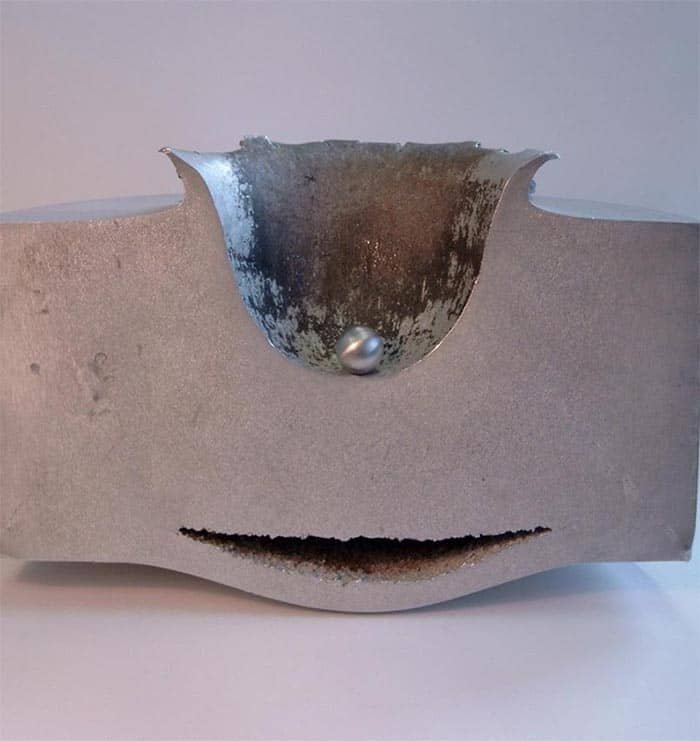
1/2 oz piece of plastic into Al at 15k mph: https://external-preview.redd.it/oi0C_a113_sSzHtSaPvzn6_0Gfg...
The thing is at orbital speeds colisions are VERY energetic events that don't behave likey normal low speed collisions. The thing coliding effectively turn into rapidly expanding plasma before any of the expected plastic deformation, shearing, etc. one would expect on a low speed collision (say a truck in full speed hotting a wall).
When you think about it, this effectively all the fuel and oxydizer that has been used to place the given object into orbit releasing all it's energy at once in a very small area.
As an example let's say your steel plate manged to hit a 700 kg satellite at ~8 km/s, which is perfectly possible with, with the worst case being a 16 km/s combined in a head on collision. How much energy will get released ?
Say the sattelite has been put in orbit using thr Soyuz 2 launcher, which can accelerate up to 7000 kg to tje orbital speed of 8 km/s. Soyuz 2 weighs about 312 tons, more than 90% of which is fuel and oxydizer. It could launch 10 of our 700 kg satellites.
This effectively means a 700 ks sattelite hittimg your 8 ton steel plate is equivalent of a point detonation of ~30 tons of perfect mixture of liquid oxygen and kerosene.
I don't tging a 8 ton steel plate will survive that in any usable shape.
It's only unsolvable in the current context that a nuclear bomb going off in MEO or GEO is worse than some space trash. If the situation became dire enough that we couldn't get off the planet, then you could just detonate some high yield explosives in orbit.
https://en.wikipedia.org/wiki/High-altitude_nuclear_explosio...
Assuming that the dangerous orbiting debris is in a few "layers" (like a shell at a certain distance from the earth) which conflict with satellites operating at the same layer, it should only come in at any of 360° angles on a semi-2D plane. Like, it's not going to strike a satellite from much of an angle above or below, because then it would by definition not be in orbit, correct?
Could we not reasonably launch a series of deflective plates or shields in the same plane through the "danger zones" encircling important satellites, or creating a safe zone for passage with shuttles?
Obviously we can't create a ring around the entire globe, nor protect all satellites, but it seems that a few well-placed shields in the worst areas would accumulate a growing "cleanup score" over time.
It sounds like you're assuming that orbits are typically close to circular. I have no idea how true that is, but I imagine that a Kessler-type chain reaction would tend to make it less true.
2) It’s hard to get your head around the relative velocities you can get from orbital debris. A bullet travels at around 750 miles per hour. A satellite in low-earth orbit travels at 17,500 miles per hour. Orbital debris could impact a spacecraft at something like a cosine loss of that number, which depending on the exact inclination could be on the order of 10,000 miles per hour. So a factor of 15 faster than a bullet.
Shielding takes mass. Mass is expensive. It costs $5000/pound to launch mass into low earth orbit;
No, the problem is, while the probability to collide with any one debris particle is low, there are just a lot of them. So when your plate collides with some, there are still a lot of them.
This is how I get most of the TV shows and movies that I watch, now that streaming services are fragmenting into uselessness.
If two objects collide in LEO (I really mean close to Earth at this point) the perigee of any resulting fragment must be at the same distance or lower so even if resulting apogee is high the object must spend at least some time close to Earth where it will be captured by atmosphere.
The real problem are objects that collide above LEO where it is possible for collision fragments to have orbit that will never hit appreciable atmosphere and they can orbit for hundreds or thousands of years.
Satellite observations of Earth's ground and meterological conditions are vastly more useful than an equivalent expense of space-based solar shielding.
And if you really want to block solar flux, there are far more efficient options, either atmospheric aerosols or L1 orbiting centrifugally-stabilised nanofilm mirrors.
Though I'm dubious about the practicality of any such, the notion of a reflecterised or even simply an absorptive graphene film might be a potential application of such a material. The challenge would be to get it into position, deploy it, and maintain position and orientation over time, without disrupting the fabric itself. As an application for a very low mass-to-area substance with high opacity or reflectivity (as an absorption medium, it would re-radiate thermal energy in all directions as a blackbody, reflectorisation would tend to halve the necessary area, if I'm thinking this through correctly).
Graphene is increadibly lightweight, at 0.763 mg/m^2, or 0.763 kg/km^2. A shield capable of blocking 1% of solar flux (1% * 2 * pi * (8000 km)^2) would weigh about 3 million kg, or 3,000 tonne, if comprised of a single graphene layer. The actual mass budget would be far larger, but based off this minimum with addition of more structural members (likely: nanofilliments), guidance, station-keeping, and possibly some form of visibility enhancements. The concept isn't immediately and obviously intractable, however.
https://en.wikipedia.org/wiki/Graphene
The total material required would be a minuscule fraction of that require to blanket numerous orbital levels in particles of similar blocking potential.
The fact that paint-chips travel at sufficient velocity to cause damage, I somehow doubt that even the most wild guesses as to the actual amount of debris is accurate. It must be several orders of magnitude too low.
A lot of theories have been proposed to de-orbit these hazards, personally I think our only hope is MegaMaid.
That's just ludicrous.
1) https://en.wikipedia.org/wiki/High_Frequency_Active_Auroral_...