The 1989 coronal mass ejection caused lots of problems with radios, which is probably one of the better known side effects of a solar storm. But it also took out power grids because utilities got a phantom current that just showed up out of nowhere on their long cables. This current can also cause problems for other long metal things buried in the ground like oil pipelines.
IIRC a similar event in the 19th century electrocuted a bunch of telegraph operators. They unplugged the power as a safety measure, but the Earth's magnetic field generated so much current in the telegraph cables that they still worked.
True but you are underselling it a bit. Aurora was seen as far south as Colombia and in Colorado it reportedly was bright enough to wake people up because they thought it was day.
It is assumed that had that occurred today it would have fried the power grid on at least a continental scale.
According to the Wikipedia article, it only gave some electric shocks, not actually killed them.
So the ground is not as grounded as we'd like it to be?
There may be a correlation between the currents and weather/natural events.
I’m totally okay with pure science for science’s sake, but you left me hanging.
His students launch balloons to the edge of space to conduct research and to carry up trinkets that they sell to fund their missions. If you scroll down on the linked page, you'll see one of the silk roses they sent up on a recent mission.
More details in a discussion from last year:
https://en.m.wikipedia.org/wiki/Geomagnetically_induced_curr...
Imagine how spooky it would be to be struck by ground current without understanding... Whether or not you survive could depend entirely on what direction you're standing. One direction will mean your feet are at different voltages and current jumps into your nice conductive veins and arteries, all passing right through your heart. The other direction means the front and back of each foot is at different voltages, and you may not even feel it. Hundreds of people just drop dead of heart attacks around you.
[1]: https://www.theverge.com/2016/8/29/12690402/lightning-strike...
We did have a power outage in the middle of Norway at 17.26 CET (UT +1 hour) yesterday: https://www.nidaros.no/trondheim/bakklandet/strombrudd/flere...
Power outages in Norway are very rare. I think it if the first one I have experienced in 10-15 years. Could it be related?
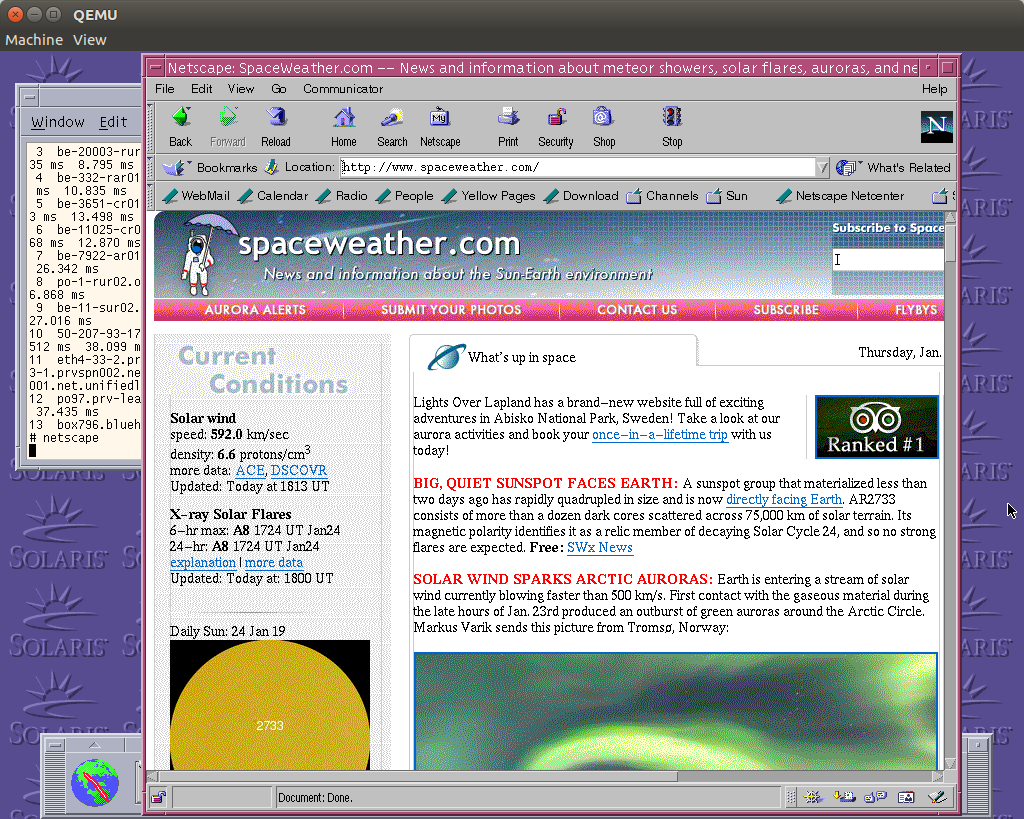
> About 15 minutes before the disturbance in Norway, the interplanetary magnetic field (IMF) near Earth abruptly swung around 180 degrees, and the solar wind density jumped more than 5-fold. Earth may have crossed through a fold in the heliospheric current sheet--a giant, wavy membrane of electrical current rippling through the solar system. Such crossings can cause these kind of effects.
I am genuinely curious because, anecdotally, my son and I had a difficult night sleeping and a friend said she and her son also had difficulty sleeping that night.
And, today I learned of the existence of the heliospheric current sheet!
http://wso.stanford.edu/gifs/HCS.html
Last I heard, astronomers didn't permit current flow in space. Or, anyway, talking about it.
As I recall, the sun is constantly shedding ionized material known as solar wind. This plasma carries the magnetic field from the sun with it. From "above", the magnetic field looks like a giant spiral with the sun at the center.
It sounds like the earth may have moved through a particularly dense spot of the solar wind which interacted strongly with the Earths magnetic field. This would probably also cause unusually strong auroras.
That's about the extent of my knowledge (plus I'm on my phone and it's a bit difficult to get into a lot of detail). I'm sure someone else around here can correct me and/or give more insight.
[1] https://www.ndr.de/fernsehen/sendungen/hamburg_journal_1800/...
That is the cause!1!!
:-)
Does this imply that the points a pretty far away from each other to measure an effect from such a large imf? If so, I’m curious as to the equipment that would enable such a measurement. This is A wholly different ball game than measuring ground currents across a pcb.
But I didn't pay enough attention in high school physics, so....
The electrical measurement is in 10s of microvolts per meter and was ~10 mV/m. It's hard to translate that to current since the ground impedance can vary, but it's in the milli- or microamps per meter. This is high for this kind of activity, but much lower than the limit the grid can handle.
In the bad old days a storm like this would have been enough to kill. Telegraph operators would have been exposed to kilovolts across their ears on a line 100s of km long. The ground current may a couple milliamps, but that could still cause hundreds of amps to flow.
Original observer's notes: https://spaceweathergallery.com/indiv_upload.php?upload_id=1...
1) Because its more spectacular there's been discussion of exploding substations and arcing power lines. Which is true.
However a more practical HN topic would be "we all know" that inter building LAN networking should be optical for power isolation reasons, but "we all know" that often you can get away for years with copper network cables over a short enough distance if they're on a similar enough electrical feed. If you live in Florida, world capitol of thunderstorms, the wiring and switch ports won't survive a week, but maybe northern yankees can do copper inter building networking for years between lightning related failures. Anyway, yesterday, if you lost some ethernet switch ports or entire switches connected to 100 meter copper lines over long distances maybe to an outbuilding or up a tower or to the roof for cameras or something, well, you kinda know why now. Of course you probably lose 0.1% per year of hardware anyway under normal conditions so maybe losses were mere coincidence... or was it? There's probably a dollar value to blown ethernet ports related to that storm; can't say if its $10K or $10M worldwide but I'm sure at least SOME money was lost in hardware and lost productivity.
2) Aside from bulk power transport, and wired signalling, a third application of ground current is archaeological / geological resistance surveys.
https://en.wikipedia.org/wiki/Electrical_resistance_survey
The idea is underground "stuff", perhaps geology layers, perhaps ancient ruins, has varying DC resistance compared to typical background dirt and rock, and we have the technology to measure and map those electrical anomalies and therefore determine things about underground stuff. Cool. When the background electrical and magnetic fields are quiet/constant -ish, anyway.
I've always wanted to participate in one of those, never got the chance. Anyway weird earth currents mean its probably pretty hopeless to try gathering research data during a geomagnetic storm. Yeah I know the 4-wire technique is supposed to help and differential measurements and all that, but the gear is designed for normal conditions not crazy storms so there seems no way you're gonna get good data during a severe storm.
I mean, even the most obvious non-ground measurement problem is even differential GPS is going to get annoyed at massive ionospheric disturbances so you're going to have time/location noise in the data, if nothing else. I wonder how bad the geomagnetic weather has to be to keep construction civil engineering surveyors home for the day, probably pretty bad indeed, but I bet a lot less and a lot more likely to happen than it takes to "short out substations" and vaporize high voltage lines or whatever doomsayer stuff.
Aside from DC resistance measurements, I know the same people do magnetic surveys and likewise having a huge geomagnetic storm as a noise source would seem likely to degrade the gathered data.