It’s an interesting article, I hope to see more research on the subject.
Although my weight has been trending downward, slowly, which is great since that's happening without trying to limit the amount I eat at all. That's very different from when I wasn't vegan, my weight would always trend slowly upward unless I was making a deliberate effort to cut back on calories.
BUT: I think the real reason I'm slowly losing weight on a vegan diet is the simple fact that eating a restricted diet (ANY restricted diet) requires you to think about and analyze absolutely everything that enters your mouth. It introduces a level of mindfulness that just wasn't there when eating an unrestricted diet. For me, this has had the side effect of also cutting out most processed food (read: junk food) from my diet, even though most junk food is vegan. I'm convinced this is the biggest value of being vegan.. it just makes you think about everything you buy at the grocery store, everything you order when out to eat, etc.
Another commenter calls this "paying attention to what you eat" - I think that's right on target, however cliche it may sound.
Many people have started losing weight just by doing this - without actively changing their diet. It has a really profound subconscious impact on what/how much you put in your mouth.
The psychological/hormonal aspect of food is fascinating.
One minute you're being mindful about your intake, the next you're stood paralysed in the chilled aisle physically unable to choose a meal as they're all "so bad".
If you're in tip-top mental health, then restricted diets can work. But for anyone reading who's dealing with proper body image or any other food related issues - just be careful please.
SO true. It's all about altering those marginal decisions that add up to something noticeable.
Being vegetarian has made my weight much easier to manage too - which is a helpful additional benefit.
I remember watching a video of two women, one skinny, one overweight, who were good friends. They said that the skinny one always eats way more food, but doesn't gain any weight.
They had a camera crew follow them both around and it was true that the skinny woman ate larger meals. The difference was all the time in between. The skinny woman didn't eat anything, while the overweight woman was snacking regularly.
The total calorie counts for the day were much larger for the overweight woman.
In weight lifting you have this concept of "hard gainers," who are generally men who want to gain muscle mass / weight, but can't seem to, "no matter how much they eat." A common refrain from them is something like "I ate a whole pizza on my own, and still nothing!"
Well, the moment they start actually counting their calories, it's the same story you just told. Sure, they ate a whole pizza on Saturday, but also nothing much else that day, and they ended up short of their caloric needs, and then every other day that week was even less, minus the occasional splurge that also didn't bring their average up high enough.
This goes for people who "can't" lose weight too -- when they start counting calories they are surprised to find that they eat a shitload of calories they didn't know about, most of which are empty of nutrition.
One way to reframe the question of calories is to start considering calories per week, instead of per day. You start to get the picture either way--whether you're trying to gain or lose--when you're thousands off your goal by day 3 and realize what a big adjustment you'll have to make during the next 4 days to make your count right.
I get that the research is often done from a medical or public health perspective, not a biological one, so compliance is an important factor to consider, but when I talk to people, I find the conclusion they draw from reading these results in the media is not that most people in these studies fail to follow the diet. The conclusion they draw is that a lot of people will not lose weight if they follow the diet successfully. This happens over and over again every time a new study comes out, and the belief a lot of people internalize from it is that we really have no fucking clue what the connection is between what people eat and whether they're overweight, and we don't know what if any change in how they eat will result in them losing weight.
That leaves them vulnerable to unscrupulous and/or unwitting opportunists hawking diet systems backed by complicated theories about toxins or hormones or genetic types.
Simply writing down your calories consumption - with no limitations whatsoever - helps to lose weight.
It's much healthier when it's bound up in a lot of fiber, as you find it in unprocessed fruit. The soluble and insoluble fiber form a protective barrier that reduces the total amount and rate at which it is absorbed.
Anecdotal, but moving to the US, the insane amount of sugar that is put in every form of food is very scary.
https://www.cato-unbound.org/sites/cato-unbound.org/files/im...
Confirmation bias: people who try new diets and hate them probably talk about it a lot less.
Placebo: people getting caught up hearing about how everyone with their diet feels so much better are convinced they feel better too
Gut fauna: any change, regardless of what it was, causing a population shuffling inside the gut
Avoiding "something": any change, regardless of what it was, involved exclusion of one specific thing which was a sensitivity/allergy/poorly digested/feeding a particular gut bacteria
Thoughtfulness: any change required people to be much more conscientious about what they ate which led to different habits, one of which was critical to feeling better
Lies and exaggerations: diet and nutrition has become a kind of religion replacing God in an increasingly atheist society, some people act with strange quasi-religious zeal for their personal health belief set
I tend to not believe anything anybody says about nutrition. Evidence for anything fits into three categories: guessing, anecdotes, extremely specific cause-and-effect studies without real-world conclusions. The fourth category of believable, properly blinded, controlled, long term human studies does exist but the volume is very low.
I mean we have one group handwriting about gluten and meanwhile one of the tastiest vegan foods is pure gluten.
I don't think vegan food prep takes significantly more time than other food prep from raw sources, at least on average over a varied diet, though I guess "becoming vegan" might be the impetus for a lot of people to start making their own food for the first time.
Not by itself, but when properly seasoned. Hail Seitan!
err no it doesn't.
> Realistically, vegan food prep takes a long time
err no it doesn't. If you are cooking actual food, then it takes no more time than cooking food that you are add meat to.
To reinforce the overeating-junk-food theory, my weight loss has slowed as I have discovered alternative vegan treats and snacks.
When I was able to see, in realtime, for example, I had a 500 calorie deficit today, and should hence lose 1lb in 1 week at this rate, and see it actually HAPPEN, it created a positive feedback loop. For the first time in my life, over many types of eating, some vague diet attempts, some periods working out more, some periods working out less, I could FINALLY see a direct result from my activities.
I had avoided it for a long time because I thought it would be miserable and tedious to track what I eat, but it's actually made it much easier to be disciplined, and see which foods are 'worth it' and which aren't.
It's pretty simple really: they're paying more attention to what they eat, meaning they take in more reasonable amounts of calories as a side effect.
Ultimately it is all about calories. Source: lost and kept off 150lbs, no thanks to fad diets.
That doesn't necessarily follow. The vegans could end up eating huge amounts of soda and potato chips, and the low-carb people could go crazy on bacon.
I suspect this also works across meals as well. For example traditional Thai, Mexican or Italian food tends to be very caloric and palatable. Yet traditional societies in Thailand, Mexico and Italy tend to be much thinner than their counterparts that start consuming a typical American diet.
I think the explanation is that if you have lasagna on Monday, tacos on Tuesday, and curry on Wednesday, each meal is novel and delicious. In contrast if you eat tacos on Monday, tacos on Tuesday, and tacos on Wednesday, well tacos start to lose some of their appeal.
This suggests a diet, that I've yet to hear of. First cut out side dishes in favor of one-pot meals. You can still have a lot of variety of ingredients, but they're blended together in a homogenous, so that every spoonful is nearly identical. That eliminates the buffet effect.
Second, do something like meal-prep Sunday. Give yourself fairly wide latitude when picking out your meals. However, whatever you pick out, you're going to eat that same dish for pretty much every meal for a week straight. Even with your favorite your dish, my guess is that by the end of the week you'll find it barely appetizing.
A less drastic approach might be using variety as a pump to shift consumption across food groups. Strictly restrict variety in the least healthy food groups, while allowing it for healthy food. People who love desert can still eat their favorite desert, but you pick one single desert dish and that's the only desert you can have for a month. In contrast give yourself unlimited freedom to enjoy whatever green vegetable strikes your fancy.
Pls have a look into Michael Greger's How not to die, or Colin Campbell China Study.
Vegan is not always healthy. Plant based, unprocessed food does the trick. Fatty and salty french fries are technically vegan. There is a lot of junk food on the vegan side, which is also highly processed and features lots of sugar. It is not enough to stop eating dead animals, drinking milk or eggs.
However dismissing meat is inevitable for a healthy diet.
I dont think this is true. There seem to be many people that have (in some cases greatly) benefitted from a carnivore diet. Take Mikhaila Peterson as an example (https://www.youtube.com/watch?v=znGkfrl_F5s).
On what do you base this bold claim?
> Vegan is not always healthy. Plant based, unprocessed food does the trick. Fatty and salty french fries are technically vegan. There is a lot of junk food on the vegan side, which is also highly processed and features lots of sugar. It is not enough to stop eating dead animals, drinking milk or eggs.
I've been a junk food vegan for long enough (in a city that makes it easy) to prove to just about anyone that being vegan won't automatically make you healthier. It's way too easy to scarf half a bag of oreos in a day.
For what it's worth, this mostly doesn't actually happen. There is some good science behind maintaining ketosis in children under careful monitoring by a physician. Most of the empirical evidence in adults is that it's hard to achieve and harder to maintain. The weight loss some people achieve on "keto" diets is mostly just due to caloric restriction when it's been measured carefully.
The upside is you don't really want to have your body in ketosis anyway.
I think you need to look at people on an individual basis. I start to get skeptical that what turned out to worked for me can work for everybody else. For me I think portion size and increased physical activity were big.
I can eat a big 2 pound ribeye and not feel like that at all. I definitely am starting to think that the only way to lose weight is to figure it out yourself. I lost 75 lbs eating sauerkraut and Johnsonville brats for 5 months, kept at that weight for several months, then went back to eating “normally” and gained back 50 over the course of the next year.
One thing to consider is that fructose is a metabolic poison that is poorly regulated by metabolism. Fructose bypasses all of the controls that glucose is subject to and forces lipid biogenesis in the liver (by mass action for the chemists). Consuming fat and fructose is large amounts is nearly guaranteed to give you a fatty liver.
On the other hand, anyone choosing to follow an "extreme" diet is likely to be more aware of their food intake than the average person and adjust behavior in various ways.
I thought it was agreed upon that if you consume more calories than you burn regardless of their fat/protein/carbohydrate profile, you were going to gain weight?
The way I've developed my diet is by observing energy level, mood, ethic, cost, convenience, and allergic-ish reactions, which my skin is prone to.
But there is near zero actionable advice on diet available to me, because weight is never an issue.
Curious what foods seem to boost or depress mood and reactions that you have discovered.
From my observation, it seems that people go on a diet because they know what they're eating isn't good for them or its too high in calories or it goes against their beliefs or something. So people are already suspicious of what they're eating but aren't overly thinking about what they're eating. By going on a diet you now need to think about what you're eating in order to meet the requirements of the proposed diet and therefore you are being more conscious about what you will and won't eat.
By doing this you are already a step ahead of people who might eat whatever they feel like which may include lots of highly processed high fat and/or high carbohydrate foods every now and then or more than they realise.
So when people say they went keto, or went paleo, or cut out sugar, or cut out fat and lost weight and/or felt better. I always ask them was it actually the diet, or was it because you were simply conscious and considerate about what you were eating due to the fact that you were trying to fit to a particular diet.
Now you gotta work for food you don't really want.
Insulin and blood glucose drive obesity and metabolic damage, but they don't make it hard to stay on diets. The difficulty of staying on a diet is due to a separate system in your brain that takes other factors in to account to decide if you should eat. Every successful diet boils down to finding foods that make your brain happy while keeping excessive levels (and durations) of sugar and insulin out of your blood[0].
If you had access to unlimited candy, you might eat too much and damage your body - and indeed many people do just that. If you had access to unlimited non-starchy vegtables your stomach capacity probably wouldn't be enough to maintain obesity. If you had access to unlimited sticks of butter, you would probably get sick of the very concept of butter before you ate an unhealthy number of sticks. Vegan and carnivorous diets largely rely on the last two facts.
[0] There are other things involved in your body's metabolic signaling system, but blood glucose and insulin are especially well-researched and easy to measure.
E.g., if I avoid eating refined carbs (sugar, white flour, etc) for a month or so, suddenly hunger is this mild, easily tolerable sensation. I just end up eating less. If I go back on them for a while, hunger returns to being MUST EAT NOW.
I used to hear people talk about forgetting to eat, and I would always think, "How is that even possible?" But now I know: we might use the same word, but the experience can be very different.
This is what I do, or try to do. This seems high on the self-denial scale but in my case I noticed that simple foods taste better than you think they as you learn to appreciate them, especially if you let yourself get hungry first. I tend to not over-eat such food as much.
I have had a similar experience, but I've also known several people who have tried various diets and quickly dropped off them because it wasn't working for them. So while it's true that if you ask all your vegan friends if they enjoy being vegan, they'll probably mostly say yes, there's a huge possibility for selection bias/survivor bias.
The lesson I've drawn is not "pick a restrictive diet and you'll feel better", but more "some things work for some people but not others, and we have no idea why". :-/
In truth, science seems to be still very far from understanding the complexity of how our bodies process food.(One recurring constraint seems to be the difficulty in controlling for "real life eating").
Learning from "traditional" diets and cuisine might be the best practical way to go about eating healthy. A bit of a black hole approach, but practical for most people.
It can also be combination of the two food categories that causes issues. Insulin spikes from carb intake and dietary fat are not a good combination. At least according to diets like "Keto". Both of those diets tend to have lopsided intake of fats and carbs.
I'm back on the weight loss train (lost 60 pounds about ten years ago, and have to take 40 off again that I put back on slowly) and like last time, I mostly avoid these ultraprocessed foods simply because they're all way over my calorie budget.
I would suggest that it's rather about setting a goal, working hard towards achieving it, and seeing measurable results of your work.
They tend to eat a lot of bread.
My pet theory is that all these diets make you way more conscious of what you are eating and all you need to do is find one you are happy with.
Both groups cut a significant fraction of their intake calories and lost weight as a result?
confirmation bias about "feeling better"?
I can eat McDonalds everyday for a month and still lose weight.. how?
Order a small fries and a double patty cheeseburger. Eat nothing else during the entire day, drink plenty of water, and exercise for at least 30 minutes.
But it is important in the sense of "which diet is easiest to follow?".
That will vary person to person. But for many people, the answer is low-carb/intermittent-fasting. It eliminates the blood sugar/hormonal response, requires less effort than regular eating, and still lets you eat palatable food.
It doesn't make sense at all.
There is quite a bit of research on satiety - how full foods make you feel. It's actually quite straight forward: Protein, water and fiber make you feel full. Carbs do not. Mostly fat does not (you need a certain minimum amount of fat in your diet).
You feel full after eating a lot of roast beef, because it's got tons of protein in it, not because it's not "processed".
You can gorge on chips because they are carbs and fat and have almost no protein, not because they the process of creating the chips confuses your body.
Guess what? You can gorge just as heavily on homemade 4-ingredient bread (technically slightly less if you use bread flour, which is high in protein).
Perhaps your current diet + healthy carbs would still help you achieve your goals?
Everything they serve at chili's, even seemingly innocuous things like a chicken breast meal have been made or modified to make them hyper-palatable, easy to chew, swallow, and overeat.
For non-American's, chili's is a sit down chain restaurant where you order off a menu. Other comparable restaurants are Applebee's, and TGI Fridays.
Most things in fast food places come premade and frozen from some factory somewhere and usually just fried up either in oil or on a 'grill'. Almost nothing is actually prepared in those places.
Though, if you're in Canada, A&W serves real eggs and Bacon and stuff for breakfast and their onion rings are actually cut and prepared in store(though the batter and breading aren't). Everything else though came preprepared.
Isn't this just a very scary way of saying "delicious"?
This is one of the reasons why some people (like me) can eat cake made of 50% sugar and butter nearly endlessly. It's an unnatural combination and somehow transitions our brains into zombie mode where we never feel satiated.
For that reason you can find that combination in a lot of processed food...
[1] https://biology.stackexchange.com/questions/43673/5050-sugar...
And that study conflicts with this study, which shows a high-carb diet does have an impact on rat obesity: https://www.ncbi.nlm.nih.gov/pmc/articles/PMC4497311/
That macros ratio of carb and fat is indeed interesting
I also won't eat a 50/50 lard/sugar mix. It's the fact that processing the food made it more palatable.
Despite being "unprocessed," it provides poor nutrition and hits the right buttons for compulsive overconsumption.
Why are canned corn and green beans ultraprocessed? They contain nothing but corn/beans and a touch of salt. If the salt is the problem, why do the unprocessed meals have added salt?
It looks like for the unprocessed meals, they chose a bunch of high in vegetables and whole grains, high fiber meals and chose a bunch of high calorie foods for the ultraprocessed meals [1]. No surprise people ate more calories when given the high calorie foods.
They say "dietitians scrupulously matched the ultraprocessed and processed meals for calories", but also that people were told to each as much as they like. What does that even mean? The calories can only be the same if you fix the quantity.
They don't define "ultraprocessed" or provide any mechanism for weight gain that would apply to their very varied selection of "ultraprocessed" foods.
The term "processed" is used to scare people about food, but the term is so broad that there can't possibly be a single mechanism by which various processed food would be unhealthy. Processing includes cutting, grinding, heating, cooking, mixing, adding ingredients, drying, deboning... basically anything you do to food. It's one thing to say a specific process, like adding sodium nitrite, is harmful. Making a blanket statement that all cutting, cooking and combining of foods is bad should raise a bit more skepticism.
If the article has a more specific definition of processed, they should mention it because their choices seem pretty arbitrary.
[1] Study meals: https://www.cell.com/cms/10.1016/j.cmet.2019.05.008/attachme...
It looks like they were going for energy density (and composition, for that matter). BUT: They absolutely botched that one. While overall density was the same between the two groups, the energy density without beverages was almost twice as high in the ultraprocessed group. TBH, I'm a bit baffled how this huge discrepancy managed to remain in there.
I mean, they even admit as much:
  However, because beverages have limited ability to affect satiety(DellaValle et al., 2005),
  the ~85% higher energy density of the non-beverage foods in the ultra-processed versus unprocessed
  diets (Table 1) likely contributed to the observed excess energy intake (Rolls, 2009).
It looks like they're using the NOVA classifications[0]; there have been a couple of other articles relating to the same system posted here recently, e.g. [1].
The NutriSource in "Whole milk (Cloverland) with NutriSource fiber" is apparently 100% partially hydrolyzed guar gum[2], which I believe would qualify the combination as ultraprocessed under this part of the definition from [0]: "Substances only found in ultra-processed products include some directly extracted from foods, such as casein, lactose, whey, and gluten, and some derived from further processing of food constituents, such as hydrogenated or interesterified oils, hydrolysed proteins, soy protein isolate, maltodextrin, invert sugar and high fructose corn syrup.". By contrast, skim milk (as used in the unprocessed menu) has nothing added, only removed, and so would fall under their Group 1 "unprocessed or minimally processed foods".
As for whether this is actually a useful classification system, I don't know. I have no reason to believe any of the studies are bogus, but taken as a whole, it does seem like an attempt to launder the naturalistic fallacy into some scientific respectability.
[0] http://archive.wphna.org/wp-content/uploads/2016/01/WN-2016-...
[1] https://news.ycombinator.com/item?id=19930970
[2] https://www.nestlehealthscience.us/brands/nutrisource/nutris...
I have a personal theory that to me seems like the simplest explanation for why junk food is fattening. It's not processing per se. It's simply that people will eat more calories when offered delicious, high-calorie foods. Put a bunch of bland highly processed tofu in front of me and I won't eat many calories. Give me some mostly unprocessed peanuts and raisins to munch on and I'll eat much more. Raw, unseasoned ingredients aren't optimized for taste and convenience, while processed foods often are. I'd also expect people eat more calories at a fine French restaurant (or any restaurant) for the same reason: they design their meals to be delicious. But no one is going to write an article saying delicious and convenient calorie-dense foods cause weight gain.
To be scientific, how do you measure the ultraprocessed-ness of foods?
Using more calories than are consumed causes weight loss.
This is rudimentary physics, there are no new theories needed to explain it.
Yes. For most of human history, food was scarce. People regularly died from starvation.
Today, that is no longer the case. Despite the outrage industry's continued and tired claims that hunger is at all time highs, etc, the truth of the matter is that most people in developed countries -- far more than ever before -- have access to all the nutrition they need at a price they can afford.
Unfortunately, people are not used to that availability, and thus are not able to process it rationally. Instead we binge eat. For example, there is a free box of bagels today at work and I'm going to have one now because cream cheese... yum!
> “Ultraprocessed” foods seem to trigger neural signals that make us want more and more calories, unlike other foods in the Western diet
Eating more calories than burning them isn't being set aside by the new theory.
Here, for example is a recent study by Harvard Medical School detailing how partipants on a low-carb diet burned more than 250 calories more then people on a high-carb diet.
https://www.eurekalert.org/pub_releases/2018-11/bch-ldc11121...
You are countering the claim that diet is about calories in being less than calories out by claiming that, because a low-carb diet causes more calories to be burned, it negates this claim.
I think you are simply trying to qualify the claim by showing also that, while it is true that you will lose weight if you consume fewer calories than you expend, it also so happens that what you eats influences the basal metabolic rate. That is certainly an interesting point, but it ultimately relies on the truth of the claim you're attempting to attack. In order to believe your counterclaim, one must believe that the relationship between rate of caloric expenditure and caloric intake is important.
Except, well, if you want to actually do any rocketeering.
[1] https://royalsocietypublishing.org/doi/full/10.1098/rspb.201...
Is 'ultraprocessed' a matter of physical processing? Chemical? Or is it actually about superstimuli, which may or may not actually experience a lot of processing? Cheese is a great example: all cheese is chemically processed milk, pasteurized cheese is also heat treated, aged cheese has more chemical changes, and finally "processed" cheese is also emulsified. Where's the line?
The article gives us "industrial food formulations made up mostly or entirely of ingredients... that are not found in a similar form and combination in nature." So a wedge of aged Parmesan is clearly ultraprocessed - even the natural lactose is gone! Somehow, I don't think that's what they're blaming obesity on.
It also references "frosted snack cakes and ready-to-eat meals from the supermarket freezer", which is one of the least helpful examples I've ever seen. Frosted snake cakes probably date back a few hundred years, but this obviously means to include Ho-Hos and exclude what you'd get at a tea shop. Ready-to-eat stir-fry can be normal stir-fry tossed in the freezer, perhaps with a stabilizer to sell it in stores. Or you could have a TV dinner with chicken nuggets, fitting exactly the same description.
The study described is interesting, and does control for some suspects like energy density. But "ultraprocessed" is not a chemical, or even a defined term. It's hard to see this as anything but preliminary work showing that there's a problem somewhere in a large set of foods, which now needs to be narrowed down.
The article defines "processed" and "unprocessed":
Processed foods add a few substances such as sugar, fat, and salt to natural food products, with the goal of improving preservation or sharpening taste. The category includes canned vegetables and fish, cured and salted meats, cheeses, and fermented drinks such as wine and beer.
Unprocessed foods are the edible parts of plants (such as seeds or roots or leaves) and animals (such as meat and eggs). The main processing of this food type is freezing, drying or pasteurizing to extend storage life. Salts, sugars, oils and fats are not added.
And the nature of ultraprocessed food:
Ultraprocessed foods often contain a combination of nutritive and nonnutritive sweeteners that, Small says, produces surprising metabolic effects that result in a particularly potent reinforcement effect. That is, eating them causes us to want more of these foods.
The first definition of ultraprocessed is "industrial food formulations made up mostly or entirely of ingredients... that are not found in a similar form and combination in nature". That includes a lot of merely 'processed' foods. A highly aged cheese will have basically no naturally-occurring ingredients left, and any bread with leavening and refined flour fails "form and combination found in nature". Similarly, the fat and salt flavors of strong cheese, or the sweetened flavors of a pastry with sugar, go beyond "sharpening taste" to creating entirely new nonnatural flavors.
We can all apply the Potter Stewart test to say that Twinkies are ultraprocessed and sharp cheddar isn't, so I don't meant to be pedantic here. But I think this loose definition points to genuinely important unresolved questions.
Where on the scale from sausage to Twinkie does the problem start?
Is it really true that an Entenmann's coffee cake causes vastly different eating habits than equal access to a home-made version? Can we isolate the difference?
Above all, which differences actually drive this? 'Ultraprocessed' is not a food additive but a loose class of recipes, and it'd be nice to reduce that to a distinction we could put on a label.
The problem probably doesn't isolate to any one additive or alteration, but we should be able to find something more concrete than a vague naturalistic appeal. The study in question has some promising work in that direction, like controlling for energy density. Outright added calories are a long-standing suspect (since we're likely to use the same amount of e.g. spaghetti sauce despite store-bought versions having far more sugar), but Hall's work suggests that the problem persists even without that. I'd very much like to see more of these studies to replicate the effect and extract a more substantive definition of 'ultraprocessed'.
But the example picture includes white flour, which is wheat processed to make it more palatable. The removal of the wheatgerm does increase shelf-life, but this is only a side effect. If the processing was really intended to maximize shelf-life then it would be processed into polished grains like rice or barley is, not into flour.
What is "processing" and how does it contribute to confusing gut-brain signalling? The article lists kinds of food that we all agree are "processed", but I have no idea why I think they're "processed" the same way a dumb ML model might correctly classify something as a cow while having a nonsense mapping from feature space to outcome.
Not trolling. Can someone list a set of specific ingredients or techniques which are constituent of "processing", and how these things are connected to the article's mechanism? I am aware of past mixed research on artificial sweeteners and satiety, but clearly that's both an older finding and a mixed one, so the article is alluding to something more that isn't explained.
I feel dumber having bothered to read it. News flash, food that tastes good makes people want to eat more of it and that will make you gain weight. Film at 11.
Shit I could have told them that. Every last Cajun in Lafayette is bigger than a whale, why? Because Cajun food is the best damn tasting food in the whole country.
They should have added in my grandma's rice dressing and seafood gumbo as a third category. Would have blown 'processed food' right out of the water.
    Canned corn
    Deli turkey
    Refried beans
    Sour cream
    Whole milk
    Canned peaches
    Scrambled eggs
    Sausages
    Blueberry yoghurt
    Bagels
    Cream cheeese
    Canned chili
    Frozen macaroni and cheese
    Canned green beans
    Peanut butter
    Non-fat greek yoghurt
For another example, the ultra-processed menu had scrambled eggs made with liquid, pasterurized eggs from a carton; the unprocessed menu had an omelette made from fresh eggs. Does pasteurizing eggs make them unhealthy? If so, how, and what studies support this? If not, why bother including different egg dishes in the menus?
Or for another example, some of the ultra-processed meals used as a protein source Tyson brand steak; some of the unprocessed meals used Tyson brand "beef tender roast". What is the difference between these, and why do we think Tyson steak is bad and Tyson beef roast is good? Alternatively if we don't think there's a difference why use different products in the two menus?
If if we accept that the study did show an effect, it almost seems designed to obscure the underlying cause, since it was so aggressively scattershot.
One could also quibble about the choice of foods; the ultra-processed menu leaned hard into meat and carbs with little or no greens, while the unprocessed menu had lots of broccoli and other green veggies. But obviously you could construct a much healthier diet from the ultra-processed menu, or a much less healthy diet from the unprocessed menu. I love broccoli, but if you drown it in rich sauces, it's not going to do your diet many favours.
Similarly, why is it the unprocessed diet snack selection had unsalted nuts? Salt doesn't count as processed (right?) so was this just picked to try and make the snacks taste less good so people would eat less, or...?
The menu PDF is here if anyone is curious; https://www.cell.com/cms/10.1016/j.cmet.2019.05.008/attachme...
The methodology here seems SUPER bad.
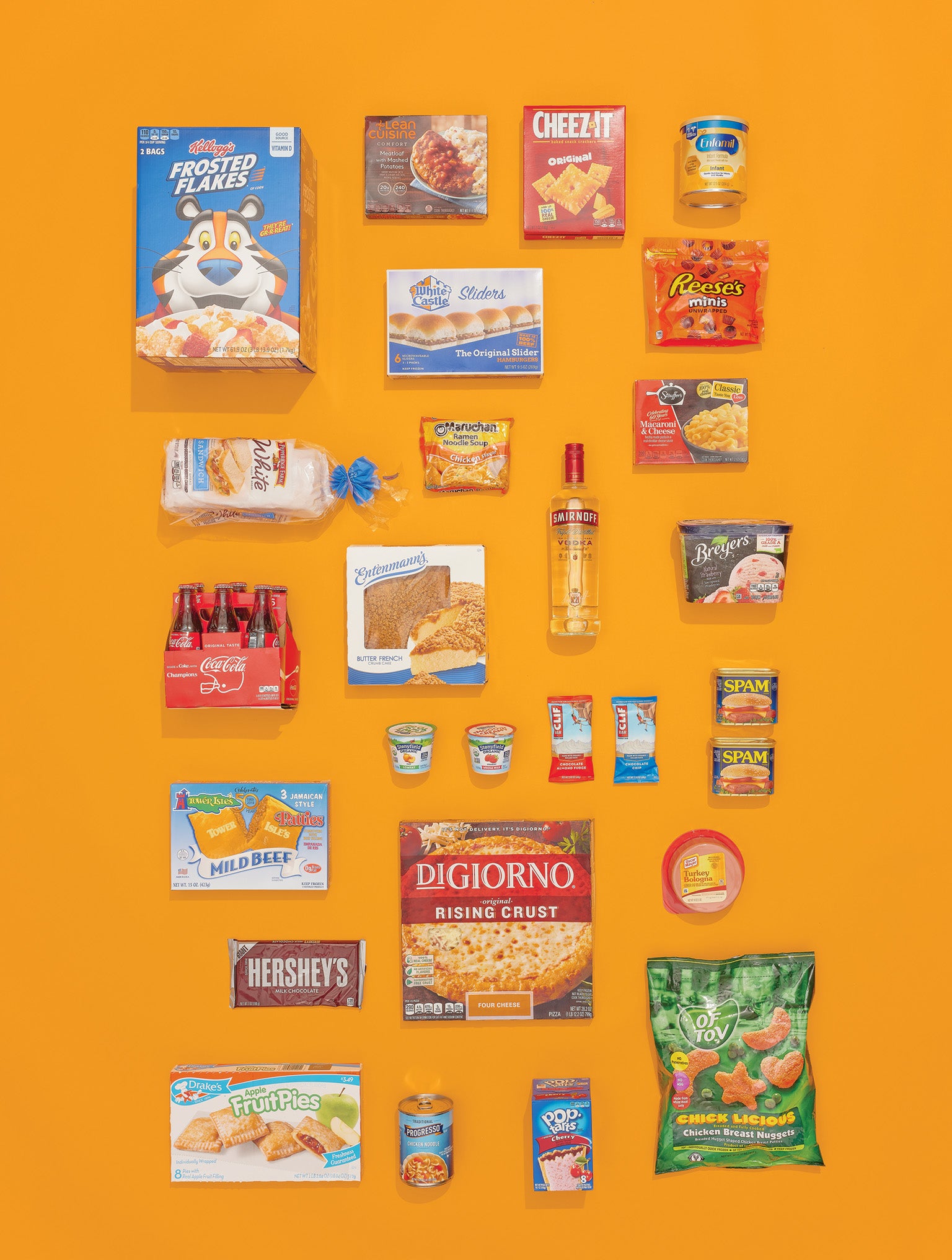
This seems like nonsense. There's baby formula in the top right corner: were they really feeding baby formula to grown adults in the lab trials?
Or did the authors of this piece just grab a bunch of foods from the grocery store and assumed they were related to the study?
I want a link to the actual study. Pictures like the above just piss me off. There's a lot of issues in health-reporting and diet reporting. Lots of "Ultraprocessed" discussion going on, but there's no definition of what "ultraprocessed" is.
--------
EDIT: Here's the next photo:
https://static.scientificamerican.com/sciam/assets/Image/201...
Are you seriously telling me that __canned peas__ are highly processed? That's ridiculous. Especially in the face of highly-refined, enriched, white-flour in the "unprocessed" food picture.
Look: I get that Spam and frozen-pizza are "ultraprocessed" foods. But canned peas and Goya chickpeas are processed? Who made these photographs? They fed Spam to people in hospital, and these images are drawing conclusions about canned peas.
-------------
I think there's something to be said about "Spam is bad for you" (actual study) vs "We fed Spam to 20 people in a hospital for 2 weeks, and we've concluded that Frosted Flakes and canned peas are bad for you". Unfortunately, this article feels a lot like the latter conclusion.
There's a PDF of the actual menu, although it's just as random. Apparently wheat flour pasta is unprocessed, but a wheat flour tortilla is ultra-processed, sure, okay.
Wow. I appreciate the link. Honestly, seeing the menu makes me think it is somewhat quackery. But it seems like Scientific American really did represent this study correctly.
The main thing I've noticed is that the "ultraprocessed" foods are low in fiber, and they try to make it up with large doses of "NutriSource Fiber" pretty much every day.
There are exceptions: Canned Corn (wtf?) makes it on the list of "ultraprocessed", and has decent fiber from my memory. A few days later they have beans + beef. But otherwise, the primary source of fiber in that diet is artificial Nutrisource Fiber.
Dietary Fiber is core towards feeling full. Its no secret to me (at least) that more fibrous foods (even when low in calories) fill me up quicker than fiber-free foods. I can eat 2 or 3 500+ calorie donuts for example, but trying to eat 800-calories worth of "ultraprocessed" canned corn (that's 1.5 kg / 3.3 pounds of corn) is simply infeasible in one sitting.
Or to put it another way: 800 calories in corn is roughly 3x 8.5 oz cans of corn. Still "ultraprocessed" (lol) according to this study, but its going to be way healthier than drinking diet lemonaid with Nutrisource Fiber.
Funnies aside capitalism without regulation quickly devolves into oligarchy. So throwing few more regulations is fine. You can always buy bags of sugar yourself and eat it with a spoon if you prefer.
Whole Wheat Flour, Water, Sugar, Wheat Gluten, Raisin Juice Concentrate, Soybean Oil, Yeast, Cultured Wheat Flour, Molasses, Salt, Soy Lecithin, Grain Vinegar, Citric Acid, Soy, Whey.
Enriched Flour (Wheat Flour, Malted Barley, Niacin, Reduced Iron, Thiamine Mononitrate, Riboflavin, Folic Acid), Water, High Fructose Corn Syrup, Yeast. Contains 2% or Less of: Soybean Oil, Salt, Soy Flour, Sodium Stearoyl Lactylate, Ammonium Sulfate, Calcium Sulfate, Ascorbic Acid, Calcium Propionate (Preservative), Enzymes
Sources (for some reason instacart had some ingredient lists and ralphs' website had others but neither had ingredient list for both):
https://www.instacart.com/store/items/item_152519229
https://www.ralphs.com/p/kroger-enriched-white-sandwich-brea...
https://www.ralphs.com/p/barilla-farfalle-pasta/000768085010...
Edit: previous link was an erratum. Original:https://www.ncbi.nlm.nih.gov/pubmed/31105044
That's the difficult part--the insulin spikes from ultraprocessed food will make you hungrier and eat more as well as lower your basal metabolism. "Calorie range" is a moving target.
One thing I learned is that satiety isn't just about the meal you just ate or how full your stomach just got. If your blood sugar spikes, no matter how big a meal you had or if you ate 4000 calories in one sitting, you'll be hungry again in 3 or 4 hours. Eating a high fiber diet, I can just eat one meal a day or even skip a few days of eating without ever feeling the kind of gnawing hunger I used to get within a few hours of having a full meal.
Aside from blood sugar, fiber is also important because high fiber foods, especially ones with any water content, are usually the lowest calorie density foods and you can eat much larger quantities than you can with highly processed foods. You have to be more careful of highly dehydrated ones like whole grain crackers and dried fruit, but they're still far better and harder to abuse than chips & candy.
https://scholar.google.com/scholar?q=fiber+on+satiety&hl=en&...
Let me dump some info though for more discussion.
A Western-like fat diet is sufficient to induce a gradual enhancement in fat mass over generations. This study used mice and bred them over 4 generations. Each generation became fatter than the previous one. http://www.jlr.org/content/51/8/2352.full
What was the key element of this “Western-like fat diet”? A high ratio of omega-6 to omega-3 fatty acids. The omega-6 is due to a high amount of linoleic acid, of which seed oils contain a large amount.
The results show that high-fat diets, when that fat is composed largely of linoleic acid, made mice fat and that epigenetic changes likely drove the increase in fat mass over generations.
Notably, at a time where overweightness and obesity have steadily increased over generations in most industrialized countries, consumption of LA and ARA has increased. In France, an increase of 250% and 230%, respectively, occurred from 1960 to 2000.
The consumption of large amounts of linoleic acid, mainly from seed oils, is something new in the world. Humans didn’t evolve eating that much, which is around 10-fold higher than dietary requirements.
Decreasing the linoleic acid content to 1% of the diet reversed the obesogenic property of the high-fat diet. Adding omega-3 fatty acids of the type in fish and fish oil also reversed the obesogenic properties of the diet. Excess linoleic acid induces inflammation, a key factor in chronic disease such as diabetes, heart disease, and cancer. https://onlinelibrary.wiley.com/doi/full/10.1038/oby.2012.38
The modern Western diet has been consumed in developed English speaking countries for the last 50 years, and is now gradually being adopted in Eastern and developing countries. These nutrition transitions are typified by an increased intake of high linoleic acid (LA) plant oils, due to their abundance and low price, resulting in an increase in the PUFA n-6:n-3 ratio. This increase in LA above what is estimated to be required is hypothesised to be implicated in the increased rates of obesity and other associated non-communicable diseases which occur following a transition to a modern Westernised diet. https://journals.plos.org/plosone/article?id=10.1371/journal... https://www.researchgate.net/publication/269696521_A_high_fa...
Soybean oil and other seed oils are in almost all ultra-processed foods. They might also be linked to the depression epidemic. Men in the highest tertile (third) of linoleic acid intake had more than double the risk of depression. https://www.ncbi.nlm.nih.gov/pubmed/19427349?dopt=Abstract
We saw above that linoleic acid leads to fat accumulation and insulin resistance. People in the highest tertile of visceral fat had 6 times the risk of colorectal cancer as those in the lowest. Insulin resistance was associated with up to 4 times the risk. https://www.ncbi.nlm.nih.gov/pubmed/19837793
High waist circumference is associated with 2 to 3 times the risk of colorectal cancer. https://www.ncbi.nlm.nih.gov/pubmed/7847643
One of the worst ingredients found in ultra-processed food is seed oil. Soybean oil is the most common. Seed oils cause obesity and increase the risk of chronic disease, like cancer. https://blog.aicr.org/2017/06/13/processed-foods-calories-an...
The average American eats more than half of calories as ultra-processed food. To stay lean and healthy, you must avoid the ultra-processed junk that passes for food among average people. Eat whole, minimally processed foods. Meat, fish, eggs, fermented dairy, non-starchy vegetables.
And I'm being genuine, because I'd like to see where I'm flawed.
A few commenters have pointed to "dietary fiber" as that number on a food label which might warn of "ultraprocessing". This is reasonably close because the definition of fiber is actually dependent on digestion. It might be important to remember that fiber is properly understood as a metric, i.e. "indigestible fraction", rather than as a substance per se. For example, pureeing a piece of fruit reduces the satiety effect of consuming it:
https://www.sciencedirect.com/science/article/pii/S019566630...
This is a rather simple and compelling demonstration that simple substance-content analysis does not tell you everything you need to know about what you're eating.
TFA also comes close to explaining, in my opinion, the strange phenomenon with fad diets where they seem to work well for early adopters and not so well after they catch on. In the early stages of a fad diet, food manufacturers haven't caught on, and dieters are forced to prepare food from scratch. In the later stages, you buy the frozen bag of "paleo" chicken nuggets from the freezer aisle or you unseal a quart of "vegan" milk in the morning when you have coffee. These products are not the same thing eaten by someone who cut up raw chicken and rolled it in cashew flour, or someone who blended their own almond-milk.
This is a great hypothesis that's worth testing. I'd love to see some market research evaluating how many people at the real thing in specific amounts vs shifted to processed foods that merely had the label. Then, also if they overate those foods due to the convenience or taste.
Hopefully they accounted for bioavailability of nutrients. The way I've seen this framed is you'll get more energy from powdered rice than an equivalent amount of whole rice.
I didn't see preservatives in that list. Though some of the items like salt and sugar are preservatives, added preservatives also abound in processed foods. Since the goal of preservatives is to basically kill bacteria/fungus to prolong shelf life that would presumably have an impact on our gut flora, which recent studies have shown is actually fairly important to our digestion and weight gain.
The big open question for me - and what I've long thought was one of the main contributors - is caloric density. Were these people eating roughly the same volume of food, which just happened to have more calories when ultraprocessed? Or is the density about the same, and they are actually consuming a larger volume?
Ice cream is not heavily processed compared to the kind of protein bars that aspiring bodybuilders eat, but you can easily binge thousands of calories of ice cream in a single sitting. It's not so easy to binge protein bars, despite companies doing their chemical best to make them taste like candy.
Or compare those protein bars to the sweet, easy-to-eat bars (can't find brand names now) at Whole Foods that brag about having a small number of minimally processed ingredients. If you cram something full of honey or figs you can make it dangerously easy to feed your demons with while still being "natural" and "minimally processed." You won't see expensive bars sold to health-conscious well-off people implicated in the obesity epidemic, but that's a matter of class, not nutrition.
Why bother obsessing over abstract, ill-defined distinctions like "processed" or "ultraprocessed" instead of teaching people to recognize that companies are systematically and scientifically exploiting our human weaknesses for profit and ruining our health in the process? Educate people to look at a Snickers bar, or a bar full of honey and dried fruit from their fru-fru grocery store, and see a cold, calculated, predatory attack. Food companies attack the weaknesses in our eating behavior the way a lion seeks out the neck of a wildebeest. The lion doesn't specifically want the wildebeest to suffer and die; it just wants to eat its flesh. Likewise, Mars Inc. does not specifically want Americans to suffer from obesity and diabetes; it just wants to sell a lot of candy bars.
I suspect the obsession with these distinctions is motivated by the desire to find a positive story to address the obesity crisis with. Negative stories about food and eating are hard to sell to the public, who by and large (heh) just want to enjoy their food in an uncomplicated way. Not to mention that many people working in public health see them as a risk factor for eating disorders. Stigmatizing a category of food is a positive story because it promises us that once this subset of food is out of the picture, we can have an easy, healthy, uncomplicated relationship with food, without any need to address our own behavior. It locates the entire problem in a category of inanimate substances that can be purged from our world. It's a much happier story than saying we have desires and tendencies that don't always serve us, and that some of the most powerful forces in our society seem bent on making sure those desires and tendencies lead us to the worst possible place. But I suspect that eventually we'll have to face up to that, like we did with the tobacco industry, except that we'll have to accept the existence of the food industry and an indefinite, partly adversarial relationship with it.
Amusing anecdote - for some reason, after a night on the town in Hong Kong, I ended up back in my hotel room, ravenous, with nothing to eat but a box of 10 protein bars that had been gifted to me.
I tore through the whole box in under 10 minutes. My stomach did not thank me.
Then you have alcohol, alcohol advertising and culture, food eating in culture (from dating at restaurants, to pizza for the team, visiting someones house and they make a 3 course meal and it's rude not to finish).
Basically losing weight or not drinking alcohol requires some degree of pushing aside social norms and not fitting in. Arguing with people and making them slightly confused, angry or concerned. Being an asshole (even though really you are not, you just want to choose what to eat).
In the UK it's madness. Not drinking at Friday lunchtime would be seen as weird if you have been seen drinking before.
It also means literally throwing away food in the bin to go to landfill. Someone gave you chocs for your birthday? In they go.
Yeah "smaller portion size" is simple but not easy!
A very precise and plausible explanation of the effect at the level of specific hormones released can be found here:
https://www.bbdnutrition.com/2018/06/08/the-perils-of-food-p...
Another likely cause is that highly-processed foods often contain seed oils, which usually have high levels of linoleic acid. One of the effects of linoleic acid (amongst many others) is to increase appetite:
What? They aren't being whacked with hammers or given electric shocks.
And, regarding "more people", whatever is unethical for 500 people is unethical for 5.
1) everything they listed, 2) food tasting good > "my body is adequately satiated". This is not a mystery. We just don't want to admit that our food is very tasty, we're serving our people too much food, and that we have no self control.
The body may have an "inborn satiety mechanism", but that doesn't mean it rules our brain. My body sends me pain when I run too much and my knees hurt. Do I stop running? Not if running makes me feel good.
So this is considered a “privilege” among researchers and scientists in this day and age... It used to be what separated science from pseudoscience.
We should repeat this kind of studies. This methodology should be encouraged.
I just have a small doubt about a particular point: it mentions 'a very low carbohydrate ratio'.
But this is not clear at all.
Is 30% of carbohydrates very low? So far some studies actually claim this.
Is it 5% of carbohydrates, like the ketogenic diet proponents claim is necessary to be in a ketogenic state?
For me, the proportion of carbohydrates that can be considered very low actually makes too big a difference to not to dive further.
People should generally eat more protein in the form of meat, eggs, fish, nuts, cheese, etc. You feel fuller and with a little exercise you can quite easily turn it into muscle.
Some interesting observations in these comments, much better than you usually see.
Could even kick off an HN diet study? Detailed recording of everything that can be sensibly noted, you pick the dietary changes and do it for a long, long time. Something like that might cut through the clutter?
India as I understand has rising levels of obesity, yet their food seems a lot less processed than western diets - though someone may have more accurate information than me.
1. Eat when you are hungry 2. Even when you are hungry, eat only a medium portion(your stomach can be half filled). 3. Reduce sugar in take (any form of sugar) 4. Include physical activities in your daily work / home life. Walking via stairs, cycling or walking to work etc.. you don’t necessarily need to do any dedicated exercise routines (well if u have time, its good to do). 5. Do not consume food after 7 pm. ( can take small portion of regional fruit if you are really hungry). 6. Most importantly, get a good sleep (10pm to 5am). 7. Get rid of all the measuring apps that you have in your phone, fitness, calorie calculator.. these are useless. Every human is unique in their nature and each individual needs certain amount of energy to do a work(differs from individual to individual) .. so we cannot set a common standard (BMI ) for all.
Always have time to cook fresh food on daily basis. I am from southern part of India and its very easy here to get fresh fruits, veggies, meat on daily basis. Mostly importantly, we buy on daily means and cook for the day. We never carry/food for the next day. Almost zero processed/frozen food. I believe processed food are the root cause for most of the health related issue that we face now a days.

.jpg)