If I can spend $5k to save a week of optimization work, it's a good deal. Also buying clockspeed can't create new bugs either, which is a risk with any code change.
That said, companies that need more speed often don't need that extra speed on just one node. So that's really $5K x N nodes. When you consider that just the CPU costs $15K, and not the complete cost of a system, I think it's a lot harder to justify. You better have that next lower tier $10K CPU and know that you need just that little bit more. And then... you probably ought to be investing in scaling out horizontally while that $5K x N buys you time.
Some software does not like high clockspeeds. For example, game engine in GTA V starts acting up when framerate gets too high.
If you look at a longer time horizon, there are other dynamics. Your contract may not allow you to reduce license spend in three years, but you can shrink your hardware spend.
No reason not to capture margin for a handful of top-binned chips.
https://www.reddit.com/r/UnresolvedMysteries/comments/aop378...
tldr; Most likely food, makeup, toothpaste etc. Especially food safe and biodegradable glitters. They are also located close geographically (New Jersey) to those industries.
Here's one: EVE Online servers. Back in 2013, CCP had at least one 4.4GHz Xeon they used to host fleet fights with thousands of players:
https://forums-archive.eveonline.com/message/3917593/#post39...
Why? Because EVE is mostly written in Python, which is both very slow and, thanks to the GIL, effectively single-threaded. It's a fundamentally limiting architecture, but that extra single-core performance let them push it just a little further – which for them was (is?) well worth it.
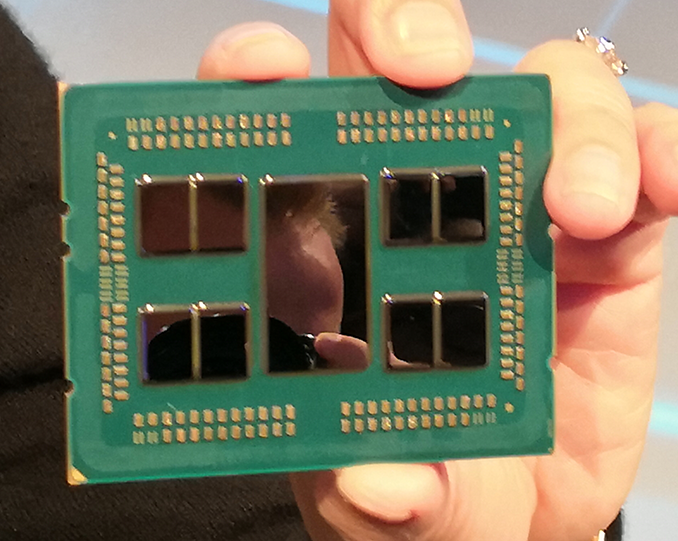
upto 64 Cores/128 Threads and 128 PCI express lanes (that's on all of them irrespective of the core count) - 8 channel memory.
Given AMD's insanely aggressive pricing on the Zen 2 consumer line I'm expecting a proper knockdown drag out fight.
If Intel follows, then they have both just lost money. Might make sense if ruining the market drives the competitor out, but that’s not likely with Intel.
[1] https://images.anandtech.com/doci/13561/amd_rome-678_678x452...
AMD should go as aggressive as possible with the pricing to steal market share from Intel because it has nothing to worry about in regards Intel responding with a price war - it just won't happen. Intel couldn't even bring itself to do that with it's mobile chips - twice. First with Strong-arm and then with Atom. It lost the mobile market twice because of its insatious margin greed.
That really isn't relevant. Most consumers buy a new computer when their old one breaks or becomes unbearably slow. Most corporate buyers have a consistent 3-5 year procurement cycle. AMD don't need everyone to rush out and buy new computers, nor do they particularly want it - huge spikes in sales are detrimental to the supply chain, as we saw with the GPU mining fad.
AMD want and need to consistently beat Intel on value over a protracted period, so that whenever a customer does choose to upgrade their computer they choose an AMD processor. At the moment, they're looking good in terms of both architecture and fabrication; the main problem AMD is likely to face is with partner relationships, because of Intel's historical dominance and use of anti-competitive practices.
This rough math means if AMD takes half of the new CPU orders, they should have about 10% server CPU market share within a year, consistent with some analyst estimates [1]
It's fun seeing something that can chew through kdenlive video editing of 2160p, 60fps video and encode a project into HEVC like a hot knife going through butter.
If all my tooling and supply chain is geared towards Intel on the server lines, it'll take a much better value proposal, volume guarantees, and the threat my competition will do it first to make me add a new line geared towards AMD.
OTOH, for cloud powerhouses that design their own hardware, even a marginal improvement in TCO/performance will tip the scales.
This largely comes down to a problem of folks assuming that 'price' is correlated strongly with 'cost'. It's not and never has been.
The reason these parts exists is for optimising for expensive software that's charged per core. For the same performance bump, you can add two cores and pay Intel $2000 and Oracle $10000, or you can buy a chip clocked higher and pay Intel $5000.
I assure you it's not. This thing is going to go into a 2U server, which is going to run ~$400 month for the rackspace, power and bandwidth. It's also not going to be purchased by folks building their own stuff from Newegg based on supermicro chassis and misc parts, it's going to be bought from Dell and HP as one part of the expense of a $30k+ server.
Could I build something cheaper and find cheap local colo to make it a 'significant' portion of TCO? Yes, doesn't change anything about the reality that this is not the target market so it makes no sense to be concerned about the cost in such a market. TBH if this segment of the market is your concern, you should buy a threadripper and hope the ECC ram you bought works with it. But, it's not the same market.
This is precisely the reason that moore’s free lunch ending matters so much; everything needs to be rearchitected such that the server is faster than single core across normal usage
But we’re not at all close to such a world