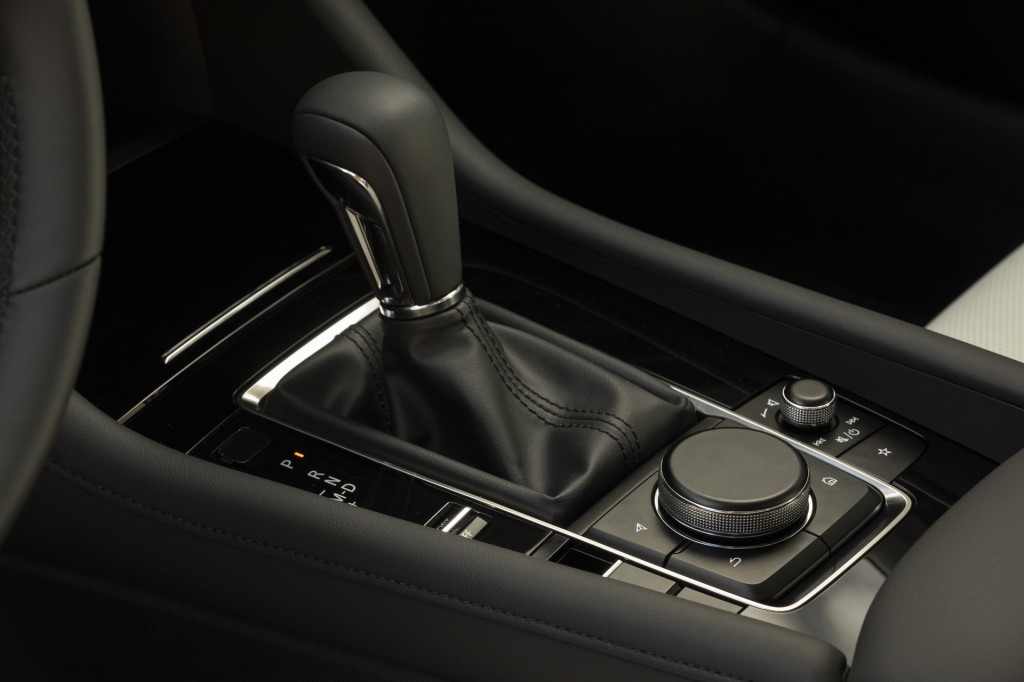
But Mazda's cockpit isn't plane cockpit either. Please go for a test drive with new Mazda 3 and you will be surpised how stupid is this decision.
If you want to volume up, change a song, yes, it is easy.
But if you want for example turn on GPS navigation, you need to use this wheel near the gearbox to: - leave a radio interface (you must look at screen and turn the wheel at the same time) - find where is a navi (by turning the wheel and pressing it, still looking at the screen) - choose, again with the wheel, to start typing your destination - and what most: again with wheel (turning it and pressing) type the address simultaneously looking on an onscreen keyboard.
All that while not looking on the road and holding your steering wheel with one hand and another on navigation wheel on central canal.
How come this is safer by tapping on the screen?!
There is no safe way to interface with a screen while driving. You are taking your eyes off the road, and your focus goes with it necessarily. The safest option is no screens. It's the only reason I would never get a Tesla. If it's mission critical it needs to be physical.
It's different in a plane, because you can safely take your eyes off the sky. In fact flying by instruments only is routinely the only choice; night time, weather. So a glass cockpit/touch screen controls make sense there. But even then the key controls are still physical.
Some interfaces it’s pretty clear that they are best served by physical buttons, toggles, switched, etc. Blinkers, gear selector, volume, windows, for example.
Some interfaces it’s equally clear that they are best served by touch. Text input through an on screen keyboard obviously beats a scroll wheel to select individual letters. Likewise panning and zooming a map.
Now, whether some of these interfaces are being operated while parked or driving is actually a completely separate matter. As you note, any touch feature can be dynamically locked out from operating while in drive. But to answer that question you can’t take the position of a nanny chastising a child. You have to take a holistic view of what actual users in the real world will do based on your decisions.
So, navigation is a great example. People need to navigate while driving. Sometimes that means interacting with the navigation interface while under way, whether it’s due to updating a route, checking for traffic, zooming in and out. As much as you might like to, car designers don’t get to choose whether drivers are going to do this activity while driving. They can provide an interface that is as safe and convenient as possible, or drivers will just use their phones instead.
Every car nav system I ever used, including fairly recent Audi and Mercedes ones, that depended on physical buttons for input was universally terrible. So bad that it wasn’t worth using and so the phone was used instead.
Compared to the Tesla Model 3 nav system which is fully touch, highly responsive, and beautifully rendered. It is a total joy to use and increases overall safety through large touch affordances which make sense for the driving environment. And it’s so easy to activate I almost always have my destination plugged in, which means the car is showing me upcoming traffic and helping me avoid accidents through alternate routes, which is also increasing safety and decreasing overall traffic congestion.
You say people need to interact with navigation while driving, which is simply not true. People want to interact with navigation while driving. They could cope without it. We didn't even have navigation all that long ago, to say we need it is a stretch let alone to touch it while driving. If it's causing accidents, and it is, it should be considered dangerous. Perhaps the Model 3 is better at it, but it is still a danger to look away from the road even for a second or two.
That means screens are out, and we need better ways to display and interact with information while driving. HUDs, sounds or feel is all I will agree is safe.
> Sometimes that means interacting with the navigation interface while under way, whether it’s due to updating a route, checking for traffic, zooming in and out.
You shouldn't be fiddling with the navigation system while driving - you should do that while you're still in park. Even when I look down at my phone to see what lane I need to be in for a second, it's amazing how much distance passes when going at highway speeds. Unless you are using autopilot, it's dangerous to mess around with the map, and it's not that hard to pull over to do it, either.
What does that have to do with anything? The touchscreen controls for most of that aren't even enabled when driving.
But on the Mazda you can't even do these things with the touchscreen while NOT driving.
Things like that. Maybe after few years you will memorize parts of this.
I am not telling resignation from touchscreens is bad. Just Mazda didn't offer anything useful instead of it.
Media buttons on the steering wheel were peak car usability. What is there really to be looking at other than the road while you drive? A map at best, but we can do better there too. A HUD of upcoming turns projected onto the glass for example. We had HUDs in cars in 1989 (Nissan Silvia) and some modern cars are bringing it back. I think that's the perfect blend of usability without compromising safety.
Your sarcasm looks a lot less smart once you examine the actual options.
Maybe voice commands are just not ready for polish (guessing Szczepańska is polish) but seems to work fine for at least english and spanish.
Voice output that spells is silly (as is Google's navigation, which overwhelms you with information you do not need).
As for key presses to navigate a menu you would be surprised how quickly a human memorized exactly how many times to press what buttons to get to where they want to go. In my current car I know that if I press Home, down x3, and OK I will end up in the Media menu. I can do all this without taking mu eyes off the road (or even thinking about it much after a year+ with this vehicle.
Wow, well put! This is definitely something that we lost with the current gen of interfaces, and this articulation didn't occur to me.
Losing keypresses or clicks/touches at random, unpredictable freezes and/or delays on interactions, all this contributes to a general sense of unreliability and not being able to infer the state of the device. Consistency is actually a much more important metric than just plain latency.
When you design something, you don't design for ideal use, you design to eliminate risky misuse. This is a core axiom of user interface design. It's not good enough to just slap a warning disclaimer on it, as the designer, you're still liable.
I would have my engineering licence revoked if I ignored possible avenues of misuse, could design them out but didn't, and then ended up in court because they misused it and someone died. This isn't a hypothetical, this is how it works in the non-software world where engineering decisions can routinely kill people.
The reality is, people will be adjusting their radios while they drive. They will be looking for open restaurants, changing their destination, and a number of other things while driving, and pretending like they're not worth accommodating ignores some very fundamental principles on the topic of economics.
Did you miss the part where they said they will be projecting an HUD onto the windshield so drivers won't have to look down? Your comment is arguing against a solution Mazda did not propose.
Curiously, most of the people who are defending touchscreens in this thread are not addressing the 2 safety issues brought up - inadvertent torque applied by drivers and inattention to the road ahead.
whether you're looking down or forward, you're spending your attention looking at the HUD, not the road or any other sensor.
The screen is touch enabled but I cannot remember the last time I actually touched it.
I am thinking on their new (soon) CX-30 as a possible new car as I loved the CX-5 and was told it would be mostly be based on the Mazda3.
I think this just proves there are no safe manual interfaces for setting a navigation destination. Drivers should use a voice interface or stop the vehicle in a safe location.
https://images.hgmsites.net/lrg/2019-mazda-mazda3_100689497_...
You don't even need to look down to do it, because after 10 minutes of driving in your car, you've memorized the buttons.